Best Weighted Vests of 2026

A weighted vest sounds like a simple way to add resistance to a walk or workout—until you put one on and realize the load has to go somewhere. The good ones spread weight across your torso rather than stacking it on your shoulders, stay put when you bend or pick up the pace, and fit close without feeling like a backpack full of sand. The bad ones smell like a gym bag by week two, have hook-and-loop straps that let go mid-set, and cost more than their stitching suggests. What a vest fixes: convenience—more work from ordinary movement, no dumbbell required.

Over nine months, I wore 12 weighted vests on dog walks, treadmill incline sessions, and bodyweight circuits in my garage; teammates took theirs on weekend hikes and yard work. Fit and comfort beat load bragging rights—the best ones nearly disappear on your body, not the heaviest. Versatility and value round it out: removable weights, adjustable closures, and a cut that works over a T-shirt or light jacket decide whether one earns a hook by the door.

1

Best Overall

RUNmax Adjustable 20 lb Vest

93 /100
Trail Score Outstanding

Key details

Load
20 lb, removable
Shell
1000D tear-resistant nylon
Warranty
Lifetime
Fits Chest
28–48 in
Check Price on Amazon

Twenty-eight to forty-eight inches. That's the chest range RUNmax states for this vest, and it's the widest of anything we recommend — broad enough for a big-framed lifter to close and narrow enough that a smaller frame can still cinch it down. A range that wide, plus weights you can take out, is why this is the vest we point most people to first.

The load is removable. Twenty pounds of it sits in individual pockets closed with velcro, so you can strip the vest down for a first week of walking and build back as the walks get easier. The shell is 1000D tear-resistant nylon over mesh padding, the waist closes with quick-release buckles, and the whole thing carries a lifetime warranty against defects — unusual at this price.

Material matters more than it sounds. Most vests in this group wrap iron sand in neoprene, and neoprene is where the new-vest smell comes from. This one puts its weights behind a woven nylon shell instead, and it was the first difference we noticed with the boxes open side by side.

One habit to build: crank the waist strap down before you start, not a mile in. A loose waist is where bounce comes from, and with the belt genuinely tight this vest stays put through walks, stairs, and loaded carries.

Pros

  • Removable 20 lb load you can dial back
  • Stated chest range of 28 to 48 inches
  • 1000D nylon shell resists tears
  • Lifetime warranty against defects

Cons

  • No shoulder padding on this version
Our verdict

We recommend it as the default because the fit range and removable load cover the widest spread of bodies and training stages, and the nylon shell sidesteps the smell that dogs the neoprene vests here.

Check Latest Price
2

Best Value

Renoj Weighted Vest 16 lb

92 /100
Trail Score Outstanding

Key details

Body
Neoprene with mesh panels
Load
16 lb, fixed
Extras
Phone pocket and reflective strips
Check Price on Amazon

Sixteen pounds, sewn in. There's no stripping this vest down and no adding to it, so if you want one vest to carry you from a first walk to a loaded ruck, that's the limit you're accepting. What you get in return is a simpler, softer vest than the adjustable ones here, and one that costs less than most of them.

Fit is why it earns a place. The chest panel is reinforced to keep the load from sliding, the straps run short enough to close on a smaller frame, and the two front buckles sit high enough that a heavier chest isn't taking the pressure. Of everything we wore, this is the closest to a vest that fits like a glove straight out of the bag.

Day to day it's the easy one: breathable mesh panels under the neoprene, reflective strips front and back, a phone pocket, and a clip that doesn't slip once it's set. It's a walking vest, though, and a flat mile in it feels like a hill. Wear a shirt underneath and wipe it down with a damp cloth rather than washing it.

Pros

  • Close, secure fit that suits smaller frames
  • Reinforced chest panel limits shifting
  • Phone pocket and reflective strips
  • Quick to put on and take off

Cons

  • Fixed weight, so no progression
Our verdict

Buy it if you want one honest vest for daily walks and don't care about adding weight later; the fit is the best of the fixed-weight vests we tested.

Check Latest Price
3

Best for Women

BAGAIL Women's Weighted Vest

93 /100
Trail Score Outstanding

Key details

Body
Neoprene and iron sand
Care
Wipe clean, air dry
Load
10 lb, fixed
Extras
Detachable phone pouch, reflective strips
Check Price on Amazon

BAGAIL builds this as a women's vest, and the shaping is the whole point: the straps sit above the bust instead of pressing across it, and the weight spreads through front and back panels rather than pooling at the hem. If a unisex vest has always felt like it was cut for someone else's torso, start here.

The body is sweat-resistant neoprene around fine iron sand, with reflective strips down the front and back and a detachable pouch that swallows a phone, keys, and a lip balm. It goes on and off in one motion, the clip is a sturdy one, and the whole thing wipes clean. Small details, but they're the ones that decide whether a vest gets worn.

The line runs from 5 to 30 pounds, and the 10 we wore is a sensible walking weight for most people — enough to notice on a hill, light enough to forget on the flat. Neoprene keeps a faint new-vest smell for the first few days, so leave it out on the porch before your first walk.

Pros

  • Shaped to sit above the bust
  • Detachable pouch and reflective strips
  • Sweat-resistant, wipe-clean neoprene
  • Easy to get on and off

Cons

  • Shifts when you pick up the pace
Our verdict

The women's vest we recommend first: shaped so the straps clear the bust, comfortable enough for an hour-long walk, and light enough to wear every day without thinking about it.

Check Latest Price
4

Best for Heavy Loads

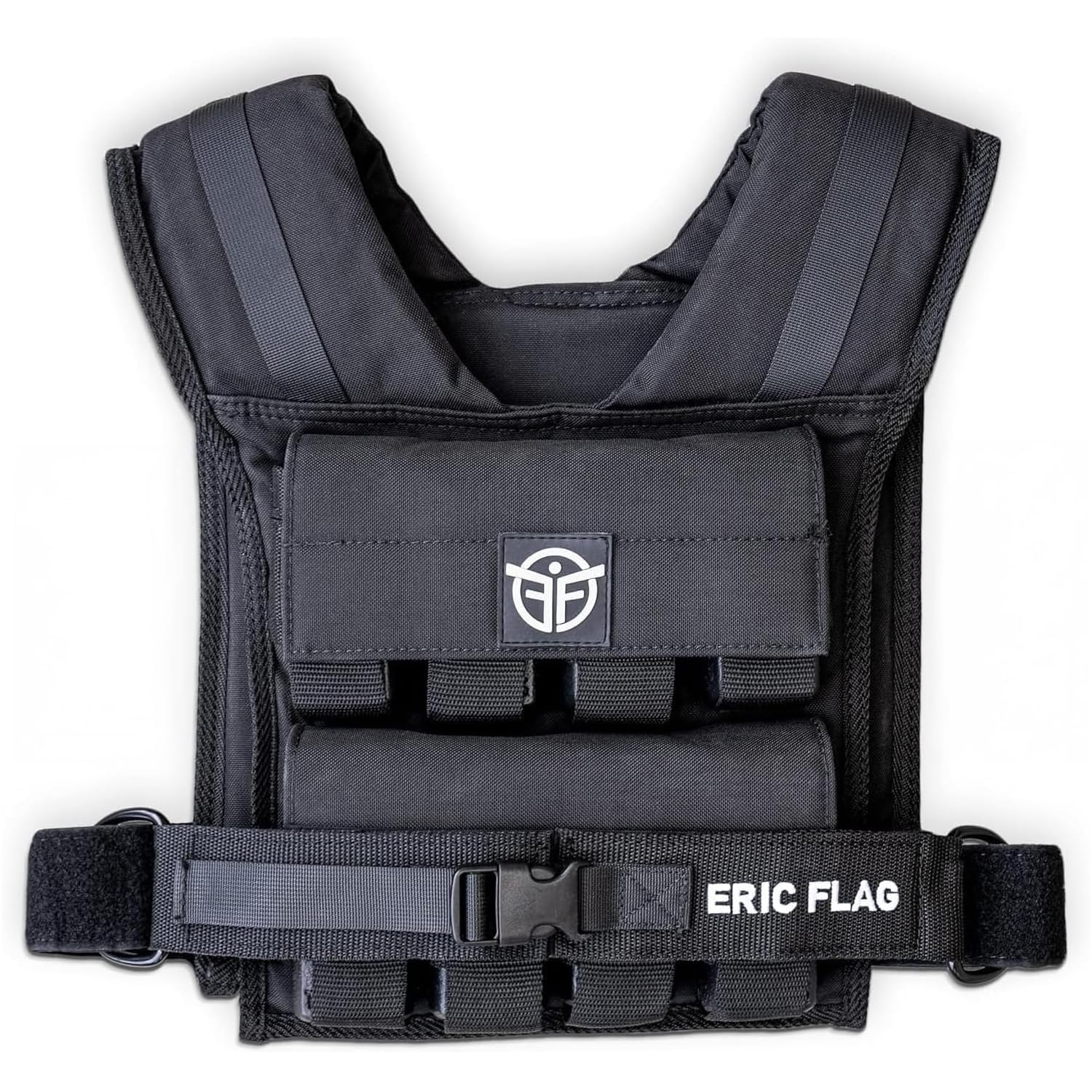
ERIC FLAG 40 lb Weighted Vest

93 /100
Trail Score Outstanding

Key details

Shell
1000D Oxford nylon
Pockets
16, eight front and eight back
Empty Weight
1.6 lb
Removable Weights
16 plates at 2.4 lb each
Check Price on Amazon

Sixteen plates, 2.4 pounds each, eight in the front and eight in the back. Empty every pocket and the shell weighs 1.6 pounds, which means the usable range here runs from almost nothing up to a real 40-pound load.

The small increments are what you're paying for. Adding 2.4 pounds at a time is a far gentler progression than swapping five- or ten-pound sandbags, and it lets you load up for pull-ups, dips, and jumping squats without wrestling a duffel bag of loose weight. We think that granularity matters more than the headline number.

The shell is 1000D Oxford nylon on a buckle closure, and the straps stay snug without restricting your arms — worth noting, since a loaded vest that fights your range of motion is useless for calisthenics. Loading all 16 pockets takes a few minutes the first time.

Pros

  • 16 removable 2.4 lb iron plates
  • Load anywhere from nearly empty to 40 lb
  • 1000D Oxford nylon shell
  • Straps stay snug without restricting movement

Cons

  • Most expensive vest here
Our verdict

The vest to buy if you want to keep adding load for years — 2.4-pound steps from nearly empty to a genuine 40 pounds, in a shell built to carry it.

Check Latest Price
5

Best with Shoulder Padding

RUNmax Pro 20 lb Vest

93 /100
Trail Score Outstanding

Key details

Load
20 lb, removable
Shell
Tear-resistant nylon
Warranty
Lifetime service
Shoulder Pads
Included
Check Price on Amazon

Padded shoulders, a 20-pound load, and a lower price than our top pick. For anyone who has finished a long walk with red stripes across the collarbones, the pads alone are the argument.

The rest is sensible: removable weights, a tear-resistant nylon body, a phone holder and a water bottle holder on the sides, and a lifetime service warranty. The closure is hook-and-loop rather than buckles, which keeps it quick to get on and off in a cold garage.

Where it lands for us is walking and lifting. Padding tells on a two-hour hike, the side holders keep your hands free, and the whole thing undercuts our top pick. That's a fair trade for a vest you'll wear on footpaths and in the gym rather than on a track.

Pros

  • Included shoulder pads ease collar pressure
  • Removable 20 lb load
  • Phone and water bottle holders
  • Lifetime service warranty

Cons

  • Bounces when running
  • Hook-and-loop closure can loosen with wear
Our verdict

We like it best for long walks and gym sessions where padded shoulders matter more than a rock-solid running fit.

Check Latest Price
6

Light First Vest

ZELUS Weighted Vest 8 lb

91 /100
Trail Score Outstanding

Key details

Body
Lycra and SBR
Load
8 lb, fixed
Fits Chest
31.5–37.8 in
Visibility
360-degree reflective strips
Check Price on Amazon

Eight pounds is the lightest load in this group, and that's the whole case: it's the vest to buy when you want to add resistance to a daily walk without signing up for a training block.

For the money you get reflective striping that wraps the whole vest, two arm pockets, and buckle straps that adjust across the chest. The Lycra and SBR body is soft against a shirt, and the weight spreads evenly enough that it doesn't dig into the shoulders on a flat walk. If you walk before dawn, the reflectivity is worth more than any other line on the spec sheet.

It's a walking vest and it acts like one. Pick up to a jog and the sand-filled body shifts inside the shell; the load sits lower than on the plate-style vests here and doesn't hold still the way they do. For the dog walk and the evening loop, none of that gets in the way.

What it comes down to is how much vest you need. Eight pounds doesn't change how you walk, it doesn't demand a training plan, and it costs less than most of this group. If that's the vest you want, this is the simplest version of it — and the shell is honest about what it is.

Pros

  • Light 8 lb load for daily walks
  • 360-degree reflective striping
  • Two arm pockets for keys and phone
  • Soft Lycra body over a shirt

Cons

  • Chemical smell that can linger after airing
  • Stated chest range of 31.5 to 37.8 in
Our verdict

The lightest vest here and the easiest way to try loaded walking — reflective, soft against a shirt, and simple enough to wear every evening without a plan.

Check Latest Price
7

Posture on Walks

Henkelion Weighted Vest 12 lb

91 /100
Trail Score Outstanding

Key details

Body
Neoprene
Load
12 lb, fixed
Extra
Back mesh pocket
Filler
Iron pellets and metal rock
Check Price on Amazon

The load sits high and close, and the effect on a walk is that your shoulders come back on their own. Posture is the most noticeable thing about this vest, and it's why it stays in the rotation for long dog walks.

The filler is iron pellets and metal rock rather than sand, wrapped in neoprene, with an elastic band that rides at the waist and a mesh pocket on the back that takes extra weight if you want to add more. A single buckle at the collarbone holds the whole thing on.

Posture is a strange thing to shop for, but it's the reason to buy this one. On a two-mile loop your shoulders stay back without you thinking about it, and on a hike the load sits close enough that you forget the vest is there. That's a walking vest doing its job, and it's the one we reach for when posture is the goal.

The neoprene does arrive smelling of rubber; a few days on a porch rail before the first wear handles most of it. And it's slim enough to disappear under a loose jacket in cold weather, which is more than the padded vests here can claim.

Pros

  • Load sits high and cues better posture
  • Fits under a jacket in cold weather
  • Back mesh pocket takes extra weight
  • Simple to get on and off

Cons

  • Single chest strap, so it's a walking vest
Our verdict

The pick for walkers who want a posture cue as much as resistance — light enough to forget, secure enough for an hour on the trail, and not built for running.

Check Latest Price
8

Larger Frames

Zikopomi Weighted Vest 12 lb

92 /100
Trail Score Outstanding

Key details

Body
Neoprene and iron sand
Load
12 lb, fixed
Straps
Two adjustable elastic straps
Visibility
Reflective strips front and back
Check Price on Amazon

The cut is generous through the chest and shoulders, and two elastic straps pull it in. On a broad or heavy frame it closes properly instead of gaping at the sides, which is not something every 12-pound vest here manages.

The body is neoprene around iron sand, double-stitched at the seams, with reflective strips front and back and a buckle closure. It goes on and off in seconds, and the weight splits evenly between the front and back panels, so it doesn't feel like it's pulling you forward on the incline.

Care is the usual neoprene routine: a damp cloth, air drying, and nowhere near a machine. The double stitching is the part to watch on any sand-filled vest, since a seam is where a leak starts, and this one is finished better than its price suggests.

What we keep coming back to is the ratio of comfort to price: it's the least expensive 12-pounder here, and it behaves like a vest that costs more. Even loading, quick fastening, and reflective strips on both sides are the things you notice every single time you put it on.

Pros

  • Generous cut that closes over broad frames
  • Even front-to-back weight distribution
  • Reflective strips front and back
  • Quick to put on and take off

Cons

  • Straps bottom out on smaller frames
  • Can shift during faster workouts
Our verdict

The one we point broad-chested and heavier wearers to: it closes properly where narrower vests gape, and it's comfortable enough to forget you have it on.

Check Latest Price

How We Tested Weighted Vests

We started by pulling together vests from brands we'd trust for gym gear and outdoor equipment, then whittled the list by reading specs and owner reviews: listed load, whether weights were removable, strap style, sizing range, and price per pound of resistance. We ordered 12 and spent nine months wearing them on dog walks, treadmill incline sessions, garage bodyweight circuits, weekend hikes, and yard work. Each vest got weighed on a kitchen scale to confirm the actual load, then adjusted over a T-shirt and a light jacket to see how fit changed with layers.

During everyday wear, I noted where pressure landed—shoulders, sternum, ribs, lower back—and whether I was thinking about the vest after ten minutes or forty. To test stability, I jogged in place, did step-ups, bent to tie a shoe, and carried laundry up and down stairs; a good vest stayed close without riding up or swinging. I also paid attention to hook-and-loop closures: whether they ripped loudly, held through repeated on/off, curled at the edges, or snagged my shirt.

Comfort and fit were judged over longer sessions, including a few warm afternoons when sweat was unavoidable. After each sweaty wear, I sniffed the fabric and checked whether odor lingered after airing out and washing per instructions. Quality came down to stitching, seam tape, buckles, and whether any weight pockets developed slack. For value, I compared what each vest included—fixed versus removable weights, adjustment range, and extras—against the rest of the group, then asked whether I'd reach for it for a walk, a workout, and chores, not just one narrow use. The vests that scored best were the ones that stayed quiet, stayed put, and didn't make me dread putting them on.

How to Choose a Weighted Vest

Fixed or Removable Weight

A fixed vest is one load, forever. A removable one is closer to a training plan: you strip it down in week one, add weight back when the walks stop feeling like effort, and keep going for a couple of years on the same vest. The Renoj is our fixed-weight pick, and it's the right buy for someone who already knows a mid-teens load is the number. If you're new to loaded walking, or you want one vest to cover walking, hiking, and lifting, pay for removable weights.

Think about where you'll be in six months rather than next week. Most people who buy their first vest at their body weight give up on it inside a month; most people who buy adjustable and start light are still wearing it.

Fit Beats Every Other Specification

The only number that reliably predicts whether a vest stays put is the stated chest range. One vest here covers 28 to 48 inches; another tops out under 38. If your chest is outside a stated range, the straps can't rescue it — they run out of take-up and the vest either rides up or gapes at the sides. A vest that gapes will bounce no matter how carefully you tighten it, and bounce is what turns a pleasant walk into a sore neck.

Measure your chest at the widest point over a shirt and compare it with the number on the listing before you order. Treat "one size fits all" as marketing until you find an actual range.

Bounce, Chafing, and Where the Load Sits

Where the weight sits changes what the vest is good for. Panels split between the front and back keep you balanced and comfortable for walking; a design that loads only the back pulls you forward. Shoulder padding starts to matter past about 15 pounds or an hour of wear — below that, unpadded vests are fine and easier to move in.

The trap is buying a running vest for walking, or the reverse. A single strap at the collarbone is plenty for a steady walk and not nearly enough for a run. Be honest about which one you're doing, and if it's both, buy the vest that cinches hardest.

The Smell and the Seams

Neoprene is comfortable, cheap, and the source of the chemical smell people notice in this category, since most vests here wrap iron sand in it. A few days of airing handles the worst of it; if you're sensitive, a nylon shell is the workaround, and our top pick has one. Seams are the other long-term risk — sand and pellets escape where the stitching gives, so look over the shoulders and the hem when the vest arrives rather than after the return window.

How Much Weight to Start With

Roughly 5 to 10 percent of your body weight is a sensible place to begin, which puts most people in the 8- to 16-pound band. Add weight only when your current walks feel normal again, and add time before you add pounds. If you're torn between two sizes, take the lighter one — the vest that's too heavy is the one that ends up by the door.

Frequently Asked Questions

Final Verdict

After all of it, the RUNmax 20-pound vest is the one we hand to most people. It fits chests from 28 to 48 inches, the weights come out so you can start well below 20 pounds, and the nylon shell avoids the smell that hangs around so many neoprene vests.

Two exceptions worth knowing. If you plan to keep adding load for years, the ERIC FLAG 40 is the better long-term buy, with 2.4-pound steps up to a genuine 40. If you want one comfortable vest for daily walks and no fiddling, the Renoj is the simpler choice.