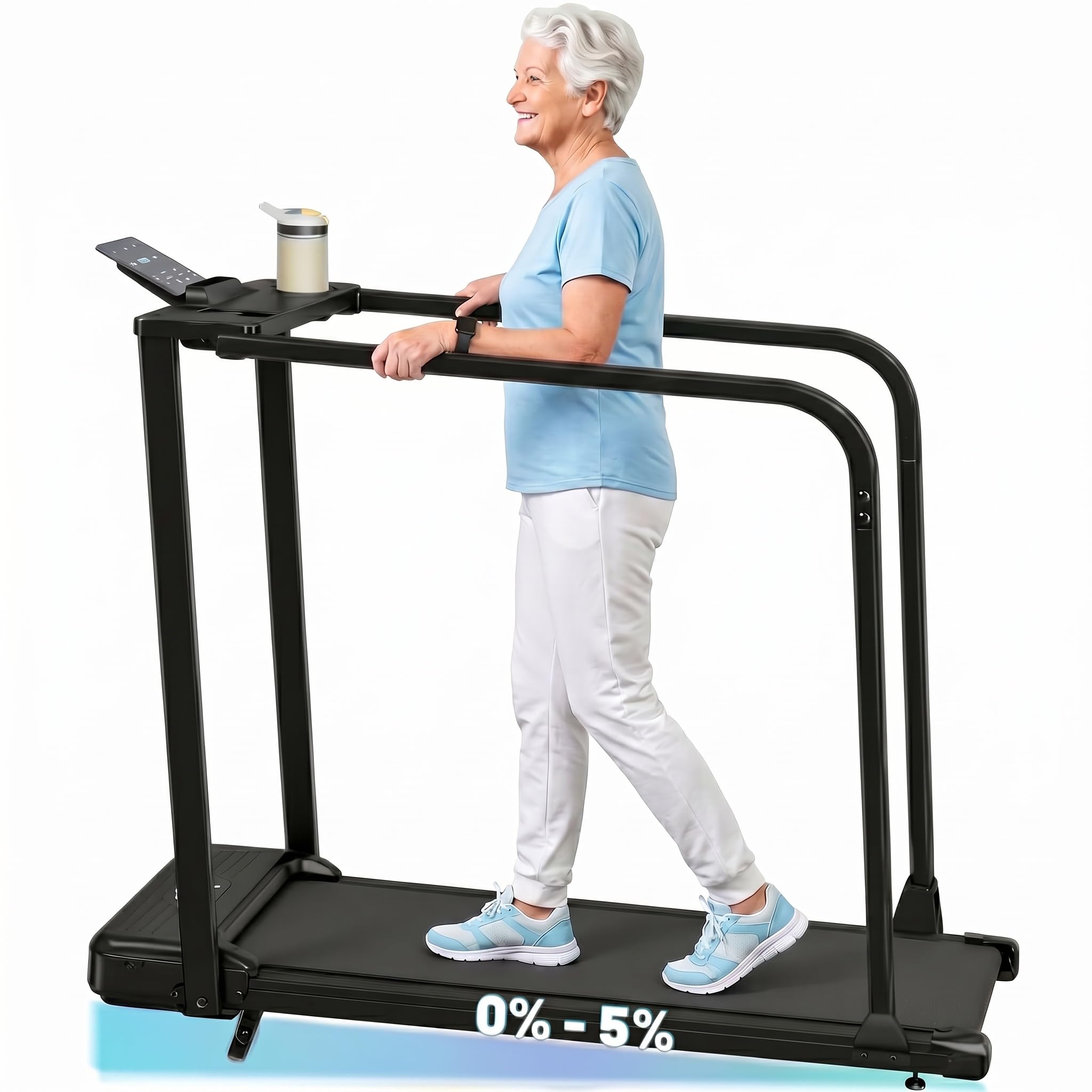
Best Treadmills for Seniors of 2026

The first question I hear about a treadmill for an older parent is not about speed or workout programs—it’s whether the machine will feel steady underfoot and whether it will actually get used. A good one turns a spare corner into a reliable place to walk when sidewalks are icy, the afternoon is too hot, or balance makes an outdoor loop feel risky. The right machine is not the one with the most features; it’s the one you can step onto without a lunge and trust not to wobble.

I learned that the hard way with a hand-me-down treadmill that had a short deck and a console I had to squint at. Over the past six months, I’ve put eight treadmills through daily walks, from compact models that fit a guest-room corner to larger machines with longer handrails. Step-up height, handrail reach, how gradually speed and incline change, and whether the footprint leaves room for a chair nearby matter more than a feature list. The picks below are the ones I’d trust with my own family.

1

Best Overall

Exerpeutic 4002 Senior Treadmill

84 /100
Trail Score Excellent

Key details

Deck Size
53 x 23 in.
Speed Range
0.3 to 4 mph
Handrail System
Full-length padded rails
Weight Capacity
400 lb
Check Price on Amazon

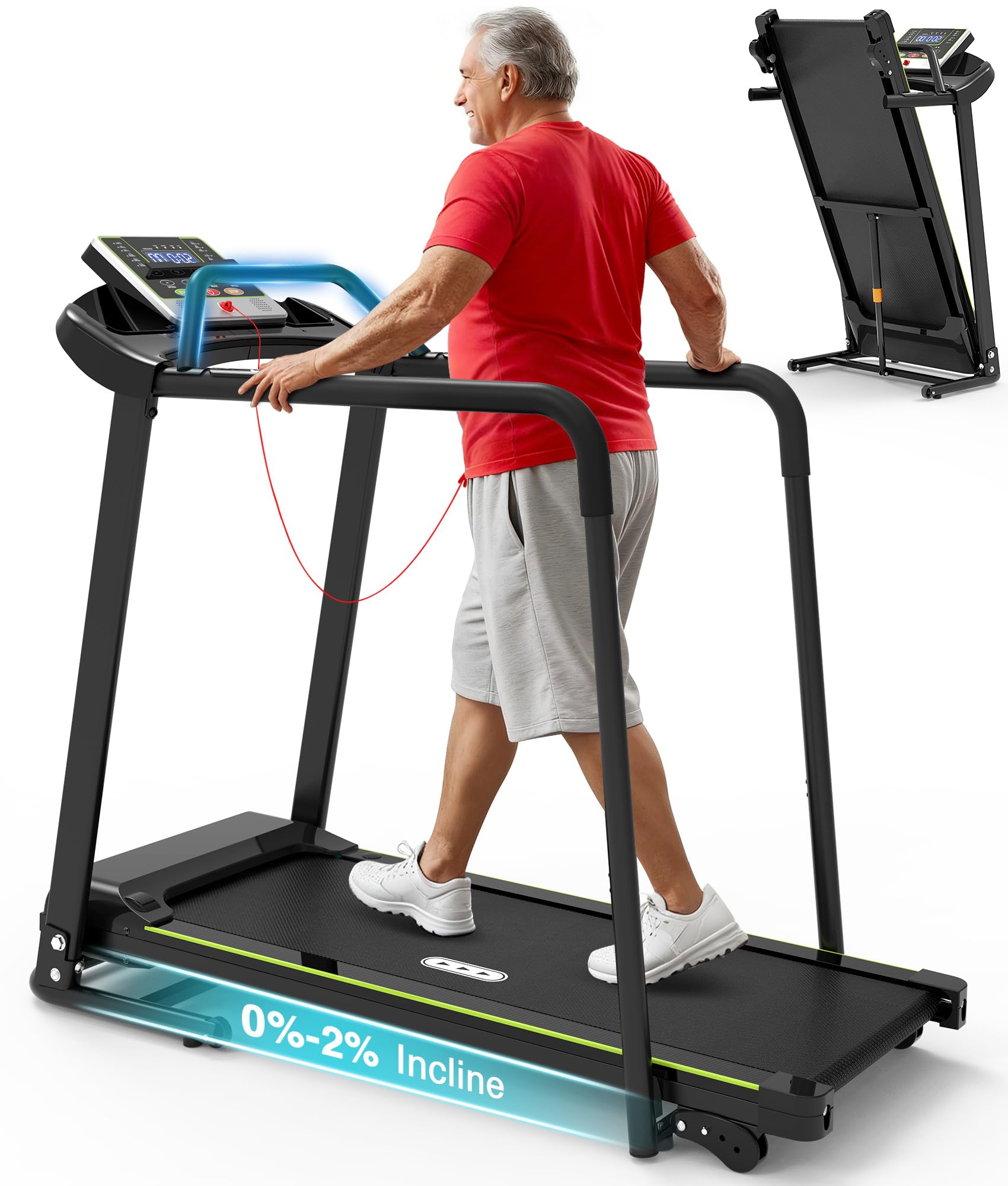
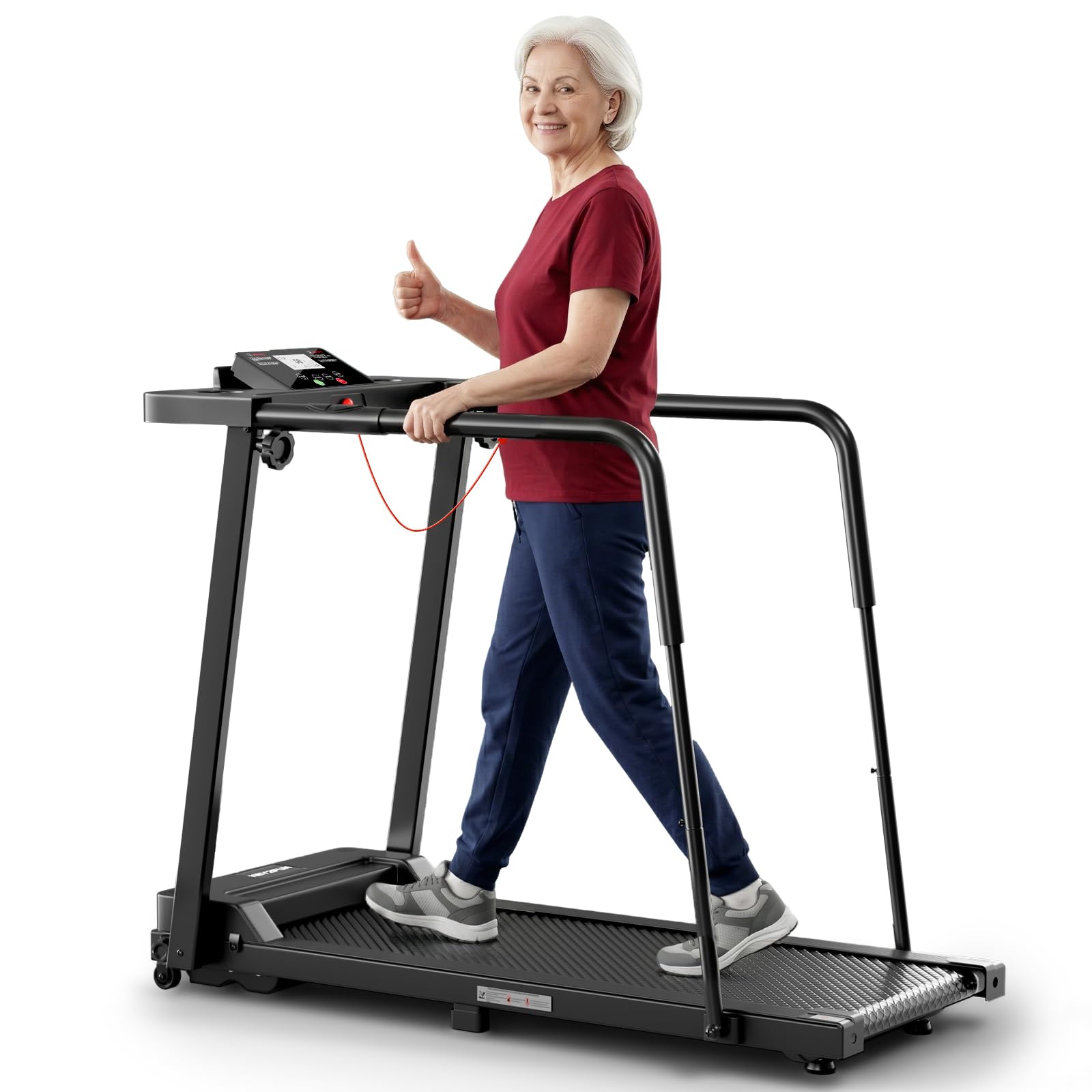
The 400 lb capacity and full-length padded rails are the two facts that make the Exerpeutic our top pick. For a senior who wants to hold on with both hands from the first step to the last, that combination is more useful than a long feature list. We also like the 0.3 mph start and the 4 mph ceiling: the slow start lets the belt begin at a crawl, and the low ceiling keeps the machine in walking territory.

The deck measures 53 by 23 inches, the widest figure in this group, and the low step-up is the other detail we appreciate. A wide deck gives you room to place your feet without aiming, and a low deck means less lifting to get on. The six deck cushions soften the walk, while the backlit LCD and two pockets keep the essentials in view and within reach.

At 71 lb, the Exerpeutic is not the machine you move from room to room on a whim; it wants a permanent spot. We are also happy to trade a higher top speed for stability, because 4 mph is plenty for daily walking and rehabilitation. The 2-year limited warranty is the longest listed in this group, and on a machine meant for daily laps, that coverage is more reassuring than an app.

Pros

  • 400 lb capacity is the highest here
  • Full-length padded handrails support both sides
  • Starts at a gentle 0.3 mph
  • Longest warranty here at two years

Cons

  • Takes up a dedicated 53-inch footprint
  • 4 mph ceiling won't suit a jogging partner
Our verdict

We recommend the Exerpeutic as the safest default for senior walking: 400 lb capacity, full-length rails, and a 0.3 mph start in one stable machine.
Check Latest Price
2

Best for Variety

Redliro Walking Treadmill

86 /100
Trail Score Excellent

Key details

Deck Size
41 x 16 in.
Speed Range
0.3 to 5.5 mph
Handrail System
Extended side rails and front bar
Weight Capacity
300 lb
Check Price on Amazon

The long side rails and front bar are what make the Redliro feel like a senior treadmill rather than a standard machine with an add-on. We like that you can keep a hand on a rail while stepping on, and the 0.3 mph start lets the belt begin at a crawl. The backlit display is clear, and the safety key and heart-rate sensors are the right basics.

Where the Redliro pulls ahead of the Exerpeutic is variety. It reaches 5.5 mph, carries 12 programs, and adds auto lubrication, a soft-drop fold, and a 2% manual incline. We appreciate those extras for a household that wants a faster walk or a program to follow. The incline is set by hand, so it is not a push-button hill feature.

The main compromise is the walking surface and the weight limit. The deck is 41 by 16 inches and the capacity is 300 lb, against 53 by 23 inches and 400 lb on the Exerpeutic. The narrower deck is the detail we keep coming back to for an unsteady walker, because room to place your feet is a safety feature, not a luxury. The rails can be removed for other household members, but the machine is at its best with them on.

Pros

  • Long side rails plus a front bar
  • 0.3 mph slow start
  • 12 programs and 5.5 mph top speed
  • Auto lubrication and soft-drop folding

Cons

  • Only a 1-year warranty
Our verdict

We see the Redliro as the feature-rich alternative for lighter, confident walkers who want long rails, more programs, and a faster walking pace.

Check Latest Price
3

Best Budget

KEY2FUN P05 Walking Treadmill

83 /100
Trail Score Excellent

Key details

Speed Range
0.6 to 5 mph
Machine Weight
58.5 lb
Handrail System
Extended anti-slip rails
Weight Capacity
300 lb
Check Price on Amazon

At 58.5 lb, the KEY2FUN is one of the lighter machines in this group, and that is the first thing we noticed when moving it into place. If the treadmill has to share a room or move between spots, that matters more than a program count. The compact body also leaves more floor visible, which is the point of a budget walking machine for a small home.

The 0.6 mph start is the compromise. It is still slow, but it is not the 0.3 mph crawl of the top pick and the Redliro; for someone who needs the gentlest possible first step, that gap is real. Otherwise the numbers are sensible: 5 mph top speed, 300 lb capacity, and a 3.0 hp brushless motor. The extended anti-slip rails give you something substantial to hold, and the large LCD and handrail heart-rate sensors are useful without demanding a manual.

We also like that the KEY2FUN includes a lubricant and a safety key, two small things that make setup less of a scavenger hunt. The compact body is the other trade-off: it fits tight spaces, but a tall walker with a long stride should check the walking surface before ordering. For a shorter daily walk in a small room, the sacrifice is easy to live with.

Pros

  • Light 58.5 lb frame
  • Extended anti-slip rails for balance
  • Large LCD and handrail heart-rate sensors
  • Lower-cost choice for small spaces

Cons

  • Starts at 0.6 mph rather than 0.3
Our verdict

Our budget pick is the KEY2FUN, a lighter walking treadmill that asks less of a small room and a tight budget.

Check Latest Price
4

Incline Walks

Krisrate Walking Pad with Handrails

81 /100
Trail Score Excellent

Key details

Incline
5%
Folded Size
39.76 x 17.32 x 2.5 in.
Speed Range
Up to 4 mph
Weight Capacity
300 lb
Check Price on Amazon

A 5% incline is the reason the Krisrate is on this list. It is the steepest grade here, well beyond the Redliro's 2% manual setting, so you can add effort without adding speed.

We like that the incline is set at the deck with foot pads before you start, rather than changed mid-walk. The extra-long handrail, 4 mph top speed, 300 lb capacity, six-layer belt, and remote cover the senior-walking basics. The 2.5 hp brushless motor is matched to walking pace, and the folded size of 39.76 by 17.32 by 2.5 inches stores flatter than the full-size treadmills here.

What keeps it out of the runner-up slots is reliability. A treadmill that can arrive with a belt that will not move, or stop working after a few months, is the wrong kind of surprise for someone walking alone. Test it immediately, keep the packaging until you have several walks on it, and use the safety key every time. The incline and fold-flat body are real advantages; the uncertainty is why this remains an also-consider.

Pros

  • 5% incline adds effort without speed
  • Extra-long handrail for balance
  • Folds to 2.5 inches flat
  • Remote control and LED display

Cons

  • Mixed reliability; test the belt on arrival
Our verdict

The Krisrate is worth a look if incline is your priority, but we keep it out of the top tier for daily rehab walking.

Check Latest Price
5

App-Guided Walks

FYC Q23L Walking Treadmill

82 /100
Trail Score Excellent

Key details

Speed Range
0 to 7.5 mph
Machine Weight
66 lb
Handrail System
Full-size extended rails
Weight Capacity
300 lb
Check Price on Amazon

The 7.5 mph top speed is the tell: the FYC is a family treadmill with senior-friendly rails, not a dedicated recovery machine. That is not automatically a problem. If one person wants a gentle walk and another wants a jog, the extended handrails still give the senior walker something to hold. But the high ceiling means the slow end deserves a closer look.

The senior-friendly parts are real. The extended handrails run alongside the deck, the 300 lb capacity is standard for this group, and the 66 lb frame is lighter than the Exerpeutic and Redliro. The six-layer belt and eight spring shocks are aimed at knee comfort. The Fit Show app adds virtual scenes, which we think is a nice distraction for someone who finds indoor laps dull, though it is not a safety feature.

The deck is where we hesitate. The machine is 50.5 inches long overall, and the walking surface is the number to check before you buy if you are tall; the compact footprint leaves less room for a long stride. The slowest starting speed is not specified, so confirm it before choosing this for rehabilitation. A household that will share the machine can live with both checks; a solo senior should not have to.

Pros

  • Extended handrails for balance
  • 7.5 mph ceiling suits a mixed household
  • App adds virtual walking scenes
  • 66 lb frame is lighter than the top pick

Cons

  • Deck may feel short for a long stride
Our verdict

We like the FYC for a mixed household that wants rails and a faster walk, not for a senior who needs the most predictable slow start.

Check Latest Price

How We Tested Treadmills for Older Walkers

We started with roughly 30 treadmills sold as senior-friendly or marketed to older adults, then filtered by deck height, footprint, handrail design, control layout, warranty, and return policy. That left eight machines at a mix of sizes and prices, from compact models meant for tight rooms to full-size treadmills with longer rails. We tested those eight over six months, using them the way an older walker actually would: daily 30-minute walks, slower balance-focused sessions, and occasional incline work.

Each machine was assembled by one person, and we timed how long it took from box to first walk, noted which steps really needed a second set of hands, and checked whether the belt stayed centered after the first week. We set them up in a spare bedroom, a finished basement, and a living-room corner, then logged every error code, belt slip, console freeze, and service call over the six months. Our test panel included two walkers over 65 and one recovering from knee surgery, which made the small things obvious fast: a short deck, a hard-to-reach safety key, or a handrail that ended too soon.

For suitability, we stepped on and off without using the console for balance, checked whether the handrails let us keep a thumb on the speed controls, and practiced stopping by pulling the safety key. We changed speed and incline mid-walk to see how quickly the deck responded and whether the transition felt abrupt. For size and compactness, we measured each footprint and walked around the machine in a 10-by-10 room to see whether it crowded a chair or doorway. For quality and value, we pushed off the deck to check for frame flex, listened for rattles at a normal walking pace, and compared what each machine delivered over six months against its price.

How to Choose a Treadmill for Seniors

Start With the Handrails and the Step-Up

We put handrails first for a reason: full-length rails are the difference between a treadmill you use and one that makes you nervous. They let you keep both hands supported while stepping on and off, and they give you something to grab if you lose your rhythm. Short console rails are not the same thing; check that the rails run alongside the deck. A low step-up height matters just as much, especially after hip or knee surgery. Measure from the floor to the belt and compare it with the first step of your stairs; if the treadmill is higher, keep looking.

Match the Speed Range to Walking, Not Running

A 0.3 mph start is the number to look for if you need a rehabilitation pace. Some walking treadmills start at 0.6 mph—still gentle, but twice as fast at the first step. A 4 to 5.5 mph top speed is plenty for senior walking; 7.5 mph is a running ceiling that adds range you may not use. We care more about small speed increments, such as 0.1 mph, than a high top speed. Small steps are how you build confidence without startling yourself.

Choose Capacity and Deck Size for the Walker

Capacity is about the walker's weight, not the machine's size. A 300 lb rating is common here; 400 lb gives a heavier walker more margin and usually comes with a sturdier frame. Deck size is the other half of the fit. The Exerpeutic lists a 23-inch-wide deck, while the Redliro lists 16 inches; that difference is easy to feel when you place your feet. If you use a walker, have a wide stance, or take long strides, choose width and length over a compact body.

Plan the Footprint and the Move

Compact is a relative word. A 58.5 lb machine is easier for one person to shift than a 71 to 79 lb model, but every treadmill needs a permanent clear space in front of a power outlet. Check the overall length as well as the folded size: the Redliro folds to 51.2 by 27.4 by 9.4 inches, and the Krisrate folds to 39.76 by 17.32 by 2.5 inches. A folded machine still needs room to lean or stand, so measure the wall space before you commit.

Prioritize Controls, Safety Key, and Warranty

Senior-friendly controls should be readable from standing height, with a safety key you can clip to clothing and speed buttons that do not require a manual. A backlit LCD helps in a dim room, but large characters matter more than color. We also weigh the warranty: the Exerpeutic carries two years, while the Redliro carries one. On a machine used every day, that extra coverage is worth more than a dozen preset programs you may never open.

Frequently Asked Questions

Final Verdict

Buy the Exerpeutic if you want the safest all-around senior treadmill: its 400 lb capacity, full-length rails, 0.3 mph start, and 23-inch deck give you more margin on capacity and deck width than any other pick here. The 4 mph ceiling is a walking limit, not a flaw for this buyer. If you want a faster walk and more programs, the Redliro is the alternative, but only for a lighter user who is comfortable on a 16-inch deck. For the tightest budget and smallest room, start with the KEY2FUN.