Best Water Filter Pitchers of 2026

Filtered water shouldn't require a plumber. A pitcher takes whatever comes out of your tap — the chlorine, the faint swimming-pool note, the mineral tang of hard water — and turns it into something you'll actually get up to refill. The catch is that the trade isn't equal from pitcher to pitcher: some drip so slowly you abandon the glass, some stand too tall for the shelf you had in mind, and some lids fight you every time you try to fill them. What you're really buying is a routine you'll keep up with, twice a day, for years.

Over the past six months, my team and I have filled, poured from, and refilled 12 pitchers in our own kitchens, and the pattern held: the ones worth keeping were the ones that disappeared into the routine. The detail first-time buyers miss is that the pitcher is the cheap part — replacement filters, and how often you're genuinely swapping them, decide whether a bargain stays a bargain. Below are the picks we kept reaching for, grouped by the kitchens and habits they fit.

1

Best Overall

Waterdrop Lucid 10-Cup

93 /100
Trail Score Outstanding

Key details

Width
5 in.
Capacity
10 cups (2.4 liters)
Filter Life
Up to 200 gallons (3 months)
Certification
NSF/ANSI 42 and 372
Check Price on Amazon

Ten cups, a lid you never lift, and the lowest price of any full-size pitcher in this guide: that combination is why the Lucid is the one we recommend first. The fill door on the lid flips open under the tap, so you refill one-handed without moving the pitcher off the shelf. After a week of that, lifting a whole lid off a competitor at the sink feels like unnecessary work.

The part that surprised us was the cartridge. Waterdrop rates it for 200 gallons or about three months, where Brita's standard filter is 40 gallons or two: four changes a year instead of six. It's certified to NSF/ANSI 42 and 372 and states PFOA/PFOS and chlorine reduction, and a full reservoir clears in a few minutes, long enough to unload the dishwasher and short enough that you don't plan around it.

At 10 by 5 by 10.1 inches it wants a shelf rather than a door bin, so measure the gap to the shelf above before you commit. Replacement cartridges are the PF-01A, sold in multi-packs, and an indicator on the lid tracks the filter's life so you aren't counting months in your head.

Pros

  • Ten cups with a hands-free fill door
  • Cartridge rated 200 gallons or three months
  • NSF/ANSI 42 and 372 certified
  • Lowest price of the full-size pitchers here

Cons

  • Filters are Waterdrop-specific PF-01A cartridges
Our verdict

We recommend it to most households: ten cups, a fill door you never have to lift, and a filter rated for three months, all at the lowest price of the full-size pitchers here.
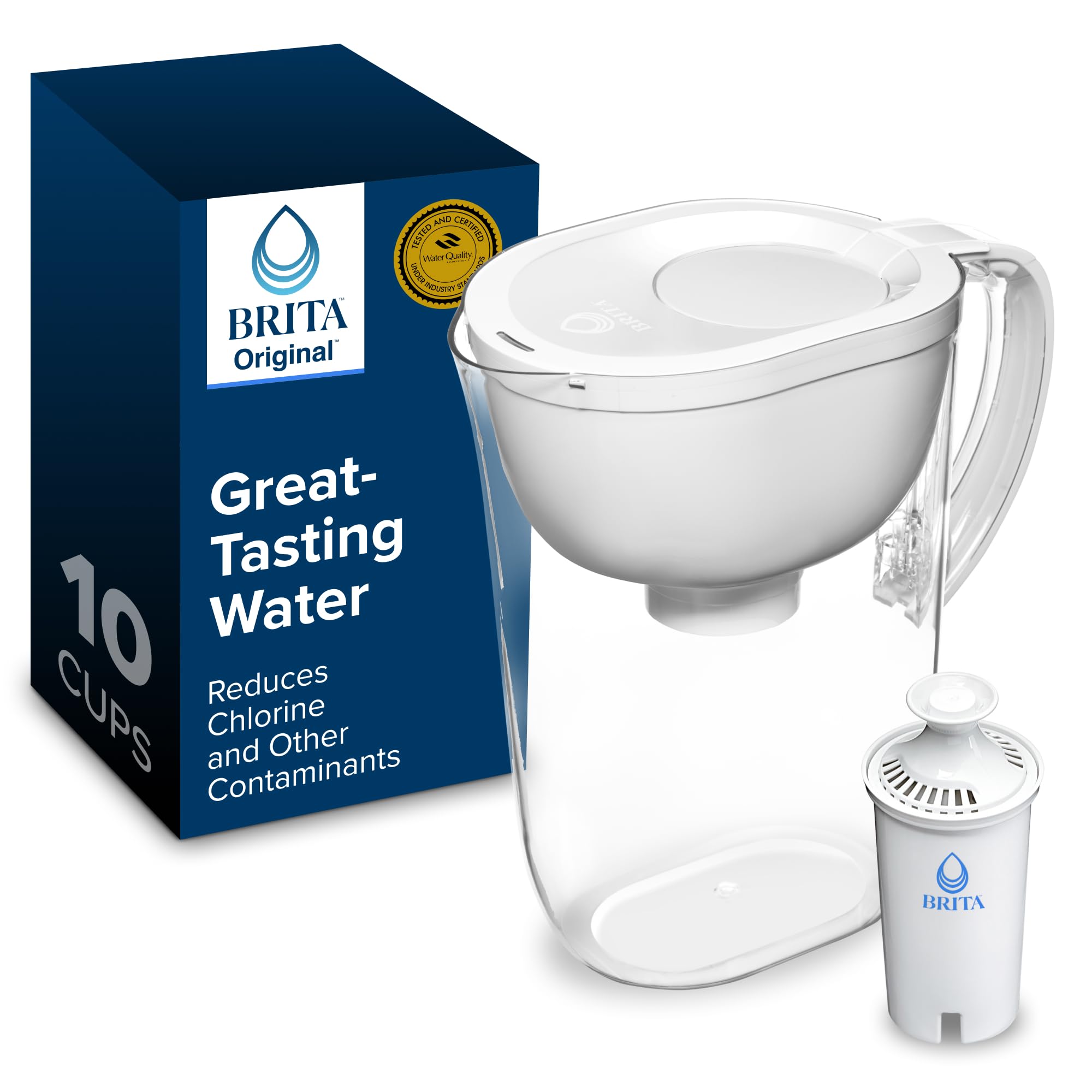
Check Latest Price
2

Best for Easy Filter Replacements

Brita Large 10-Cup

93 /100
Trail Score Outstanding

Key details

Width
5.4 in.
Capacity
10 cups
Filter Life
40 gal standard, 120 gal Longlast
Contaminants Reduced
Chlorine, mercury, copper, zinc, cadmium
Check Price on Amazon

One pitcher, two cartridges: that's the deal the Brita Large offers, and it's the reason it stays in the guide. The standard filter is rated for 40 gallons, roughly two months; the Longlast is rated for 120 gallons, about six, which means two changes a year if you go that route. Brita cartridges turn up in nearly every grocery store and hardware aisle, which is not something we can say for the Waterdrop.

Ten cups is the right size for two or three people, enough for three 24-ounce bottles before a refill, and at 5.4 inches wide it sits on a shelf beside the milk without a fight. We poured it full one-handed and the locking lid stayed put, which matters more than it sounds when you're filling a bottle in a hurry.

The listed reductions run longer than most here: chlorine for taste and odor, plus mercury, copper, zinc and cadmium, and the listing cites WQA and NSF/ANSI certification. Brita also backs it with a 30-day money-back guarantee, which is a low-risk way to find out whether your water is the problem or the pitcher is.

Pros

  • Takes two filter grades, including a 120-gallon Longlast
  • Ten cups in a 5.4-inch-wide body
  • Reduces chlorine, mercury, copper, zinc and cadmium
  • Widely stocked replacement cartridges

Cons

  • Handle can snap and the body can crack
Our verdict

Buy it for the filters: Brita sells a 40-gallon cartridge and a 120-gallon Longlast, and either is easy to find in a store.

Check Latest Price
3

Best for Narrow Spaces

Waterdrop Elfin 7-Cup

93 /100
Trail Score Outstanding

Key details

Width
3.8 in.
Capacity
7 cups (1.68 liters)
Filter Life
Up to 200 gallons
Certification
NSF/ANSI 42 and 372
Check Price on Amazon

Three and eight-tenths inches is the number that matters here. At 3.8 inches wide the Elfin is the narrowest pitcher in this guide, and that difference decides whether a shared shelf holds a pitcher or nothing at all. It runs 9.7 inches deep and 10 inches tall, so check headroom as well as width.

Seven cups, 1.68 liters, is a two-person pitcher: a round of glasses and a pot of coffee, but not a stockpot of pasta, and you'll refill it more than once with guests in the house. It also costs about what the 10-cup Lucid does, so you're buying the footprint and the look rather than a discount.

What we didn't expect was how much of the bigger pitcher's kit comes along at this size: the same hands-free fill door, a filter indicator, NSF/ANSI 42 and 372 certification, and a cartridge rated up to 200 gallons. Colors are the other draw. This is the best-looking pitcher in the set, and the pink is a long way from the white plastic most of these settle for.

Pros

  • Narrowest body in this guide at 3.8 inches
  • Hands-free fill door and filter indicator
  • NSF/ANSI 42 and 372 certified
  • Best-looking pitcher in this set

Cons

  • Seven cups empties fast for a family
  • Rated only to 300 ppm TDS
Our verdict

We point small kitchens here: seven cups in a 3.8-inch footprint, with the same hands-free fill door as our top pick.

Check Latest Price
4

Best for Easy Cleaning

PUR 7-Cup Pitcher

93 /100
Trail Score Outstanding

Key details

Capacity
7 cups
Cleaning
Body is dishwasher safe
Filter Life
40 gallons (2 months)
Certification
NSF certified: chlorine, mercury, copper, zinc
Check Price on Amazon

Cleaning is the chore nobody thinks about when they buy a pitcher, and then the reservoir starts to smell in July. The PUR is the only pitcher in this guide whose listing says the body is dishwasher safe, and that's most of why it earns a place: pull the filter, rack the rest, done.

We also liked how quickly it moves water, with a full reservoir clearing in a couple of minutes. Seven cups, a slim body that fits on a fridge shelf, and NSF certification for chlorine, mercury, copper and zinc make it a sensible package for a small kitchen or a home office.

Where it belongs is one or two people in an apartment or a first place, where the compact shape and the easy clean matter more than volume. The body comes apart for cleaning, which is the whole point, and the price sits well below the two Britas. If you want the same footprint with a cartridge rated for three months instead of two, the Elfin is the alternative.

Pros

  • Dishwasher-safe body
  • Fast filtration for a seven-cup pitcher
  • NSF certified for chlorine, mercury, copper and zinc

Cons

  • Lid can lift off while you pour
  • Only a 40-gallon cartridge, so six changes a year
Our verdict

The pitcher we hand to anyone tired of scrubbing a reservoir by hand: it's dishwasher safe, filters fast, and sits at the low end of this group on price.

Check Latest Price
5

One Person

Brita Metro 6-Cup

93 /100
Trail Score Outstanding

Key details

Weight
1.4 lb
Capacity
6 cups (40 fluid ounces)
Filter Life
40 gallons (2 months)
Filter Indicator
Electronic
Check Price on Amazon

Six cups and 1.4 pounds: this is the pitcher that gets poured rather than dreaded. Lifting it out of the fridge one-handed with a glass already in the other hand is the entire point of the Metro, and it's the lightest pitcher here.

The listed reductions match the bigger Brita's, chlorine for taste and odor plus mercury, copper, zinc and cadmium, and an electronic indicator on the lid counts the filter's life down instead of leaving you to guess. We like that the light does the remembering; it's the sort of thing you stop noticing until you own a pitcher without one.

Here's the wrinkle: at this size it costs more than the 10-cup Lucid, which holds four more cups. That isn't a knock on how it filters. It's the premium for a pitcher a kid can lift and that won't crowd a nightstand or a desk. Buy it for the size and the weight; buy the Lucid if you're shopping for capacity.

Pros

  • Lightest pitcher in this guide at 1.4 pounds
  • Electronic filter-change indicator
  • Six cups suits a one-person kitchen

Cons

  • The whole lid comes off for every refill
  • Costs more than bigger pitchers in this set
Our verdict

For one person, a dorm room, or a desk, we like this one: 1.4 pounds, six cups, and an electronic indicator that counts the filter down.

Check Latest Price

How We Picked and Tested 12 Water Filter Pitchers

We began with roughly 40 pitchers on the market and narrowed by capacity, whether replacement filters are stocked widely and priced sensibly, and where the pitcher is meant to live — fridge door, fridge shelf, or countertop. That left 12, from slim 6-cup models to 10-cup workhorses, each moving into a tester's kitchen for six months.

Taste was the first thing we judged, and we judged it plain: we chilled filtered water overnight, tasted it cold and again at room temperature, and compared both against unfiltered tap from the same sink. We also left a full pitcher in the fridge for three days and tasted it again, which is how we caught the plastic and stale notes that don't show up in a fresh glass. Cold water hides a lot; room temperature does not.

Functionality and ease of use got timed rather than described. We filled each reservoir from the kitchen tap and clocked how long a full cycle took, poured a glass mid-cycle to see whether the lid held or the spout dribbled, and counted how many glasses we got before a refill. We pulled and reseated every lid one-handed with the pitcher full — some popped off cleanly, others needed two hands and a yank — and washed each by hand and, where allowed, in the dishwasher, watching for cracks, clouding, and lids that stopped seating.

Because durability and value show up late, we ran each filter to the end of its rated life, noting what flow and taste looked like at month two or three, then set the per-gallon filter cost against the pitcher's price. Design counted only where it changed the routine: a handle that fits a small hand, a spout that doesn't drip, a footprint that slides into a crowded door bin.

How to Choose a Water Filter Pitcher

Match Capacity to the Cups You Actually Pour

Six or seven cups suits one or two people who drink water at home and fill a bottle for the road. Ten cups suits a couple that cooks, or anyone filling three bottles before work. The gap is concrete: our 10-cup picks hold three 24-ounce bottles, the 7-cup Elfin about two.

Two traps sit here. A quoted capacity is the water the pitcher holds, not the number of glasses you get before the reservoir is empty and filtering again, so size up if you also cook with filtered water. And compact in a listing usually describes the footprint, not the volume: a narrow pitcher can be just as thirsty as it is small.

Width Decides Fridge Fit, Height Decides Whether It Fits at All

Measure the shelf before you fall for a shape. On a full shelf, width is the constraint: the Elfin is 3.8 inches across, the Lucid 5, the Brita Large 5.4. In a door bin, depth and height matter more, and a 10-inch pitcher may not clear the shelf above it.

Weight only matters if you lift it. Ten cups is about five pounds of water before you count the plastic, which is why the 6-cup Metro at 1.4 pounds is the one to hand a kid or carry to a desk. If the pitcher stays on one shelf and you pour at the sink, ignore this entirely.

The Lid Is the Daily Friction

A lid you lift off every time you refill is the most common frustration in this category, and it's the thing a spec sheet never tells you. Two picks here have a fill door that opens under the tap; the others need the lid off. That's a second or two, several times a day, for as long as you own it.

Think about the moment rather than the feature. Filling at a crowded sink with a wet hand makes a hands-free door earn its keep; a pitcher filled once a morning on a desk makes it irrelevant. A lid that doesn't seat securely is worse than one that comes off by design, because it can lift while you pour.

Read the Filter, Not the Pitcher

Cartridge life is where the real cost sits. The standard Brita and PUR cartridges are rated for 40 gallons, about two months; the Waterdrop filters are rated up to 200 gallons, about three. Over a year that's six cartridges versus four, and the price per cartridge varies enough that the cheaper pitcher isn't always the cheaper year.

Then check what the certification covers. NSF/ANSI 42 is about taste and odor, mostly chlorine; 372 certifies the materials are lead-free, not that lead is removed. If a specific contaminant is your reason for buying, look for it on the filter's certified list and confirm the replacement cartridges carry the same certification. One last check before you restock: compare the bundled pitcher-and-filter price against a lone cartridge, because the pitcher sometimes comes out cheaper.

Frequently Asked Questions

Final Verdict

We recommend the Waterdrop Lucid to most households. Ten cups covers a couple or a small family, the fill door removes a small daily annoyance, and a three-month cartridge means fewer purchases and fewer chances to forget one.

Two changes of plan are worth knowing. If you want filters you can pick up at the grocery store, or a cartridge that goes six months, the Brita Large is the better buy. If the pitcher has to live in a narrow gap, the Elfin does the same job 1.2 inches narrower.