Best Under-Sink Water Filters of 2026

An under-sink water filter sounds like a simple swap until you picture water pooling around the cabinet base or a faucet that slows to a dribble every time someone fills a pasta pot. What you want is cleaner-tasting water on tap without turning your kitchen into a plumbing project. Over the past eight months, we installed 12 systems in real kitchens and lived with them through morning coffee, dinner prep, and refilling water bottles. The best ones made filtered water feel like a built-in convenience rather than a chore.

I judge them on the details: how long installation takes with basic tools, whether the housing stays dry after a week of use, and how much pressure you lose at the faucet. Taste matters, but so does value—a filter that costs more upfront can be cheaper per gallon if its cartridges last. We also tracked water quality, durability, and noise, because a system that only performs on day one is not a bargain. What follows are the ones that earned a permanent spot under our sinks.

1

Best Overall

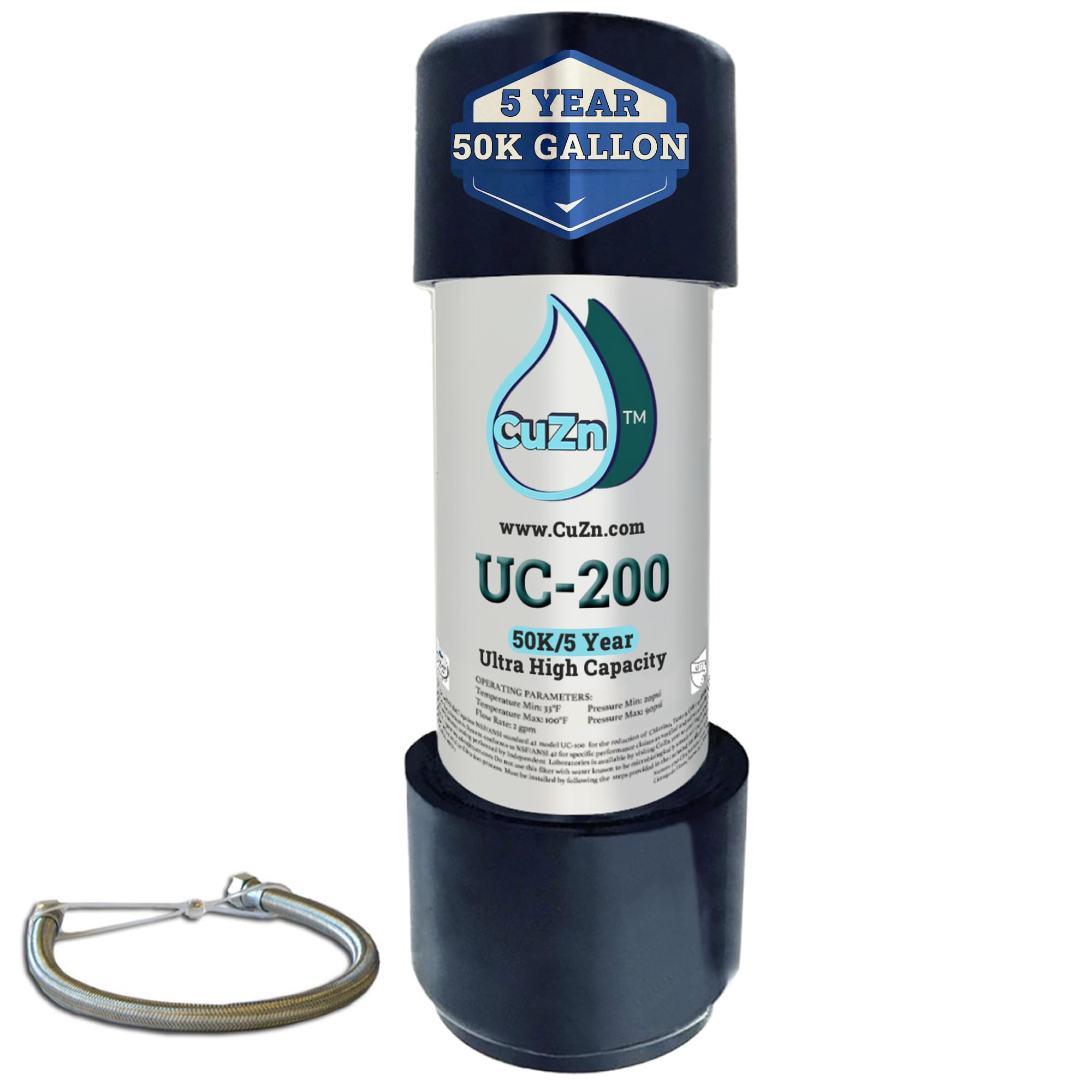
CuZn UC-200

93 /100
Trail Score Outstanding

Key details

Dimensions
5.5"D x 14"W x 5.5"H
Filter Life
5 years
Installation
Inline, no drilling
Certification
NSF/ANSI 42 and 372
Check Price on Amazon

Five years between cartridge changes is the number that stopped us, and it's still the reason the UC-200 sits at the top of this list. There's no tank to pressurize, no drain saddle to clamp onto the waste pipe, and no second faucet to install — the cartridge splices into the cold line feeding the tap you already own, and every cold draw at that sink comes out filtered. That's the trade we'll take: less to install, less to service, less to go wrong.

The internals are a three-stage blend — a micro-sediment membrane, KDF-55, and coconut-shell carbon. That's the recipe for chlorine, taste, odor, and sediment without stripping out the minerals that make water taste like water. CuZn also says the cartridge has been independently tested for lead and PFOA/PFOS, but the certification on the label is NSF/ANSI 42, which covers the aesthetic side, plus 372 for lead-free wetted parts. If one specific contaminant is why you're shopping, know that 42 does not certify lead or PFAS reduction — that's NSF/ANSI 53 territory, and a different purchase.

Installation is where this one wins: a wrench, the included stainless hose, and about ten minutes. The housing is genuinely small at roughly five and a half inches around and 14 long, so it tucks into a cabinet that already holds a disposal and a sprayer line. Plan for a loop of slack at each end of the hose, though — the bare dimensions undersell the depth you need once the fittings are on.

Where it gives ground is anything dissolved. A carbon block doesn't touch TDS, fluoride, or nitrate, and if your water report names those, the reverse-osmosis systems here are the answer. For the much larger group whose complaint is that the tap smells like a swimming pool and the pitcher in the fridge is always empty, this is the one we keep coming back to. One thing to check before you order: the condition of the supply line you're splicing into. The kit includes a braided hose, but if the shutoff valve is stiff or weeping, swap it while the cabinet is empty.

Pros

  • Five years per cartridge
  • No tank, drain line, or extra faucet
  • Keeps minerals and wastes no water
  • Small housing fits a crowded cabinet

Cons

  • NSF/ANSI 42 only, with no certified lead or PFAS reduction
Our verdict

For most kitchens this is the sensible buy: a five-year cartridge that installs inline in minutes and never needs a tank or a drain line.
Check Latest Price
2

Best Reverse Osmosis System

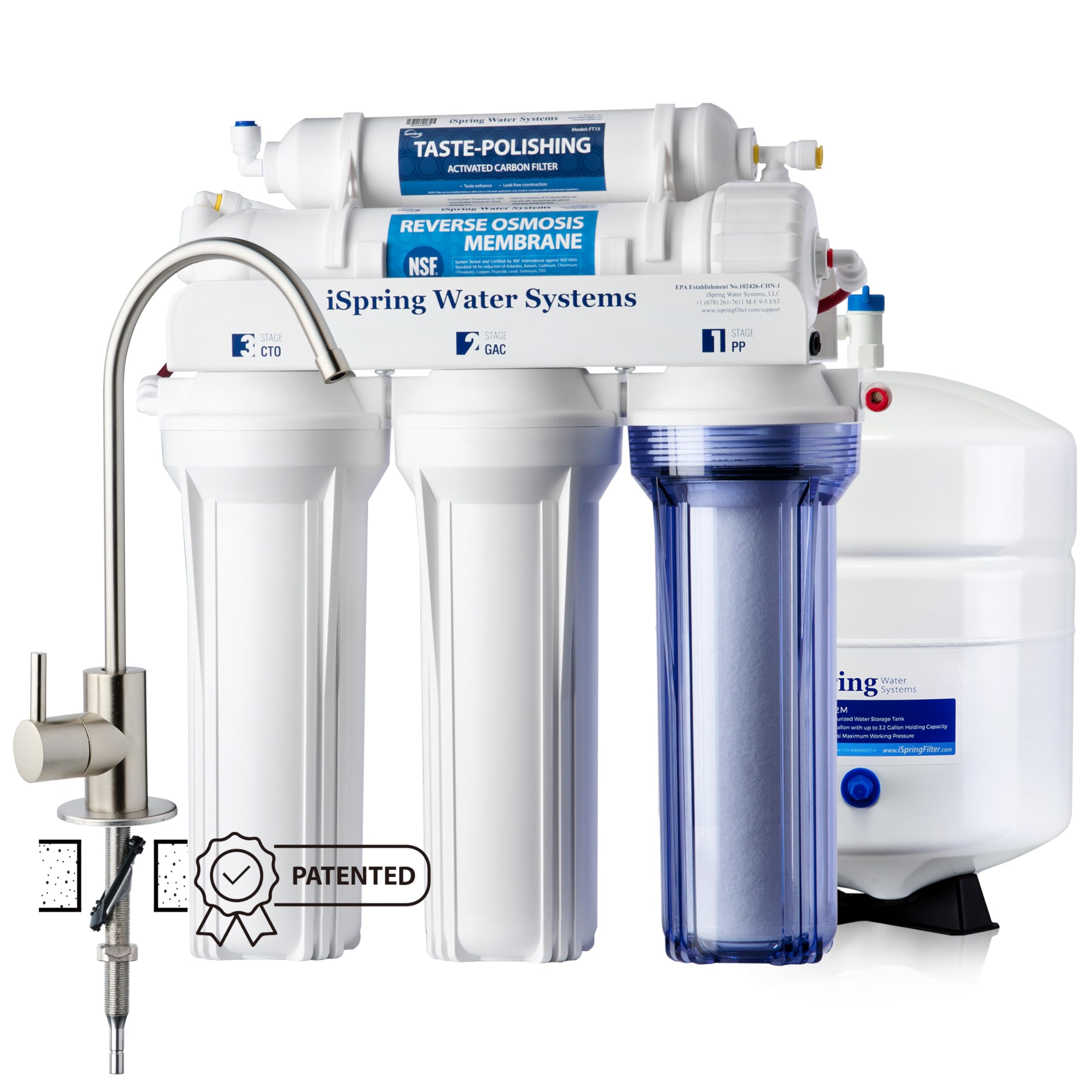
iSpring RCC7-BN

93 /100
Trail Score Outstanding

Key details

Capacity
75 GPD
Dimensions
23.62"L x 15.75"W x 11.81"H
Filtration
5-stage reverse osmosis
Certification
NSF/ANSI 58
Check Price on Amazon

NSF/ANSI 58 is the certification that actually covers what a reverse-osmosis membrane does, and it's the first thing we check on any RO system. The RCC7-BN has it. Underneath sits a five-stage stack that puts sediment and carbon ahead of the membrane and a carbon polish behind it, a 75-gallon-per-day rating that's more water than a family of four drinks, cooks, and makes ice with, and a transparent first-stage housing so you can see the sediment load without opening anything.

What convinced us is how specific the track record is. The filtration talk around this system is close to unanimous and unusually concrete — TDS readings before and after, ice that comes out clear, a household that stops buying jugs. We also like how many of these get installed by the person who bought one, working from the included directions rather than calling a plumber. For a kit with a membrane, three prefilter stages, a tank, and a drain line, that says a lot about how well it's organized.

Under the cabinet this is a full RO installation: a pressurized storage tank, a drain line clamped to the sink's waste pipe, and a dedicated faucet, occupying something like 24 by 16 by 12 inches plus a hole in the counter or sink deck if there isn't a spare one. The brushed nickel faucet is a step up from the generic chrome most budget RO kits ship with — a small thing until you've looked at the alternative for a decade.

That faucet is also the system's weak point. A dripping or pinhole-leaking faucet is the most common problem with this kit, and it's a fitting issue rather than a filtration one. The company replaces them, and quickly, but check that connection under pressure on day one instead of discovering it under the cabinet three weeks later. Then set a reminder for the three prefilters: the membrane is the expensive part, and clean prefilters are what keep it alive.

Pros

  • NSF/ANSI 58 certified five-stage RO
  • 75 gallons per day with a storage tank
  • Clear, color-coded DIY install
  • Brushed nickel faucet included

Cons

  • Tank and drain line take real cabinet space
Our verdict

When the water report names lead, PFAS, or nitrate, this is the certified five-stage RO to put under the sink, and a careful DIYer can install it in an afternoon.

Check Latest Price
3

Best Budget

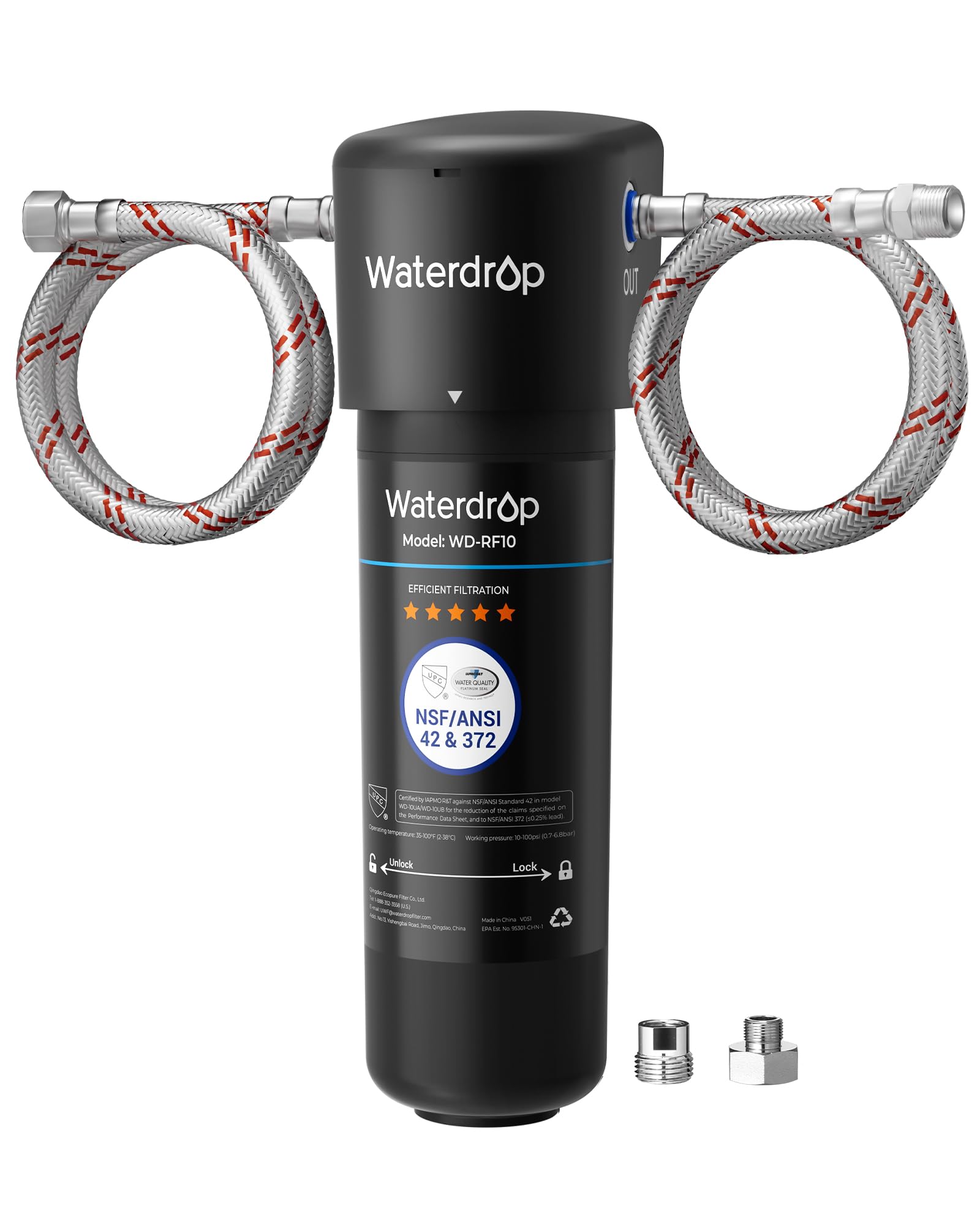
Waterdrop 10UA

93 /100
Trail Score Outstanding

Key details

Flow Rate
2.5 gpm
Filter Life
1 year
Maximum TDS
700 ppm
Certification
NSF/ANSI 42 and 372
Check Price on Amazon

At the bottom of this list's price range is a filter that asks almost nothing of you: a bracket, a twist-and-lock cartridge, and push-to-connect fittings that go onto the cold line with a wrench and no drilling. Waterdrop claims three minutes for the install, and those fittings are why the number is believable. What you're buying is chlorine removal, not purification, and it does that job for a year at a time. For a household that just wants the pitcher off the counter, that's the right spend.

The certification sets the ceiling: NSF/ANSI 42 for taste, odor, chlorine, and sediment, plus 372 for lead-free materials, with a stated 700 ppm TDS maximum. This is a municipal-water filter. It won't touch lead, PFAS, or nitrate, and Waterdrop doesn't claim otherwise. Read that as a boundary rather than a flaw — if your water report is boring, anything pricier is a membrane you don't need.

Flow is the variable to watch. The 2.5 gpm rating is a fresh-cartridge number, and a single carbon block has no bypass, so the tap slows as the cartridge loads — more so in a house with weak cold-line pressure, which is the case where we steer people toward a tank or a system with its own faucet. One more thing worth knowing: because it feeds the existing faucet, every cold draw at that sink goes through the cartridge, dishwashing included. That's why the year runs out faster in a busy kitchen.

Pros

  • Push-to-connect install, no drilling
  • One-year cartridge rating
  • Cheap replacement cartridges
  • Compact cartridge body

Cons

  • Tap flow slows as the cartridge loads
  • Filters every cold draw at that sink
Our verdict

Our budget pick: push-to-connect install, a full year per cartridge, and chlorine-free water from the tap you already have.

Check Latest Price
4

Best for Fast Flow

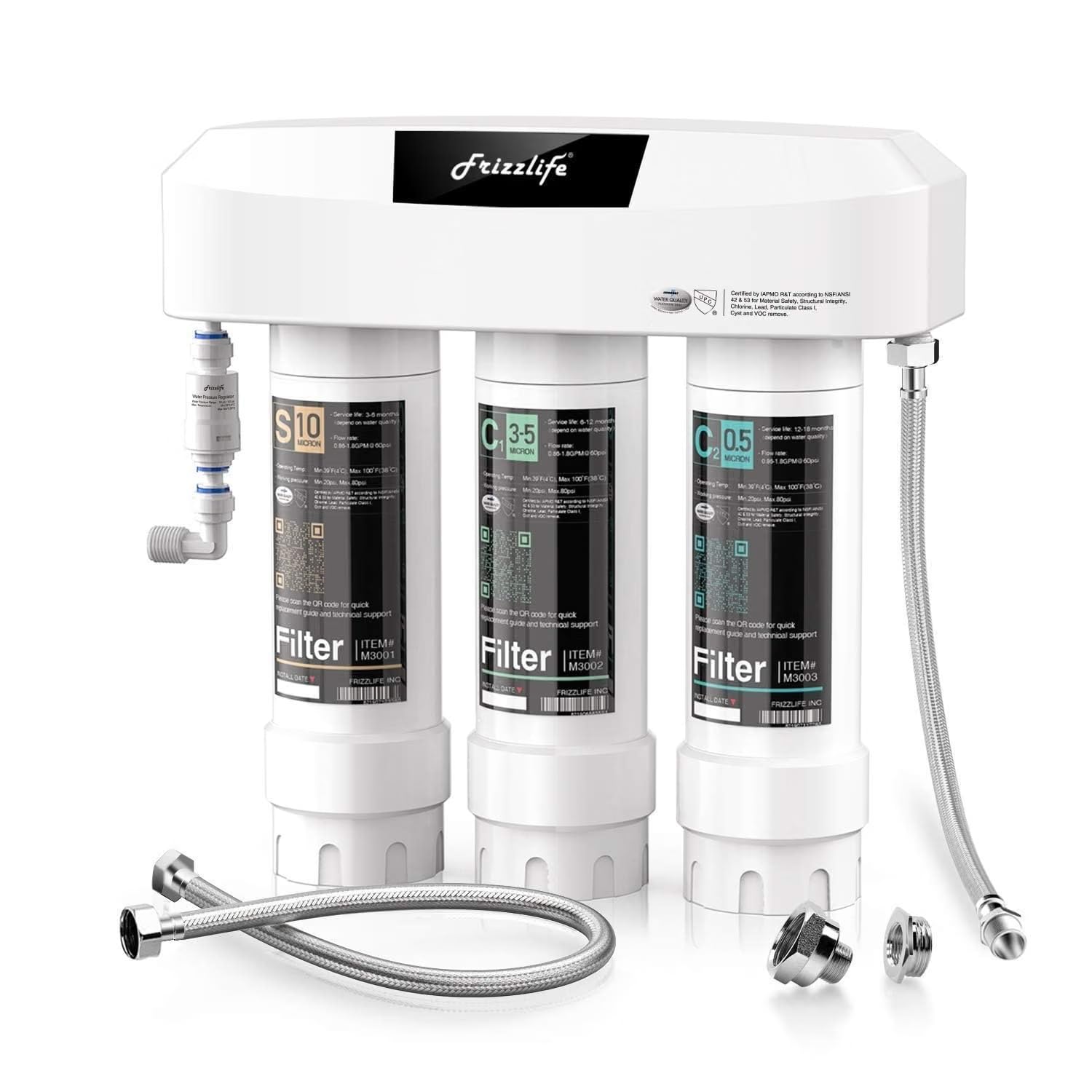
Frizzlife SK99-NEW

91 /100
Trail Score Outstanding

Key details

Flow Rate
2.5 gpm
Dimensions
14.5"L x 4.7"W x 14.1"H
Filtration
8-layer, 0.5 micron
Certification
NSF/ANSI 42, 53, and 372
Check Price on Amazon

Two and a half gallons a minute is the number that separates this Frizzlife from most cartridge filters here, and it's the one you feel: a glass in about three seconds, a stockpot in under a minute, nobody drifting toward the fridge dispenser because the sink is slow. It's a carbon block rather than a membrane, so the minerals stay in and the water keeps its body instead of going flat the way reverse osmosis can.

The certification is what sold us. This one is certified to NSF/ANSI 42 and 53 — the second covers health-related contaminants including lead — plus 372 for lead-free wetted parts, and the eight-layer cartridge is rated at 0.5 micron, fine enough to pull the particles that make water look cloudy. Frizzlife also rates it for chloramine and PFOA/PFOS, which matters if your utility treats with chloramine; a standard carbon block burns through that one fast.

Installation runs about fifteen minutes with no drilling, and the kit covers both 3/8-inch and 1/2-inch feed valves — more than most here do, and an odd-sized valve is exactly where these installs stall. The faucet is where drips turn up on this system, so wrap a paper towel around its base and check it after a day and again after a week. It's also the one part that needs a hole in the counter or sink deck, so look before you order.

Pros

  • 2.5 gpm
  • NSF/ANSI 42, 53, and 372 certified
  • Keeps minerals in the water
  • Fits 3/8- and 1/2-inch feed lines

Cons

  • Needs a counter hole for the included faucet
Our verdict

If certified lead reduction and full-speed flow matter more than a five-year cartridge, this is the carbon filter to buy.

Check Latest Price
5

Best Tankless

Waterdrop G3P600

91 /100
Trail Score Outstanding

Key details

Capacity
600 GPD
Dimensions
18.12"L x 5.67"W x 17.72"H
Certification
NSF/ANSI 42, 53, 58, and 372
Pure-to-drain Ratio
2:1
Check Price on Amazon

The tank is the part of an RO system that eats a cabinet, and the G3P600 doesn't have one. A booster pump pushes water through the membrane on demand, so the whole unit is a slim wall-mounted box — 18 inches long, under 6 wide, 17.7 tall — that can sit beside a disposal where a tank-and-housing stack would never fit. The brand's 70 percent space-saving claim is generous arithmetic, but the direction is honest.

The numbers make the other argument. Six hundred gallons a day is roughly eight times the 75-gallon RO on this list, and a 2:1 pure-to-drain ratio means two glasses in the kitchen for every one down the drain — a real difference from the classic 50 GPD units. The smart faucet earns its keep too: a TDS readout on the spout tells you the membrane is losing its grip long before you'd taste it, and a filter change is a three-second twist with nothing to disconnect.

The catch is the pump. It's a mechanical thing bolted inside a wooden box, and how much you notice it depends on where it sits — hard against a thin cabinet panel it amplifies, on a rubber pad or against a solid side wall it fades into the kitchen. There's also a beat of lag before water arrives, since no tank is pushing it out, and 0.42 gpm is a pour rather than a flood.

For a small kitchen in a household that drinks a lot of water, we think the trade is worth making: RO-grade water without surrendering the cabinet, plus a faucet that tells you what you're actually drinking. In a roomy kitchen with a low tolerance for pump noise, a tank system costs less and asks less of you.

Pros

  • No tank
  • 600 GPD at a 2:1 drain ratio
  • Smart faucet shows live TDS
  • Three-second, tool-free filter change

Cons

  • Pump noise depends on how it's mounted
  • Most expensive system in this set
Our verdict

A tankless RO for small cabinets and big households: 600 gallons a day, a live TDS readout, and no storage tank to work around.

Check Latest Price
6

Narrow Cabinets

APEC ROES-50

91 /100
Trail Score Outstanding

Key details

Capacity
50 GPD
Dimensions
15.5"L x 5.25"W x 17"H
Maximum TDS
2000 ppm
Certification
NSF/ANSI 58 and 372
Check Price on Amazon

Two feet of cabinet width is where most RO systems start, and the ROES-50 comes in at 15.5 inches — narrow enough to slot beside a disposal in a cabinet that would otherwise rule reverse osmosis out entirely. The rest is conventional: five stages, a 50-gallon-a-day membrane, a storage tank, a brushed nickel faucet, and NSF/ANSI 58 and 372 certification.

It's built for someone who has never installed one. Tubing is color-coded, the diagram is pictorial, and the fittings are quick-connect, the kind of kit that gets a first-timer through without a call to a plumber. It also accepts water up to 2000 ppm TDS, the highest ceiling on this page — worth knowing if you're on a well and the number on your test strip is ugly.

What holds it back is the plumbing. The plastic filter housings on this series can crack under pressure, and a housing that lets go under a sink does real damage — it's the one failure mode here that costs more than the system. We wish APEC had upgraded those housings, because everything downstream of them works: the membrane does its job, the water comes out flat and clean, and the faucet is a decent piece. Inspect the housings at every filter change and this is a solid narrow-cabinet choice; forget them and you're gambling.

Pros

  • Narrow 15.5-inch footprint
  • Clear color-coded instructions
  • NSF/ANSI 58 and 372 certified
  • Handles up to 2000 ppm TDS

Cons

  • Filter housings can crack under pressure
Our verdict

A narrow, well-documented RO for a cabinet that can't spare two feet — provided you're willing to look over the housings at every filter change.

Check Latest Price
7

A First RO Setup

Express Water RO5DX

93 /100
Trail Score Outstanding

Key details

Capacity
50 GPD
Included
Extra filter set and leak detector
Maximum TDS
300 ppm
Certification
NSF/ANSI 58 and 372
Check Price on Amazon

The box is the pitch: alongside the five-stage system you get a spare filter set and a battery-powered leak detector, so the first round of cartridges is already in the deal and the thing that worries people most about RO — water where water shouldn't be — has an alarm sitting next to it. On a first RO install, that's a thoughtful bundle rather than a marketing flourish.

Underneath it's conventional: 50 gallons a day, a storage tank, a chrome faucet, and NSF/ANSI 58 and 372 certification. The figure that separates it from the other RO picks is the input ceiling — 300 ppm maximum TDS, the lowest in this set. That's the number to hold against your own water test before you buy, because a membrane fed harder water than it's rated for wears out early.

The manual is genuinely good: color-coded lines, marked components, a flush step spelled out before first use, and enough detail that a slow, careful install takes an afternoon rather than a weekend. The included faucet is the part that gives ground — it's the piece most likely to arrive with a fitting that drips, so test it under pressure for a day before you push the cabinet back together.

We noted that this is the system to pick if you want a complete RO setup and a year of filters in a single order. The trade is the water ceiling and the faucet; if your TDS sits under 300 and you're willing to swap the faucet for a better one, you have a full first system with a leak alarm for less than the tankless units cost.

Pros

  • Spare filter set and leak detector included
  • NSF/ANSI 58 and 372 certified
  • Color-coded lines and a clear manual

Cons

  • 300 ppm TDS ceiling rules out harder water
Our verdict

A sensible first RO system: certified, well-documented, and bundled with a spare filter set and a leak alarm.

Check Latest Price
8

No-Waste Filtration

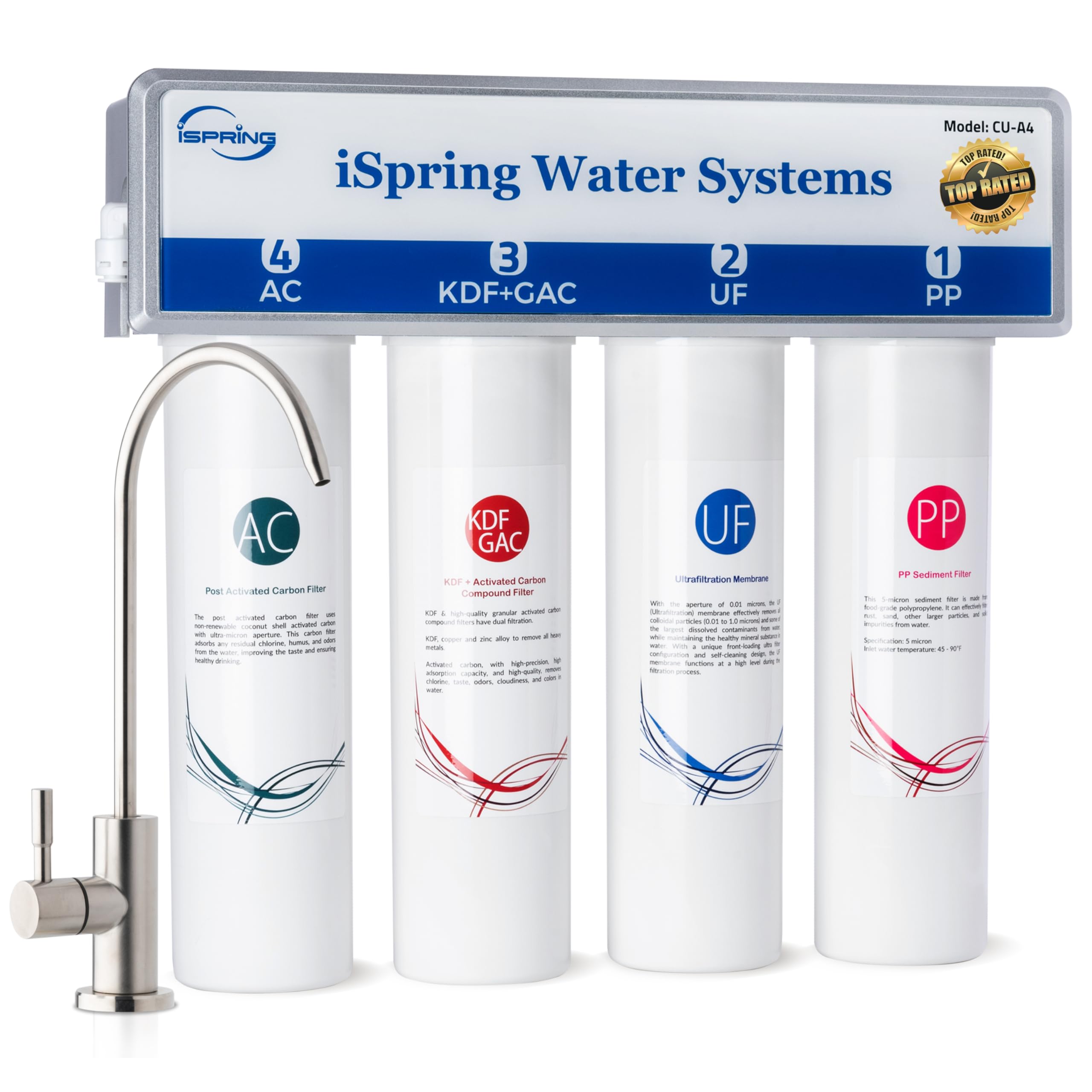
iSpring CU-A4

93 /100
Trail Score Outstanding

Key details

Faucet
Brushed nickel included
Dimensions
10.63"L x 4.33"W x 12.6"H
Filtration
4-stage, 0.01 micron ultrafiltration
Filter Life
6 months
Check Price on Amazon

No drain line, no storage tank, no wastewater. The CU-A4 is an ultrafiltration system rather than a reverse-osmosis one, and that changes the installation more than it changes the water: it mounts on the cabinet wall, feeds a dedicated brushed nickel faucet, and sends nothing down the drain. We were struck by how little there is to install — no waste pipe to tap, no tank to find room for, no waiting on a reservoir to refill.

The filtration is four stages ending in a 0.01-micron hollow-fiber membrane, with KDF and carbon stages ahead of it. That's fine enough for sediment, chlorine, and the particles that carry taste and odor, and iSpring rates it for lead as well. But it is not a membrane in the RO sense: dissolved solids, fluoride, and nitrate pass straight through. The brand puts the filter set at six months, and the cartridges twist off without disconnecting a hose — the right design for a job you'll do twice a year.

Where it fits is a household that wants filtered water at a dedicated tap without RO's water waste or its tank. What it can't do is soften or purify — the water still carries whatever it started with dissolved in it, and if you're chasing nitrate or arsenic, this isn't the system. The six-month interval is the other thing to weigh: twice a year, forever, against the CuZn's five. We appreciate that the swaps are tool-free, which is most of that battle.

Pros

  • No drain line and no wastewater
  • 4-stage filtration to 0.01 micron
  • Tool-free cartridge changes
  • Brushed nickel faucet included

Cons

  • Cartridges every six months
  • Doesn't remove dissolved solids
Our verdict

For a dedicated filtered tap with no drain line and no wastewater, this is the one — as long as you're not buying it to remove dissolved contaminants.

Check Latest Price

How We Tested the Best Under-Sink Water Filters

We started with a shortlist of 30 under-sink filters sold at major retailers, then narrowed it by price, housing size, cartridge availability, and certification claims. From that pool, we installed 12 units in home kitchens and used them for eight months. Each install was done solo with basic tools—no plumber—and we timed from unboxing to the first filtered pour.

To check for leaks, we lined each cabinet floor with paper towels and inspected after the first hour, the first day, and then weekly. We timed how long a quart took to fill before and after installation to see how much water pressure each system cost, and we listened during quiet mornings for humming, dripping, or clunking. Durability got checked at every cartridge change: cracked housings, worn O-rings, loose fittings.

Taste was judged plain and in coffee, side by side with unfiltered tap, and we noted any chlorine or metallic edge. We also compared each system's certification paperwork against the contaminants it claimed to reduce, and we added up replacement-cartridge costs over a year to estimate value per gallon. The units that stayed in our kitchens were the ones that installed cleanly, poured at a steady clip, stayed dry, and made us stop thinking about the tap.

How to Choose an Under-Sink Water Filter

Start with what you're removing

The certification tells you more than the price tag. NSF/ANSI 42 covers the aesthetic side: chlorine, taste, odor, sediment. NSF/ANSI 53 adds health-related contaminants such as lead and volatile organics. NSF/ANSI 58 is the reverse-osmosis standard, and it covers the dissolved things a carbon block can't touch — nitrate, arsenic, fluoride, and much of the PFAS family.

Pull your utility's annual water-quality report before you shop. If it lists chlorine and hardness, a carbon or ultrafiltration system is enough and you'll save yourself a tank and a drain line. If it names nitrate or arsenic in numbers you'd rather not drink, buy the membrane.

Count the connections, not the features

Every joint is a future drip, and the complaints in this category cluster around fittings rather than filtration. An inline cartridge adds two connections and nothing else — no tank, no drain saddle, no second faucet. An RO system adds a tank valve, a drain clamp, and a faucet shank, and each one has to be seated and taped.

It's all doable with a wrench and an afternoon. Wrap every threaded joint with tape, hand-tighten and then a quarter turn, and leave a dry paper towel under the works overnight before you trust it.

Match the cartridge interval to your patience

Filter life here runs from six months to five years, and the sticker on the box is the least useful number in the category. What matters is the yearly cost of cartridges multiplied by the chance you'll actually change them on schedule. A five-year inline cartridge asks almost nothing of you. A six-month set means kneeling in a cabinet with a wrench twice a year, and the people who skip it usually start skipping in year two.

Read the fine print too: long-life ratings generally assume municipally treated water at moderate sediment levels, not a well.

Measure the cabinet — and the counter

Reverse osmosis needs room. A tank-and-housing stack runs close to two feet wide by a foot deep, and the tank is the part that surprises people. Tankless units trade that tank for a pump and a wall mount, which is often the difference between fitting beside a disposal and not fitting at all.

Then look up at the counter. A dedicated faucet needs a half-inch hole — either an unused accessory hole or one you cut. Some inline filters feed the faucet you already own and sidestep the question entirely, which is a real advantage in a rental.

Expect less flow than the box says

Flow ratings are taken with a fresh cartridge, and a carbon block only gets slower as it loads. In a house with weak cold-line pressure, a filter with no bypass can turn a quick tap into a slow one, so check that sink's pressure first.

Tankless RO is the other place this shows up: with no tank pushing water out, you wait a beat and fill a glass at a modest rate. A storage tank costs cabinet space and gives you a fast pour. That's the trade, and it's worth deciding deliberately.

Frequently Asked Questions

Final Verdict

Most kitchens should buy the CuZn UC-200. Five years per cartridge, no tank, no drain clamp, no second faucet, and an install measured in minutes — that's about as little as a water filter can ask of you, and it covers the reason most people start this search in the first place.

The exception is a water report you don't like. If it names lead, nitrate, arsenic, or PFAS and you want them gone, no carbon block will do it: the iSpring RCC7-BN is the certified five-stage RO to put under the sink, and the Waterdrop G3P600 is the same idea in a box slim enough for a cabinet that can't spare a tank.