Best Walkers with Wheels of 2026

A walker with wheels should feel like a quiet extension of your arm, not a shopping cart with a mind of its own. The first test is stability: does it stay planted when you lean on it, or does it scoot away on a slick floor? After that, the details start to matter—how much it weighs, whether it folds flat enough for a car trunk, and whether the frame still feels tight after months of use. The right one gives you back the confidence to walk to the mailbox, cross a parking lot, or get through a crowded doctor's office without bracing for a wobble.

I've spent the last six months with 12 different walkers, assembling each one out of the box, folding and unfolding it until the motion felt automatic, and steering it through grocery aisles and along cracked sidewalks. The differences are not subtle: a sturdy frame and well-placed wheels can make the difference between a steady stroll and a white-knuckle grip. Below are the ones that earned a spot by the door.

1

Best Overall

Drive Nitro Euro-Style Rollator

96 /100
Trail Score Outstanding

Key details

Folding
One-hand fold, locks closed
Storage
Removable zippered bag
Front Casters
10 in
Walker Weight
17.5 lb
Check Price on Amazon

The walk from the kitchen to the bathroom is easy for almost any rollator. The walk to the mailbox, over a driveway lip and a heaved slab of sidewalk, is where this one separates itself. Its front casters measure 10 inches — roughly double the small wheels on the value picks here — and that size is what lets it roll over a curb or a tree root instead of stopping dead against it. Indoors, the same casters pivot the frame around a coffee table without a three-point turn.

What settled it for us is that the Nitro doesn't force a choice between indoors and out. The handles push-button up and down, the backrest moves with a thumb screw, and the frame folds with one hand and locks shut under the seat, so it stands on its own in a closet or a car trunk. Add the padded seat and a removable zippered bag that lifts out for errands, and it's the only pick here that covers a whole day away from home.

At 17.5 pounds it's a two-hand lift into a trunk, which is the honest cost of those casters — though it's still lighter than the 8-inch-wheeled VOCIC and HOMLAND, which you might not expect from the wheel size. If your walking is mostly indoors, the Drive two-button folding walker does that job for a fraction of the money and less than half the weight.

Pros

  • 10-inch front casters clear curbs and cracked pavement
  • One-hand fold that locks closed and stands up
  • Padded seat, adjustable backrest, removable bag
  • Lighter than the 8-inch-wheeled rollators here

Cons

  • The priciest walker in this roundup by a wide margin
Our verdict

If you want one walker that handles a cracked sidewalk as well as a hallway, this is the one we recommend first: big casters, a real seat, and a one-hand fold.
Check Latest Price
2

Best Budget

Drive Two-Button Folding Walker

95 /100
Trail Score Outstanding

Key details

Frame
Aluminum
Front Wheels
5 in
Walker Weight
7.5 lb
Weight Capacity
350 lb
Check Price on Amazon

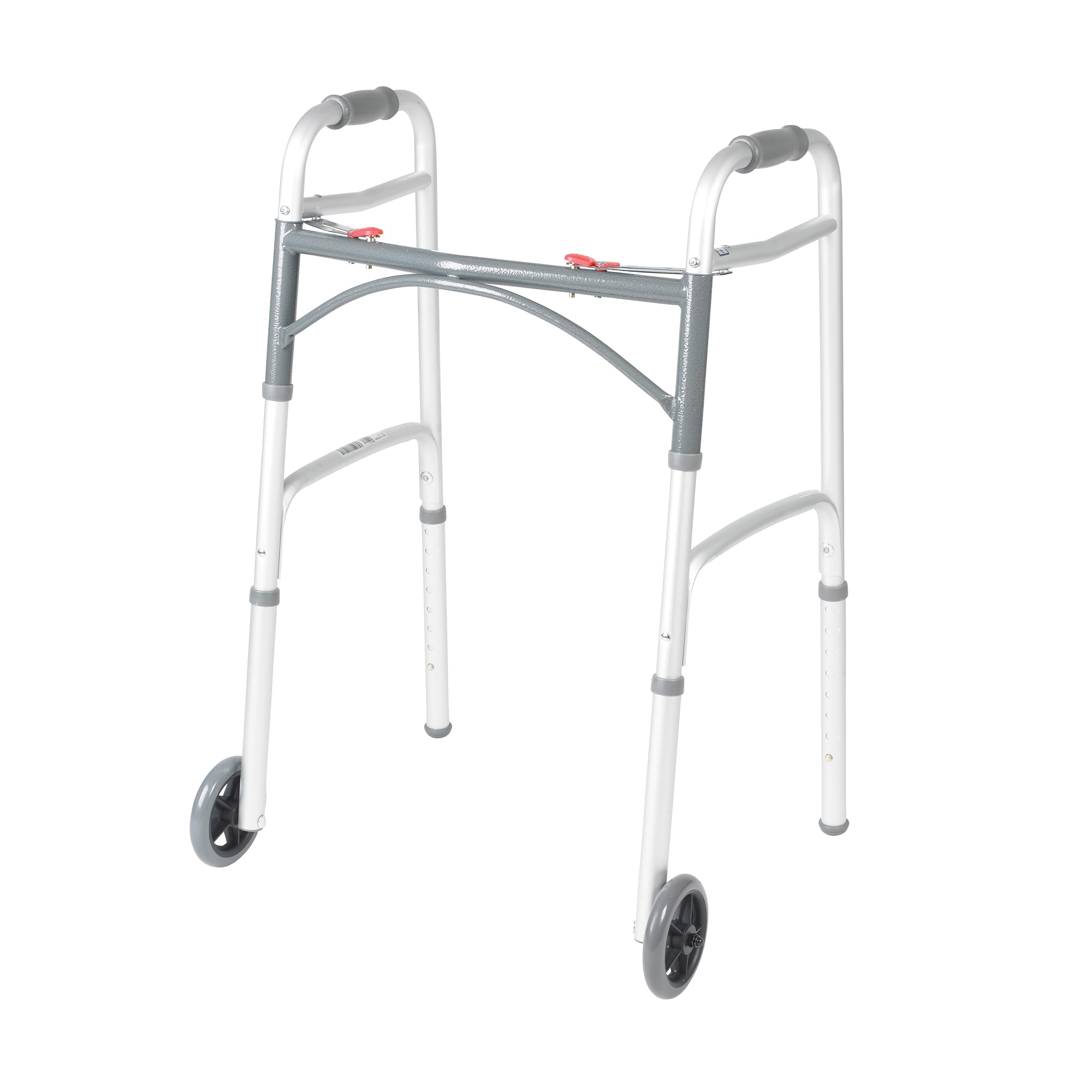
This is the least expensive walker here, and it's also the one we recommend most often for the weeks after surgery. The frame is aluminum, weighs 7.5 pounds, and carries up to 350 pounds, so it's light enough to move between rooms with one hand and strong enough for a big adult to lean on. Five-inch wheels roll at the front, and glide caps at the back let the rear legs slide over carpet and tile rather than being lifted with every step.

The two push buttons at the top collapse it to about four inches deep, thin enough to stand behind a door or slide into a back seat, and the handles adjust through a wide range so two people of different heights can share it. Setup is a few minutes of unfolding, with the handle height set by hand.

What it doesn't do is just as clear. There's no seat when the walk gets long and no brake lever when the driveway slopes, so it's a walker for the distance between two rooms and the flat route to the mailbox rather than a rest stop two blocks from home. The rear glide caps also mean you push it more than you roll it, which is quiet and gentle on hardwood but a different feel from a four-wheeler.

Pros

  • Holds 350 pounds at only 7.5 pounds
  • Two buttons fold it to about four inches deep
  • Rear glide caps slide over carpet and tile

Cons

  • Five-inch wheels stop at gravel and broken pavement
Our verdict

The best value here: a 7.5-pound aluminum walker that holds 350 pounds and folds flat, for anyone whose walking is mostly indoors.

Check Latest Price
3

Best for Tall Users

VOCIC Z21 Rollator

93 /100
Trail Score Outstanding

Key details

Wheels
8 in, puncture-proof
Height Range
4 ft 11 in to 6 ft 3 in
Walker Weight
22 lb
Weight Capacity
350 lb
Check Price on Amazon

A six-foot-three user on a standard rollator spends the day stooped over the grips. The Z21 is built for both ends of that range: the handles adjust for users from 4 feet 11 inches to 6 feet 3 inches, and the seat drops on its own adjustment, so long legs and short legs each get a frame that meets them where they stand.

Height isn't the only thing that adjusts. The seat carries 1.6 inches of padding shaped to take pressure off the hips, the brake handles have three modes — free rolling, drag for a slope, and a full lock for sitting down — and the storage bag clips onto the handlebars and lifts off when you don't want it. Eight-inch puncture-proof tires are the right middle ground for a driveway, a lawn, and a strip of pavement.

Where it loses us is the lift. At about 22 pounds it's the heaviest walker here, and the same mass that makes it feel planted makes it a chore to get into a car. If it lives on the ground floor and comes out for a daily walk, that's a fair trade for the height range. If it has to travel twice a day, the HOMLAND gives you a wide seat at 20.4 pounds, and the Drive folding walker is lighter still.

Pros

  • Handles fit users from about 4 feet 11 inches to 6 feet 3
  • Seat height adjusts separately from the handles
  • Eight-inch puncture-proof tires for pavement and lawns
  • Three brake modes including a full lock

Cons

  • About 22 pounds, the heaviest walker here
Our verdict

If the person using it is well over six feet or well under five, this is the rollator that will actually fit — the handles and the seat both adjust.

Check Latest Price
4

Best Wide Seat

HOMLAND Foldable Rollator

93 /100
Trail Score Outstanding

Key details

Brakes
Three modes with lock
Wheels
8 in, puncture-proof
Seat Size
16 x 12 in
Walker Weight
20.4 lb
Check Price on Amazon

Most rollator seats are narrow and firm, and the 12-inch square on the Medline steel model is a fair example of the type. HOMLAND goes the other way: a 16-by-12-inch seat on a 22-inch frame, with 1.6 inches of cushion and a backrest behind it. For a heavier or broader user — or anyone whose hips complain after ten minutes — that's the difference between a rest and a wince.

The frame is built around that seat, and it shows. The load path is a triangle rather than a single crossbar, and the front supports are doubled, which is the bracing you want under a bigger person at rest. The pinch-proof hinge on the fold is a detail we appreciated: it collapses in seconds and won't take a finger with it. Eight-inch puncture-proof wheels, loop brakes with a locking position, and a 20.4-pound frame round out a very complete package.

One thing to check on arrival: spin both front wheels. A wheel that wobbles at the fork won't straighten out with a brake adjustment, so it's worth catching before the return window closes. Past that, this is the most comfortable place to sit in the roundup, and it folds small enough for a closet.

Pros

  • 16-by-12-inch cushioned seat with a backrest
  • Triangular bracing and doubled front supports
  • Pinch-proof hinge folds in seconds
  • Eight-inch puncture-proof wheels and locking brakes

Cons

  • 20.4 pounds is a two-hand lift into a trunk
Our verdict

Buy this one for the seat: 16 inches of cushion makes a rest stop feel like sitting down rather than perching on a ledge.

Check Latest Price
5

Best for Higher Weight

Medline Heavy-Duty Bariatric Walker

92 /100
Trail Score Outstanding

Key details

Grip Span
20.5 in
Handle Height
33.5 to 43.5 in
Walker Weight
11 lb
Weight Capacity
500 lb
Check Price on Amazon

Five hundred pounds is more than any other walker here will carry, and the frame is built accordingly: extra-wide, with 20.5 inches between the hand grips and side cross braces for stiffness. It still folds flat on two buttons, and at 11 pounds it's lighter than every rollator in this roundup.

The handles adjust from 33.5 to 43.5 inches, the tallest range here, so a six-foot-four user can stand upright instead of folding over the frame. Five-inch wheels roll at the front and glide caps sit at the back, which means it moves across tile and carpet with a push rather than a lift.

Two practical notes. Give the wheels a spin the day it arrives — a defective one out of the box is the failure worth catching while the return window is open. And measure your narrowest doorway before you order, because the extra-wide frame that carries 500 pounds is also the reason a 30-inch door feels snug.

For a user over 350 pounds, none of that outweighs the capacity. This is the one walker here we trust with the job, and the width is simply the price of it. Under 350 pounds, the Medline steel rollator carries 350 pounds in a narrower 16.5-pound frame that's easier to live with.

Pros

  • Rated to 500 pounds
  • 20.5-inch grip span for a wider stance
  • Handles adjust up to 43.5 inches
  • Folds flat at 11 pounds

Cons

  • Extra-wide frame is tight through 30-inch doors
Our verdict

Rated to 500 pounds with a wide span between the grips, this is the walker to choose when a standard frame feels like a risk.

Check Latest Price
6

Car Transport

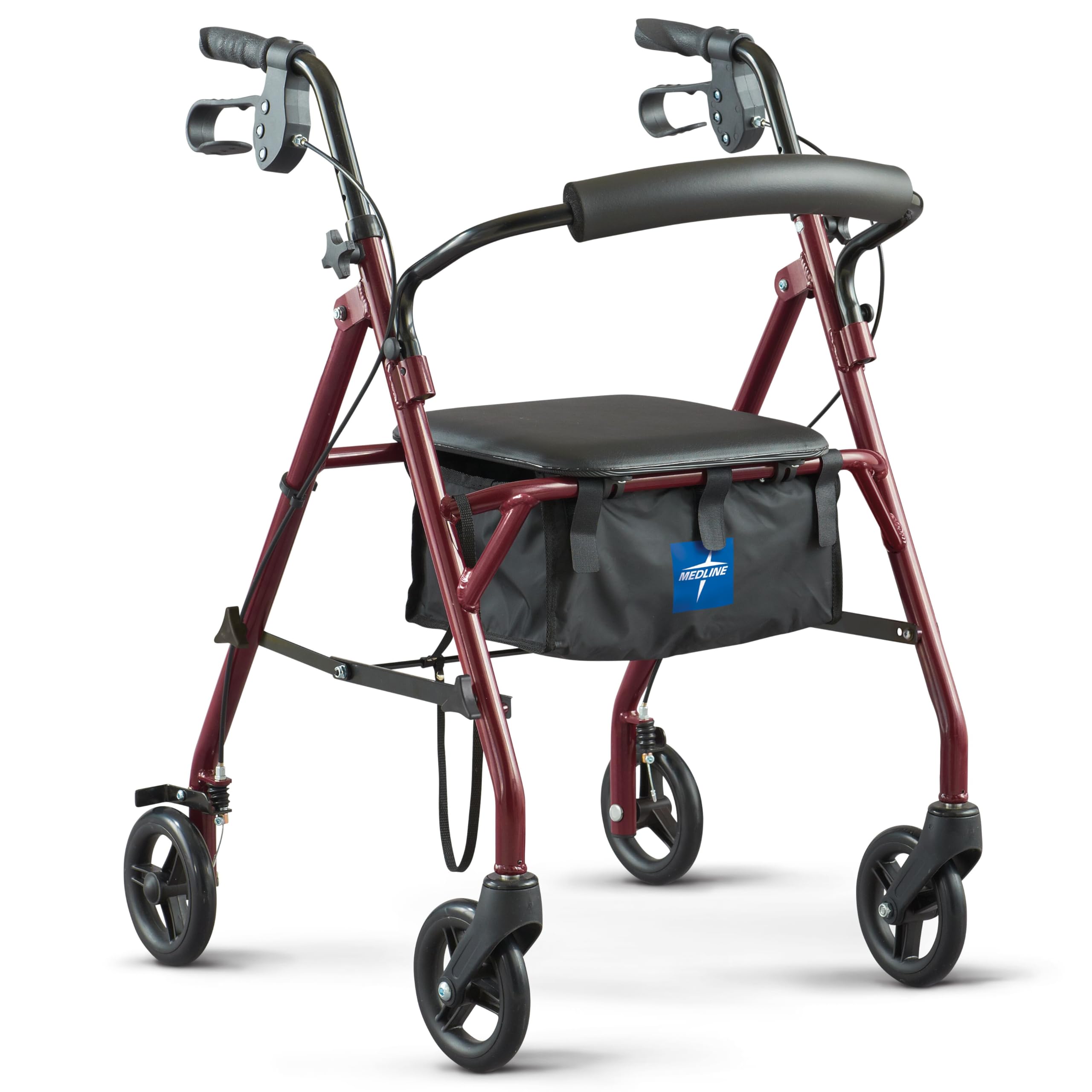
Medline Steel Rollator

91 /100
Trail Score Outstanding

Key details

Wheels
6 in
Seat Size
12 x 12 in
Walker Weight
16.5 lb
Weight Capacity
350 lb
Check Price on Amazon

Sixteen and a half pounds for a rollator rated to 350 pounds is the number that stands out. The two 350-pound rollators beside it here weigh about 20 and 22 pounds, and that gap is the one you feel every time you lift the frame into a trunk or up a step. The frame is steel, the seat is a 12-inch square with a backrest behind it, and the wheels are 6 inches.

Braking works differently on this one. You push up on the handle to slow the roll and push down to lock the wheels in place, and the grips are shaped for hands with a weak or painful grip rather than a full fist. Storage sits under the seat, and the frame folds down for a back seat or a closet.

Six-inch wheels are the compromise. They're fine on tile, carpet, and a smooth sidewalk, and less happy on gravel or a broken curb — that's where the VOCIC's eight-inch tires and the Nitro's ten-inch casters come in. What you get in exchange is the least you can spend for 350 pounds of capacity in a rollator, in a package one person can handle alone.

Pros

  • 350-pound capacity in a 16.5-pound frame
  • Push-up-to-brake, push-down-to-lock handles
  • 12-inch padded seat with backrest

Cons

  • Six-inch wheels suit smooth ground best
Our verdict

The lightest way to get a 350-pound rollator: 16.5 pounds, a padded seat, and brake handles that work with a weak grip.

Check Latest Price
7

Tight Spaces

Vive 3-Wheel Walker

91 /100
Trail Score Outstanding

Key details

Frame
Three-wheel, folds flat
Handles
Adjust to 38 in
Storage
Removable bag
Walker Weight
11 lb
Check Price on Amazon

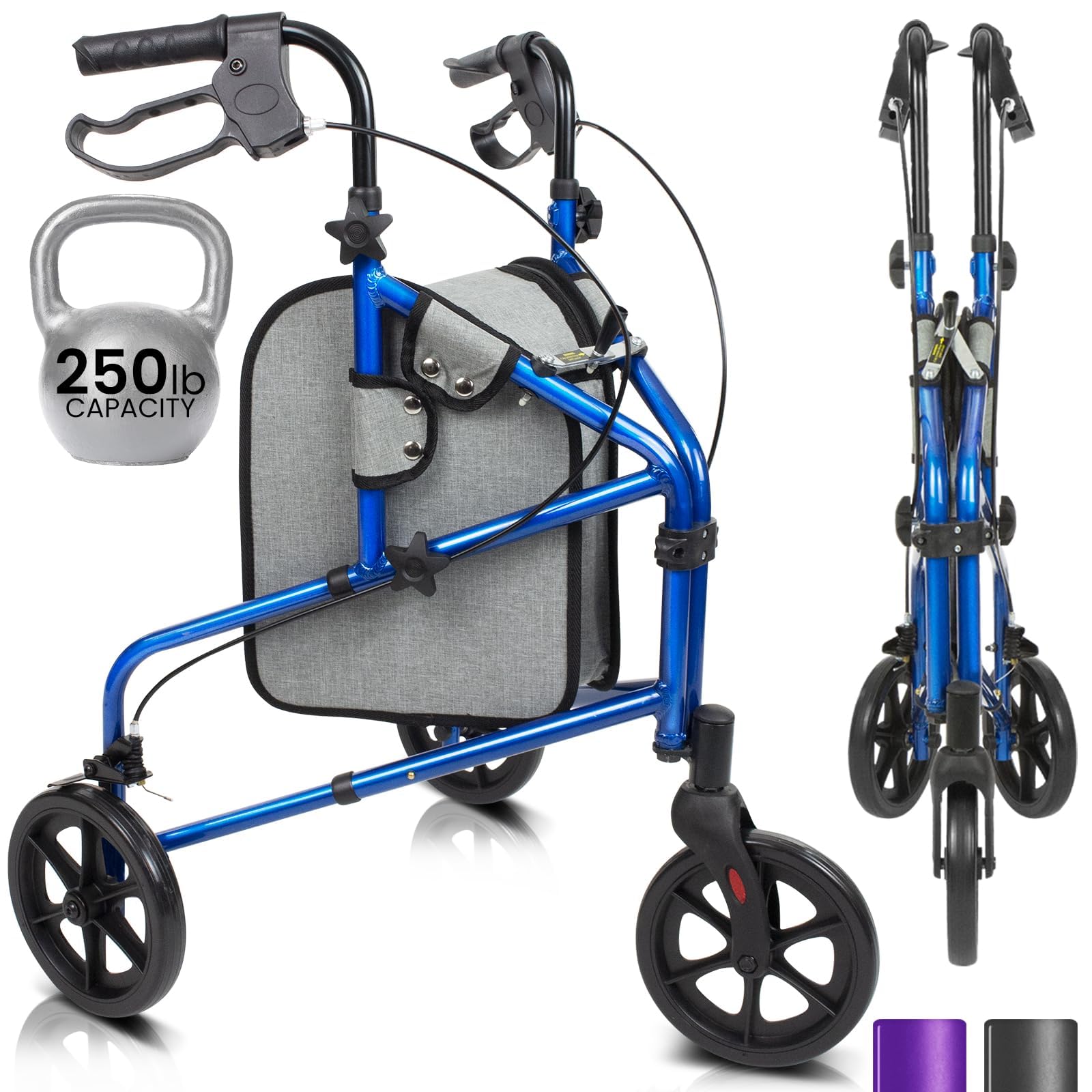
Three wheels is a trade, and the Vive makes it honestly. You give up the fourth point of contact and the seat; in return you get a frame that turns inside a hallway, folds flat, and weighs 11 pounds — light enough to lift into a back seat with one hand. For getting from a parked car into a doctor's office, that trade is worth making, and it's the easiest of these to live with in a small apartment.

It's a simple device, well made for what it is: three pieces snap together out of the box, the handles rise to about 38 inches, and a removable gray bag carries a purse or a folder. Folded, it stands behind a car seat, which is the point — this is a walker you keep by the door in a home where floor space is already spoken for.

Where it stops being right is anywhere the ground isn't level. Three wheels tip more readily than four, particularly on a lawn, a curb, or a sloped driveway, and if you lean your weight on the handles to get up out of a chair, this isn't the walker for that. It also costs more than several four-wheel rollators here, which is worth knowing before you assume the simpler design is the cheaper one.

Pros

  • 11 pounds and folds flat for a back seat
  • Turns in spaces a four-wheel rollator can't
  • Handles rise to about 38 inches
  • Removable bag and a lifetime guarantee

Cons

  • Three wheels tip more readily on uneven ground
  • No seat for a rest stop
Our verdict

The easiest walker here to live with in a small apartment or a small car — as long as the ground under it is flat and firm.

Check Latest Price

How We Tested Walkers With Wheels

We started by reading through hundreds of customer reviews and spec sheets, narrowing the field to walkers with four wheels, hand brakes, and a seat, then filtering out models that were too wide for a standard doorway or too heavy for one person to lift into a trunk. Twelve models made the cut.

Each one arrived in a box, and I assembled them solo in my garage, timing how long it took and noting whether the instructions matched the hardware. Then I folded and unfolded each walker at least a dozen times—one-handed where possible—checking whether the latch clicked shut and whether the folded package slid into the back of a compact car without wrestling.

Over six months, I used them on my driveway, on cracked sidewalks, through grocery aisles, in a crowded doctor's office, and along a park path. I leaned on the handles to see if the frame flexed, pushed them over thresholds and onto carpet, and tested the brakes on a slight incline. I also lifted each one into a car trunk and carried it up a short flight of steps.

At the end of six months, I checked the wheels for flat spots, the brake cables for slack, the seat fabric for wear, and the frame joints for wobble. The walkers that held up shared a few traits: a wide base, a sturdy frame, and a folding mechanism that still felt tight after months of daily use.

How to Choose a Walker with Wheels

Two Wheels or Four

Two front wheels with glide caps at the back make the lightest, least expensive walker: it folds flat, slides across carpet, and costs a fraction of a rollator. What it does not give you is a brake or a seat, so it suits moving between rooms and along a smooth path rather than a long outing.

Four wheels bring hand brakes and usually a seat, which is what you want once the walk goes past the mailbox. The trade is weight and money — the four-wheel picks here run 16.5 to 22 pounds against 7.5 pounds for the basic folding walker.

Wheel Size Sets the Route

Five- and six-inch wheels handle thresholds, carpet, tile, and smooth pavement, and that is about the limit: gravel, tree roots, and heaved concrete stop them cold. Eight inches is the useful middle ground for a driveway, a lawn, and a strip of sidewalk, and 10 inches is what takes a curb without a lift.

Walk your usual route and look at the ground before you decide. If there is a curb or a cracked slab on it, pay for the bigger wheels — that is exactly what the Drive Nitro's 10-inch front casters buy you.

Capacity Is Not the Same as Weight

Shoppers mix up two numbers. Capacity is what the frame carries, and the picks here run from 300 to 500 pounds; you want headroom above your own weight, especially if the walker is also taking your hand and a bag of groceries. The second number is the walker's own weight: 7.5 pounds is a one-hand lift, 22 pounds is a two-hand job.

If the walker travels in a car, choose the lightest frame that meets your capacity. The Medline steel rollator is the clearest example here at 350 pounds of capacity in a 16.5-pound frame.

Seats, Backrests, and Brakes

A rollator seat is a rest stop, not a chair. Lock the brakes before you sit, and never be pushed along while seated. Beyond that, size matters more than most shoppers expect: a 12-inch square is a perch, while a 16-by-12-inch cushioned seat with a backrest is somewhere you can actually recover.

If you plan to sit for more than a minute at a stretch, put cushion thickness and backrest height ahead of storage pockets and frame color.

Fit at the Handles

Handles should land at the crease of your wrist when you stand with your arms at your sides. Higher and you will hike your shoulders; lower and you will stoop. Check the published range against that measurement — the widest span here reaches from 33.5 to 43.5 inches, and tall users need the top of it.

Grip span matters too. A wider span, like the 20.5 inches on the Medline heavy-duty, gives broad shoulders room for a natural stride, while a narrower frame is easier to steer in a small kitchen.

Frequently Asked Questions

Final Verdict

The Drive Nitro Euro-Style is the walker we point most people to, because it doesn't make you choose between the hallway and the sidewalk: 10-inch casters, a one-hand fold, and a seat for the walk home.

If your walking is indoors, or you're buying for the weeks after surgery, the Drive two-button folding walker does that job at 7.5 pounds for a fraction of the money. And if capacity is the deciding number, the Medline heavy-duty is the only walker here rated to 500 pounds.