Best Countertop Water Filters of 2026

Tap water is one of those things you don't think about until you pour a glass and catch a whiff of chlorine — or a faint metallic aftertaste no amount of ice can hide. A countertop water filter is the simplest fix I've found: it sits next to your sink, hooks up to the faucet in minutes, and gives you filtered water without a plumber or an under-sink installation. The catch is that not every model earns its counter space — some dribble so slowly you give up waiting, some leak at the connection, and some cartridges quit early enough to make a bargain unit expensive.

I've lived with countertop filters for years, and over the past nine months my team and I put 11 of them through daily use — filling kettles, washing vegetables, making coffee, and drinking glass after glass. What separated the good ones wasn't a single spec; it was how they handled the everyday stuff: taste, speed, capacity, and whether they still felt solid after months of constant use. The picks below are the ones I'd actually keep on my counter.

1

Best Overall

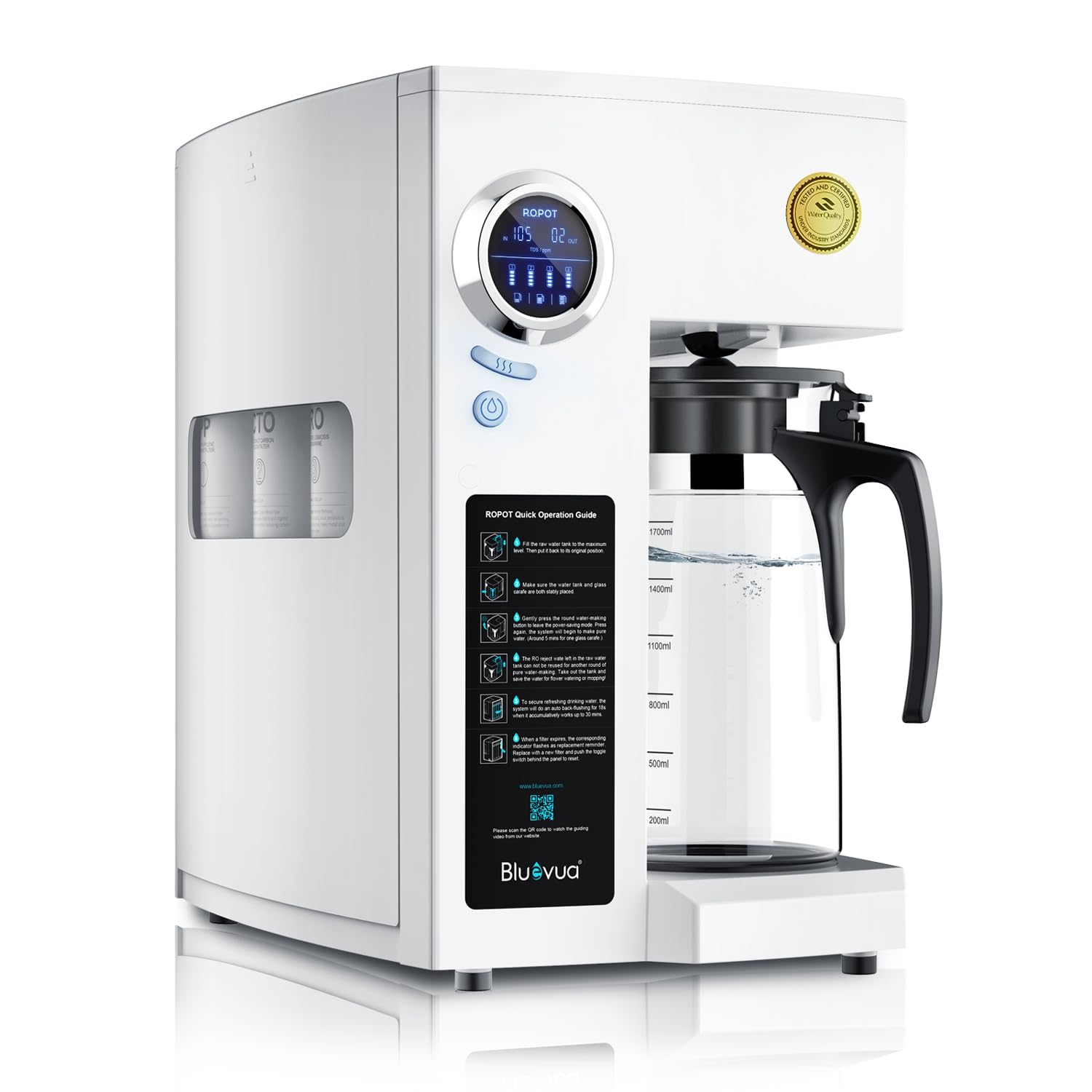
Bluevua RO100ROPOT

92 /100
Trail Score Outstanding

Key details

Setup
Plug-in, no plumbing
Footprint
10.9 x 15.4 x 14.3 in
Filtration
5-stage RO with remineralization
Filter Life
12 to 24 months
Check Price on Amazon

A countertop reverse-osmosis unit sounds like it should need a plumber. This one doesn't: it sits on the counter, plugs into an outlet, and fills the glass carafe that comes with it. Five stages, including a remineralization filter at the end, and a display that tracks how much life the filters have left.

Of everything here, this is the one we recommend when the goal is genuinely cleaner water rather than just better-tasting water. Carbon pitchers handle chlorine and a few metals; RO takes out the dissolved material they can't reach, and Bluevua adds minerals back at the end so the result doesn't taste flat and empty the way stripped water can. We also like that the filters are rated for 12 to 24 months — the longest interval in this group by a wide margin, against two months for a standard carbon pitcher.

The compromises are real but narrow. It's a batch machine: 0.26 liters a minute means you fill the carafe and wait a few minutes rather than holding a bottle under a tap. It needs an outlet, and it produces reject water that has to go somewhere — we run ours into a jug and use it on houseplants rather than watching it disappear down the drain. None of that bothers a household that fills a carafe in the morning and another at dinner.

What settled it for us is the combination: the deepest filtration on this list, no plumbing, and a filter change you do roughly once a year. The borosilicate carafe is a nicer touch than it sounds, too — no plastic pitcher to scratch and cloud over after a few months of daily use.

Pros

  • Five-stage RO with a remineralization stage
  • No plumbing
  • Filters rated for 12 to 24 months
  • Glass carafe instead of plastic

Cons

  • Needs an outlet and about 15 inches of depth
  • Produces reject water you empty by hand
Our verdict

We recommend this to anyone who wants genuinely purified water without a plumber — five stages, a remineralizing finish, and filters that last a year or more.

Check Latest Price
2

Best Gravity Filter

Big Berkey 2.25 Gal

91 /100
Trail Score Outstanding

Key details

Body
Polished 304 stainless steel
Capacity
2.25 gallons
Footprint
8.5 x 8.5 x 19.25 in
Filtration
Gravity, two Black Berkey elements
Check Price on Amazon

Two and a quarter gallons of filtered water, no cord, no plumbing, and nothing to install — that combination is why we keep recommending the Big Berkey to households that don't want another appliance humming on the counter. It's a polished stainless tower, 19¼ inches tall, and it earns that footprint.

You fill the upper chamber and gravity does the rest, dripping through two Black Berkey elements at about 0.03 gallons a minute. In practice that means filling it before bed and having water ready at breakfast; it isn't a machine you top up mid-glass. Budget about an hour for the first assembly and priming, because that step is fiddlier than the rest of the process put together.

The running cost sits in the elements rather than in the water, and that's the number to think about before you commit. The spigot deserves care at assembly — seat the washer squarely, since a drip at that joint is the usual trouble spot. One more practical note that catches people out: this one can't ship to California or Iowa, so check before you order.

Pros

  • 2.25 gallons without power or plumbing
  • Polished 304 stainless steel chambers
  • Two Black Berkey elements included

Cons

  • Tall: 19¼ inches plus room to lift the lid
  • Slow gravity flow means planning ahead
Our verdict

For gallons on hand with no cord in sight, this is our pick for a big household — just measure the height before it lands on your counter.

Check Latest Price
3

Best Budget

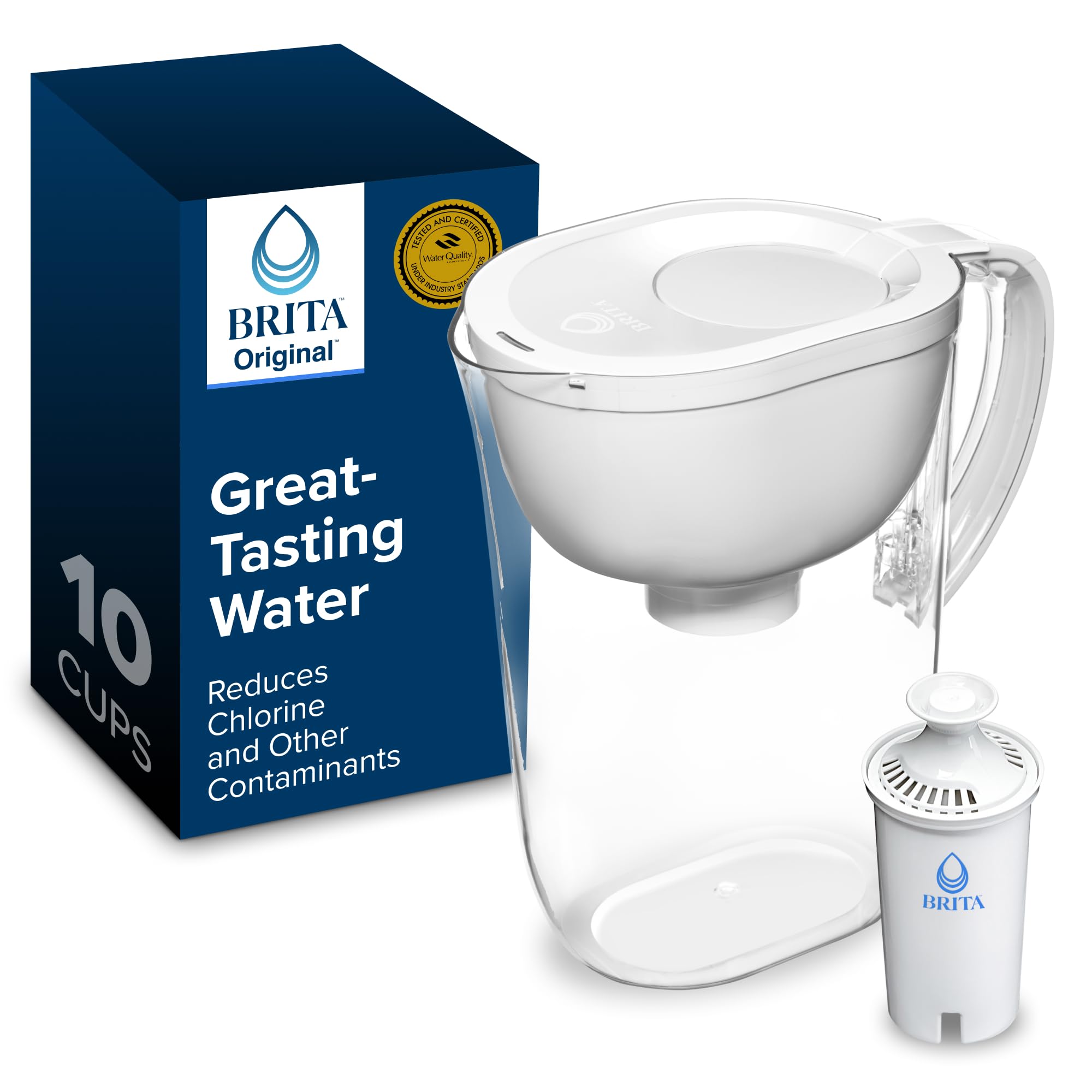
Brita 10-Cup Pitcher

93 /100
Trail Score Outstanding

Key details

Capacity
10 cups
Footprint
10.7 x 5.4 x 10.1 in
Filtration
Carbon; chlorine, copper, mercury, cadmium
Filter Life
2 months or 40 gallons
Check Price on Amazon

The handle is the part to think about. It's molded into the body rather than bolted on, so when one of these pitchers cracks — and the handle and the base seam are where it happens — the whole thing retires, filter and all. That's the trade for a pitcher this light and this inexpensive, and it's the one weak point in an otherwise simple design.

What you get for it: ten cups total, a filter rated for two months or 40 gallons, and certification for chlorine taste and odor plus copper, mercury, zinc, and cadmium. The lid locks for pouring, the body is BPA-free, and at 5.4 inches wide it slides onto a fridge shelf without a fight.

We still think it's the right first filter for one or two people who mainly want the chlorine edge off their tap water. Standard filters are sold in multipacks almost everywhere, so you're never hunting for one, and nothing about the pitcher needs explaining. Just mark the calendar — the rating is 40 gallons or two months, whichever comes first, and a light drinker hits the date long before the volume.

Pros

  • Certified for chlorine, copper, mercury, cadmium
  • Slim 5.4-inch body fits a fridge shelf
  • Standard filters are cheap and widely sold
  • Locking lid makes pouring one-handed

Cons

  • Handle and base seam crack with age
Our verdict

The pitcher we point to when you just want better-tasting tap water for one or two people, without buying an appliance.

Check Latest Price
4

Best Fridge Dispenser

Waterdrop 40-Cup Dispenser

89 /100
Trail Score Excellent

Key details

Capacity
40 cups, 21 in the body
Footprint
8.5 x 12.4 x 8.7 in
Filtration
Carbon fiber, NSF 42 and 372
Filter Life
Up to 200 gallons
Check Price on Amazon

If your household empties a ten-cup pitcher before lunch, the arithmetic of refilling is what you're really shopping around. Waterdrop's answer is a 40-cup dispenser — 21 of those cups in the body, the rest in the upper reservoir — that measures just 8.5 by 12.4 by 8.7 inches.

We like this one for the size-to-footprint ratio: it holds a family's day of drinking water and still leaves shelf room, which is why it's the dispenser we suggest before the bulkier alternatives. The pull-down spout fills a glass or a bottle without lifting the whole thing, and the carbon fiber cartridge is NSF 42 and 372 certified and rated for up to 200 gallons.

Two things to know. It does not lower TDS, and that's stated plainly up front — hard water, mineral scale, and whatever a TDS pen reads are outside this filter's job. And as the cartridge loads up, flow slows; when refills start crawling, that's your cue to change it rather than a fault to chase. Neither matters much if you're on treated municipal water and simply want the chlorine and sediment out, which is exactly the buyer this one is built for.

Pros

  • 40-cup capacity, 21 cups in the body
  • Narrow 8.5-inch depth fits a fridge shelf
  • Filter rated for up to 200 gallons
  • NSF 42 and 372 certified carbon fiber

Cons

  • Does not reduce TDS or hardness
  • Flow slows as the cartridge loads
Our verdict

The dispenser we hand a busy family: 40 cups, a fridge-friendly footprint, and a filter rated for 200 gallons.

Check Latest Price
5

Best Compact RO

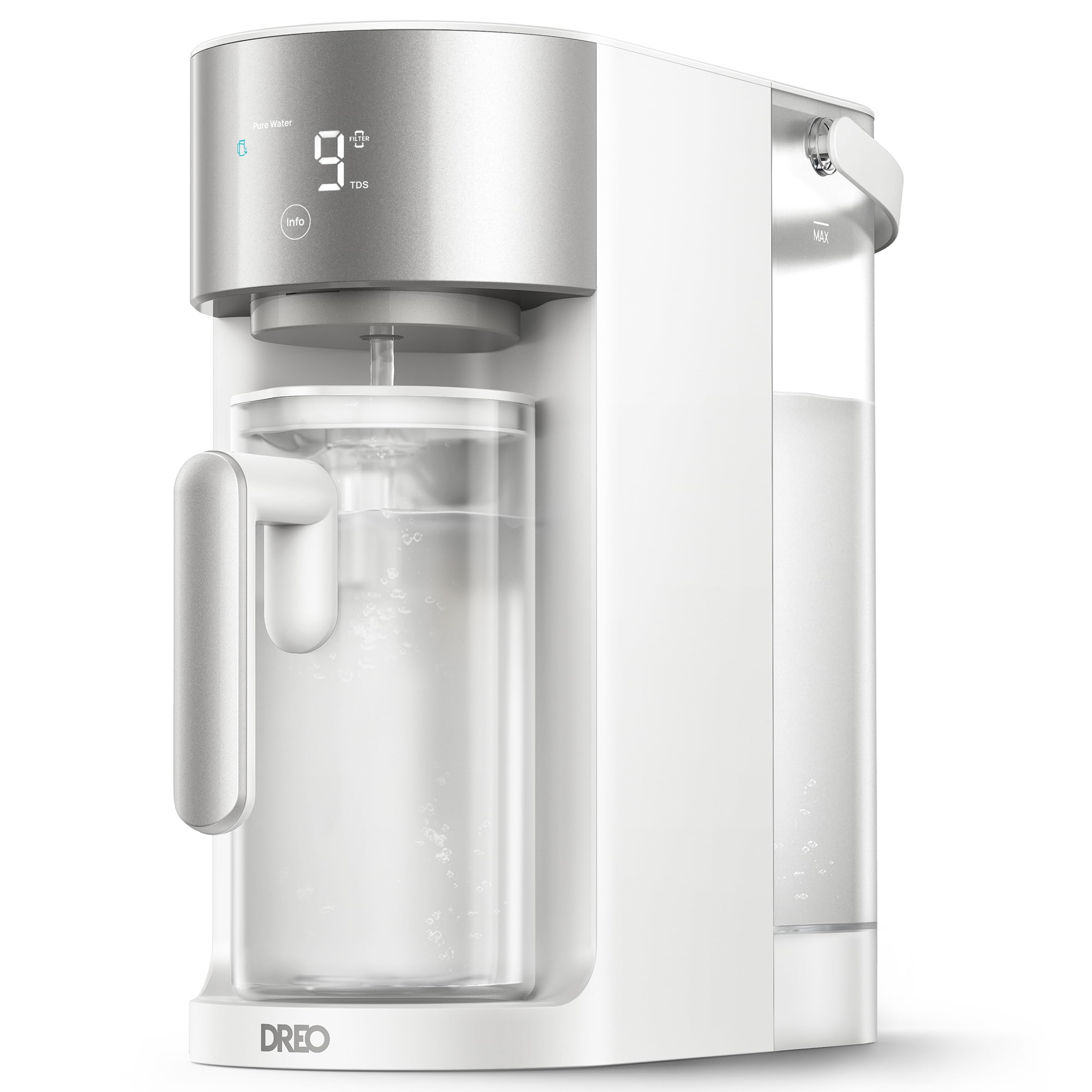
DREO RO Water Filter 112

87 /100
Trail Score Excellent

Key details

Capacity
3 liters
Footprint
14.5 x 6.7 x 13.4 in
Filtration
7-stage RO, 0.0001 micron
Monitoring
Real-time TDS display
Check Price on Amazon

This is the cheaper way into reverse osmosis on this list, and for a small kitchen it's the one we point to. Six and three-quarter inches of width, a three-liter pitcher, and real RO filtration — DREO takes the RO idea and shrinks it to fit a counter that has no room for a full-size unit.

Seven stages, a 0.0001-micron membrane, and a 3:1 pure-to-drain ratio, so a good share of what goes in comes out as drinking water rather than down the drain. The bit we appreciated most is the display: it reads incoming and outgoing TDS in real time, so you watch the number drop from your tap to the glass instead of taking the filtration on faith. The sensor refills the pitcher for you and stops when it's full.

The three-liter pitcher is the catch. A couple will empty and refill it comfortably; a family of five will spend a lot of time watching it fill. It's also rated to a 500 ppm maximum input TDS, so on very hard or mineral-heavy water, check that figure before you buy. What you get in return is the water quality of a bigger RO machine in a fraction of the width.

Pros

  • Real-time TDS readout, in and out
  • 3:1 pure-to-drain ratio
  • Auto-fill sensor and self-cleaning
  • Slim 6.7-inch width

Cons

  • Three-liter pitcher runs dry fast for a family
  • Rated to 500 ppm input TDS
Our verdict

A slim, quiet RO unit that fits a small kitchen — you give up capacity, not water quality.

Check Latest Price
6

Well Water, Lead

ZeroWater 23-Cup Dispenser

88 /100
Trail Score Excellent

Key details

Capacity
23 cups (5.4 L)
Included
TDS meter
Filtration
5-stage ion exchange
Certification
IAPMO: PFOA/PFOS, lead, mercury
Check Price on Amazon

A TDS meter comes in the box, and that little reader is the reason to consider this dispenser over the others. You test your tap water, test what comes out the other side, and know exactly when the filter is done instead of guessing from a calendar on the fridge door.

It's the most aggressive filter here that doesn't need a power cord. Five stages of ion exchange pull out virtually all dissolved solids, and the cartridge is IAPMO certified to reduce PFOA/PFOS, lead, chromium, and mercury — the list that matters if you're on a private well or in an older house with lead service lines. The 23-cup body means you're not refilling it every few hours.

Our view: if dissolved contaminants are why you're shopping, this is the one to get. The cost shows up later. On hard water these cartridges can be spent in a couple of weeks, which makes a cheap dispenser expensive to run, and because the filtration takes the minerals out along with everything else, the water tastes flat until you put them back — mineral drops fix it, but that's one more thing on the shopping list.

Pros

  • Included TDS meter shows before and after
  • IAPMO certified for lead, PFOA/PFOS, mercury
  • Removes virtually all dissolved solids
  • 23-cup body needs fewer refills

Cons

  • Cartridges can be spent in weeks on hard water
  • Lid and spout are the fragile parts
Our verdict

If lead, PFAS, or well water is what sent you shopping, this is the filter to get — and the included meter proves it's working.

Check Latest Price
7

Budget Gravity

Purewell 3-Stage Gravity

88 /100
Trail Score Excellent

Key details

Body
304 stainless steel
Capacity
2.25 gallons
Filtration
3-stage, 0.01 micron ultrafiltration
Filter Rating
3,000 gallons per element
Check Price on Amazon

Same shape, same idea, much less money: the Purewell is a two-chamber stainless gravity filter in the Berkey mold, and it's the one we suggest to anyone who likes the look of that setup but not the outlay.

Three stages instead of two — carbon for chlorine and taste, silver ion in the mix, and a 0.01-micron hollow-fiber membrane that acts as a physical barrier rather than just adsorbing. Add NSF/ANSI 42 and 372 certification, a 2.25-gallon capacity, and two elements rated at 3,000 gallons each, and assembly that takes about twenty minutes. It comes with a stand of its own.

Gravity is gravity, and this one is slow — you fill it the night before, not mid-meal. The spigot is the weak point; a drip there is the thing to watch, and seating the valve properly on day one saves you a wet counter later. The steel body itself is solid, while the elements are the delicate part, so handle them gently when you swap them.

Where it lands for us: a good gravity filter for a household that wants chlorine, sediment, and fine particulates out without electricity, in a footprint that fits a counter corner. It won't have the Berkey's following, and the two aren't identical inside, but it does the same job in the same shape for a fraction of the cost.

Pros

  • 2.25-gallon stainless gravity body
  • 3,000 gallons per element
  • NSF/ANSI 42 and 372 certified
  • Stand included

Cons

  • Slow gravity flow
  • Spigot drips are the weak point
Our verdict

The gravity filter we suggest when the Berkey is more than you want to spend — same format, same footprint, much less outlay.

Check Latest Price
8

Continuous Flow

iSpring CKC1C

92 /100
Trail Score Outstanding

Key details

Housing
Clear, see-through canister
Capacity
10,000 gallons
Connection
Faucet diverter valve
Filtration
5-micron carbon block
Check Price on Amazon

The housing is clear, which sounds like a gimmick until you've owned a filter you can't see into. You watch the cartridge darken, you know when it's spent, and you never unscrew the thing on a guess.

It's a countertop canister that connects to your kitchen faucet through a diverter valve — no drilling, no plumber, but a hose that clips onto the aerator. Inside is a 5-micron carbon block rated to pull 95 percent of chlorine along with sediment, rust, and odor, and the system is rated for 10,000 gallons.

Two things it isn't. It isn't standalone: while it's in use it owns the tap, so you're not filling a pot and rinsing vegetables at the same time. And it isn't universal — the adapters don't fit every faucet, and the diverter joint is where a drip shows up. Check your aerator thread before you order, and expect the cartridge to need a firm hand on the wrench at swap time. Neither point matters if the sink is the only place you want filtered water to come from.

What it does better than anything else here is volume. There's no reservoir to refill and no carafe to wait on — you turn the tap and filtered water comes out until you stop, which is why it suits anyone who cooks with their water as much as they drink it. Standard 10 by 2.5 inch cartridges keep replacements easy to find and cheap to change.

Pros

  • Clear housing shows when the cartridge is spent
  • Unlimited filtered water, no refilling
  • Standard 10 x 2.5-inch cartridges
  • 10,000-gallon system rating

Cons

  • Ties up the faucet while in use
  • Adapter fit varies by faucet
Our verdict

For filtered water on tap with nothing to refill, this is the one — provided your faucet takes the adapter.

Check Latest Price

How We Chose and Tested Countertop Water Filters

We started by pulling together every countertop filter we could find from brands with published filter certifications, clear replacement-cartridge availability, and a footprint that wouldn't swallow the sink. We ruled out models with vague filtration claims or cartridges that were impossible to reorder, then narrowed the list to 11 units across price points. Each one lived on a real kitchen counter for nine months — not a lab bench — and got used the way anyone actually uses one: filling the coffee maker, topping off pasta pots, rinsing fruit, and refilling water bottles for the fridge.

We hooked each filter to a standard kitchen faucet and timed how long it took to fill a quart jar, then a gallon, noting whether the flow slowed as the cartridge aged. Capacity got checked in real terms: how many glasses we could pour before refilling the reservoir, and whether the unit fit under a cabinet without blocking the faucet's swing. For leaks, we ran the diverter valve through dozens of on-off cycles and kept a dry paper towel under the base; any damp spot got logged. Ease of use came down to cartridge swaps — whether we needed tools, whether the indicator reset cleanly, and how much counter space the whole thing claimed.

Taste was the part we argued about most. We compared filtered water against tap at room temperature and chilled, looking for chlorine, metallic notes, and aftertaste, then made coffee and tea with each to see if the difference survived brewing. We also tracked filter life against the manufacturer's gallon claims and calculated cost per gallon using replacement-cartridge prices, because a cheap unit with costly cartridges isn't a value. After nine months, we checked housings for cracks, valves for stiffness, and bases for wobble — the small durability signs that show up long after the honeymoon.

How to Choose a Countertop Water Filter

Start With What You Want Removed

Carbon, which covers the pitchers and most dispensers here, handles chlorine, taste, odor, and a handful of metals. Ion exchange goes further into dissolved solids, lead, and PFAS. Reverse osmosis takes out nearly everything and adds a power cord and reject water to the deal, while gravity systems do fine work with no electricity at a trickle.

If your complaint is a chlorine edge on municipal water, a carbon pitcher is genuinely enough. If you're on a well or worried about lead, you need RO or ion exchange — no amount of carbon gets you there, whatever the packaging implies.

Size Capacity to Your Refill Rhythm

Capacity is really a question about how often you're willing to stop and fill something. Ten cups suits one or two people who drink water with meals; 23 to 40 cups keeps a family in cold water without constant topping up; two and a quarter gallons of gravity-filtered water gives you a reserve you fill once a day.

A pitcher you refill three times before dinner is a worse purchase than a dispenser that costs a little more. Be honest about how much water leaves your kitchen in a day.

Measure the Spot Before You Buy

A dispenser needs shelf height and a spigot that clears the shelf above it. A gravity filter needs vertical room for a 19- or 20-inch tower, plus space to lift the lid and pour into the top chamber. A countertop RO needs depth and an outlet within reach of its cord.

Watch the word compact. In this category it usually means the unit fits a refrigerator shelf, not that it's small on a counter — the Waterdrop dispenser is narrow but still 12.4 inches across.

Expect the Spigot to Be the Weak Point

Valves, seals, and handles are where these products give trouble, not the filtration itself. Across the dispensers and gravity systems here, a dripping spigot is the recurring issue, and plastic bodies crack at the handle and the base seam.

Seat the valve squarely when you assemble the unit, don't fill above the spout line, and put it somewhere a stray drip won't ruin a shelf. On a stainless gravity system, tighten the spigot once and check it again after the first week.

Budget for Cartridges, Not the Box

The purchase is the small number. Carbon filters run about two months or 40 gallons, RO stages last a year or two, and ion-exchange cartridges can be spent in a couple of weeks if your water is hard.

Get a TDS reading of your tap water before you choose. It tells you which filters will exhaust early, and it turns a cheap machine into an expensive one faster than any sticker price does.

Frequently Asked Questions

Final Verdict

Two things decide this for us. If you want the cleanest water a countertop machine can make, and you have an outlet and about fifteen inches of depth to spare, the Bluevua RO100ROPOT is the recommendation — nothing else here filters as deeply or asks as little of you afterward, and the remineralizing stage keeps the result drinkable rather than clinical.

If a plug-in appliance isn't in the budget yet, the Brita 10-cup pitcher still does the job most people actually have: chlorine and a few metals out, for a small outlay and a filter you can buy anywhere. Buy the RO when water quality is the concern; buy the pitcher when taste is.