Best Treadmills of 2026

A treadmill is the rare piece of home gym equipment that earns its footprint — when it's the right one. The wrong one becomes the most expensive coat rack in the house, and fast: a deck that flexes underfoot, a belt that drifts sideways, a console that quits in month four. What you're actually buying is a machine that holds up 40 minutes into an interval session, doesn't rattle the floor joists, and goes together without calling in a favor.

I've run on treadmills in drafty garages and in living rooms where the TV volume had to go up two notches, and the gap between good and bad shows up around mile three. My team and I spent ten months with seven machines, assembling, folding, moving, and logging real miles on each. One thing first-time buyers miss: the belt and deck matter more than the top speed printed on the box, and weight cuts both ways — heavy means stable, but it's also why delivery day needs two people. Below, the picks run from compact walkers to full-size runners.

1

Best Overall

Horizon 7.4AT

80 /100
Trail Score Excellent

Key details

Motor
3.5 CHP
Warranty
Lifetime frame and motor
Running Surface
22 x 60 inches
Weight Capacity
350 lb
Check Price on Amazon

A 22-by-60-inch running surface paired with a 3.5 CHP motor is the combination that makes the 7.4AT the treadmill we point a real runner toward. Sixty inches is long enough to hold a stride at speed without hunting for the front of the deck, and the drive changes pace quickly enough that interval work does not turn into a negotiation with the console. The QuickDial controls are the detail we appreciate most: you scroll to the speed you want instead of stabbing a plus button.

Nothing here needs a subscription. The console pairs over Bluetooth with Peloton, Zwift, and other training apps, and the machine runs perfectly well with none of them, which is a relief next to treadmills that put their best features behind a monthly fee. The coverage is the other half of the argument: a lifetime warranty on the frame and motor, five years on parts, and two on labor, second here only to the 3G Cardio.

What it asks in return is floor space and patience. Assembled it measures 76 by 37 inches and weighs 318 pounds, so this is a corner that stays a corner; the folding frame is for pushing it aside for guests, not for putting it away every evening. Getting the console onto the rails is the awkward step of assembly, and the deck is a two-person lift.

Two things to check in the first week. Belt tracking is the common one, and alignment at the rear roller is a five-minute adjustment worth doing before the belt starts rubbing a side rail. If a fault code appears on the console, call it in early rather than living with it, since the warranty is what makes that a phone call instead of a loss.

Pros

  • 22 x 60-inch deck holds a full stride at speed
  • QuickDial controls make interval changes quick
  • Pairs with free apps; no subscription required
  • Lifetime frame and motor warranty

Cons

  • 318 pounds and 76 inches long, so it claims a permanent spot
Our verdict

We recommend the 7.4AT to anyone who intends to run indoors rather than walk: the deck and motor are the real thing, and the warranty covers the parts most likely to fail.

Check Latest Price
2

Best Gym-Style Machine

3G Cardio Elite Runner X

86 /100
Trail Score Excellent

Key details

Motor
4.0 HP
Warranty
Lifetime frame and motor (residential)
Running Surface
22 x 62 inches
Weight Capacity
400 lb
Check Price on Amazon

The Elite Runner X is built for the person who has already admitted the gym is not happening and wants the machine that would have been waiting there. The numbers read like club equipment: a 22-by-62-inch deck, a 4.0 HP motor, a 400-pound user rating, and a 7.5-inch step-up that keeps you clear of a normal ceiling.

That makes it the least compromised treadmill here and the least convenient. It does not fold, it is 84 inches long, and it weighs 366 pounds, so it is a room rather than a wall. Judged as gym equipment that happens to live at home, the money is defensible: lifetime coverage on the frame and drive motor, ten years on parts, and two on labor is the strongest warranty in this guide, and it is what gives a large purchase a horizon.

What we noticed on the heavier frame is that the deck does not shudder when you push the pace, which is the giveaway on a lighter machine, and the Ortho Flex suspension takes the sting out of longer runs. A 10.1-inch display and FTMS Bluetooth are there for training apps, though the one-touch speed and incline keys and the built-in programs mean you can ignore the screen entirely.

Assembly takes two people, and the box is awkward enough that where the delivery lands matters. Pick the room before you order, because once it is bolted together and sitting on its own weight, it is not moving for a while.

Pros

  • 22 x 62-inch deck and 4.0 HP motor for fast running
  • Lifetime frame and drive-motor warranty for home use
  • Heavy frame stays steady and soft on joints
  • 7.5-inch step-up leaves ceiling clearance

Cons

  • Non-folding, 84 inches long, and 366 pounds
Our verdict

The Elite Runner X is for the runner with a room to spare and no patience for a folding deck: the most treadmill here, and the least movable.

Check Latest Price
3

Best Budget

WELLFIT WFTM007

83 /100
Trail Score Excellent

Key details

Incline
0-15% automatic
Folded Size
31.89 x 28.35 x 43.7 inches
Running Surface
43.02 x 17 inches
Weight Capacity
400 lb
Check Price on Amazon

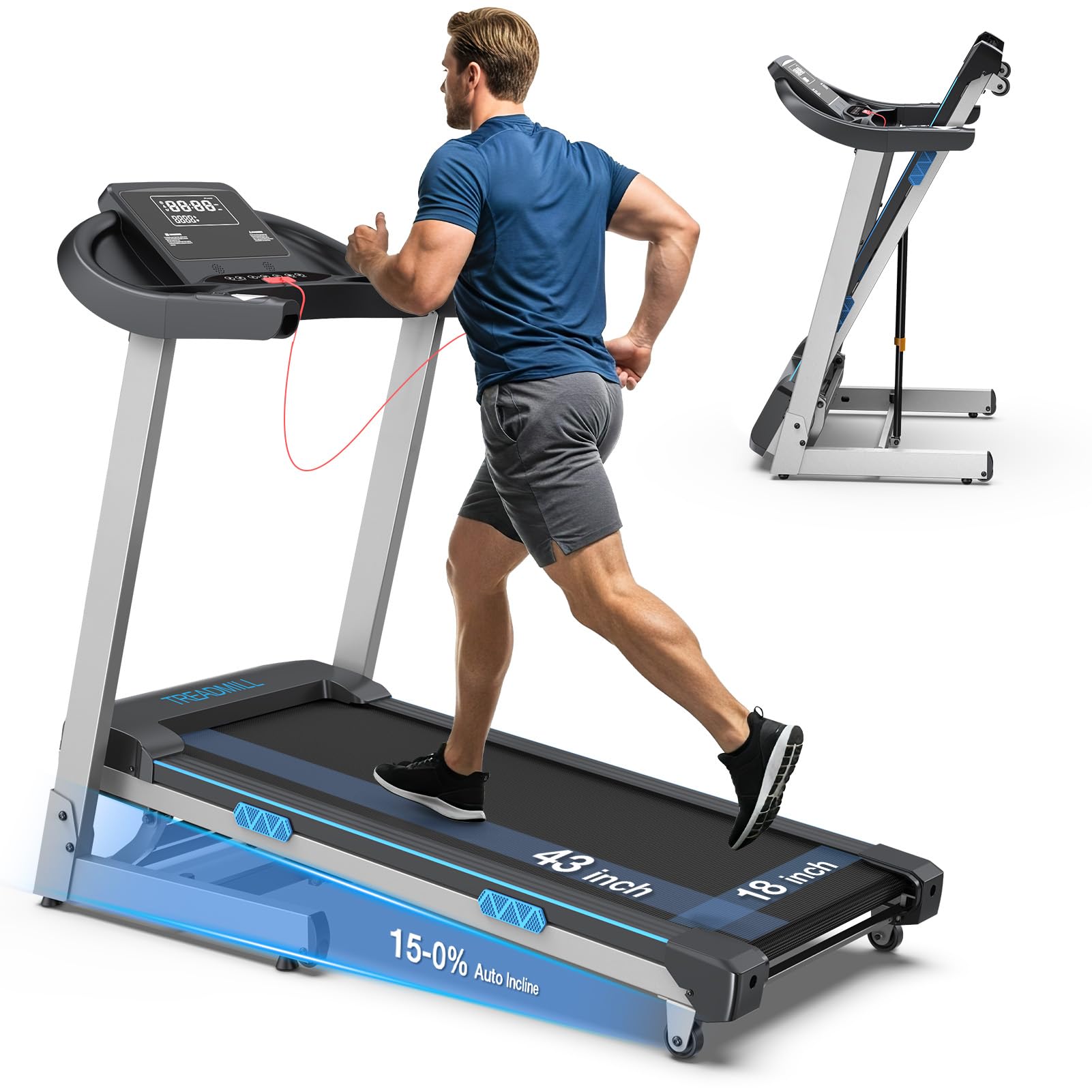
Folded, the WFTM007 takes up roughly 32 by 28 inches of floor, the kind of number that decides whether a treadmill can live in an apartment at all. Open, it gives you a 43-by-17-inch belt, a 4.0 HP motor, a 0-15% automatic incline, and a 400-pound user rating, which is a lot of machine for the least money in this guide.

We found the assembly is six screws and two wheels, so the unpacking takes longer than the build. The automatic incline is the feature that earns the recommendation: you change the grade from the console mid-walk instead of stepping off to move a manual ramp, and fifteen percent is enough to turn a flat walk into a climb. The console is deliberately plain, with LED readouts, heart-rate handles, forty programs, and Bluetooth for headphones or an app, and plain is the right call at this end of the market.

The 43-inch belt is where the savings show. It is generous for walking and a steady jog and cramped for anyone holding 8.8 mph with a long stride, so treat this as a walking and light-jogging machine that folds away afterward. If running is the point, the Horizon is the better spend; if it is daily steps with some hill work, this one does the job.

Pros

  • 0-15% automatic incline at the budget end
  • 400-pound rating, highest of the folding models here
  • Folds to about 31.89 x 28.35 x 43.7 inches
  • Six-screw assembly

Cons

  • Two-year warranty, well short of the lifetime ones here
Our verdict

The WFTM007 is the budget pick we point walkers toward: automatic incline, a 400-pound rating, and a folded footprint small enough for an apartment.

Check Latest Price
4

Best Folding Design

Sunny Premium Auto Incline

78 /100
Trail Score Very Good

Key details

Incline
0-12% automatic
Top Speed
8 miles per hour
Folded Size
40.25 x 28 x 54.75 inches
Running Surface
48.8 x 16.5 inches
Check Price on Amazon

The fold is where this Sunny earns its place: lift the deck and a hydraulic strut takes it down in a slow, controlled drop, so you are not wrestling 123 pounds of steel to the floor at the end of a session. Folded it is roughly 40 by 28 inches; open, the frame is 64 inches long and 28 wide, short enough to sit along a wall in a spare room.

We think it is the right shape for a household that walks and jogs and has to put the machine away afterward. The 0-12% automatic incline and four quick speed keys cover interval walking without a subscription, and the belt is 48.8 inches long, longer than the WELLFIT's, which gives a jogging stride somewhere to land.

Two limits shape who this suits. The belt is 16.5 inches wide, which is snug for a broad-shouldered runner, and a 2.0 HP motor with an 8 mph ceiling is built for walking and steady jogging rather than hard intervals. In a small room with a walking habit, neither matters much; in a training block for a fast 10K, both do.

Speed consistency is the thing to check first. The belt should hold a steady pace on the level, and one that visibly slows and catches every few seconds is a return rather than a quirk to live with, so test it at 4 mph in the first week before you settle into a routine.

Pros

  • Hydraulic soft-drop fold is controlled, not a drop
  • 48.8-inch belt is long for a compact folder
  • 0-12% automatic incline with quick speed keys

Cons

  • Parts coverage runs only 180 days
Our verdict

The Sunny is the folding treadmill we point to first: a controlled soft-drop fold, a 48.8-inch belt, and an 8 mph ceiling that suits walkers and joggers rather than racers.

Check Latest Price
5

Incline Walking

Cursor X5FD

85 /100
Trail Score Excellent

Key details

Incline
Up to 40%, five settings
Running Surface
38.6 x 15.4 inches
Weight Capacity
350 lb
Deck Height At Full Incline
15 inches
Check Price on Amazon

Forty percent is steeper than anything else in this guide, and it is the entire reason the X5FD exists. At full slope the deck rises 15 inches off the floor, and the 51-inch dual handrails are tall enough that walkers around six feet can stay upright instead of hunched over a console.

It is not a running machine, and it does not pretend to be. Top speed is 7.5 mph, the belt measures 38.6 by 15.4 inches, and the whole thing weighs 57 pounds and folds to roughly six inches deep, so it stands against a wall between sessions. The 350-pound user rating is generous for a machine this light.

We like it for what nothing else here does: a stair-simulation mode, a genuine 40% climb, and a footprint that fits a bedroom. It suits hiking training and steep walking better than it suits a workout that changes grade every ninety seconds, and at the budget end of this group it is a low-commitment way to find out whether incline walking is your thing.

Pros

  • 40% incline in five settings, steeper than any pick here
  • 51-inch handrails keep tall walkers upright
  • 57 pounds and folds to about six inches deep

Cons

  • Manual incline, so you set the grade before you start
  • One-year warranty is the shortest here
Our verdict

Buy the X5FD if your cardio is steep walking and your floor space is small: it climbs harder than anything else here and runs nothing like a gym treadmill.

Check Latest Price

How We Tested the Best Treadmills

We started by pulling the treadmills sold by major retailers and filtering on deck size, motor rating, weight capacity, folded footprint, and what the machine claimed to do for the money, then cut anything with a steady pattern of complaints about belt drift, wobbling frames, or dead consoles. That left seven machines, which we assembled ourselves and lived with for ten months — long enough for the novelty to wear off, which is exactly when a bad treadmill starts talking.

Assembly came first. We timed each build solo with a stopwatch, from box to first step, and noted where the instructions went vague or a second pair of hands was genuinely required. Then we measured the footprint unfolded and folded, pushed each machine through a standard doorway, and weighed it to see how honest the shipping specs were — and whether the transport wheels did anything useful on carpet.

The real work happened on the deck, during early-morning easy runs, weekend incline walks, and short intervals. We watched whether the belt drifted to one side, whether the frame shook as speed climbed, whether the deck gave underfoot or felt plank-stiff, and how quickly the incline responded when we changed it mid-run. Every few weeks we checked the belts for fraying, listened for new squeaks, and confirmed the console and controls still did what they promised on day one. And we kept asking whether the machine justified what it asked for, because a plain treadmill with a rock-solid frame beats a feature-stuffed one that flexes underfoot.

How to Choose a Home Treadmill

Start with the deck, because it decides what the machine is for

Deck length sets the ceiling on everything else. Sixty inches is the number that lets a full stride land at speed, which is why the Horizon and the Elite Runner X clear it; the 43 inches on the WELLFIT tells you it is a walker before you read another specification. Width works the same way: 20 to 22 inches suits running, 16 to 17 is a walking belt.

The trap is a big motor on a short deck. Horsepower sells the listing, but a 4.0 HP motor dragging a 43-inch belt still leaves a tall runner chopping their stride. If you are over six feet, start at 55 inches of length and go up from there.

Motor, speed, and the number that actually matters

Compare continuous-duty horsepower, not the peak figure. A 2.0 HP motor handles walking and light jogging, 3.0 to 3.5 CHP is where running gets comfortable, and the 4.0 HP motors on the WELLFIT and the Elite Runner X are there to hold pace under a heavier user. Top speed follows the same logic: 8 mph is a jogging ceiling, 10 to 12 mph is running, and you pay for the last two miles an hour whether you use them or not.

Automatic incline versus a manual ramp

An automatic incline changes grade from the console, so you can lift the deck mid-walk and let a training app drive the terrain. A manual incline is a set of fixed positions you choose before you start, and on a machine like the Cursor that means stopping to change it. At the budget end, automatic incline does more for a walk than a bigger screen or a longer program list.

Read the warranty by parts and labor, not by the frame

Every treadmill here promises a frame for years, and the frame is not what fails. Parts and labor are, and that is where these policies separate: the Elite Runner X covers parts for ten years and labor for two, the Horizon for five and two, and the folding models drop to 180 days or two years on parts. Ask what a belt, a control board, and a service call cost once that window closes, because those repairs decide whether a treadmill is worth fixing.

Floor space, weight, and what folding is really for

Add up the working footprint, not the folded one. The Horizon measures 76 by 37 inches assembled and weighs 318 pounds; the Elite Runner X runs 84 inches long and 366 pounds. Neither moves once it is down. Folding earns its keep on the lighter machines, and the Sunny's hydraulic drop makes putting the deck away a controlled one-handed job.

Check deck height at full incline too. The Cursor raises its deck 15 inches at a 40% grade, which matters under a sloped ceiling or a low basement joist.

Frequently Asked Questions

Final Verdict

The Horizon 7.4AT is the treadmill we recommend to most people who plan to run at home: a 60-inch deck, a 3.5 CHP motor, free app pairing, and the longest parts and labor coverage here after the 3G Cardio. It is heavy and it claims a corner of a room, and that is the honest price of a deck that does not flex under a stride.

If you have a spare room and want the machine a gym would have bought, the Elite Runner X is worth the step up. If your workout is walking with incline, the WELLFIT delivers it for the least money here and folds into a closet-sized footprint.