Best Under-Desk Treadmills of 2026

An under-desk treadmill sounds perfect until you picture the reality: a heavy slab that rattles the floor, drowns out your morning call, and ends up folded against the wall by February. The worry is fair — these are small motors doing a job usually reserved for gym equipment. What a good one buys you is quieter, simpler movement: a couple of miles logged during meetings instead of another hour in a chair.

Over the past eight months, my team and I have walked on six of them, under real desks and through real calls. The differences show up fast — how the belt tracks, how the motor sounds at 3 mph, and whether it still rolls out from under the sofa without a fight in month six. One thing I'd tell any first-time buyer: ignore the top speed. Almost nobody walks faster than 4 mph at a desk; what matters is whether the deck is long enough for your natural stride. The picks below are the ones we kept stepping back onto.

1

Best Overall

TRAILVIBER X01 Walking Pad

92 /100
Trail Score Outstanding

Key details

Incline
0-12% auto, 9 levels
Deck Size
41 x 16.5 in
Top Speed
4 mph
Weight Capacity
450 lb
Check Price on Amazon

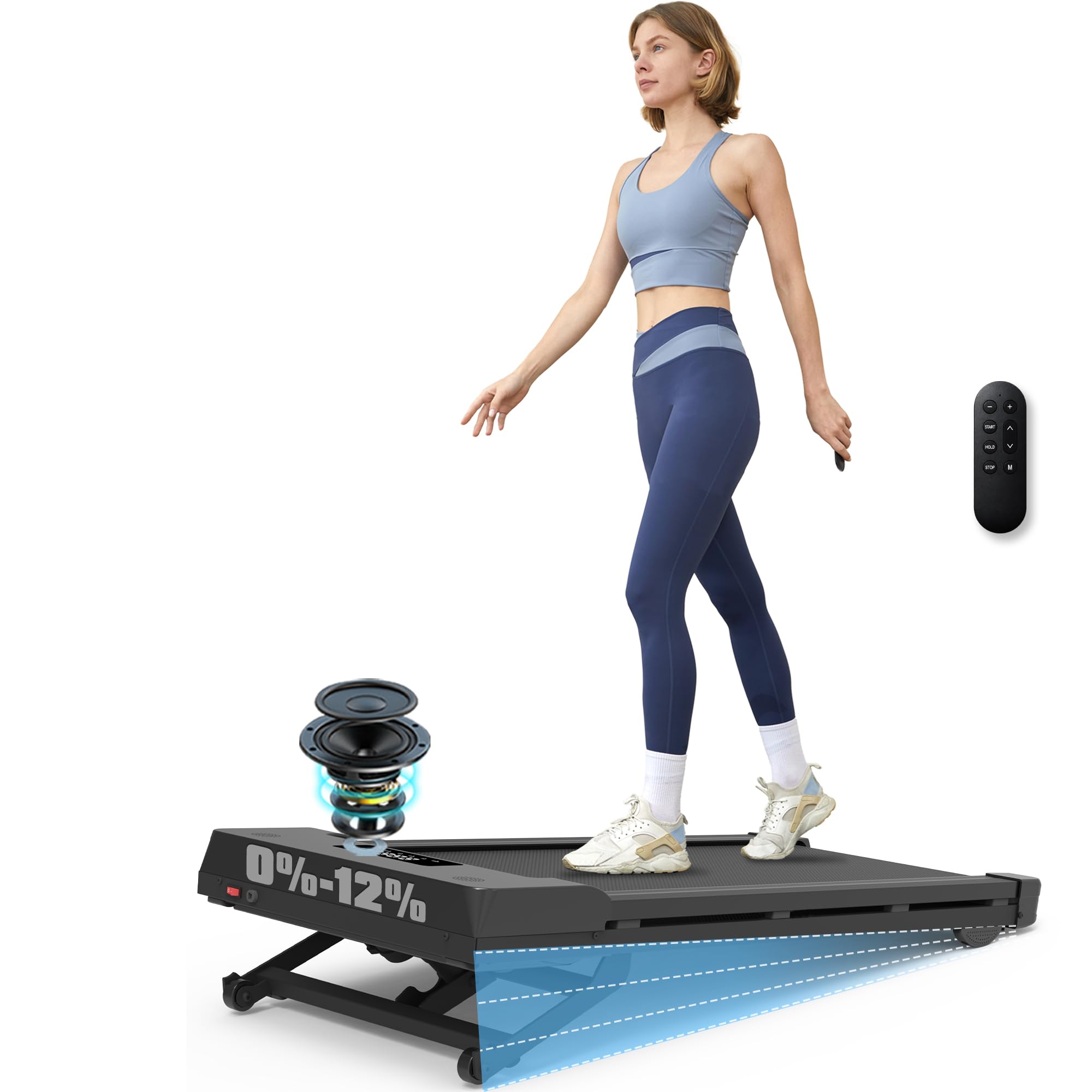
A 12% grade on a machine that lives under a desk sounds like a marketing line until you use it. The X01 changes incline from the remote across nine levels while you're walking, without breaking stride, and that's the whole argument for spending more here — the cheaper pads either make you stop and reset a wedge or skip incline altogether. We reached for that button far more often than we expected to, usually in the last ten minutes of a session when the walk needed to feel like something.

The deck backs it up. At 41 by 16.5 inches it's the largest belt here on a pad without handrails, and the reinforced steel frame carries 450 pounds. It's also the tallest machine in this guide at 6 inches, and 48 inches long, so measure the clearance under your desk at standing height before you order — the low-profile pads here sit closer to 4 inches.

Smaller details earn their keep too. The LED display is legible from a standing position, the Bluetooth speaker and FitYo app are pleasant rather than essential, and the front wheels make a 44-pound machine easy to push aside. What we keep coming back to is the three-year warranty. On something with a motor and a moving belt, that coverage is worth more than another app feature.

Pros

  • 12% auto incline adjusts from the remote
  • 450 lb capacity on a 41-inch belt
  • Three-year warranty coverage
  • Wheels make it easy to reposition

Cons

  • Tops out at 4 mph
Our verdict

The best all-around under-desk treadmill we tried: a 12% incline you can change from the remote, a 450-pound frame, and a three-year warranty.
Check Latest Price
2

Best for Faster Walking

PACEROCKER ROCKER-S

90 /100
Trail Score Outstanding

Key details

Incline
0-12% auto, 9 levels
Deck Size
38.6 x 15.7 in
Top Speed
5 mph
Weight Capacity
450 lb
Check Price on Amazon

The X01 and this pad are near twins — same 2.5 HP motor, same 12% auto incline across nine levels, same 450-pound frame — so the decision comes down to the belt and the ceiling. The ROCKER-S runs 38.6 by 15.7 inches, roughly two inches shorter and an inch narrower, and it walks up to 5 mph where our top pick stops at 4.

Whether that trade works depends on your stride. Taller walkers feel the shorter deck before they feel the extra speed; if you're average height and like to finish a session at a brisk clip, the higher ceiling is the more useful half of the swap. It feels planted underfoot at the top of its range, and quiet enough that we could hold a conversation over it — the real test when the desk doubles as a phone desk.

Two remotes ship in the box, one weighted toward speed and one toward elevation, and we liked having a spare to leave in a drawer. Bluetooth pairs with the FitYo app for tracking, there's a speaker if you want one, and the three-year warranty matches the top pick's.

Pros

  • 5 mph ceiling for brisk sessions
  • 12% auto incline across nine levels
  • Two remotes, so one lives in a drawer
  • 450 lb reinforced steel frame

Cons

  • Shorter, narrower belt than the X01
Our verdict

For brisk walkers, this pairs the top pick's incline and 450-pound capacity with a 5 mph ceiling — at the cost of a shorter belt.

Check Latest Price
3

Best for Jogging

FOUSAE Incline Walking Pad

92 /100
Trail Score Outstanding

Key details

Height
4.7 in
Incline
10%
Top Speed
6.2 mph
Weight Capacity
350 lb
Check Price on Amazon

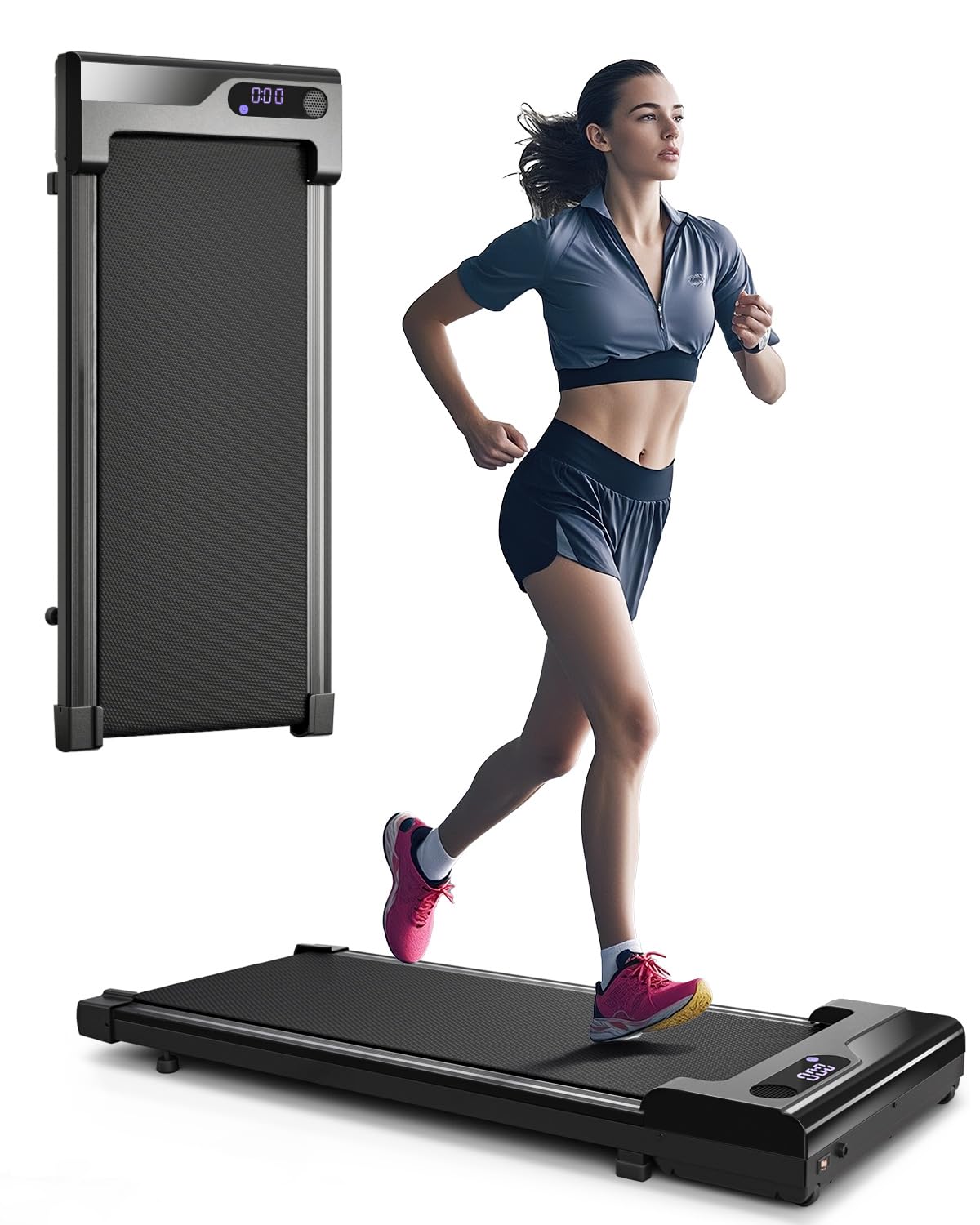
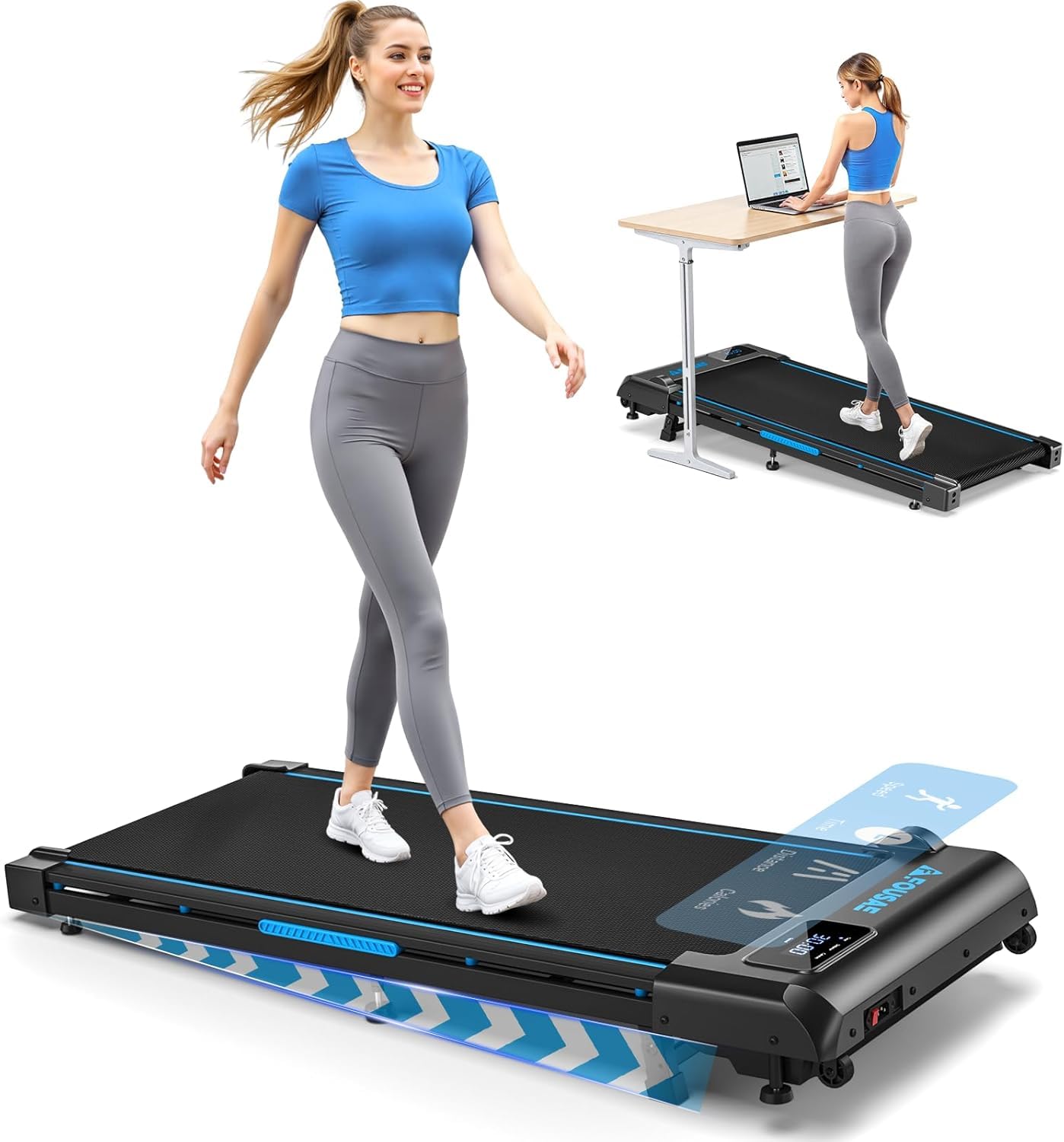
6.2 mph is jogging pace, and no other pad here without handrails gets close. That number reframes the FOUSAE: it's a walking pad you can break into a run on, which matters if your standing-desk sessions turn into ten minutes of sweat rather than a slow shuffle through email.

The hardware supports the claim. A 2.75 HP brushless motor rated under 40 dB sits behind a 350-pound frame, and the deck is 4.7 inches tall and about 46 inches long — slim enough to leave in place under a desk and light enough at 38 pounds to wheel aside. Twelve HIIT programs and a countdown mode give you something to follow when self-direction fails; the countdown got more use from us, because knowing a session ends in eight minutes makes it easier to start one.

What it doesn't have is anything to hold. Without handrails, the top speed is only useful if you're already steady on your feet at a jog, and the machine rewards a shorter, quicker stride rather than a long relaxed one. For a brisk walk with a few running minutes at the end, that's the right shape. For anything sustained, the machines with rails here are the better bet.

Pros

  • 6.2 mph ceiling, fastest here without handrails
  • 2.75 HP brushless motor rated under 40 dB
  • Twelve HIIT programs plus countdown mode
  • 38 lb and 4.7 in tall

Cons

  • 350 lb capacity trails the 450 lb picks
Our verdict

If your under-desk walks regularly turn into jogs, this is the pad to beat: 6.2 mph, 12 programs, and no handrails in the way.

Check Latest Price
4

Best With a Handrail

WELLFIT TM037PRO

90 /100
Trail Score Outstanding

Key details

Incline
0-12% auto
Deck Size
40 x 16 in
Unit Weight
57 lb
Weight Capacity
375 lb
Check Price on Amazon

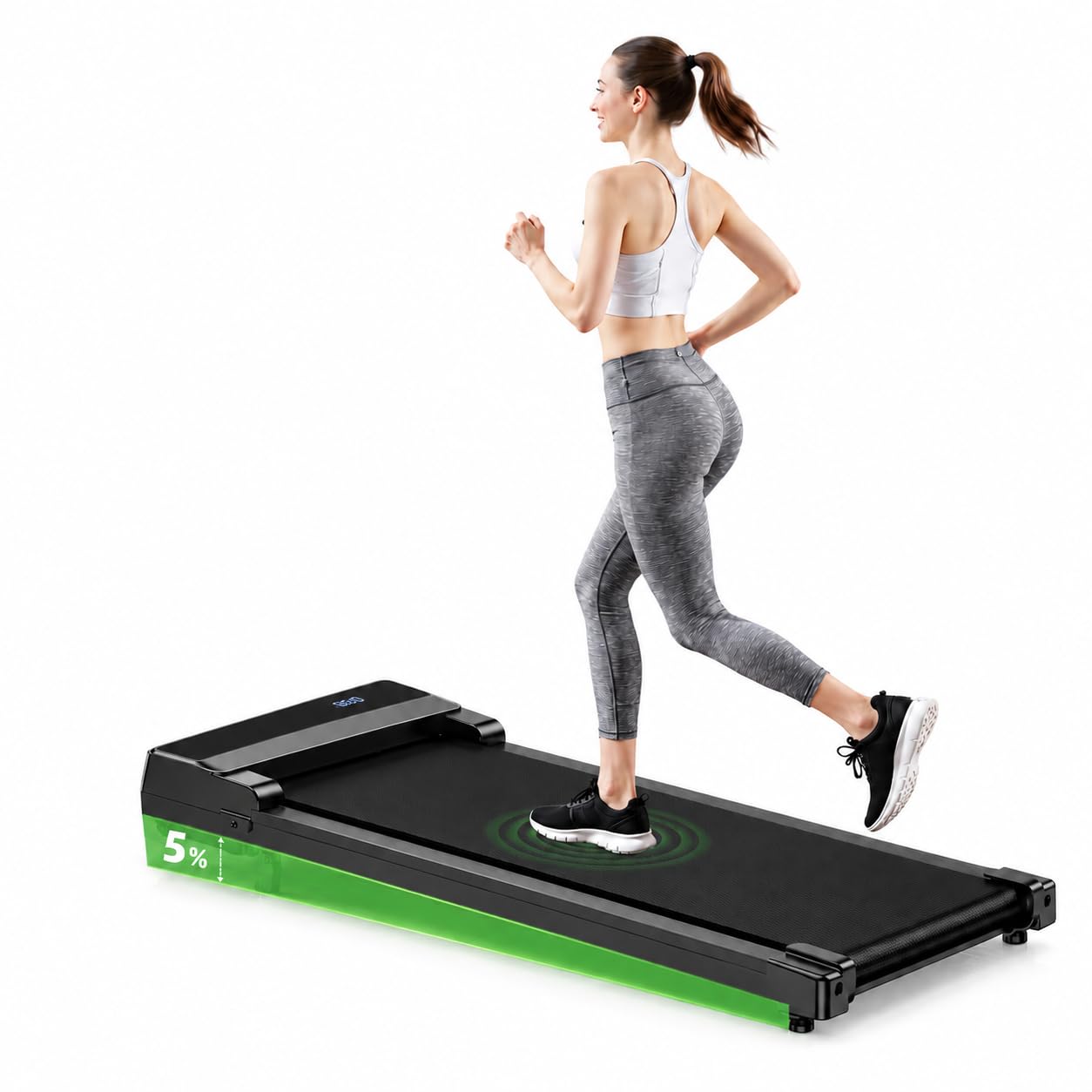
The dual handrails are the whole story here: fold them down and the deck slides under a desk at 5.5 inches tall, fold them up and you have a treadmill you can properly jog on with something to hold. If you never plan to hold on, you're paying for a frame and rails you won't use.

For the buyer who wants both, it's the most capable machine in this guide. A 3.5 HP brushless motor, a 7.6 mph top speed, 375 pounds of capacity, a 40 by 16 inch belt and a 12% auto incline put it ahead of every other pick on paper. The tablet tray on the console is the detail we appreciated most — it turns twenty minutes of walking into twenty minutes of the show you were going to watch anyway — and the rails give you something to steady against as the incline climbs.

Beyond the motor, the small hardware is what you're paying for: console buttons, a remote, app control, and a three-year full warranty that matches the top pick's. Of everything here, it's the one that behaves like a real treadmill when you need it to and like a walking pad when you don't.

Pros

  • Folding rails give support at jogging pace
  • 7.6 mph top speed and 3.5 HP motor
  • 12% auto incline with console and app control
  • Three-year full warranty

Cons

  • 57 lb, the heaviest machine here
  • Rails must be folded before desk use
Our verdict

The pick for anyone who wants to jog as well as walk at a desk — folding rails, a 12% auto incline, and 7.6 mph make it the most capable machine here.

Check Latest Price
5

Best for Small Spaces

CYBERGOING T10 Walking Pad

86 /100
Trail Score Excellent

Key details

Incline
7% fixed
Deck Size
36 x 15 in
Unit Weight
36.4 lb
Weight Capacity
300 lb
Check Price on Amazon

Seven percent, set before you start: that's the arrangement the T10 offers, and it's a deliberate one. The incline is fixed rather than powered, so you choose the grade when you step on and live with it for the session. In exchange the machine stays light at 36.4 pounds with a 15 by 36 inch belt, which is the difference between a pad you heave out and one you slide under the bed with a foot.

The motor is the other interesting choice. A 1 HP Bosch unit is modest next to the 2.5 and 2.75 HP motors elsewhere in this guide, and it's paired with a 0.6-4 mph range that never asks much of it. The result is a steady walker rather than a performer — the kind of machine that does the same thing every day without drama, which is what most desk walking asks for.

Controls run through the app or the remote, and the 300-pound capacity is the honest limit of a pad this light. For a small office, a spare room, or an apartment where the machine disappears at five o'clock, that trade reads well.

Pros

  • Light 36.4 lb with a compact 36-inch belt
  • Fixed 7% grade for set-and-walk sessions
  • App and remote control
  • 300 lb capacity

Cons

  • Fixed 7% incline, set before each session
Our verdict

A light, small-footprint pad for tight rooms — as long as you're happy setting a 7% grade before you start and leaving it there.

Check Latest Price
6

Budget Incline Walks

Wilpkracy Incline Walking Pad

92 /100
Trail Score Outstanding

Key details

Height
10.5 cm (4.1 in)
Incline
5% manual
Top Speed
3.7 mph
Weight Capacity
120 kg (264 lb)
Check Price on Amazon

Incline is usually the first thing budget pads drop, so finding one at this end of the range is the reason to look at this machine. Five percent, set manually before you start, is enough to change how a flat walk feels — it turns a shuffle into something with a bit of intent.

What surprised us is how little else is given up. The deck sits a little over 4 inches off the floor, the machine weighs about 36 pounds and arrives with nothing to assemble, and the remote is the kind you learn in a minute: up, down, stop. The belt uses the same five-layer diamond-textured surface as the pricier pads, and the whole thing slides under a bed when the day is done.

One limit comes with the low ticket: capacity is 264 pounds, which makes it a one-person machine in most households. Below 4 mph it's a walker and nothing more, and that's fine — for a solo walker who wants a grade underfoot without a big outlay, this is the sensible place to land.

Pros

  • 5% incline at a budget price
  • No assembly needed
  • Just over 4 in tall, about 36 lb
  • Remote is simple to learn

Cons

  • 264 lb capacity limits sharing
Our verdict

The budget pick we point solo walkers to: a 5% incline, a four-inch profile, and no assembly, at the value end of the range here.

Check Latest Price
7

Simple Daily Steps

Vhorilix Walking Pad

89 /100
Trail Score Excellent

Key details

Height
4.3 in
Speed Range
0.6-4 mph
Unit Weight
16 kg (35 lb)
Weight Capacity
264 lb
Check Price on Amazon

Nothing on the XM-A1 needs explaining. You take it out of the box, stand on it, and press the remote — no assembly, no app, no incline to think about. For a first walking pad, that simplicity is the feature.

Sixteen kilos and 4.3 inches of deck height make it one of the easiest machines here to live with in a small room: it rolls under a sofa on its front wheels and doesn't need a dedicated corner. The 2.5 HP motor covers a 0.6-4 mph range, the belt layers a diamond-textured top over silicone shock absorbers, and the LED shows speed and distance — enough to know what you've done without opening anything.

What you give up is everything extra, which is the point. A two-year warranty is longer than the other budget pads here offer, and fewer parts means fewer things to fail. Buy it as a plain, light pad you'll actually leave out. If you want a grade underfoot, the Wilpkracy and MJWW both give you one for similar money.

Pros

  • About 35 lb with transport wheels
  • 4.3 in profile slides under furniture
  • Two-year warranty, longer than other budget pads here
  • No assembly or app required

Cons

  • No incline, app, or Bluetooth
Our verdict

The simplest pad here: about 35 pounds, 4.3 inches tall, no assembly and no app — a good first walking pad for a small room.

Check Latest Price
8

First Walking Pad

MJWW Incline Walking Pad

85 /100
Trail Score Excellent

Key details

Height
4.5 in
Incline
6%
Top Speed
3.8 mph
Weight Capacity
300 lb
Check Price on Amazon

Every speed change announces itself with a beep, and that chirp is the only thing about this pad you'll notice in a quiet room — the belt and motor stay close to silent at walking pace. Small detail, but if you share a workspace, it's the difference between unnoticed and noticed.

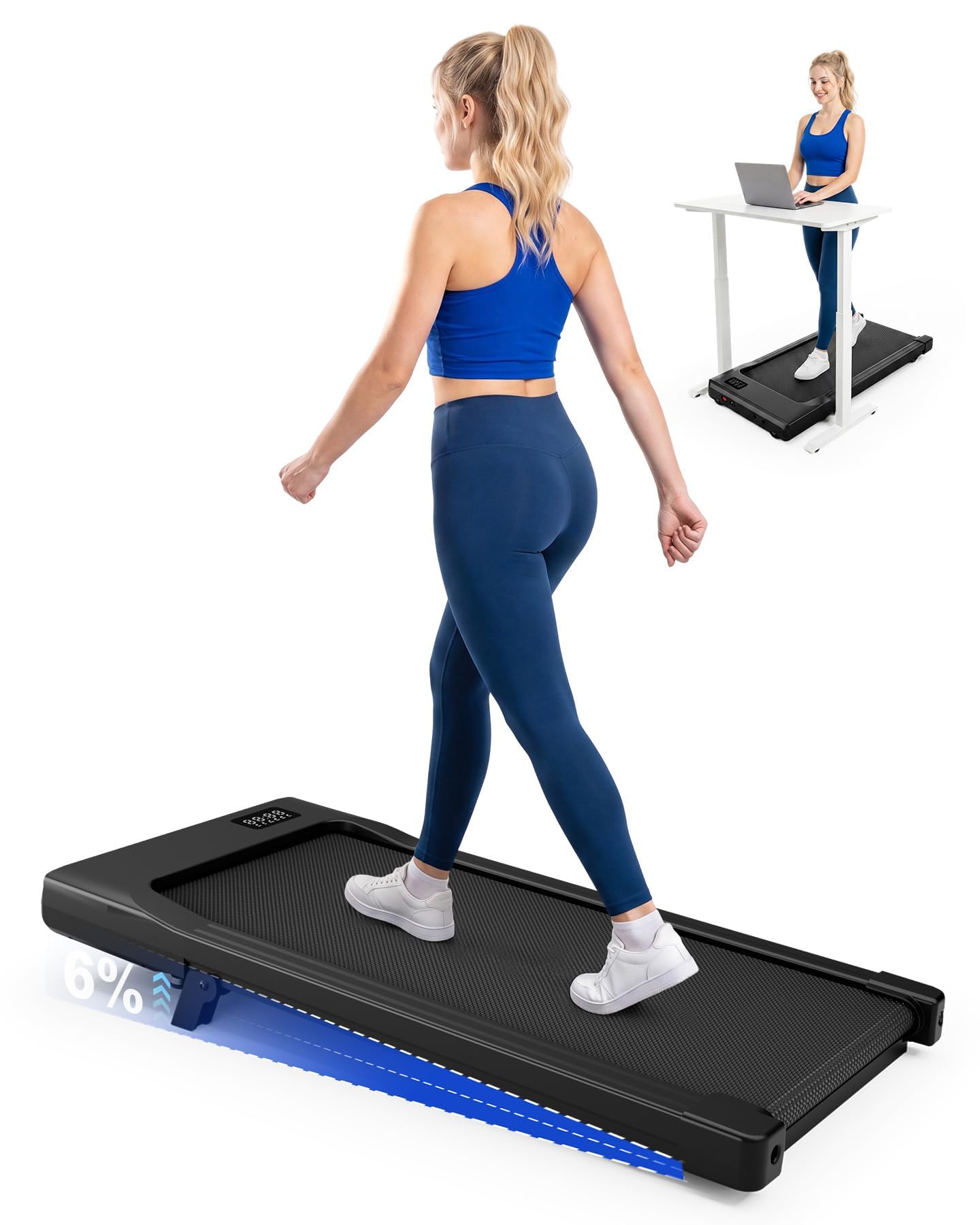
Six percent of incline at the lowest price here is the real pitch, and it holds up: a grade makes a flat walk feel deliberate, and behind it sit a 2.5 HP motor rated under 45 dB, a 300-pound frame, and a 4.5-inch profile that tucks under a desk without crowding your shins.

Controls run through the remote or the app, the shock-absorbing deck stays comfortable over a long session, and at 41 pounds it rolls aside when you want the floor back. The honest limit is pace — 3.8 mph is a walk, not a jog — and that's the whole trade for a machine at this end of the range.

Pros

  • 6% incline at the lowest price here
  • Slim 4.5-inch profile
  • Remote and app control
  • 300 lb capacity on an alloy steel frame

Cons

  • Tops out at 3.8 mph
Our verdict

A cheap, slim way to add a grade to your workday — the 6% incline and 4.5-inch profile do the work, as long as you only want to walk.

Check Latest Price

How We Chose and Tested the Best Under-Desk Treadmills

We started by pulling the walking pads and under-desk treadmills sold by brands with an actual track record, then narrowed by deck length (40 inches or more, so a normal stride isn't cut short), motor rating, the height of the unit so it clears a standing desk, and whether replacement belts and parts are sold at all. That left six models across three price bands. Each one has now been walked on for eight months.

Every unit lived under a real desk for at least a month at a stretch and got used the way anyone would use one: taking a call at 2 mph, answering email at 3, and doing a longer evening walk with a game on in the background. We recorded noise on a phone decibel meter at 2 and 4 mph, and noted whether the belt drifted toward one side after an hour of steady walking. Incline settings, where a model had them, were cycled through at each level to see whether the deck stayed stable or the motor started to labor.

App testing was blunt: pair the machine, start a walk, and log every dropped connection and every workout the app failed to save. For compact size we measured what each unit actually demanded — clearance under furniture, room to turn around, and whether one person could roll it out and set it up without rearranging the room. Because reliability is the whole ballgame with a motorized pad, we kept a running log of anything that slipped, squeaked, or stopped tracking, then weighed that against what the thing cost.

How to Choose an Under-Desk Treadmill

Measure the gap, not the machine

The number that decides whether an under-desk treadmill works for you is the space between the floor and your desk at standing height. Pads in this guide sit 4.3 to 6 inches tall, so a 6-inch machine can leave you hunched where a 4-inch one wouldn't. Raise the desk, step on the pad, and check where your keyboard lands before anything else.

Length matters as much. These machines run 36 to 48 inches of belt and frame, and most will stick out past a 24-inch-deep desk, so count the floor behind your chair as part of the setup. A short 36-inch deck saves room; a 41-inch deck gives a long stride somewhere to land.

Automatic, fixed, or no incline

Three versions of incline exist here. Automatic changes grade from the remote while you walk, across nine levels on the X01 and the ROCKER-S, and it's the feature most likely to keep the machine in use past the first month. Fixed means a grade you set before you start, like the T10's 7%. None means a flat belt, which is cheaper, lighter, and perfectly fine for steady walking.

A manual incline you have to stop and reset tends to stay wherever you left it, so it only pays off if you actually set it. If you're unsure how much you'll use a grade, buy automatic or buy flat rather than paying for a middle ground you won't adjust.

Match the motor to the pace you keep

Motor figures look impressive in isolation; what matters is the speed range they serve and the weight they carry. A 2 to 2.5 HP motor is plenty for 4 mph walking, which is most of what happens under a desk. Runners land harder than walkers, so any jogging ambition should push you toward a stronger frame and more capacity rather than a bigger horsepower number.

If you want to run, look at the ceiling first: 6.2 mph on the FOUSAE and 7.6 mph on the WELLFIT are the two picks here that break out of a walk. For walking only, put the difference into incline or a lighter machine instead.

Quiet is two noises, not one

Motor hum is the noise shoppers worry about; footfall is the one that carries through a floor. Brushless motors, the kind in the FOUSAE and the WELLFIT, are generally the quietest of the group, but a decibel figure on a listing is the seller's own measurement and rarely describes a real room. If you're on calls all day, a headset does more for you than a spec sheet.

A dense mat under the pad softens both the thump downstairs and the belt's own vibration. It's the cheapest improvement you can make to any machine on this list.

Decide where it lives before you buy

Weight is the specification people regret ignoring. The lightest pads here are around 35 pounds and slide under a sofa on their wheels; the heaviest is 57 pounds and wants a permanent address. If the routine is walk in the morning and stow it at night, buy on weight and wheels first and capacity second.

If it's staying out, the reverse applies. A heavier frame is steadier underfoot at speed, and steadiness is what makes a forty-minute walk comfortable rather than a balancing act.

Frequently Asked Questions

Final Verdict

Start with the TRAILVIBER X01 unless something specific rules it out. The 12% auto incline is what keeps a walking pad from becoming a coat rack, the 41-inch belt fits most strides, and the 450-pound frame with a three-year warranty makes it the safest long-term bet in this set.

Two requirements change the answer. If you want to jog with a hand on something, the WELLFIT folds its rails down for desk use and runs to 7.6 mph. If you want a grade for less and walk alone, the Wilpkracy delivers one at the value end of the range.