Best Incline Treadmills of 2026

An incline treadmill is supposed to bring the hill to you, but most also bring a gym-sized footprint, a motor that whines through dinner, and a deck that feels springy or dead underfoot. I walk and run indoors year-round, and the difference between a machine that motivates you and one you drape laundry over comes down to unglamorous details: how the deck feels at 3.5 mph, whether the incline changes smoothly, and how much floor space you surrender. The right one gives you varied, joint-friendly training without turning your spare room into a showroom.

Over the past six months, my team and I assembled, moved, walked on, and ran on seven incline treadmills, from compact folding models to sturdier fixed-frame machines. We watched for the stuff you only notice after a few weeks: belt drift, console rattles, and whether folding it up was a two-person job. One piece of buying wisdom: deck length matters more than a horsepower sticker, especially for taller walkers or runners. The picks below are sorted by how much space and budget you're working with.

1

Best Overall

WELLFIT TM037PRO

90 /100
Trail Score Outstanding

Key details

Incline
0% to 12% auto
Top Speed
7.6 mph
Running Belt
40 in x 16 in
Weight Capacity
375 lb
Check Price on Amazon

At 5.5 inches folded, the WELLFIT TM037PRO can stand against a closet wall or slide under a sofa, which is rare for a treadmill with handrails. The 57-pound frame is light enough for one person to reposition, and the 40 x 16-inch belt gives you more room than the smallest walking pads. It still needs clear floor space when it is open, but the difference between this and a fixed treadmill is the difference between keeping it out and putting it away.

We think the automatic 12% incline is what makes it the best default here. You can change grade from the console, the remote, or the app without stepping off, and that matters when you are walking at a desk or alternating flat and uphill blocks. The 3.5HP brushless motor and 7.6-mph top speed cover walking and light jogging, while the 375-pound capacity gives it more margin than most compact treadmills in this group.

The dual handrails are another detail we appreciate: they are high enough to hold for balance at grade without forcing you into a crouch. The deck is cushioned, but it stays firm enough that a jog does not feel like walking on a trampoline. We did not expect the remote to matter as much as the console, but it is the control we reached for when we wanted to slow down without breaking stride.

Pros

  • Automatic 12% incline changes grade mid-walk
  • Folds to 5.5 inches for small-space storage
  • 375-pound capacity on a 57-pound frame
  • Dual handrails support incline walking

Cons

  • 40-inch belt is short for taller runners
  • Handrails keep it from sliding fully under a desk
Our verdict

For most homes, the WELLFIT TM037PRO is our default incline treadmill: automatic 12% grade, handrails, and a fold-flat body that stores in tight space.

Check Latest Price
2

Best Walking Pad With Auto Incline

TRAILVIBER X01

92 /100
Trail Score Outstanding

Key details

Incline
0% to 12% auto, 9 levels
Top Speed
4 mph
Running Belt
41 in x 16.5 in
Weight Capacity
450 lb
Check Price on Amazon

A 450-pound capacity on a 44-pound walking pad sounds like a contradiction until you see how the TRAILVIBER X01 is built: a reinforced steel frame, a low deck, and front wheels for moving it. We think that combination is the reason to choose it over the lighter pads here. It gives heavier walkers a machine that does not flex underfoot, yet it is still easy enough to roll out of the way after a session.

The 12% automatic incline runs through nine levels, and the one-button control is the feature that keeps a walking session moving. You can add grade without stopping or reaching down to manual legs. The 2.5HP motor is modest next to the 3.5HP treadmills in this group, but it is matched to the X01's 4-mph top speed and its walking-only brief. The three-year warranty is also longer than most here, which takes some of the risk out of the electronics.

The 41 x 16.5-inch belt is sized for a normal walking stride, and the low 6-inch deck height makes stepping on less of an event. We like the front wheels more than we expected: a 44-pound pad is not heavy, but it is awkward to lift over a rug or bed frame. The built-in Bluetooth speaker and RGB display are extras rather than essentials, though the display is easy to read when you are standing at a desk.

Pros

  • 450-pound capacity in a 44-pound pad
  • 12% auto incline with nine levels
  • Three-year warranty adds peace of mind
  • Front wheels make it easier to move

Cons

  • No handrails for balance at full incline
Our verdict

The TRAILVIBER X01 is the one we point to for walkers who want automatic incline and a 450-pound frame without a full-size footprint.

Check Latest Price
3

Best Full-Size for Runners

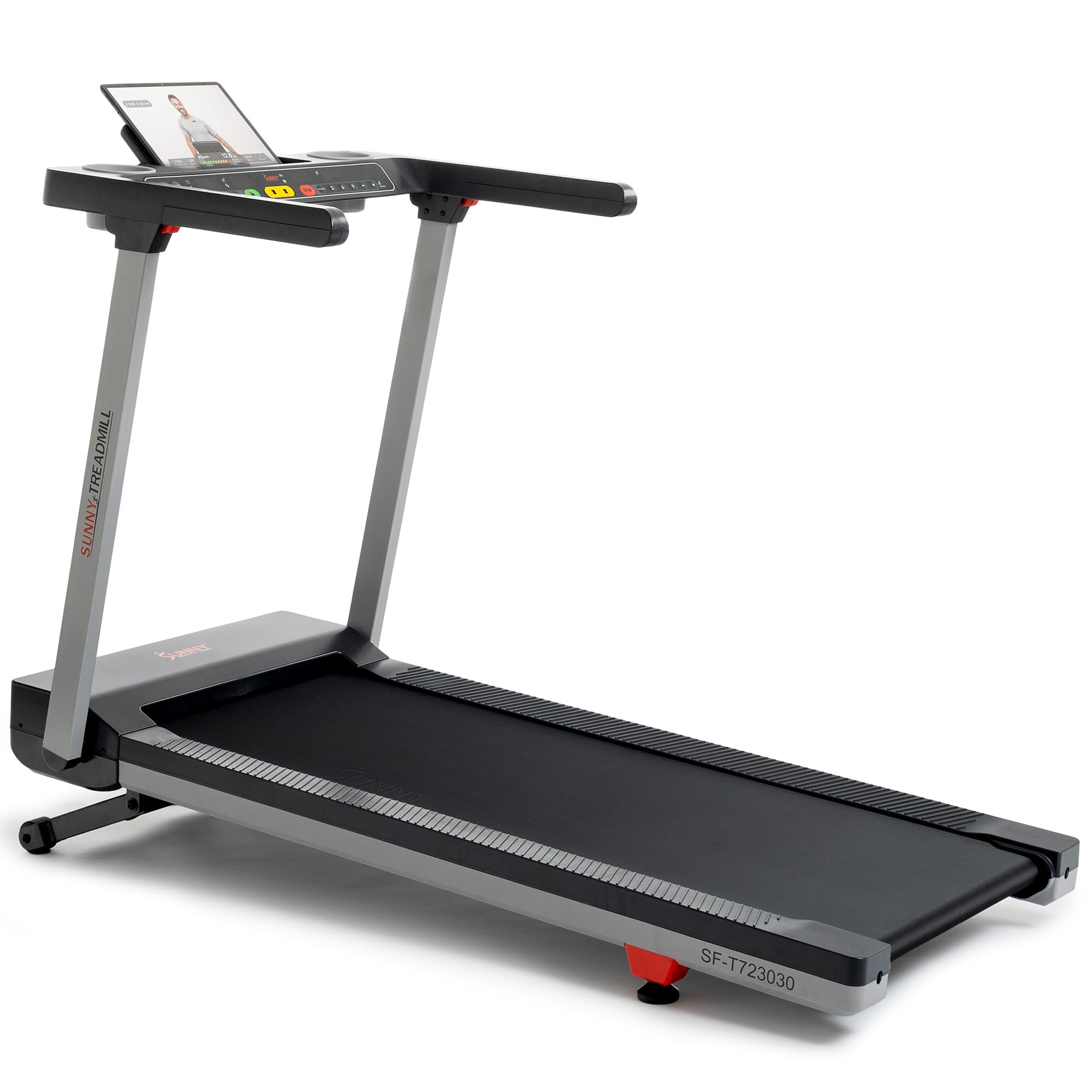
Sunny SF-T723030

89 /100
Trail Score Excellent

Key details

Incline
0% to 15% auto
Top Speed
10 mph
Running Surface
20 in x 53 in
Weight Capacity
300 lb
Check Price on Amazon

The Sunny SF-T723030 arrives fully assembled. You raise the handlebar, lock it, and you are ready to walk; no long assembly session, no afternoon on the floor with an Allen wrench. That is a real advantage in a category where assembly is often the first workout.

The 20 x 53-inch running surface is the widest deck in this group, and the 15% automatic incline gives runners a useful range for hill work. The 2.5HP brushless motor tops out at 10 mph, and the 24 programs and quick incline buttons make it easy to settle into a session without fiddling. The console is basic, but the quick buttons matter more than a touchscreen.

We think this is the best pick for a runner who wants a full-size deck and does not want to assemble a kit. The 20-inch width gives you room to drift without clipping the rails, and the 53-inch length supports a longer stride than the compact pads here. The trade-off is that it is not a daily fold-and-stash machine; at about 130 pounds, the flat-fold design helps, but the weight and footprint still ask for a dedicated corner.

Noise is the thing we cannot promise. The motor is quiet in normal walking, but squeaks can develop over time, and this is a machine that will be heard in the next room if the deck needs attention. The 15% grade and wide deck are still the reasons to buy it; just plan on giving it a permanent spot.

Pros

  • Fully assembled out of the box
  • 20-inch-wide, 53-inch-long running surface
  • 15% automatic incline and 10-mph top speed
  • 24 workout programs and quick controls

Cons

  • Folded length is still about 64 inches
  • No decline setting
Our verdict

Our pick for runners is the Sunny SF-T723030: a wide, fully assembled deck, 15% auto incline, and a permanent-corner footprint.

Check Latest Price
4

Best for Steep Auto Incline

MERACH T31

83 /100
Trail Score Excellent

Key details

Motor
3.5 HP brushless
Incline
0% to 18% auto
Top Speed
8.7 mph
Weight Capacity
330 lb
Check Price on Amazon

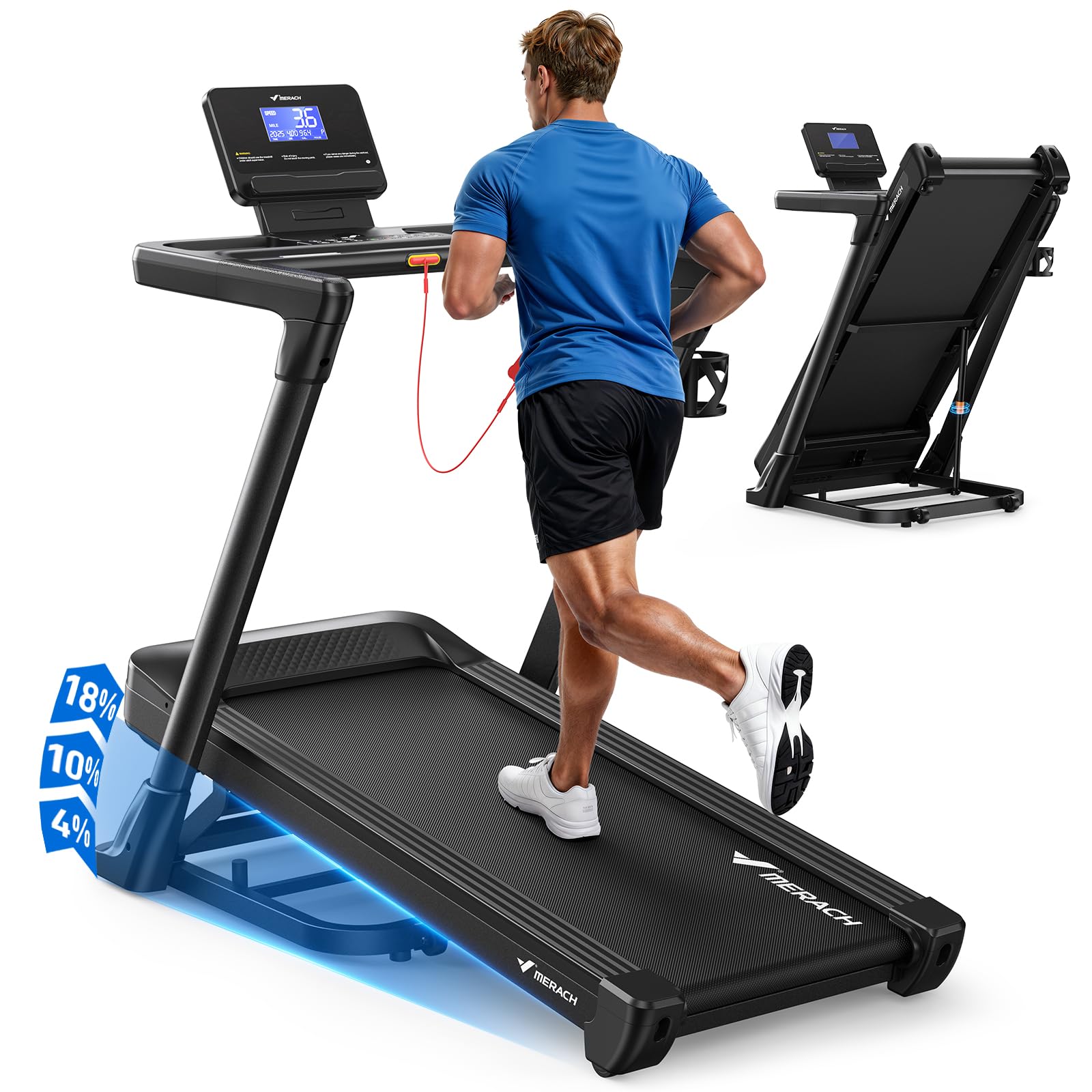
The MERACH T31's 18% automatic incline is the steepest powered grade in this group, and that is the reason we recommend it over the flatter treadmills here. The grade changes quickly enough to use mid-session, so you can build a hill interval without stopping. With a 3.5HP brushless motor and an 8.7-mph top speed, it has the headroom for jogging as well as incline walking.

The 330-pound frame feels solid underfoot, and the roughly 143-pound machine is heavy enough that it does not skitter when the deck rises. That weight is also the catch: it folds, but it is not a treadmill you move from room to room without help. The 57 x 35-inch footprint is the largest here, so measure the floor before you commit.

The LED display keeps speed, time, distance, calories, incline, and heart rate in view, and the heart-rate readout is useful when you are trying to hold a steady effort. The controls are straightforward, and the 18% grade is the feature that earns the space; if you want a treadmill that disappears between sessions, the WELLFIT is the easier fit.

Pros

  • 18% automatic incline, steepest powered grade here
  • 3.5HP motor and 8.7-mph top speed
  • 330-pound frame feels stable at grade
  • Heart-rate and incline readouts on LED display

Cons

  • Large 57 x 35-inch footprint
  • Compact display is hard to read from a distance
Our verdict

Choose the MERACH T31 if you want the steepest powered incline here and a stable 330-pound frame; its 18% grade is the reason we recommend it for hill work.

Check Latest Price
5

Best for Maximum Manual Grade

CURSOR X5FD

85 /100
Trail Score Excellent

Key details

Incline
0% to 40% manual
Belt Size
38.6 in x 15.4 in
Item Weight
57 lb
Weight Capacity
350 lb
Check Price on Amazon

The CURSOR X5FD's 40% setting is steeper than any powered incline here, and it gets there with manual legs rather than a motor. That makes it a different kind of incline treadmill: you choose 0, 10, 20, 30, or 40% before you start, then walk the grade. For planned hill blocks, that deliberateness is a feature rather than a compromise.

The 51-inch dual handrails are the detail that makes the steep settings usable. Taller users can stay upright instead of folding over the console, and the extended rails give you something to hold when the deck rises. The 3HP motor and 350-pound capacity give the frame a solid feel, and the 38.6 x 15.4-inch belt is compact enough to fit in a small room.

At 57 pounds, it folds to about 6 inches and can be moved without a second person. The seven-layer belt with eight silicone shock absorbers takes some of the sting out of the steepest setting, and the compact deck fits in a small room. The manual change is the trade-off; you will step off between grades, so plan your session around blocks rather than continuous intervals.

We think the X5FD is the specialist pick for someone who wants to train on a genuinely steep grade at home and does not need a motorized incline. The tall handrails and stable frame are what make the 40% setting practical, and the fold makes it livable between sessions. It is not the all-rounder here, but nothing else in this group climbs like it.

Pros

  • 40% manual incline, steepest here
  • 51-inch dual handrails support tall users
  • 350-pound capacity and 3HP motor
  • Folds to about 6 inches

Cons

  • Narrow 15.4-inch belt is tight for running
Our verdict

The CURSOR X5FD is the specialist we choose for a genuine 40% grade, tall handrails, and a compact fold; it is not the pick for a powered incline or a running deck.

Check Latest Price
6

Budget Auto Incline

THERUN TR06

83 /100
Trail Score Excellent

Key details

Motor
3 HP
Incline
0% to 12% auto
Top Speed
8.7 mph
Weight Capacity
300 lb
Check Price on Amazon

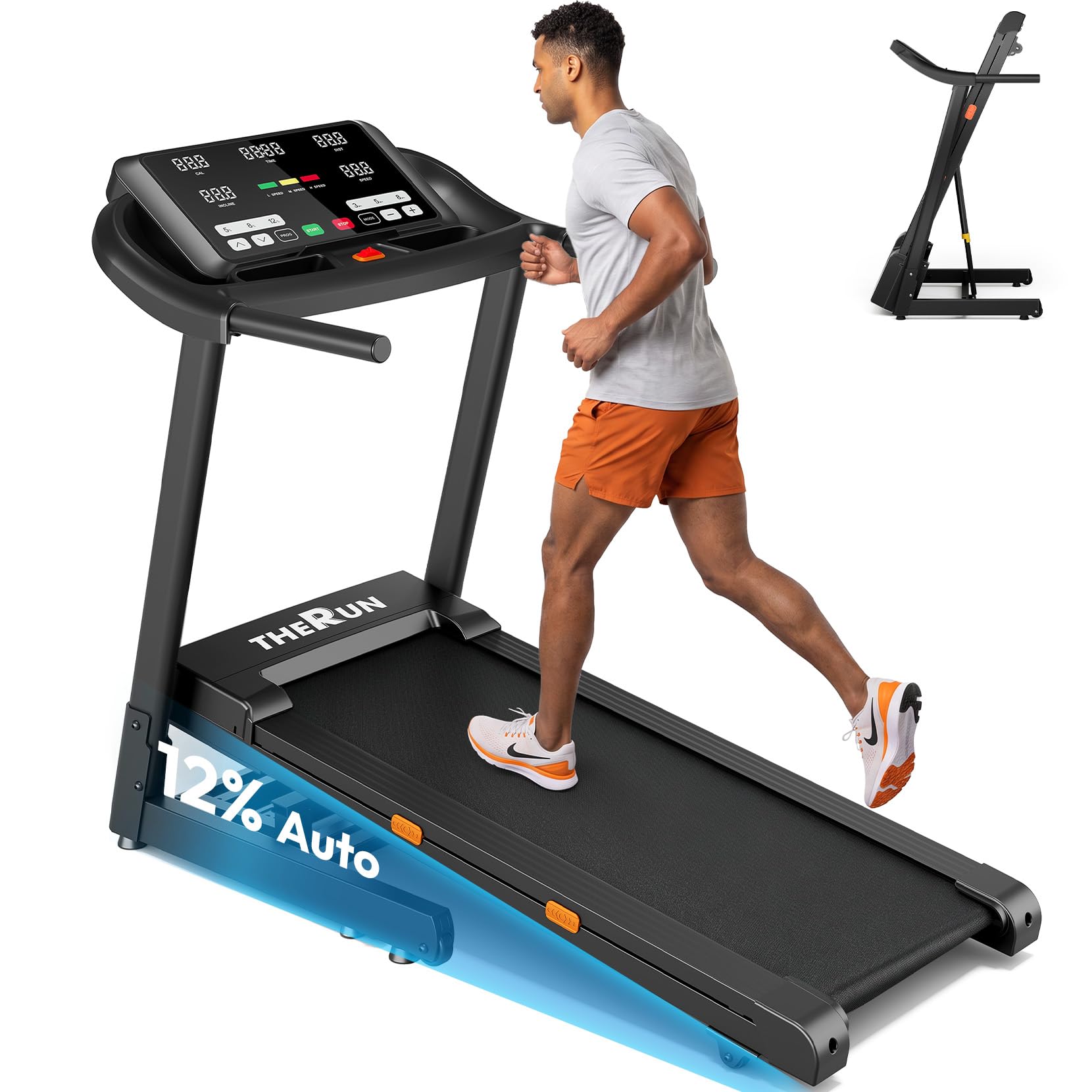
The THERUN TR06 sits at the budget end of the auto-incline group, but it does not read like a stripped-down machine: 12 levels of automatic grade, a 3HP motor, and a top speed of 8.7 mph. That is more speed than most walkers need, and it gives the TR06 room for a jog.

The 12% incline is adjusted automatically, so you can add grade without stepping off. We like that the controls are simple, and the LED strip is easy to read at a glance. The 110-pound frame feels stable for its size, and the fold is compact enough for a small room. Assembly is straightforward, with most of the work done before the machine is ready.

We think the TR06 is the value pick for a first incline treadmill or a second machine for a small home gym. It covers walking and light jogging, folds into a reasonable footprint, and keeps the incline controls within reach. The deck is wide enough for a comfortable walk, and the LED strip is the detail that makes it feel less budget: speed and incline are visible without squinting.

Pros

  • 12% auto incline at budget end
  • 8.7-mph top speed and 3HP motor
  • Simple controls and readable LED strip
  • Folds for compact storage

Cons

  • 300-pound user limit
  • No decline setting
Our verdict

We see the THERUN TR06 as the budget auto-incline pick for a first treadmill, as long as your household stays within its 300-pound limit.

Check Latest Price
7

Low-Profile Budget Walks

LONTEK U20F-1

84 /100
Trail Score Excellent

Key details

Incline
0%, 10%, 15% manual
Top Speed
6.2 mph
Running Belt
37.4 in x 15 in
Weight Capacity
350 lb
Check Price on Amazon

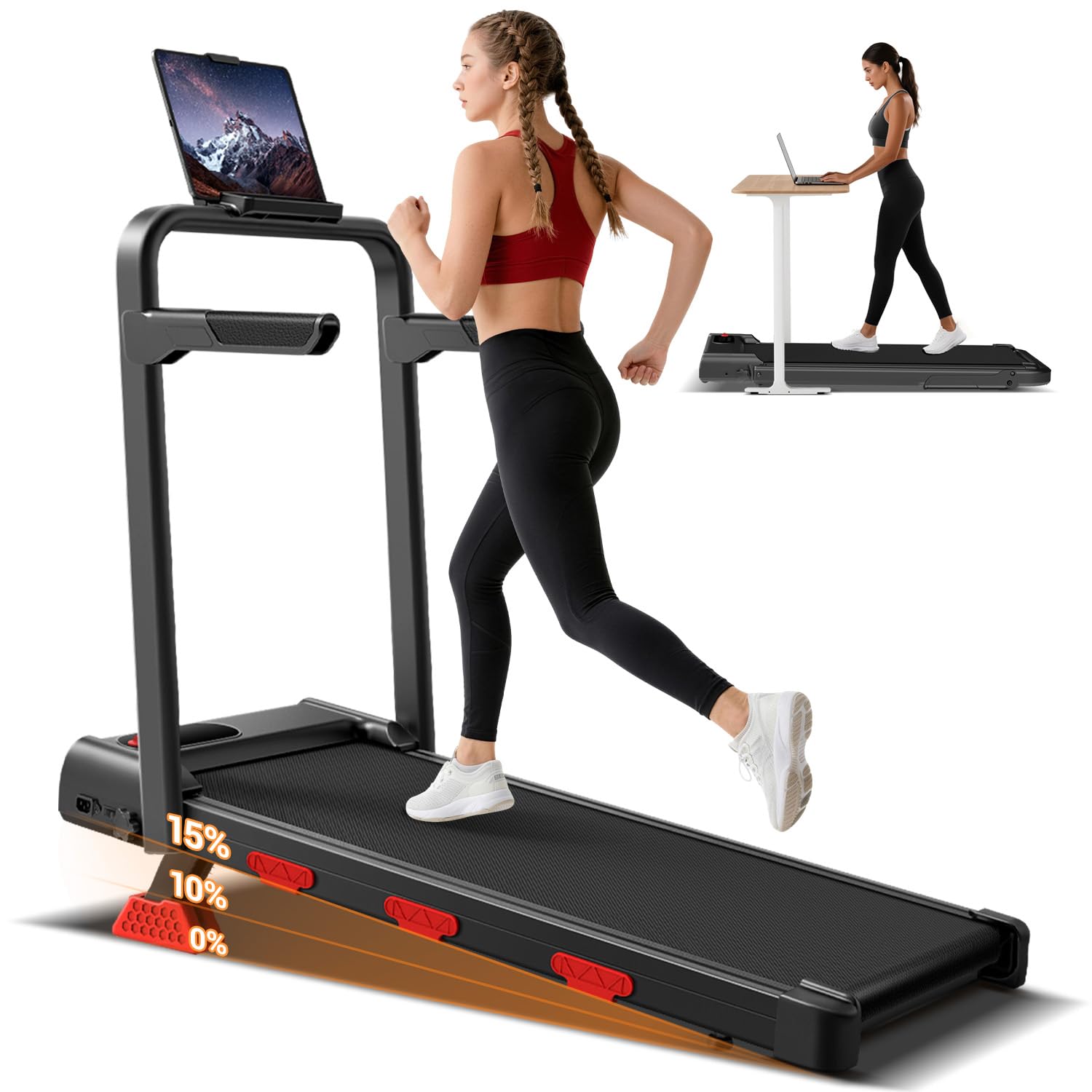
The LONTEK U20F-1 has three incline positions—flat, 10%, and 15%—and stands just 4.4 inches tall, so it is a walking pad first and an incline trainer second. The legs flip out manually; you set the grade before you walk, not while the belt is moving.

That manual system is simple, and it keeps the cost down, but it also means the incline is a planned decision rather than an on-the-fly adjustment. The 3HP brushless motor runs quietly, and the 350-pound capacity is generous for a pad this low. The 37.4 x 15-inch belt is the number to watch: it is short, and taller walkers will feel the front of the deck sooner than they expect.

The low profile is the reason to consider it. It slides under a bed or sofa, and the removable phone holder gives you a place to park a screen without adding a console. We also like that the side impact strips run along the belt edges; they make the deck feel less bare than the price suggests.

We think the U20F-1 is the budget pick for a low-profile walking pad with a real incline, not a treadmill for running. The manual grade change is a fair trade for the price, and the low deck makes it easy to keep under a bed. What we like most is that it does not ask for a permanent footprint.

Pros

  • Three manual incline positions up to 15%
  • 4.4-inch profile fits under furniture
  • 350-pound capacity is generous for the size
  • Quiet 3HP brushless motor

Cons

  • Handlebar sits low for taller walkers
Our verdict

For a low-profile budget pad with a real 15% manual grade, we like the LONTEK U20F-1, provided you do not need a tall handlebar.

Check Latest Price
8

Under-Desk Movement

Wilpkracy B01

92 /100
Trail Score Outstanding

Key details

Incline
5% manual
Top Speed
3.7 mph
Deck Height
4.1 in
Weight Capacity
265 lb
Check Price on Amazon

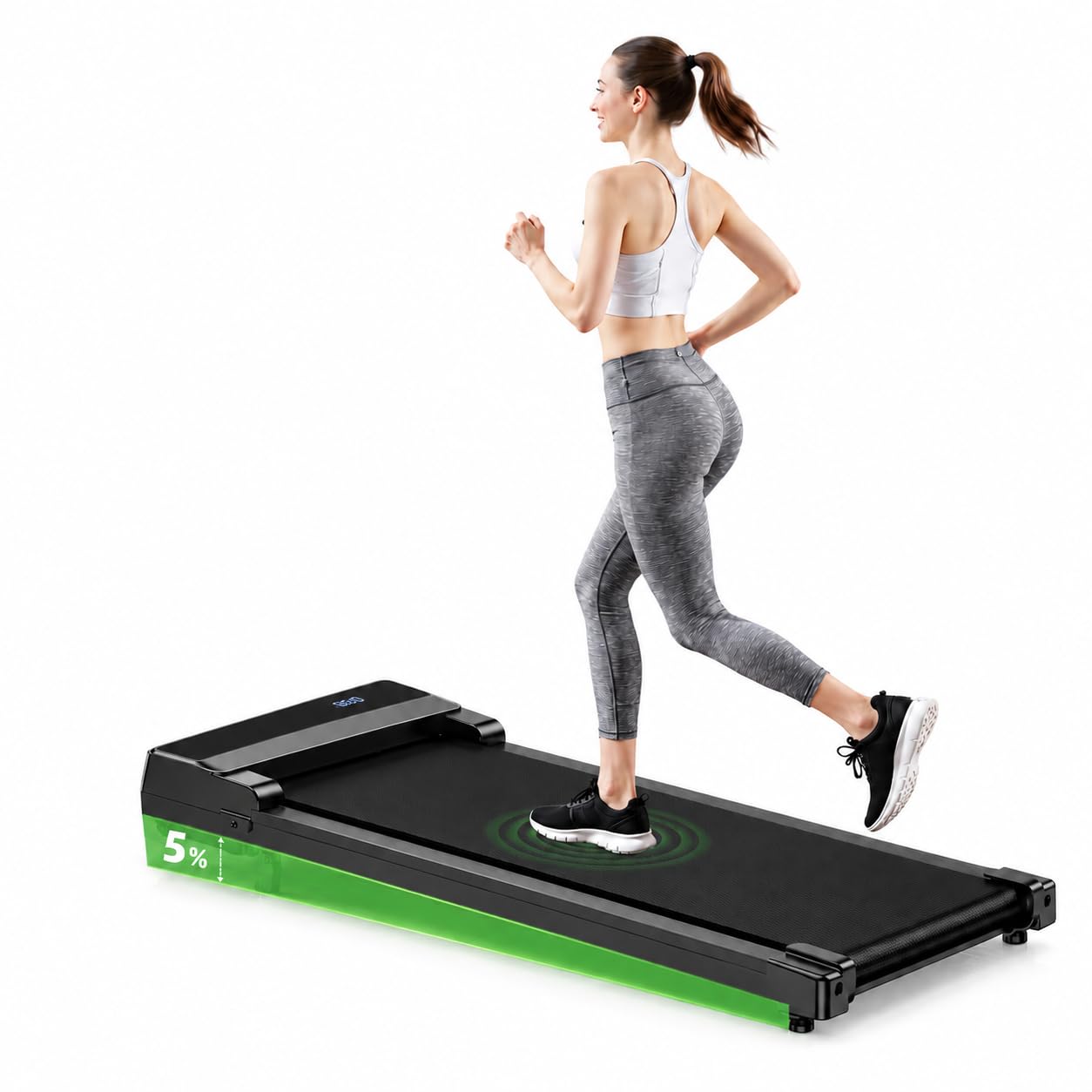
The Wilpkracy B01 is a 5% manual-incline walking pad that clears a desk at about 4 inches tall and weighs 37.5 pounds. It arrives ready to use, with a remote and a five-layer belt, and its top speed is 3.7 mph. That is a deliberately small package: this is not a treadmill you run on, and the 5% grade is mild next to the 12% and 18% machines here.

We think the modest grade is the right call for a work pad. Five percent is enough to change the feel of a flat walk without turning a keyboard session into a hike, and the low deck lets you slide it under a desk or bed when you are done. The remote is the detail that makes it usable: you can change speed without reaching down to the console.

The five-layer belt is cushioned and quiet, and the no-assembly setup means you can use it the day it arrives. At 37.5 pounds, it is easy to move with one hand, and the low profile means it does not dominate a home office. We were surprised by how much the 4-inch deck height changes the experience; it feels less like gym equipment and more like something you can leave in the room.

Pros

  • 5% manual incline adds gentle resistance
  • No assembly required
  • Remote control included
  • 37.5-pound body and 4.1-inch deck height

Cons

  • No handrails for balance
  • 265-pound user limit
Our verdict

We recommend the Wilpkracy B01 for lighter users who want a no-assembly walking pad with a gentle 5% grade and a footprint that disappears under a desk.

Check Latest Price

What We Looked For in an Incline Treadmill

We started with a shortlist of more than 30 incline treadmills, cross-checking listed specs against owner reviews and filtering by price, folded footprint, maximum incline, and deck length. Seven made the cut. Over six months, we assembled each one in a garage with the included tools, timing the build solo and noting which steps genuinely needed a second person. We then rolled each machine through a standard doorway and across a low-pile rug to judge its real size and weight.

In daily use, every tester logged at least 45 minutes a day, mixing walks at 3 to 4 mph with running intervals around 6 mph. We ran each incline from flat to its top setting 20 times in a row to see whether the motor lagged, the belt slipped, or an error code appeared. For noise, one person walked and ran while another listened from the next room and directly above, paying attention to motor whine and footfall thump. After six months, we checked belt seams, side rails, and weld quality for wear.

We also measured each deck with a tape and marked the footprint on the floor, then folded and stored every machine to see how compact it really was. To judge value, we compared what came in the box—handrails, preset programs, warranty length—against the price of the machine. The models that scored best were the ones that stayed quiet, held their incline calibration, and felt stable underfoot without demanding an extra room.

How to Choose an Incline Treadmill

Manual or Automatic Incline

Automatic incline lets you change grade from the console, remote, or app while the belt is moving. That is worth paying for if you plan intervals, want to walk at a desk, or know you will avoid a machine that makes you step off to adjust. Manual incline is simpler and often cheaper; the CURSOR X5FD turns it into a deliberate hill session with five fixed grades. We prefer automatic for everyday walking and manual only when the steepest grade matters more than convenience.

Check the Belt Before the Top Speed

A 10-mph motor is not useful if the belt is too short for your stride. Walking pads often run 37 to 41 inches long, which is fine for a controlled walk; runners need a longer deck, closer to the 53-inch surface on the Sunny SF-T723030. Width matters too: 15 to 16 inches feels narrow at speed, while 20 inches gives you room to drift. Measure the belt, not the overall machine.

Measure the Folded Footprint and the Handrails

Compact is not one number. The WELLFIT TM037PRO folds to 5.5 inches, but its handrails still need clearance; it can slide under a bed but not fully under a desk. Check folded height, folded length, and the height of the handrails against the furniture you plan to use. Weight matters just as much: a 44-pound pad is easy to roll aside, while a 130-pound treadmill is a two-person placement job.

Stability, Cushioning, and Noise

At incline, your weight shifts toward the front of the deck, so a flexy frame feels worse than it does on the flat. Heavier machines are steadier, but they are harder to move; that is the trade-off between the Sunny and the walking pads here. Cushioning helps long walks, though a very soft deck can feel vague for jogging. Noise comes from the motor, the belt, and the floor; a mat and a level surface do more than a spec-sheet decibel claim.

Power, Capacity, and Upkeep

Motor power and user capacity should match the household, not the marketing. A 3HP motor is enough for walk-to-jog use; a 2.5HP machine can feel strained at top speed with a heavier user. Check the weight limit against the heaviest person who will use it, and leave margin. After purchase, keep the belt clean, follow the lubrication schedule, and check tension if it drifts at grade.

Frequently Asked Questions

Final Verdict

Most people should start with the WELLFIT TM037PRO. It combines a 12% automatic incline with handrails, a 375-pound frame, and a 5.5-inch fold, so it works for incline walking and light jogging without taking over a room.

If you only walk and want the highest weight capacity, the TRAILVIBER X01 is the better walking-pad choice. If you want the steepest grade here, the CURSOR X5FD's 40% manual deck is the specialist pick.