Best TENS Units for Back Pain of 2026

Back pain has a way of making every chair in the house feel like the wrong one. A TENS unit won’t fix the underlying cause, but it can interrupt the pain signal long enough to get you through a workday or an evening without reaching for another pill. The catch is that not all of them are built for real life: some menus are impossible to read mid-flare, some pads lose their grip after a few sessions, and some barely last a week on one charge.

Over four months, my team and I worked through 14 units, using them on lower backs during desk work, after long walks, and on the couch at night. We compared how quickly each took the edge off, how easy it was to adjust intensity without breaking concentration, and how long a charge actually lasted. The best ones share a few quiet virtues: pads that stay put, controls that make sense, and relief that outlasts the session. The picks below earned their keep on relief, build quality, and what you get for the price.

1

Best Overall

NueMedics Tens 24

93 /100
Trail Score Outstanding

Key details

Channels
Dual, two lead wires
Charging
USB-C with wall adapter
Programs
24
Pads Included
6 large electrodes
Check Price on Amazon

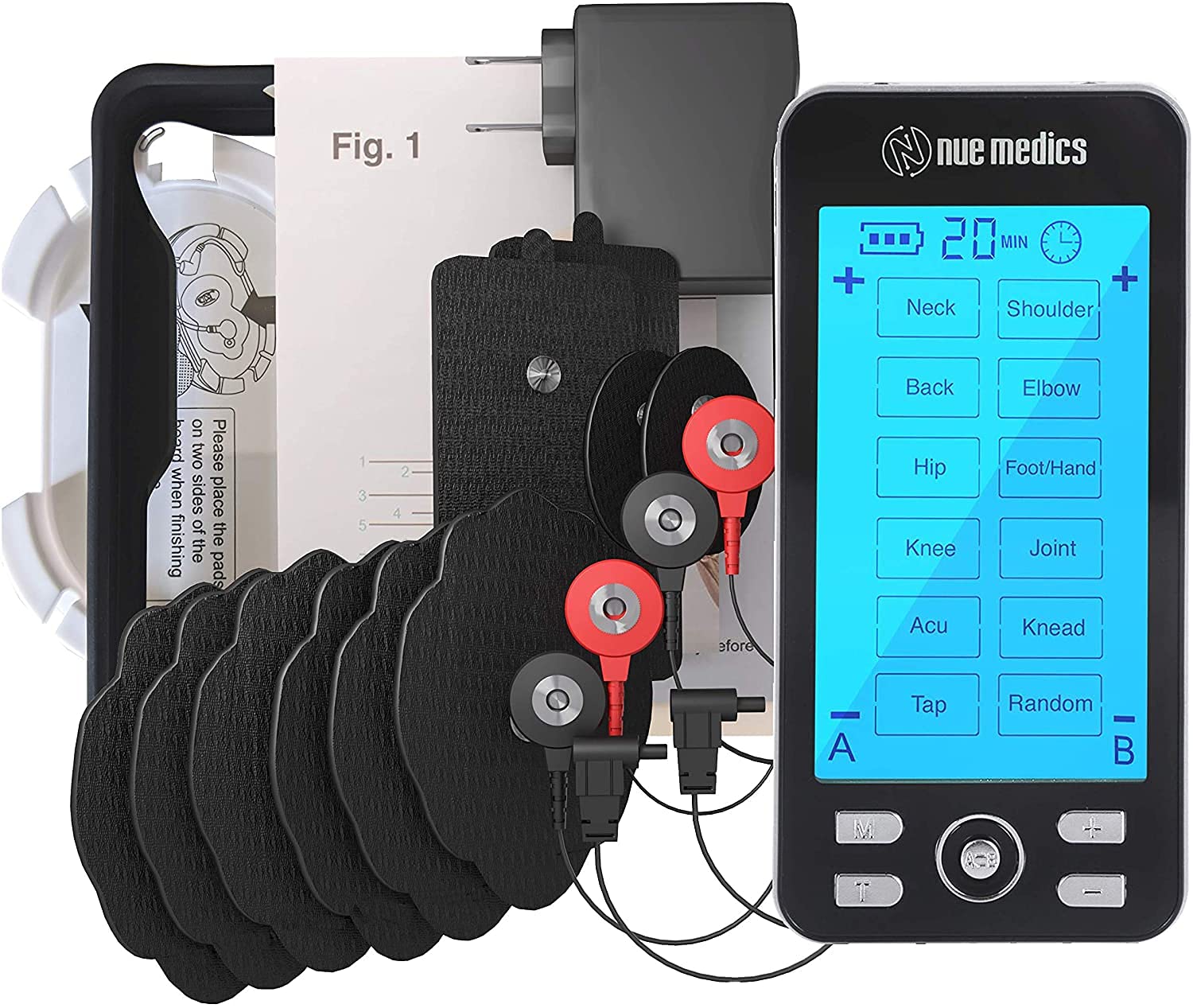
The intensity buttons on the Tens 24 stay locked until every pad is stuck to skin, and that one detail is why it leads this list. Anyone who has had an electrode peel loose mid-session knows the sharp jolt that follows. Here the unit simply won't deliver until contact is back.

Six large electrode pads come in the box, and for a back that matters more than any mode count: two of them bracket the spine at the level that aches, while the rest let you work a hip or shoulder in the same session. Two lead wires run both channels together, and the 24 programs cover the ground most people need — a steady pulse for a long session, a kneading pattern for tight muscle, a tapping one for the spot that flinches. It's our default for an ordinary sore back, and the unit we end up comparing the others against.

The controls are a plain keypad and a small screen, and the program names — Neck, Shoulder, Back, Knee and so on — at least tell you where the maker expects each one to be used. We ignored most of the list after the first week and settled into two programs, which is roughly what happens with every unit here.

Charging is USB-C with the wall block included, so there's no dedicated cable to keep track of. The pad and wire holder does more than it looks like it will: pads stored flat and dust-free keep their tack noticeably longer, and six large ones give you more room to rotate placement than the four-pad kits here.

Pros

  • Six large pads cover a lower back properly
  • Intensity stays locked until all pads are seated
  • Two leads run both channels together
  • USB-C charging with a wall adapter in the box

Cons

  • Program names don't describe how a mode feels
Our verdict

We think most people with a sore lower back should start here: six large pads, two channels, and a lock that stops the unit firing until every pad is seated.

Check Latest Price
2

Best for Long Sessions

TechCare Plus24

93 /100
Trail Score Outstanding

Key details

Battery
Up to 20 hours
Channels
Dual, independent
Programs
24 modes, 20 levels
Pads Included
10 in three sizes
Check Price on Amazon

TechCare rates the Plus24's built-in battery at up to 20 hours of continuous use, and that headroom is the reason to choose it over the other dual-channel units here. Two or three sessions a day for a week without hunting for the cable is a different kind of convenience. For anyone using a TENS unit on a schedule — a bad flare, a standing job, recovery from surgery — we think it's the easier unit to live with.

The trade-off is the menu. Twenty-four programs are grouped into four categories, so reaching the one you want means scrolling through a chain of screens, and the names don't tell you much about the feel of the pulse. We found our two settings and stayed there. The large LCD is genuinely good, though: big, bright and easy to check at a glance.

The pad kit is the most thoughtfully sized in this group: two large rectangles for the lumbar strip, six medium squares for the muscles either side of the spine, and two small pads for a neck or knee. Add the Type-C cable and wall adapter and there's nothing else to buy on day one. It's a nightstand unit rather than a pocket one, and it's happiest left plugged in beside the bed.

Pros

  • Battery rated for up to 20 hours of use
  • Large, readable LCD
  • Ten pads in three useful sizes
  • Channels set independently

Cons

  • Program menu takes a lot of scrolling
  • Too bulky to carry in a pocket
Our verdict

For daily sessions and long ones, this is our pick: a battery rated for up to 20 hours, a screen you can read at a glance, and ten pads in three sizes.

Check Latest Price
3

Best for Two Areas

AUVON Dual Channel TENS

93 /100
Trail Score Outstanding

Key details

Channels
Dual, independent
Charging
USB, rechargeable
Programs
20
Pads Included
4 large, 4 square
Check Price on Amazon

Two channels that can run different programs at different strengths is the AUVON's argument. A kneading pattern on the left side of your back at one level and a steadier pulse on the right at another, and the unit treats them as separate jobs — useful when one side of a back is markedly tighter than the other.

Four square pads and four large 2-by-4-inch rectangles come in the box, the right mix for a back, along with two lead wires, a pad holder and a USB cable. Twenty programs is plenty; we cycled through about six in the first week and now use two. Nothing about it asks for much: one hand, a wall outlet overnight, and a flat surface for the pads.

Where it gives ground is longevity. Of the units we recommend here, this is the one whose record on still working a year in is least settled, so buy it for the independent channels and the generous pad kit, and treat the warranty as part of what you're paying for rather than a footnote.

Pros

  • Each channel takes its own mode and strength
  • Four large 2-by-4 pads suit a back
  • Rechargeable and small enough to carry
  • Pad holder included for tidy storage

Cons

  • Long-term reliability is the least settled of our picks
Our verdict

Our pick when each side of your back needs its own treatment: independent channels, four large pads, and a body small enough to carry.

Check Latest Price
4

Best Kit

Belifu 24-Mode TENS

91 /100
Trail Score Outstanding

Key details

Extras
Bag and cable ties
Channels
Dual, independent
Programs
24 modes, 20 levels
Pads Included
10 reusable
Check Price on Amazon

Ten pads, a drawstring bag and reusable cable ties look like filler in a product listing; in practice they're what keeps a TENS unit usable. Gear like this fails in a drawer — pads pick up lint, leads knot into a ball — and the bag plus fastening ties are the difference between a kit you reach for and a tangle you avoid.

Underneath is a capable unit: 24 programs, 20 intensity steps, A/B channels you can set separately, and a lithium battery that charges from a wall block, a power bank or a laptop. We treated the first couple of sessions as practice, working through the buttons with the manual open, and after that the layout stopped needing thought.

Adhesion is where it asks for patience. The pads hold well when they're new and lose their grip as they pick up oil and lint, which is true of every TENS pad and the reason ten of them are worth having. Wipe the skin first, store them face-down on a clean surface, and the supply stretches much further than the number suggests.

Pros

  • Ten reusable pads in the box
  • Bag and cable ties keep leads tidy
  • Separate A/B channel settings
  • Charges from wall, power bank or laptop

Cons

  • Control layout takes a few sessions to learn
Our verdict

The tidiest kit here: ten pads, a bag and cable ties, plus 24 programs and separate channels in a body you can carry.

Check Latest Price
5

Best Budget

TENKER 24-Mode TENS

91 /100
Trail Score Outstanding

Key details

Channels
Dual output
Charging
USB cable only
Programs
24 modes, 20 levels
Pads Included
6 square, 2 large
Check Price on Amazon

The TENKER sits at the bottom of this group on price, and it isn't a stripped-out version of the others: 24 programs, 20 intensity steps, two output channels and a rechargeable battery all come as standard.

Two outputs mean two people can use it at once, or one person can work a lower back and a shoulder without swapping leads mid-session. The first two sub-modes hold a steady pulse instead of cycling through a pattern, which suits anyone who finds the kneading and tapping programs more distracting than soothing.

Small corners are cut. There's a USB cable in the box but no wall adapter, so plan on charging from a laptop or a spare phone brick. The screen is basic, the buttons are plastic, and nothing here feels expensive — none of which matters much once the pads are on and the current is where you want it.

For a first unit, a spare to leave at work, or a gift for someone who isn't sure TENS will do anything for them, this is the one we point to. It also carries a stated 12-month warranty, which matters more on an inexpensive unit than on a costly one.

Pros

  • Dual output for two areas or two people
  • Steady-pulse sub-modes for constant stimulation
  • Rechargeable with no battery purchases
  • Least expensive unit in this group

Cons

  • Only two large pads in the box
Our verdict

A sensible first TENS unit: two outputs, 24 programs and a rechargeable battery for the least money in this group.

Check Latest Price
6

Best for Full-Back Coverage

Etekcity 4-Channel TENS

93 /100
Trail Score Outstanding

Key details

Battery
Up to 7 days per charge
Channels
4, in A and B pairs
Eligibility
FSA and HSA eligible
Pads Supported
Up to 8
Check Price on Amazon

Four channels and up to eight pads is more coverage than anything else here, and for a lower back that aches across its whole width, that's the entire point. Put four pads around the painful area rather than two and you're treating the region instead of a spot.

The channels are grouped as A and B pairs, so you get two independent settings rather than four — each pair moves together, which is worth knowing before you count channels. In practice that still covers a strong program on the back and a gentler one on a shoulder at the same time, and the memory function holds your last setup so you aren't rebuilding it every evening. It's listed as FSA and HSA eligible too, which is worth checking against your own plan before you pay.

At 3.4 ounces with a bright LCD, this is the unit we reach for when the whole back is involved and one program won't cover it. Nothing else on this list will run eight pads at once, and for wide, diffuse lower-back pain that capability is worth more than a longer mode list.

Two things to plan around. The battery is rated at up to seven days per charge, and heavy daily sessions will have you reaching for the cable sooner than that — this is the unit to charge on a schedule rather than on instinct. The pads, meanwhile, are ordinary consumables on standard snap connectors, so buying a spare set at the same time is the sensible move.

Pros

  • Four channels drive up to eight pads
  • Memory function keeps your last setup
  • FSA and HSA eligible
  • Light enough to hold in one hand

Cons

  • Battery life is the least predictable part of it
Our verdict

The pick for pain that spans the whole lower back: four channels, eight pads, and a memory that keeps your settings between sessions.

Check Latest Price
7

Pocket Carry

MEDVICE 16-Mode TENS

93 /100
Trail Score Outstanding

Key details

Weight
4.8 oz
Battery
Up to 10 hours
Programs
16 modes, 20 levels
Pads Included
Large, medium and small
Check Price on Amazon

At 4.8 ounces and about the size of a deck of cards, the MEDVICE disappears into a shirt pocket, which is the whole reason to consider it. Start a session, walk to the kitchen, sit through a meeting — no cable, no brick, nothing to set down.

Sixteen programs with 20 intensity steps is a shorter menu than the 24- and 30-program units here, and we count that as a feature: fewer screens to page through when your back is already talking. What it doesn't give up is punch. The current is strong enough that most people will live in the bottom third of the range, so don't mistake the small body for a gentle one.

The battery is rated for up to 10 hours of continuous use, and the kit covers large, medium and small pads — the large ones being what you want on a back. It's happiest as the unit you keep in a bag or a desk drawer; for the couch, the bigger screen on the TechCare is easier to work one-handed.

Pros

  • 4.8 ounces, small enough for a shirt pocket
  • Short 16-program menu is quick to navigate
  • Strong output for its size
  • Pads in three sizes in one kit

Cons

  • Pad adhesive gives out before the unit does
Our verdict

For a unit that lives in a pocket or a work bag, this is our pick: light, simple, and stronger than its size suggests.

Check Latest Price
8

Fine Intensity Steps

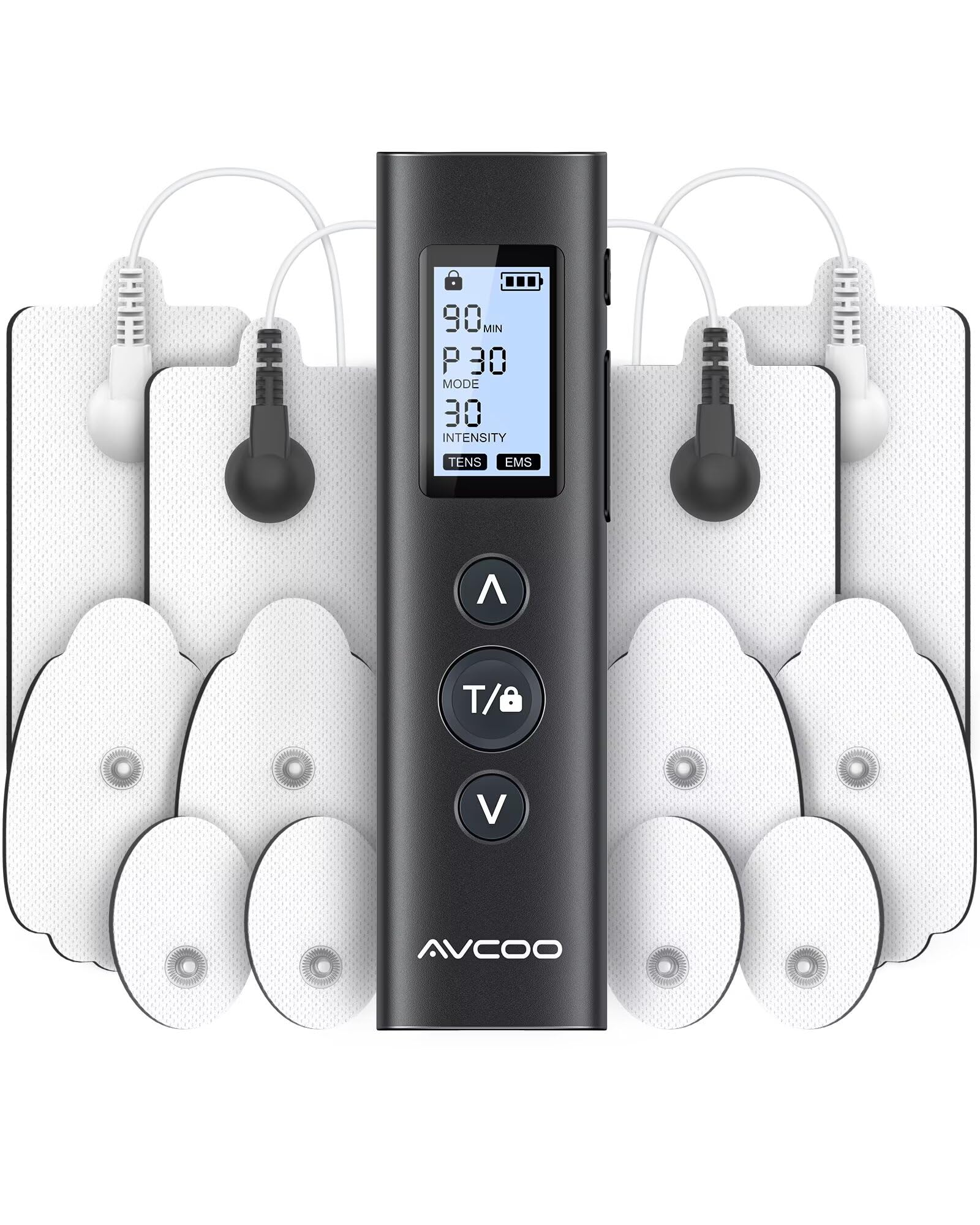
AVCOO 30-Mode TENS

93 /100
Trail Score Outstanding

Key details

Weight
0.09 lb
Battery
Up to 30 hours
Programs
30 modes, 30 levels
Pads Included
12 in three shapes
Check Price on Amazon

Thirty intensity levels is the spec that separates the AVCOO from most of this group, and it's not a marketing number. On a unit with fewer steps, the jump from one setting to the next can be the difference between a pleasant current and too much; more steps across the same range means a level you can sit with for half an hour.

It's also the slimmest thing here: 4.8 by 1.3 by 0.5 inches and about an ounce and a half, which makes it the one that vanishes in a jacket pocket. The interface picks a body area first and then a program, so you're choosing a back rather than decoding a program number, and it remembers where you left off between sessions.

Twelve pads in three shapes — four large rectangles, four palm-shaped and four ovals — is the most generous pad kit in this group, and the battery is rated for up to 30 hours of use. Treat that as a best case rather than a promise; it's the biggest claim here and the one that depends most on how hard you run it.

The case for it is a back that reacts to small changes in intensity, and a routine you want to run anywhere. It's the newest design here and the least proven, and the program list still needs a read-through before it makes sense — but for fine control in a shell this thin, nothing else here is as close a fit.

Pros

  • Thirty intensity steps give finer control
  • 0.09 lb and half an inch thick
  • Twelve pads in three shapes
  • Body-area interface with memory function

Cons

  • Program list needs a read-through before it makes sense
Our verdict

For fine control in a pocket-sized body, this is our pick: 30 intensity steps, twelve pads and the slimmest shell here.

Check Latest Price

How We Tested TENS Units for Back Pain

We started by pulling together the TENS units that show up most often in physical-therapy forums, retailer best-seller lists, and recommendations from a few practicing PTs, then narrowed the field to 14 models that covered a range of prices, channel counts, and pad sizes. We skipped anything with proprietary pads that cost more than the device itself, and we favored units with clear intensity controls and a rechargeable battery or standard batteries we could replace.

For four months, we used each unit on lower backs—mine and two colleagues’—during desk work, after long walks, and on the couch at night. We logged a 0-to-10 pain rating before and after every 20-minute session, noted whether relief lasted past the session, and wrote down how many sessions each unit ran on a full charge. We also handed the remote to someone who had never used a TENS unit and timed how long it took to go from power-on to a comfortable tingling sensation without checking the manual.

Pads got the most scrutiny. We stuck each set to the same lower-back spot, wore them through an hour of desk work, peeled them off, and counted how many sessions they survived before the edges curled or the gel stopped sticking. We tugged cords, clipped units to waistbands, and dropped them onto carpet to see how the casing and buttons held up. At the end, we compared what came in the box—extra pads, a case, batteries—against the price, because the pads are the recurring cost.

How to Choose a Tens Unit for Back Pain

Pads decide more than programs

The electrodes are the part that touches you, and for a back the useful shape is a rectangle about two by four inches. Two of those bracketing the spine cover the strip where most lower-back pain sits; the small squares in most kits are for a neck, elbow or knee. Count the large pads before you count programs — a 16-mode unit with two big rectangles does more for a back than a 30-mode unit with none.

Placement matters as much as size. Put pads either side of the ache rather than directly on the sorest point, and keep them at least an inch apart so the current travels through muscle instead of bunching under one electrode.

One channel or two

Channels are the number of circuits the machine drives, and the split matters because back pain is rarely symmetrical. Two independent channels let you run a kneading program at one strength on the left and a steady pulse at another on the right. A single channel with two leads sends the same signal to both sides.

Four channels, as on the Etekcity here, cover more skin at once but pair up for settings, so what you gain is area rather than extra adjustment. If your pain sits on one side only, save yourself the complexity.

Intensity steps beat mode counts

Twenty-four programs sounds like value until you've paged through them twice. What changes comfort far more is how many intensity steps sit between the floor and the ceiling: 20 is standard in this group, and the AVCOO's 30 gives finer ground. If you've tried a TENS unit and found one level too much and the one below too little, that's the specification to shop by.

Modes matter less in practice. Most people find a steady pulse and one kneading pattern and stay there, which is why a short menu is not the compromise it looks like.

Power, size, and where you'll actually use it

Rechargeable batteries have largely replaced the 9-volt in this group, and that's the right call for something you'll use twice a day. Rated runtimes run from about 10 hours to a claimed 30, which matters mainly if you travel or treat on a schedule.

Size is the other half of the decision. A unit that lives on a nightstand can be big and readable, while one destined for a pocket should weigh under five ounces and come with a pouch. Decide which habit is yours before you compare anything else.

Frequently Asked Questions

Final Verdict

Start with the NueMedics Tens 24. Six large pads, two leads and an intensity lock that keeps the unit quiet until every electrode is seated make it the most forgiving choice for a sore lower back, and the controls stay out of your way once you've found two programs you like.

Shop differently if you have a specific habit. Pain that needs a different treatment on each side points to the AUVON dual-channel unit; pain spread across the whole lower back, or a back plus a shoulder at once, points to the Etekcity four-channel unit and its eight pads. Each gives something up — the AUVON in long-term certainty, the Etekcity in charge per session — but neither has a rival here for what it does.