Best Infrared Heating Pads for Back Pain

A far-infrared heating pad sends heat into the tissue just under your skin rather than warming the air around you, so the good ones feel like a deep, steady warmth instead of a hot water bottle pressed to your back. The catch is that the label is easy to slap on — plenty of pads sold as infrared are just a coil in a soft cover, with one hot spot in the middle and cool corners.

I've spent enough bad-back weeks on frozen peas to have firm opinions about what a heating pad owes you: even heat corner to corner, a controller you can read without your glasses, and a timer that quits before you do. My team and I used 12 infrared back pads over the past eight months, through long desk days and slow evenings on the couch. One thing that surprises first-time buyers is that infrared takes a few minutes longer to feel hot than a conventional pad, but it holds steadier once it does. The picks below got all of that right.

1

Best Overall

UTK Far Infrared Heating Pad for Back

89 /100
Trail Score Excellent

Key details

Weight
4.5 lb
Dimensions
15.75 x 23.43 x 0.39 inches
Stone Fill
Natural jade and tourmaline
Heating Range
103°F to 159°F (±1°F)
Check Price on Amazon

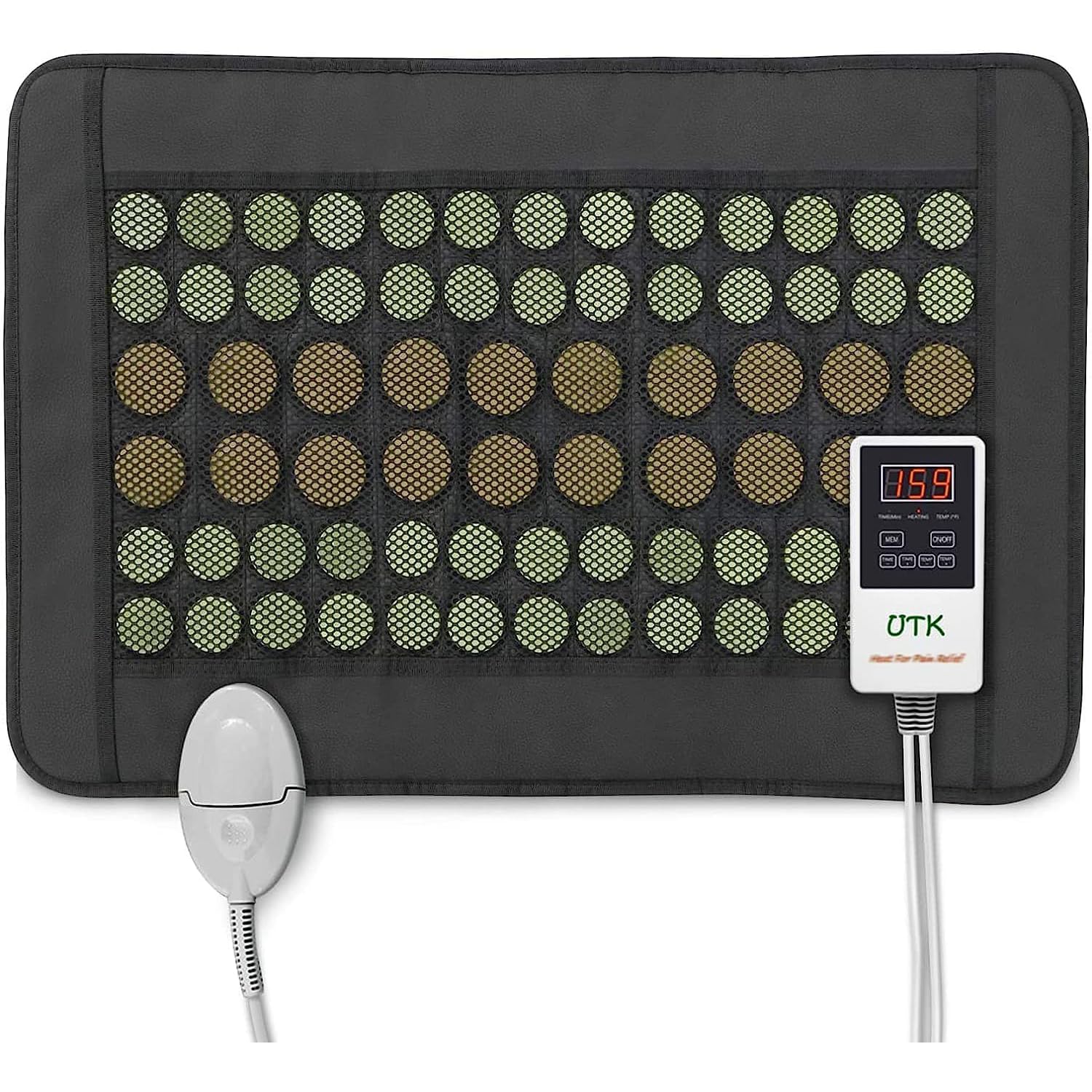
The number that matters here is 159 — the top of this pad's range and, along with the UTK belt, the highest ceiling in this group. What we appreciated just as much is the step between settings: you choose any temperature from 103°F to 159°F and it holds within a degree, instead of the three or four presets most pads offer. Back pain isn't the same two days running. Some evenings you want heat you can feel through a sweatshirt; others you want a low, steady warmth to lean into while you read, and being able to dial in the exact middle is what turns a heating pad from an occasional thing into a nightly habit.

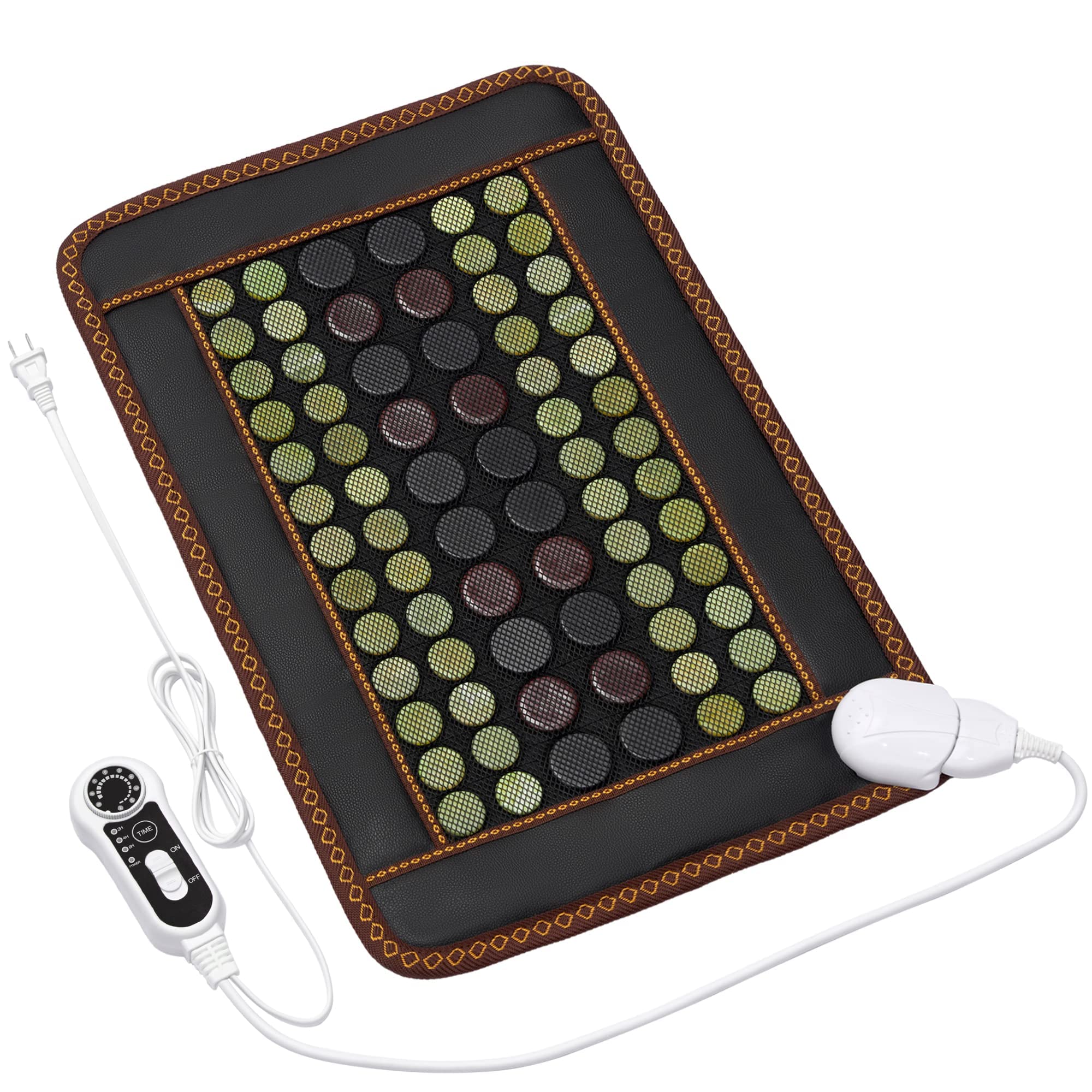
Coverage is the other reason it's our default. The mat is roughly 23 by 16 inches, so it lays across the whole lower back and reaches between the shoulder blades when you sit back against it, and it's filled with jade and tourmaline rather than a wire alone. The 4.5 pounds keeps it where you put it — no chasing it up your spine — and we noticed the stones keep giving off warmth for a few minutes after the element cycles off. There's an auto shut-off and almost no EMF across the heating area, which we were glad to see given how long sessions tend to run.

What it isn't is soft. You're lying on stone, and on a thin lower back you can feel individual pebbles, so keep a thin towel between you and the jade — thick enough to cushion, thin enough that the heat still comes through. If the appeal of a heating pad for you is sinking into something plush on the couch, the Bob and Brad pad is the shape you want instead. This one is a wide, firm slab of controllable heat, and it rewards people who use it that way.

Pros

  • Single-degree control from 103°F to 159°F
  • Roughly 23 x 16-inch mat covers the whole back
  • 4.5 pounds of jade and tourmaline hold heat and stay put
  • Auto shut-off and near-zero EMF in the heating area

Cons

  • Controllers and elements can fail within the first year
Our verdict

If you want to fine-tune the heat across a wide area, this is the pad to buy: single-degree control, whole-back coverage, and enough weight to stay put.

Check Latest Price
2

Best Full-Body Coverage

HealthyLine Far Infrared Heating Mat

88 /100
Trail Score Excellent

Key details

Weight
14 lb
Controls
Memory function and auto shut-off
Dimensions
72 x 24 x 1.2 inches
Stone Fill
Jade and tourmaline
Check Price on Amazon

Seventy-two inches long and 14 pounds heavy isn't a heating pad in the throw-it-on-the-couch sense. It's a mat you commit to, and for a bad back that's the point: lie down on it and it runs from your hips to your shoulders, with 24 inches of width to spare and 1.2 inches of stone between you and the bed.

The jade and tourmaline are what you're paying for. They heat slowly and then radiate, and the warmth is the kind you can stay on for an hour without your skin feeling scorched — we were surprised by how long a session we took at a moderate setting without wanting to move. The controller has a memory function, so it comes back on at your last temperature, which sounds like a small thing until you're resetting it every night, and an auto shut-off runs behind it.

Where it earns its keep is night pain: lying flat on a long mat does more for a mid-back ache than draping a small pad over a chair. Two things to know before you commit. It's deliberately firm, so it wants a supportive surface — a decent mattress or the floor — and it doesn't drape the way a smaller pad does. And the electronics are the risk rather than the stones: cords and controllers quitting in the first weeks is the failure to watch for, so run it hard inside the return window before you come to rely on it at 2 a.m.

Pros

  • Full-length 72 x 24-inch coverage
  • Stone heat you can stay on for an hour
  • Controller memory keeps your last setting
  • Firm 1.2-inch stone build with heat-resistant mesh

Cons

  • Firm 14-pound mat needs a supportive surface
Our verdict

For back pain that's worst at night, this is the one: a long, firm stone mat you lie flat on, with the deepest coverage here.

Check Latest Price
3

Best Budget

Bob and Brad TheraHeat Weighted Heating Pad

84 /100
Trail Score Excellent

Key details

Power
85W
Weight
2.4 lb
Cord Length
8.2 ft
Heat Settings
6 settings, 100°F to 150°F
Check Price on Amazon

Soft is the first impression — brushed flannel, not stone — and weight is the second: 2.4 pounds of ceramic beads sewn in, enough that it stays draped over a shoulder or a hip without a strap doing all the work. That combination is what makes it the pad for someone who wants heat while watching TV rather than a scheduled therapy session.

Six settings cover 100°F to 150°F, the timer runs 30, 60, or 90 minutes, and the cord is 8.2 feet, long enough to reach the couch from the outlet behind it. The feature no other pad in this group has is moist heat: mist the flannel lightly and the warmth turns humid and seems to sink in differently. We liked it more than the ceramic-bead design suggests — it's the closest thing here to a hot towel.

Where it gives ground is presence and top-end heat. A flannel pad this light drapes where you put it rather than holding a wide plane against your back, so you'll adjust it more than you adjust the jade mats, and the 150°F ceiling is a gentle warmth rather than the fierce heat the UTK pads deliver — if you like a pad that makes you flinch for a second, this isn't it. For everyday, portable warmth none of that matters much. It's also the cheapest way into far-infrared here, which for a first pad is a sensible place to start.

Pros

  • Soft flannel over 2.4 pounds of ceramic beads
  • Moist-heat option by misting the fabric
  • 8.2-foot cord reaches across a room

Cons

  • Top-end heat is gentle, not fierce
  • Timer stops at 90 minutes with no stay-on mode
  • Connector and element failures within months
Our verdict

The couch pad: soft flannel, 2.4 pounds, six heat settings, and a moist-heat option none of the others here offer.

Check Latest Price
4

Best Hands-Free Belt

UTK Massage Far Infrared Heating Belt

84 /100
Trail Score Excellent

Key details

Weight
2.2 lb
Max Heat
159°F
Dimensions
55.12 x 8.66 x 0.79 inches
Stone Fill
20 natural jade stones
Check Price on Amazon

Every flat pad here has the same flaw — it slips, and you spend the session hitching it back into place. The UTK belt answers that with a strap: 55 inches of it, long enough to sit around the waist and fasten, so the heat stays on your lower back while you stand at the counter, fold laundry, or work at a desk.

The heating half is the same technology as our top pick: 20 natural jade stones, a top temperature of 159°F, and a digital controller with one-button start and memory. We came back to the vibration more than we expected to — it's a gentle buzz over the lumbar area rather than a massager, and it does more for the fidgety feeling of sitting still than for the pain itself. For a parent or grandparent who finds small buttons confusing, that one-button start is the detail that makes this one usable without help.

The limit is width. The belt is 8.66 inches deep, so it treats a band across your lower back and nothing else — no shoulder blades, no mid-back — and the heating area stays that size even though the strap fits a wide range of waists. If your ache wanders, a mat is the better tool. If it sits low and you'd rather not lie down for it, this is the only pick here that keeps working while you get on with your day.

Pros

  • Stays on your lower back while you move
  • Reaches 159°F with a digital controller
  • 20 jade stones plus lumbar vibration
  • Strap fits a wide range of waists

Cons

  • Only 8.66 inches deep, so it treats a band
Our verdict

If your ache sits low and you'd rather not lie down for it, this belt delivers 159°F jade heat and gentle vibration hands-free.

Check Latest Price
5

Long, Gentle Sessions

Fencholist Jade Far Infrared Heating Pad

84 /100
Trail Score Excellent

Key details

Timers
2, 4, or 6 hours
Mat Size
23.6 x 15.7 in
Stone Fill
72 jade and tourmaline stones
Heat Settings
9 settings, 59°F to 131°F
Check Price on Amazon

The spec that decides this one is 131°F. That's the top of its nine settings, and it's a long way below the 159°F the UTK pads reach, so treat it as a pad for gentle, long, even warmth rather than heat you can feel through a sweater. If your back likes a low, constant temperature for an hour, that ceiling isn't a limitation at all; if you want deep heat, it will frustrate you.

What it does well is the long session. Three timer settings run two, four, or six hours — far longer than the 30 to 90 minutes on the soft pad here — and the 72 jade and tourmaline stones spread warmth across a 23.6 by 15.7-inch mat without hot spots. Stone-filled pads take longer to come up than a wire pad, so give it ten or fifteen minutes before you judge it.

We think the trade is fair. You give up the fierce top end and get long, even sessions with a stated one-year warranty, which counts for something on a pad that sits against your spine for hours. The stones are firm under a bare back, so a thin towel helps; beyond that, this is the quiet, unfussy jade mat to buy if the UTK's price or its hotter settings put you off.

Pros

  • Nine temperature steps with simple controls
  • Timers run two, four, or six hours
  • 72 jade and tourmaline stones across a wide mat
  • Stated one-year warranty

Cons

  • 131°F ceiling rules out deep, fierce heat
Our verdict

A solid choice for long, low-heat evening sessions, and the one jade mat here with a stated one-year warranty.

Check Latest Price

How We Tested 12 Infrared Back Pads Over Eight Months

We started with research, not a shopping cart: I pulled every infrared back pad I could find from the established heat-therapy brands and compared listed wattage, surface dimensions, timer steps, auto-shutoff behavior, and whether each carried an independent safety certification. Anything uncertified came off the list, as did pads too small to cover a lower back. That left 12, all bought at retail so no brand could send us a handpicked unit.

Each pad then lived where a heating pad actually lives for the next eight months: strapped to a desk chair through the workday, flat on the couch after an evening walk, and wrapped around a lower back during floor stretches. Sessions ran at least 20 minutes, and I rated my back before and after each one to see whether the relief outlasted the timer.

For heat, we took surface readings with an infrared thermometer at five points across each pad at 5, 15, and 30 minutes and noted which corners lagged, then timed how long each took to reach its set temperature and counted the available settings and timer steps. Controllers got adjusted in a dark room to see whether they worked by feel. Fit we checked with a tape measure against the listed dimensions, then wrapped each pad around two testers of very different heights, seated and lying down, to see whether it shifted. Comfort came down to fabric against bare skin and whether the pad felt lumpy under a back. Over the months we folded and flexed each one, tugged the cord at the connector, washed removable covers as directed, and logged every error code and dead unit. Value was the last filter: what a pad offered at its price versus everything else on the table.

How to Choose an Infrared Heating Pad for Your Back

Start With the Top Temperature

Far-infrared pads heat a mass — jade, tourmaline, ceramic beads — and radiate from it, so the number at the top of the range tells you more about the experience than any claim on the packaging. Across this group the ceiling runs from 131°F to 159°F, and that gap is the difference between a pad you lie under for an hour and one that has you shifting after ten minutes.

Buy a little more headroom than you think you need. You can always turn a 159°F pad down to 120°F; you can't push a 131°F pad past its ceiling. The step between settings matters too — a single-degree dial lets you find the setting that's strong without being punishing, where three presets make you settle for close enough.

Match the Shape to Where You'll Be

A flat mat is for lying or leaning. It covers the most area, and the wide ones span a lower back and reach up between the shoulder blades when you sit back against them. A belt is for staying upright: you fasten it and keep working, but it treats a band a few inches deep and nothing else. The full-length mats go further still, running hips to shoulders for someone who lies flat.

Be honest about which one you'll do. The pad that lives on the bed gets used nightly; the one that requires you to lie down for twenty minutes in the middle of the afternoon often doesn't.

Weigh Stone Fill Against Softness

Jade, tourmaline, and ceramic beads hold heat and release it slowly, which is why stone pads feel different from a wire-and-fleece pad: the warmth keeps arriving after the element cycles off, and it feels less like surface heat. The cost is weight and firmness. A four-and-a-half-pound mat stays where you put it; a fourteen-pound one doesn't move at all, and you feel individual stones through a shirt.

A thin towel fixes the stones without blocking the heat — thick enough to cushion, thin enough that you still feel warm. If plush matters more than depth, buy flannel and accept a lighter, milder pad.

Check the Timer, the Controls, and the Cord

Auto shut-off is standard on these pads, but timer length isn't: 30 to 90 minutes on the soft pads here, two to six hours on the jade mats. Long timers suit low temperatures and evening sessions; short ones suit high heat. If the pad is for someone with arthritis, look at the buttons — one-button start and a memory function make a real difference at night.

Cord length decides where you sit. Measure from the outlet to your usual spot before ordering; 8.2 feet is generous, and a short cord quietly relocates your whole evening.

Expect the Controller to Be the Weak Point

When these pads fail, it's usually the controller or the heating element rather than the fabric or the stones. That isn't a reason to skip one; it's a reason to buy where returns are easy. Run it for two long sessions in the first week, keep the receipt, and note the warranty term before you come to depend on it — one pad here states a full year, and the rest leave you to ask.

Frequently Asked Questions

Final Verdict

Buy the UTK far-infrared pad. It has the widest spread of useful heat — 103°F to 159°F in single-degree steps — across a mat wide enough for a whole lower back, and the stone fill keeps radiating after the element switches off. Nothing else here gives you that much control over where the heat lands.

If your pain is worst when you lie down, the HealthyLine mat runs hips to shoulders and is built to be stayed on. If you want heat while you're up and moving, the UTK belt is the one that stays on. And if softness matters more than depth, the Bob and Brad pad is the easiest of the five to live with.