Best Suspension Trainers of 2026

Hanging your bodyweight from a strap wedged in a doorframe is enough to make anyone pause. A suspension trainer is only as good as its anchor, buckles, and the webbing between them; a slipping cam or frayed strap turns a workout into a repair project. A good one fixes that: full-body strength work anywhere there's a door or beam, no gym required. Over eight months, our team put 12 suspension trainers to work at home, in hotel rooms, and in a backyard.

The best ones weren't the flashiest. They had wide, grippy webbing, cam buckles that locked without a fight, and anchors that adjusted in small increments so you could find the same starting position every time. Several arrived with instructions closer to a parts diagram than a setup guide—a real hurdle. I judged value by how much actual training you could do—rows, presses, split squats, core work—not by the accessory count, and I only trusted portability once the setup felt safe to hang from. The picks below are the ones I trust in my own doorway.

1

Best Overall

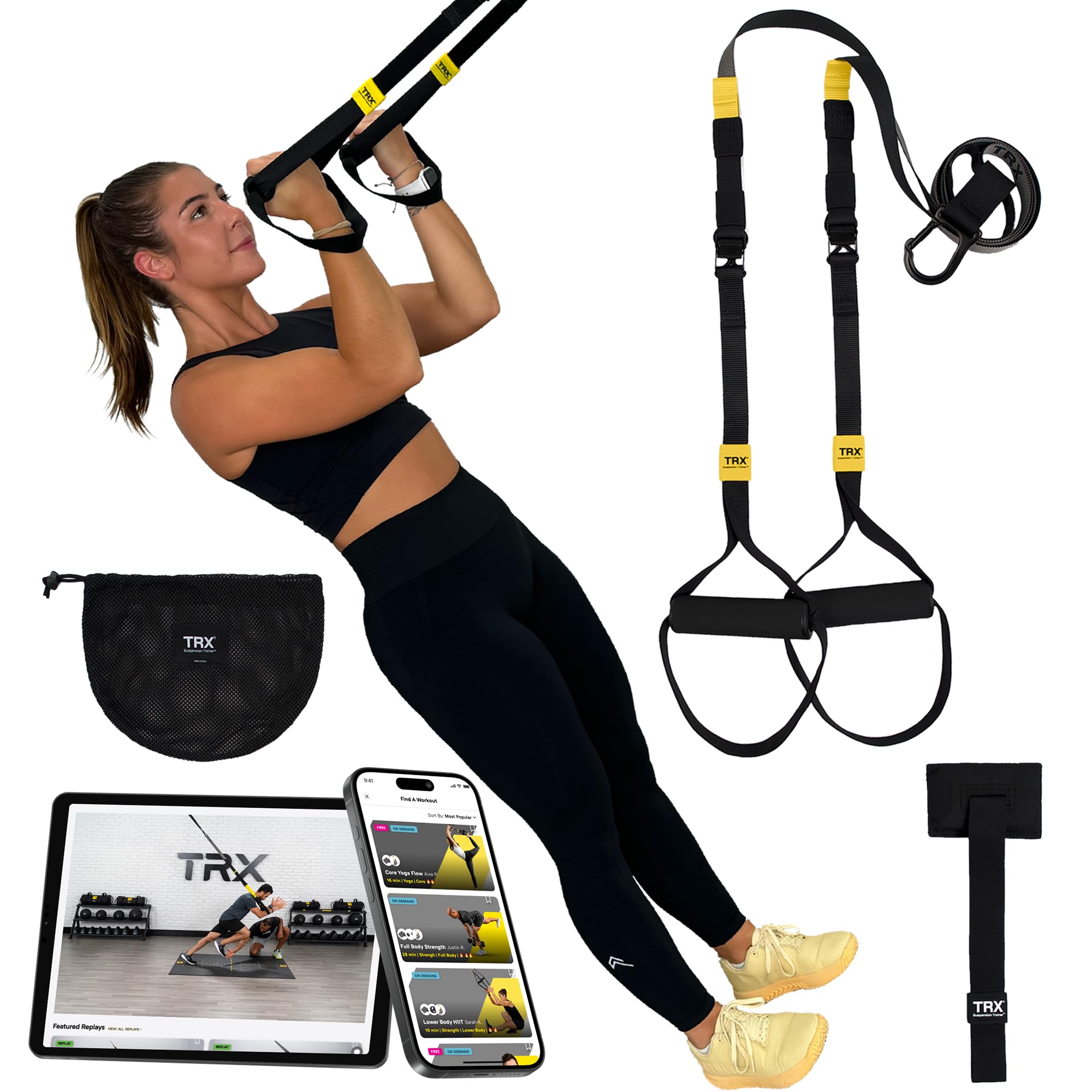
TRX All-In-One Home Gym

96 /100
Trail Score Outstanding

Key details

Weight
1.7 lb
Anchors
Door, beams, trees, posts
Max Load
700 lb
Warranty
1 year
Check Price on Amazon

A 700-pound safety rating is the number that settled this one for us. It's twice the rating on the cheaper TRX GO and nearly three times the Bodytorc's 250 pounds, and it covers the whole system rather than just the webbing. For a heavier lifter, or for anyone who likes explosive rows and jump squats, that headroom is the difference between a strap you lean back into and one you treat gently.

What else the extra money buys is a box that covers both places you'll hang it: a door anchor for the apartment and a separate anchor for a tree, pole, or post, so the same strap goes to the park on Saturday. We counted the printed material as a real feature rather than filler. A 65-minute DVD, a 35-page workout guide, and a couple of bonus circuits give a beginner somewhere to start on day one, and that matters more than it sounds if you've never used straps before.

At 1.7 pounds it folds into its mesh bag and disappears into a duffel, which puts it in the same weight class as the TRX GO — the difference between those two is the load ceiling and the programming, not the packing. One practical note: the mesh bag is for carrying rather than protecting, so pack the strap against something soft. Otherwise this is a kit that stays rigged on a door and gets used, which is more than we can say for most home equipment.

Pros

  • 700-pound rating, the highest here
  • Door and outdoor anchors both included
  • Printed DVD, guide, and bonus workouts
  • 1.7 pounds with a mesh carry bag

Cons

  • Costs more than every other pick here
Our verdict

The kit we keep set up on a door: 700-pound-rated, anchored indoors or out, and packed with a printed program worth following.
Check Latest Price
2

Best Value

TRX GO

95 /100
Trail Score Outstanding

Key details

Weight
1.5 lb
Anchors
Indoor and outdoor
Max Load
350 lb
Warranty
3 years
Check Price on Amazon

The surprise here is the weight. The GO comes in at 0.68 kilograms against the All-in-One's 1.7 pounds, which is close enough that nobody would notice the difference in a bag — if you assumed the cheaper TRX was the pared-down ultralight, it isn't. You get the same two anchors, one for a door and one for a tree or post, and the same mesh carry bag.

The three-year warranty is the longest stated on any strap in this group, and on gear you hang your body weight from that's worth more than a longer feature list. We also liked the foam handles, which stayed comfortable through high-rep rows where hard-coated grips start to bite. Wipe them down after a sweaty session rather than stuffing them damp into the bag.

Where it lands for us: this is the TRX kit we hand to someone who trains at home a few times a week and takes the straps on a trip now and then. It packs the same as the All-in-One, costs less, and the warranty runs longer. The All-in-One earns its premium with a printed program and bonus workouts in the box; if you want a coach included, that's the upgrade. For everyone else this is the better buy of the two.

Pros

  • Packs the same as the top pick
  • Three-year warranty, longest in this set
  • Indoor and outdoor anchors included
  • Foam handles stay comfortable

Cons

  • 350-pound rating is half the top pick's
Our verdict

Nearly the same weight as our top pick for less money, with a three-year warranty and both anchors in the bag.

Check Latest Price
3

Best for Wide-Angle Work

Lifeline Jungle Gym XT

91 /100
Trail Score Outstanding

Key details

Weight
16 oz
Anchors
Two non-scuff door anchors
Adjustment
Cam-style locks
Anchor Design
Patented split anchor
Check Price on Amazon

The split anchor is the reason to look at this one. Instead of a single strap dividing into a V, each side anchors on its own, so you can set the straps narrow for presses, shoulder-width for rows, or wide for flys. We found the wide position the most useful of the three — it turns a chest fly into something closer to a cable machine than an approximation of one.

Two non-scuff door anchors come in the box, where the other kits here give you one, and the straps also loop-and-cinch over a bar, beam, or tree limb. At 16 ounces it's the lightest kit in this group by a wide margin: it lives in a gym bag and you forget it's there. The cam-style adjusters move fast enough that we reset the length between sets instead of leaving it where the last exercise put it.

What's missing is coaching. The kit is straps and anchors, with no workout program included, so you'll be sourcing exercises yourself — fine if you already know your way around straps, a real gap if you don't. Set against that, it does most of what the TRX kits do for a good deal less money, and it does the wide-angle work they can't. For anyone past the beginner stage, that's a trade worth taking.

Pros

  • Split anchor allows wide, narrow, and neutral angles
  • Two door anchors, where the others include one
  • Lightest kit here at 16 ounces
  • Cam adjusters reset length quickly

Cons

  • Cam buckle can loosen under load; check it seats
Our verdict

Two independent straps instead of one V, so you can press, fly, and row at angles a single anchor pulls you out of.

Check Latest Price
4

Best for Custom Setups

Bodytorc Suspension Trainer

90 /100
Trail Score Outstanding

Key details

Weight
3.4 lb
Handles
Detachable
Max Load
250 lb
Adjustment
Anodized cam buckles
Check Price on Amazon

Detachable handles are the detail that separates this kit from the pack. Unclip them and the strap ends take ropes, a straight bar, or whatever handle you prefer; the same clips let you swap the handles out for foot cradles when you're working hamstrings. The two straps are completely separate rather than joined at a single point, so hanging them off a chin-up bar keeps both sides vertical instead of pulling inward.

Length markings stitched onto both straps are the thing we appreciated most in use. Matching left and right by eye is the small annoyance that makes people stop adjusting between sets, and the markings cut it down to a glance. The anodized cam buckles held where we set them, and the whole kit packs into a bag small enough for a trunk.

The heel hooks are the one fiddly part: they take a moment to get onto a foot, especially in socks, so loop them on while you're sitting down rather than hopping around on one leg. At 3.4 pounds this is the heaviest kit here, and that's the price of the extra hardware and the two fully separate straps. It's also the most flexible option in its price range, which is why it's the one we suggest to people who already own a bar and a rope.

Pros

  • Detachable handles accept ropes and bars
  • Length markings make matching sides quick
  • Straps hang vertical off a chin-up bar
  • Anodized cam buckles hold their setting

Cons

  • 250-pound rating is the lowest in this set
Our verdict

Separate straps, detachable handles, and length markings on both sides make this the kit for anyone who wants to hang extra attachments.

Check Latest Price
5

Rental Apartments

OUUO Suspension Straps

90 /100
Trail Score Outstanding

Key details

Shell
TPE over steel core
Anchor
Built-in door anchor
Weight
1.98 lb
Strap Length
75 in
Check Price on Amazon

No separate anchor loop to thread is the whole idea here, and it works. The anchor is built into the top of the strap, so you drape it over the door, shut the door, and pull — nothing to clip on, nothing to lose at the bottom of a bag. We hand this to someone in a rental without a second thought: the section that meets the door and frame is a soft TPE shell over a steel core, built to keep a painted surface from scuffing.

The carabiner at the bottom is exposed, which keeps the kit from being door-only: clip on an extension strap and the same setup reaches a beam, a pull-up bar, or a low branch. Both straps mount independently on that anchor, so you adjust left and right separately instead of sliding a single loop back and forth. At 900 grams it's light enough to leave hanging between sessions.

Seventy-five inches is on the short side. That's plenty for door work, where the strap only has to clear the top of the door and reach your hands, but a high rafter or a thick branch will want an extension strap in the bag. Set against the TRX kits it's a simpler system with less reach, and for a rented apartment that's usually the right trade.

Pros

  • Built-in door anchor, nothing to thread
  • Soft TPE shell protects doors and frames
  • Carabiner takes extension straps and bars
  • Straps adjust independently left and right

Cons

  • 75-inch straps are short for high anchors
Our verdict

The door anchor is built into the strap, so there's nothing to thread or lose — the one we hand to anyone in a rented room.

Check Latest Price
6

First-Timer Kit

Moulyan Training Straps

90 /100
Trail Score Outstanding

Key details

Weight
2.65 lb
Material
Nylon
Kit Contents
Two straps, door anchor, extension strap, guide
Check Price on Amazon

The kit list is the reason this one is here: two adjustable straps, a door anchor, an extension strap, and a training guide. The extension strap is the piece that matters — it turns a door-only setup into something you can loop around a beam or a thick branch, which is what a garage or a backyard actually asks for.

The nylon webbing and metal buckles are the honest parts. Because the two straps are separate rather than joined, they hang straight off a beam, and the door anchor is a plain webbing loop that packs flat in a bag. Set both sides against a wall the first time you rig it so you start even. At 1.2 kilograms it's light enough to keep in the car.

Our read is that this is a try-it kit. If you're not sure suspension training will stick, it teaches you the movement — the lean-back angle, the wobble, the way a row finds your midsection — for the least money on this page. If it does stick, you'll graduate to one of the kits above, and this becomes the set that lives in the garage.

Pros

  • Extension strap included for beams
  • Two separate straps, not a joined V
  • Light enough to keep in the car

Cons

  • Hard-coated handles, no padding
Our verdict

The least expensive way to find out whether suspension training sticks: two straps, a door anchor, and an extension strap, with nothing wasted.

Check Latest Price

How We Chose and Tested the Best Suspension Trainers

We started by gathering the suspension trainers that kept surfacing in customer reviews and training forums, then narrowed the field by anchor type, strap width, buckle design, and price. We left out systems that required permanent ceiling mounts or proprietary anchors; the goal was a fair spread of portable, door-anchored options. The final shortlist was 12 trainers, which we used for eight months in living rooms, hotel rooms, a backyard, and a garage gym.

Every trainer got the same first test: I hung it in a doorway, set the straps to a neutral starting length, and did a set of rows, presses, and split squats. I noted whether the anchor shifted under load, whether the cam buckles held without creeping, and whether the webbing stayed flat instead of twisting. Strap adjustment was timed with one hand and then with two, because a system that fights you between exercises is a system you stop using. I also read the included instructions—or tried to—and logged where setup got confusing, since several models assume you already know how a suspension trainer works.

Durability and portability got their own passes. After each session, I checked the webbing for fraying, the stitching for pulls, and the buckles for cracks; then I packed the trainer back into its bag and carried it on a walk to see whether it was genuinely portable or just technically foldable. For value, I compared what each system included against how much real training it supported—not the accessory count. The trainers that scored highest were the ones I stopped thinking about mid-set: the anchor stayed put, the straps moved when I wanted them to, and nothing needed re-rigging between exercises.

How to Choose a Suspension Trainer

Start With What You Can Hang From

The anchor decides more than the strap does. A door anchor sits over the top of a closed, latched door and depends on the door resisting a sideways pull, so it only works on a hinged door that swings free and shuts firmly. A hollow-core door isn't built for that load, and sliding doors and doors with a self-closer leave you no gap. Loop-and-cinch straps wrap a beam, bar, or branch instead, which is the better answer in a garage or a park.

If a doorway is your only option, buy a kit designed around one. The OUUO's anchor is sewn into the strap; the TRX kits give you a separate door anchor plus an outdoor one. If you plan to wrap a beam, look at it first — the strap has to go all the way around, and a wide, deep beam can eat more length than you expect.

Read the Load Rating as a System

Ratings in this group run from 250 to 700 pounds, and they cover the strap, anchor, and buckles together rather than just the webbing. A controlled bodyweight row puts a fraction of your weight through the system; a jump squat or a hard, fast fly puts far more. If you're near the top of a rating, or you train explosively, take the higher number — the TRX All-in-One's 700 pounds gives the most headroom here, the Bodytorc's 250 the least.

A high rating doesn't make a better trainer. It makes a more forgiving one, and the trade is usually weight and cost. A 350-pound kit is plenty for most people doing smooth, controlled bodyweight work.

Single Anchor or Split Anchor

A single anchor gathers both straps into a V. Setup is quicker, the two sides stay matched automatically, and for rows, squats, split squats, and planks it's all you need.

A split anchor mounts each strap separately, as on the Lifeline and the Bodytorc. That buys angle changes — narrow for pressing, wide for flys — and keeps both straps vertical when you hang them off a chin-up bar. It also means twice as much adjusting. If pressing and fly work are why you're buying, the split design is worth the extra fiddling; if you're building a pulling and legs routine, it isn't.

Adjusters and Length Markings

You'll change the strap length more often than you expect, because every exercise has its own sweet spot. Cam buckles release and grip in one motion and are the quickest design in this group; cinch-style adjusters want two hands and some patience. Markings on both straps, as on the Bodytorc, let you match sides without measuring against your chest every time.

Two traps to know. Load the strap before the buckle teeth have seated and it can creep, so give the tail a tug before you lean back. And match both sides by eye whenever you change anything — a strap slightly longer on one side quietly turns a symmetrical exercise into a lopsided one, which is how people end up sore on one side only.

Weight, Handles, and What's in the Box

Packed weights here run from 16 ounces to 3.4 pounds, and the difference is hardware rather than quality. The light kits are the ones you take places; the heavier ones have more metal in the buckles and two fully separate straps. Handles matter daily: foam grips are kinder over high reps, and hard plastic is fine for legs and core, where your hands do less work.

Check what comes in the bag, too. A printed guide or DVD earns its place in the first month, and a longer warranty is worth real money on gear you hang your body weight from — the TRX GO's three years is the longest here, against one year on the TRX All-in-One.

Frequently Asked Questions

Final Verdict

For most people, the TRX All-in-One is the one to buy. The 700-pound rating gives it more headroom than anything else in this group, the door and outdoor anchors cover the apartment and the park, and the printed program means your first month isn't guesswork.

Two swaps worth knowing about: the TRX GO does most of the same job with a three-year warranty and a lower load ceiling, and the Lifeline's split anchor reaches the pressing and fly angles neither TRX kit can.