Best Spin Bikes for Home of 2026

The fear with a home spin bike is that it becomes an expensive clothes rack—wobbly, noisy, and impossible to adjust once it's built. The right one makes the ride feel solid enough that you forget you're not in a studio; the frame stays planted when you stand, the resistance changes smoothly, and the fit works for everyone in the house. I've been riding at home for years, and the details that matter most aren't the flashiest screen or the heaviest flywheel. Over eight months, my team and I rode seven spin bikes hard, and the differences showed up fast.

Assembly was the first reality check: some bikes went together in under an hour with labeled parts, while others had me chasing bolts. Once built, I noticed comfort on longer rides, whether the saddle and handlebars slipped, how loud the ride was before anyone else woke up, and what the money actually bought. The picks below are the ones that stayed sturdy, quiet, and worth it months in—not just on day one.

1

Best Overall

pooboo Magnetic Exercise Bike

91 /100
Trail Score Outstanding

Key details

Drive
Belt
Resistance
100-level magnetic
Fits Heights
4.9 to 6.3 feet
Weight Capacity
350 lb
Check Price on Amazon

A home bike usually has to fit more than one person, and this one covers 4.9 to 6.3 feet of rider, among the widest spans in this group. Seat and handlebars both move, so a 5-foot-2 rider and a 6-foot-2 partner can share it without either one riding bunched up. That range, a 350-pound weight limit and 100 steps of magnetic resistance are the core of why it is our default pick.

The magnetic, belt-driven setup is what makes it livable in an apartment. There is no felt pad dragging on a flywheel — the thing that eventually turns a cheap friction bike into a squeaking annoyance — so the loudest part of a session is your own breathing. The steel frame is rated to 350 pounds, tied for the top of this group, and that rating matters more than usual when two adults take turns on the same machine.

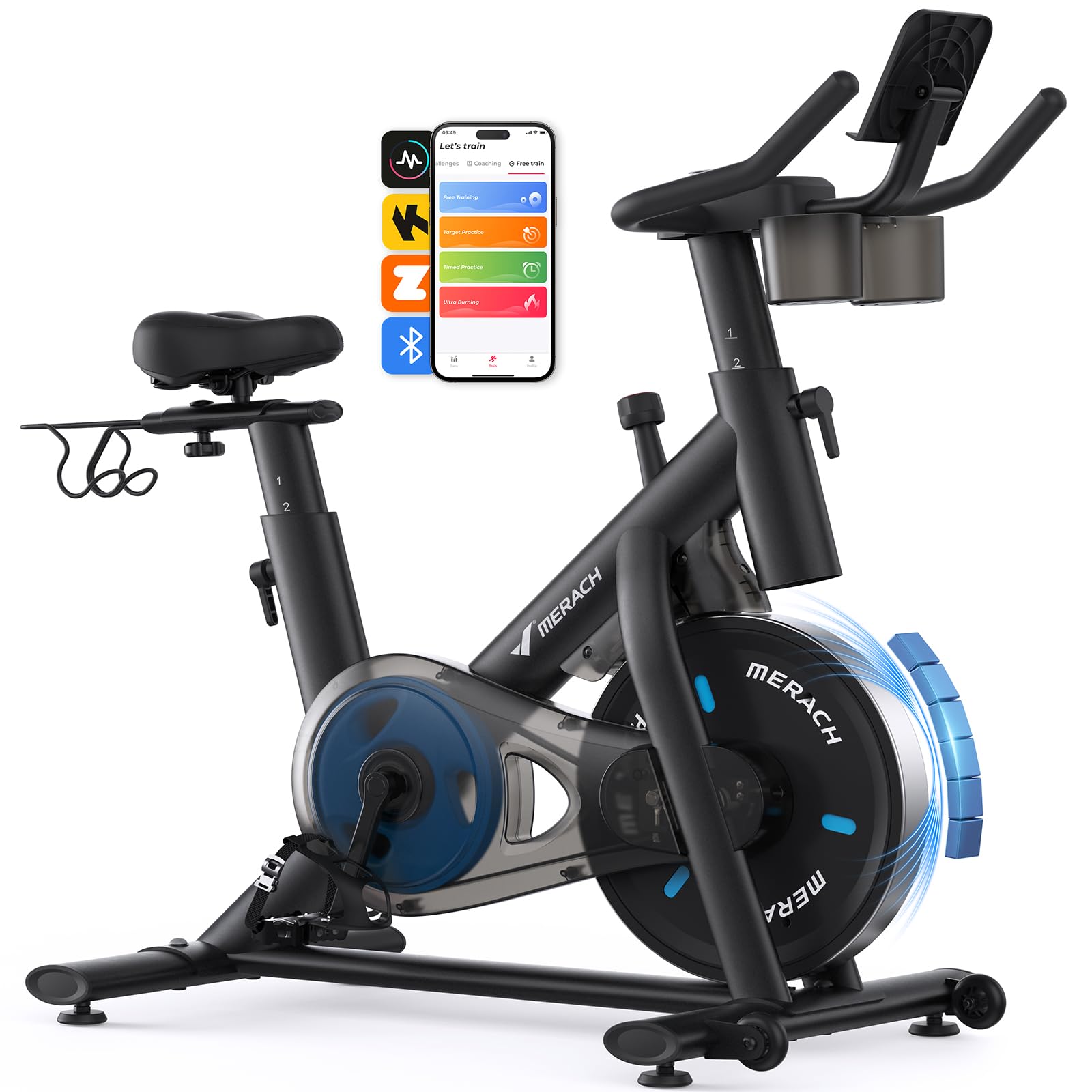
The console is the plain part: speed, distance, time, calories, odometer and pulse on a small LCD. The useful work happens on the tablet rack, which is wide enough for an iPad or a small laptop, and the bike pairs over Bluetooth with the MERACH app for guided rides. If you already follow classes on a screen, that is plenty. If you want the bike itself to lead a workout, it won't.

What settled it for us is the stack of things that are simply better here than at the same money: the fit range, the weight rating, the quiet belt, and a holder that swallows a real tablet in its case. What it does not do is light up a screen or coach you. At a budget price that is a trade we take every time — the hardware got the money.

Pros

  • Fit range spans 4.9 to 6.3 feet
  • 350 lb frame rating, tied for highest here
  • 100-step magnetic resistance with belt drive
  • Tablet rack holds a tablet or small laptop

Cons

  • Guided rides need your own phone or tablet
Our verdict

Our pick for most homes: the widest fit range here, a 350-pound rider rating, and a belt drive quiet enough for an apartment.

Check Latest Price
2

Best for App-Based Training

Schwinn IC4 Indoor Cycling Bike

91 /100
Trail Score Outstanding

Key details

Warranty
10 years frame, 3 years parts
Resistance
100-level magnetic
Item Weight
112 lb
Weight Capacity
330 lb
Check Price on Amazon

The IC4 is the one we point to when someone has already chosen their classes. It pairs over Bluetooth with Peloton, Zwift and the JRNY app, and its 100 micro-adjustable magnetic levels line up with the resistance numbers a class calls out — the detail that makes app-led training feel like the studio rather than a guess. Add a 10-year frame warranty with three years on parts, and the premium tier has a clear job.

Weight is the other half of the story. At 112 pounds it is the heaviest bike here, and that mass is what keeps the frame still when you come out of the saddle for a climb. It also means you place it once and leave it, and that the console wants a wall outlet within cord reach — check the socket before you commit the corner.

Two things to plan for. The saddle is hard and thin, so a padded cover or a replacement is money well spent. And the memberships are separate purchases after the two included months of JRNY; the bike does not arrive with a training plan. Neither is a flaw in the machine. What you are paying for is a bike that will still be the right shape in five years, which is the calculation worth making if you have already worn out something cheaper.

Pros

  • Bluetooth pairing with Peloton, Zwift and JRNY
  • 100 micro-adjustable magnetic resistance levels
  • 10-year frame and 3-year parts warranty
  • 112 lb frame stays planted in standing climbs

Cons

  • Apps cost extra after the included trial
  • Arrives unassembled
Our verdict

We point app-led riders here: it pairs with Peloton and Zwift, and the 10-year frame warranty is the longest in this group.

Check Latest Price
3

Best for Taller and Heavier Riders

JOROTO X2 PRO Exercise Bike

91 /100
Trail Score Outstanding

Key details

Flywheel
40 lb
Item Weight
80.4 lb
Fits Heights
4 feet 9 to 6 feet 4
Weight Capacity
350 lb
Check Price on Amazon

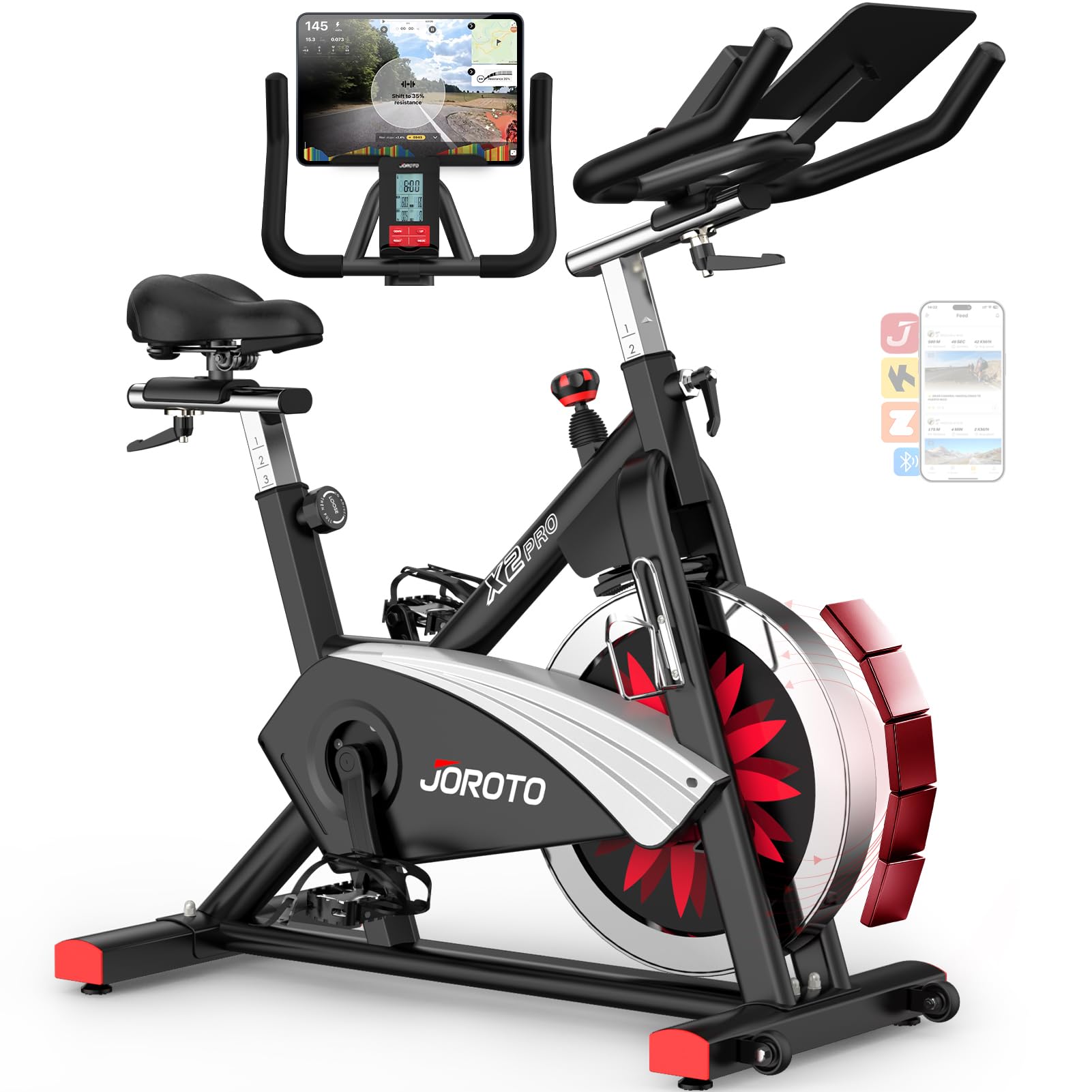
Eighty pounds of bike with a 40-pound flywheel — this is the closest thing in the group to the machine you get in a studio, and it is the one to look at if you ride out of the saddle rather than sitting and spinning. The frame is rated to 350 pounds, seat and handlebars adjust through four directions each, and the fit range runs from 4 feet 9 to 6 feet 4, the widest here.

That last number is the real reason it earns a place. This is the bike in this set that a 6-foot-4 rider can set up properly; most of the others top out around 6 feet 1 or 6 feet 2. The belt drive is smooth and quiet enough for an early ride, and the 12.6-inch tablet holder is the largest here, which matters if you follow classes on a full-size tablet.

The caveat sits at the hard end of use. Belts have shredded and pedals have worked loose on some of these bikes, and the saddle can twist on its post if the clamp is not firm. Check the pedal threads when you build it, keep an eye on the belt guard, and this is a great deal of bike for the tier — the poundage is buying the stability, not just the shipping weight.

Pros

  • Widest fit range here: 4 feet 9 to 6 feet 4
  • 40 lb flywheel and 350 lb capacity
  • Largest tablet holder in this group at 12.6 inches
  • Smooth belt-driven magnetic resistance

Cons

  • Saddle can twist on its seat post
Our verdict

Start here if you are tall or ride out of the saddle: we trust the 350-pound frame and 40-pound flywheel under a hard effort.

Check Latest Price
4

Best Midrange Option

MERACH S26 Exercise Bike

90 /100
Trail Score Outstanding

Key details

Drive
Belt
Item Weight
62 lb
Fits Heights
4 feet 8 to 6 feet 2
Weight Capacity
300 lb
Check Price on Amazon

Almost every bike here has one part you will end up replacing, and on this one it is the saddle. It is firm, long sessions are where you notice, and a cover or a replacement is worth ordering with the bike. Everything around it is quietly competent, which is why it still earns its place in this group.

The frame is the substantial part: 62 pounds of reinforced steel in an inverted triangle, rated to 300 pounds, with belt-driven magnetic resistance that keeps the noise down. At 42.6 inches long and 19.3 wide it tucks into a corner more easily than the studio-sized bikes here, and the seat and handlebars adjust for riders from 4 feet 8 to 6 feet 2.

Where it lands: this is the step up from the budget bikes for someone who wants a heavier, stiller ride without paying premium money. The console is basic and the guided workouts live in the MERACH app on your own device, so the value depends on whether you will use them. If you won't, the pooboo does the same job at a lower tier.

Pros

  • 62 lb reinforced frame rated to 300 lb
  • Belt-driven magnetic resistance runs quiet
  • Compact 42.6 x 19.3 inch footprint
  • Bluetooth app with guided workouts

Cons

  • Resistance can jump rather than ramp smoothly
Our verdict

This is the quiet, solid midrange bike we suggest for riders up to 6 feet 2, and the stillest ride here short of the premium machines.

Check Latest Price
5

Best for Tight Spaces

CHAOKE 520A Exercise Bike

89 /100
Trail Score Excellent

Key details

Floor Space
32.3 x 19.2 x 39.4 inches (D x W x H)
Item Weight
48 lb
Fits Heights
4.7 to 6.1 feet
Weight Capacity
300 lb
Check Price on Amazon

Floor space is what sells this one. At about 32 by 19 inches of footprint and 48 pounds, it fits the corner of a bedroom that a studio-sized bike would dominate, and it is light enough for one person to shift out of the way. You give up some of the planted feel of the 80- and 112-pound bikes here, and in return you get a 300-pound rating, 100 steps of magnetic resistance and a fit range of 4.7 to 6.1 feet.

One thing to check: the handlebar collar wants a firm hand, because a partly tightened collar lets the bars rock. The saddle suits shorter sessions better than long ones. Otherwise it is a quiet, simple machine that arrives mostly built and finishes in about half an hour — and the H-frame keeps it stable for something this easy to move.

Pros

  • Compact 32.3 x 19.2 inch footprint
  • 48 lb, light enough to move alone
  • Quiet magnetic belt drive
  • Mostly pre-assembled, about 30 minutes

Cons

  • Fit range stops at 6 feet 1
  • Saddle suits short sessions better than long ones
Our verdict

For a small room this is what we choose: one of the smallest footprints here, 48 pounds to move, and a 300-pound rating.

Check Latest Price
6

Tight Budgets

CURSOR CBE10 Exercise Bike

0 /100
Trail Score Fair

Key details

Resistance
Friction
Item Weight
39.7 lb
Fits Heights
4 feet 8 to 6 feet 2
Weight Capacity
300 lb
Check Price on Amazon

This is the bike for someone who wants to find out whether they will actually use a spin bike before spending much. It weighs 39.7 pounds, needs about half an hour of tool-free assembly, and carries a 300-pound rating with a tablet mount and a fit range of 4 feet 8 to 6 feet 2. Resistance is friction rather than magnetic, adjusted through a knob.

Friction is the honest trade. A pad presses on the flywheel, so resistance builds with a more mechanical feel, the pad wears, and it can start to squeak as it does — that is the part you service. The light frame is the other trade: easy to move, but hard standing efforts on a 39.7-pound bike do not feel as locked in as they do on the heavier machines here. For steady seated cardio in front of a screen, it does the job at the lowest tier in this group.

Pros

  • Least expensive tier in this group
  • 39.7 lb and easy to move
  • Tool-free assembly in about 30 minutes
  • Tablet mount and 300 lb capacity

Cons

  • Friction pad wears and can start to squeak
  • Light frame feels less planted standing up
Our verdict

The bike we suggest for a first-timer: the least expensive tier here, and fine for steady seated cardio if you accept a friction pad.

Check Latest Price
7

Quick Setup

YPOO BC710 Exercise Bike

87 /100
Trail Score Excellent

Key details

Item Weight
44 lb
Pre-assembled
80%
Weight Capacity
300 lb
Resistance Levels
16
Check Price on Amazon

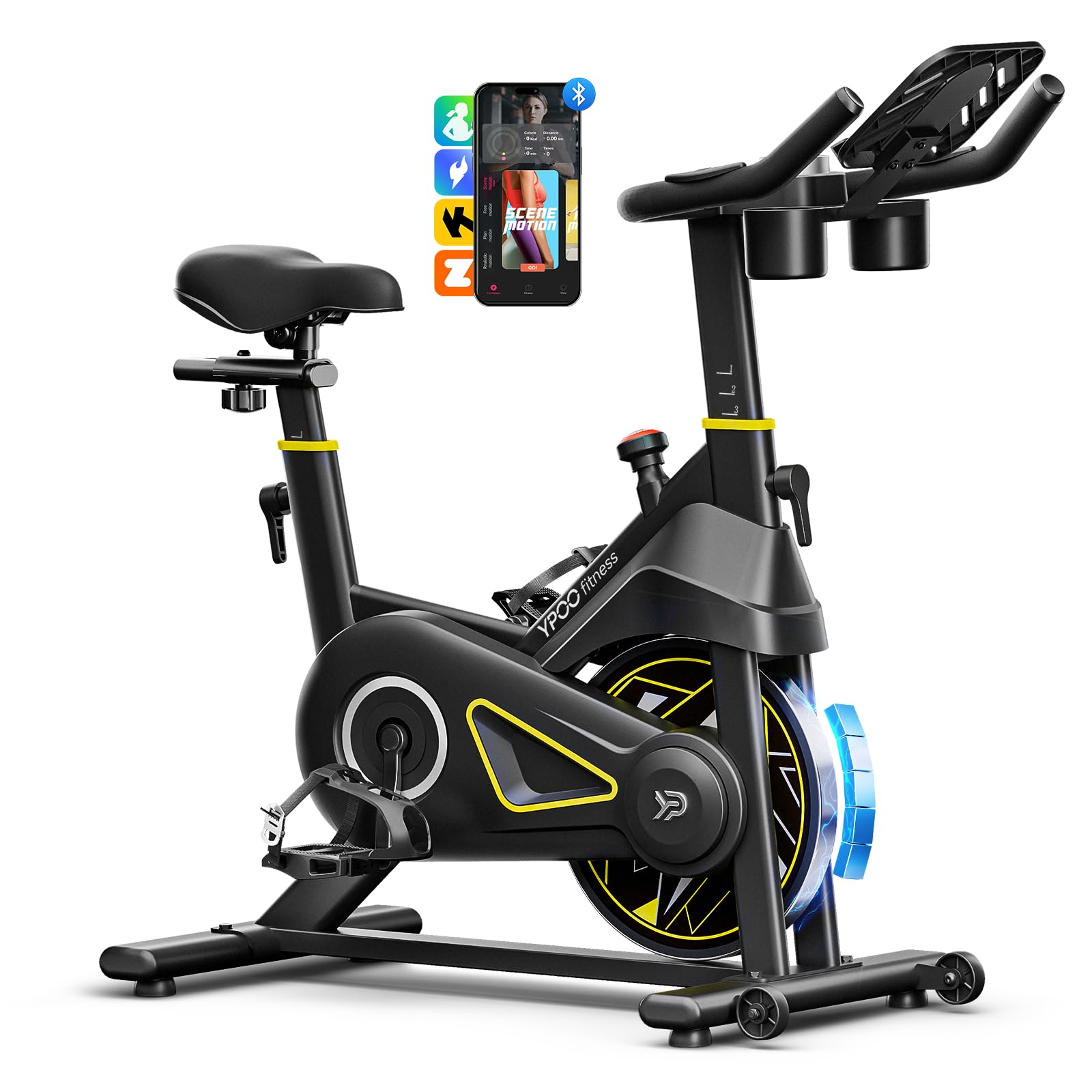
Most of this one arrives built. It ships 80 percent assembled and finishes in about half an hour, which matters if the bike is a gift or you have no interest in an evening with an Allen key. At 44 pounds and roughly 33 by 19 inches, it is also easy to park against a wall between sessions.

The specification is sensible for the tier: magnetic resistance with 16 levels, a belt drive, a 300-pound frame, adjustable seat and handlebars for riders from 4 feet 8 to 6 feet 1, and an emergency stop built into the resistance knob — press it and the flywheel stops. The app pairings cover guided and virtual riding through YPOOFIT, Kinomap and Zwift.

The reason it sits in the also-consider group rather than higher is the electronics. The monitor has quit on some of these bikes after a few months, which leaves you riding without feedback, and 16 resistance steps are coarse for interval work. The frame and the ride are sound; the screen is the weak link. Buy it for the quick setup and the small footprint, and treat the console as a bonus rather than a feature.

Pros

  • 80% pre-assembled, about 30 minutes to finish
  • Resistance knob doubles as an emergency stop
  • 44 lb with a compact 32.9 x 19.3 inch footprint
  • Magnetic belt drive with 16 levels

Cons

  • Monitor can quit after a few months
Our verdict

We like it for the shortest setup here — mostly built, light and quiet — with a console we do not count on.

Check Latest Price

How We Tested Home Spin Bikes

We built a shortlist by comparing frames, resistance systems, footprint, warranty, and replacement-part availability, then bought seven bikes that represented the range of what shoppers actually consider. We assembled each one ourselves, timing the unboxing and solo build and noting whether the included tools, instructions, and labeled parts matched the manufacturer's claims.

Each bike lived in a normal room for eight months, not a showroom. We rode morning intervals before work, longer weekend sessions, and quick 20-minute sweats, with riders from 5-foot-2 to 6-foot-1 adjusting saddle and handlebar height to check fit. We listened for flywheel whir, pedal clunk, and floor vibration at 6 a.m. with someone asleep in the next room, and we stood out of the saddle for sprints while rocking the handlebars side to side to feel for wobble.

Assembly was scored by actual build time and whether we needed a second person. Comfort showed up after 30 minutes, not five: saddle soreness, reach to the handlebars, and whether the seat post slipped mid-ride. We checked durability by wiping down sweat, inspecting welds and plastic covers, and rechecking bolts each month, and we tracked reliability by whether resistance responded consistently ride after ride. For value, we compared what came in the box—pedals, tablet holder, warranty—against the price, and noted any rattle or wobble that made a bike feel cheaper than it was.

How to Choose a Home Spin Bike

Fit Comes Before Features

Every bike here has an adjustable seat; what separates them is how far it travels and whether the handlebars move too. Across this group the range runs from roughly 4 feet 8 to 6 feet 4, and the figures worth comparing are the minimum and maximum rider height rather than the number of adjustment positions a listing brags about.

Set the saddle so your knee is almost straight with the pedal at the bottom of the stroke, then check that the bars come to you without locking your elbows. A bike that tops out at 6 feet 1 is the wrong purchase for a 6-foot-3 rider no matter how good the rest of it is.

Magnetic or Friction Resistance

Magnetic resistance moves magnets toward the flywheel, so nothing rubs, nothing wears and the ride stays quiet — most of the bikes here are magnetic. Friction bikes press a felt or leather pad against the flywheel: cheaper, with a heavier, more mechanical feel, but the pad wears and can start to squeak.

Ignore titles that read "magnetic friction" and look at the resistance mechanism itself. If the bike lives in a bedroom or above a neighbor, the quiet design is worth paying for.

Weight, Stability and Floor Space

A heavier bike feels planted, especially when you stand, and this group runs from about 40 pounds to 112. That weight is also a moving problem: past 60 pounds it is a two-person job to shift, so decide where the bike lives before it arrives.

Measure the footprint, then add clearance for the pedals and for getting on and off. The floor space here runs from roughly 32 by 19 inches to 54 by 31.

Consoles, Apps and What You Pay Later

An LCD showing time, distance and calories is enough for most riders and costs nothing after purchase. Bluetooth pairing adds guided classes and virtual courses, but the memberships behind them are bought separately, and the bike's own screen usually just relays data to the device you mount on it.

Be honest about whether you will follow classes. If you will, pay for the pairing and check the tablet holder is wide enough for your tablet in its case. If you won't, put the money into the frame and the resistance instead.

Saddles, Pedals and the Small Details

Assume you will change the saddle, because it is the most common complaint about home bikes and a cover costs little. Pedals matter too: the Schwinn's flip so you can wear cycling shoes with cleats or ordinary trainers, while most bikes here use toe cages.

Look for transport wheels if the bike gets moved, a bottle holder if you ride long, and a resistance knob that also stops the flywheel — a brake you can hit mid-sprint is worth having.

Frequently Asked Questions

Final Verdict

The pooboo is the bike we recommend to most homes: it covers the widest span of riders in this group, holds a 350-pound rider, and the belt drive keeps it quiet enough that an early session will not wake the house. If you follow app classes and want the bike to last a decade, the Schwinn IC4 is worth the step up, because its Bluetooth pairing with Peloton and Zwift is the reason to spend more.

And if the bike has to live in a corner of a bedroom, the CHAOKE's 32-inch footprint decides it before anything else gets a vote.