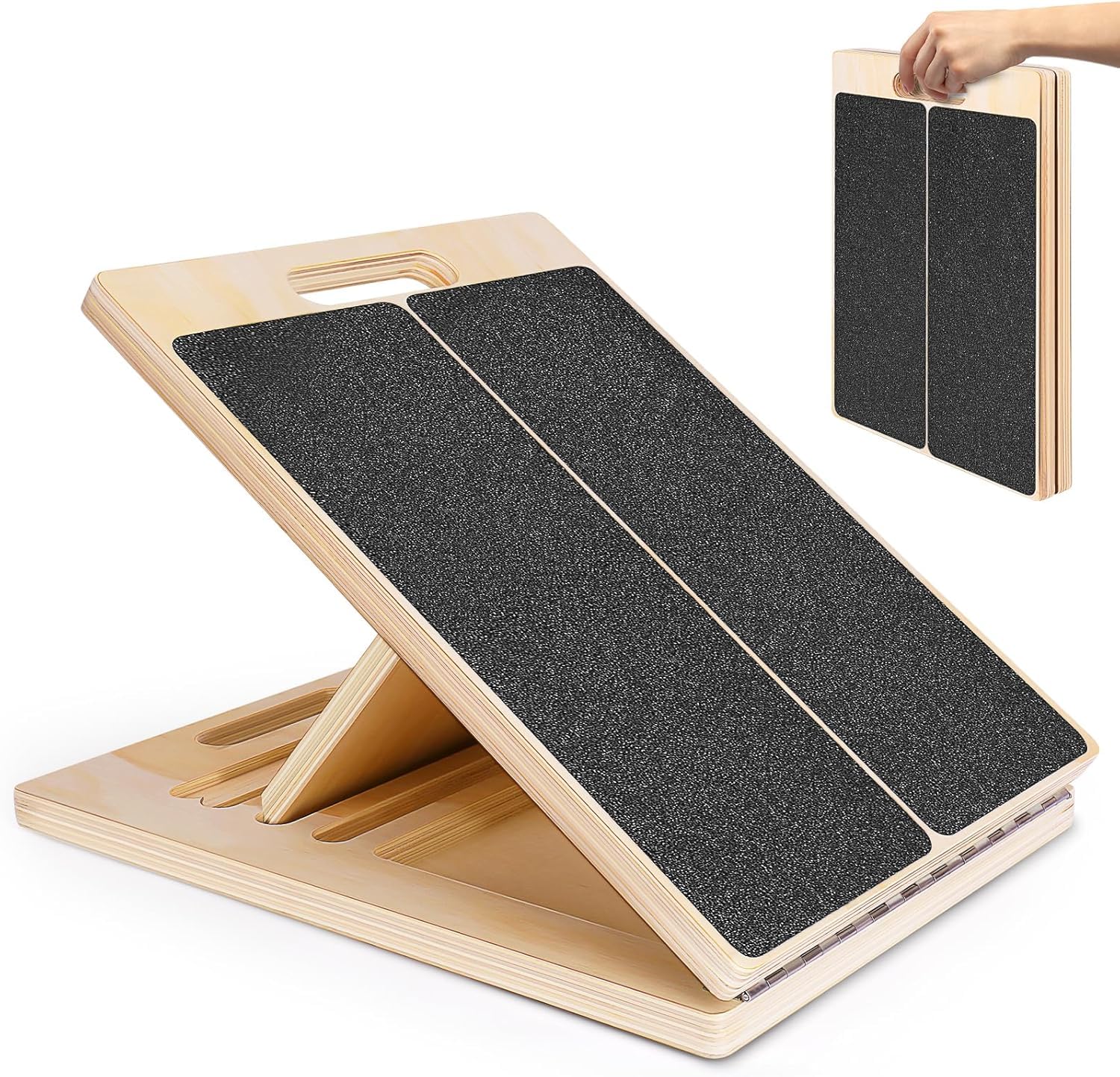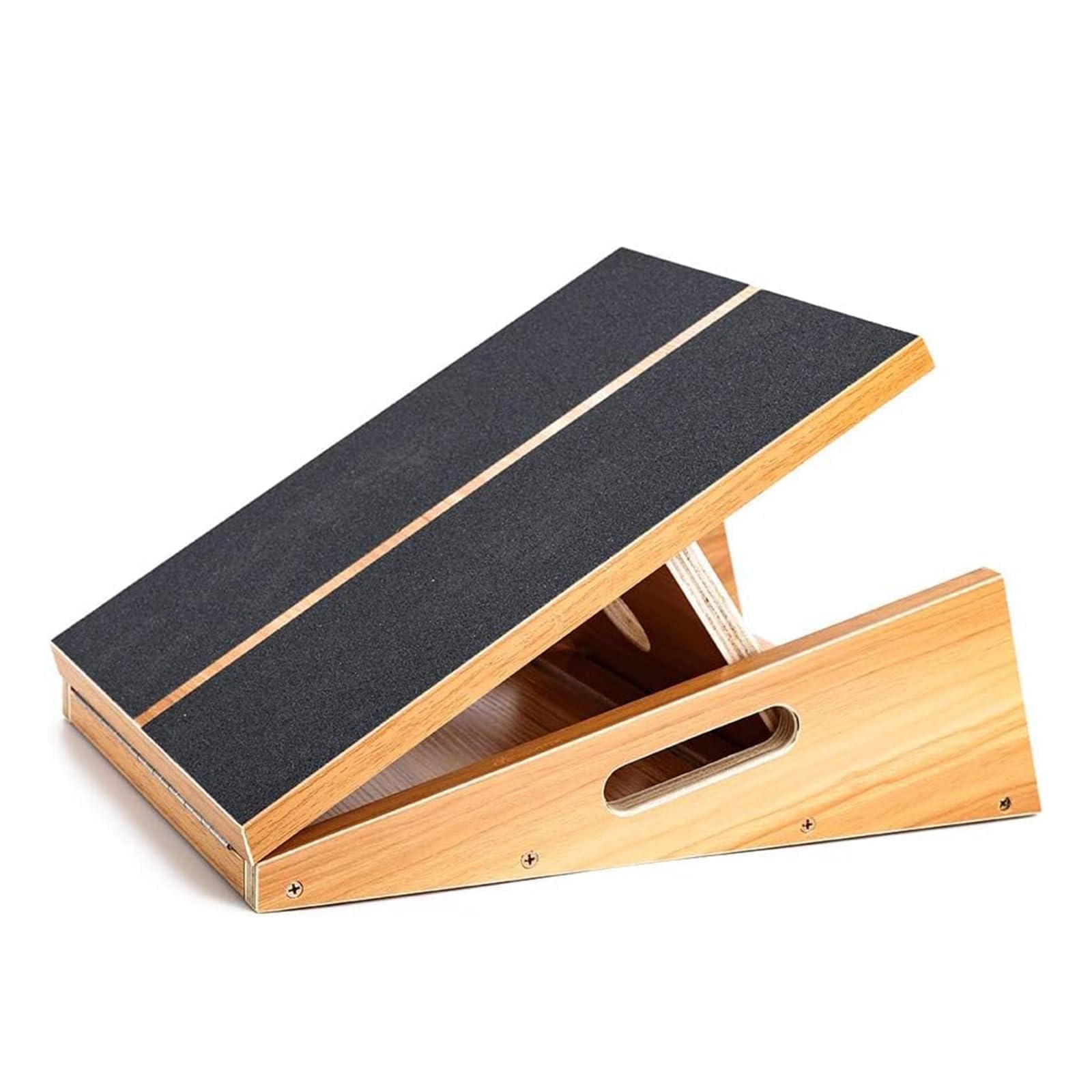
Best Slant Boards for Calf Stretching of 2026

The first step out of bed is usually the tell. If your calves feel like taut cables before you've made coffee, or your heels complain for the first ten minutes of a run, a slant board lets you load that tissue at a controlled angle instead of hoping a curb stretch does the job. It's just a wedge, but the details decide whether you actually use it — a board that rocks underfoot, slides on hardwood, or only offers angles too shallow to reach your calves tends to end up behind the couch by week three.

Mine has lived under my desk for the past six months, and the team has put 12 boards through daily wear in that time: barefoot before a morning run, in socks during work calls, in sneakers after a long walk. What separates a good one isn't glamorous. It's whether the deck stays planted, whether the height settings genuinely change the stretch, whether the price gap between models shows up anywhere but the box, and whether the thing still feels solid after a few hundred repetitions. The picks below are the ones I'd leave out in the open.

1

Best Overall

StrongTek Wooden Slant Board

96 /100
Trail Score Outstanding

Key details

Weight
8.97 lb
Material
Lauan hardwood plywood
Platform
16 x 12.5 in
Incline Angles
15°, 20°, 25°, 30°, 35°
Check Price on Amazon

Most of the boards in this roundup start at 23 degrees or steeper. The StrongTek starts at 15 and climbs in five-degree steps to 35, which means the gentlest setting is one you can stand on for a full minute without your heel lifting off the deck. That single difference is most of why it's our top pick.

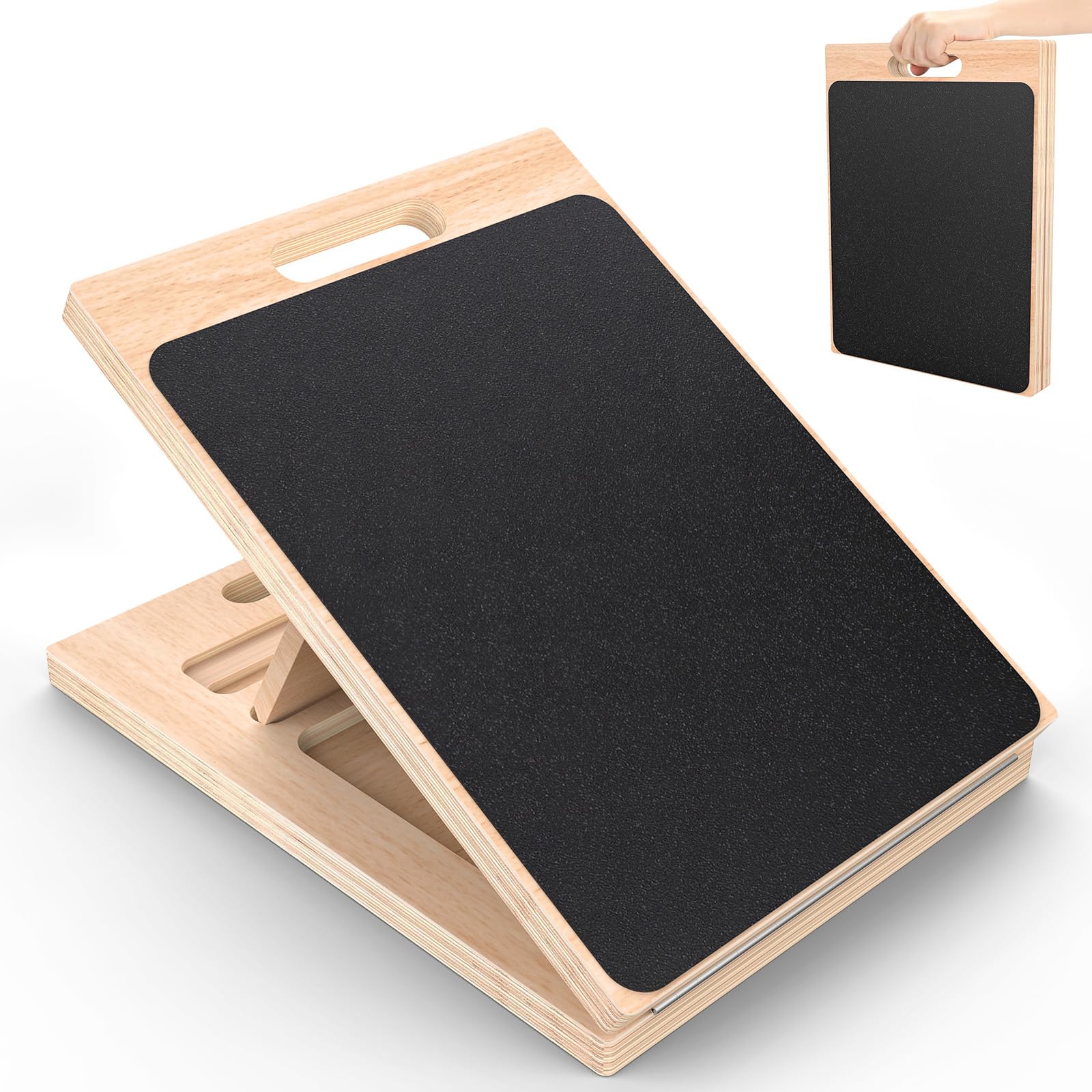
The deck is 16 by 12.5 inches, the largest here, cut from Lauan hardwood plywood with grip tape across the whole surface and side handles set into the frame. At 8.97 pounds it's roughly twice the weight of the folding boards, and you feel that when you carry it. You don't feel it when you're standing on it, which is the point of the weight: the base sits flat and stays flat as you lean forward into the stretch.

Changing the angle takes a second — lift the deck, move the prop, drop it back down — and the deck sits flush at every setting with no rock in it. The handles carry plastic collars where they meet the frame, a small thing that keeps a splinter out of your palm when you haul the board around one-handed.

Thirty-five degrees is the ceiling, so if you want a steep platform for deep Achilles work or elevated heel squats, the NORBASE or the XCMVCN reach 45. For calf stretching, though, 15 to 35 covers the useful ground, and the build is the most convincing in this group. It costs the most and it's the one we think of as a purchase you make once and then stop shopping.

Pros

  • Gentlest start at 15 degrees
  • Solid base that doesn't rock
  • Largest deck in the group
  • Side handles for carrying

Cons

  • Heaviest board here at 8.97 lb
  • Highest price in this roundup
Our verdict

Our pick if you want one board to last: the 15-degree floor suits a tight calf on day one, and the plywood deck stays planted at every setting.

Check Latest Price
2

Best Value

MUCITAGF Wooden Slant Board

95 /100
Trail Score Outstanding

Key details

Weight
8.49 lb
Platform
16 x 12.5 in
Incline Angles
15°, 20°, 25°, 30°, 35°
Weight Capacity
500 lb
Check Price on Amazon

You can spend a lot more on a slant board and get very little more than this. The MUCITAGF runs the same 15-to-35-degree ladder as our top pick, in the same five-degree steps, on a 16-by-12.5-inch deck, and it's rated to 500 pounds — the highest figure in this group. For most people stretching calves at home, that's the whole list of requirements met for less money.

The build is a solid wooden unit with side handles rather than a folding board, so it stays where you put it. It's also the board whose surface we appreciated most: the textured deck holds a sock foot at 15 degrees, which means you can stretch in what you're already wearing instead of hunting for shoes.

There's no setting steeper than 35 degrees, so this isn't the board for someone pushing toward deep Achilles work or a 45-degree squat platform. It also wants a patch of floor rather than a slot in a cupboard. In exchange there's no hinge to work loose, and it comes with a three-year warranty.

Pros

  • Same 15-to-35 ladder as our top pick
  • 500 lb weight rating
  • Textured deck holds a sock foot

Cons

  • No setting steeper than 35 degrees
  • Heavier and bulkier than a folding board
Our verdict

Buy this one if you want the same 15-to-35 range and a 500-pound rating as the StrongTek without the premium price — most home stretchers won't need more.

Check Latest Price
3

Best for Tight Calves

ANVICTOX Reinforced Slant Board

90 /100
Trail Score Outstanding

Key details

Weight
5.6 lb
Dimensions
15.7 x 11.8 x 1.55 in
Incline Angles
15°, 20°, 25°, 30°
Weight Capacity
250 lb
Check Price on Amazon

If you've stood on a 30-degree wedge and felt your heel lift straight off, this is the board built with you in mind. Its four settings run 15, 20, 25, and 30 degrees — the smallest jumps in this group, and a top end that stops about where most calf stretching actually lives.

The other half of the pitch is at the joints, where the frame uses longer fasteners instead of the short ones that turn up at this price, and that's the detail we care about on a board taking your full weight at an angle. At 5.6 pounds it's light enough to move between rooms, and low enough to slide under a desk while you work.

What we can't do is vouch for it the way we can the StrongTek. The record behind this one is short, so we're judging the design rather than years of use, and the 250-pound rating is the lowest here apart from the jjshund's 200.

For a beginner, a post-injury ankle, or anyone whose calf has been tight for years, the gentle ladder is worth more than a wider range you can't use yet. Fewer degrees, more of them usable — that's the trade, and at this price it's a good one.

Pros

  • Four settings in five-degree steps
  • Reinforced screws at the frame joints
  • Light 5.6-pound board

Cons

  • 250 lb weight limit
  • No setting above 30 degrees
Our verdict

The board to start on if 30 degrees feels like too much — four gentle settings and light enough to move around, with a 250-pound limit to check first.

Check Latest Price
4

Best for Steeper Angles

NORBASE Portable Slant Board

92 /100
Trail Score Outstanding

Key details

Weight
5 lb
Dimensions
15.74 x 11.81 x 1.37 in
Incline Angles
30°, 35°, 40°, 45°
Check Price on Amazon

Thirty degrees is where this board starts, and that tells you most of what you need to know. If you already stretch regularly, or you want a platform for elevated heel squats and deeper Achilles work rather than a first cautious calf stretch, the NORBASE's 30-to-45-degree range is more useful than a gentle ladder you've grown out of.

It's a 5-pound wooden board with a 15.74-by-11.81-inch deck, a cut-out carrying handle, and grip pads underneath. The four settings run 30, 35, 40, and 45 degrees, so the top of the range moves in five-degree steps and the bottom simply doesn't exist.

Two things earned it a place. The 45-degree setting is the deepest here alongside the XCMVCN and the jjshund, and the deck stays solid at it, with none of the flex a thinner board shows at that angle. The carrying handle sounds trivial until you're moving a board between the bedroom and the living room twice a day.

One thing to watch: at 5 pounds this is a light board with a prop under it, and light boards are where hinge screws and brackets work loose. Check the fasteners every few weeks and stop using it if a bracket starts to move. Kept in one room, it's a lot of board for the money.

Pros

  • Reaches 45 degrees for deep work
  • Solid, non-slip deck at 5 lb
  • Carrying handle

Cons

  • No setting below 30 degrees
Our verdict

Worth it if you're past the beginner stage and want 45 degrees for deep calf work; if you need 15 or 20, this isn't your board.

Check Latest Price
5

Best Budget

XCMVCN Adjustable Slant Board

91 /100
Trail Score Outstanding

Key details

Weight
4.6 lb
Included
Workout poster, instructions
Dimensions
15.7 x 11.69 x 1.57 in
Incline Angles
23°, 30°, 35°, 40°, 45°
Check Price on Amazon

This one folds flat and weighs 4.6 pounds, so it slides under a couch or into a closet between sessions, and a board you can put away is a board you'll actually use daily. That's most of why it's our budget pick.

The angle range is the other half of it: five settings from 23 to 45 degrees, a wider spread than either of the mid-price boards and steeper at the top than the StrongTek. Twenty-three degrees is still a real starting angle — not the 15 degrees a very tight calf wants — but it's gentler than the NORBASE's 30.

The surface is a non-slip deck on a padded base, and it's wide enough for both feet at once when you're stretching both calves together. It ships with a workout poster and instructions, and setup is a matter of unfolding it and checking the screws.

That last part is the honest caveat: this is a light board with a hinge, and hinges are the first thing to work loose. Tighten the screws when it arrives and every month or so after that. Do that and it gives you most of what the premium boards give you for a fraction of the outlay.

Pros

  • Five settings from 23 to 45 degrees
  • Folds flat for storage
  • Non-slip deck and padded base

Cons

  • No setting below 23 degrees
Our verdict

The budget pick for anyone who needs the board to disappear between sessions: folds flat, five settings, and a 45-degree top end.

Check Latest Price
6

Strap-Assisted Stretching

Paleclouds Slant Board with Strap

87 /100
Trail Score Excellent

Key details

Included
Stretch strap
Folds Flat
Yes
Incline Angles
23° to 45°
Check Price on Amazon

The stretch strap is what separates this from the other budget folders: a looped, non-elastic strap long enough to pull a foot toward you from a seated position, so you can add a calf or hamstring pull without finding a wall or sacrificing a bath towel.

The board itself does what the rest of the folding group does — five settings between 23 and 45 degrees, a non-slip sandpaper deck, a built-in handle — and adds a locking clasp that holds it shut once it's folded. A poster comes in the box too.

What we didn't expect to value is the clasp. Folding boards that don't latch flop open while you carry them, and that small annoyance is how a board ends up living permanently on the floor. This one goes into a cupboard and stays closed until you want it.

Sort the weight limit before you order: the product page gives two different figures, 460 pounds in the description and 300 in the specifications, so plan against the lower one. Below 300 pounds this is a sensible first board with a genuinely useful extra in the box.

Pros

  • Includes a looped stretch strap
  • Folds flat and latches shut
  • Five settings from 23 to 45 degrees

Cons

  • No setting below 23 degrees
Our verdict

A sensible first board with a strap in the box — buy it if you want to work seated as well as standing, and plan against the lower weight figure.

Check Latest Price
7

Under 200 Lb

jjshund Folding Slant Board

87 /100
Trail Score Excellent

Key details

Weight
4.8 lb
Dimensions
15.5 x 11.6 x 1.45 in
Incline Angles
20°, 30°, 35°, 40°, 45°
Weight Capacity
200 lb
Check Price on Amazon

Two hundred pounds is the number to read first here, because everything else about this board looks like the rest of the budget group: five settings, a sandpaper deck, a 4.8-pound frame that folds flat.

If you're comfortably under that limit, we think it's the best value in this roundup — the cheapest way into a five-setting board, and it reaches 45 degrees like the boards that cost more. A 140-pound user and a 180-pound user are both fine; a shared household with a 220-pound adult isn't.

There's a gap in the ladder worth knowing about. The settings run 20, 30, 35, 40, and 45 degrees, so the jump off the bottom is twice the size of the others. If 20 degrees is comfortable and 30 is too much, this board has nothing in between — the ANVICTOX does. The sandpaper also grips a sock or a shoe better than bare skin.

Fasteners are the other consideration: a 4.8-pound folding board puts your whole weight through a handful of screws. Tighten them when it arrives and check them monthly, and the low price stops looking like a gamble.

Pros

  • Cheapest five-setting board here
  • Rises to 45 degrees
  • Sandpaper deck grips socks and shoes

Cons

  • 200 lb weight limit
  • Ten-degree gap at the bottom of the ladder
Our verdict

Only buy this one under 200 pounds — then it's the cheapest five-setting board here, with a sandpaper deck that grips socks and shoes.

Check Latest Price

How We Chose and Tested Slant Boards

We started with a long list of roughly 40 boards pulled from retailer listings, physical therapy forums, and the recommendations of two physical therapists we consult, then filtered on the things you can check before buying: how many angle settings a board offers, stated weight capacity, deck material, footprint, and whether it folds or carries easily. Price acted as a filter rather than a verdict — a board costing twice as much had to earn it in the deck and the grip. Twelve made the cut.

Testing ran six months, with each board living where a real one would: beside the bed for a barefoot stretch before a run, under the desk for mid-afternoon breaks, and in the living room after evening walks. We stood on every board in bare feet, socks, and sneakers, because grip changes completely between the three, and we checked each claimed incline against a phone level rather than trusting the printed markings.

Sturdiness got the least forgiving test — weight shifted onto the high edge, side to side, watching for flex in the deck, a corner lifting, or the whole board skating across hardwood and low-pile rug. Over the months we noted splinters, lifting veneer, peeling grip tape, loosened hinges, and whether the steeper settings still felt stable, which is where the cheaper boards separated from the rest. We also tracked whether the extras, like a stretch strap or carry handle, got used at all, and whether the board still felt like good value by month six.

How to Choose a Slant Board for Calf Stretching

The lowest setting decides whether you'll use it

Every board here adjusts, but they don't start in the same place. The gentlest setting runs from 15 degrees on the StrongTek and the ANVICTOX to 30 on the NORBASE, and we put more stock in that bottom number than in the top one. A calf that can't take 20 degrees gets nothing from a board that starts at 30, however many settings sit above it.

If you're coming back from an injury, or you've never stood on a wedge, buy a 15- or 20-degree floor and ignore the ceiling. If you already stretch daily and want a platform for elevated heel squats, a steeper floor is fine and you get more usable range higher up.

Folding boards trade rigidity for storage

The boards that fold away weigh 4 to 5 pounds and hinge in the middle; the solid ones run closer to 9 and don't move at all. Both hold you up. The difference shows in the fasteners, which is where a folding board gives out first: long screws through a plywood edge last, short ones into a hinge don't.

If the board gets folded and unfolded every day, check the screws monthly and stop using it the moment a bracket shifts. If it will live in one spot beside a counter, buy the heavier board and stop thinking about it.

Match the load rating to the household

Capacities in this group run from 200 to 500 pounds, and the figure isn't a formality. The cheapest board here is rated to 200, which rules out plenty of adults and most shared homes, and a board shared with a teenager needs headroom too.

Read the number in the specifications rather than the headline. One board here states 460 pounds in its description and 300 in its specs; when two figures disagree, plan against the lower one.

Platform, grip, and where you'll stand it

A 16-inch deck takes a whole foot with a shoe on; 15 inches is close enough that it rarely matters. Grip is the part people underestimate. Sandpaper holds a sock or a shoe well and is rough on bare skin, while textured PVC is the friendlier surface for bare feet.

Whatever the angle, set the board within arm's reach of a counter, wall, or door frame for the first few sessions at a new setting. Balance, not calf flexibility, is what makes people quit a steep board.

Frequently Asked Questions

Final Verdict

The StrongTek is the board we point people to. It starts where a tight calf can genuinely begin, steps up in five-degree increments, and stands still underfoot at every setting. It costs the most here and it's the heaviest, and neither has bothered us once it's on the floor.

If the budget is tighter, the MUCITAGF covers the same 15-to-35 range with a 500-pound rating for less. If your calf won't tolerate anything past 20 degrees yet, the ANVICTOX's four gentle steps will do more for you than a wider ladder you can't climb.