Best Saddle Stools for Posture

A saddle stool works by subtraction. No backrest to lean into, no flat seat to slide forward on — just a horn-shaped perch that rolls your pelvis forward and drops your thighs below your hips so your spine stacks itself. If your lower back starts complaining around 2 p.m., that's the whole appeal. The catch is that every saddle stool looks about the same in a product photo, and what actually separates them — how deep the dish is, how the casters handle a rug, whether the gas lift still holds its height by Friday — only shows up after weeks of sitting. We spent seven months with 11 of them finding out.

First-time buyers shop the silhouette and ignore what's under it. A rock-solid base and a well-made cylinder will outlast prettier upholstery, and cushioning that's too plush defeats the shape entirely — you sink until the saddle stops doing its job. Assembly is the other wildcard, ranging from ten minutes with one Allen key to a hydraulic swap that tests your patience. The picks below earned their price on all of it.

1

Best Overall

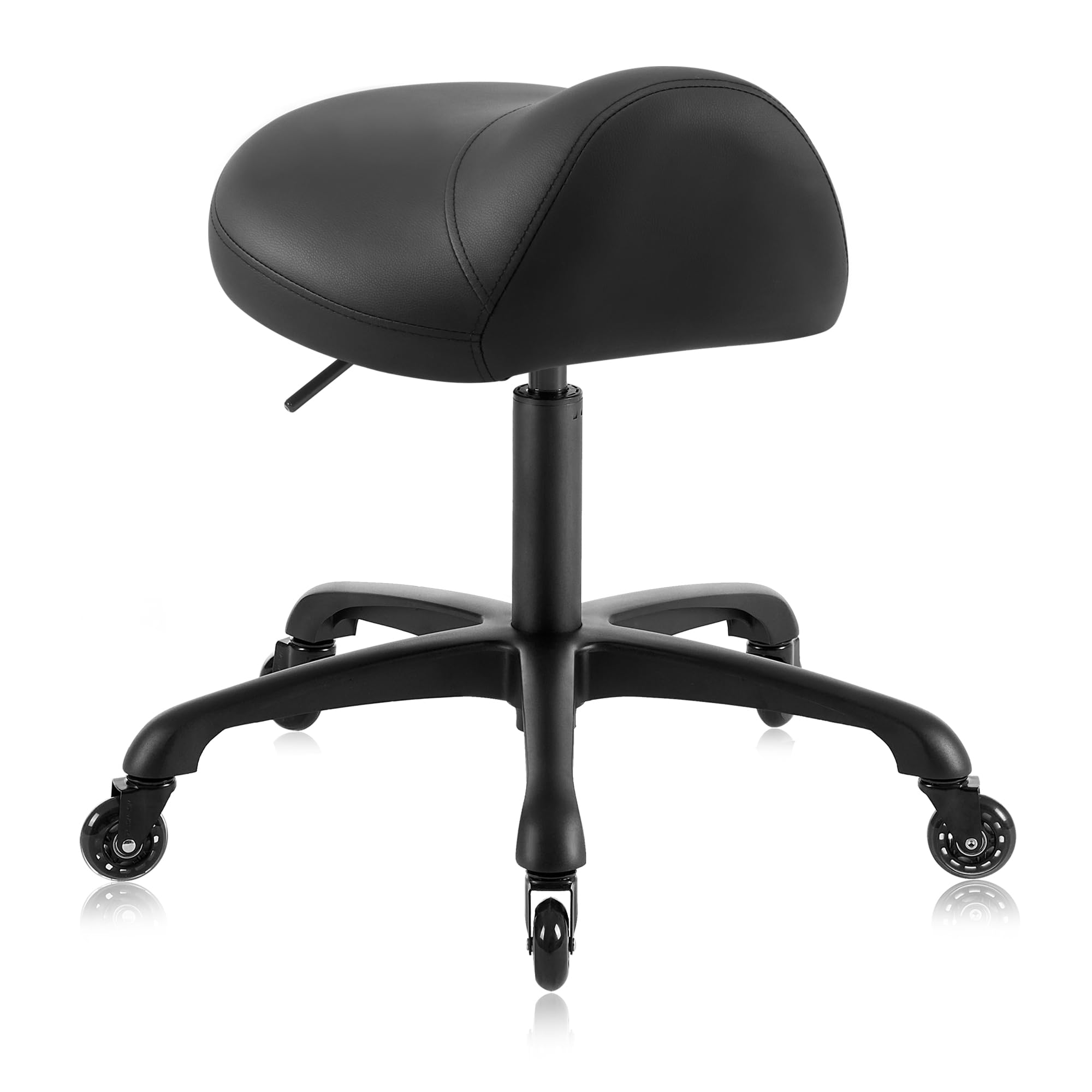
FRNIAMC Professional Saddle Stool

88 /100
Trail Score Excellent

Key details

Seat Height
19.7-29.5 in (50-75 cm)
Stool Weight
12 lb
Weight Capacity
400 lb
Check Price on Amazon

Ten inches of travel is the number that matters here. The FRNIAMC's seat runs from about 20 inches to 29.5, the widest spread in this group, so the same stool sits under a standard 30-inch desk in the morning and against a 36-inch kitchen island in the afternoon. Most of the others here are designed for one half of that range or the other.

Sat on, the saddle does what the shape promises: hips above knees, pelvis tipped forward, and the low back settling into its curve without you bracing to hold it there. That, rather than any feature on the box, is why it's our default pick — it makes the posture happen instead of asking you to maintain it. The metal base carries 400 pounds without the give a lighter frame invites.

The floor of that range is what you should check against your own setup. At roughly 20 inches the seat is still higher than the lowest point of a task chair, and if you work at a keyboard tray or a low sewing bench it will feel like something you climb onto rather than sit down into. Give the shape a week, too; your inner thighs will let you know you've changed seats.

Assembly is a three-piece job that takes a couple of minutes, and the swivel moves between a laptop and a workbench without a push-off. The component worth watching is the lift, which can stop holding its top height after a few months of daily use. Buy it somewhere with easy returns and that risk is covered.

Pros

  • Height range spans roughly 20 to 29.5 inches
  • 400-pound capacity on a metal base
  • Snap-together assembly without tools
  • Saddle shape holds hips higher than knees

Cons

  • Lift can stop holding height after a few months
Our verdict

Our pick for most people: the seat spans desk and counter height, the base carries 400 pounds without flexing, and the saddle shape does the postural work for you.
Check Latest Price
2

Best for All-Day Comfort

DR.LOMILOMI 505 Saddle Stool

89 /100
Trail Score Excellent

Key details

Seat Width
18 in
Upholstery
Medical-grade vinyl
Seat Height
19-25 in
Weight Capacity
400 lb
Check Price on Amazon

The money went into the seat. A dense molded foam base with a memory foam layer on top, wrapped in the kind of vinyl dental and massage practices specify — water, oil, and stain resistant, and it wipes down between clients. At 18 inches across it's one of the widest seats here, and the whole stool weighs 13 pounds.

Height runs 19 to 25 inches, the base is aluminum and rated to 400 pounds, and the casters roll quietly across a hard floor. Assembly is four pieces: five wheels pressed into the base, the cylinder dropped in, the seat on top. Six inches of travel is the shortest range in this group, which settles what the stool is for.

Where it earns its place is a long shift at a fixed height. Three hours at a treatment table and the foam still feels like foam rather than a plate with a cover stretched over it, and the medical-grade upholstery is the difference between a stool you can disinfect daily and one you have to baby. It's the most expensive stool here, and what you're paying for is the seat and the finish, not a bigger range.

Pros

  • Memory foam layered over dense molded foam
  • Medical-grade vinyl wipes clean
  • 18-inch seat, one of the widest here
  • 400-pound aluminum base with quiet casters

Cons

  • Tops out at 25 inches, so counter work is out
Our verdict

Worth the premium if you sit at one height all day: the memory foam seat and clinic-grade vinyl are the most comfortable, most cleanable combination here, on a quiet 400-pound base.

Check Latest Price
3

Best for Tall Work Surfaces

Kaleurrier Rolling Saddle Stool

90 /100
Trail Score Outstanding

Key details

Base
Aluminum, five-star
Seat Width
14.6 in
Seat Height
22.8-28.7 in
Weight Capacity
300 lb
Check Price on Amazon

This stool starts at 22.8 inches, which is about where several of the others here are already thinking about coming down for a desk. If your work happens at a 36-inch island, a standing desk, or a tall salon station, the Kaleurrier lives in the right part of the range instead of making you pay for travel you'll never use. It climbs to 28.7 inches.

At 10 pounds it's the lightest full-size stool in the group, and the reinforced aluminum five-star base is the reason it doesn't feel like it. The seat is 14.6 inches wide over high-density sponge and PVC leather, assembly needs no tools, and the pneumatic lift is described as certified explosion-proof — the industry's way of saying the cylinder won't fail under load.

Two trade-offs are worth naming. The 300-pound capacity is the lowest of our picks, so a heavier user belongs on the Master Massage or the VEVOR. And the range won't come down for a low bench, a pedicure height, or a child's table. Neither limit bites at a counter, and the narrow seat keeps your thighs clear when you're working close to the bench.

Pros

  • Seat runs 22.8 to 28.7 inches
  • 10-pound aluminum base, easy to carry
  • Narrow 14.6-inch seat clears your thighs at a bench
  • Tool-free assembly

Cons

  • 300-pound capacity is the lightest here
  • Won't go low enough for a low bench or table
Our verdict

For counter-height and standing-desk work, this is the one: the seat starts high and climbs to 28.7 inches on a light aluminum base you can carry with one hand.

Check Latest Price
4

Best Budget

VEVOR Ergonomic Saddle Stool

88 /100
Trail Score Excellent

Key details

Cushion
14.8 x 14.1 in, 2.4 in thick
Base Width
21.3 in
Seat Height
21.7-28 in
Weight Capacity
450 lb
Check Price on Amazon

What the least money here buys is more than we expected: a 21.3-inch base that's wider than most, a 450-pound rating second only to the Master Massage, and a 2.4-inch cushion — roughly a fifth thicker than the standard seat — that you can't feel the frame through.

Seat height runs 21.7 to 28 inches, which covers a counter and a standing desk but not a low bench. There are five PU casters, an SGS-certified cylinder, and a build that goes together without tools in a few minutes.

For a garage, a workshop, or a kitchen where the stool gets dragged around and knocked into cabinets, this is the value call: the money went into the base and the foam rather than the finish. The wide footprint is the part we appreciate most, because at 28 inches a narrow base starts to feel like something you balance on, and this one doesn't.

The casters are plain PU, fine on tile and hardwood and less fine on a rug. And if you're not yet sure a saddle seat suits you, this is the cheapest way to find out without committing much — the fit is personal in a way no spec sheet settles.

Pros

  • 450-pound capacity on a widened 21.3-inch base
  • 2.4-inch high-density foam cushion
  • No-tool assembly in a few minutes
  • Lowest-priced stool we recommend here

Cons

  • Starts at 21.7 inches, tall for shorter users
  • Plain casters that prefer hard floors
Our verdict

The value pick: a wide 450-pound base and a genuinely thick seat cushion for the least money here, though the casters are happiest on hard floors.

Check Latest Price
5

Best for Larger Bodies

Master Massage Saddle Chair

85 /100
Trail Score Excellent

Key details

Seat
18 x 16 in
Seat Height
52 cm
Weight Capacity
550 lb
Upholstery Warranty
5 years
Check Price on Amazon

Five hundred fifty pounds, and an 18-by-16-inch seat to go with it — nothing else here comes close on either count. If you've bottomed out the cylinder on a cheap stool, or you're fitting out a treatment room for a range of body sizes, this is the one built for the job.

The foam is the other half of the story: 2.5 inches of multi-layer small-cell foam and a five-year guarantee on the upholstery, the longest backing of any seat in this group. That's why we recommend it for heavy daily use — it's the stool here that doesn't need to be handled gently, on hard floor or carpet.

Two costs come with the size. An 18-inch seat is a lot of saddle for a small frame and will push your thighs wider than the narrower seats here. And the seat sits lower than the counter-height picks, so this is a bench-and-desk stool rather than a standing-desk one. The lift is the wear item; expect to replace the cylinder around the two-year mark, well inside the life of the upholstery.

Pros

  • 550-pound capacity, the highest here
  • 18 x 16 inch seat with 2.5-inch foam
  • Five-year upholstery guarantee
  • Rolls easily on hard floor and carpet

Cons

  • Wide seat overwhelms smaller frames
  • Seat sits lower than the counter-height picks
Our verdict

For heavier users and shared clinic rooms this is the sturdiest seat in the group: 550 pounds of capacity, a broad 18-inch seat, and foam that holds its shape.

Check Latest Price
6

Quiet Clinic Rooms

Antlu Memory Foam Saddle Stool

88 /100
Trail Score Excellent

Key details

Seat
Dual-layer memory foam
Seat Width
15.7 in
Seat Height
21.5-29.5 in
Weight Capacity
280 lb
Check Price on Amazon

Quiet is the feature. Antlu rates the casters on this one under 30 decibels, and in a treatment room where a squeaking wheel is the loudest thing in the building, that's the difference between a stool you can use during a session and one you can't.

The seat is a dual-layer memory foam saddle, 15.7 inches wide, over a high-density foam base. Height runs 21.5 to 29.5 inches — the second-widest range in this group — and it's built four inches taller than a standard saddle chair, which is the part that matters if you work at tables between 33 and 43 inches.

Assembly takes a couple of minutes and needs no tools, the swivel turns freely, and the whole stool weighs 14 pounds, so it moves between rooms in one trip.

Where it lands: a good stool that a couple of the others here beat on capacity and long-term wear. Two hundred eighty pounds is the lowest rating in this group, and the wheels and the lift are the parts that go first after months of daily rolling. Buy it for the seat and the quiet, and plan on a set of casters somewhere down the line.

Pros

  • Dual-layer memory foam seat
  • Casters rated under 30 decibels
  • 29.5-inch top suits 33 to 43 inch tables
  • Tool-free assembly in about two minutes

Cons

  • 280-pound rating is the lowest here
  • Wheels and lift are the first parts to wear
Our verdict

The quiet one: memory foam and near-silent casters make it the best fit for treatment rooms, as long as you're under its 280-pound rating.

Check Latest Price
7

Salon and Spa

TASALON Wheeled Saddle Stool

88 /100
Trail Score Excellent

Key details

Base
Cast aluminum
Wheels
3 in
Upholstery
PVC leather
Weight Capacity
400 lb
Check Price on Amazon

A cast aluminum base and three-inch glide wheels are the two things that separate a salon stool that lasts from one that doesn't, and the TASALON has both. It's also the one here we picture in a high-traffic chair rental rather than a home office: 400 pounds of capacity, a five-point spider base, and PVC leather that wipes down between clients.

The seat is a triangular 16-inch saddle and the padding is firm rather than plush — exactly what some people want after years of sinking into soft stools, and more than others can take by the end of a long day. Check the seat height against your station before you order; this is a stool you buy for a specific bench, not a general-purpose perch.

Pros

  • Cast aluminum spider base
  • Three-inch glide wheels
  • PVC leather wipes clean
  • 400-pound capacity

Cons

  • Firm padding that some find hard by day's end
Our verdict

Built for salons: a cast aluminum base, three-inch wheels that clear hair and thresholds, and firm PVC upholstery that wipes down fast.

Check Latest Price

How We Tested the Best Saddle Stools for Posture

We started with roughly 40 saddle stools built for desk and workshop use rather than salon chairs, then narrowed the field by hydraulic height range, seat dimensions, weight rating, and price until 11 were left — a spread from budget imports to serious ergonomic furniture. Testing ran seven months, long enough for cheap foam to pancake and for a mediocre cylinder to start creeping down by mid-afternoon.

Every stool went into the same rotation: a home-office desk for two-hour stretches, a kitchen island for chopping and folding laundry, and a craft table in the evenings. We assembled each one with a stopwatch running and wrote down where the instructions stalled us. Every few days we wrapped painter's tape around each cylinder at seated height to see whether the stool had sagged overnight, and we rolled each one across hardwood, over a rug edge, and through a door threshold, noting where the casters caught, skated, or lurched.

Comfort got judged at minute five versus minute ninety — whether the horn pressed into the inner thigh, whether the foam bottomed out onto the plate underneath, whether the saddle was narrow enough to close our knees. We also checked that each base cleared a desk crossbar without clipping it. After the first month we went back over stitching, welds, and finish, and pressed a thumb into every cushion to see how much it sprang back. Value came down to whether the extra money bought denser foam and a better cylinder, or just nicer fabric.

How to Choose a Saddle Stool for Posture

Start With the Height, Not the Saddle

Saddle posture is simple mechanics: hips higher than knees, pelvis tipped forward, spine stacked. That only happens if the seat sits at the right distance below your work surface. As a rule of thumb, a standard 30-inch desk wants a seat around 22 to 26 inches and a 36-inch counter wants 27 to 30. Measure your surface and subtract roughly 8 to 10 inches rather than guessing from your own height.

The trap is that every listing advertises the top of its range. The number to check is the bottom, because a stool that can't come down is the wrong stool for a low bench, and a seat that starts high is where shorter users end up perched. Our picks split cleanly on this: the DR.LOMILOMI tops out at 25 inches, the Kaleurrier starts at 22.8, and the FRNIAMC covers both ends.

Judge the Foam, Then the Width

A saddle puts your weight on the ischial bones and the inner thighs, so a seat that's fine for twenty minutes can be miserable by hour three. High-density foam holds up better than a thick layer of soft foam, and a memory foam layer over a firm base is the combination that lasts — it's what the DR.LOMILOMI and the Antlu both use. Thickness figures help (2.4 inches on the VEVOR, 2.5 on the Master Massage), but density matters more than depth.

Width decides who the stool fits. A 14.6-inch seat like the Kaleurrier's keeps your thighs clear at a bench; an 18-inch seat like the Master Massage's spreads the load but pushes your legs wider. If you already have hip or groin pain, a flat seat is usually the better choice, because a saddle asks those joints to open every time you sit down.

Capacity and Base Material

Weight capacity is a proxy for margin — how much reserve the cylinder, base, and seat plate have. The stools here run from 280 to 550 pounds. If you're within a few dozen pounds of a rating, size up: the extra capacity shows up as a stiffer base and less give at full height.

Base material matters most when the seat is high. A cast aluminum or steel five-star base with a wide footprint is steadier at 28 inches than a narrow plastic one, and you feel the difference every time you shift your weight. The VEVOR's 21.3-inch base and the TASALON's cast aluminum spider are the two clearest examples here. The trade is floor space and a couple of pounds when you carry the stool between rooms.

Wheels and Floors

Hard two-inch casters are fine on tile and hardwood and close to useless on a thick rug; three-inch glide wheels clear thresholds, rug edges, and the curled lip of a floor mat. If your work surface sits on carpet, treat a chair mat as part of the purchase — it's cheaper than replacing casters every year, and it's the difference between gliding and scooting.

Frequently Asked Questions

Final Verdict

Start with the FRNIAMC. Its seat covers a 30-inch desk and a 36-inch counter, the 400-pound base stays planted, and the saddle puts your pelvis where it belongs without you thinking about it — which is the whole point of buying one of these.

If you work at a single height all day, the DR.LOMILOMI's memory foam seat is the more comfortable place to sit. If your bench is tall, the Kaleurrier starts where most of the others stop.