Best Kneeling Chairs for Posture of 2026

A lot of office chairs let you settle into a slump and call it support. A kneeling chair changes the geometry: it tips your pelvis forward, opens the angle between torso and thighs, and makes it harder to collapse into your lower back. What I didn’t expect was how differently the good ones do it—some rock gently, some sit rigid, some look like furniture and some look like gym equipment. The right one takes pressure off your back without making your knees or shins pay for it.

I spent eight months rotating 11 kneeling chairs through my home office, the kitchen counter, and the dining table. I noted whether the back support kept me upright without forcing it, whether the rocking motion helped or distracted, and whether the frame felt sturdy when I leaned side to side. Assembly, adjustability, and appearance mattered more than I expected—a chair you dread building or hide when guests arrive is one you stop using. The winners were comfortable, stable, and well built first; value followed, and the picks below are the ones that cleared every bar.

1

Best Overall

NYPOT Adjustable Kneeling Chair

85 /100
Trail Score Excellent

Key details

Warranty
5 years
Cushioning
Memory foam
Seat Height
20.5 inches
Height Settings
3
Check Price on Amazon

Three height settings is the detail that makes the NYPOT the easiest kneeling chair to live with here. It lets the seat meet a standard desk instead of forcing you to adapt your setup, and the seat and knee pads can be angled separately. For a first kneeling chair, that adjustability is worth more than a fancy frame: it gives you room to find the position where your shins take some weight without your hips sliding forward.

We also like the rocking base, which turns a static perch into something you can nudge through the day. The motion is gentle, not a full rocker, and it helps break up the locked-in feeling of a long desk session. But the chair is not self-correcting: the shin pads are where it will win or lose you, and some pressure there is normal until you get the height and desk relationship right. We start with short sessions and adjust before deciding.

The five-year warranty is a meaningful vote of confidence at this price, and the linen-like upholstery looks more considered than the usual black office chair. Assembly is straightforward, and the wooden frame feels tidy rather than overbuilt. The memory foam in the seat and knee pads has enough give to take the edge off, though it is still a firm place to sit.

For most people buying their first kneeling chair for posture, this is the one we point to. It has the adjustment to fit different desks and bodies, the cushioning to make the position tolerable, and a warranty that backs the purchase. What we keep coming back to is the separate pad adjustment: it is the difference between a chair that fits and one you fight.

Pros

  • Three height settings suit different desks
  • Seat and knee pads adjust separately
  • Gentle rocking keeps you moving
  • Five-year warranty backs the frame

Cons

  • Rocker can feel wobbly when leaning
Our verdict

For a first kneeling chair, the NYPOT is our default: three height settings and adjustable pads fit more desks and bodies than the fixed alternatives here.

Check Latest Price
2

Best Premium

Varier Ergonomic Kneeling Chair

84 /100
Trail Score Excellent

Key details

Frame
Lacquered ash plywood
Seat Height
20 inches
Adjustability
Fixed
Weight Capacity
243 lb
Check Price on Amazon

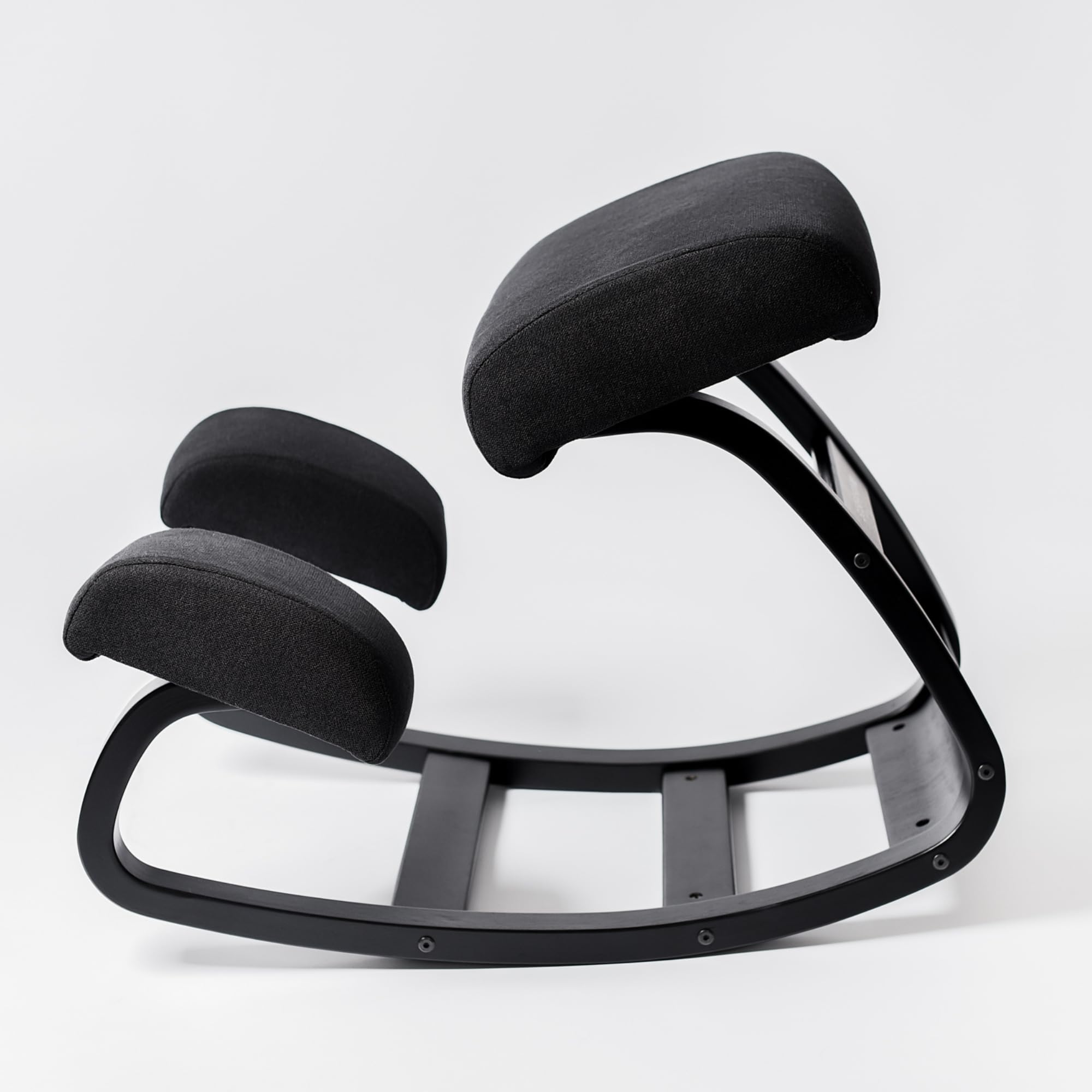
The Varier's seat sits at a fixed 20 inches, and its curved ash runners let it rock gently rather than lock you in place. That fixed geometry is the trade-off: there is no height lever or angle adjustment, so the chair has to fit you and your desk as sold. We paid attention to that before recommending it, because a premium chair that misses your desk height is an expensive mistake.

What the Varier does better than the adjustable chairs here is make active sitting feel natural. The backless shape opens your hips, and the rocker keeps you shifting instead of collapsing into one position. We found the motion easy to settle into, and the recycled polyester cushions are firm enough to support without feeling like a padded throne. It is the pick for someone who wants the chair to prompt movement, not for someone who wants to fine-tune every contact point.

The build is the other reason it earns its place. Lacquered ash plywood, a simple assembly, and felt pads for wood floors make it feel like furniture rather than office equipment. We also noticed the rocker can creak over time, which is worth knowing if you work in a quiet room.

Our verdict is that the Varier is the best premium choice for a dedicated active-sitting setup. It rewards someone who wants a beautifully made chair and is willing to adapt the desk to it. If you need adjustable height or a lower entry price, the NYPOT is the more practical buy.

Pros

  • Curved runners make active sitting feel natural
  • Lacquered ash frame looks like furniture
  • Simple assembly with felt pads included
  • Backless shape opens the hips

Cons

  • Lower 243-pound capacity
Our verdict

The Varier is our premium pick for active sitting, provided its fixed 20-inch seat matches your desk and you want motion rather than adjustment.

Check Latest Price
3

Best for Taller Users

Austin Kneeling Chair

79 /100
Trail Score Very Good

Key details

Frame
20-ply birchwood
Adjustability
Fixed height
Weight Capacity
265 lb
User Height Range
5'2" to 6'6"
Check Price on Amazon

The Austin's 5'2" to 6'6" user-height range is the reason it stands out. Most kneeling chairs here give you a seat height and let you work out the rest; this one is built around a taller desk setup, with a 265-pound capacity and a heavy-duty 20-ply birch frame reinforced by three crossbars. The fixed frame keeps the geometry simple, and the memory-foam cushions soften the contact points.

We liked the gentle rocking base, which makes the chair feel more forgiving than a rigid wooden perch. The open hip angle is the point: you sit tall without a backrest doing the work. But the fixed height is a real constraint. If your desk is lower or your torso is shorter, you may end up reaching for the keyboard rather than settling into the chair. The rocker also asks for some core engagement, so it is not the chair for flopping back.

What we wish were better is the assembly. The bolts need to go in loosely first, and a few chairs arrive with gaps or hardware that will not tighten cleanly. Check every joint before you sit, and expect to spend a little time getting it square. The frame is substantial, the cushions are comfortable, and the rocker adds useful movement.

Pros

  • User-height range spans 5'2" to 6'6"
  • Heavy-duty 20-ply birch frame
  • 265-pound weight capacity
  • Gentle rocking base adds movement

Cons

  • Can feel wobbly for larger users
Our verdict

The Austin is our pick for taller users who want a high-capacity kneeling chair with a sturdy frame, as long as a fixed seat height works at their desk.

Check Latest Price
4

Best Folding

Master Massage Folding Kneeling Chair

80 /100
Trail Score Excellent

Key details

Weight
14.8 lb
Folding
Yes
Seat Size
13 x 13 inches
Height Settings
6
Check Price on Amazon

Folding is the feature that sets the Master Massage apart. The wooden frame collapses for storage, and universal wheels let you move it out of the way; at 14.8 pounds, it is light enough to carry between rooms. The seat and knee rest are 13 by 13 inches, and the manual height adjustment offers six positions. That makes it a practical chair for a small apartment or a desk that has to do double duty.

We like the idea of a kneeling chair that can disappear when guests arrive, and the cinnamon wood frame looks warmer than the black metal alternatives. The posture position is right: the seat tilts you forward and the knee pad supports your shins. The vinyl cover is easy to wipe, and the six-position height adjustment is simple to reset when someone else uses the chair.

The folding mechanism is the part to inspect. The chair has a light, portable feel, and that comes with a little more movement than a rigid frame; make sure the joints are locked before you settle in. For short sessions, a small space, or a chair you need to tuck away, it is a clever solution. It is not the chair we reach for on a full day at the desk.

Pros

  • Folds for storage in small rooms
  • Six manual height positions
  • Light enough to move easily
  • Wheels make it easy to reposition

Cons

  • Thin cushions for long sessions
Our verdict

The Master Massage is the folding pick for small spaces and occasional desk sessions, with the caveat that its cushions are thin for long days.

Check Latest Price
5

Best Budget

Yaheetech Rolling Kneeling Chair

78 /100
Trail Score Very Good

Key details

Casters
Pressure-lock
Tilt Settings
3
Weight Capacity
220 lb
Cushion Material
Faux leather
Check Price on Amazon

The Yaheetech is the chair we point to when the budget is the deciding factor. It gives you the basic kneeling posture, three tilt settings, and pressure-lock casters for very little money. The faux-leather cushions wipe clean, and the frame rolls easily when you are not sitting on it.

We found the casters clever in theory: they lock when you put weight on the seat, so the chair stays put while you work and rolls when you get up. In practice, the seat and knee pad are firm, and the three tilt settings are changed with tools rather than a lever. That makes it a set-it-and-forget-it chair, not one you fine-tune through the day. For a short work session or a starter chair, that is a fair trade.

The value is real, but so is the compromise. The chair is best for someone who wants to try kneeling without committing much money. What it gets right is the basic geometry: the open hip angle is there, and the locking casters make it more practical than a fixed rocker in a shared room.

Pros

  • Low entry price for a kneeling chair
  • Pressure-lock casters stay put under weight
  • Three tilt settings
  • Wipe-clean faux leather

Cons

  • Can feel unstable when shifting weight
Our verdict

The Yaheetech is our budget pick for a first kneeling chair, with locking casters that make a cheap chair more practical at a shared desk.

Check Latest Price
6

Angle Tinkerers

TinyHaven Wooden Kneeling Chair

76 /100
Trail Score Very Good

Key details

Frame
Solid wood
Cushioning
High-density foam
Weight Capacity
250 lb
Angle Combinations
24
Check Price on Amazon

Twenty-four angle combinations is a lot of adjustment for a chair at this price. The TinyHaven lets you change the seat and knee-pad angles independently, so you can dial in a position instead of accepting the factory geometry. The solid wood frame supports up to 250 pounds, and the high-density foam is meant to resist bottoming out. The gentle rocking motion is a bonus for anyone who fidgets.

We appreciate the idea of a chair that can be tuned this precisely. Most kneeling chairs here ask you to adapt to their fixed angles, and that is fine until your shins or hips want something slightly different. The wood frame looks more like furniture than a metal office chair, and the rocking motion adds a little life to the seat. The trade-off is that all those settings come as a kit you assemble.

The caveat is assembly and quality control. The chair arrives as a kit, and the fasteners are the weak point: some units show up with screws that will not thread or a seat bolt that will not tighten. We check every hole before starting and return it rather than force a bad fit. For a tinkerer who wants maximum angle adjustment, it is worth a look; for a low-effort purchase, the NYPOT is safer.

Pros

  • 24 angle combinations for fine-tuning
  • Solid wood frame supports 250 pounds
  • High-density foam cushions
  • Gentle rocking motion

Cons

  • Fastener and quality-control issues
Our verdict

The TinyHaven is for tinkerers who want 24 angle combinations and a wood frame, provided they are willing to inspect the hardware on arrival.

Check Latest Price
7

Budget Rocking

VIVO Wooden Rocking Kneeling Chair

80 /100
Trail Score Excellent

Key details

Warranty
1 year
Seat Height
22.3 inches
Weight Capacity
250 lb
Cushion Thickness
4 inches
Check Price on Amazon

Four-inch mesh cushions are the VIVO's best argument. They put more material between your shins and the frame than the budget chairs with thin vinyl pads, and the mesh should breathe better during a long session. The rocker frame is solid beach wood, rated to 250 pounds, and the whole chair has a simple, open look. At the budget end, that combination is hard to argue with.

We like the cushion thickness on paper, because shin pressure is the usual complaint with kneeling chairs. The mesh cover should breathe better than vinyl, and the rocker gives the chair a gentle motion. The frame is simple, and assembly is mostly a matter of lining up the legs and supports. The chair is also light enough to move between rooms without much fuss.

The cushions are firm rather than plush, so the thickness does not necessarily translate to softness. We would keep it on a hard floor and check the screws after assembly, because a rocker puts more stress on the joints than a fixed frame. The one-year warranty is shorter than the five-year coverage on the NYPOT, which is worth weighing if you want a long-term desk chair.

At the budget end, the VIVO makes sense if you want a wooden rocker and a thick cushion without paying premium prices. It is not the chair for a heavy user or someone who wants a locked-down feel. The mesh cushions are the part we keep coming back to: they are more breathable than vinyl and easier to live with in a warm room.

Pros

  • Four-inch mesh cushions
  • Solid wood rocker frame
  • 250-pound capacity
  • Breathable mesh cover

Cons

  • Can feel wobbly when leaning
Our verdict

The VIVO is a budget rocker for a light-duty home desk, with thick mesh cushions and a motion that suits fidgety sitters.

Check Latest Price

How We Tested 11 Kneeling Chairs for Posture

We started by scanning the kneeling-chair market and narrowing it to models with adjustable seat and shin angles, a stated weight capacity, and a return policy that made an at-home trial realistic. We ruled out fixed-geometry chairs and joints that looked likely to loosen, then ordered 11 to test over eight months. Two testers of different heights used each chair through the same rotation: a full workday at a home-office desk, shorter laptop sessions at the kitchen counter, and long reading stretches at the dining table.

Assembly came first. We timed how long each chair took one person to build with the tools in the box and noted whether the instructions made sense without a video. Once built, we adjusted seat and shin-pad positions between testers and sat in 45- to 90-minute blocks. We watched whether the back support kept the lower back from collapsing into a slump, whether the open hip angle still felt sustainable by mid-afternoon, and whether the rocking motion encouraged small posture shifts or just felt tippy. Stability got its own pass: leaning side to side, reaching for a coffee mug, pushing back from the desk.

We listened for frame creaks, checked pad compression after repeated use, and judged build quality at the joints and contact points. Appearance mattered because a kneeling chair is hard to hide, so we considered whether the design looked at home in a living room or only in a spare-room office. Finally, we weighed value against what came in the box—all-day comfort, easy adjustability, and sturdiness—not just the sticker. Chairs that needed constant re-tightening or sent us back to a regular chair before lunch fell out; the rest we kept using after the test period ended.

How to Choose a Kneeling Chair for Posture

Fit the Seat to Your Desk and Your Legs

Seat height is the first number to check. A kneeling chair puts you in a higher, more forward position than a regular office chair, and if the seat sits too low you will reach for the keyboard with rounded shoulders; too high and your shins take more weight than they should. Most desks sit around 28 to 30 inches at the work surface, so compare that with the chair's seat height and leave room for your knees under the desk. A fixed chair like the Varier is lovely when it lands right; an adjustable model like the NYPOT is the safer buy when you are unsure.

A chair marketed as ergonomic can still be the wrong height. Measure your desk before you fall for a fixed frame, and remember that the seat height is only useful if the knee pads land comfortably too.

Decide How Much Adjustment You Need

Kneeling chairs differ most in whether you can change the seat and knee-pad angles independently. More adjustment sounds better, but only if you will use it. The TinyHaven's 24 angle combinations suit someone who wants to tinker; the Yaheetech's three tilt settings are changed with tools, so they are a set-once feature. If two people share the desk, look for tool-free height and angle changes. If you are the only user, a fixed chair with the right geometry can be simpler and more solid.

The trap is assuming every adjustment is convenient. A chair that needs a wrench to change position will stay in one setting, so buy the range you can actually reach and reset.

Treat Cushioning as Part of the Fit

Shin pressure is the make-or-break comfort issue with kneeling chairs, and thickness alone does not tell you whether a pad will feel soft. A four-inch mesh cushion like the VIVO's has more material to spread load, while a thin vinyl pad can feel firm after a short session even though it wipes clean. High-density foam is supportive but not plush; memory foam softens the contact point but can bottom out under a heavier user. If your shins are sensitive, choose a chair with generous padding or plan to add a pad, and build up your sitting time gradually.

Choose Rocking or a Locked-Down Feel

A rocker keeps you moving, which is the point of active sitting, but it can also feel less secure than a fixed frame. Curved wooden runners, like the Varier's, give a smooth, quiet rock on a hard floor; casters with pressure locks, like the Yaheetech's, stay put when you sit and roll when you get up. If you have carpet, check that the base will still move or lock as intended, and use felt pads on wood floors. If you want a chair that never shifts under you, choose a fixed frame and accept that you will need to get up to move.

Do not read a rocker as a stability feature. It is a movement feature, and the chair still needs a base that feels planted when you stop moving.

Check the Frame, Fasteners, and Warranty

Wooden and folding frames are only as good as their joints. Look for a chair with a clear weight rating and a frame that feels substantial rather than merely light. Folding models save space but add hinges and hardware to check; multi-piece wooden chairs can arrive with fasteners that need to be started loosely and tightened in sequence. A five-year warranty, like the NYPOT's, is a meaningful signal at this price; a one-year warranty, like the VIVO's, asks you to inspect the chair carefully on arrival. Tighten everything after the first week of use.

Frequently Asked Questions

Final Verdict

Our default is the NYPOT for most desks. Its three height settings and separately adjustable pads give you more room to get the fit right than the fixed chairs here, and the five-year warranty makes the midrange price easier to justify. If you need to tuck the chair away, the Master Massage folds; if you want a premium active-sitting chair and your desk matches a fixed 20-inch seat, the Varier earns the upgrade. The right pick is the one that fits your desk and your shins, not the one with the longest feature list.