Best Rollators of 2026

The trouble with most rollators isn't the walking — it's everything else. A frame wide enough to feel steady is also wide enough to clip a doorframe, and wheels big enough to handle a cracked sidewalk add pounds you have to hoist into the trunk. Get that balance wrong and the rollator ends up parked by the door. What you want is something that holds you steady on a sloped driveway and still folds small enough for the back seat.

I learned that helping my mother shop for one: every model she tried was either rock-solid and too heavy or light enough to lift and a little twitchy over uneven pavement. Since then my team and I have spent eight months with 11 rollators, assembling them out of the box, folding them into trunks, and taking them on grocery runs and evening walks. Spec sheets rarely tell you which one feels right — a brake that grabs half an inch late or a handle that sits just shy of comfortable does. The picks below are the ones that got both halves of that tradeoff right.

1

Best Overall

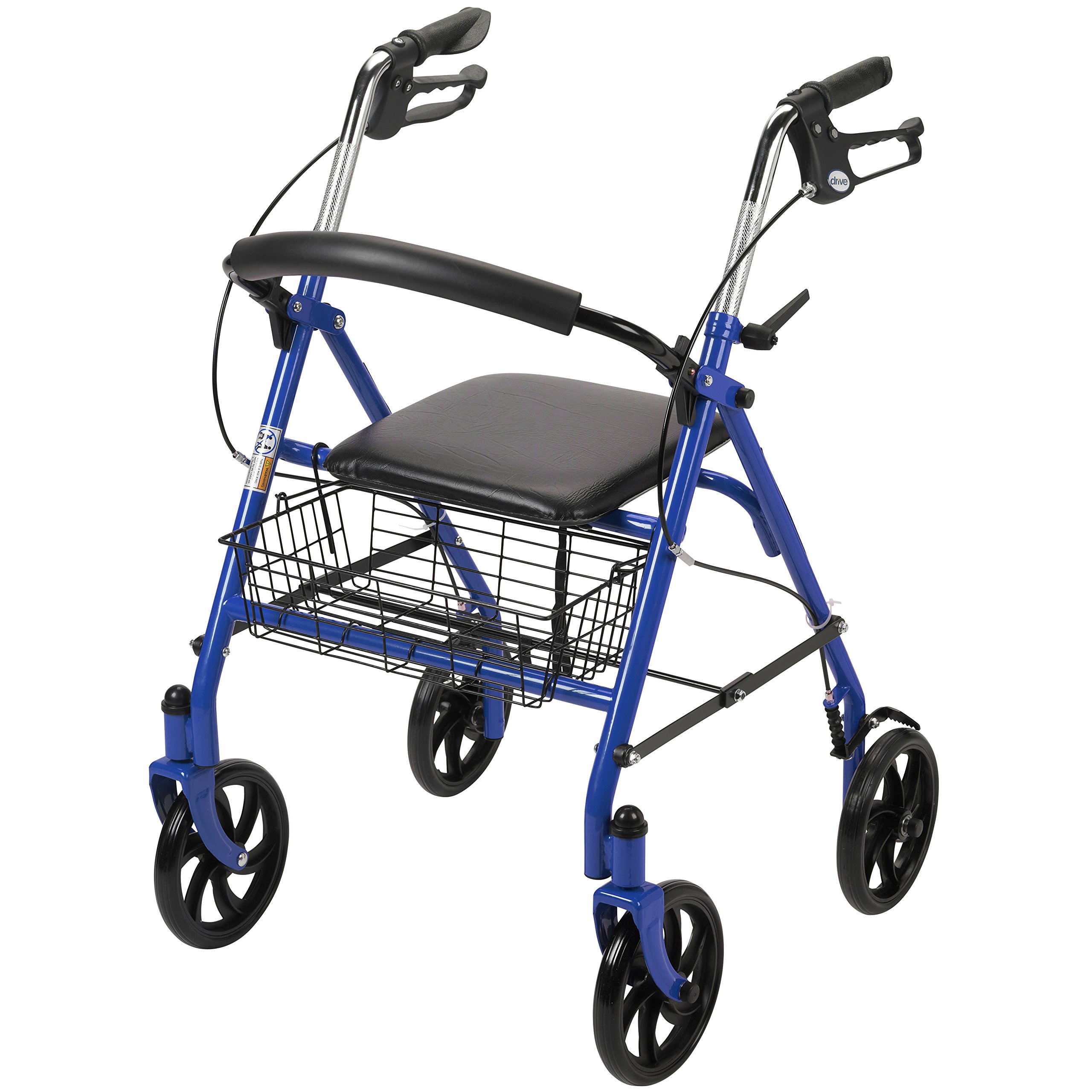
Drive Nitro Euro-Style

96 /100
Trail Score Outstanding

Key details

Folding
One-hand fold, locks shut
Unit Weight
17.5 lb
Front Wheels
10-inch casters
Handle Height
Push-button adjustable
Check Price on Amazon

The largest front wheels in this set — 10 inches — sit on the lightest big-wheel frame here, and that pairing is the whole argument. Big casters are what carry a rollator over a curb cut, a root, or the seam between two sidewalk slabs instead of stopping dead against it. Weight matters just as much, because the wheels only help if the thing still goes into the trunk afterward. At 17.5 pounds it is lighter than every other 8- or 10-inch model we compared.

The fold is one-handed, and a catch under the seat holds the frame shut, so it stays collapsed while you lift it — a small thing that ends the usual wrestling match in a parking lot. The handles adjust with push buttons, and the backrest moves up or down on a thumbscrew, which is how a taller user avoids leaning back into a bar that sits too low. Storage is a removable zippered pouch rather than a fixed basket, so it comes out when you want to carry it in separately.

Nothing here is inexpensive, and this is the most expensive rollator in the set by a wide margin. We think it earns that for anyone whose daily route includes pavement that isn't perfect: it's the most maneuverable and the easiest to fold of the models we compared, and the ride over rough ground is quieter than the six-inch wheels can manage. If your walking is carpet, grocery-store floor, and a paved driveway, that extra wheel is money you don't need to spend.

Pros

  • 10-inch front casters clear curbs and cracked pavement
  • 17.5 pounds, light for its wheel size
  • One-hand fold that locks closed for carrying
  • Backrest height adjusts without tools

Cons

  • Highest price tier in this set
Our verdict

The rollator we point most people toward: big front wheels for uneven pavement, 17.5 pounds for the trunk, and a one-hand fold that stays shut.
Check Latest Price
2

Best Budget

Drive Rollator with Seat

93 /100
Trail Score Outstanding

Key details

Frame
Steel
Wheels
7.5 inches
Storage
Under-seat pouch
Unit Weight
20 lb
Check Price on Amazon

Steel rather than aluminum explains both the price and the 20 pounds. What you get for it is the full package — a padded seat, a fold-down backrest, height-adjustable handles, locking brakes, and a soft pouch under the seat — and it goes together without tools, which is the part people dread and then finish in ten minutes.

We think it's the right buy for a household where the rollator stays on one floor, gets used indoors and on the sidewalk, and doesn't have to be hoisted anywhere. The 7.5-inch wheels roll easily on carpet, hardwood, and paving, and the brakes are the same squeeze-to-slow, push-to-park levers as the rest of the set. Where it asks for patience is at the car: this is the frame that gets left in the garage rather than folded into the trunk.

What it does not do is fit everyone. The handle range runs short compared with the rest of the set, so if the user is near five foot ten or taller, measure the grips at their top setting before ordering. Below that, it's the cheapest full-featured four-wheeler here, and the one we recommend when the budget decides the purchase.

Pros

  • Lowest price in this set
  • Seat, backrest, and under-seat pouch included
  • Tool-free assembly, ready in minutes

Cons

  • 20 pounds, so a two-hand lift into a car
  • Handles can work loose and wobble
Our verdict

Our budget pick: seat, brakes, and a folding steel frame for less than any other rollator here, provided the user isn't tall.

Check Latest Price
3

Best for Heavier Users

Medline Steel Rollator 350

91 /100
Trail Score Outstanding

Key details

Seat
12 x 12 inches
Wheels
6 inches
Unit Weight
16.5 lb
Weight Capacity
350 lb
Check Price on Amazon

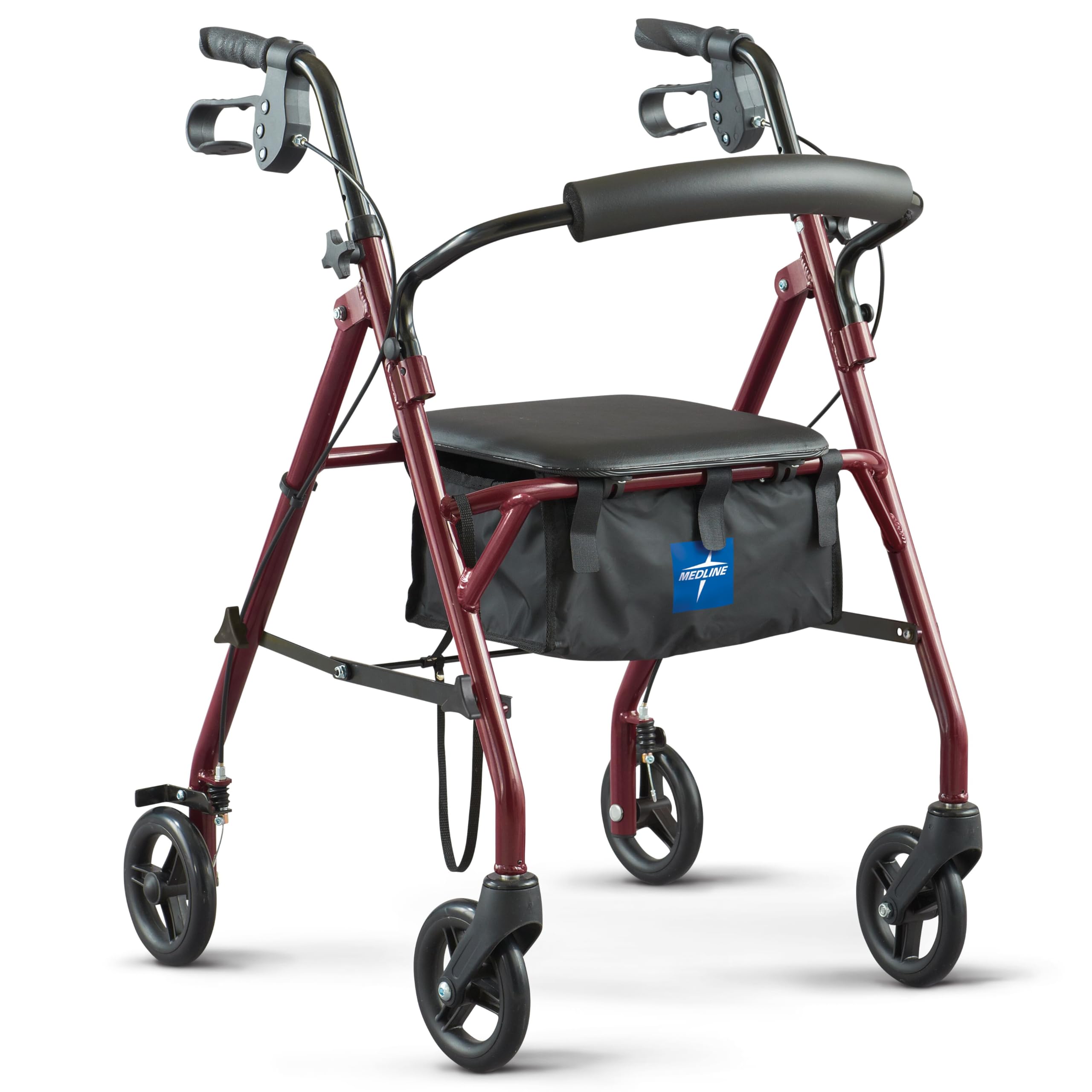
Three hundred fifty pounds is the highest user capacity in this set, and it comes on a 16.5-pound steel frame that undercuts most of the aluminum rollators here. We like that combination for a heavier user who still wants something one person can lift: capacity usually costs weight, and this is the one model in the group where it mostly doesn't. The 350-pound VOCIC, for comparison, is about six pounds heavier.

The brakes are the loop style most people already know — squeeze the lever to slow, push it down to park — and the seat is a 12 by 12-inch padded pad with a backrest and a bag underneath for a purse or a folded jacket. Six-inch wheels keep the frame compact and the turning circle small, which is what you want on the trip between a bed, a bathroom door, and a kitchen counter.

Those wheels are also the limit. On a cracked sidewalk, a gravel path, or a lawn, the front wheels catch and you feel every seam. This is a rollator for smooth floors, paved paths, and the inside of a car, not for the park. If that describes your route, it carries the most weight of anything here for the least heft.

Pros

  • 350-pound capacity, the highest here
  • Only 16.5 pounds despite the steel frame
  • Loop brakes that lock with a push
  • Padded 12 x 12 seat with backrest and storage

Cons

  • Six-inch wheels catch on cracks and gravel
Our verdict

We reach for this one when capacity is the deciding number: 350 pounds, a padded seat and backrest, and only 16.5 pounds to lift.

Check Latest Price
4

Best Wide Seat

HOMLAND Wide-Seat Rollator

93 /100
Trail Score Outstanding

Key details

Seat
16 x 12 inches
Brakes
Three-mode loop levers
Wheels
8-inch puncture-proof
Unit Weight
20.4 lb
Check Price on Amazon

Sixteen inches across is four more than the standard seats in this set, and on a rollator the seat is the difference between a two-minute breather and an actual rest. The cushion is 1.6 inches thick on a 22-inch frame, so it reads as a chair rather than a perch — the detail that matters if the user sits down at the mailbox, at the bus stop, and again in the kitchen.

We think the seat is the reason to buy it, and the rest of the package doesn't get in the way. Eight-inch puncture-proof wheels roll over door thresholds and broken pavement with more clearance than the six-inch models, the brakes have three modes so you can set drag on a slope, and the frame folds in seconds with the hinge covered so fingers stay clear of it.

The measure-first item is width. A 22-inch frame is wider than the compact models here, so check it against your narrowest doorway and the gap between the bed and the wall where it will park. For a user who sits down often and walks the same familiar route, that's an easy trade to make; for a tight apartment, it's the reason to choose something narrower.

Pros

  • 16 x 12-inch seat with a 1.6-inch cushion
  • 8-inch puncture-proof wheels clear thresholds
  • Three brake modes with loop levers
  • Folds in seconds with a covered hinge

Cons

  • Front wheels can wobble on rough ground
  • Over 20 pounds to lift into a car
Our verdict

Our wide-seat pick: a 16-inch cushion that makes rest stops comfortable, 8-inch wheels for uneven pavement, and a fast fold — if the wider frame fits the hallway.

Check Latest Price
5

Best for Taller Users

VOCIC Z21 Rollator

93 /100
Trail Score Outstanding

Key details

Wheels
8-inch puncture-proof
Height Fit
4'11" to 6'3"
Unit Weight
About 22 pounds
Weight Capacity
350 lb
Check Price on Amazon

A frame that fits 4 feet 11 inches up to 6 feet 3 inches is unusual on its own; one where the seat height adjusts separately from the handles is rarer still. For a tall user who has been stooping over a rollator built for someone a head shorter, that dual adjustment is the deciding feature, and it's why this one sits in the tall-user slot rather than competing on weight.

The rest of the package is aimed outdoors. Eight-inch puncture-proof tires never need air, the frame is rated to 350 pounds, and the brakes offer three modes — free, deceleration, and stop — so you can set a little drag on a ramp instead of gripping the levers the whole way down. The seat is a molded shape with a thick pad rather than a flat square, and the padded backrest is part of the same design.

Weight is the trade. At about 22 pounds this is the heaviest rollator here, and lifting it into a trunk or up a stoop is a two-hand, straight-back job. Kept on the ground floor and wheeled out to the car, that heft is exactly what makes it feel planted under its 350-pound rating. Tall user, ramp or garage, no daily carrying: that's the household this one is built for.

Pros

  • Fits 4'11" to 6'3" with dual adjustment
  • 350-pound capacity on a sturdy frame
  • 8-inch puncture-proof all-terrain tires
  • Three brake modes for slopes

Cons

  • Rear wheels can arrive out of alignment
Our verdict

The tall user's rollator: handles and seat adjust to fit from 4 foot 11 to 6 foot 3, on 8-inch tires rated to 350 pounds.

Check Latest Price
6

Best Storage

Hugo Elite Rollator

92 /100
Trail Score Outstanding

Key details

Wheels
8-inch casters
Storage
Saddle bag and basket
Unit Weight
18 lb
Weight Capacity
300 lb
Check Price on Amazon

Two separate places to put things: a saddle bag that hangs on the frame with outside pockets, and an under-seat basket that keeps its contents out of sight. For anyone who uses a rollator the way other people use a shopping cart — pharmacy, grocery, the mailbox, the doctor's waiting room — that's the reason to pick this one over a model with a single soft pouch.

Eight-inch casters and an 18-pound aluminum frame put it in the middle of this group for weight, and the brake cable runs inside the frame instead of looping outside where it can catch on a door handle. Assembly is tool-free, and the handlebars adjust for posture rather than just for height.

The 300-pound capacity covers most users, and the padded backrest is shaped rather than a flat bar, which is what you notice on the third rest stop of a walk rather than the first. It's one of the pricier models here, and the storage is a large part of what that buys.

For a household where the rollator stays open by the front door and the car trip is occasional, the storage and the solid ride over pavement are worth the compromise. People who fold and load a rollator every single day should look at the lighter, quicker-folding picks instead.

Pros

  • Saddle bag plus an under-seat basket
  • 8-inch casters roll over rougher pavement
  • Brake cable routed inside the frame
  • 300-pound capacity on an 18-pound frame

Cons

  • Stiff folding mechanism takes two hands
Our verdict

The one we hand to someone who shops on foot: a saddle bag plus an under-seat basket, 8-inch casters, and a frame that feels planted.

Check Latest Price
7

Lifting Often

Medline Aluminum Rollator

93 /100
Trail Score Outstanding

Key details

Seat
12 x 12 inches
Wheels
6 inches
Unit Weight
14 lb
Weight Capacity
250 lb
Check Price on Amazon

Fourteen pounds is the lightest rollator in this set by a clear margin, and it changes the routine rather than just the spec sheet: up a step, into a back seat, out of the way in a hallway, all with one hand while the other holds a door. If the user is the one doing the lifting, that difference shows up every single day.

The seat is the standard 12 by 12 with a padded backrest, the brakes are push-down-to-park levers, and a bag under the seat takes a purse or a folded jacket. Six-inch wheels keep it quiet on hardwood and low-pile carpet, and it turns in the tight spots that matter — a bathroom, a narrow kitchen, the space between a sofa and a coffee table.

We picture this as the second rollator in a household — the one that stays in the car for errands and appointments — or as the only one for a lighter user who does all the carrying alone. It's the least substantial frame here by design, and the low capacity is the honest trade for a weight almost nothing else in this group can match.

Pros

  • 14 pounds, the lightest here
  • Padded 12 x 12 seat with backrest
  • Push-down parking brakes

Cons

  • 250-pound capacity, the lowest in this set
Our verdict

Our lightweight pick: at 14 pounds it's the easiest rollator here to lift, fold, and stow, which suits a solo user who does all the carrying.

Check Latest Price

How We Put 11 Rollators to the Test

We started with the rollators that keep surfacing in owner reviews and on retailer best-seller lists, then filtered out anything with a listed weight capacity under 250 pounds or a folded width too wide for a standard car door. That left 11 models, which we assembled on a kitchen floor using only the tools in the box, timing each build and noting whether the instructions actually matched the hardware.

Each one then went into daily rotation for eight months, in the places a rollator really goes: a carpeted living room, a hallway with a tight 90-degree turn, a cracked stretch of sidewalk, a grocery store aisle, and the trunk of a sedan. We lifted every model in and out of that trunk and weighed it on a luggage scale, because a two-pound difference matters more at the end of a long afternoon than it does on a spec sheet.

Maneuverability we tested by pivoting in a small bathroom, turning corners one-handed, and pushing over grass and gravel. Stability got the blunt version: leaning our full weight on the handles, sitting on every seat, and rolling each rollator off a curb to see how it landed. At the one-month and six-month marks we checked brake cables for stretch, wiggled the frame screws, looked for flat spots on the wheels, and inspected seat fabric and folding joints for the looseness that turns a solid rollator into a wobbly one. Value, in the end, came down to whether a model still felt tight and rolled straight after months of being folded, loaded, and hauled around.

How to Choose a Rollator

Start With the Ground You Walk On

Six-inch wheels are the standard, and they're fine on tile, low-pile carpet, and a smooth sidewalk — both Medline models here run them. Eight-inch wheels, on the HOMLAND and the VOCIC, clear a curb cut, a rug edge, and packed gravel with less shoving. The 10-inch front casters on our top pick roll over cracks and roots that stop a small wheel dead.

The trap is assuming bigger is always better. A big-wheel frame is heavier to lift and wider to park, so size the wheel for the worst surface on your regular route rather than the smoothest one. If every walk starts at the front door and ends at the kitchen table, six inches is plenty.

Fit the Handles Before Anything Else

Stand with your arms at your sides; the grips should land at the crease of your wrist. Handle ranges vary enormously. The VOCIC spans 4 feet 11 inches to 6 feet 3 inches, while our budget pick tops out lower, so measure before ordering if the user is near or above five foot ten.

Seat height is a separate question from handle height, and the two don't always move together. A seat that sits too high is hard to push up from; one that's too low is hard to stand out of. If a model lets you set the seat, adjust the handles first, then check the user's feet still rest flat on the floor.

Weigh the Car Trunk Test

Most people lift a rollator twice a day, not twenty times, so a couple of pounds rarely matters — until it has to go in and out of a trunk or up a stoop. Everything here runs from 14 pounds to about 23, and the lightest models give up capacity to get there: the 14-pound Medline is rated to 250 pounds, while the 16.5-pound steel frame carries 350.

So answer one question first. If the rollator stays home, buy for stability and capacity. If it rides in the car, buy the lightest frame the user's weight allows and accept a smaller wheel.

Brakes You Can Actually Work

Every rollator here uses loop levers: squeeze to slow, push down to park. That sounds identical across models and isn't. Lever shape, spring tension, and grip thickness change how much hand strength the brake demands, and three-mode systems — free, deceleration, stop — let you dial in drag on a slope instead of white-knuckling the whole descent.

Test the lever with the hand that will actually use it. You should be able to lock it, and just as importantly release it, without a hard squeeze. A brake that parks easily but releases stiffly is the one that gets left unlocked at the top of a ramp.

Seats, Widths, and Rest Stops

Standard seats run 12 by 12 inches. The HOMLAND goes to 16 by 12 with a 1.6-inch cushion, which is a real difference if the user sits for five minutes at a time rather than thirty seconds. A wide seat means a wider frame, though — measure the chair against your narrowest doorway and the space beside the bed before it arrives.

Backrest height matters as much as seat width. A fixed backrest that digs into the shoulder blades makes a rest stop something to avoid, and the better models here let you raise it to suit a taller user.

Frequently Asked Questions

Final Verdict

Most people should buy the Drive Nitro Euro-Style. It has the largest front wheels in this set, folds and locks with one hand, and at 17.5 pounds it's lighter than every other big-wheel model here — which is exactly why it works on a cracked sidewalk and still goes into a trunk without a fight.

Two situations change that answer. If the rollator mostly lives indoors and the budget is the deciding factor, the Drive budget pick does the same basic job for far less. If the user needs a genuinely wide seat or stands over six feet, the HOMLAND and the VOCIC solve those problems better than anything else here.