Best Pull-Up Bars for Doorways of 2026

A doorway pull-up bar has one job and one way to fail: it holds fine until the day it doesn't, and your trim pays for it. I've seen the crease a cheap lever bar leaves across painted casing, and felt the wobble that shows up around rep eight. What you're buying is grip that doesn't slip, a span that fits your frame, and hardware that goes up in a minute without a drill. Get those right and the bar disappears into your routine instead of becoming a weekend project.

Over the past five months, my team and I have hung 14 of them in our own doorways — a hallway, a bedroom, a basement stairwell — twisting, pressing, and pulling until each one earned its place or didn't. The thing nobody tells a first-time buyer: measure the depth of your casing, not just the width of the door. A bar that spans 32 inches but can't clear a deep molding will rock on every pull. The picks below are the ones I stopped thinking about mid-set, which is the highest praise this category gets.

1

Best Overall

AmazeFan Pull-Up Bar

92 /100
Trail Score Outstanding

Key details

Mount Type
No-drill
Doorway Fit
Fits almost all doors
Weight Limit
400 lb
Grip Positions
Multi-angle
Check Price on Amazon

The AmazeFan arrives ready to hang, and that is a big part of why it is our top pick. There is no box of bolts to sort through: the two hooks sit 21.65 inches apart, so the bar drops over narrow closet doors and corner openings that leave wider lever bars stranded. With a 400-pound rating, it has more headroom than most of the no-drill bars here, and the silicone pads give the frame a softer landing than bare metal.

What sold us on it for daily use is how little it asks of the doorway. The multi-angle grips are comfortable for wide, neutral, and close pulls, and they stay kind to bare hands during repeated sets. The bar stores without drama, too. Fit is the one thing to verify before ordering: the 36.22-inch bar and the 21.65-inch hook spacing need a flat, compatible top ledge, and thick or ornate trim can interfere. In a standard opening, though, it seats with a reassuring thunk and stays there through a set.

The AmazeFan is not the least expensive no-drill bar here, and it is not the lightest. What it buys you is a fast, stable setup with a higher weight rating than most of the field. For a renter or a homeowner who wants one bar that works in the main hallway and can move to a closet door when guests come, this is the one we reach for first.

Pros

  • No assembly or drilling required
  • 400-pound weight rating
  • Multi-angle grips and silicone frame pads

Cons

  • Can leave scuff marks on painted trim
Our verdict

The AmazeFan is our top pick because it hangs without assembly, fits narrow openings, and has the sturdiness and 400-pound rating for daily use.

Check Latest Price
2

Best Screw-In

Maximiza Screw-In Bar

91 /100
Trail Score Outstanding

Key details

Mount Type
Screw-in
Doorway Fit
27–39 in wide
Weight Limit
300 lb
Frame Requirement
Solid wood trim, 1 in thick
Check Price on Amazon

Screwing a bar into the doorframe is a commitment, and the Maximiza is the one we trust most when the bar is going to stay up. The three sets of heavy-duty mounts are the clever part: put one over the basement doorway, another in a hallway, and the chrome bar moves between them without a new round of drilling. That turns a fixed install into something closer to a multi-room setup.

The anchored design is why it feels calmer overhead than a lever bar. The bar sits against fixed mounts, so your weight is not relying on friction against the trim, and the low-profile shape leaves more headroom than the hook-over designs. The 300-pound rating is lower than the 400- and 500-pound bars here, but the limit is tied to a mount that does not shift when you pull. We like that the bar is slim enough to leave up without banging your head.

The bar can rotate a touch during pull-overs; the lock helps, but check the collars before a hard session. That is a small annoyance rather than a dealbreaker, and the fixed mounts still make it the most planted bar in this group. That is the trade for a setup that feels this secure.

Pros

  • Three mount sets for multiple doorways
  • Anchored screw-in design resists shifting
  • Low-profile bar leaves headroom

Cons

  • Requires solid wood trim and drilling
Our verdict

For a permanent install on solid wood trim, the Maximiza is the bar we trust most, and its extra mounts make it easy to move between doorways.

Check Latest Price
3

Best Budget

Iron Gym Pull-Up Bar

91 /100
Trail Score Outstanding

Key details

Bar Width
37 in
Mount Type
No-drill
Weight Limit
300 lb
Grip Positions
3
Check Price on Amazon

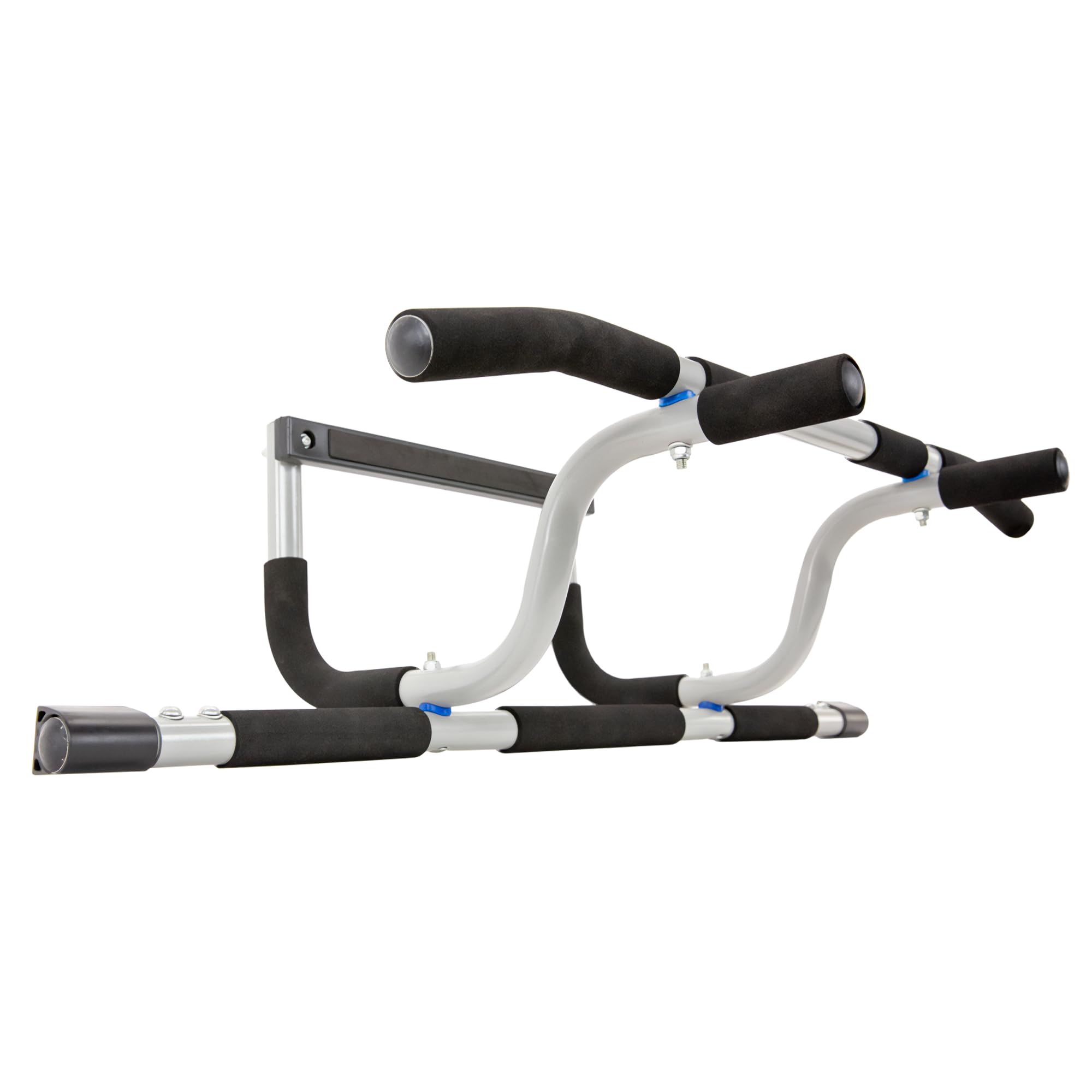
The Iron Gym is the bar we keep coming back to for a quick set because it asks so little: hang it on the frame, do your pull-ups, and take it down before dinner. At 4.7 pounds, it is light enough to move with one hand, and the three grip positions cover narrow, wide, and neutral pulls without adding a pile of parts. The black and grey finish is plain, but it disappears against a door frame.

The leverage design is simple, and that simplicity is both the appeal and the catch. It depends on a clean top ledge and trim that can take the load, so a loose or ornate frame can turn a solid bar into a wobbling one. We also appreciated that the bar comes off in seconds, which makes it easier to share a doorway with the rest of the house.

For a first pull-up bar or a second bar for a spare doorway, that trade-off is easy to accept. The 300-pound rating is enough for many households, and the low weight makes it the easiest bar here to stash behind a door. Just measure the ledge before you buy, because this one is less forgiving of an odd frame than its simple shape suggests. It is a starter bar in the best sense: simple enough to use every day, cheap enough to try.

Pros

  • Light enough to move and store easily
  • Three grip positions
  • No screws or assembly required

Cons

  • Foam grips can tear with regular use
Our verdict

The Iron Gym is our budget pick for quick no-screw sets, provided your doorway has a clean ledge and you can live with foam grips that wear.

Check Latest Price
4

Best for Taller Users

Ultimate Body Press XL

88 /100
Trail Score Excellent

Key details

Mount Type
No-drill
Doorway Fit
24–36 in wide
Elevated Bar
1 in above trim
Weight Limit
300 lb
Check Price on Amazon

The first thing a taller lifter notices is the height. Ultimate Body Press sets the bar an inch above the trim and 10 inches out from the wall, which buys enough clearance for a full hang without your knees folding up toward your chest. That one design choice makes it the bar we point tall users to before they start comparing grip counts.

It is also one of the heavier no-drill bars here at 10.2 pounds, and that weight is reassuring when you are hanging from it. The 300-pound rating is standard for this group, and the expandable ends fit a range of openings without tools. Assembly takes more pieces than a simple hook-over bar, but the payoff is a wider, more adjustable frame. The steel tubing feels substantial, and the foam grips are dense enough for long sets.

The fit is the part to check: thick or decorative trim can keep the bar from seating, so measure the depth before ordering. We also like the multiple grip options, which give you a wider pull without forcing your wrists into an awkward angle. In the right opening, the extra height is worth the extra assembly.

Pros

  • Elevated bar adds clearance for full hangs
  • 300-pound rating and adjustable ends
  • Multiple grip options

Cons

  • ⚠️ Plastic spacers can crack
Our verdict

Taller users should start with the Ultimate Body Press XL, whose elevated bar buys a fuller hang in exchange for a little extra assembly.

Check Latest Price
5

Best for Wide Doorways

JFIT Deluxe Pull-Up Bar

90 /100
Trail Score Outstanding

Key details

Mount Type
Screw-in
Doorway Fit
25.25–40 in wide
Grip Styles
Three
Weight Limit
300 lb
Check Price on Amazon

Wide doorways are where the JFIT earns its keep. It extends from 25.25 to 40 inches, so it reaches across openings that leave 36-inch bars dangling short, and the screw-mount brackets give it a fixed anchor rather than a friction fit.

The neoprene grips are a nice surprise: they are removable, sweat-friendly, and held on with Velcro, which makes them easy to reposition or wash. The bar also flips to a lower position for sit-ups and crunches, so it covers more than pull-ups if you have the floor space. We found the width adjustment secure once the collars are tight, but the bar can twist a little during pull-overs if you do not check them.

The catch is installation. This is a screw-in bar, so it takes tools and a permanent address, and it is not the one to choose if you are renting or unwilling to drill. For a permanent setup in a wide frame, though, the extra reach and the removable grips make it a strong value. The 300-pound rating is ordinary for this group, but the fit range is not.

Pros

  • Extends to 40 inches for wide frames
  • Removable neoprene grips
  • Screw-mount brackets for a fixed anchor

Cons

  • Leaves small screw holes in the frame
Our verdict

The JFIT is our pick for wide doorways, with a 40-inch reach, screw-in security, and removable grips that make daily use more comfortable.

Check Latest Price
6

Best Certified No-Drill

Sportneer Pull-Up Bar

86 /100
Trail Score Excellent

Key details

Mount Type
No-drill
Doorway Fit
29.5–37 in wide
Weight Limit
440 lb
Frame Requirement
Solid wood
Check Price on Amazon

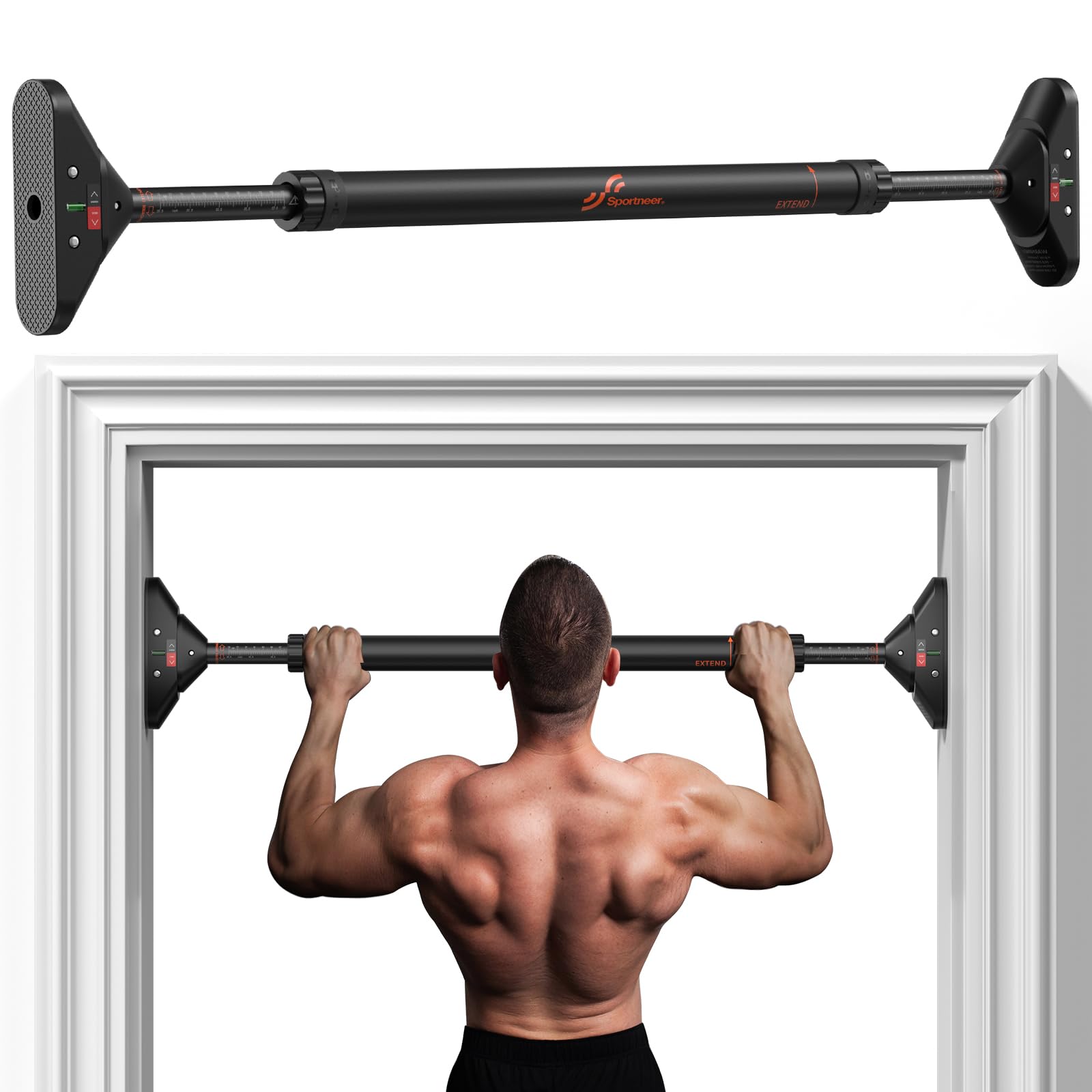
The Sportneer is the no-drill bar that comes with the most paperwork, and in this category that is a good thing. It is independently tested to ASTM and EN957 for structural safety and CA65 for environmental safety, which is more than most bars here can claim. The hardware is also substantial for the money.

The bar uses two large PVC mats and a locking mechanism to grip the frame, and the 440-pound rating gives it plenty of headroom. But it is not a universal fit: it is designed only for solid wood frames between 29.5 and 37 inches wide. If your trim is hollow, painted over, or outside that range, the bar cannot do its job safely.

Seating is the other thing we paid attention to. The lock needs to be firmly set, and over-tightening can crack the trim. When it is seated correctly, the wide mats spread the load better than small pads, and the bar feels stable on a solid frame.

For the right solid-wood doorway, the Sportneer is a strong no-drill choice, especially if certification matters to you. It is not the bar to force onto a hollow frame or an oversized opening, but on a compatible doorway it delivers a lot of security for the money. Keep it in the main hallway, not in a doorway you need to reconfigure every week.

Pros

  • ASTM, EN957, and CA65 certifications
  • 440-pound weight rating
  • Wide PVC contact mats

Cons

  • Only fits solid wood frames 29.5–37 in
Our verdict

The Sportneer is the no-drill bar we point to when certification matters, but it only belongs on a compatible solid-wood frame.

Check Latest Price
7

Multi-Exercise

Perfect Fitness Multi-Gym

91 /100
Trail Score Outstanding

Key details

Mount Type
No-drill
Doorway Fit
Up to 33 in wide
Frame Depth
Up to 6 in
Weight Limit
300 lb
Check Price on Amazon

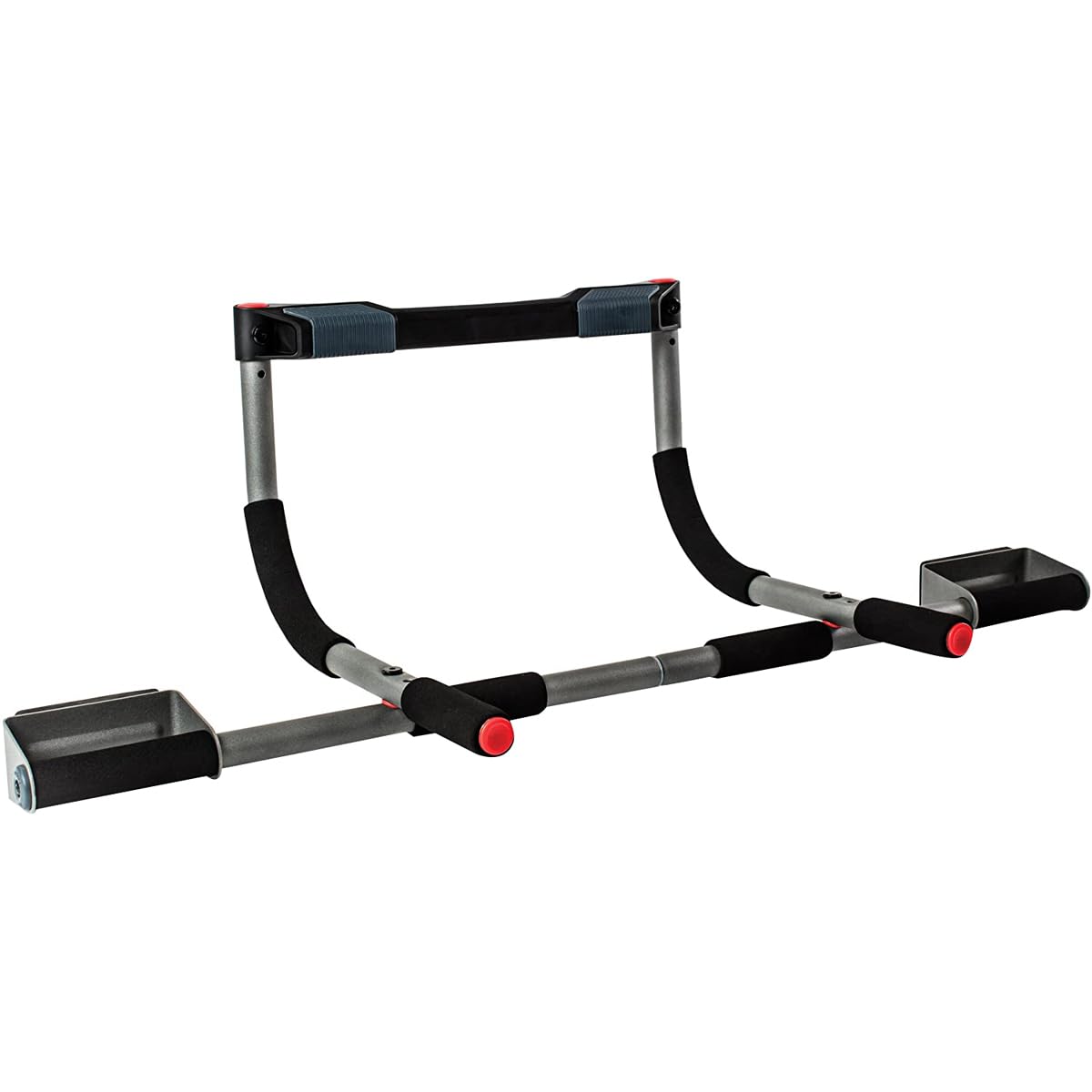
The Perfect Fitness is the only bar here that turns over and becomes a floor station. Set it in the doorframe for pull-ups, then flip it to the floor for push-ups, dips, and sit-ups. For a small apartment or a garage corner, that double duty is the reason to pick it.

As a pull-up bar, it is solid without being the most planted. The padded handles are comfortable, and the 300-pound rating is fine for most households, but the 33-inch width limit is tight for wider frames. We also noticed the plastic couplers and padding are the parts that show age first, so inspect them if the bar lives in a humid garage. The assembly is straightforward, with clear hardware, and the bar comes apart for storage.

The floor mode is not a gimmick. It gives you a place to put your hands for dips and push-ups without dragging out separate stands, and the bar stores upright when you are done. If you only want pull-ups, a simpler bar will feel more solid; if you want one piece of gear for a compact home gym, this earns its space.

Pros

  • Flips over for push-ups, dips, and sit-ups
  • 300-pound weight capacity
  • Padded handles for floor work

Cons

  • Fits doorways only up to 33 in wide
Our verdict

The Perfect Fitness is the one we choose when a single bar has to handle pull-ups and floor work, as long as your doorway is 33 inches or narrower.

Check Latest Price
8

High Capacity

Ally Peaks Adjustable Bar

86 /100
Trail Score Excellent

Key details

Bar Width
42 in
Mount Type
No-drill
Doorway Fit
5 width levels
Weight Limit
500 lb
Check Price on Amazon

The Ally Peaks is built for the household where one bar has to cover a lot of ground. It has five preset width settings, a 500-pound rating, and a 42-inch bar, so it can span a wider opening and still handle the heaviest lifter in the house. The silicone pads are a welcome upgrade over bare foam.

The 42-inch span and 500-pound rating are the draw, and the double steel pipe construction feels substantial overhead. This is not the easiest bar to set up quickly, though, and it is heavy enough that moving it between doorways is a chore.

The five settings are easy to count through, and the bar feels locked once the collars are tight. Setup takes more effort than a hook-over bar, and this is not the one to move between doorways every week. The silicone contact points are a practical touch on painted trim.

For a permanent home gym, those compromises are manageable. The bar gives bigger users more margin than the 300-pound models here, and the width settings cover a useful range. If you need to move it often, choose a lighter hook-over design instead, but for a fixed doorway it is a lot of bar for the money.

Pros

  • 500-pound weight rating
  • Five adjustable width settings
  • Silicone door-frame protection

Cons

  • Preset widths may not match every frame
  • ⚠️ Can loosen with use
Our verdict

The Ally Peaks is our high-capacity pick for a permanent doorway, with a 500-pound rating and five width settings that suit heavier users.

Check Latest Price

How We Hung, Twisted, and Rehung 14 Doorway Bars

We started by rounding up every doorway bar we could find with a stated weight rating, a published span range, and a mounting method we could actually verify, then cut the list by price band and by whether the hardware came in the box. That left 14 bars, which we hung in the doorways of our own homes over five months: a hallway, a bedroom, and a basement stairwell, plus one hollow-core frame we chose on purpose as the worst case. Two testers of different heights and weights used each bar most days, before work and again after dinner.

Assembly was timed from opening the box to the first hang, solo, using only what came in the box. We measured every frame from 28 to 36 inches wide and checked whether each bar cleared the full depth of the casing — several fit the width but pressed hard into the trim. For stability, we hung slow and controlled, then added a kip and a weighted swing, watching for side-to-side sway and any rotation of the bar in the frame. Before hanging, we taped and photographed the trim; after a week and again at the end, we looked for compression dents, cracked paint, and scuff marks.

Adjustability got its own workout: we moved each bar between two doorways, changed the grip width, and noted whether it took tools or a twist of the wrist. Durability came from living with them — checking welds, foam that had gone slick, grip tape rolling at the edges, and screws that needed retightening. Value came down to what actually worked in the box, brackets and wrench and instructions included. The bars that scored best were the ones we stopped adjusting and just started using.

How to Choose a Doorway Pull-Up Bar

Measure the opening and the trim

Start with the clear width between the door jambs and the depth from the face of one trim to the other. A 36-inch opening is common, but the bar's usable range is what matters: the Maximiza's screw-in mounts fit 27 to 39 inches, while the JFIT reaches to 40. Then look at the top ledge. A lever bar needs a flat, solid surface to pull against; ornate or rounded trim can keep it from seating.

Measure the trim thickness too. Screw-in bars such as the Maximiza need solid wood at least an inch thick, and the Sportneer is limited to solid wood frames from 29.5 to 37 inches. “Fits most doorways” is a starting claim, not a measurement. Write down your opening before you shop.

Choose between no-drill and screw-in

No-drill bars are the easy answer for renters and anyone who does not want holes. Hook-over designs such as the AmazeFan hang from the frame and lock with body weight, while lever bars such as the Iron Gym wedge against the trim. They are quick to move, but they depend on a good seat and can mark paint.

Screw-in bars trade that flexibility for a fixed anchor. The Maximiza's mounts and the JFIT's brackets put your weight on a mechanical fixing rather than friction. If the trim is solid and you are staying put, that is the more planted setup; if you cannot drill, stay with a no-drill design and check the frame requirement carefully.

Match the weight rating to the user

A 300-pound rating is common here, while the AmazeFan, Sportneer, and Ally Peaks go higher. The rating is a ceiling, not a target: the bar, the frame, and the installation all share the load. A 440- or 500-pound bar does not make a hollow frame safe.

Pick a bar with a rating above the heaviest user's body weight and check the hardware before each session. If the bar shifts, rocks, or makes a new noise at the mounting point, stop and reseat it. The strongest-looking bar in the room is only as good as the trim holding it.

Decide how much height and grip you need

Grip count matters less than comfortable spacing. Wide, neutral, and close positions cover most training, but a very wide fixed grip can be too wide for smaller users. The AmazeFan and Iron Gym keep their grips within a useful range, while the Ultimate Body Press XL is the one to choose if you want a full hang: its bar sits an inch above the trim.

Then consider whether the bar has a second job. The Perfect Fitness flips to the floor for push-ups and dips. Those features are worth paying for only if you will use them; otherwise, put the budget toward a better frame fit.

Plan for wear and frame protection

Pads and grips are wear parts. Foam can tear, silicone can leave marks, and plastic spacers can crack. Inspect the contact points and hardware every few weeks, especially if the bar stays up. A strip of paint or a small screw hole is one thing; a loose mount is another.

Keep the bar on a compatible frame and do not overtighten a no-drill mechanism to chase a wobble. If the trim is hollow, thin, or crumbling, no pad will fix it. Choose a different doorway or a different mounting method.

Frequently Asked Questions

Final Verdict

For most people, the AmazeFan is the one to buy. It hangs without assembly or drilling, fits narrow openings, and has the 400-pound rating and steady seat to handle daily use. If you can put screw holes in solid wood trim, the Maximiza is the more planted choice, and taller users should start with the Ultimate Body Press XL. The AmazeFan is still the easiest recommendation because it asks the least of your doorway.