Best Pull-Up Assist Bands of 2026

A pull-up assist band should make a hard movement feel possible, not add a new worry—will it snap, roll under my foot, or give out halfway up? I’ve used bands that felt fine on the first rep and sketchy by the twentieth, and that gap between promising and dependable is what this category is really about. The right band gives you enough lift to complete clean reps, then lets you back off as you get stronger, so resistance, length, and construction matter more than the color on the label. We put 14 bands through three months of assisted pull-ups, dips, and stretching to find the ones that held up.

Fit changes everything: a band that’s too short is a fight to step into, and one that’s too long can bottom out before it helps. We also paid attention to value—not just the sticker, but whether a band kept its resistance after weeks of use and whether it could double for rows, mobility work, and stretching. The picks below are the ones that earned a spot on the bar.

1

Best Overall

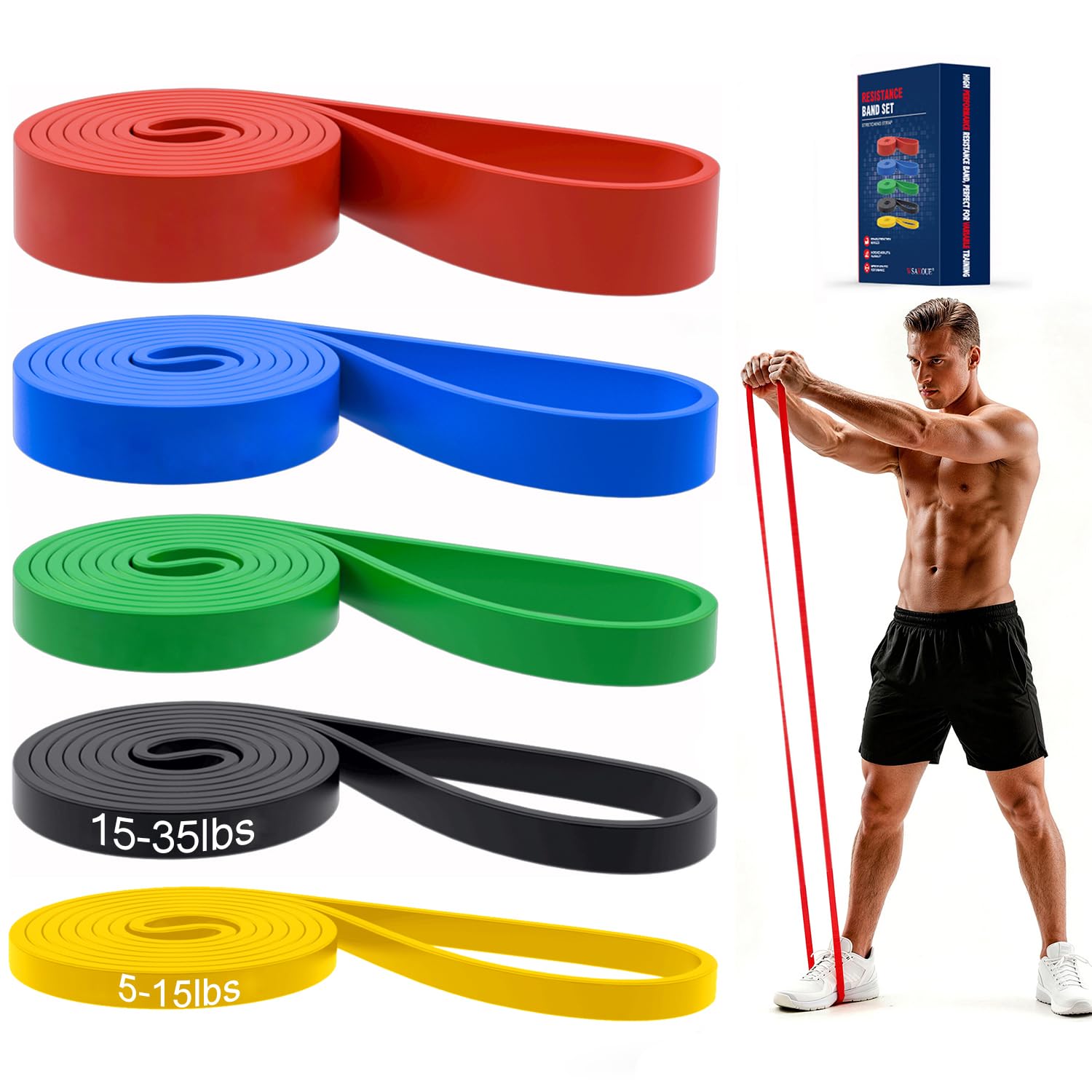
WSAKOUE Pull-Up Band Set

93 /100
Trail Score Outstanding

Key details

Bands
5
Material
Natural latex
Loop Length
82 in
Assistance Range
5–125 lb
Check Price on Amazon

Five bands, 5 to 125 pounds of assistance, and 82 inches of rubber — roughly double the length of the 41-inch loops most of this group uses. That length is what changed our mind about long bands. A short loop is close to taut the moment you hang, while a long one keeps giving, so the help builds through the bottom of the rep instead of arriving all at once. If you're draping a band over a high bar and stepping a foot in, that slack is the difference between a controlled descent and a drop.

The set grows with you. Start on the heaviest band, then drop a level once you can finish five clean reps — five bands give you more places to land than any four-band set here. At 2 inches wide the band sits under a foot without biting, and the latex is soft and odorless out of the bag, though a new band feels stiffer than a broken-in one for the first few sessions.

Everything packs into the supplied bag alongside a printed guide, so it lives in the bottom of a gym bag without a second thought. Our one reservation is the warranty: a year, where WODFitters covers its bands for life. If you're hard on equipment, that's a fair reason to look elsewhere. Otherwise the one-year cover is the only sour note.

Pros

  • Five bands spanning 5 to 125 lb
  • 82-inch loops leave room to step in
  • More levels than the four-band sets here
  • Storage bag and printed guide included

Cons

  • One-year warranty only
Our verdict

Our default recommendation: five bands from 5 to 125 pounds in long loops that leave room to step in, so one purchase covers the whole progression.
Check Latest Price
2

Best Heavy-Duty

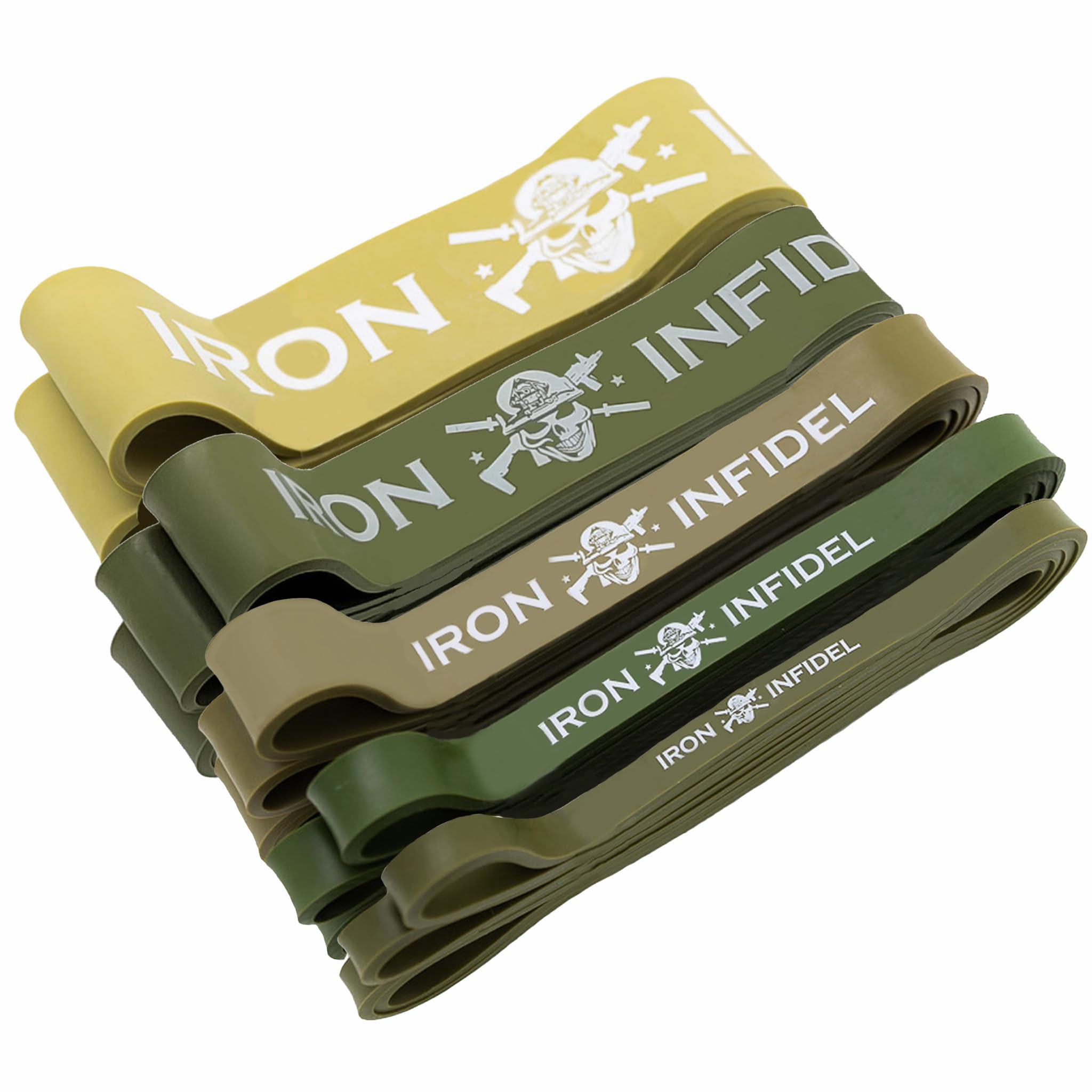
Iron Infidel Resistance Band Set

95 /100
Trail Score Outstanding

Key details

Bands
5
Material
Natural rubber
Set Weight
3.2 lb
Assistance Range
Up to 150 lb
Check Price on Amazon

Everything about this set is heavier. Five bands, 3.2 pounds of rubber, and a top end rated at 150 pounds of assistance — you can feel the difference in your hands before you have hung from a bar. You pay a premium for that, and the fair question is whether the extra material buys anything a lighter set doesn't.

Under a barbell, it does. These are the bands we're comfortable recommending for squats, bench work, and deficit pulls as well as pull-ups, because the material stays wide and flat when it's loaded instead of rolling into a rope. On the long-term question that hangs over every latex band, this is also the steadiest set in the group: 3.2 pounds across five bands is a lot of rubber, and it feels dense rather than springy.

If you're chasing a first pull-up, you're buying headroom you won't use for months, and the lightest band here is still a serious piece of equipment. The trade is simple: more rubber now, or a replacement sooner.

Pros

  • Assistance up to 150 lb
  • 3.2 lb of rubber across five bands
  • Built for barbell work as well as pull-ups
  • Holds up best of the sets here

Cons

  • You pay a premium for headroom you may not need
Our verdict

For lifters who load bands under a barbell as well as on a pull-up bar, the 150-pound top end and dense 3.2-pound build justify the premium.

Check Latest Price
3

Best Latex-Free

LEEKEY Resistance Band Set

93 /100
Trail Score Outstanding

Key details

Bands
4
Material
Latex-free synthetic rubber
Thickness
3.5 mm
Assistance Range
15–125 lb
Check Price on Amazon

The reason to look here first is the material. This is synthetic rubber rather than latex, so anyone who has reacted to latex gloves or bands can train without a second thought. Four bands, 3.5 millimeters thick, covering 15 to 125 pounds.

The ladder is spelled out: red for 15 to 35 pounds, black 25 to 65, purple 35 to 85, and green 50 to 125. That's the detail that makes a four-band set easy to live with — somewhere around week three you stop guessing which band is which.

At 3.5 millimeters they fold flat enough for a laptop bag, and the set ships with a carry bag and an exercise guide. The catch is at the easy end: the lightest band still adds 15 pounds of help, so the final step to an unassisted rep is a big one. If you can already do a couple of pull-ups that won't bother you; if you're two weeks away from your first, the five-band sets give you a gentler run-in.

Pros

  • Latex-free synthetic rubber
  • Four bands from 15 to 125 lb, each labeled
  • 3.5 mm bands fold flat for travel
  • Carry bag and exercise guide included

Cons

  • 15-lb lightest band makes the final step a big one
Our verdict

The set to buy if latex bothers your skin: synthetic rubber, four clearly labeled bands from 15 to 125 pounds, and a slim profile that travels.

Check Latest Price
4

Best Budget Set

Alllvocles 4-Band Set

93 /100
Trail Score Outstanding

Key details

Bands
4
Storage
Waterproof bag included
Material
Natural rubber
Assistance Range
5–100 lb
Check Price on Amazon

Four bands, and the heaviest stops at 100 pounds of assistance. That's the lowest ceiling of any set here, and it's the first thing to check against your own bodyweight: if you want most of your weight off the bar, this set runs out before you do.

At the other end it's the most forgiving set in the group. The yellow band is rated at 5 to 10 pounds, which is barely a nudge — exactly what you want in the last few weeks before an unassisted rep, and a sensible place to start for shoulder or rehab work. The four levels run 5-10, 15-30, 30-60, and 60-100 pounds, so the jumps are even and easy to keep straight.

Natural rubber, a storage bag, and bands that feel denser in the hand than the price suggests. What we can't call it is a one-set answer for a heavy lifter chasing a bodyweight pull-up — above 100 pounds of assistance it has nothing left to give, and the fix is a second set. Below that ceiling, the gentle bottom end is the more useful thing to own.

Pros

  • Starts at 5 lb, the gentlest band here
  • Four evenly spaced levels
  • Dense natural rubber and a storage bag
  • Good value for a first set

Cons

  • Tops out at 100 lb, the lowest ceiling here
Our verdict

A gentle four-band set we like for beginners and light assistance work — just know that 100 pounds is as much help as it will give you.

Check Latest Price
5

Best Single Band

POWER GUIDANCE Pull-Up Band

93 /100
Trail Score Outstanding

Key details

Width
2.5 in
Material
Natural rubber
Assistance
175 lb rated
Loop Length
41 in
Check Price on Amazon

If you already know how much help you need, a five-band set is money spent on bands you'll never touch. This is a single loop — 41 inches long, 2.5 inches wide, rated to 175 pounds — the widest and strongest single band in this group. For adding tension to barbell lifts, or for one heavy band to grow into, we think that is the right purchase.

The 41-inch length deserves a thought before you order. It's the conventional size for a pull-up band and it packs down to nothing, but there's less rubber to give, so it comes tight early in the rep and feels heaviest at the bottom. Taller lifters, or anyone hanging from a high bar, get more usable range from the long bands on our top pick.

Because it's one band, stepping down a level means buying another one. Start lighter than you think you need: an over-heavy band makes the rep easier while asking less of the top half of the movement, which is the opposite of what you want as you close in on an unassisted pull-up.

Pros

  • Rated to 175 lb, the strongest single band here
  • 2.5 in wide, the widest band in this group
  • Packs smaller than any set

Cons

  • One band only, so there's no lighter backup
  • 41-inch loop leaves less slack than the long sets
Our verdict

Buy one band instead of five if you know your number — this is the widest, strongest single loop here, and it packs into a corner of a gym bag.

Check Latest Price
6

Widest Range

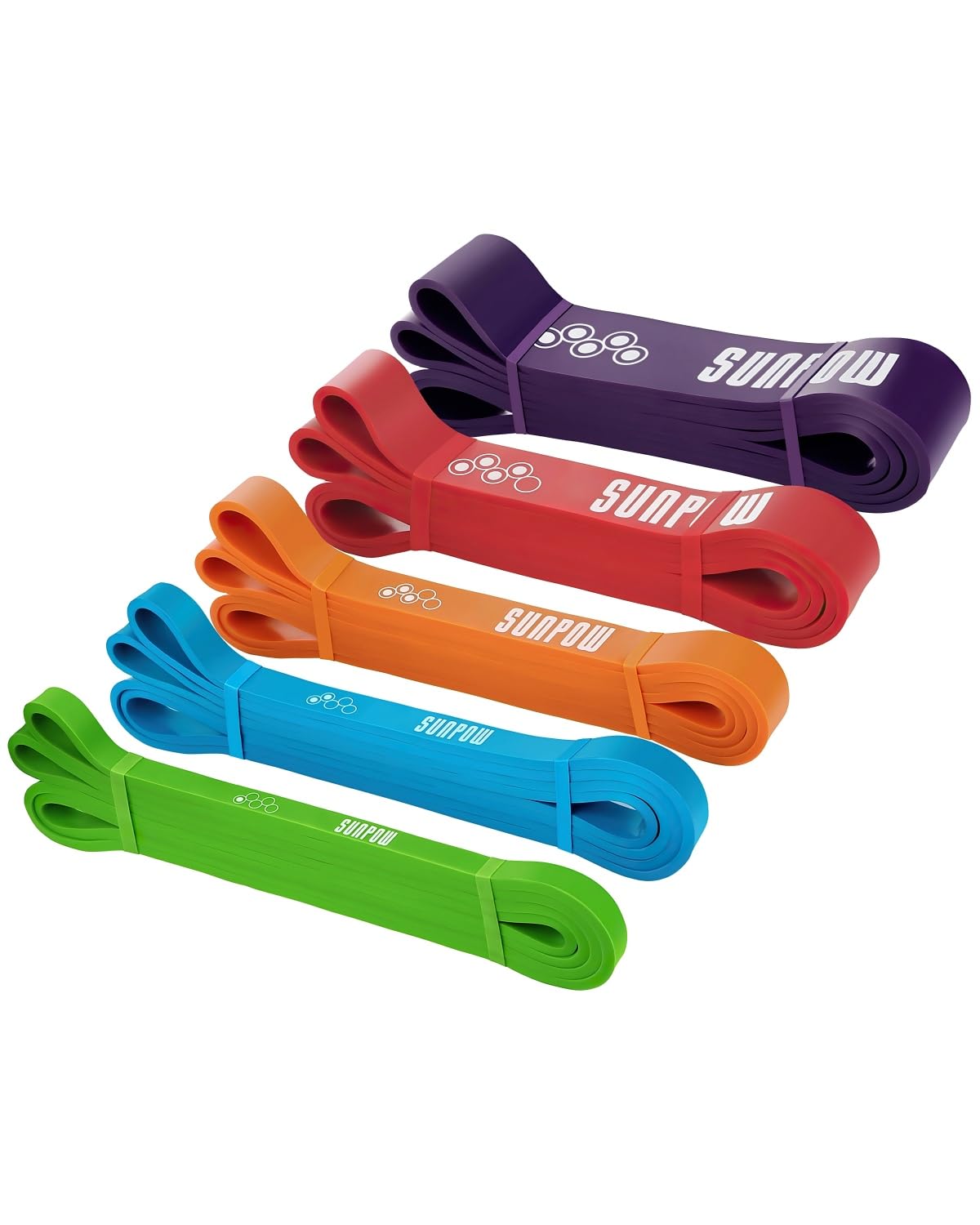
SUNPOW 5-Band Set

93 /100
Trail Score Outstanding

Key details

Bands
5
Storage
Carry sack and manual
Material
Natural latex
Assistance Range
5–145 lb
Check Price on Amazon

Five bands, and the range reaches 145 pounds — more than any other set here and twenty pounds beyond our top pick. For a bigger lifter, or anyone who wants most of their bodyweight off the bar for high-rep work, that headroom is the reason to choose this set instead.

The bands are color-coded and their ranges overlap. Green covers 5 to 30 pounds, blue 15 to 50, orange 25 to 75, and the two heaviest take you from there to 145. The overlap is deliberate — it lets you fine-tune in the middle of the range — but adjacent bands can end up feeling closer together than their numbers suggest.

A carry sack and an instruction manual come in the box, and the set weighs a touch more than the WSAKOUE without being a burden in a gym bag. The latex is billed as 99.9 percent free of the soluble proteins that set off reactions; if you have a diagnosed latex allergy, treat that as marketing and buy the latex-free set instead.

The overlapping ranges are a feature we have mixed feelings about: good for fine-tuning around a sticking point, less good when two bands feel nearly the same and you're hunting for the next step down. What isn't in doubt is the top end. If you have maxed out a 125-pound band, this is the set that picks up where it leaves off.

Pros

  • Reaches 145 lb, more than any other set here
  • Five color-coded bands with overlapping ranges
  • Carry sack and instruction manual included

Cons

  • Overlapping ranges make neighboring bands feel similar
Our verdict

The set for lifters who need more than 125 pounds of help: five bands up to 145 pounds, plus a sack and a manual.

Check Latest Price
7

Trying It Out

Amazon Basics Pull-Up Band

91 /100
Trail Score Outstanding

Key details

Width
0.75 in
Material
Natural rubber
Loop Length
41.5 in
Assistance Range
30–60 lb
Check Price on Amazon

One band, 30 to 60 pounds of assistance, 41.5 inches long, natural rubber. No bag, no manual, no second level — the plainest version of the idea, and for a first try at banded pull-ups it's all you need.

Three-quarters of an inch is narrow next to the 2- to 2.5-inch bands in the rest of this group, and you feel it under a foot or behind a knee: the load concentrates instead of spreading. Shoes, or a folded towel between band and foot, fix that. Beyond width there's nothing to learn here — it stretches, it pulls, and it does one job.

The limits are just as plain. There's a single resistance level, so progression means buying another band, and there's nothing in the box but the band itself. As a spare to keep in a gym bag, it's an easy call.

Pros

  • 30 to 60 lb of assistance from one band
  • 41.5 in loop packs anywhere
  • Nothing extra to store or lose

Cons

  • One fixed resistance, so no progression in the box
Our verdict

A no-frills single band: narrow, plain, and enough for a few assisted reps if you don't want to commit to a set.

Check Latest Price
8

Long-Term Use

WODFitters Pro Series Set

93 /100
Trail Score Outstanding

Key details

Bands
4
Warranty
Lifetime
Loop Length
41 in
Assistance Range
10–125 lb
Check Price on Amazon

Forty-one inches, four bands, and a lifetime warranty. The loop is half the length of the long bands on our top pick, and that changes where the work lands: it's close to taut as soon as you hang, so the help arrives immediately instead of building through the rep.

Resistance runs from 10 to 35 pounds on the red band up to 50 to 125 on the green, a spread that covers the useful end of pull-up work — light enough to shave a few pounds off a near-miss rep, heavy enough to carry a beginner through a full set.

The widths climb with the resistance, from half an inch on the red to an inch and three quarters on the green, and the maker's own advice is to combine two bands when you want a step between levels. That works: a light band inside a heavy one gives you a jump no single band sells, and it's how a set of four becomes a ladder of six or seven.

The warranty is what tips it for us. Latex bands are consumables — they stretch, they age, and eventually they let go — so a lifetime guarantee on a wear item is worth real money, and no one else in this group offers one. If you're tall or working from a high bar, the 41-inch loop will feel tight; the long bands on our top pick leave more room.

Pros

  • Lifetime warranty on a wear item
  • Four bands from 10 to 125 lb
  • Widths climb with resistance
  • Bands can be combined for in-between levels

Cons

  • Most expensive set here
Our verdict

The pick for anyone tired of replacing bands: a conventional 41-inch set with a lifetime warranty and a genuinely heavy 125-pound top band.

Check Latest Price

How We Chose and Tested Pull-Up Assist Bands

We started with a long list of bands sold as singles and in sets, compared stated lengths, widths, resistance ranges, materials, and price, and cut anything with vague sizing or repeated complaints about snapping. That left 14 bands, which we used for three months.

Testing happened where pull-ups actually happen: a doorway bar in my apartment, a garage rack, and a park bar on weekend mornings. We looped each band over the bar at the same height, stepped in, and did assisted pull-ups, negative reps, dips, and banded rows. We noted whether the band sat securely under the foot, rolled at the ankle, or pinched; whether it stretched smoothly at the bottom and stayed stable at the top; and whether the same length worked for testers from about 5-foot-2 to 6-foot-1.

Every week we checked for nicks, thinning, color fading, and changes in resistance, and we compared how much help each band actually gave rather than trusting the label. We also judged value by what each band could do beyond assisted pull-ups—stretching, rows, mobility—and whether it still felt solid after repeated use. The bands that scored best were the ones that stayed predictable rep after rep, not the ones that felt stiffest out of the box.

How to Choose Pull-Up Assist Bands

Start With How Much Help You Actually Need

Work out a number before you shop: how much of your bodyweight should come off the bar. A band rated at roughly a third of your bodyweight is a reasonable place to start if you can't yet do a single rep, and the lightest bands are for the last few pounds of the journey rather than the first.

Count your clean reps before you order. If you can already manage two or three, a light and a mid-weight band will serve you better than a 175-pound monster you'll use twice.

Loop Length Changes Where the Band Loads

The bands here come in two lengths: the conventional 41-inch loop, and the long 82-inch bands on our top pick. A short loop is close to taut as soon as you hang, so the assistance arrives immediately and peaks early in the rep. A long loop keeps giving and builds through the bottom, which is where most people stall.

Neither is better, but the situation decides it. If you're tall, hanging from a high bar, or you want a gentler ramp, buy the long loop. If you want a snap out of the bottom and a band that disappears into a bag, buy the short one.

Latex or Latex-Free

Most bands here are natural rubber: springy, long-lived, and cheaper. If you've ever reacted to latex gloves or elastic, the proteins in natural rubber are the likely culprit, and a synthetic set is the straightforward fix — the LEEKEY bands are the latex-free option in this group.

Don't let a low-protein or allergen-free claim stand in for that decision. Latex-free means latex-free; everything else is marketing with a number attached.

Sets for Progression, Singles for a Known Number

A set makes sense if you don't yet know what you need, or if you plan to step down through several levels over a few months. A single band makes sense if you've borrowed one, know the weight, and want only that.

Sets have a second advantage: you can double two bands for a jump the maker doesn't sell. Singles leave you buying again the moment you outgrow them.

Make Them Last, and Check Them

Latex is a consumable. Heat, sun, and a band left stretched over a bar all shorten its life, so store them loose in a bag, keep them out of a hot car, and rotate which band takes the heaviest load.

Before every session, run the band through your hands and look for nicks, cloudy patches, or a change in thickness. A band that lets go at the top of a rep drops you, and no warranty covers that. Retire a suspect band rather than taping it.

Frequently Asked Questions

Final Verdict

Start with the WSAKOUE five-band set. The 82-inch loops give you room to work, the five levels cover the climb from a heavily assisted rep to a single unassisted one, and the whole thing packs into a bag — it's the purchase that needs the fewest follow-ups.

Two situations change our answer. If latex bothers your skin, take the LEEKEY set instead; it's the only latex-free option here and its four bands reach the same 125 pounds. If you already know your number and want one band, buy the POWER GUIDANCE loop and skip the set entirely.