Best Preservative-Free Eye Drops of 2026

The first sign is rarely dramatic: a gritty feeling at 3 p.m., a blink that does not quite clear, a sting when you step into wind. Preservative-free eye drops are for those everyday dry-eye moments and for eyes that react to the preservatives in standard drops, but the category comes with its own annoyances—vials that fight back, drops that blur, solutions that sting on contact, and boxes that empty faster than expected. What you want is moisture that lasts, a soothing feel instead of a fresh irritation, and packaging that does not turn a two-second habit into a wrestling match.

I keep a box at my desk and another in my bag, and over the past four months our team tested 16 preservative-free formulas in the middle of real life: long screen days, dry office air, allergy season, and the last blink before sleep. We noted how quickly each one made gritty eyes feel comfortable, how long that comfort lasted, whether it stung or left lids sticky, and how easy it was to get a clean dose without wasting liquid. One thing I wish I had known sooner: preservative-free does not automatically mean gentle—the drop's thickness and pH can still make your eyes water or your vision blur for a minute. The picks below are the ones we kept reaching for after the novelty wore off.

1

Best Overall

Refresh Plus Preservative-Free

96 /100
Trail Score Outstanding

Key details

Count
70 vials
Format
Single-use vials
Volume
0.4 mL each
Relief Level
Mild dry-eye symptoms
Check Price on Amazon

Seventy single-use vials in one box is the first thing we notice about Refresh Plus. The formula is deliberately plain: original-strength lubricant, no preservatives, no oil, no extra claims. For mild dryness—the kind that shows up after a long screen day or in dry air—that simplicity is the point. Each 0.4 mL vial is small enough to toss in a bag, and there's no bottle to cap or tip to worry about.

We recommend it because it's the easiest preservative-free drop to live with. The 70-count box gives you the lowest cost per vial among the single-use picks here, so using a fresh vial doesn't feel like a splurge. It's also the least fussy formula in this group: no oil layer, no added ingredients that might sting sensitive eyes. We did notice the trade-off that comes with that simplicity. It's a thinner drop, so it doesn't feel as cushioning as the oil or emulsion options, and it may not last as long on a very dry day. If you need heavier lubrication, look at the next pick.

What keeps it at the top is the combination of price, count, and portability. Seventy vials go a long way if you use one a day, and the small containers disappear into a jacket pocket or a car console without taking up space. If your dryness is mild and you want one box that covers a long stretch, this is the one we point to first.

Pros

  • 70 single-use vials in one box
  • Lowest cost per vial among these picks
  • Simple, original-strength formula
  • Easy to carry in a pocket or bag

Cons

  • Vial can take a firm squeeze to dispense
Our verdict

We recommend Refresh Plus as the default preservative-free drop for mild dryness: the 70-vial box is portable, simple, and the best per-vial value here.

Check Latest Price
2

Best for Long-Lasting Relief

Refresh Optive Mega-3

95 /100
Trail Score Outstanding

Key details

Count
60 vials
Format
Single-use vials
Volume
0.4 mL each
Formula
Flaxseed oil and antioxidants
Check Price on Amazon

The oil-enhanced formula is the reason we reach for Refresh Optive Mega-3 when basic drops wear off too quickly. It adds flaxseed oil and antioxidants to a preservative-free lubricant, and the brand claims one drop can provide 10+ hours of relief. We treat that as a claim rather than a stopwatch reading, but the approach is real: the oil is designed to support the tear film's lipid layer, which is the part that slows evaporation. For eyes that feel dry again an hour after ordinary drops, that's a meaningful difference.

The trade-off is tolerance. This is a richer drop, and it can sting eyes that react to oil-based formulas. If you know your eyes are sensitive to thicker drops, start with our top pick instead. The vials are still the same 0.4 mL single-use format, so it's just as portable as the rest.

We also like it as a bedside drop: use it before sleep and you're less likely to wake up with that scratchy, dry feeling. It's the upgrade for longer-lasting relief rather than our everyday default.

Pros

  • Oil-enhanced formula for longer relief
  • Targets tear evaporation
  • Single-use vials travel well

Cons

  • Costs more per vial than basic drops
Our verdict

Choose Refresh Optive Mega-3 if ordinary drops fade too fast; its oil-enhanced formula is built for longer comfort, provided your eyes tolerate richer drops.

Check Latest Price
3

Best for Fast Comfort

Systane Ultra Preservative-Free

96 /100
Trail Score Outstanding

Key details

Count
60 vials
Format
Single-use vials
Relief Type
Fast-acting
Active Ingredients
Polyethylene glycol 400 and propylene glycol
Check Price on Amazon

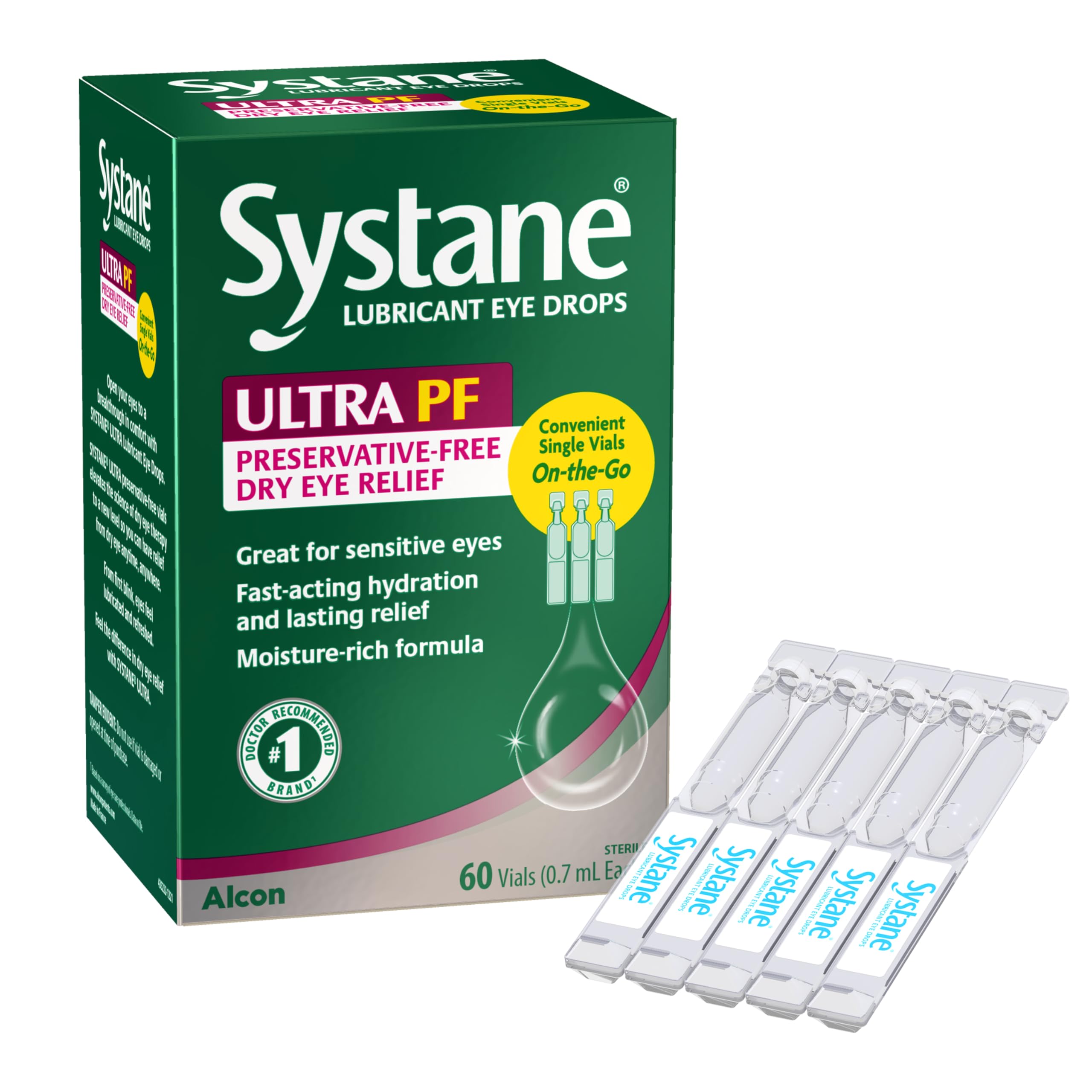
Systane Ultra Preservative-Free relies on two lubricants—polyethylene glycol 400 and propylene glycol—to deliver its fast-acting comfort. That's not a marketing flourish; those ingredients are the reason this drop feels more substantial than a simple saline-like tear. It's designed to support the aqueous layer of the tear film, the watery part that dry eye often lacks.

The 60-count box is a sensible size for regular use, and the single-use vials travel well. What we like about this one is the balance: it feels cushioning without the oiliness of the Mega-3 or the milky texture of Retaine. If your eyes are dry but not constantly angry, it's an easy drop to use through a workday. We also appreciate that the 60-count box is a manageable size rather than a bulk commitment.

If you want a comfortable, mid-weight drop that doesn't call attention to itself, this is the one we keep in the desk drawer. It's a straightforward pick for moderate dryness, and it doesn't ask you to build a routine around a specialty formula. That matters when you're using drops several times a day and don't want to think about it.

Pros

  • Fast-acting two-lubricant formula
  • 60-count box suits regular use
  • Cushioning without an oily feel
  • Sterile single-use vials

Cons

  • Costs more per vial than our top pick
  • No oil or hyaluronic acid for extra staying power
Our verdict

We suggest Systane Ultra for fast, comfortable relief in a straightforward single-use vial, especially for moderate dryness that flares during screen time.

Check Latest Price
4

Best Small Pack

TheraTears Preservative-Free

95 /100
Trail Score Outstanding

Key details

Count
30 vials
Format
Single-use vials
Formula
OxyLytes electrolytes
Development
Ophthalmologist-created
Check Price on Amazon

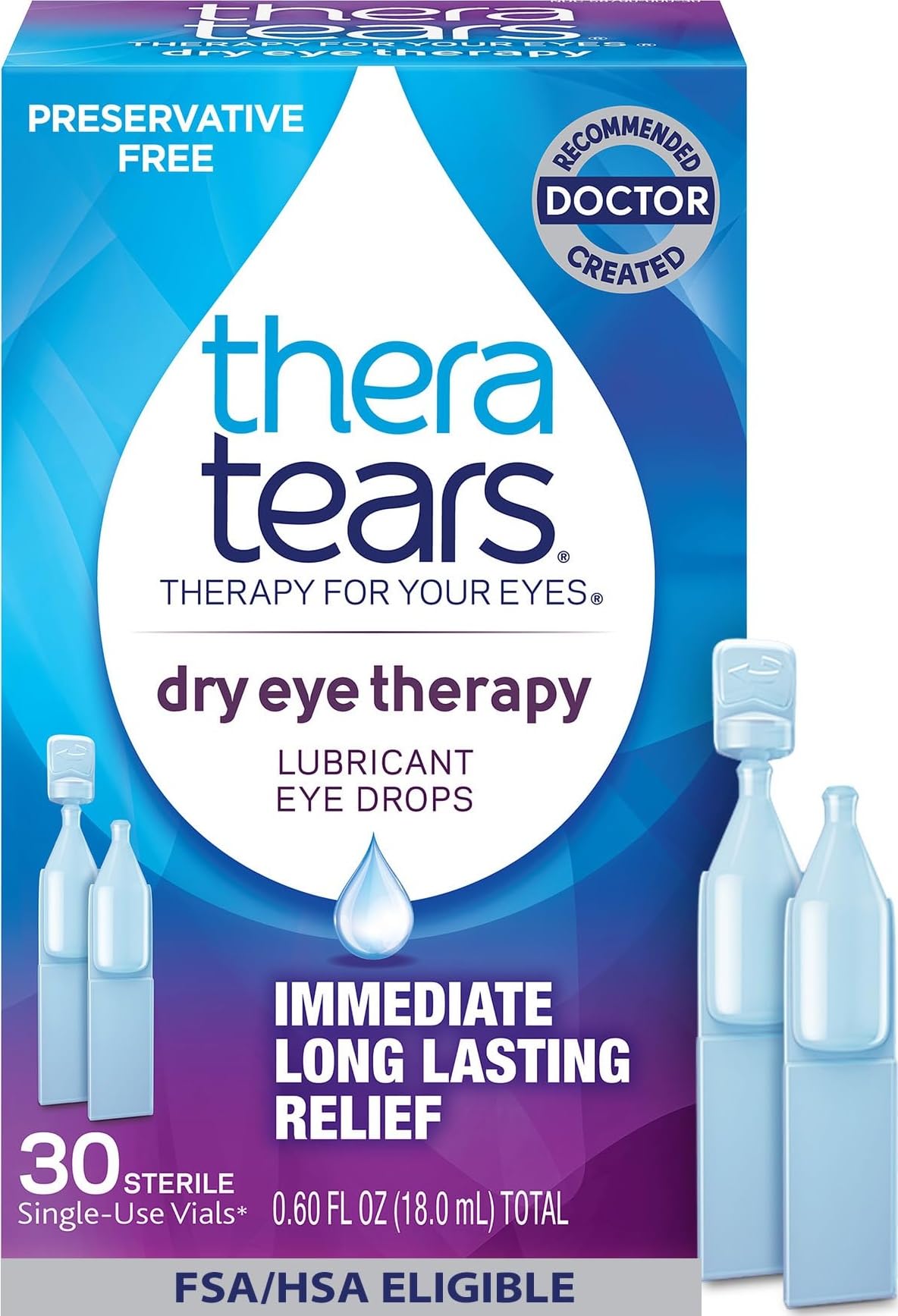
A small, low-cost 30-vial box is the first thing we notice about TheraTears, and it's the reason this is our small-pack pick. The formula uses OxyLytes, a blend of electrolytes found in natural tears, and it's designed for dry, irritated eyes. We like it as a starter box: it fits in a purse, a desk drawer, or a travel kit, and you can see whether the formula agrees with your eyes before buying a larger count.

It's a gentle, watery drop rather than a thick one, so it's better for mild to moderate dryness than for eyes that need a heavy cushion. The small pack is also the catch: if you use a vial every day, 30 goes quickly. We think of it as the box to keep in your bag for occasional use, not the one to rely on for a full month of frequent drops.

What makes it worth a place is the combination of a low upfront price and a formula that doesn't feel overbuilt. If you're new to preservative-free drops and want to test the format, this is the one we hand over first. The vials are easy to open and stash, which matters when you're trying a new drop away from home.

Pros

  • Low upfront cost for a 30-vial box
  • OxyLytes electrolyte formula
  • Compact for a purse or travel kit
  • Good option for trying preservative-free drops

Cons

  • Not the lowest cost per vial here
Our verdict

TheraTears is the box we hand to anyone who wants to try preservative-free drops without committing to a large supply.

Check Latest Price
5

Best for Stubborn Dryness

Retaine MGD

93 /100
Trail Score Outstanding

Key details

Count
30 vials
Format
Single-use vials
Volume
0.01 fl oz each
Formula
Cationic oil emulsion
Check Price on Amazon

Retaine MGD looks different from every other drop here—a milky emulsion rather than a clear tear—and it's positioned for moderate-to-severe dryness. The formula suspends oil in a preservative-free base to lubricate and protect eyes that feel dry and gritty, and it's meant for the days when a thin drop seems to disappear before you've capped the vial.

The texture is the trade-off. It feels more substantial, and it can leave vision a little smeary for a moment, especially if you're putting it in and immediately trying to read. We think that's a fair exchange for the longer comfort it provides, but it's not the drop we reach for before driving or a video call. The single-use vials are portable, and the twist-off top can leave a sharp edge, so open it carefully; that's a small handling quirk rather than a reason to skip the drop.

If your dryness is stubborn and basic drops don't hold, this is the one to try after the top pick. The 30-vial box is a good size for seeing whether the richer formula suits you, and the single-use format keeps the routine simple. It's a targeted pick, not the box we hand to someone with occasional dryness.

Pros

  • Oil emulsion for moderate-to-severe dryness
  • Long-lasting comfort from one drop
  • Preservative-free single-use vials

Cons

  • Costs more per vial than thinner drops
Our verdict

Reach for Retaine MGD when thin drops disappear too quickly; the milky emulsion is made for stubborn, moderate-to-severe dryness.

Check Latest Price
6

Sensitive Eyes

Systane Hydration Preservative-Free

95 /100
Trail Score Outstanding

Key details

Count
30 vials
Format
Single-use vials
Relief
Long-lasting hydration
Key Ingredients
HP-Guar and hyaluronic acid
Check Price on Amazon

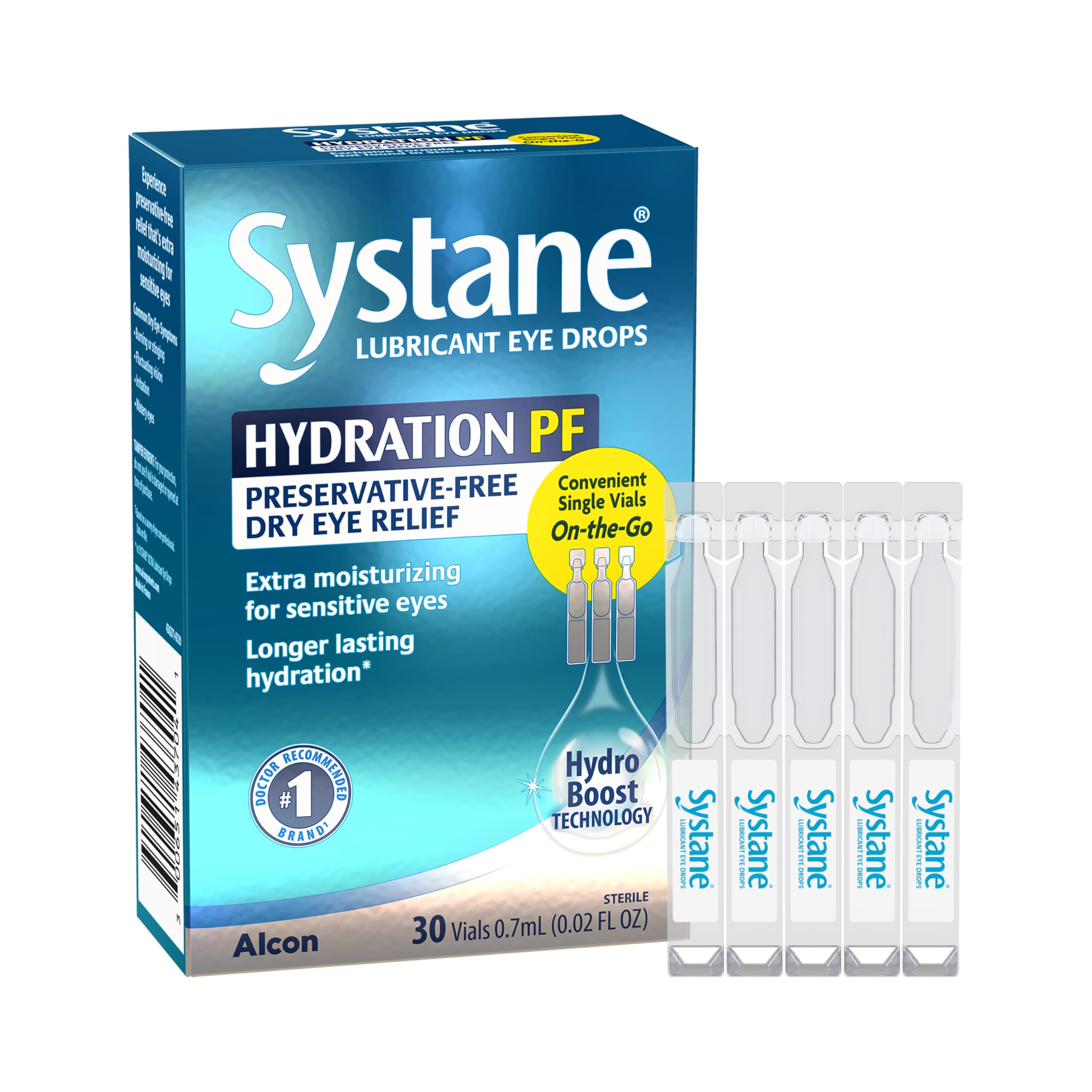
Systane Hydration Preservative-Free is built around two ingredients we look for in a drop for sensitive eyes: hyaluronic acid and HP-Guar. The formula is designed to hold moisture on the eye's surface, and the box specifically calls out eyes that are sensitive to preservatives. If your eyes sting easily or you spend long hours in front of a screen, that combination is worth a look.

The 30-vial box is smaller than most here, and the drop feels light and soothing rather than thick. We appreciate that it doesn't try to do everything: no oil, no extra claims, just a hydrating formula in a sterile single-use vial. It's a good choice for daytime use when you want comfort without a filmy residue. The light texture makes it easy to use before a meeting or a commute, and it doesn't leave the eye feeling coated.

It's also the pick we suggest if other preservative-free drops feel too harsh. Just know the 30-vial box is a smaller commitment than the 60- and 70-count boxes here, so it suits a once-or-twice-a-day habit better than all-day use. For sensitive eyes, that lighter routine is often the point.

Pros

  • Hyaluronic acid and HP-Guar formula
  • Designed for preservative-sensitive eyes
  • Light, soothing feel
  • Single-use vials for travel

Cons

  • Higher cost per vial than basic drops
Our verdict

We like Systane Hydration for sensitive eyes that sting easily, thanks to a hyaluronic-acid formula that feels light and soothing.

Check Latest Price

How We Tested Preservative-Free Eye Drops

We began with more than 40 drops and narrowed the list to 16 based on whether they were clearly labeled preservative-free, whether they came in single-use vials or multidose bottles, price per use, and whether they were easy to find without a special order. We left out anything with confusing labeling or packaging that looked likely to leak in a bag.

For four months, the 16 formulas lived in desk drawers, jacket pockets, bathroom cabinets, and bedside tables. Team members used them during long stretches at a computer, in heated apartments and air-conditioned offices, after windy walks and allergy-heavy afternoons, and before bed; anyone who wore contacts used only drops labeled for contact lens use. At each dose, we wrote down how fast dry, gritty eyes felt comfortable, how long eyes stayed comfortable before the grit returned, whether vision blurred, and whether the drop stung, reddened the eye, or left a sticky film or crust around the lids. We also watched for headaches, a strange taste in the throat, or any other side effect that made us not want to reach for the bottle again.

Ease of use got its own set of small, unglamorous tests. We opened single-use vials with dry hands and with lotioned hands, checked how much liquid was left after the labeled dose, and calculated cost per use; with multidose bottles, we tried the one-handed squeeze at a desk and counted how many drops came out per pump. We checked caps for leaks, vials for cracks, and labels for clear expiration and storage instructions, because a drop that cannot survive a bag or a bathroom shelf is not much use. The formulas that stayed in rotation were the ones that disappeared into the routine: no sting, no blur, no mess, and a price per use we could justify keeping in more than one place.

How to Choose Preservative-Free Eye Drops

Single-Use Vials vs. a Preservative-Free Bottle

Single-use vials are the simplest way to get a sterile, preservative-free dose. You open one, use it, and throw it away; there's no bottle tip to touch or cap to reseal. The trade-off is packaging waste and a higher cost per use. A preservative-free multi-dose bottle can be less wasteful, but the dispensing mechanism matters: some bottles need a firm squeeze, and a clumsy tip can waste drops or make it hard to hit your eye. If you want the easiest, most portable option, vials are the safer default. If you go through drops all day and want less packaging, choose a bottle only after you've checked that you can dispense it cleanly.

Match the Formula to the Kind of Dryness

A basic lubricant is enough for mild, occasional dryness. If your eyes feel dry again quickly, an oil-enhanced or emulsion drop can make more sense because it is designed to slow tear evaporation and add a lipid layer. Hyaluronic acid and HP-Guar formulas are another route for sensitive eyes and long screen sessions. The stronger the formula, the more likely it is to feel thick, sting, or blur your vision for a moment. We suggest starting with a small pack if you're unsure, rather than buying the largest box of a rich formula.

Comfort Is Personal—Test Before You Stock Up

Preservative-free doesn't guarantee sting-free. Some eyes react to oil, some to the pH or viscosity of a particular drop, and some people notice a brief blur with thicker formulas. A 30-vial box is a sensible trial size; it's enough to use the drop for a week or two without committing to a 60- or 70-count box. Pay attention to whether the drop feels soothing on contact, how long the comfort lasts, and whether your vision clears quickly. If a drop stings every time, stop using it and try a simpler formula.

Count the Cost per Dose, Not Just the Box

The box price can be misleading. A 30-vial box may be the cheapest way to try a drop, but a 60- or 70-vial box often costs less per dose. If you use one vial a day, do the math before you buy: a larger box can be the better value, provided you'll finish it before the expiration date. If you use drops only occasionally, a smaller box keeps you from wasting money on vials that go stale. We keep a small box in a bag and a larger box at home for that reason.

Frequently Asked Questions

Final Verdict

Refresh Plus is the box we recommend first for most people. It's simple, portable, and the best per-vial value here, which matters because preservative-free drops are a habit, not a one-off purchase. If your dryness outlasts a basic drop, step up to Refresh Optive Mega-3 for longer relief or Retaine MGD for a richer emulsion. The right choice is the one you'll carry and use before your eyes feel gritty.