Best Plyo Boxes of 2026

A plyo box looks like the simplest piece of equipment in a gym: three wooden sides and a top. Then you miss a jump by an inch, the box skids on the garage floor, or the edge catches your shin, and the simplicity stops feeling like a virtue. What a good box actually fixes is confidence — you land and know the thing under you isn't going anywhere, that the edges won't bite, and that it will survive being dragged from the garage to the driveway every week.

I've been jumping on and off these boxes for years, and over the past six months my team and I put 12 of them through their paces — wood, foam, and steel — in garages, spare bedrooms, and one very patient driveway. The ones worth keeping were stable at every height, sized so you'd actually use all three, and priced like something you buy once instead of replacing in a year. Everything below earned its spot.

1

Best Overall

BalanceFrom 3-in-1 Foam Plyo Box

93 /100
Trail Score Outstanding

Key details

Surface
Textured non-slip foam
Box Weight
10 lb
Height Options
16, 20, 24 in
Weight Capacity
250 lb
Check Price on Amazon

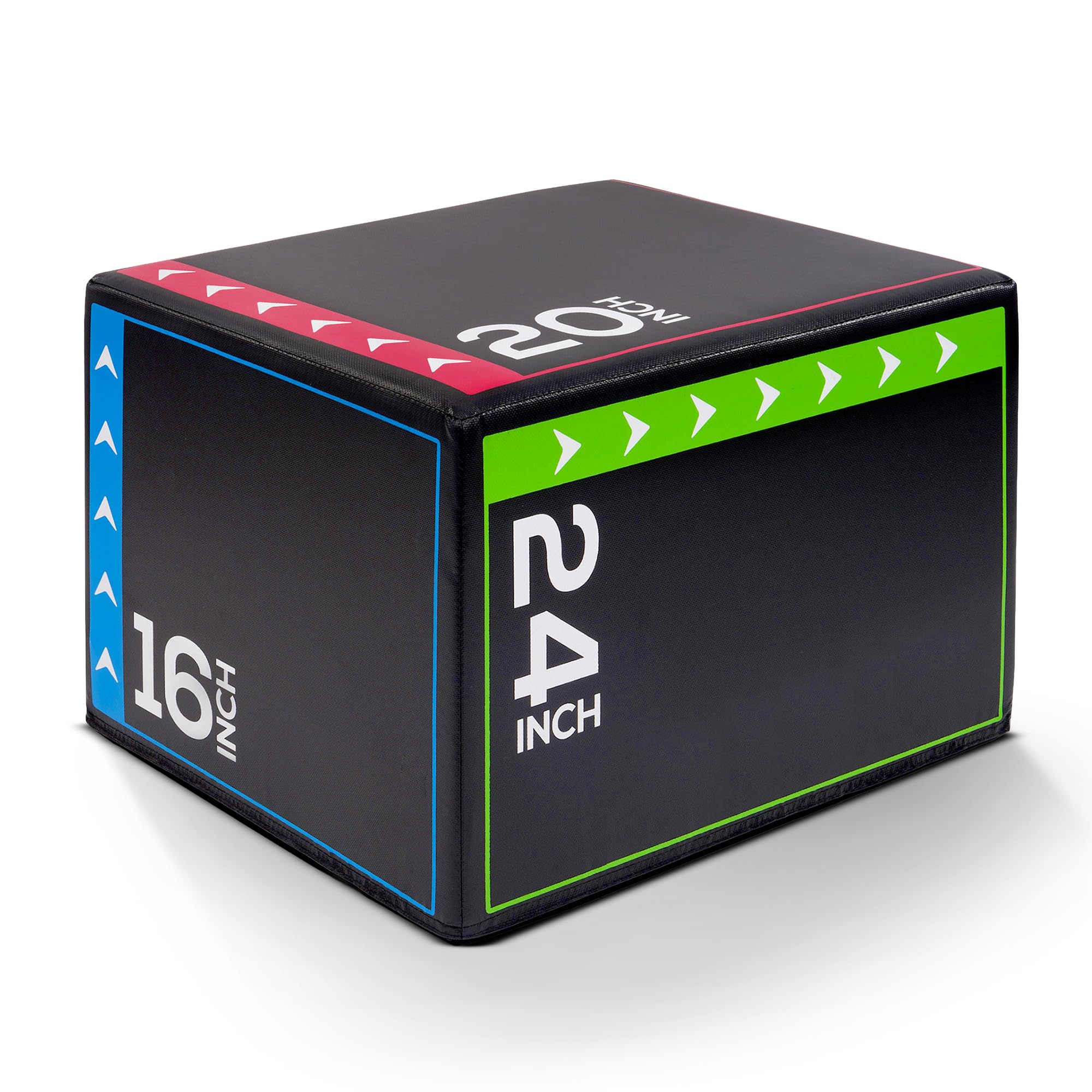
The first thing you notice about a foam box is the sound it does not make. Land on this one, or clip the edge on the way up, and nothing rings and nothing takes skin off your shin. That forgiving shell over high-density foam is the whole argument for the BalanceFrom, and it comes with three heights, 16, 20 and 24 inches, chosen by rolling the box onto a different face.

Three usable heights and a soft edge are why this is the box we recommend to most people building a home gym. Box jumps are mostly a confidence problem, and a box that does not punish a near miss gets you jumping higher sooner. Rotation does the work of adjustment, so there is nothing to rebuild between sets: 16 inches for step-ups and warm-ups, 20 for a working set, 24 when you are ready. At 10 pounds it moves with one hand, which means it doubles as a bench for split squats and dips and then goes back against the wall.

The number to check is the 250-pound weight rating, the lowest of the boxes here that publish one, so a heavier lifter should look at the wooden picks instead. The cover is textured rather than smooth, which is what you want underfoot, and the foam underneath is dense enough to feel like a platform rather than a cushion. Treat the cover as the wear surface, because it is what keeps the foam intact.

Misses are the part nobody films, and they are what sold us: everyone misses eventually, and the box you are not afraid of is the one you will actually train on. If you are over the weight rating or chasing a 30-inch jump, go wooden. Otherwise this is where most home gyms should start.

Pros

  • Three heights that rotate without tools
  • Foam edges protect shins on a missed jump
  • 10 pounds, easy to move and store
  • Textured non-slip landing surface

Cons

  • 250 lb weight limit, the lowest stated here
Our verdict

The box we point most home gyms to first: three usable heights, a foam edge that forgives a near miss, and 10 pounds you can move with one hand.
Check Latest Price
2

Best for Advanced Jumpers

Rep Plyometric Wood Jump Box

92 /100
Trail Score Outstanding

Key details

Material
3/4-inch plywood
Box Dimensions
30 x 24 x 20 in
Height Options
20, 24, 30 in
Weight Capacity
400 lb
Check Price on Amazon

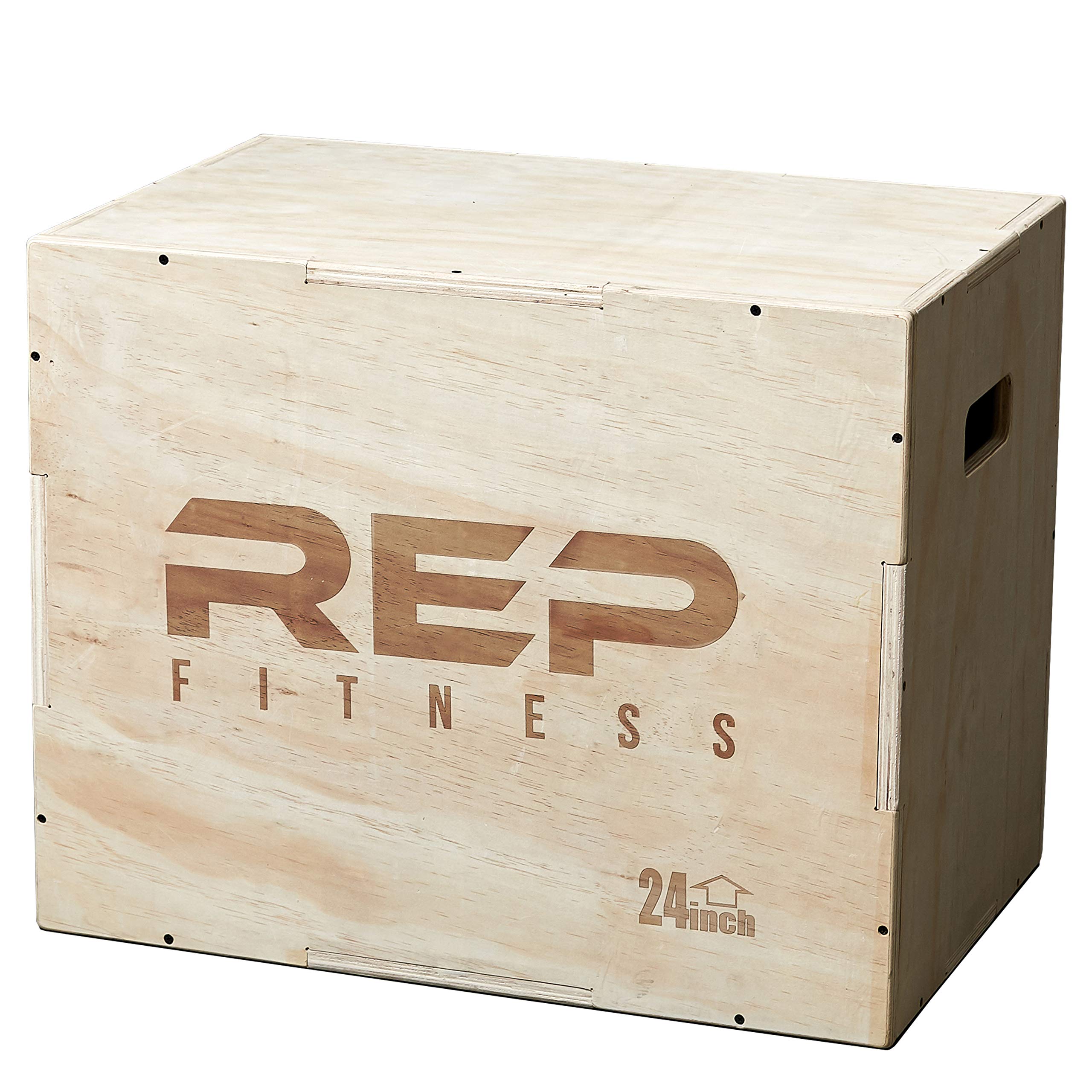
Thirty by twenty-four inches of landing surface is a different sport from the 12-by-14 deck on a compact box. Rep's 30 x 24 x 20 plywood box gives you that big face at the 20-inch setting, and it is the one we reach for when we are training jumps rather than warming up, because the target is wide enough that you land instead of aiming.

The build is why it holds still. Three-quarter-inch plywood, puzzle joints with internal bracing and pre-drilled holes mean about fifteen minutes with a power driver rather than a fight with clamps. Edges are sanded, so a missed jump gives you a scuff rather than a splinter, and the 400-pound rating covers a loaded athlete. Once it is together it is one solid piece, with no creak and nothing to re-tighten.

Fifty pounds is the price of that solidity. It does not fold, it does not tuck behind a door, and shifting it across a garage is a two-hand job, so plan on giving it a permanent spot. Hitting the edge hurts more than it does on foam, too, because wood is wood. What you get in return is a box that feels identical at 20, 24 and 30 inches, which is exactly what progression needs.

Pros

  • 30 x 24 in landing deck at the 20-inch setting
  • Internal bracing in 3/4-inch plywood
  • Pre-drilled holes, roughly 15-minute assembly
  • 400 lb weight capacity

Cons

  • 50 lb and does not fold away
Our verdict

For anyone past the beginner stage who wants a box that stays put at 24 and 30 inches, this is the one we buy, provided you have a permanent corner for it.

Check Latest Price
3

Best Budget Wooden Box

CAP Barbell 3-in-1 Plyo Box

91 /100
Trail Score Outstanding

Key details

Box Weight
15.4 lb
Box Dimensions
16 x 14 x 12 in
Height Options
12, 14, 16 in
Weight Capacity
300 lb
Check Price on Amazon

Two things sell this box: it is the least expensive wooden option here, and it is small enough to live in a room that is not a gym. The 16 x 14 x 12-inch frame is engineered wood with interlocking panels and countersunk screws, so no hardware sits proud of the surface, and the built-in handles mean you move it with two fingers rather than a bear hug.

Assembly is straightforward if you bring the right tool. The holes are pre-drilled, the panels square themselves as they interlock, and a driver turns it into a fifteen-minute job; the supplied hex key makes it a longer one. Sanded edges and a textured top do the small things right, so nothing catches a shin and your foot does not slide when you set up for a step-up.

Because it is compact, the tall face is the one to treat with respect. Stand on the 16-inch side and you are working off a 14-by-12-inch base, which is fine for step-ups and box squats but tight for two-foot jumps, so use 12 and 14 inches for jumping and keep 16 for stepping. Two of these still come in well under the price of the big wooden box, which makes a pair a sensible way to kit out a small space.

Pros

  • Least expensive wooden box here
  • Interlocking panels and countersunk screws
  • Built-in carry handles
  • Textured non-slip training surface

Cons

  • 300 lb weight rating
Our verdict

The wooden box we point budget buyers to first: small, tidy, quick to build, and stable enough for step-ups, squats and low jumps.

Check Latest Price
4

Best No-Assembly Pick

Rage Fitness Steel Plyo Box

95 /100
Trail Score Outstanding

Key details

Base
15 x 15 in
Height
12 in
Box Weight
12 lb
Top Platform
12.5 x 12.5 in
Check Price on Amazon

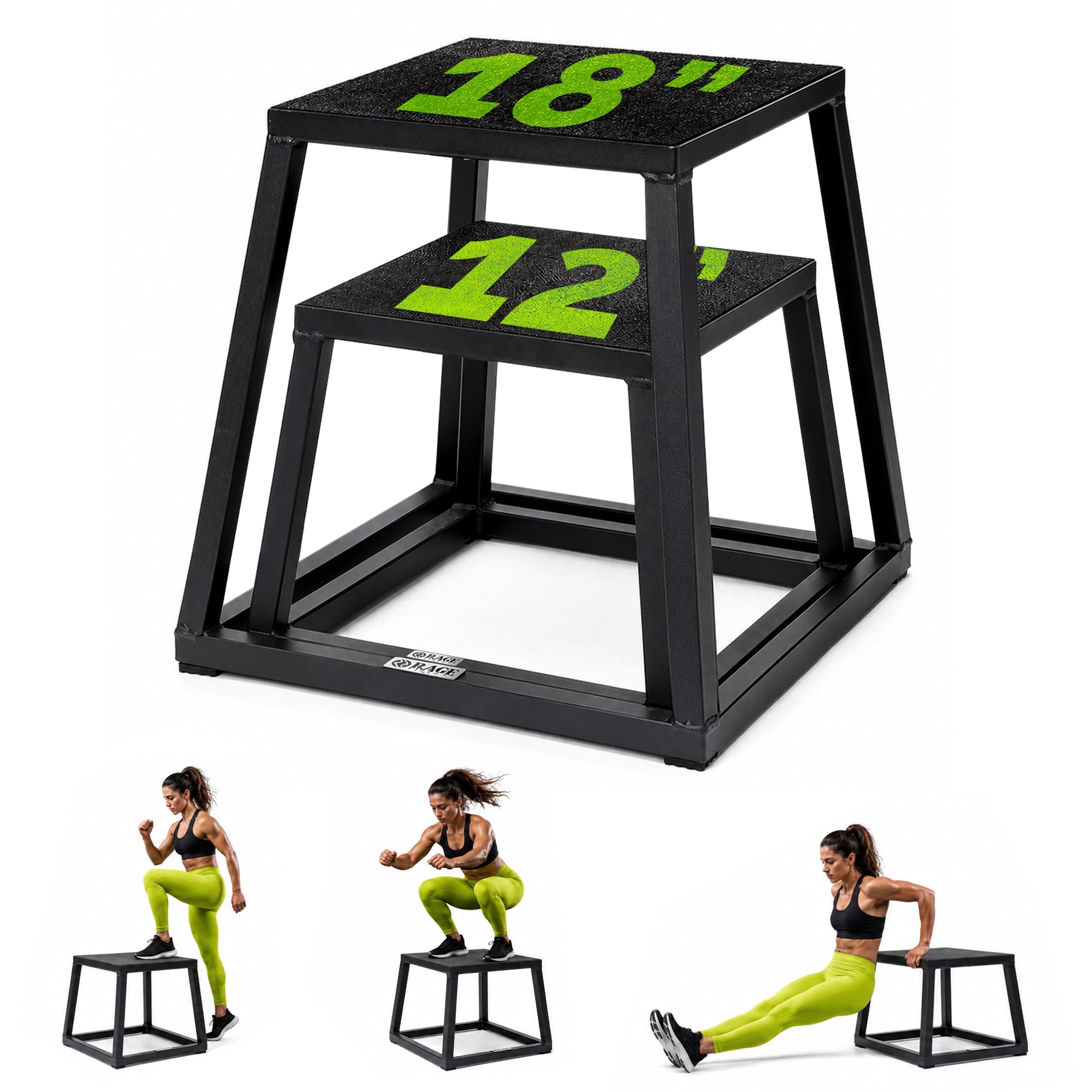
Twelve inches, one height, no assembly. The Rage box is a steel frame with a rubber deck that arrives ready to use: 12.5 inches square on top, 15 inches square at the base, 12 pounds, and about as simple as this equipment gets. There is nothing to bolt, true or tighten, ever.

That is why we like it as a step-up and conditioning platform rather than a jump box. Weighted step-ups, split squats, dips, decline push-ups: the rubber deck gives your palm something to push against, the rubber base keeps it from walking on a garage floor, and the welded frame does not wobble when you load one side with a dumbbell. It also takes up less floor than anything else here, which matters in a spare room.

The single height is the honest limitation, because there is no progression built in, so it complements a taller box rather than replacing one. The rubber top is bonded to the frame and can lift at an edge with hard use, so check the deck before each session and retire it if it peels. The one-year warranty covers manufacturing defects.

Pros

  • Arrives fully assembled
  • Rubber top and bottom hold position
  • Welded steel frame does not wobble
  • Compact 12.5-inch deck and 15-inch base

Cons

  • One height only, no progression
Our verdict

A no-assembly steel platform for step-ups, dips and low jumps; buy it for the 12-inch work, not for progression.

Check Latest Price
5

Best for High Jumps

RitFit 3-in-1 Soft Plyo Box

91 /100
Trail Score Outstanding

Key details

Cover
Zip-off PVC
Box Weight
60 lb
Height Options
20, 24, 30 in
Weight Capacity
440 lb
Check Price on Amazon

Sixty pounds of foam sounds like a contradiction until you land on a 30-inch box that does not walk out from under you. The large RitFit is 20 x 24 x 30 inches, rated to 440 pounds, and heavy enough that we trust it at the top height in a way the 15-pound foam boxes do not earn.

The foam is firm rather than plush, which is the trade: less shin cushioning, but a deck that does not bottom out when you land. The PVC cover zips off, so sweat and chalk wipe away instead of working into the surface, and there is no assembly at all: turn it to 20, 24 or 30 inches and go. At this size the weight is the feature, since a light box this tall is the one that ends up braced against a wall.

Landing short of center at 30 inches will still rock it, because foam gives and height magnifies that, so the box rewards a centered landing the way a wooden one does. It is also a fixture rather than a piece of kit you move around; dragging 60 pounds across a garage between sets gets old quickly. In a dedicated training space, neither point is a problem.

Pros

  • 440 lb capacity at the 30-inch setting
  • 60 lb keeps it planted
  • Zip-off PVC cover wipes clean
  • Three heights with no assembly

Cons

  • Heavy and awkward to reposition
Our verdict

The foam box we choose when the training height is 24 or 30 inches and the box has to stay put: heavy, firm and wipe-clean.

Check Latest Price
6

Best for Small Spaces

papababe 3-in-1 Foam Jump Box

92 /100
Trail Score Outstanding

Key details

Cover
1000D oxford weave
Material
High-density foam
Box Weight
15 lb
Height Options
12, 14, 16 in
Check Price on Amazon

Fifteen pounds and a 12 x 14 x 16-inch frame: this is the box that goes on a shelf when the workout ends. The foam is dense enough to stand on and soft enough that banging a shin into it is a nuisance rather than an injury, and the 1000D oxford cover is woven tight enough to shrug off sweat and wipe clean.

The three faces give you 12, 14 and 16 inches, which covers step-ups, split squats, calf raises, dips and low box jumps, the kind of work most people do in a spare room. It is light enough to carry into the yard, and light enough that a teenager can move it without asking for help. That soft edge also makes it a reasonable first box for someone who has never jumped onto anything.

What it cannot do is go high. The frame is small, the landing target at the tallest face is 12 by 14 inches, and papababe does not publish a weight limit for this one, so keep it to bodyweight work and do not expect it to feel planted the way a 60-pound box does. For a small room, a beginner, or a family that wants one forgiving box, that is a fair trade.

Pros

  • 15 lb, easy to carry and store
  • Three heights with no tools
  • Soft edges on shins and knees
  • Tight-woven wipe-clean cover

Cons

  • 12 x 14 in deck at the tallest face
Our verdict

A light, soft three-height box for small rooms, step-ups and new jumpers; keep the jumps low and the landing centered.

Check Latest Price
7

Small Gyms

Retrospec Leap Plyo Box

93 /100
Trail Score Outstanding

Key details

Height
18 in
Assembly
None required
Stackable
Yes, across Leap sizes
Weight Capacity
350 lb
Check Price on Amazon

The Leap is a welded metal frame with a tapered profile, wider at the base and narrower at the top, with rubber stoppers underneath and a non-slip pad on the deck. It arrives in one piece. Nothing needs bolting, tightening or truing, which is the kind of thing you appreciate every time you drag it out for a set.

Retrospec sells the Leap in 12, 18, 24 and 30-inch versions designed to stack, which is the sensible answer to storage in a small gym: one footprint, a ladder of heights, and no assembly at any of them. The 18-inch version is the one here, rated to 350 pounds and light enough to move with one hand.

The taper is also the catch. The base measures 18 inches square, but the deck on top is narrower, and a two-foot landing at speed wants more room than that. Step-ups, box squats, dips and single-leg work are where it shines; two-foot jumps are where it gets tight. Nothing about it creaks or rattles, and the welded joints will not loosen the way bolted ones can.

So this is a platform we recommend for a particular job rather than as your only box. If the plan is step-ups and strength work in a corner of a room, the Leap does it without a single tool. If the plan is jump training, start somewhere with a wider deck and add this later.

Pros

  • Welded one-piece frame, nothing to assemble
  • Rubber feet and non-slip top
  • Stacks with other Leap sizes
  • 350 lb weight capacity

Cons

  • One height per box
Our verdict

A welded, no-assembly platform that is excellent for step-ups and box squats in a tight space; treat it as a step-up tool, not your only jump box.

Check Latest Price

What Six Months of Jumping on Plyo Boxes Taught Us

We started with roughly 40 boxes sold at major retailers and narrowed that list by height options, weight capacity, material, and price before ordering 12 — a mix of wooden three-in-one boxes, foam boxes, and a couple of steel and soft-sided designs. Testing ran for six months, and every box followed the same schedule so the comparisons stayed fair.

The boxes lived where home gym equipment actually lives: a concrete garage floor, a carpeted spare bedroom, and a driveway on weekend mornings. We jumped on each one at every height it offered, first with dry hands and later with sweaty ones, and noted whether the base rocked, crept across the floor, or sank into carpet on landing. We checked grip on the top surface and how the edges felt under a heel, then moved each box mid-workout to see whether one person could reposition it without breaking form.

Out of the box, we timed assembly and noted which ones needed two people or a second trip to the hardware store, and we sniffed each box on day one and again a week later — a few foam models off-gassed for days. For durability, we dragged every box across concrete, dropped it off the tailgate of a truck, and looked for splits, peeling vinyl, and loose joints after months of use. We also landed off-center on purpose to see how each box behaved when a jump went wrong, watching for sharp corners, splinters, and tipping.

How to Choose a Plyo Box

Choose the height range before anything else

The first decision is the height you will use most, and the honest answer is usually lower than the one you are picturing. Twelve inches is step-up height for most adults, 16 to 20 inches is where beginner and intermediate jumps live, and 24 to 30 inches is an advanced target that punishes a sloppy landing.

A three-in-one box makes sense because you grow into two of its three faces. For a first box we point people to a 16/20/24 like the BalanceFrom. If you already jump at 24 inches, buy a 30-inch box such as the Rep and skip the middle rung entirely.

The tallest face is the smallest deck

On a three-in-one box you rotate the whole thing, which means the landing deck changes with the height. A 16 by 14 by 12-inch box gives a 16 by 14-inch deck at 12 inches, 16 by 12 at 14, and just 14 by 12 at 16. The higher you go, the smaller the target.

That is the trap in a spec sheet: people see a 16-inch box and picture the deck they are getting. Before ordering, find the face dimensions for the height you will use most. If that height is 24 or 30 inches, buy a large 30 by 24 by 20 box instead of a compact one.

Foam, wood or steel

Foam is the friendlier material. A missed jump lands on a padded edge instead of a plywood corner, and the box stays quiet in a garage or apartment. It also gives a little underfoot, and a light foam box can shift on a slick floor.

Wood is firm, stable and usually the best value per inch of deck, but the edges do not forgive and the box needs building. Steel arrives assembled and takes up little floor space, making it a good step-up platform, though the decks run small. If a missed jump would end your session, buy foam.

Weight ratings, and how much box you want to move

Ratings across these boxes run from 250 to 440 pounds, and the figure is worth checking against your bodyweight plus whatever you are holding. Heavier boxes are easier to trust: a 50 to 60-pound box stays where you land, while a 10 to 15-pound foam box is the one you reposition with one hand.

That is a real trade rather than a flaw. If the box goes back against the wall after every session, light wins; if it lives in one spot, weight wins. Put a mat under anything sitting on a smooth floor.

Assembly, storage and small rooms

Wooden boxes arrive flat with pre-drilled holes and take anywhere from ten minutes with a power driver to the better part of an hour with the included hex key, so bring your own bit. Steel boxes arrive built. A large 30 by 24 by 20 box claims a permanent corner of a garage, while a compact 16 by 14 by 12 tucks under a bench.

Measure the spot before ordering, and remember you need clear floor on both sides: a run-up on one side, a landing zone on the other.

Frequently Asked Questions

Final Verdict

Most people building a home gym should start with the BalanceFrom: three heights, a soft edge that forgives the miss you are going to make, and 10 pounds that moves out of the way when the workout is over. It is the box we hand to someone who has never jumped onto anything.

If you are stronger, heavier, or already jumping at 24 inches, spend the money on the Rep instead, because the 30-by-24 deck and 50 pounds of plywood are what real jump volume feels like. And if all you need is a platform for step-ups and dips, the Rage arrives built and never needs tightening.