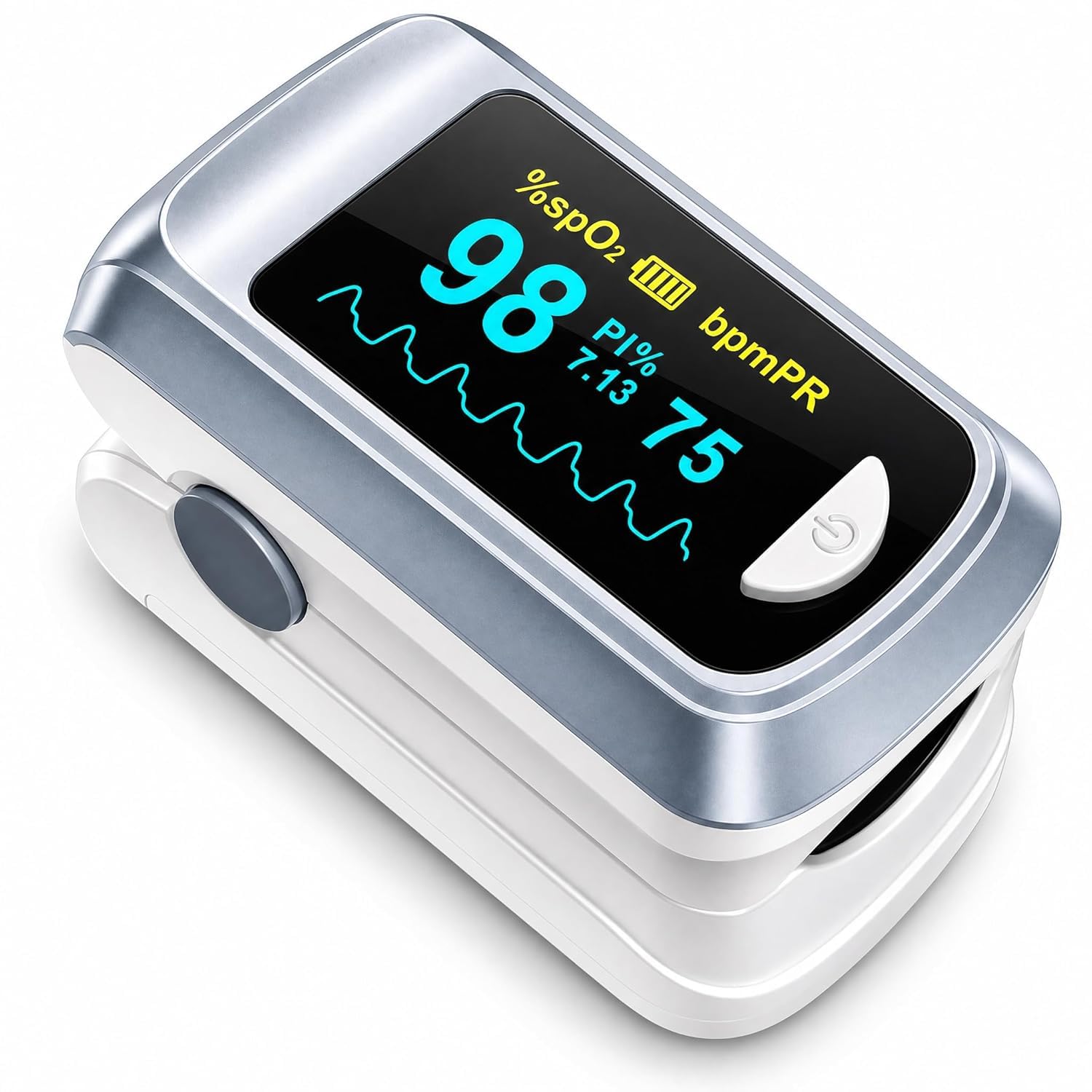
Best Fingertip Pulse Oximeters of 2026

A fingertip pulse oximeter works by shining red and infrared light through your finger and measuring how much of it the blood absorbs, which means the number on the screen is only as good as the sensor doing the shining. Two devices that look identical on a shelf can disagree by several points on the same finger, seconds apart. What you're actually buying is a reading you don't have to second-guess, one that settles quickly on a screen you can read without hunting for your glasses.

I keep one in the bathroom drawer and one in my bag, and I've learned that cold hands and dark nail polish will throw a reading off. Over four months, my team and I ran 14 oximeters through the same routine, morning, after a walk up the stairs, mid-workout, at night in a dim bedroom, comparing them side by side, sometimes on the same finger. The ones worth keeping settled on a number fast, matched the readings we trusted, and still had their original batteries at the end.

1

Best Overall

Innovo Deluxe iP900AP

95 /100
Trail Score Outstanding

Key details

Battery Life
30 hours
Signal Check
Plethysmograph and perfusion index
SpO2 Accuracy
±2%
Measuring Range
70%–100% SpO2
Check Price on Amazon

The number on the screen only helps if you can tell it is real, and that is what the iP900AP gives you that the cheaper picks here do not. Beside SpO2 and pulse rate it shows a plethysmograph waveform and a perfusion index — a read on how strong the pulse signal is under the sensor. When the trace looks ragged or the index sits low, we warm the hand and start again instead of writing down a figure that means nothing. That feature is why this is the one we hand to someone monitoring an actual illness at home rather than an occasional curiosity.

The rest of the package holds up. Innovo states ±2% accuracy across a 70% to 100% SpO2 range, the same tolerance the rest of this group claims, and it runs about 30 hours on the two AAA batteries in the box. Brightness adjusts, which matters more than it sounds: we turned the display down for middle-of-the-night checks so it does not light up the room. There is also an audible alarm and pulse-detection beeps, which some households will find reassuring and others will find intrusive.

What it does not do is remove the need for technique. A cold hand or a fidgeting finger will still produce an official-looking number that is not worth acting on, and the premium here buys the tools to notice that, not immunity from it. At the top of the price range in this group it is also more device than a weekly spot check needs — the Santamedical further down covers that job for less. The people who get their money's worth are the ones checking twice a day through a respiratory illness, or keeping an eye on a parent's baseline.

Pros

  • Perfusion index and waveform show signal quality
  • Brightness adjusts for night-time checks
  • Audible alarm and pulse-detection beeps
  • About 30 hours on two AAA batteries

Cons

  • Readings can run a few points low
Our verdict

We recommend the iP900AP first: its perfusion index and waveform tell you whether a reading is worth trusting, which is the one thing the cheaper picks can't do.

Check Latest Price
2

Best Value

Santamedical JPD-500E

93 /100
Trail Score Outstanding

Key details

Power
2 AAA batteries (included)
Warranty
1 year
In The Box
Case, neck/wrist cord, batteries
Reading Time
8–10 seconds
Check Price on Amazon

One device, several people, no instructions needed: that is the case for the JPD-500E. It is a single button, it produces SpO2 and pulse rate in a claimed 8 to 10 seconds, and the finger chamber is latex-free silicone with enough spring to close on a child's finger and a large adult's without either of them holding it in place. In a house where the oximeter gets passed around, that ease is most of the product.

The kit is what we appreciate most. A case, a neck or wrist cord, two AAA batteries and a one-year warranty all come in the box, so there is nothing to buy separately and somewhere obvious to put the thing between uses. The red LED digits are big and legible across a room, and the pulse bar graph gives a quick visual on signal strength. Nothing here is clever. Everything here is useful.

Where it gives ground to the Innovo is signal detail: you get a strength bar rather than a perfusion index, so a marginal reading asks you to use judgement instead of checking a second number. The other thing to plan for is the batteries — the cells in the box are the first thing to replace, and a spare pair kept in the case means the device never interrupts you mid-check. For straightforward household monitoring, neither is a reason to spend more.

Pros

  • Case, cord, batteries, and warranty included
  • Large red LED digits
  • Fits a wide range of finger sizes

Cons

  • Can take a while to settle on a reading
Our verdict

For a household sharing one device, we think the JPD-500E is the sensible buy — one button, big digits, and the case and cord already in the box.

Check Latest Price
3

Best Display

Mibest Blod12 OLED

95 /100
Trail Score Outstanding

Key details

Display
4 directions, 6 modes, 10 brightness levels
In The Box
Pouch with belt loop, lanyard, batteries
Battery Life
40 hours
SpO2 Accuracy
±2%
Check Price on Amazon

Four orientations, six display modes, ten brightness levels: the Blod12 puts more thought into its screen than anything else here, and the screen is the part you use every single time. The OLED panel flips so the number sits right side up whether the device is on your index finger, your thumb, or held out at arm's length. That sounds like a small thing until you have twisted your hand around trying to read a dim LCD without your glasses.

Underneath the display it is a conventional oximeter, and a good one: ±2% stated accuracy, a 0 to 100% SpO2 range, and about 40 hours on two AAA cells, which is among the longest claims in this group. At 2.89 ounces it disappears into a coat pocket, and the pouch has a belt loop — more useful than it sounds if the device lives in a work bag rather than a bathroom drawer.

Two notes from living with it. The lowest brightness setting is the one for a dark bedroom; the top end is bright enough for daylight and for waking whoever is next to you. And the reading itself can take a couple of attempts to settle, so slide it on, wait for the numbers to stop moving, and ignore the first figure that appears. Patience, not a second device.

Pros

  • OLED screen flips to four orientations
  • Six display modes and ten brightness levels
  • About 40 hours on two AAA batteries
  • Pouch with belt loop included

Cons

  • Numbers can take a few attempts to settle
Our verdict

Buy the Blod12 if you read the screen at arm's length or without glasses; that four-way OLED is the most legible display in this group.

Check Latest Price
4

Best for Travel

CHOICEMMED OxyWatch C1F

93 /100
Trail Score Outstanding

Key details

In The Box
Case, lanyard, batteries
Battery Life
40 hours
SpO2 Accuracy
±2%
Measuring Range
0%–100% SpO2
Check Price on Amazon

Take the Innovo, drop the signal analysis, and stretch the battery life, and you get close to the OxyWatch. CHOICEMMED claims ±2% across a 0 to 100% SpO2 range and about 40 hours on two AAA cells — roughly a month of daily checks before you think about replacement. For a device that lives in a glovebox, a gym bag or a carry-on, that arithmetic matters more than a waveform you will never look at.

It is also the least fussy thing here. One button, finger in, number up, and the case and lanyard come in the box so it arrives ready to travel rather than ready to be accessorized. We handed it to people who had never used an oximeter and got a reading without a single question, which is its own kind of recommendation.

The one thing to get right the first time is the battery bay: the spring contact sits at the positive end of one cell and the negative end of the other, so check the polarity marks rather than assuming both cells go in the same way. After that there is very little to learn. What you give up is any read on signal quality beyond a pulse strength indicator, and for spot checks at home that is a trade we are happy to make.

Pros

  • About 40 hours on two AAA batteries
  • Simple one-button operation
  • Case, lanyard, and batteries included
  • Powers off automatically

Cons

No notable drawbacks to flag.

Our verdict

We keep coming back to the OxyWatch for travel: 40 hours on two AAA, one button, and a case in the box.

Check Latest Price
5

Best for Tracking

Wellue Oxi 16

93 /100
Trail Score Outstanding

Key details

Spot Check
Rhythm analysis after 30 seconds
Battery Life
24 hours
Reading Time
8 seconds
Reading Memory
Up to 12 readings
Check Price on Amazon

Twelve readings, kept and viewable with one click: that is the Oxi 16's trick, and no other device in this group does it. Measure in the morning and again at night for a week and you can hand the whole record to a clinician instead of trying to remember whether Tuesday was 94 or 96. The spot-check mode goes further, running a full 30 seconds and returning a rhythm analysis alongside the number.

Set-up is one button and a battery hatch, and the numbers arrive in about 8 seconds. Battery life is stated at 24 hours — the shortest claim here, though still weeks of ordinary spot checks — and a pouch and lanyard come in the box. The spot-check mode is the one to use sitting down; half a minute is longer than it sounds when you are waiting for a result.

Where it lands for us is the trend rather than the number. A single reading on any of these devices is a snapshot; twelve of them is a pattern you can actually show someone, and that is worth more than a brighter screen or a fancier shell. If your reason for buying is a daily check you intend to keep, this is the one to get. If it is a what-if device for the cupboard, the Santamedical is the quieter choice.

Pros

  • Stores the last 12 readings
  • 30-second spot-check rhythm analysis
  • Pouch and lanyard included

Cons

  • Beep can't be silenced
  • Battery door releases too easily
Our verdict

We like the Oxi 16 for anyone tracking readings over days or weeks — 12 stored results and a rhythm check no other pick here offers.

Check Latest Price
6

Backup and Spares

HealthTree JKS50B

91 /100
Trail Score Outstanding

Key details

Power
2 AAA batteries (included)
Display
Waveform bar graph
Dimensions
2.25" x 1.2" x 1.25"
In The Box
Lanyard, batteries, manual
Check Price on Amazon

The cheapest device in this group does the basics without pretending otherwise. Readings come up in seconds, a waveform bar shows a pulse is being picked up, and batteries, a lanyard and a manual are in the box. At 2.25 inches long and 2.4 ounces it also slips into a shirt pocket in a way the larger units here do not, which is most of why it earns a place on this list at all.

The detail that catches people out is that there is no off switch. It powers down on its own, and if it goes into a drawer with the cells in, the batteries can be flat when you next reach for it — take them out for anything longer than a few weeks. That is a small thing until the one night you want it and it is dead.

Where that leaves it: a decent spare, a travel backup, or the one that lives in the first-aid kit, and not the device to buy if you will be checking every morning. At the bottom of the price range here, it is the one we mention when someone wants a second oximeter for a bag or a car. For a device that gets used a dozen times a year, that is the whole job.

Pros

  • Lowest price in this group
  • Waveform bar graph confirms the pulse
  • Batteries, lanyard, and manual included

Cons

  • Readings vary more between attempts
  • Small digits, hard to read in low light
Our verdict

The JKS50B is a workable spare and an honest budget pick, but we point most buyers to the Santamedical unless the budget is fixed.

Check Latest Price

What Four Months With 14 Oximeters Taught Us

We built the shortlist from manufacturer specs, published accuracy ranges, and customer reviews, then cut anything that wouldn't say how it performs across the normal range of oxygen saturation, ran on a battery you can't pick up at a drugstore, or had a screen our testers had to squint at. Price wasn't a filter, since cheap and expensive units went in together, but a clear accuracy claim was. That left 14 devices, which we used for four months.

Every unit lived the same four months: on the bathroom counter in the morning, after a fast walk up the stairs, mid-workout, and in a dark bedroom at night. We timed with a stopwatch how long each took from clipping on to holding a steady number, then took three readings back to back to see whether they agreed with each other. We also ran them on cold fingers straight in from a winter dog walk and on painted nails, since both are common reasons a reading looks wrong. Each device was checked beside the two units we'd come to trust most, so we could see which ones drifted.

Display and handling got their own pass. We read each screen in bright afternoon light and in a dim room, with and without glasses, and noted whether size, contrast, and the orientation of the numbers made a difference at a glance. We handed each one to someone who'd never used an oximeter and said nothing, and if they went looking for the manual, that counted against it. Battery life we tracked by logging hours of use and noting which units shut themselves off early, which ran on coin cells we had to order, and which were still going at the end on the originals.

How to Choose a Fingertip Pulse Oximeter

What ±2% Accuracy Really Means

Every pick here that publishes an accuracy figure states ±2%, and that is a tolerance rather than a promise: against a true 95%, a reading of 93 or 97 is still inside spec. So we watch consistency more than any single number. Take two or three readings a few minutes apart and see whether they agree — when they scatter, the problem is usually technique or fit rather than the device. A reading that sits several points under your own normal, repeated over hours, is the one to raise with a clinician.

When Signal Feedback Earns Its Price

A bare number cannot tell you whether the sensor is getting a clean signal. A pulse bar, a plethysmograph waveform or a perfusion index can, because they show how strong the pulse is at the sensor — so you can spot a weak or wandering trace and re-seat the device instead of trusting a bad reading. If you check once a week after a walk, you do not need it. If you are watching a respiratory illness or a parent's baseline, it is the feature worth paying for.

The Display You'll Actually Live With

Digit size beats screen size. A listing that calls its display large may mean big characters or just a big housing, and a small panel with tall digits reads more easily than a wide one with cramped characters. Orientation matters too: a display that flips means you can read it with the device still on your finger instead of contorting your hand. If you check at night, adjustable brightness is worth having — only two picks here offer it.

Batteries, Cases, and Storage

Most of these run on two AAA cells with a stated 24 to 40 hours, which is weeks of ordinary spot checks, and all of them shut off on their own. The differences that matter are dull ones: whether a case comes in the box, since a loose oximeter gets scratched and lost; whether the battery door stays shut in a bag; and whether there is a real switch. If a device relies on auto-shutoff alone, take the cells out before it goes into storage.

What "Sports and Aviation Use" Means

Several listings here state sports and aviation use and not intended for medical use. That wording describes the manufacturer's intended use rather than a hidden difference in the sensor, but take it seriously: it means spot checks, not diagnosis. Use the device to see whether your saturation is holding steady or drifting, follow whatever your clinician has told you about monitoring a diagnosed condition, and bring the readings to appointments rather than acting on them alone.

Frequently Asked Questions

Final Verdict

Buy the Innovo Deluxe iP900AP if you want to know that the number you are writing down is real. The perfusion index and waveform are the difference between a reading and a guess, and for anyone monitoring an illness at home that is worth the extra over everything else here.

If the oximeter will be shared by a household, the Santamedical JPD-500E is the simpler, cheaper answer, and it arrives with the case that keeps it findable. If you want a record rather than a snapshot, the Wellue Oxi 16 holds twelve.