Best Non-Slip Work Shoes of 2026

You don't think about your shoes until the floor turns against you: a slick patch by the dish pit, a wet ramp at the loading dock, a spill in aisle six. Non-slip work shoes are built for that half-second — but the good ones also get you through a ten-hour shift without your arches staging a revolt. The trouble is that grip and comfort are often sold separately, and the pairs that hold hardest on grease tend to be the stiffest.

I've spent the past eight months in 12 pairs, on restaurant lines, hospital corridors, and warehouse concrete, and the differences showed up fast. Sizing runs wild between brands — a 9 isn't always a 9 — and arch support ranged from genuinely supportive to a flat slab of foam. Appearance matters more than people admit, too; a couple of pairs looked so clinical they stayed in the car. The ones below held their grip when the floor got ugly, still felt fine at hour nine, and in a few cases cost half as much as the pairs they beat.

1

Best Overall

Crocs Bistro Work Clog

91 /100
Trail Score Outstanding

Key details

Style
Enclosed-toe clog
Closure
Slip-on with pivoting heel strap
Department
Unisex adult
Slip Resistance
Slip-resistant
Check Price on Amazon

Wet tile at the end of a dinner rush is the test this shoe was built for. The upper is one closed shell with no vents, so a dropped pan of stock runs off the top instead of soaking into a lining, and the outsole keeps its bite when the floor is at its worst. Wet-surface grip is the strongest thing about it, and among the picks here nothing else comes as close.

Cleaning is a thirty-second job at closing. A wet cloth lifts sauce and grease off the shell, there is no mesh to scrub, and the shoe dries quickly afterwards — worth more than it sounds when the alternative is a pair of sneakers sitting damp in a locker overnight. The heel strap pivots forward, too, so you can slide them on and off without bending, which stops being a small thing on your fourth trip to the walk-in.

The footbed is the weak spot. It comes flat, with very little arch support, so anyone standing ten hours should plan on an insole; there is room inside for a real one without the shell pinching across the top. And know what you are buying: this is a clog, it looks like a clog, and no dress code that dislikes clogs is going to be talked round.

Pros

  • Best wet-floor grip in this group
  • Enclosed shell keeps spills off the foot
  • Wipes clean in seconds at closing
  • Heel strap flips forward for a slide

Cons

  • Whole sizes only; the fit runs roomy
  • Traps heat on long shifts
Our verdict

Our pick for anyone working a wet floor: an enclosed, wipe-clean clog that grips tile better than the sneakers here, with room inside for a real insole.
Check Latest Price
2

Best for Quick On and Off

Skechers Cessnock Bungee

91 /100
Trail Score Outstanding

Key details

Style
Bungee slip-on sneaker
Closure
Bungee laces
Department
Men's
Package Weight
3 lb
Check Price on Amazon

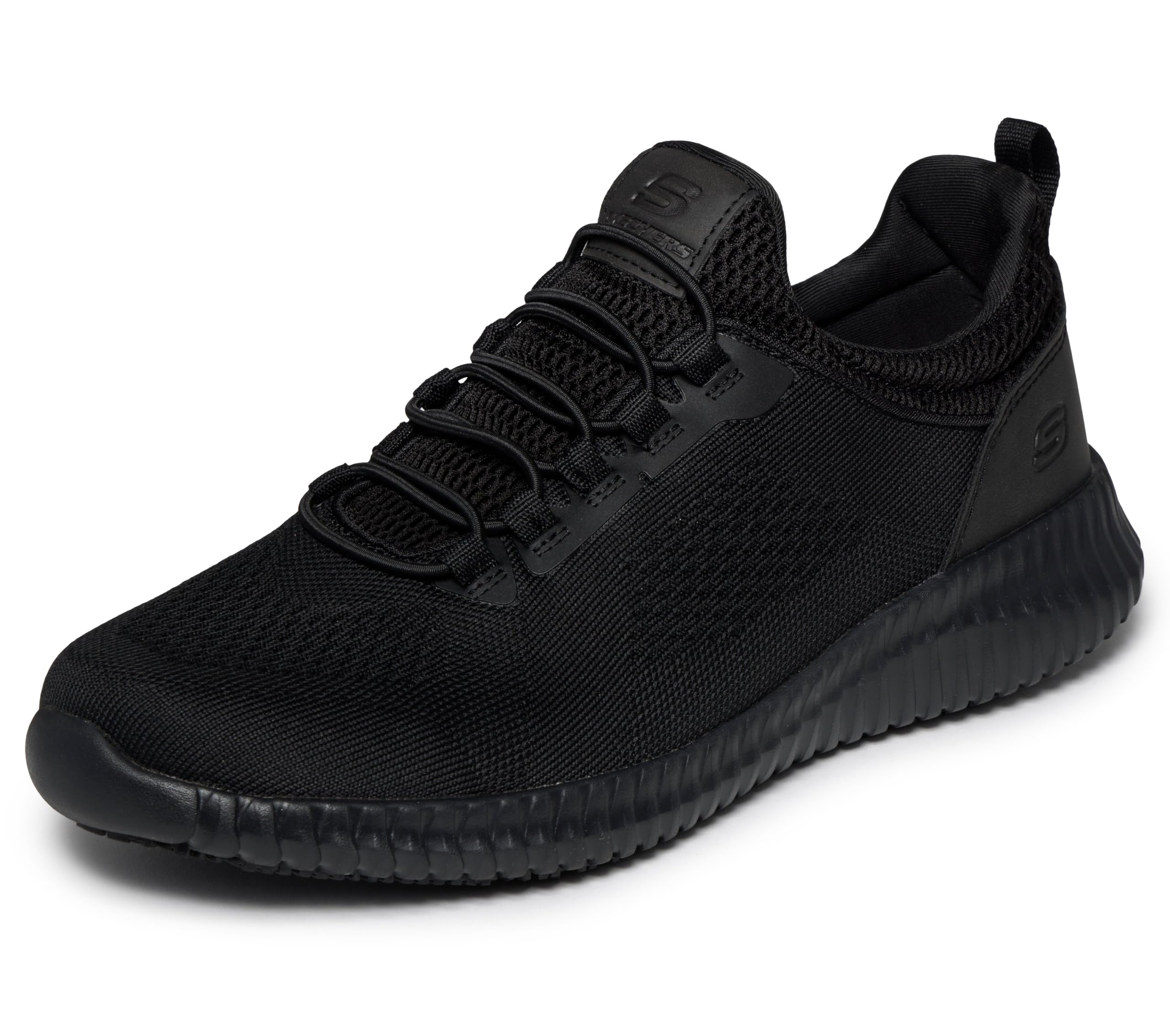
Shoes come off and on more often than anyone expects on a clinical floor — shoe covers at the door, a change before you head home, a quick swap after something spills — and laces turn every one of those into a chore. The Cessnock uses a bungee cord instead. Step in, hook the heel with a finger, and you are done, gloves and all, without bending over.

What we did not expect was how ordinary it looks. It reads as a plain trainer rather than a work shoe, which matters in settings where a clog gets a second look from a supervisor, and the tread is better on wet floors than a trainer has any business being. Pull-on and genuinely grippy at the same time is the reason it holds a place here.

Cushioning is soft from the first shift, with none of the break-in a leather work shoe demands, and the shoe stays light enough that a long day does not leave your feet feeling battered. It is the one we would hand to someone who has stopped expecting work footwear to feel like anything at all.

Pros

  • Steps on without tying or bending
  • Looks like an ordinary sneaker
  • Real traction on slippery floors
  • Soft from the first shift

Cons

  • Sole bonding can give out before the tread wears
  • Cut wide and long; runs large
Our verdict

When laces are the last thing you want to deal with, this is the pair we reach for: a slip-on that looks like a normal sneaker and grips a wet floor.

Check Latest Price
3

Best for Women

Skechers Ghenter Bronaugh

89 /100
Trail Score Excellent

Key details

Style
Work sneaker
Department
Women's
Slip Resistance
Slip-resistant
Check Price on Amazon

Almost everything in this guide is sold as a unisex or men's shoe, and sizing down a men's last does not give you a woman's fit — the heel, the instep, and the width all land differently. The Ghenter is the exception: it is cut and sold in women's sizes, with a toe box wide enough for feet that normally get pinched. For plenty of buyers that alone settles it.

Grip is solid rather than remarkable. It holds on wet tile and slick concrete and beats a plain athletic shoe comfortably, though we rank it a step behind the clogs here once a floor gets greasy. What we appreciated more was the weight — light enough to disappear over a long shift, which is not something you can say about a rubber clog.

The cushioning is soft and flexible, closer to a running shoe than a work shoe, and it is comfortable from the first shift rather than after a break-in. Support is the trade-off: the arch is minimal, so if you overpronate or you are on hard flooring all day, order with an insole in mind and take the size that leaves room for one. It is also the pick that draws compliments, which is rare in this category.

Pros

  • Sold in women's sizes, not scaled down
  • Light on the feet over a long shift
  • Soft, flexible cushioning immediately
  • Looks good enough to wear off shift

Cons

  • Not waterproof; wet floors soak through
  • Minimal arch support as sold
Our verdict

The one shoe in this guide cut and sold in women's sizes — light, wide enough for most feet, and comfortable from the first shift rather than the fifth.

Check Latest Price
4

Best Budget

Bruno Marc Non Slip Work Shoe

90 /100
Trail Score Outstanding

Key details

Style
Work sneaker
Department
Men's
Model Number
F1677
Slip Resistance
Non-slip
Check Price on Amazon

Cheap work shoes usually give themselves away — a sole that feels like cardboard, tread that is smooth by the end of a season, an upper that creases in the wrong place. The Bruno Marc does not. It is the budget pick in this guide, and it is the one where the saving shows up least in the way the shoe feels.

The toe box is wider than most sneakers at any price, and that is the detail we appreciated most: feet that have been squeezed all day stay comfortable in these. Cushioning is soft without going bottomless, grip on wet floors is as good as anything here short of the clogs, and the whole shoe is light enough that it does not drag by the end of a shift.

Against the Skechers picks it is the simpler shoe — no bungee, no women's cut, plainer cushioning — for a fraction of the money, and it does the core job just as well. If your workplace eats shoes, buy two pairs and rotate them; it is the cheapest way to keep a dry pair ready for the next shift.

Pros

  • Real grip on wet floors
  • Wide toe box for the money
  • Soft cushioning without a break-in
  • Light on the foot all shift

Cons

  • Upper does not breathe; feet run hot
  • Tread packs up and loses bite on grease
Our verdict

The budget pick we recommend without an asterisk: a wide, soft work sneaker with real grip that costs less than anything else in this guide.

Check Latest Price
5

Dress-Code Workplaces

Dr. Scholl's Harrington II

88 /100
Trail Score Excellent

Key details

Style
Slip-resistant oxford
Department
Men's
Slip Resistance
Slip-resistant
Check Price on Amazon

Every other pick here looks like work footwear. This one looks like a dress shoe — closed lacing, a smooth upper, a shape that passes at a front desk — which is the whole reason to consider it. If your manager cares more about how the team looks than about whether the shoes are trainers, this is the pair that ends the argument.

There is more room inside than the oxford shape suggests. The toe box is generous enough for wide feet without the shoe looking like a boat, and the grip on wet surfaces is better than a smooth-soled dress shoe has any business being. We came away thinking it is the most versatile shoe here for anyone who splits a day between a wet floor and a front counter.

Comfort is the part to manage. The footbed is firm and flat, closer to a dress shoe than a work shoe, so an insole is close to mandatory if you are standing eight hours — and there is room for one. Otherwise it holds its looks and cleans up with a wipe, which is more than the fabric sneakers here will do.

Pros

  • Dress-shoe looks that pass a uniform code
  • Roomy toe box for an oxford
  • Grip on wet and dry floors

Cons

  • Sole and tread can separate under heavy use
  • Firm, flat footbed for long shifts
Our verdict

Buy this one for the dress code: an oxford that passes at a front desk and still grips a wet floor, provided you add an insole before your first long shift.

Check Latest Price

How We Tested 12 Pairs of Non-Slip Work Shoes

We started with a list of about 40 styles and cut it down using the specs that actually matter on a wet floor: outsole compound, tread depth and pattern, any third-party slip-resistance rating, available widths, and whether a pair could be returned after a shift or two. Price mattered, but only as a ratio — we wanted to see what the extra money bought. That left 12 pairs, which we rotated through eight months of real shifts.

Testers wore them where the floors are worst: a restaurant line at Friday dinner service, a hospital corridor just after mopping, a warehouse with polished concrete and the occasional puddle of coolant. Separately, we walked each pair across wet, soapy quarry tile and did quick pivots and backpedals to find where the tread let go, then hosed down the outsoles to see how much water they carried onto dry floor with them.

Fit and comfort got logged hour by hour rather than on a lab bench. Testers with high arches and flat feet wore each pair for a full shift on day one and reported where they felt pressure, and we noted how many shifts passed before a pair stopped needing a break-in. We bought true sizes and half sizes up to see how each brand ran, and weighed every shoe, since a heavy pair announces itself around hour seven.

For appearance, we wore pairs with jeans and with work pants and asked testers whether they'd keep them on for the commute home. At three and six months we checked heel wear, seam separation, and toe scuffing — the difference between a shoe that's merely comfortable on day one and one that's still holding together when the tread starts to go.

How to Choose Non-Slip Work Shoes

Start With the Floor, Not the Label

Non-slip is a broad claim, and the same tread behaves differently on wet tile than on a floor filmed with fryer oil. Water needs somewhere to go, so look for channels and a squeegee-like pattern. Grease asks for a softer rubber that keeps its bite once the surface is slick, and a tread packed with food debris stops working no matter what the box promised.

The trap is assuming the label settles it. Walk a wet patch of your own stockroom before the first full shift, and if you work a fryer line, test the shoe where the oil actually lands — not on the dry carpet by the locker room.

Enclosed Toe or Vented Upper

Kitchens, labs, and clinical floors push you toward a closed shell: spills run off instead of soaking in, and a wipe with a cloth is the whole cleaning routine. The trade-off is heat. A closed foam clog keeps stock and bleach off your feet and then keeps everything else in, so if you run hot, plan on a fresh pair of socks at lunch or rotate two pairs across the week.

A fabric upper is cooler and lighter and will not forgive a dropped bucket of mop water. Pick according to what actually lands on your feet, not what looks tougher.

Fit, Half Sizes, and Room for an Insole

Work shoes are where sizing gets sloppy: several of these run large, and some come only in whole sizes, which leaves anyone between sizes picking a side. Try them at the end of the day when your feet are at their biggest, and assume you will add an insole — a flat factory footbed is the most common thing to fix in this category, and swapping one in is easier than a return.

Closure: Laces, Bungee, or a Strap

How you get in and out of a shoe matters more than it sounds on a job where you change footwear several times a shift. Laces give the most adjustable fit. A bungee system gets you close without tying. A clog's pivoting strap lets you slide in and out without bending at all. If you have back trouble or you are usually wearing gloves, that last detail is worth more than a slightly better fit.

Frequently Asked Questions

Final Verdict

The Crocs Bistro is the pair we point most people to, because the job that matters most on a wet floor is the job it does best, and the shell wipes down in half a minute at closing. Add an insole and it will carry a full shift; skip that and you will feel it by hour eight.

If your day involves getting in and out of shoes constantly, the Skechers Cessnock solves that better. If you have been making do with a men's shoe, the Ghenter is the women's-sized answer, and it is the more comfortable of the two.