Best Muscle Scraper Tools of 2026

A muscle scraper does one plain thing: it drags a hard, angled edge across skin so the tissue underneath lets go, the same idea a physical therapist uses during IASTM work. What separates a good one from a bad one isn't the marketing — it's the bevel on the edge, the weight in your hand, and whether the shape actually reaches the spot that's bothering you. Get those three wrong and ten minutes of scraping leaves you with a hot red stripe and no relief.

My own introduction to this was a calf knot that laughed at four months of foam rolling. Over the past five months, my team and I have run 14 scrapers across sore calves, locked-up shoulders, and a knee scar that never quite loosened. The lesson that surprised me most: sharper isn't better. A slightly rounded, well-machined edge does more than an aggressive blade, and the tools people keep reaching for are the ones that feel balanced in the hand and don't cramp your grip halfway through. The picks below all clear that bar — where they differ is in shape, size, and what they cost you.

1

Best Overall

H-Brotaco Stainless Scraper

94 /100
Trail Score Outstanding

Key details

Edge
Double-beveled
Weight
5.61 oz
Material
Medical-grade stainless steel
Dimensions
7.8 x 1.4 x 1.4 inches
Check Price on Amazon

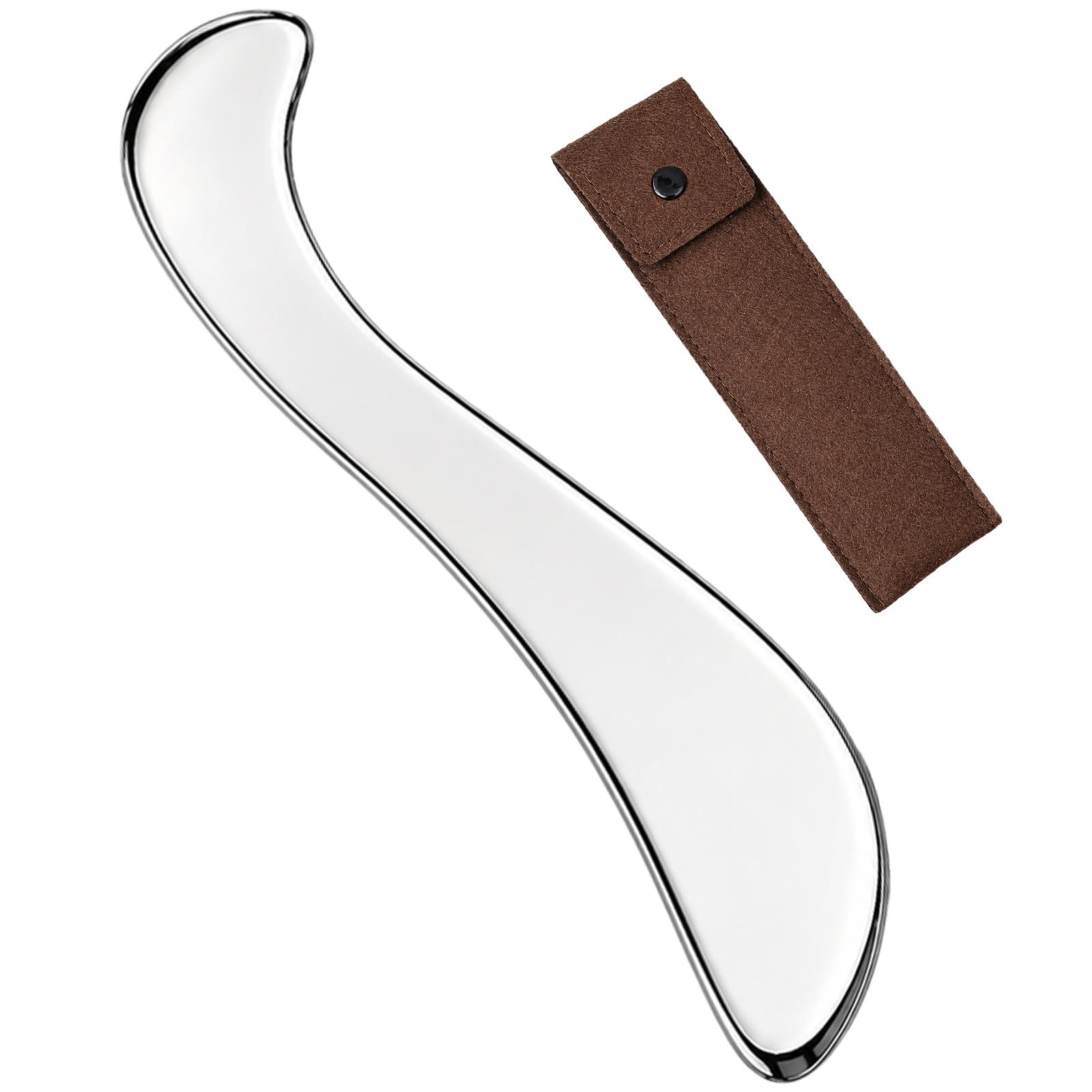
Seven and three-quarter inches is an odd thing to lead with, but length is exactly why the H-Brotaco earns our top spot. Laid along a calf or angled over a shoulder, the reach lets you keep both hands on the tool and drive from your body instead of your wrist. At 5.61 ounces it is heavy enough that the weight carries a stroke, so a long pass down a thigh does not turn into a grip contest.

The S-curve backs it up. One long flat edge covers a quad, a lat, or a hamstring; the tapered end gets down the outside of a shin and into the meat of a shoulder blade. We found the mirror-polished bevel glides on a thin film of oil with almost no drag, and a rinse under the tap brings it back to new. The fitted case means it travels without the edge knocking against everything else in the bag.

The adjustment is the girth. At 1.4 inches around the middle it is a lot for a small hand to close on, and that is where all that reach turns into a liability. Choke up on the narrow end and let the body of the tool hang past your pinky — strange for the first minute, forgotten by the third.

Pros

  • Nearly 8 inches of reach for your own back
  • 5.61-ounce heft carries the stroke
  • Mirror-polished bevel glides on oil
  • Fitted case keeps the edge covered

Cons

  • One shape only, where the sets cover more
Our verdict

We recommend it as the default home scraper because 7.8 inches of reach and 5.61 ounces of heft let you treat your own back and calves without fighting your grip.
Check Latest Price
2

Best Set

BYYDDIY 3-in-1 Scraper Set

93 /100
Trail Score Outstanding

Key details

Shapes
C, S, and D
Weight
1.15 lb
Storage
Black felt protective bag
Material
Medical-grade stainless steel
Check Price on Amazon

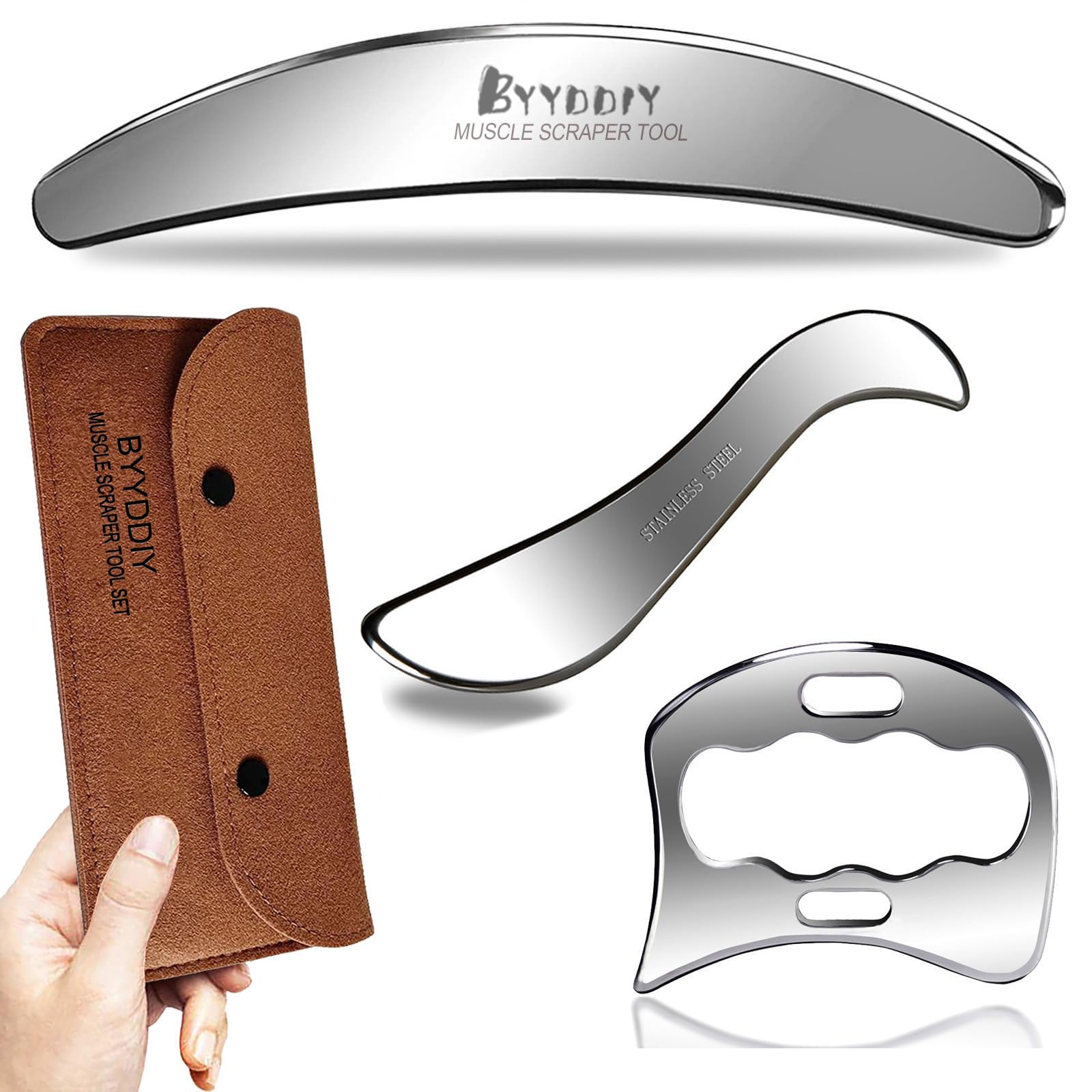
Three tools arrive in the BYYDDIY set — a C, an S, and a D — and the C is the one that justifies the whole purchase. You hold both ends and pull, which puts even, two-handed pressure down a hamstring or the back of a calf without your fingers quitting halfway.

Of the multi-tool options here, this is the set we keep reaching for. The S-shape handles broad flat work on a quad or a lat, and the D wraps the arc of a shoulder, an instep, or the top of a foot. Polish is even across all three edges, and the black felt bag keeps them from knocking against each other in a drawer.

Two things to know going in. The D-tool's finger notch is snug — fine on your own shoulder, more regripping than we wanted when working on someone else. And at 1.15 pounds for the set, no individual piece is heavy enough to turn clumsy over a long session, so the weight is a non-issue either way.

Pros

  • C-shape allows two-handed pressure on hamstrings
  • S and D shapes cover flat muscle and curves
  • Even polish and a bag that keeps them together

Cons

  • Three pieces to clean and keep track of
Our verdict

Buy the set if you want one tool per body region: the C-shape alone justifies it, and no single-piece scraper here works a hamstring as evenly.

Check Latest Price
3

Best for Control

FeelFree Sport Muscle Scraper

94 /100
Trail Score Outstanding

Key details

Finish
Mirror-polished
Weight
4.97 oz
Material
Stainless steel
Dimensions
5 x 2 x 0.5 inches
Check Price on Amazon

The FeelFree is a five-inch plate with a hole cut through the middle, and that hole is the whole idea. Hook a couple of fingers through it, brace your thumb on the outer edge, and you have a grip that does not ask your hand to clamp shut.

There are four or five genuinely different holds in that shape, so when one angle starts to ache you rotate the tool and carry on — we cycled through most of them during a week of forearm work. The edges are polished smooth, and at 4.97 ounces it glides on the same few drops of oil as the bigger scrapers.

Where it earns a place is the end of a session, on the parts a long blade skates over: the meat at the base of a thumb, the top of a foot, the strip beside the shin bone. It is the tool we reach for last and use most often on the fiddly stuff, and keeping a second one in a gym bag is an easy call.

Pros

  • Cut-out handle gives several relaxed grips
  • Compact enough for feet and forearms
  • Under 5 ounces, so the hand does not tire

Cons

  • Five inches will not reach your own back
Our verdict

We keep this one for forearms, shins, and feet: the cut-out handle gives you four or five relaxed grips, and nothing else here gets into small areas as easily.

Check Latest Price
4

Best for Tired Hands

The Wave Tool

92 /100
Trail Score Outstanding

Key details

Origin
Made in USA
Weight
4.6 oz
Material
Nylon and glass composite
Dimensions
5.5 x 1 x 3.5 inches
Check Price on Amazon

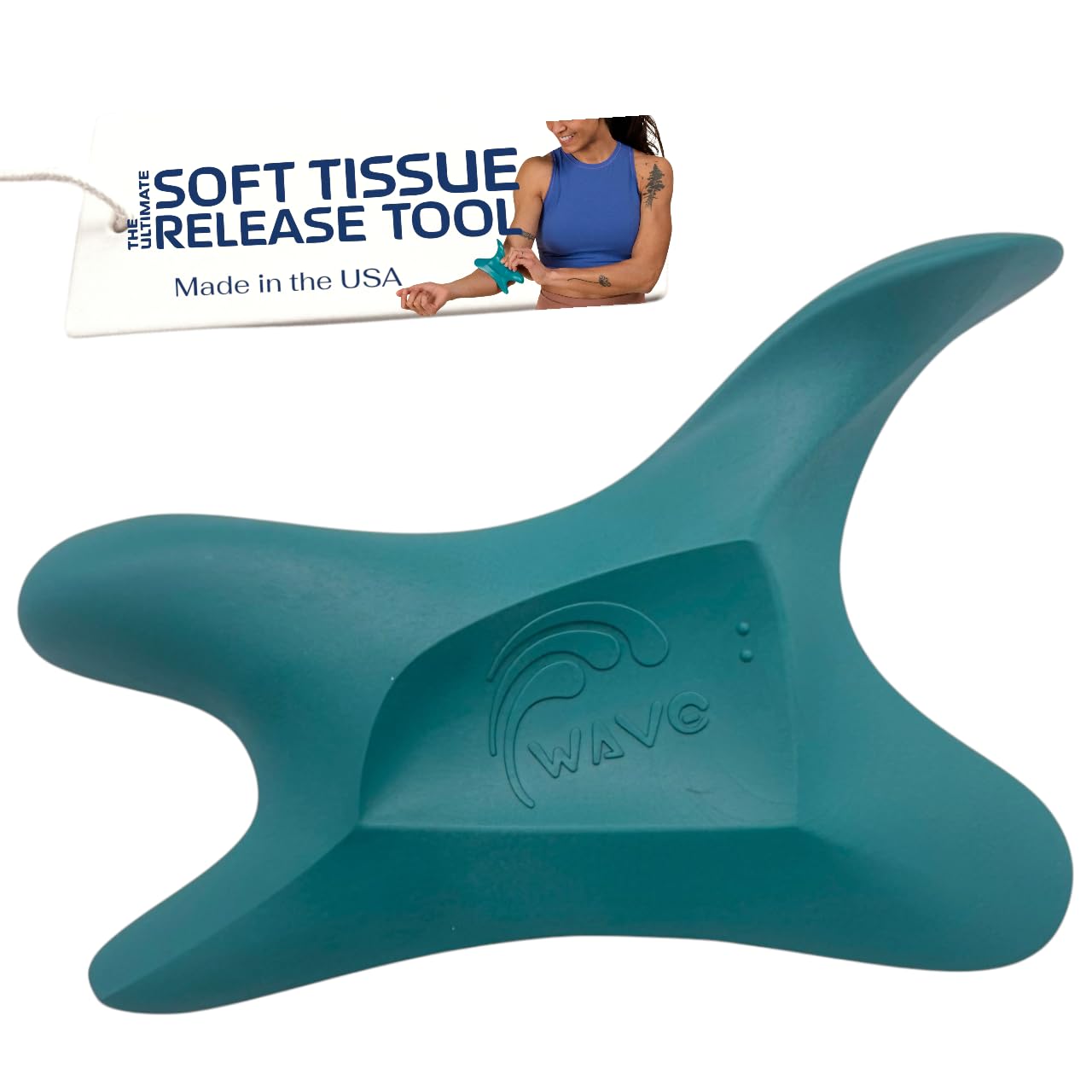
Everything else in this guide is a sheet of steel. The Wave Tool is molded from a nylon and glass composite into a three-dimensional shape with several working surfaces, and it is the only pick here designed around the hand rather than the edge.

The case for the premium price is exactly that. The body fills a palm, the grip is rounded instead of thin, and your thumb is not doing the clamping. Through a long session on a stubborn quad we were still applying real pressure at the end, where a flat plate usually has us shaking the hand out. For anyone whose thumbs ache after ten minutes of scraping, that is the difference between a tool you use and one you don't.

Two things going in. The composite is not as slick as polished steel — helpful when your hands are dry, less so once you are oiled up — and the surfaces are molded rather than hand-polished, so the feel is grippier than glassy. It is also a small therapists' shop product rather than a mass-market one, which is part of what the price buys.

Pros

  • Molded grip spares thumbs on long sessions
  • Multiple scraping edges and massage surfaces in one tool
  • Made in the USA by a physical-therapist-founded shop

Cons

  • Premium price, well above the steel picks
Our verdict

If metal tools leave your hands aching, the Wave Tool's molded body is worth the premium; we were still pressing evenly at the end of long sessions with it.

Check Latest Price
5

Gym Bag Kit

BYYDDIY 2-in-1 Scraper Set

92 /100
Trail Score Outstanding

Key details

Shapes
S and D
Weight
12 oz
Storage
Black felt protective bag
Material
Medical-grade stainless steel
Check Price on Amazon

Two tools instead of three: an S-shape for long flat strokes and a D-shape for curves. That is the BYYDDIY two-piece, and it is the set to buy if the three-tool version includes a shape you would pay for and never touch.

Both pieces are mirror-polished stainless with beveled edges, and the pair comes to 11.99 ounces in total — substantial without being something you notice in a gym bag. The S does the bulk of the work on a thigh or a calf; the D wraps the front of a shin and the top of a foot better than the long blades here.

The grip is where the saving shows. The inner edge of the cut-out is squared off rather than rounded, and after a few dozen strokes you feel it along the side of your finger. A wrap of self-adhesive tape around that edge fixes it in about a minute, and then it stops being a thought.

What you get for the money is coverage without a stray tool in the bag. The D-piece surprised us most — on shins and the top of the foot it does what we normally reach for a small plate to do — and the felt sleeve keeps both pieces together in a bag with no room to spare.

Pros

  • S and D cover flat muscle and curved limbs
  • Pair feels substantial at 11.99 ounces total
  • Felt sleeve keeps both pieces together

Cons

  • Soft felt sleeve offers little crush protection
Our verdict

A two-piece kit for anyone who wants options without a drawer full of tools; the D-piece earns its keep on shins and the top of the foot.

Check Latest Price
6

A Second Scraper

THLHKD S-Shaped Scraper

92 /100
Trail Score Outstanding

Key details

Form
S-shaped
Weight
3 oz
Material
Stainless steel
Dimensions
6.8 x 1.3 x 0.15 inches
Check Price on Amazon

Three ounces makes this the lightest scraper here, and lightness is the whole argument: it is the one you can carry every day and forget about until you need it. For a tool whose main competition is staying in a drawer, that counts for more than mass.

The shape is the familiar S-curve — 6.8 inches of long flat edge tapering to a working tip — and the stainless is listed as waterproof, so a rinse and a towel is the entire routine. It arrives with a simple sheath rather than a case, which suits the role.

The other case for it is redundancy. This is the one tool here where owning a second for the gym makes obvious sense, and the price is why. If you have been meaning to try scraping without committing to a set, start here and upgrade once you know which shape you actually reach for.

Pros

  • Lightest tool here at 3 ounces
  • S-curve covers flat muscle and contours
  • Rinses clean and dries fast
  • Least expensive scraper in this guide

Cons

  • Thin 0.15-inch plate suits light passes, not deep work
Our verdict

We recommend it as the second scraper, the one that lives in a bag, because 3 ounces and a low price make it easy to keep close.

Check Latest Price
7

Broad Flat Muscle

STICKON Stainless Scraper

91 /100
Trail Score Outstanding

Key details

Edges
Double-beveled
Weight
7.05 oz
Material
Medical-grade stainless steel
Dimensions
6.5 x 4 x 0.14 inches
Check Price on Amazon

Most scrapers here are long and narrow. The STICKON is four inches wide — a broad plate you hold with your fingertips through two cut-outs, closer to a hand plane than a blade.

Width is the point. Across a thigh, an IT band, or the outside of a hip, a wide edge covers more tissue per stroke and sends pressure straight down through your fingers instead of asking your wrist to steer. At 7.05 ounces it is the heaviest of the flat tools, which helps: the plate does the pressing.

Our verdict is that it is a specialist worth owning if the muscles you fight are broad and flat. Nothing else here covers a hip or an IT band in as few strokes, and the fingertip hold lets you change angle mid-pass without lifting off the skin.

Pros

  • 4-inch-wide edge covers broad muscle fast
  • 7.05 ounces presses without wrist effort
  • Double-beveled edges give two working angles

Cons

  • Finger holes suit average hands only
  • 0.14-inch plate leaves little to hold
Our verdict

A specialist for broad, flat muscle: if your trouble spots are thighs and hips and your fingers fit the holes, it covers ground faster than the long tools here.

Check Latest Price
8

Heat and Vibration

ZDXBO Heated Muscle Scraper

92 /100
Trail Score Outstanding

Key details

Modes
Heat, vibration, and pulse
Weight
1.17 lb
Battery
2000mAh rechargeable
Dimensions
4.92 x 4.13 x 1.18 inches
Check Price on Amazon

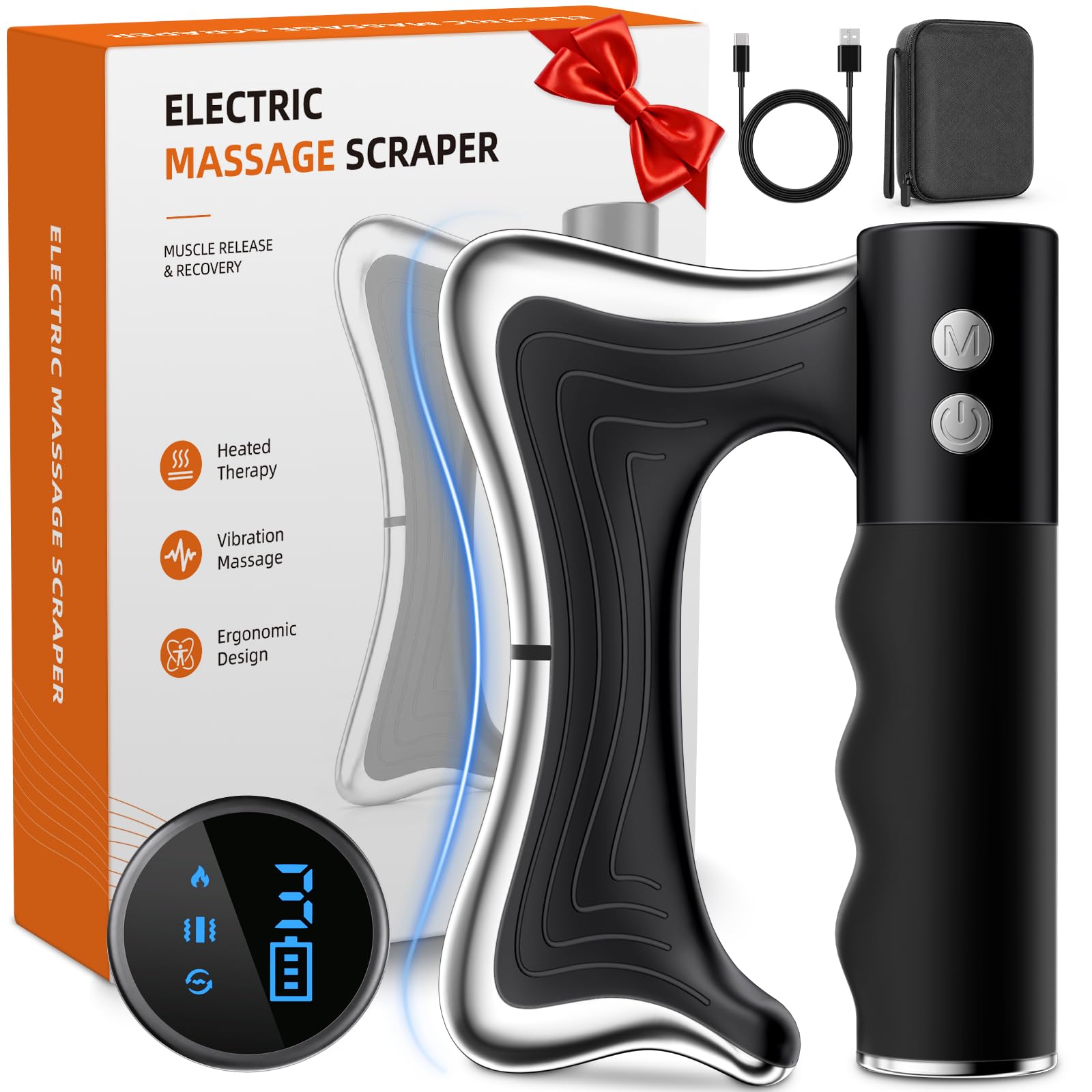
Every other scraper in this guide is a piece of steel you move yourself. This one has a motor, a heating element, and a battery, and the fair question is whether any of that makes it a better scraper.

The hardware is dense for a hand tool: three modes that pair heat with vibration or with a pulse, a small LED screen, a ten-minute auto-off so it does not sit there running, and a 2000mAh battery in a body that weighs 1.17 pounds. The scraping edge is fixed at one end, so you steer the tool rather than angling a bevel by hand.

In use, heat and vibration change the job. You get warmth into a tight shoulder and a fine buzz layered on top of the scrape, which feels nothing like a cold steel edge and a few drops of oil. It is also blunter: you cannot finesse the contact angle the way a plate lets you, and the battery is a step the steel tools never ask for.

Where it fits is the days you cannot be bothered to oil up and work a muscle properly. Ten minutes of heat and buzz on a sore shoulder is easier to start than a full scraping routine, and a tool you pick up beats a better one that stays in a drawer.

Pros

  • Heat and vibration make a session easier to start
  • Three modes suit different sore spots
  • Ten-minute auto-off protects the battery
  • Cordless, with no cable across the room

Cons

  • Recharging adds a step steel never has
Our verdict

Worth it if heat and vibration are what get you to keep a recovery routine; if you want precision through your fingertips, a steel scraper is the better buy.

Check Latest Price

How We Tested 14 Muscle Scrapers

To build the shortlist, I read through material specs and customer complaints — chipped edges, handles that torqued mid-stroke, tools that arrived with a burr — and pulled in everything that looked machined rather than stamped. We ended up ordering 14 tools, ranging from single flat blades to multi-piece sets to one heated, vibrating option, and lived with them for five months.

Testing happened where the soreness does: calves and quads after long runs, forearms after a heavy week of typing, shoulders during a Sunday-night wind-down, and a surgical scar that had been tight for two years. Every tool got the same run — three two-minute passes over the same area, then a check the next morning for bruising and for whether the knot had actually softened. I dragged each edge across the back of my hand first to feel the bevel, then along a taut pair of nylons to see whether it glided, snagged, or nicked the fabric.

We measured steel thickness with calipers and weighed each tool, because a blade that's too thin flexes against a tight IT band and one that's too heavy tires your wrist before the session is done. Grip got its own test: a full 10-minute pass on the same shoulder, noting where the handle dug in and when my hand started to cramp. For the electric model, we charged it fully and ran it until it died, timing sessions so we knew how many uses a charge really covered and whether the heat and vibration justified the extra battery management. Anything with an edge that caught skin or left a mark closer to a scrape than a treatment got flagged early.

How to Choose a Muscle Scraper Tool

Shape Comes Before Steel

The familiar S-curve does the most jobs: a long flat edge for quads, lats, and calves, and a tapered tip for smaller territory. A C-shape is different in kind — you hold both ends and pull, which is the only way to get even, two-handed pressure down a hamstring when nobody is helping you. Broad plates and D-shapes suit arcs and wide sweeps.

If you don't yet know which you'll reach for, a two- or three-piece set is an inexpensive way to find out. In our experience most people then settle on one piece for the great majority of sessions and keep the others for the odd spot.

Reach Is the Spec Nobody Reads

A five-inch tool gives you control on forearms, shins, and feet. A seven- or eight-inch one gives you reach — enough to work your own upper back and the back of a calf without dislocating a shoulder to do it.

The trap is buying the smallest scraper because it stores neatly, then discovering you cannot get it onto the muscle that is actually bothering you. If your trouble spots are on your back, buy length first and control second.

Grip, and Where Hand Fatigue Comes From

Scraping is a repeated, low-force movement, and thin steel is unforgiving: a flat plate with no give digs into the fingers after a few dozen strokes. Finger holes and cut-outs solve that only if your hand fits them, and a hole with a squared-off inner edge can be worse than no hole at all.

Before you commit, hook your fingers through and check that your hand stays relaxed rather than clamped. A grip you have to squeeze to hold is a grip that ends the session early.

Edges, Polish, and Enough Slip

A mirror-polished, double-beveled edge is what lets a tool glide instead of grab: one bevel for broad flat pressure, the other for a sharper, more targeted angle. On arrival, run a fingernail along the working edge. It should feel like a butter knife, not a blade — a burr is a reason to send it back, not something to sand down yourself.

Use a few drops of massage oil or lotion rather than a flood. If the edge starts skipping, add slip before you add pressure.

Manual Steel or a Powered Scraper

Powered scrapers add heat and vibration to the same motion, which makes a session easier to begin and less dependent on your own muscle. The trade is precision: the head is usually fixed, so you steer rather than angle the edge, and there is a battery to keep charged.

Steel has no such dependencies — rinse it, dry it, and it works whenever you do. Treat a powered unit as a second tool for sore, cold mornings rather than the one that replaces everything else.

Frequently Asked Questions

Final Verdict

For most people the H-Brotaco is the scraper to buy: nearly eight inches of reach, enough weight to carry a stroke, and a polished bevel that glides on a few drops of oil. Nothing else here makes your own back and calves as easy to treat.

Two exceptions are worth naming. If you want one tool for each region, the BYYDDIY three-piece set covers flat muscle, curves, and small joints for a modest step up in price. And if steel in your palm is the thing that stops you, the Wave Tool's molded body is the one to hold first.