Best Lion's Mane Supplements of 2026

Lion's mane doesn't pep you up the way caffeine does — it's the slow kind of supplement, the one people take to stay on task through a Tuesday afternoon or remember why they walked into the kitchen. That's what makes it hard to shop for: two bottles can both promise 1,000 mg while one holds pure fruiting body extract and the other is mostly mycelium grown on grain, padded out with fillers. What you want is a formula clean enough that you'll still be taking it in week eight, priced per serving like a daily habit rather than an indulgence, and in a form that disappears into your morning.

I've kept a pouch of lion's mane powder in my desk drawer for two years, and the difference between the ones I finish and the ones I quietly retire comes down to mixability and how I feel by mid-afternoon. Over the past three months, my team and I put 14 supplements through real mornings — capsules with breakfast, powders stirred into coffee and smoothies — keeping notes on focus, recall, and anything our bodies complained about. A tip first-timers never hear: give it a month, not a week, and take it early in the day if you're prone to vivid dreams.

1

Best Overall

Real Mushrooms Lion's Mane Capsules

91 /100
Trail Score Outstanding

Key details

Form
Capsule
Count
300 capsules
Beta-glucans
>30%, lab verified
Mushroom Source
Fruiting body only
Check Price on Amazon

The number we look for first on a lion's mane bottle is a beta-glucan percentage, and most of them don't print one. This one does: over 30%, independently verified by NSF International, on capsules made from fruiting bodies alone — no mycelium, no grain, no starch or carriers. That is the whole reason it's our top pick. Much of what's sold as lion's mane is mycelium grown on brown rice, and the dried mycelium-and-rice matrix goes straight into the capsule, so the grain the fungus grew on can make up a good share of what you swallow. Here the label names one ingredient and puts a figure on the part that matters.

Taking it is about as uneventful as a daily supplement gets. Two capsules with breakfast, no aftertaste, no repeat afterwards, and a 300-count bottle that outlasts every other capsule on this list — which counts for more than it sounds like when you're the one remembering to re-order. The capsules are also USDA Organic, non-GMO, and vegan, and the mushroom is grown in the U.S.

The trade-offs are size and money. These are large capsules, and we noticed them going down in a way we didn't with the Dr. Emil bottle. And this is the most expensive bottle in the group, which is easier to accept once you divide 300 capsules at two a day — 150 doses — but it's still a bigger check up front than most people expect to write for a mushroom.

Pros

  • Fruiting body only, no grain fillers
  • Beta-glucans over 30%, lab verified
  • 300 capsules per bottle
  • Certified organic, non-GMO, vegan

Cons

  • Large capsules to swallow
  • Most expensive bottle in this group
Our verdict

Our top pick is the one lion's mane capsule you can check instead of trust: fruiting body only, beta-glucans verified by an outside lab, and enough capsules to make the bottle price a long-term calculation.
Check Latest Price
2

Best for Focus

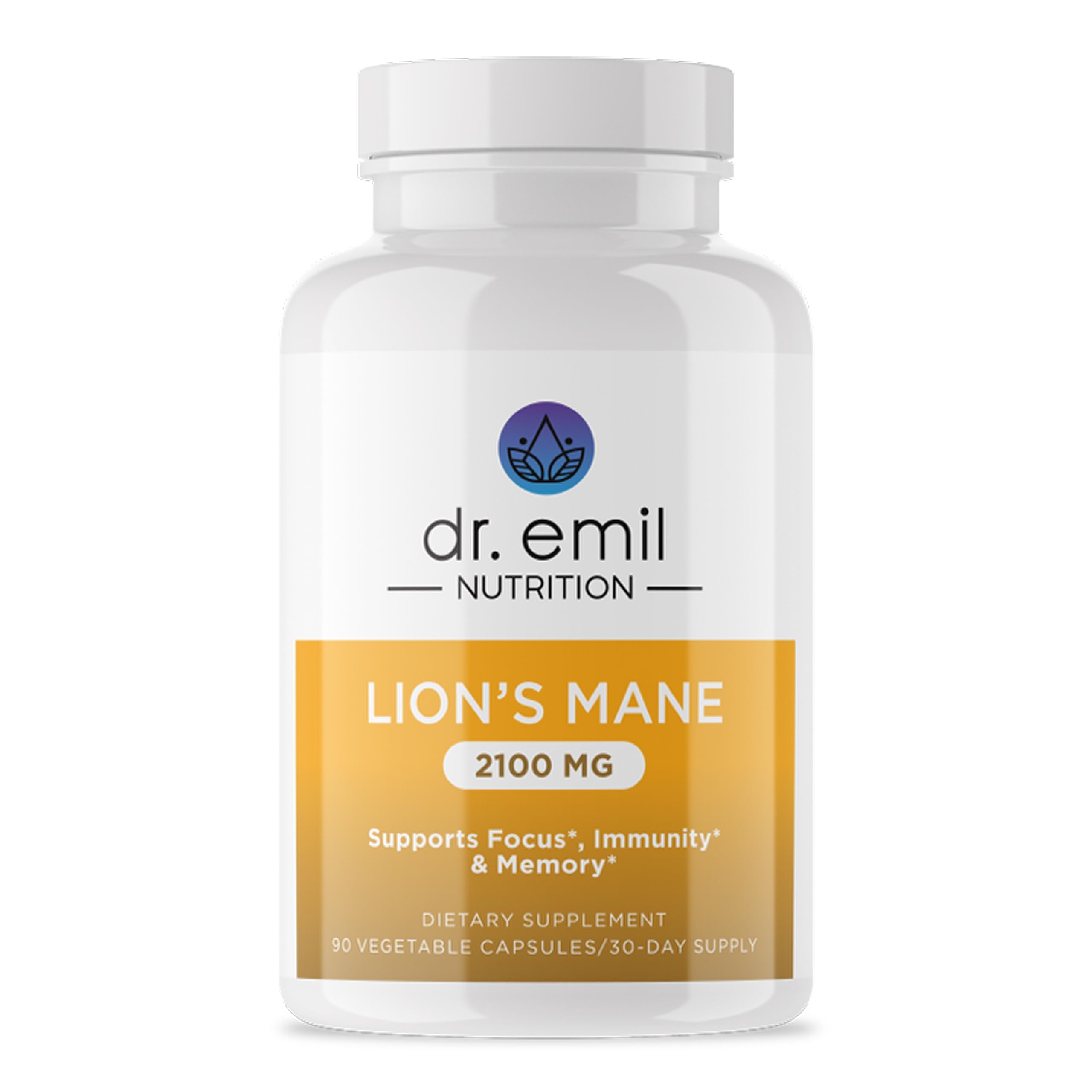
Dr. Emil Lion's Mane

89 /100
Trail Score Excellent

Key details

Form
Capsule
Count
90 capsules
Testing
Third-party tested, cGMP
Lion's Mane Extract
2,100 mg
Check Price on Amazon

The person this bottle suits is the one taking lion's mane for work: the afternoon of scattered attention, the word that won't arrive, the email that takes three passes. Dr. Emil labels a 2,100 mg extract dose from mushrooms grown in the U.S., the biggest figure in this group, and of everything here this is the pick whose case rests most squarely on focus, recall, and brain fog.

It's also the easiest of the serious options to try, because the bottle is a 90-count and the price sits at the low end for what you get. Doctor-formulated, third-party tested in a cGMP facility, vegan and non-GMO, free of gluten and dairy — the label is clean throughout. What it doesn't print is a beta-glucan percentage, which is the one place it concedes ground to our top pick: you're trusting the stated extract dose and the testing rather than a measured active content.

Plan around the bottle size. Ninety capsules is a short runway next to the 300-count options, and ours emptied well before the Real Mushrooms did. The capsules themselves are small and easy to swallow, though, which is more than we can say for our top pick — and it makes this the bottle we hand to someone who has quietly given up on horse pills.

Pros

  • 2,100 mg extract, the highest here
  • Focus and recall are the core of its case
  • Third-party tested, cGMP, vegan
  • Budget bottle price

Cons

  • 90 capsules empty fast
  • No beta-glucan figure on the label
Our verdict

We reach for this one when focus is the goal — the highest extract dose in the group, in a bottle small enough to try without much risk.

Check Latest Price
3

Best for a Smaller Commitment

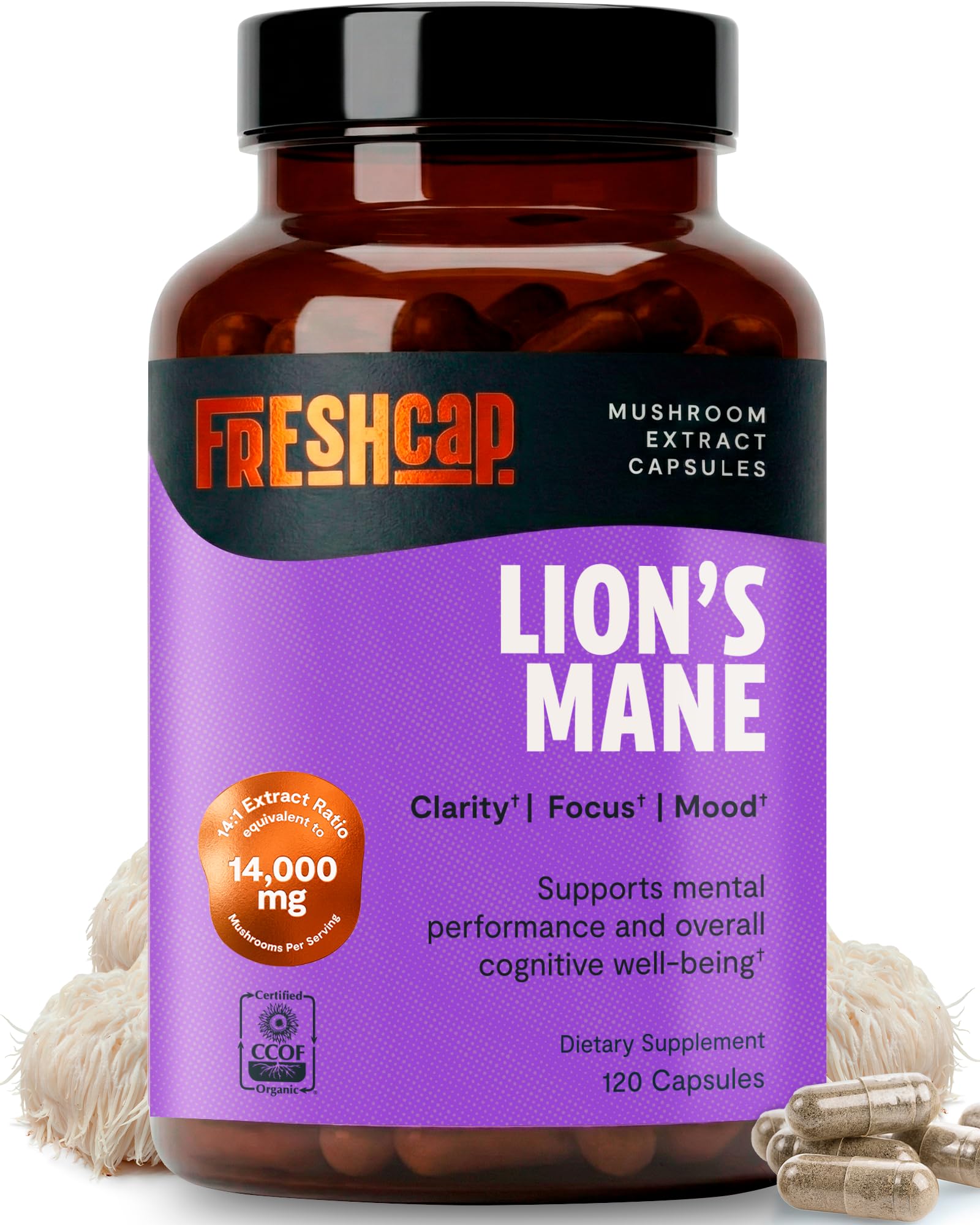
FreshCap Lion's Mane Capsules

91 /100
Trail Score Outstanding

Key details

Form
Capsule
Count
120 capsules
Extraction
Triple-extracted
Mushroom Source
Whole fruiting body
Check Price on Amazon

Everything that earns our top pick its place — whole fruiting body, no grain, no fillers, a third-party test — FreshCap does too, in a bottle that's easier to say yes to. The extraction is triple, the organic certification comes from CCOF, and the capsule is 100% mushroom. If a 300-count bottle feels like a commitment for something you haven't tried yet, start here.

It's 120 capsules, two a day for a two-month supply, and they go down easily with no aftertaste worth mentioning. We kept ours beside the coffee grinder and never once thought about it, which is the highest compliment a daily supplement can earn. The label is also unusually plain about what's in it, which we appreciate in a category that likes to hide behind shaggy mushroom photography.

The catch is arithmetic. Fewer capsules in the bottle means a higher cost per capsule than the 300-count picks, so the smaller commitment costs a little more per day. Whether that matters depends on how sure you already are that lion's mane is for you. If you're not sure, start here and move up later.

Pros

  • Whole fruiting body, triple-extracted
  • CCOF certified organic
  • Easy to swallow, no aftertaste
  • Two-month supply per bottle

Cons

  • Higher cost per capsule than 300-count bottles
Our verdict

Buy it if you want the fruiting-body standard without the top pick's price: triple-extracted, certified organic, and easy to swallow twice a day.

Check Latest Price
4

Best Bulk Buy

Double Wood Lion's Mane

93 /100
Trail Score Outstanding

Key details

Form
Capsule
Count
300 capsules
Testing
Third-party tested, made in USA
Strength
1,000 mg
Check Price on Amazon

Three hundred capsules of a stated 1,000 mg, manufactured and tested in the U.S., for a midrange bottle price — that's the pitch, and it's a good one if quantity is what you're shopping for. It's the same capsule count as our top pick for a good deal less money.

What the label won't tell you is the thing we ask first: whether the extract comes from fruiting bodies or from mycelium grown on grain. Double Wood says its ingredients are globally sourced and tested for safety here, which is a manufacturing statement, not a formulation one. If you're chasing the fruiting-body standard our top pick sets, this is not a substitute, and you should keep moving.

If you mainly want a lot of lion's mane at a modest price, though, it earns its spot. The capsules aren't oversized, there's no unpleasant taste to plan around, and the case for this bottle is strongest on memory and focus — the two things it's bought for. Call it the sensible bulk buy: not the one to choose while reading panels closely, but a lot of daily doses for the money.

Pros

  • 300 capsules at a midrange price
  • 1,000 mg stated strength
  • U.S.-manufactured and third-party tested
  • Capsules aren't oversized

Cons

  • Doesn't say fruiting body or mycelium
Our verdict

For a long, affordable supply of a stated 1,000 mg extract, we like this bottle — as long as you don't need the label to tell you whether it's fruiting body.

Check Latest Price
5

Best Powder

Micro Ingredients Lion's Mane Powder

93 /100
Trail Score Outstanding

Key details

Form
Powder
Servings
151
Serving Size
1,500 mg
Mushroom Source
Fruiting body and mycelium
Check Price on Amazon

The pouch lives next to the kettle in our kitchen, because a scoop of this disappears into black coffee with nothing behind it but a faint earthiness. Of the powders we tried, it's the one we reach for: freeze-dried, organic, filler-free, and mild enough that you stop noticing it by the second week.

The numbers are generous. Eight ounces, a 1,500 mg scoop, 151 servings in the pouch — nothing else here stretches that far, and the scoop that comes with it makes a consistent dose easy without a scale. It's also free of soy, dairy, gluten, preservatives, and added flavors, which is a shorter exclusion list than most powders manage.

Two caveats. The label names both fruiting body and mycelium, so this isn't the pure fruiting-body extract our top pick is; if that distinction is the reason you're shopping, pay more elsewhere. And it's grainy in cold water — it wants hot coffee, a shaker bottle, or a blender, and it will sink to the bottom if you just stir it into a glass.

Pros

  • 151 servings per pouch
  • Mild enough for hot coffee
  • Organic, non-GMO, filler-free
  • Measuring scoop included

Cons

  • Fruiting body plus mycelium, not fruiting body alone
Our verdict

We like it best as a drink rather than a dose — 151 servings of mild organic powder that disappears into coffee, as long as you're happy with mycelium in the blend.

Check Latest Price
6

Best Liquid Drops

MaryRuth's Lion's Mane Drops

90 /100
Trail Score Outstanding

Key details

Form
Liquid drops
Dietary
Vegan, sugar-free, gluten-free
Bottle Size
1 fl oz
Certifications
USDA Organic, Non-GMO
Check Price on Amazon

Most supplement habits die at the capsule, and a dropper is a fair answer to that. MaryRuth's comes in a 1 fl oz bottle that's USDA Organic, non-GMO, vegan, sugar-free, and free of dairy, nuts, and gluten, and it tastes sweet enough that taking it isn't a chore. It's the format we keep on hand for people who dread pills.

We've put ours into coffee and taken it straight under the tongue, and both work — there's no mushroom funk to hide, which is more than we can say for the powders. What you give up is precision. The label gives no milligram figure, so there's no way to line its dose up against a capsule, and you're buying on the traditional nervine framing rather than a measured extract.

The bottle is also small. An ounce of drops goes quickly at a full dropper a day, which makes this the shortest-lived purchase in the group and the one you'll re-order most often. It's a good bottle for a trial and a less good one for a long-term supply, and that's really the whole decision.

Pros

  • Sweet enough to take straight
  • USDA Organic, vegan, sugar-free
  • No capsules to swallow
  • Mixes into coffee unnoticed

Cons

  • 1 fl oz bottle empties quickly
  • No milligram dose on the label
Our verdict

It's the bottle we hand to capsule-haters: sweet, organic, and easy to take anywhere, provided you accept a small bottle and no stated dose.

Check Latest Price
7

Mycelium Formulations

Host Defense Lion's Mane Capsules

93 /100
Trail Score Outstanding

Key details

Form
Capsule
Count
120 capsules
Serving
2 capsules daily
Mushroom Source
Organic mycelium on brown rice
Check Price on Amazon

This is mycelium, not mushroom. Host Defense grows certified organic mycelium on organic brown rice substrate and bottles the dried result, which makes it a genuinely different product from the fruiting-body extracts that dominate this list — and the one most people have already heard of, since Paul Stamets' name is on the label.

That isn't a criticism. Mycelium has its own research behind it, the sourcing is American, and the capsules are small and easy to take, two a day with food or without. The brand earned its reputation on cultivation, and for a lot of people this is the bottle that started them on mushrooms in the first place.

But buy it knowing what it is. If you want a fruiting-body extract with a measured beta-glucan content, this isn't that, and at 120 capsules it's the most expensive capsule here per two-capsule dose. Choose it because you want mycelium, or because the name gives you confidence, not because it's the default.

Pros

  • Certified organic, U.S.-grown mycelium
  • Small, easy-to-swallow capsules
  • Backed by a well-known cultivator
  • Simple two-a-day dose

Cons

  • Mycelium grown on rice, not fruiting body
  • Priciest capsule here per dose
Our verdict

Buy it because you want Paul Stamets' mycelium, not in spite of it — small capsules and organic sourcing, at a per-capsule price that reflects the name.

Check Latest Price
8

Cheapest Daily Habit

Deal Supplement Lion's Mane

91 /100
Trail Score Outstanding

Key details

Form
Capsule
Count
240 capsules
Strength
750 mg
Mushroom Source
Fruiting bodies and mycelium
Check Price on Amazon

Two hundred and forty capsules, 750 mg each, two a day for a four-month supply — the label does the arithmetic for you, and the cost per day lands near the bottom of this group. If you've already decided lion's mane is part of your morning, that's a persuasive combination.

The formula is fruiting bodies and mycelium, third-party lab tested, non-GMO, and free of gluten, soy, and dairy. The capsules are on the larger side but go down easily enough, with no vitamin burp and no aftertaste to plan around — the plain, forgettable delivery that suits a kitchen counter.

It's a quantity buy, and that's the honest description: no beta-glucan figure, no extract percentage, just a stated 750 mg and a long runway. The case for it is strongest on mental clarity and morning fog and weakest on verified potency. If you're still deciding whether lion's mane does anything for you, buy a smaller, better-documented bottle first and come back to this one.

Pros

  • 240 capsules, a four-month supply
  • Very low cost per daily dose
  • Third-party tested, non-GMO
  • No gluten, soy, or dairy

Cons

  • Fruiting body and mycelium blend
  • No potency figure beyond 750 mg
Our verdict

This is the one for a habit you've already decided on: a four-month supply at a cost per day near the bottom of the group.

Check Latest Price
9

Potent Liquid Dose

NutraHarmony Lion's Mane Liquid

91 /100
Trail Score Outstanding

Key details

Form
Liquid
Bottle Size
4 fl oz
Serving Size
1,200 mg
Mushroom Source
Organic fruiting bodies
Check Price on Amazon

Four ounces of liquid at 1,200 mg a serving is a different proposition from the little dropper bottles — you're getting a real supply rather than a sample, and the dose is stated, which is more than the other liquid here manages.

The formula is the part we like most: USDA Organic fruiting bodies, hot-water extracted and alcohol-free, which is the traditional preparation and the one that puts mushroom rather than grain in the bottle. It tastes sweet and slightly minty, easy neat or in tea, and it's the liquid we reach for when someone wants a measured dose without a capsule.

Two things hold it back. It's the newest product in this group, with the shortest history behind it, so you're buying on the label rather than on a long record. And it's the pricier of the two liquids, which for a daily habit adds up faster than the bottle price suggests.

Pros

  • 1,200 mg per serving, clearly stated
  • Organic fruiting bodies, hot-water extracted
  • Sweet and easy to take
  • 4 oz bottle outlasts dropper bottles

Cons

  • Newest product with the shortest record
  • Pricier than the other liquid here
Our verdict

Choose it for a measured liquid dose you'll actually finish: organic fruiting bodies, hot-water extracted, in a four-ounce bottle.

Check Latest Price

How We Tested Lion's Mane Supplements

We started with about 40 products sold at major retailers and narrowed them by reading the supplement facts panel instead of the front label: dose per serving, fruiting body versus mycelium, whether the extract was standardized, whether beta-glucan content was disclosed, and what else rode along in the capsule. Anything without a third-party certificate of analysis, or dosed far below what the research uses, came off the list. We also weighed the powder ourselves to check the scoop against the stated dose and worked out cost per 1,000 mg, so a bargain bottle with a thimble-sized serving couldn't sneak through.

That left 14 supplements, which our team used over three months. Everyone took one product for at least four weeks before rotating, so each got a fair stretch rather than a single distracted morning. Capsules went down with breakfast; powders went into black coffee, cold water, and a banana smoothie, and we noted whether they clumped, floated, turned the drink gritty, or left an aftertaste we'd dread at 7 a.m.

The lived-in part mattered as much as the label. We logged 90-minute work blocks and rated our focus afterward, ran a small recall check — names, where the keys went — and wrote down anything physical: headaches, an unsettled stomach, sleep that turned strange. Anyone who abandoned a bottle early had to say why, because a supplement you stop taking is worth nothing at any price. Two of these are still on our shelves months later, which is the review that counts.

How to Choose a Lion's Mane Supplement

Fruiting Body or Mycelium: Read the First Line

Lion's mane mycelium is almost always grown on grain, often organic brown rice, and the dried mycelium-and-rice matrix goes into the capsule. A bottle that says "mushroom mycelium" can therefore be substantially the grain it grew on rather than mushroom. Fruiting-body extracts skip that step. Neither is worthless — mycelium has its own research and its own advocates — but they are different products, and only one of them is what most people think they're buying.

Turn the bottle over before you order. If the panel says mycelium, or names a substrate, expect grain in the capsule. If it says 100% fruiting body and prints a beta-glucan percentage, you're looking at a measured extract. Our top pick and FreshCap both clear that bar.

What a Milligram Number Tells You

Doses here run from 750 mg to 2,100 mg, and the gap is narrower than it looks because serving sizes differ — two capsules, three capsules, or a scoop each deliver a different total. A big figure split across a multi-capsule serving isn't automatically more mushroom than a smaller figure taken in two capsules.

So compare per serving, then look for the thing a milligram count cannot tell you: how much of that extract is beta-glucan. Only some labels print it, and when they do, it's the closest thing to a potency measure you'll get without sending the bottle to a lab yourself.

Capsules, Powder, or Liquid

Pick the format you'll keep using, not the one with the best numbers on it. Capsules travel, need no measuring, and give a fixed dose. Powders are the cheapest way to take lion's mane daily and disappear into coffee or a smoothie, though they're grainy in cold water and want a shaker. Liquids suit anyone who dreads pills and are the simplest to add to a drink, at the highest cost per dose.

If you haven't taken lion's mane before, a smaller bottle in any format is the smarter first buy. You'll learn more about whether it suits you from one modest bottle than from a bulk order you feel obliged to finish.

Certifications, Fillers, and Added Pepper

Mushrooms take up what they grow on, which is the practical reason USDA Organic and a named third-party tester are worth paying for. NSF International and CCOF both appear on the better bottles in this group, and either one tells you someone outside the brand looked at the jar.

Scan the rest of the panel for two things. Fillers — rice flour, starch, "myceliated grain" — push the mushroom further down the capsule. And added black pepper or piperine, used to improve absorption, which can be rough on a sensitive stomach and turns a one-ingredient capsule into a two-ingredient one.

What It Costs to Take Every Day

Bottle price is the least useful number on the shelf. Divide by servings instead: a 300-count bottle taken two at a time is 150 doses, while a 90-count bottle at the same rate is 45. The cheap-looking bottle can end up the expensive habit, and the premium one can work out cheaper per day than it first appears.

Then decide whether the difference buys something you care about — a printed beta-glucan figure, an organic certification, a form you'll actually take on a Tuesday. That's the only markup worth paying.

Frequently Asked Questions

Final Verdict

Buy the Real Mushrooms capsules if you want lion's mane you can verify: fruiting body only, beta-glucans measured and checked by an outside lab, and 300 capsules that make the bottle price look smaller every week you take them. It's the one bottle here that answers the question the whole category turns on.

If that's more commitment than you want, Dr. Emil's 90-count bottle is the one we hand to someone testing the waters, and FreshCap gets you the fruiting-body standard for less. And if capsules are the obstacle, the powder in your coffee or the drops in your tea will get you there just as reliably.