Best Lightweight Rollators for Seniors of 2026

A lightweight rollator should make getting around easier, not make you feel like you're steering a shopping cart with a bad wheel. The trick is finding one that's light enough to lift into a car trunk or carry up a few steps, yet still stable when you lean on it, turn a corner, or pause to sit down. That balance is the whole game, and it's where flimsy frames and fussy assembly can turn a helpful mobility aid into a daily frustration.

Over the past eight months, my team and I have tested 10 lightweight rollators in everyday settings: doctor's appointments, grocery runs, sidewalks, kitchen floors, and the back of a hatchback. We assembled each one out of the box, folded and unfolded it repeatedly, and paid close attention to the things shoppers actually ask about, including whether the frame feels sturdy, how easily it maneuvers through tight spaces, and whether the price matches the quality. A lightweight rollator is only worth it if it feels secure under your hands, and the picks below are the ones that earned that trust.

1

Best Overall

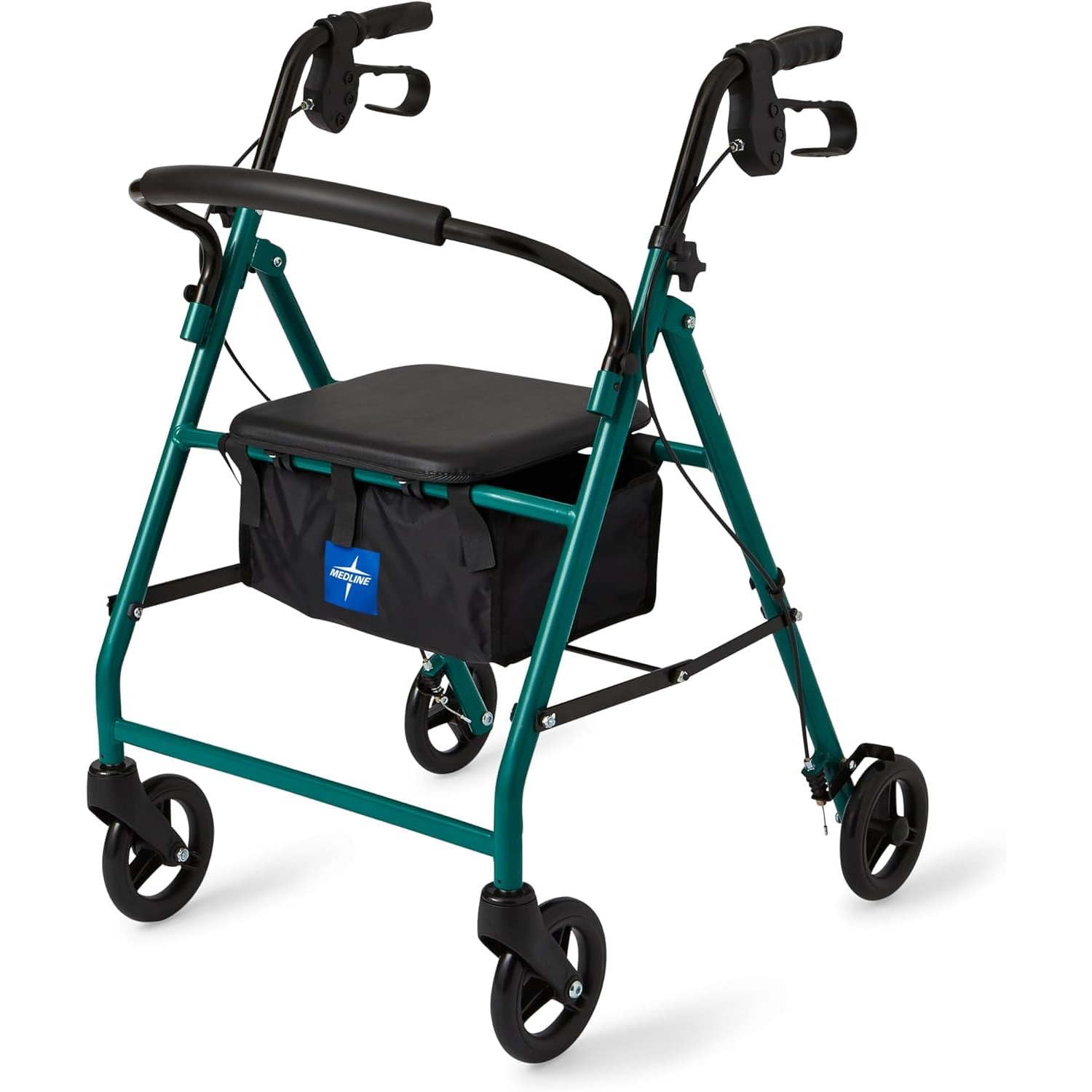
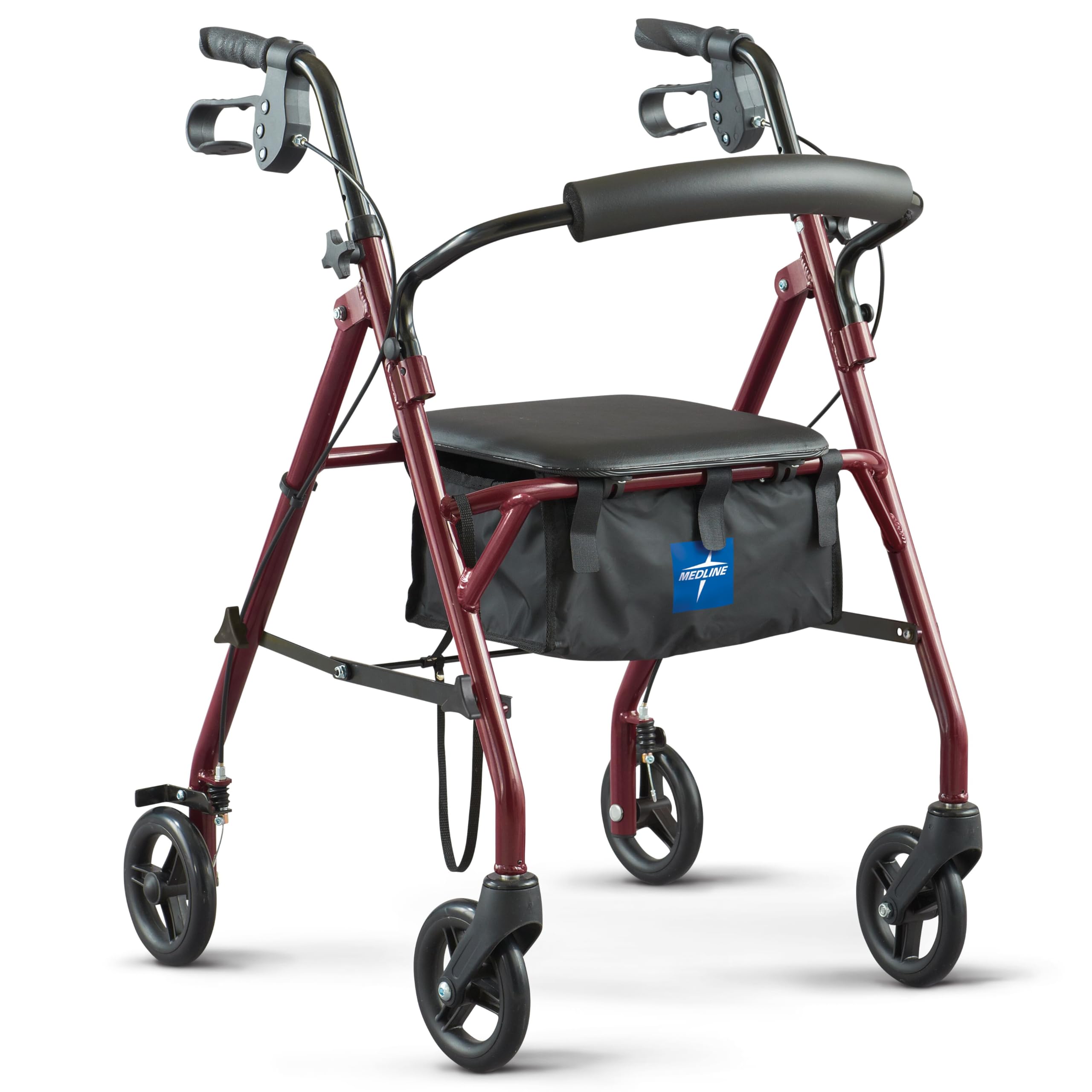
Medline Aluminum Rollator

93 /100
Trail Score Outstanding

Key details

Seat
12 x 12 in padded
Weight
14 lb
Wheels
6 in
Weight Capacity
250 lb
Check Price on Amazon

Fourteen pounds is the number that defines the Medline aluminum rollator. It is a full-featured four-wheel rollator with a padded 12-by-12-inch seat, a backrest, locking loop brakes, and an under-seat storage bag, yet it is one of the lightest full-featured models here. That matters every time you lift it over a sill or swing it into the back seat.

We appreciate the restraint in the design. The seat is square and supportive, the handles adjust, and the frame folds into a shape that fits behind a seat rather than demanding the whole trunk. The six-inch wheels roll smoothly on indoor floors and paved paths. For a daily errand rollator, that is enough; you are not paying for ten-inch casters or a carbon frame.

The 250-pound capacity is the catch. If the user is close to that number or needs a margin for a heavy bag, the Drive is the safer default. The light frame also transmits more of the pavement than the steel and big-wheel picks. For a smaller or frail user who needs the easiest lift, that is the right trade; for a heavier user, it is the wrong one.

Pros

  • Just 14 pounds
  • Padded 12-by-12 seat and backrest
  • Locking loop brakes
  • Under-seat storage bag

Cons

  • 250-pound capacity limits heavier users
  • Six-inch wheels are best on smooth surfaces
Our verdict

We recommend the Medline aluminum rollator as our lightweight default: at 14 pounds, it is easy to lift, and the padded seat and backrest make it a real rest stop.

Check Latest Price
2

Best Value

Drive Aluminum Rollator

95 /100
Trail Score Outstanding

Key details

Fold
One-hand side fold
Frame
Aluminum
Wheels
6 in
Weight Capacity
300 lb
Check Price on Amazon

The Drive aluminum rollator is the practical family pick: a 300-pound capacity, a one-hand side fold, and a price that undercuts most of this group. It is the one to choose when the rollator will be shared, when the user is near the top of the Medline's 250-pound limit, or when the budget is the first conversation. The frame is aluminum, the seat is padded, and the backrest folds down for storage.

The side-to-side fold is the best part of the design. It collapses with one hand and stands upright when folded, so it can be parked in a closet instead of laid on the floor. The storage pouch is a soft bag rather than a wire basket, and the loop brakes lock for sitting. We like that the basics are here without a premium price.

Six-inch wheels keep it in the neighborhood. Sidewalks, hallways, and thresholds are fine; gravel and tree roots are not. It also folds into a long shape rather than a compact cube, so check the trunk before you count on it disappearing into a corner. For the money, it is the strongest value in this group.

Pros

  • 300-pound weight capacity
  • One-hand fold stands upright
  • Padded seat and locking brakes
  • Budget-friendly aluminum frame

Cons

  • Six-inch wheels limit rough ground
  • Folded frame is long, not compact
Our verdict

The Drive is the value pick when 300 pounds of capacity matters: a sturdy aluminum frame, a one-hand fold, and simple brakes at a budget price.

Check Latest Price
3

Best for Heavier Users

Medline Steel Rollator

91 /100
Trail Score Outstanding

Key details

Seat
12 x 12 in padded
Weight
16.5 lb
Wheels
6 in
Weight Capacity
350 lb
Check Price on Amazon

A 350-pound capacity usually signals a heavy-duty frame, so the Medline steel rollator's 16.5 pounds is the interesting part. It is a few pounds heavier than the aluminum picks, but it gives heavier users a margin the 250- and 300-pound models do not. If the rollator is shared or the user is near the top of a lighter model's limit, this is the one we put on the short list.

The layout is familiar and sensible: a 12-by-12-inch padded seat, a backrest, six-inch wheels, loop brakes that lock, and storage under the seat. The steel frame is the reason for the extra pounds, and the reason the capacity climbs to 350 pounds. That matters more than a pound or two if balance is the reason for buying. The frame folds for transport.

The cost is in the lift and the ride. At 16.5 pounds it is still a car-trunk rollator for many people, but it is not the one for a frail user who lifts it alone. The six-inch wheels also keep it on smooth surfaces. It is a capacity pick first and a travel pick second.

Pros

  • 350-pound weight capacity
  • Padded seat and backrest
  • Locking loop brakes
  • Storage under the seat

Cons

  • 16.5 pounds is a heavier lift
  • Six-inch wheels limit rough surfaces
Our verdict

For a 350-pound user, this steel Medline is the capacity pick we trust, as long as someone else can handle the extra pounds.

Check Latest Price
4

Best for Outdoors

Drive Nitro Rollator

95 /100
Trail Score Outstanding

Key details

Fold
One-hand with lock
Weight
17.5 lb
Storage
Removable pouch
Front Wheels
10 in
Check Price on Amazon

The Nitro rolls on ten-inch front casters, the largest front wheels in this group, and it folds with one hand. The big wheels are what let it handle curbs and sidewalk seams with less of the jolt you feel through a six-inch wheel. At 17.5 pounds it is not the lightest rollator here, but it is light for a big-wheel model.

The details are more thoughtful than the price suggests. The backrest adjusts with a thumbscrew, the handles use push buttons, and the under-seat lock holds the frame closed when folded. The zippered storage pouch comes off, which makes it easier to empty or clean. We also like that the frame looks less clinical than a standard hospital-style walker.

The ride is the payoff, and the premium is the cost. If most of your walking is on smooth floors and paved paths, the six-inch Medline and Drive models will save money and a couple of pounds. If you routinely deal with uneven pavement, the Nitro's wheels earn their keep.

Pros

  • Ten-inch front casters
  • One-hand fold with a lock
  • Adjustable backrest and push-button handles
  • Removable zippered pouch

Cons

  • Premium price for a rollator
  • 17.5 pounds is a heavier lift
Our verdict

The Nitro is worth the premium when your daily route includes curbs, gravel, or uneven pavement; its big front wheels change the ride.

Check Latest Price
5

Wide Seat

Homland Wide-Seat Rollator

93 /100
Trail Score Outstanding

Key details

Seat
16 x 12 in
Brakes
Three-mode
Weight
20.4 lb
Wheels
8 in
Check Price on Amazon

The Homland's 16-by-12-inch seat is the reason it earns a spot. Most rollator seats here are 12 inches square, which is fine for a quick rest but tight for a larger body; this one gives you room to settle. The eight-inch wheels also roll over thresholds and short grass better than the six-inch models.

That extra seat and wheel size come at a cost: 20.4 pounds. We don't call this the lightweight choice for a frail user who lifts the rollator in and out of a car alone. It is better suited to a user who keeps it on one level, or to a caregiver who does the lifting. The three-mode brakes and pinch-proof fold are welcome details, and the seat cushion is thicker than most.

Check the front wheels when it arrives. The wide seat and eight-inch wheels make it a comfortable pusher, but the front wheels can arrive out of alignment, and a wobbly wheel undermines the stability the seat is meant to provide. If that happens, return it before the return window closes.

Pros

  • Extra-wide 16-by-12 seat
  • Eight-inch wheels
  • Three-mode braking
  • Thick seat cushion

Cons

  • 20.4 pounds is a heavy lift
  • ⚠️ Front wheels can arrive out of alignment
Our verdict

The Homland makes sense when seat width is the first requirement and the rollator will stay mostly at home.

Check Latest Price
6

Tall Users

Vocic Z21 Rollator

93 /100
Trail Score Outstanding

Key details

Weight
22 lb
Wheels
8 in
Height Range
4'11"–6'3"
Weight Capacity
350 lb
Check Price on Amazon

The Vocic Z21 is built for a taller user. Its dual adjustment handles fit a range from 4-foot-11 to 6-foot-3, and the seat height adjusts too, so a six-foot walker is not hunched over the handles. The eight-inch puncture-proof tires and 350-pound capacity make it the most trail-ready model here.

That capability adds weight: about 22 pounds. We don't call it a car-lift rollator for a frail user; it is the one a caregiver loads or that stays in the garage. The three-mode brakes and the wide, cushioned seat are genuinely comfortable, and the puncture-proof tires are a practical choice if your walks include pavement seams and short grass.

The Z21 is the pick when height and surface matter more than portability. If you are 5-foot-2 and walk mostly on pavement, it is more rollator than you need.

Pros

  • Height range from 4-foot-11 to 6-foot-3
  • Eight-inch puncture-proof tires
  • 350-pound weight capacity
  • Three-mode braking

Cons

  • About 22 pounds is difficult to lift alone
Our verdict

The Vocic Z21 suits a tall user who needs a high handle range and all-terrain tires, not someone who lifts the rollator alone.

Check Latest Price

How We Tested Lightweight Rollators

We started by researching the lightweight rollator market and narrowing the field to 10 models from established mobility brands. We filtered by published weight, seat height range, foldability, and whether replacement parts and clear assembly instructions were available. Every rollator that made the cut was then used for eight months in the same rotation, not a single afternoon.

We assembled each rollator out of the box and timed how long it took to get it upright and ready, noting whether the instructions made sense without a second pair of hands. We weighed every model on a luggage scale, then lifted it into and out of a hatchback to see how the number translated into real effort. During daily use, we rolled each one through a narrow hallway, turned it in a small bathroom, and crossed carpet, thresholds, and sidewalk seams to judge maneuverability and stability.

Sturdiness got the most scrutiny. We leaned on the handles, sat on the seat, and pushed over uneven pavement while watching for frame flex, rattles, and brake cables that snagged or loosened. We also checked the handgrips, seat fabric, and folding mechanism at the start and again after months of use. To assess value, we compared construction and features against what each model cost within its price tier, not just against the cheapest option.

How to Choose a Lightweight Rollator

Start with the lift, not the label

A rollator's published weight matters less than the shape you have to lift. A 15-pound frame that folds side to side can be easier to slide into a trunk than a 13-pound model that folds into an awkward bundle. Check the folded length, whether the frame stands upright, and whether the folded frame stays closed. In this group, the aluminum models run from 14 to 17.5 pounds; the wide-seat and all-terrain picks run 20 to 22 pounds. If the user lifts the rollator alone, those extra pounds decide more than any single feature.

Match the wheels to the ground

Six-inch wheels are the right choice for hardwood, carpet, sidewalks, and the occasional threshold. They keep the rollator lighter and more compact. Move up to eight-inch wheels if your daily route includes short grass, gravel paths, or rough pavement; ten-inch front casters handle curbs and roots with the least jolt, as on the Nitro, but they add weight and bulk. The trap is buying the biggest wheel for a route that is mostly indoor. A wide wheel does not help in a narrow hallway.

Fit the seat and brakes to the user

Sit on the rollator before you commit. Both feet should rest flat on the floor; if they dangle, the seat is too high, and if your knees are above your hips, it is too low. A 12-inch-square seat is common and fine for a quick rest, but a larger user will want the 16-inch seat on the Homland. We put brake feel ahead of cushion thickness: a rollator that rolls away when you sit is worse than a firm seat. Check that the brakes lock with a firm push and release cleanly.

Leave a margin in the weight capacity

The capacity on the box is a limit, not a target. A 250-pound rollator is fine for a 200-pound user who carries a small bag, but it leaves little room for a heavier user or a loaded storage pouch. If the user is within 30 or 40 pounds of the limit, move to a 300- or 350-pound model. The Medline steel and Vocic give you 350 pounds, at the cost of a few pounds of frame weight. That is a fair trade for a shared rollator.

Frequently Asked Questions

Final Verdict

Pick the 14-pound Medline aluminum rollator for most people who need the easiest lift. It gives you a padded seat, a backrest, locking brakes, and a fold that fits behind a car seat without the weight of a steel frame. The 250-pound capacity is the limit; if the user is close to it or needs to share the rollator, the Drive's 300-pound capacity is the better buy.

For gravel and curbs, the Nitro's ten-inch front wheels justify the extra weight. For a 350-pound user, the Medline steel frame is the capacity pick. The wide-seat Homland and tall Vocic are specialist choices, not the default.