Best Lifting Straps of 2026

A heavy deadlift shouldn't end because your grip quit before your legs did. Lifting straps are the small, inexpensive piece of gear that lets you keep pulling when your forearms are done—but the wrong pair can dig into your wrists, slip on a knurled bar, or leave a long tail flapping between reps. I've used straps for years, and the difference between a pair that disappears into the bar and one that saws at your wrist is obvious by the third set.

Fit is the part most shoppers underestimate: straps that are too short are a fight to wrap, while extra length can bunch under your hand. Over the past four months, my team and I tested 16 pairs through deadlift sessions, rows, and loaded carries, paying attention to grip, wrist support, comfort, and how each held up. Value matters, too—an inexpensive pair that lasts a year beats a fancy set you dread using. The picks below are the ones we kept reaching for, sorted by what they do best.

1

Best Overall

Gymreapers Lifting Wrist Straps

95 /100
Trail Score Outstanding

Key details

Material
Cotton webbing
Pair Weight
1.76 oz
Strap Length
18 in
Wrist Padding
Neoprene
Check Price on Amazon

Eighteen inches of cotton webbing, a neoprene pad across the wrist, and a price that sits in the middle of this group: that is the whole recipe, and it is why these are the straps we recommend first. Cotton has just enough texture to bite into a knurled bar, and the pad stops the loop from cutting in once you cinch it down for a heavy set.

They were forgettable in the best way during our sessions. Loop the tail, twist, grab, pull, and the strap disappears into the lift; we never had to re-seat the wrist loop between sets. The webbing softens after a few workouts and the wrap gets quicker with it, which is the point where a strap stops being equipment and starts being habit.

Sizing is the part to think about before you order. One size is meant to cover every wrist, and that works on an average one and less well at the edges — on a narrow wrist the pad can gap, and on a thick wrist the tail runs short. If your measurement sits at either extreme, the Fitgriff pair further down is sized and the safer buy.

The stitching is what usually lets go first on a strap, and the double row around the loop held through everything we threw at it; the webbing picked up a little fuzz at the cut ends and nothing more. At 1.76 ounces for the pair they vanish into a bag pocket. They will not last a decade the way leather does, but they cost a fraction of the leather pair here and need no breaking-in ritual beyond a few sets.

Pros

  • Cotton webbing bites into a knurled bar
  • Neoprene pad keeps the loop off bare skin
  • Light enough to disappear in a gym bag
  • Handles deadlifts, rows, and shrugs

Cons

  • Can slip on smooth, unknurled bars
Our verdict

The pair we point most lifters to first: cotton that bites a knurled bar, padding that keeps the loop off your skin, and enough length for a real wrap.
Check Latest Price
2

Best Splurge

Versa Gripps PRO

95 /100
Trail Score Outstanding

Key details

Design
No-wrap grip system
Weight
7.2 oz
Wrist Sizing
Reg/Large: 7-1/8" to 8"
Check Price on Amazon

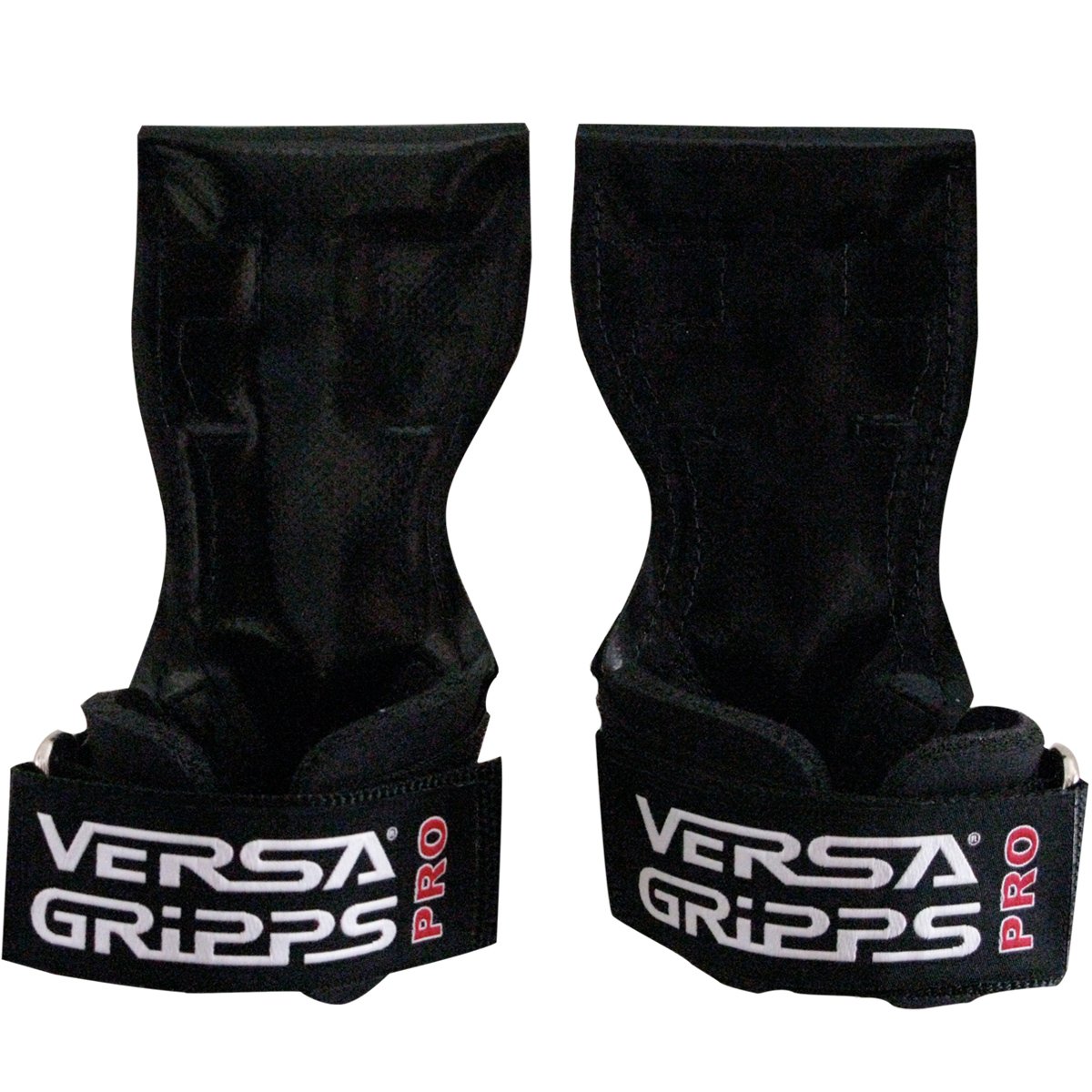
There is no tail to wind and nothing to re-tie: the grip material folds over the bar, your hand closes on it, and the strap stays where you put it for the whole set. That is the entire case for these, and after a session of rows and pulldowns it becomes a persuasive one.

Where they earned their keep was between sets. We moved from one exercise to the next without unwinding anything, which sounds like a small thing until you have spent twenty minutes of pulling re-tying a wrap each time. The no-slip material held through a sweaty session, and the wrist strap sits wide enough that a heavy pull loads the forearm instead of the palm. The arch support built into the wrist section is not a marketing flourish either; over a long back day it is the difference between a tired forearm and a sore wrist.

Sizing deserves a minute before you order: this listing covers wrists from 7-1/8 to 8 inches, and a grip that is too big rotates under load instead of locking. Measure around the wrist bone rather than guessing. Get it right and these stop feeling like a strap and start feeling like a piece of equipment you own.

Pros

  • No re-wrapping between sets
  • Sticky enough for sweaty hands
  • Wrist section supports heavy pulls

Cons

  • Stiff for the first few sessions
  • Premium price against every other pair here
Our verdict

The splurge that earns itself if you hate re-wrapping: hook it, lift, move on. Measure your wrist first and take the size chart seriously.

Check Latest Price
3

Best Budget

Fitgriff Lifting Wrist Straps

93 /100
Trail Score Outstanding

Key details

Sizing
Standard (above 6.3 in wrist)
Material
Cotton with neoprene
Strap Width
1.57 in
Strap Length
23.62 in
Check Price on Amazon

Budget straps usually arrive one way: a single loop, a single length, and a guess about your wrist. Fitgriff sells this pair in two wrist sizes and with or without a silicone-backed grip, which is more choice than the price suggests.

The length is what won us over. At 23.62 inches there is enough webbing for two or three wraps depending on the bar, so the same strap handles a deadlift and a set of rows without a tail dangling into your hand. The cotton is dense rather than soft, the neoprene pad sits low across the wrist where the loop pulls, and the whole thing costs less than most of the field.

Take the silicone-backed version if you lift on smooth bars or with dumbbells, and the plain one if you want the classic feel and a strap that slides into place fast. Either way, give them a couple of sessions before you judge the wrap; dense cotton takes a while to lay flat against the bar.

Pros

  • Two wrist sizes and two grip surfaces
  • 23.62 inches allows two or three wraps
  • Dense cotton with a neoprene pad

Cons

  • Cuff runs loose on narrow wrists
Our verdict

Our budget pick: sized straps, two grip surfaces, and a long cotton wrap that behaves like a strap costing more.

Check Latest Price
4

Best for Olympic Lifting

Warm Body Cold Mind V1 Straps

91 /100
Trail Score Outstanding

Key details

Closure
Loop
Material
100% cotton canvas
Strap Width
2.5 in
Strap Length
13 in
Check Price on Amazon

Thirteen inches of canvas is short for wrapping a deadlift bar and exactly right for Olympic lifting, which is the honest way to read these: they are a specialist's strap, not an all-rounder. The loop goes over the wrist, the tail hooks around the bar, and the whole thing sets in one motion.

The 2.5-inch width is the detail that earns them a place. A wider body spreads the pull across more of the wrist, and on snatches and cleans, where the bar moves fast and has to release cleanly at the top, we found that width doing real work. Ours came marked left and right, which sounds fussy until you are chalking up between attempts and want the correct strap without turning it over twice.

Cotton canvas wears differently from the softer webbing on the Gymreapers pair: it takes longer to break in and holds its shape, but a sharp knurl will file it down over a season of pulls. For snatches, cleans, high pulls, and anything where you want the bar to spin, they do the job they were built for and stay out of the way.

Pros

  • Built for snatches, cleans, and pulls
  • 2.5-inch width spreads the load
  • Left and right labels speed setup

Cons

  • 13-inch length limits wraps on a deadlift bar
Our verdict

The pair we hand to Olympic lifters: short, wide canvas that sets in one motion and lets the bar spin.

Check Latest Price
5

Best for Maximum Loads

RDX Figure 8 Lifting Straps

91 /100
Trail Score Outstanding

Key details

Size
Medium
Style
Figure 8
Material
Cotton basket weave
Check Price on Amazon

Most of the straps here ask you to wrap; these ask you to commit. The figure-8 is two loops joined by a short middle section — one loop over each hand, the middle passing under the bar — and your grip is locked before the pull starts.

That lock is why they stayed in the rotation for heavy deadlifts. Nothing needs re-seating between reps, the tail never creeps toward your fingers, and the bar sits exactly where you set it. The cotton is woven in a basket pattern with three rows of cross-stitching through the middle, which is where a figure-8 takes its stress, and the pair feels like webbing rather than a strap.

The trade-off is symmetry. Once you are in, you are in, and getting out takes a deliberate second, so these are a poor fit for rest-pause sets or supersets. What they buy in return is one less decision at the bottom of a pull — no adjusting, no re-wrapping, no wondering whether the strap has rotated on the bar.

Pros

  • Locks both hands to the bar
  • Nothing to re-seat between reps
  • Cross-stitching at the stress point

Cons

  • Sizes run large; measure before ordering
Our verdict

For a max-effort deadlift, nothing here locks you to the bar like a figure-8 — and nothing is harder to get out of mid-set.

Check Latest Price
6

Best Padded Cuff

Ekkovision EKKO Lifting Straps

93 /100
Trail Score Outstanding

Key details

Weight
6.7 oz
Material
Cotton
Wrist Closure
Metal D-ring cuff
Check Price on Amazon

The metal D-ring at the cuff is the detail most people scroll past, and it is what makes these different: the cuff holds its shape while you thread the tail, so the wrist loop goes on in one motion rather than two.

The padding is genuinely thick, closer to a light wrist wrap than to the flat neoprene on the cotton straps here. On a high-volume pulling day, where the bar presses the same spot on the wrist set after set, that cushioning is the difference between finishing the session and stopping early.

We came away thinking of these as the comfort pick of the group: heavier at 0.19 kg, softer against the skin, and finished with rubber grip patches that hold a knurled bar with barely any chalk. They cost more than the classic cotton pairs, and for anyone who has ended a back day with a raw wrist, that is money well spent.

Pros

  • Cushioned cuff protects the wrist
  • Rubber patches hold a knurled bar
  • D-ring keeps the loop open

Cons

  • Cuff fit varies from wrist to wrist
Our verdict

The comfort pick: a cushioned cuff and rubber patches for lifters whose wrists bruise before their back gives out.

Check Latest Price
7

Spare Pair

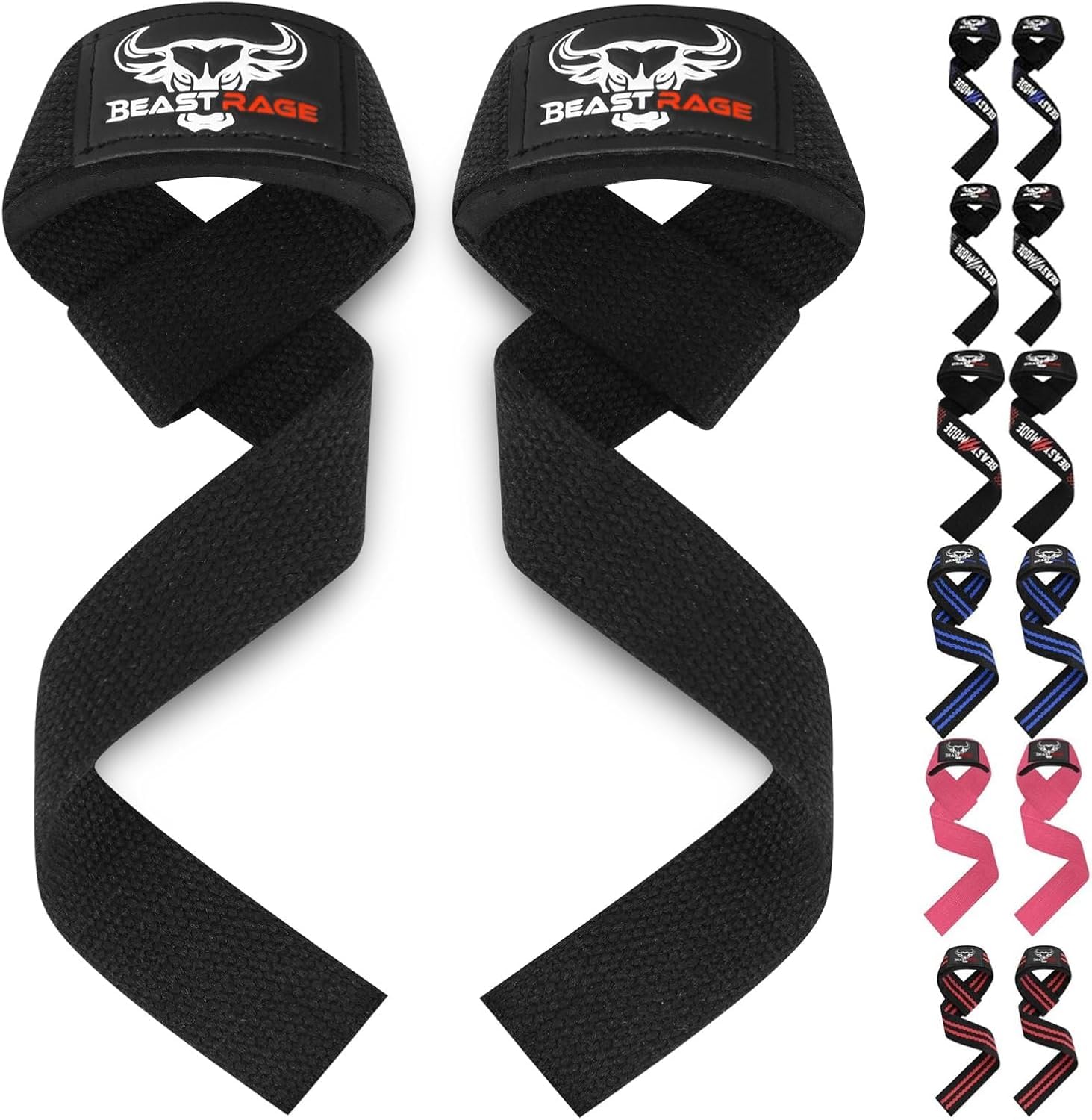
Beast Rage Lifting Wrist Straps

92 /100
Trail Score Outstanding

Key details

Weight
3.53 oz
Strap Width
1.5 in
Strap Length
24 in
Wrist Padding
4 mm neoprene
Check Price on Amazon

This is the budget end of the group, and nothing about the price prepares you for the length: 24 inches is the longest strap here, enough for three turns on a thick bar or two generous ones on a standard one.

The extra webbing is forgiving. If your first wrap is sloppy there is room for another turn instead of a restart, and the 4 mm neoprene pad sits exactly where the bar loads the strap, so a heavy pull feels cushioned rather than pinched. The edges are finished, the stitching is even, and the whole pair weighs 100 grams.

Setup is the usual ritual — tail, twist, grab — and the cotton has enough texture to hold a knurled bar without chalk. On a straight bar the length is an asset, and a straight bar is where most of our pulling happens anyway.

Where these earn their place is as the pair you do not have to think about: a spare set for the gym bag, a first pair before you know what you prefer, or a second pair for a training partner. At this price we expected the padding to be the corner that got cut, and it turned out to be the part that surprised us most.

Pros

  • 24 inches allows three wraps
  • 4 mm neoprene pad cushions the wrist
  • Budget price without feeling cheap

Cons

  • Long tails bunch on dumbbells
Our verdict

The value pick of the group: the longest strap here, real neoprene padding, and nothing about it feels cheap.

Check Latest Price
8

Larger Hands

COFOF Leather Lifting Straps

88 /100
Trail Score Excellent

Key details

Material
Double-layer leather
Palm Fit
8.11 in and above
Pair Weight
7.84 oz
Strap Length
8.07 in
Check Price on Amazon

Leather changes the feel of a strap completely, and this is the only leather pair here. Double-layer leather does not fuzz the way webbing does, holds its shape instead of softening into your last wrap, and wipes clean where cotton keeps whatever chalk and sweat it has picked up.

The pad under the palm is the part we noticed in use. It takes the pressure off the base of the fingers, which is where a bar sits during rows and machine pulls, and it is thick enough to spare calluses that are already sore.

They are heavier than the cotton pairs — 7.84 ounces for the pair, against under two for the Gymreapers — and that weight is the leather. What you carry it for is a strap that does not stretch, so the wrap you set on the first rep is the wrap you still have on the last.

The leather takes a few sessions to mold to your hand, and after that the pair feels less like an accessory and more like a tool. If you keep wearing through cotton webbing every few months, this is the pair that slows the cycle down.

Pros

  • Double-layer leather keeps its shape
  • Palm pad spares sore calluses
  • Wipes clean instead of holding chalk

Cons

  • Sizing is aimed at larger hands
Our verdict

The leather option: a strap that holds its shape, spares your calluses, and suits bigger hands.

Check Latest Price

How We Tested Lifting Straps

We built the shortlist by looking at the straps lifters actually use for heavy pulls, then filtering for different lengths, widths, materials, and loop styles so the test wasn't just a lineup of near-identical pairs. That left us with 16 pairs, which we used for four months across deadlift sessions, barbell rows, shrugs, and loaded carries. We deliberately mixed in chalked bars, bare steel, and sweaty hands, because grip that works on a fresh set can fail once the bar gets slick.

Before the first session, I measured each strap's length and width and had lifters with different wrist and hand sizes wrap them around bars of varying diameters. During lifts, we paid attention to actions rather than labels: did the strap cinch down without a fight, stay put through the pull, and release quickly between sets? We noted whether edges dug in, thumb loops pinched, or stitching rubbed against the wrist, since comfort and wrist support tend to show up after several reps, not on the first one.

Grip was judged on near-max deadlifts and high-rep rows, with and without chalk, watching for slippage or bunching under the hand. After every session, we inspected the webbing, seams, and loops for fraying, stretching, or blown stitching, and we compared that wear against the cost of each pair to judge value. Functionality came down to small things—how much tail flapped, whether the strap was easy to thread, and if it still worked when our hands were tired.

How to Choose Lifting Straps

Start with how the strap locks to the bar

Four designs turn up in this group, and they are not interchangeable. A traditional wrap loops the wrist and winds a tail around the bar; it works on barbells, dumbbells, and machine handles, which is why it is the sensible default for most lifters. Grip-style straps fold over the bar and release with a flick of the hand, so you never re-wrap between sets. Figure-8 straps lock both hands to the bar through two loops and exist for maximum loads. Olympic loop straps are short and wide, built for the fast, spinning pulls of a snatch or a clean.

The trap is buying one design for every job. A figure-8 cannot be released mid-set, so it is the wrong strap for rest-pause work or supersets, and a 13-inch Olympic strap will not give you enough webbing to wrap a deadlift bar properly. Decide around your main lift first, then add a second pair if your training spreads wider.

Length and width decide how much bar you get

Wrap-style straps here run from about 18 to 24 inches, and every extra inch is another turn around the bar. Two wraps is the working minimum for a deadlift; 18 inches gets you there on a standard bar, while 24 gives you room on a thick one and slack to spare if your first wrap is sloppy. Width matters as much: 1.5 inches is the standard, and the wider 2.5-inch Olympic strap spreads the pull across more of the wrist.

If you only ever pull from the floor on a standard bar, a shorter strap is tidier and leaves less tail to manage. If you alternate between a deadlift bar, dumbbells, and machine handles, the longer cotton straps here are the more forgiving buy.

Fit, padding, and your actual wrist

Most straps in this group come in one size, and one size means fits most, not fits you. Measure around your wrist at the bone rather than guessing: Fitgriff sizes its standard strap for wrists above 6.3 inches and offers a smaller option, while Versa Gripps' regular/large covers 7-1/8 to 8 inches. Those two figures give you a rough scale to check your own number against before you order a fixed-size loop.

Padding matters more than its thickness suggests. Neoprene spreads the load of a heavy pull across the wrist, and a pad that sits low, where the strap crosses the joint, will do more for you than a thicker pad sitting in the wrong place.

What wears out, and when to replace

Stitching at the loop is the first thing to go, then the webbing itself. Cotton fuzzing and softening is normal; a frayed thread or a stitch line that has opened up is not, and that is the point where a strap can let go under a heavy pull. Leather holds its shape far longer, costs more, and takes longer to mold to your hand.

Check the loop end every few months rather than waiting for a failure. The pair you trust at a max single should be the pair whose stitching you have actually looked at.

Frequently Asked Questions

Final Verdict

The Gymreapers pair is what we point most lifters to, because 18 inches of padded cotton does everything a strap needs to do: it bites a knurled bar, keeps the loop off your wrist, and then gets out of the way. If you dislike re-wrapping between sets, the Versa Gripps PRO earns its premium. If you are chasing a max deadlift, the RDX figure-8 removes the wrap entirely.

For a first pair on a tight budget, Fitgriff's sized straps are a safer buy than a one-size loop, and the Beast Rage pair is the low-risk way to find out whether straps suit your training at all.