Best Heavy Bag Stands of 2026

A heavy bag hung from a ceiling joist is still the gold standard — right up until you rent, or the ceiling is finished, or the one joist in the room runs the wrong direction. That's what a stand buys you: a real bag workout in a garage, a spare bedroom, or a basement corner with nothing overhead worth trusting. The tradeoff is that a stand holds the bag out on a lever, so every bit of force you throw comes back into the frame instead of into the house.

Over the past six months my team assembled and hit on eight different stands, from plain single-post frames to four-legged cages, and the gaps between them show up fast. My first stand crept two inches across the garage floor during a single round of kicks. The number printed biggest on the box, max bag weight, matters less than whether the frame stays put at half that load — and the picks below each earned their spot for a different reason.

1

Best Overall

Century Heavy Bag Stand

89 /100
Trail Score Excellent

Key details

Frame
3-inch tubular steel
Footprint
48 x 48 inches
Hang Height
84.25 inches
Weight Limit
100 lb
Check Price on Amazon

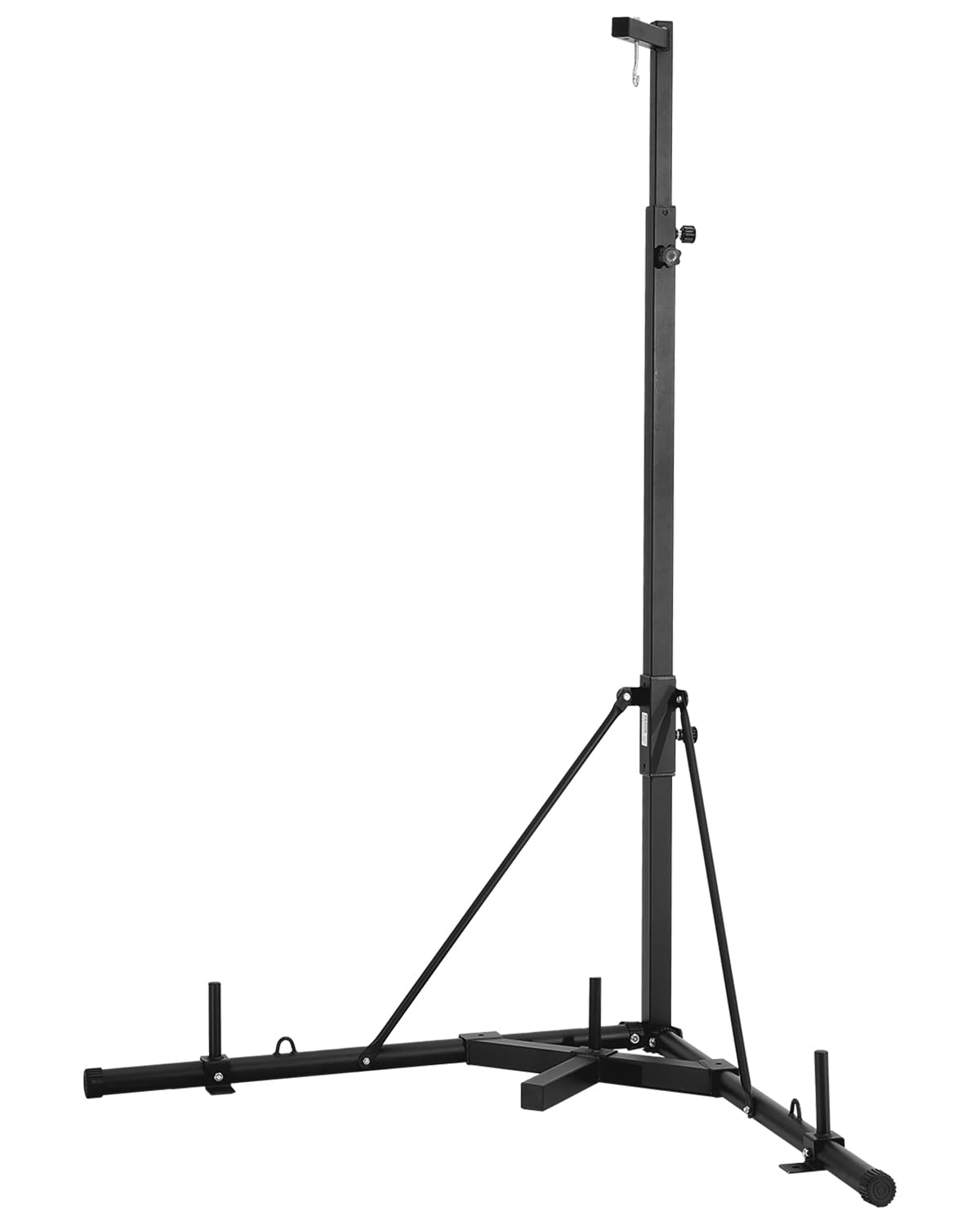
A 3-inch main tube is a lot of steel for a home stand. What that buys you is rigidity: grab the upright and shove it and the frame barely answers, where the lighter stands in this group flex and rattle under the same hand. Add three weight-plate pegs and a 100-pound bag rating and you have the frame we trust with a full-size bag.

That rigidity is why it's our top pick. Assembly is one of the friendlier jobs in this category, with parts labeled, holes lined up, and one person able to stand it upright without help. The one wrinkle is the hardware: the bolts can bottom out before the joints feel truly snug, so an empty frame rattles a little when you shake it. Load the pegs and that goes away.

Height is where you have to do a little arithmetic. At 84.25 inches the hook clears most bags, but subtract a 48-inch bag and a short chain and the bottom of the bag sits about 30 inches off the floor, which is fine for punching and low for knees and kicks. There's no height adjustment on this one, so measure your own bag before you commit.

The square base tucks into a corner better than the deeper frames here, which matters in a garage that still has to hold a car, and the powder-coated finish shrugs off scuffed gloves and leaning bags. Plan the route in before you build it, though, because the assembled base is the widest thing in this group.

Pros

  • 3-inch tubular steel frame
  • Three weight-plate pegs
  • Rated for 100-pound bags
  • One person can assemble it

Cons

  • Base is wider than a standard interior doorway
  • Bag and weight plates sold separately
Our verdict

Our top pick: a 3-inch tube, three weight pegs, and a 100-pound rating make it the stand we trust with a full-size bag in a corner.
Check Latest Price
2

Best Height-Adjustable

VEVOR Punching Bag Stand

86 /100
Trail Score Excellent

Key details

Stand Weight
37.9 lb
Weight Limit
140 lb
Width X Height
46.5 x 91 inches
Height Adjustment
180–232 cm
Check Price on Amazon

If your household spans a thirteen-year-old and a six-foot adult, the VEVOR solves what the fixed stands can't: the hook moves from 180 to 232 centimeters, roughly six feet to seven and a half. That's the widest range here, and it's the reason this is the stand we reach for when one frame has to serve more than one person or more than one bag size.

It also carries the highest bag rating in this group at 140 pounds, which is the number that matters if you already own a heavy bag and don't want to replace it. The catch is the frame. At 37.9 pounds it's the lightest stand here, so the pegs aren't optional: load three plates before you throw anything at full power and it settles down; leave them off and the base walks when you open up.

The 90-degree corner base is a genuinely useful shape, sitting flush into a garage corner instead of pushing four square feet into the middle of the room, and there's a hook on the frame for resistance bands. Assembly is the weak spot, with the hardware and tools all present but instructions that assume you've built one before. At the top of its height range it's also a tall object for a low basement, so measure the ceiling before you buy.

Pros

  • Widest height range here, 180–232 cm
  • 140-pound capacity, the highest in this group
  • Corner-shaped base saves floor space
  • Band hook built into the frame

Cons

  • Lightest frame here at 37.9 pounds
  • Suction feet need a hard, smooth floor
Our verdict

Buy this one if two people of different heights share the bag: the hook spans six to seven and a half feet and it carries 140 pounds.

Check Latest Price
3

Best Foldable

VIVOHOME Foldable Bag Stand

80 /100
Trail Score Excellent

Key details

Warranty
1 year
Stand Weight
38.9 lb
Weight Limit
132 lb
Height Adjustment
72–90.6 inches
Check Price on Amazon

Folding is the entire argument for this stand. If the bag lives in a spare room or a living-room corner, being able to collapse the frame against the wall between sessions is the difference between owning a heavy bag and using one. The triangular base and the powder-coated steel mean it isn't a flimsy thing once it's standing, either.

Height runs from 72 to 90.6 inches, which covers a kid's bag and an adult's in the same frame, and VIVOHOME backs it with a one-year warranty, longer than the 30-day coverage on the Fuel. Capacity is 132 pounds, so it will take a filled heavy bag with a little room to spare.

Rigidity is where it gives ground. The folding joints are the part to watch: they work loose and want re-tightening, and the frame has more give in it than the Century when the bag swings back into the upright. The short top arm also keeps the bag close to the frame, so hang it and check that gap before you plan on throwing kicks. For a first bag, a rented apartment, or a room that has to go back to being a room, that's a trade worth making. For a 100-pound bag and hard hooks, it isn't.

Assembly is quick by the standards of this group, with a low parts count that makes a solo build realistic, though the instruction sheet leaves a step or two to guesswork. Plan on going back over the fasteners after the first week rather than trusting the first pass.

Pros

  • Folds away between sessions
  • Adjusts from 72 to 90.6 inches
  • One-year warranty, the longest stated here
  • 132-pound capacity

Cons

  • Short top arm keeps the bag close to the frame
  • Folding joints loosen and need re-tightening
Our verdict

We recommend it when the stand has to disappear between workouts, since it folds flat and adjusts from 72 to 90.6 inches.

Check Latest Price
4

Fixed Garage Gym

Fuel Pureformance Bag Stand

88 /100
Trail Score Excellent

Key details

Plate Pegs
Standard 1-inch plates
Stand Weight
54.4 lb
Weight Limit
100 lb
Assembled Dimensions
55.91 x 47.24 x 87.01 inches
Check Price on Amazon

The Fuel is the heaviest frame here at 54.4 pounds, and that weight is the pitch: more steel low down means less of the walk-and-shudder you get from a light stand when you open up on the bag. It's rated for 100 pounds and carries three integrated plate pegs, sized for standard 1-inch plates rather than the Olympic set a lot of home gyms already own, so check the hole size on what's in your garage before you order.

That plate detail is the one thing that keeps it out of the top tiers for us, because it turns a stand into a stand plus a set of weights. The frame itself is straightforward, finished in a scratch-resistant powder coat, and it takes up more floor than the others: the assembled length runs to almost 56 inches against the Century's 48.

Assembly is the mixed part. The hardware is all there and the frame goes together with hand tools, but the bolts want coaxing before everything seats, so leave more time than the sheet suggests and don't torque anything down until the whole frame is standing.

At 87 inches the hang point sits a couple of inches above the Century's, which lifts the bottom of the bag slightly for taller users. In a garage or basement where the stand stays put and the plates are already on the shelf, that's a sensible combination.

Pros

  • Heaviest frame here at 54.4 pounds
  • 100-pound bag rating
  • Three integrated plate pegs
  • Scratch-resistant powder-coated steel

Cons

  • 30-day warranty is short for a striking frame
  • Deeper footprint than the other stands here
Our verdict

A solid 100-pound stand with the most steel in this group; buy it if you already own standard 1-inch plates and want a heavier frame in a fixed spot.

Check Latest Price

How We Tested Heavy Bag Stands

We started with roughly thirty stands sold by big-box sporting goods chains and specialty boxing suppliers, then cut anything with a footprint too wide for a single-car garage, a stated bag capacity under 100 pounds, or mounting hardware that only accepted one brand of bag. Eight made the cut.

Each one lived in a real room for six months rather than a showroom: a bare concrete garage floor, a carpeted spare bedroom with a low ceiling, and a basement slab with a slight slope. I put every stand together alone, using only the tools that came in the box, and timed it. Then I hung a 70-pound bag, worked my way up to each stand's stated limit, and threw three-minute rounds of jabs, crosses, and low kicks.

What I watched for: whether the base lifted or walked (I taped the feet to the floor and checked the marks after every session), whether the bag clipped the uprights on a hard cross, and whether bolt holes lined up without a rubber mallet. Around week eight I went back over every weld and powder-coated joint looking for cracks, rust, or a frame that had started to lean.

I also weighed each frame and dragged it across the room by myself, since a stand you can't shift is one you stop using, and I set the asking price against the gauge of the steel and the hardware in the box.

How to Choose a Heavy Bag Stand

Match the rating to the bag you actually own

Treat the weight rating as a ceiling rather than a target. A 100-pound rating covers a 100-pound bag plus the chain and hardware hanging from the same hook, and a bag filled to the top of its own limit leaves no margin. Our picks run from 100 pounds on the Century and the Fuel to 132 on the VIVOHOME and 140 on the VEVOR, so a 70-pound bag sits comfortably on any of them while a 100-pound bag is already at the limit of two. If you own the bag first, shop by its filled weight.

Judge height by where the bottom of the bag lands

Frame height on its own tells you nothing useful. Subtract the chain and the bag from the hang point: an 84-inch stand with a 48-inch bag and a 6-inch chain leaves the bottom of the bag about 30 inches off the floor, which is thigh height on most adults and fine for punching but low for knees and kicks. Run that subtraction against your own shin before you buy.

If one frame has to serve a tall adult and a child, adjustability covers ranges a fixed frame can't: 72 to 90.6 inches on the VIVOHOME, 180 to 232 centimeters on the VEVOR.

Measure the room, the door, and the ceiling

The base is the number that catches people out. A 48-inch square footprint won't pass a standard interior door once the stand is built, so decide where it lives before assembly day, and reserve floor space in front of the bag for footwork instead of tucking the frame into a corner and hoping. Overhead, you need clearance to lift a bag onto the hook, which means a stand between 84 and 91 inches tall wants a full eight feet.

If the room has to go back to being a room, a folding frame is the only type here that stows, and its joints are the part that pays for it.

Plan for the plates

Every stand here depends on added weight to feel planted, and none of them comes with plates. Three pegs give you more anchor points than one, but check the peg diameter against your plates before you count on them: a peg sized for 1-inch holes won't take an Olympic plate. Sandbags work where pegs don't. On smooth concrete, suction feet add grip; on carpet or a rubber mat, only the plates will.

Frequently Asked Questions

Final Verdict

For most people the Century is the stand to buy: a 3-inch frame, three weight pegs, and a 100-pound rating in a footprint that fits a corner, with no adjustment to complicate it. Do the bag-bottom arithmetic first, because the height is fixed.

If the frame has to serve a six-foot adult and a teenager, the VEVOR's 180-to-232-centimeter range and 140-pound rating earn the extra setup fuss. If it has to fold away between sessions, the VIVOHOME is the only stand here that will.