Best Yoga Straps of 2026

A yoga strap looks like the simplest thing in your prop bag — until the buckle slips halfway through a hamstring stretch, or the webbing gives just enough to make you wonder why you bothered. The right strap extends your reach so you can hold a stretch long enough for it to actually do something, whether you're inching toward your toes or working on a bind in triangle pose. A good one stays put, adjusts without a fight, and feels the same in month six as it did on day one.

I've spent the past three months with 14 straps — cotton, nylon, and a few blends — using them in my living room, at studio classes, and on the floor after runs. The difference between a strap you reach for and one that sinks to the bottom of the bag comes down to two things most shoppers don't think to check: how much the strap itself stretches under load, and how easily the buckle moves when your hands are sweaty. The picks below are the ones that earned their place.

1

Best Overall

OPTP Stretch Out Strap

95 /100
Trail Score Outstanding

Key details

Weight
4 oz
Included
Illustrated exercise book
Material
Nylon
Strap Style
Multi-loop
Check Price on Amazon

The booklet that ships in the bag with the Stretch Out Strap is why this is our top pick. It shows each position and the muscle it targets, so the strap you bought for one tight hamstring turns into a routine you can follow without a therapist in the room. Pair that with webbing that holds firm when you pull and a four-ounce weight, and you have the strap we point to first for stretching, yoga, and the exercises people bring home from physical therapy.

The design is as simple as it gets: a run of stiff nylon webbing with loops sewn along its length, so hands and feet find a hold almost anywhere. We appreciated how flat it packs, since it lives in a gym bag without claiming a pocket of its own. Non-elastic webbing is the entire point here, because an inch of pull moves your leg an inch instead of vanishing into slack.

Because the webbing is stiff, it also works where a soft belt bunches: around the arch of a foot for a calf or plantar-fascia stretch, or over a shoulder for a chest opener. Floor work is where we kept reaching for it, since a strap that stays put matters more than one that feels plush.

One thing we noticed after a few weeks: grabbing a loop is faster than threading a buckle. Midway through a hamstring hold, when you want two more inches, you move your hand to the next loop and the stretch continues without a reset. That small speed difference is what makes a daily routine actually daily.

Pros

  • Illustrated exercise book included
  • Non-elastic webbing holds firm under a pull
  • Loops give grip points along the strap
  • Four-ounce strap packs flat

Cons

  • Stiff nylon webbing is firm against bare feet
Our verdict

Our pick for most people: a stiff, non-stretch strap with an illustrated exercise book, so home stretching and PT homework both have a clear starting point.
Check Latest Price
2

Best Lightweight Loop Strap

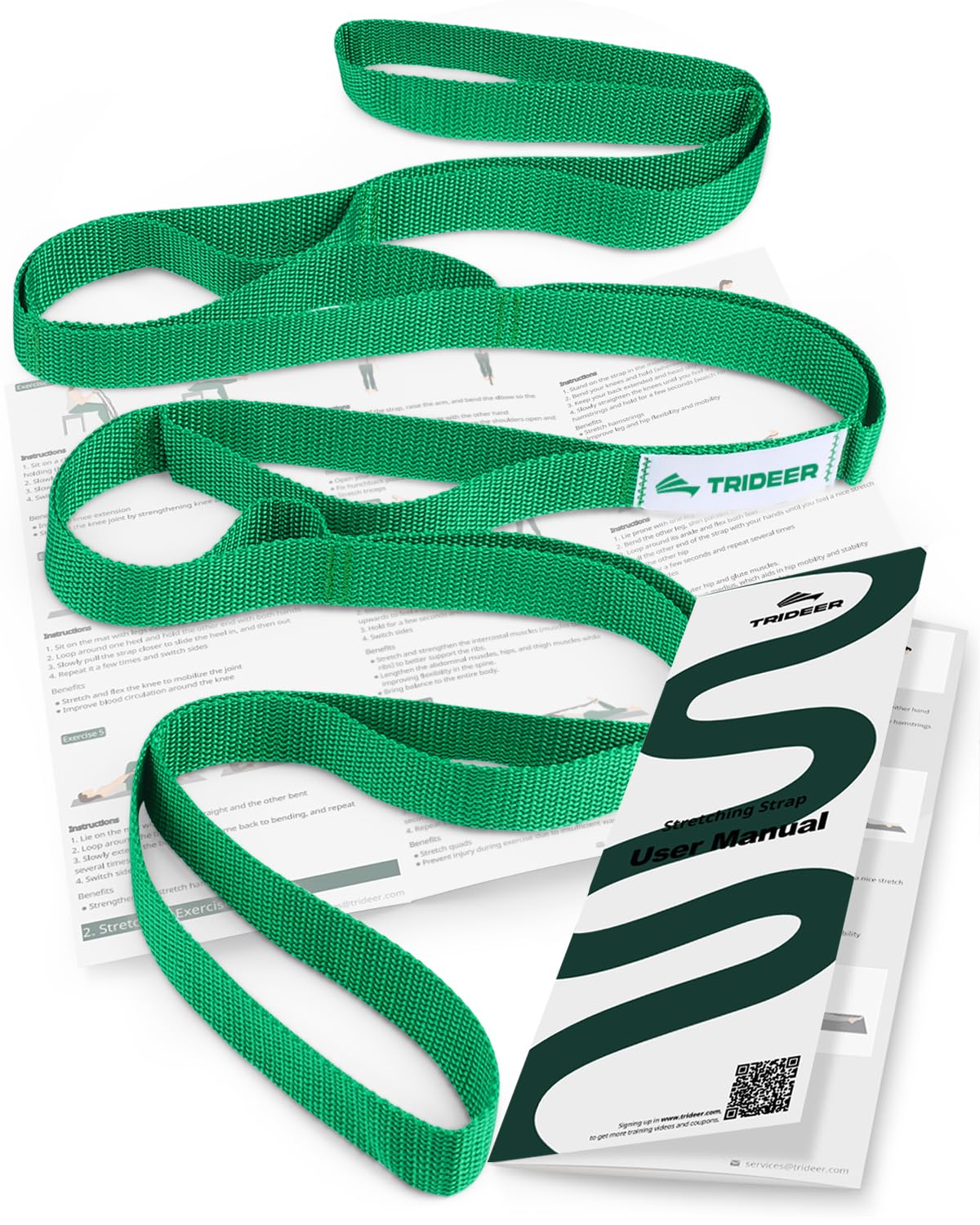
Trideer Stretching Strap

95 /100
Trail Score Outstanding

Key details

Loops
10
Width
1 inch
Length
75 inches
Material
Polypropylene
Check Price on Amazon

Three ounces is the number that decides where this strap lives. The Trideer rolls into a coil small enough to drop in a laptop bag, so it goes to the office, the gym, and on the trips where a padded strap stays home. Seventy-five inches of webbing with ten loops along it means you can find a hold sitting, standing, or flat on your back.

What we like most is how little fuss there is to it: grab a loop, pull, move to the next one when you want more. The fabric has no give at all, which is exactly right for assisted stretching and useless as a resistance band. It is a plain strap with plain edges, and for the price that is the whole appeal, a full set of hand and foot positions with nothing to maintain.

Length and width are the two things to weigh. At 75 inches it covers most seated and supine stretches but runs out of reach for taller users in a reclining hamstring stretch, where one of the 8-foot straps is the smarter buy. For a strap you will carry everywhere and barely notice, we have not found a reason to look further.

Pros

  • Light 3.2-ounce strap packs into any bag
  • Ten loops for hand and foot holds
  • Fabric does not stretch under a pull

Cons

  • Narrow 1-inch webbing is firm on hands and bare feet
Our verdict

Light enough to live in a gym bag and firm enough to pull against, this is our pick when you want ten grip points and a small bill.

Check Latest Price
3

Best Padded Handles

CTRL Sports Stretch Strap

95 /100
Trail Score Outstanding

Key details

Loops
10
Width
1.5 inches
Length
78 inches
Included
Carry bag and guide
Check Price on Amazon

Most loop straps are the same length of webbing with holes sewn into it. The CTRL Sports strap is the one here that pads the part you actually hold, with neoprene sleeves over the handle loops at each end, so a long hamstring hold stops being a grip contest. The webbing is wider than the budget straps as well, at an inch and a half.

We noticed the padding most during floor work, where your hands are overhead and the strap does the pulling. It is a well-made piece of kit beyond the handles: the stitching at the loops is substantial and the nylon has no give, so what you pull is what you get. The drawstring bag and printed guide are a bonus rather than the reason to buy.

Seventy-eight inches is generous without being unwieldy, long enough for most supine stretches and short enough to coil into its bag without a fight. Very tall users doing extended-leg floor work will still want one of the 8-foot straps. What we kept noticing is how the padded ends make it feel like equipment rather than a length of webbing, which is why it stays out on the floor between sessions.

Pros

  • Padded handles ease long holds
  • Reinforced stitching at the loops
  • Carry bag and printed guide included

Cons

  • Heavier than the unpadded loop straps here
Our verdict

If long hamstring holds leave your hands sore, these padded neoprene handles are the difference: a comfortable, well-built loop strap for daily stretching.

Check Latest Price
4

Best Budget

Tumaz Yoga Strap

96 /100
Trail Score Outstanding

Key details

Width
1.5 inches
Buckle
Metal D-ring
Length
6 feet
Material
Cotton
Check Price on Amazon

A D-ring strap solves a problem loops cannot: any length you want, set once and cinched tight. The Tumaz is the version we point most people to, partly because the double-ring buckle grips where you set it and partly because almost nothing else here costs as little.

The webbing is a cotton blend, softer against the skin than the nylon straps and a little thicker in the hand, which we liked for poses where the strap crosses the arch of a foot or runs behind the back. Fifteen-plus colors and three lengths, 6, 8, and 10 feet, mean you can match a mat and a height at the same time.

A cinch buckle is only as good as its hold. The welded D-rings here are sized to the webbing so the strap does not creep when you pull hard, and the cotton's texture helps; thin, slick webbing in a small ring is where buckles usually fail.

In a class it does what a strap should: loops over a hand in a second, soft enough that you forget you are holding it, small enough to roll into a mat bag. We ended up liking it more than the fancier straps for exactly that reason, since nothing about it asks you to think. The color range is not a gimmick either; a strap you like the look of is easier to spot in a shared prop bin.

Pros

  • Lowest price of any strap here
  • Soft cotton blend against the skin
  • Double-ring buckle holds its setting
  • Three lengths and many colors

Cons

  • 6-foot version runs short for tall users
Our verdict

The cheapest strap in this guide, and the one we hand to anyone who wants soft cotton, a D-ring that holds, and a color they will actually use.

Check Latest Price
5

Best Premium

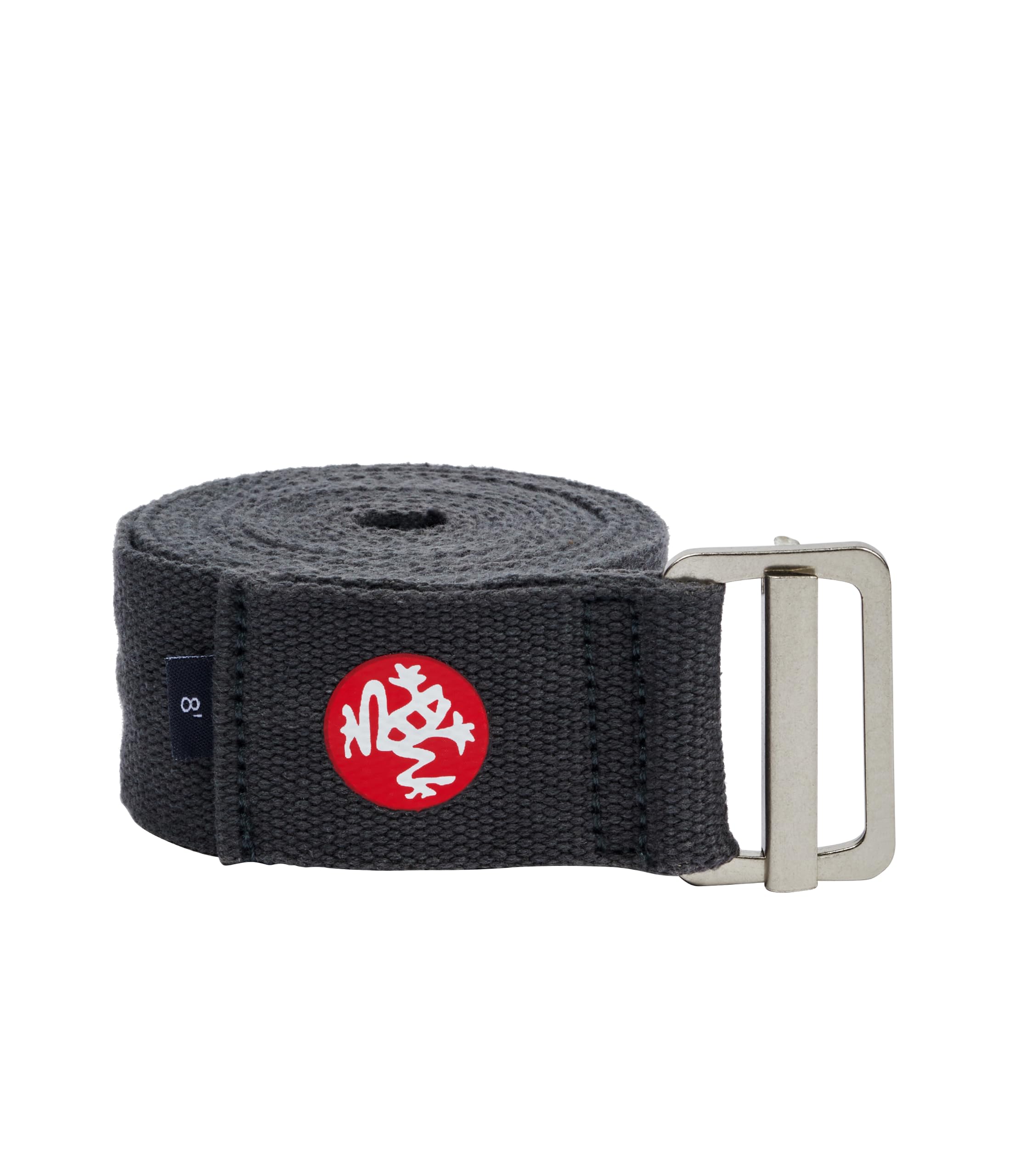
Manduka Align Yoga Strap

94 /100
Trail Score Outstanding

Key details

Width
1.75 inches
Buckle
Zinc alloy cinch
Length
8 feet
Material
Unbleached cotton
Check Price on Amazon

At 1.75 inches wide, the Align is the broadest strap in this group, and that extra quarter inch is the difference between a strap that presses into your palm and one you can pull against without thinking about your hands. It is the strap we reach for when a stretch needs real tension, a supine hamstring pull or a shoulder opener against the floor, rather than a light assist.

The buckle is the other reason it earns its place. It is a zinc alloy cinch with a middle bar that holds the webbing flat instead of letting it bunch, and it adjusts far enough to make a hand loop or a long rein in the same breath. Eight feet of unbleached cotton covers tall practitioners, and the cotton has enough texture to stay put in the buckle without feeling scratchy.

It is not a strap to toss in a pocket: five and a half ounces of wide cotton rolls into a coil the size of a fist and a bit, and the buckle adds a hard lump to a packed bag. That is the price of the width, and it is a fair one if the strap lives on a hook by the mat rather than in a carry-on.

Pros

  • Widest webbing here at 1.75 inches
  • Zinc alloy buckle resists slipping
  • Eight feet of unbleached cotton

Cons

  • The priciest strap in this guide
  • Wide cotton and a metal buckle add bag bulk
Our verdict

The widest strap here, with a buckle that refuses to slip; worth the premium if you are tall, have large hands, or want one strap for a decade.

Check Latest Price
6

Best for Rehab Progress

KneeSled Ultra Stretch Strap

93 /100
Trail Score Outstanding

Key details

Loops
10 numbered
Width
1 inch
Length
80 inches
Included
Stretch chart
Check Price on Amazon

The loops on most straps are anonymous. The KneeSled numbers all ten, which sounds like a small thing until you are three weeks into a rehab protocol trying to remember which loop you reached last Tuesday. Hand on loop four this week and loop five next week is progress you can see without hunting for a tape measure.

Eighty inches of one-inch nylon gives you more length than the standard 75-inch straps, which matters for heel slides and leg raises done from a bed or the floor. The stitching is doubled and tripled at the loops, so the pull spreads across the webbing instead of concentrating at one seam. It does not stretch, which is what you want when the goal is a few more degrees out of a joint.

The included chart covers the usual post-op ground: hamstring and quad stretches, heel slides, shoulder work. What we appreciate is that the chart and the numbering point the same direction, so you are not decoding an illustration to work out where your hand goes.

It is a specialty strap and it knows it. For general stretching or yoga, a plain looped strap does the same job; where the numbering earns its keep is a protocol with weekly targets, and the unglamorous business of getting a leg into bed after surgery without asking for help.

Pros

  • Ten numbered loops for tracking progress
  • Illustrated stretch chart included
  • Extra length at 80 inches

Cons

  • Costs more than plain looped straps
Our verdict

Numbered loops and a stretch chart make this the strap for anyone following a rehab protocol who wants to see progress from one week to the next.

Check Latest Price
7

Longer Reach

Gaiam Yoga Strap

95 /100
Trail Score Outstanding

Key details

Width
1.5 inches
Buckle
Metal D-ring
Length
8 feet
Material
Polyester
Check Price on Amazon

Eight feet of polyester webbing and a metal double-ring buckle is the classic yoga-strap recipe, and Gaiam has been making it long enough that nothing about it surprises. The length is the part that matters: it covers tall practitioners and floor poses where you want the strap around both feet, and the cinch shortens it to a hand loop for a standing stretch.

What we noticed in use is how little the buckle gets in the way. It slides to length and holds, without the bulk of the padded or numbered straps here. It is also the one in this group that feels most at home in a class: plain, soft enough on the hands, and inexpensive enough that leaving it at the studio is not a disaster.

Pros

  • Eight-foot length for tall users and floor work
  • Adjustable metal D-ring cinch
  • Durable polyester blend

Cons

  • Plain webbing with no padding or loop markers
Our verdict

An 8-foot strap with a metal cinch buckle at a price that makes it easy to own one for home and one for the studio.

Check Latest Price
8

Padded Grip Points

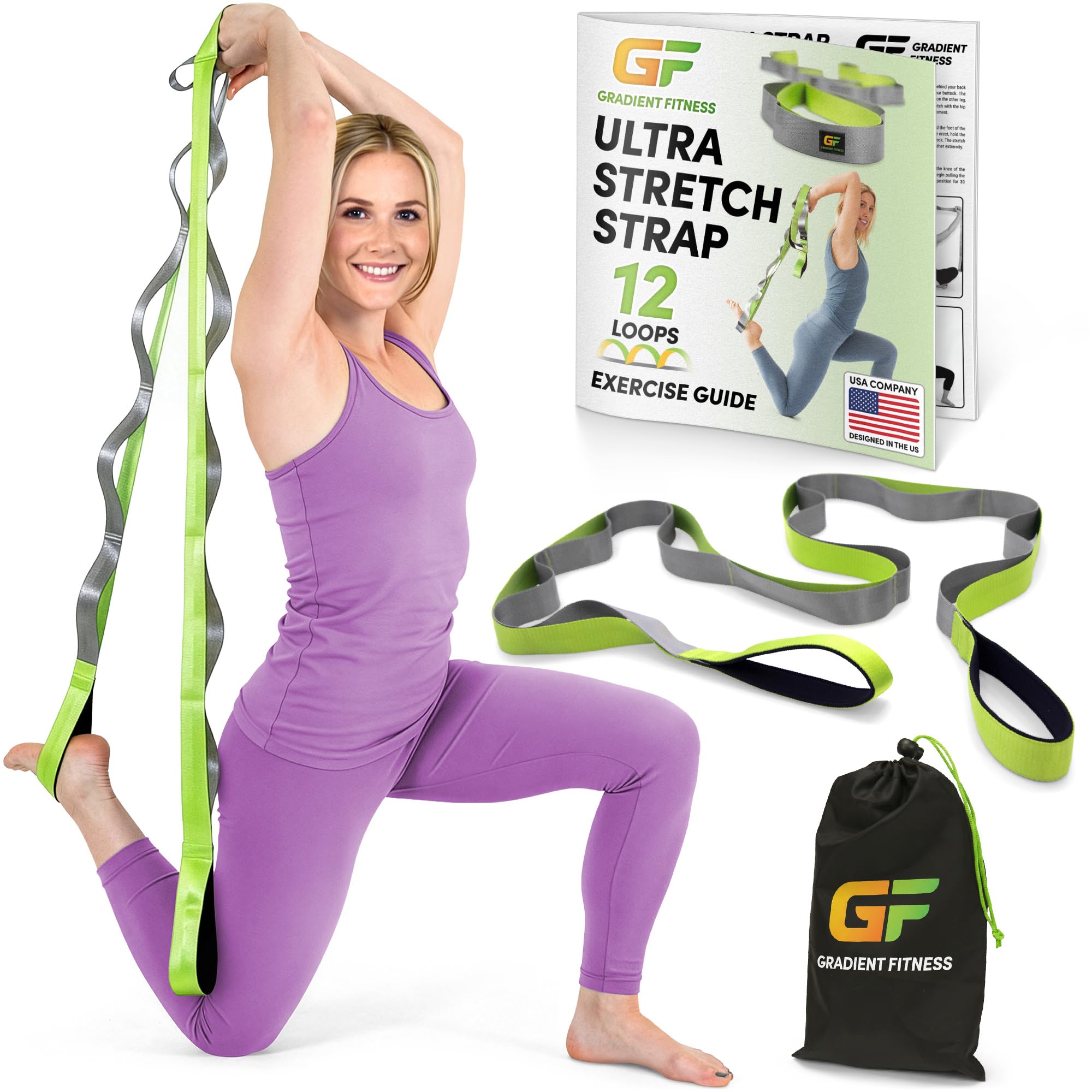
Gradient Fitness Stretch Strap

95 /100
Trail Score Outstanding

Key details

Loops
12
Width
1.5 inches
Length
8 feet
Included
Carry bag and manual
Check Price on Amazon

Twelve loops is the most on any strap here, and the spacing is tight enough that you can shift your hand two inches at a time instead of four. The end loops and handles are lined with foam, so the parts taking the most pressure, the arch of a foot and the palm, are the parts that are cushioned.

At eight feet it is one of the longer loop straps, which we liked for reclining hamstring stretches and for taller users. What we did not expect was how much the padding changes the feel of a pull: the foam takes the edge off, so you hold a stretch longer before your foot complains. The end loops are generous, though, and on a small foot they can feel roomy rather than secure.

Pros

  • Twelve loops, the most in this group
  • Foam-lined ends cushion hands and feet
  • Carry bag and instruction manual included

Cons

  • Bulkier to pack than a bare 6-foot strap
Our verdict

Twelve loops, padded ends, and a carrying bag for less than most padded straps: the pick if you want maximum grip points on a budget.

Check Latest Price

How We Put 14 Yoga Straps Through Their Paces

We started with a shortlist of more than 40 straps sold at major retailers, then narrowed it to 14 based on materials, length options, buckle style, and the price range most shoppers actually spend. That gave us a mix of cotton, nylon, and blended webbing, plus loop straps, D-ring straps, and a few adjustable designs.

For three months, those 14 straps went everywhere my practice did: unrolled on the living room floor for morning stretches, stuffed into a tote for studio classes, and used after runs to open up hamstrings and calves. I noted how each one felt in a hamstring stretch with my foot in the loop, then in a shoulder opener held behind my back, and in a longer bind where the strap has to stay taut without cutting in. I also counted how many grip positions a loop strap offered and whether a longer strap could handle both a seated forward fold and a standing quad stretch without readjusting.

To check stretchiness — the kind you don't want in a strap — I loaded each one against a doorframe and pulled hard, watching for give. I timed how long it took to change the length one-handed, paid attention to how the buckle felt with sweaty hands, and inspected stitching, edges, and hardware after repeated twisting and tugging. The straps that made the final list held their length, adjusted smoothly, and showed no fraying or slipping after three months of near-daily use.

How to Choose a Yoga Strap

Loops or a D-Ring Buckle

A looped strap gives you a set of fixed grip points, and that is a real advantage when you follow a printed exercise sheet: the loop you used last session is the loop you use today. It also speeds up a stretch, since moving your hand two inches takes a second rather than a buckle reset. A D-ring strap trades those fixed points for continuous adjustment, which suits yoga poses, sharing one strap between people of different heights, and wrapping a foot and a thigh in one go.

Check the buckle's grip before you commit. Wide webbing in a welded ring holds; thin webbing in a small ring creeps under load, and a strap that shortens itself mid-stretch is worse than no strap. If the strap is for rehab exercises, loops are simply the easier tool to follow a protocol with.

Length and Reach

Six feet covers most mat work for an average-height adult. Eight feet is the safer default if you are tall, if you stretch lying down with a leg extended, or if you like the strap wrapped around both feet, and 10 feet exists for very tall users and specific poses. Here is the trap: a strap used doubled is half as long. Loop a 6-foot strap around your foot and hold both ends and you are working with three feet of reach, which is where most complaints about short straps begin. If you are around six feet or taller, start at eight.

Width, Material, and Hand Comfort

One-inch nylon is light, packs small, and concentrates the pull on a narrow band of hand or arch, which is fine for short holds and noticeable in a long one. Webbing of 1.5 to 1.75 inches spreads that load, and padded handles help most in the hamstring holds where you are hanging on rather than pulling. Cotton feels softer against skin and grips a buckle well; nylon and polyester are lighter and shrug off sweat. Whichever you choose, look at the stitching at the loops, because that seam takes the entire pull.

Guidance, Numbering, and Build Details

An exercise booklet is worth more than it sounds. A strap plus an illustrated set of positions is a home program; a strap alone is a strap. Numbered loops go a step further and let you measure progress by loop rather than by feel, which is why rehab-focused straps bother with them. Check the ends too: a padded end loop is easier to get a foot into, and a small carry bag is the difference between a strap that travels and one that stays in a drawer.

Frequently Asked Questions

Final Verdict

Start with the OPTP Stretch Out Strap. It is firm, light, and comes with the thing most straps do not: a booklet that shows you what to do with it, which is why it is our pick for stretching, yoga, and PT homework alike.

If you want a buckle instead of loops, the Tumaz is the least expensive way to get one that holds, and the Manduka is there for tall practitioners who want the widest webbing here and do not mind paying for it. The choice that actually matters is loops versus buckle and 6 feet versus 8, so settle those two and the rest is comfort.