Best KT Tape for Knee Support of 2026

A knee brace that migrates down your shin by mile three is annoying. Tape that curls at the corners before you've even laced up is worse, because you've spent the money and you're getting none of the support you paid for. Kinesiology tape is meant to fix both at once: it steadies the kneecap and the muscles around it without the bulk, heat, and constant readjusting of a sleeve. When it works, the ache fades and you keep moving instead of sitting down to re-wrap.

The catch is that a cheap roll and a pricey one can both peel up within the hour — what separates them is the adhesive, the stretch, and how cleanly the edges are cut. I've taped my own knee for years, and over the past three months my team and I wore 16 rolls through runs, gym sessions, and long days on our feet. A roll that fights you during application ends up wrinkled, and wrinkles lift first. The picks below are the ones that survived a shower and still came off without a fight.

1

Best Overall

KT Tape Pro Synthetic

93 /100
Trail Score Outstanding

Key details

Format
20 precut strips
Material
Synthetic
Strip Size
10 in x 2 in
Water Resistance
Water resistant
Check Price on Amazon

The first thing we look for in knee tape is whether it can survive a sweaty session without turning into a loose flag at the edges, and the KT Tape Pro is the pick we trust most for that. Its synthetic fibers are designed to dry fast and stay water resistant, and the stronger elastic core gives the kind of support that feels more secure than soft cotton when you are moving around. We also appreciate the precut 10-inch by 2-inch strips: they are ready to go, and you can trim them down for smaller anchors.

For a knee, that 10-inch length is enough for many common applications, though a larger knee or a full-wrap pattern may need two strips overlapped. The rounded corners are a small but useful detail because they give the ends less to catch on clothing or a sock. The adhesive is listed to hold for 4 to 7 days, which we treat as a ceiling rather than a promise; if the edges start lifting after a shower, dry them and smooth them back down, and replace the tape once the support goes slack.

The main trade-off is cost. It is one of the more expensive precut options in this group, and that matters if you tape several times a week or are still learning how much tape a knee application takes. We think the Pro earns the money for activity where hold matters, but a bulk box or an uncut roll makes more sense for practice. If you want the closest thing to a set-and-forget knee tape here, this is the one.

Pros

  • Fast-drying synthetic fabric
  • Water-resistant hold for sweaty sessions
  • Precut 10-inch strips save time
  • Stronger elastic core for knee support

Cons

  • Premium price among precut options
Our verdict

We recommend the Pro for knee taping that has to survive sweat and showers, because its synthetic fabric and stronger elastic core hold support longer than the cotton original.

Check Latest Price
2

Best Budget

KT Tape Original Cotton

91 /100
Trail Score Outstanding

Key details

Format
20 precut strips
Material
Cotton
Strip Size
10 in x 2 in
Water Resistance
Water resistant
Check Price on Amazon

The Original is the tape we point to when someone wants to try kinesiology taping without paying for the Pro. It is a cotton elastic tape with the same precut 10-inch by 2-inch strips, and the softer feel can be more pleasant against skin than the slicker synthetic Pro, especially for everyday wear. We also like the beige color because it disappears under most clothing.

What you give up is some security in wet, high-sweat conditions. The cotton is breathable and comfortable, but it does not dry as fast or feel as secure when wet as the synthetic Pro, so we save it for dry days, desk days, and lighter activity. Application matters here: start with clean, dry skin, rub the adhesive after you press it down, and give the ends a little extra attention.

The bigger caution is skin tolerance. This is the one in our set where irritation is a real part of the story, so patch-test a short strip before you commit to a full knee application, and remove it slowly with oil if it starts to pull. The 20-strip box is still a sensible way to keep everyday tape on hand, and the lower cost makes it easier to experiment with placement.

We recommend it for budget-minded, dry-weather taping rather than for a swim or a muddy match. If you need maximum hold, the Pro is the better spend; if you want a soft cotton tape for a normal day, this one is easy to live with.

Pros

  • Lower cost than the Pro
  • Soft, breathable cotton
  • Precut 10-inch strips
  • Beige blends under clothes

Cons

  • Skin irritation can occur
  • Hold weakens in heavy sweat
Our verdict

We keep this one for budget-minded everyday taping, where soft cotton and precut strips matter more than maximum water resistance.

Check Latest Price
3

Best Uncut Roll

Hampton Adams Kinesiology Tape

89 /100
Trail Score Excellent

Key details

Format
2 uncut rolls
Adhesive
Latex-free
Material
Cotton blend
Water Resistance
Water resistant
Check Price on Amazon

A 10-inch precut strip is convenient until you need a longer run down the side of the knee or a custom Y-strip, and that is where the Hampton Adams two-pack earns its place. The rolls are uncut, so you can measure against the knee, cut the length you actually need, and stretch the tape yourself rather than making a precut strip work. We like that freedom for anyone tapping the same knee several times a week.

The tape is a cotton blend with a latex-free adhesive and a water-resistant finish, and it has enough stretch to move with the knee without feeling rigid. The two-roll format is genuinely useful because you can keep one roll at home and one in a gym bag, and you are not stuck with a short strip when a longer anchor would be better.

The trade-off is setup. You need scissors, a clean line, and a little practice to get the tension even; a rushed cut gives you a strip that lifts at the corner. That is the work you accept for the custom fit. If you want no measuring and no scissors, choose a precut box instead.

If you already know the knee application you like, the uncut roll is the more adaptable buy. The Hampton Adams pack is for the tinkerer who wants the tape to fit the knee, not the other way around.

Pros

  • Two uncut rolls for custom lengths
  • Water-resistant cotton blend
  • Latex-free adhesive
  • Good value for a two-roll pack

Cons

  • Adhesive can leave sticky residue
Our verdict

We reach for the uncut Hampton Adams rolls when a knee needs longer strips or custom tension that precut strips cannot give.

Check Latest Price
4

Best Bulk Precut

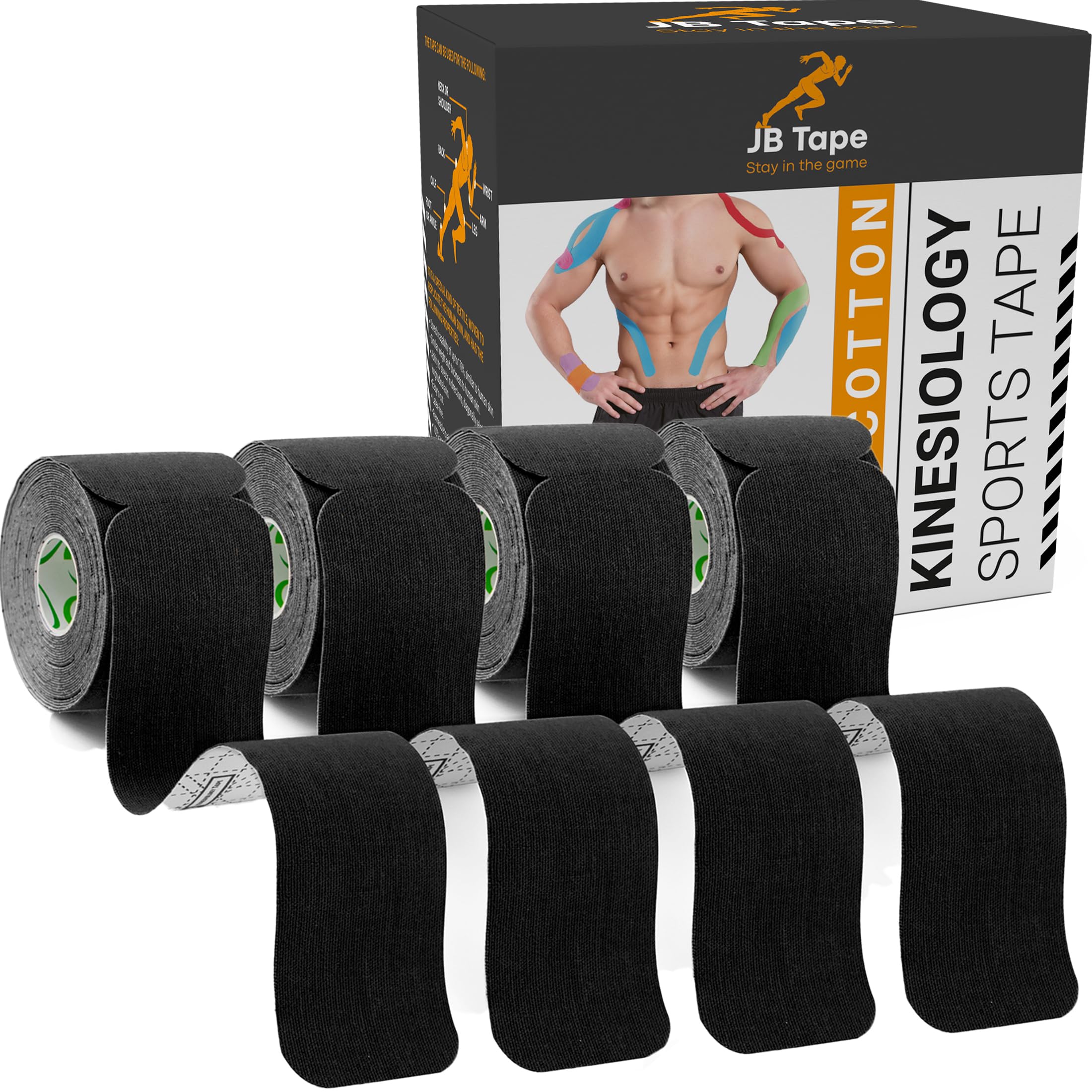
JB Tape Kinesiology Tape

90 /100
Trail Score Outstanding

Key details

Format
4 rolls, 80 precut strips
Material
95% cotton, 5% spandex
Strip Length
10 in
Listed Wear Time
3–5 days
Check Price on Amazon

Eighty precut strips is the detail that makes JB Tape worth a look if knee taping is a routine rather than an occasional fix. The strips are 10 inches long, which is a practical length for common knee applications, and the box gives you four rolls so you are not rationing the last few pieces. We like that it takes the supply question out of the way.

The fabric is a 95% cotton, 5% spandex blend, so it has a softer, more cloth-like feel than the synthetic Pro, and the rounded corners help the ends stay down. The manufacturer lists 3 to 5 days of wear, which is in line with the rest of this group, but the cotton surface is not the one we choose for a wet, high-friction session.

The catch is that it is a cotton tape first: it rewards a clean, dry application, and it is not the one we choose for a wet, high-friction session. We treat the first strip as a test and keep the rest of the box for days when the knee is dry and the tape has a chance to settle. For a high-volume kit, it is a sensible buy; for maximum water resistance, the Pro is still the safer choice.

What we like most is the value per application: four rolls and 80 strips mean you can practice a knee pattern without feeling like you are wasting tape. If you tape often and want precut convenience, this is the box we hand to a busy athlete.

Pros

  • Eighty precut strips per box
  • 10-inch strips suit knee applications
  • Soft cotton-spandex blend
  • Rounded corners resist lifting

Cons

  • Adhesion can vary between applications
  • Skin irritation can occur
Our verdict

We recommend JB Tape when you tape a knee often, because the box gives you a large supply of precut strips without a premium price.

Check Latest Price
5

Best Cooling Option

Heali Kinesiology Tape

91 /100
Trail Score Outstanding

Key details

Format
20 precut strips
Additives
Magnesium and menthol
Strip Size
2 in x 10 in
Water Resistance
Water resistant
Check Price on Amazon

Heali is the tape in this group that does something extra: magnesium and menthol are built into the adhesive, and the menthol gives a cooling sensation that can feel soothing on an achy knee. We expected the add-on to feel like a gimmick, but the cooling effect is noticeable, and it can come back when the tape gets wet, which is a small pleasure on a hot day.

Underneath the sensation, it is a standard precut tape: 20 strips, 2 inches by 10 inches, water resistant, and easy to apply. The 10-inch length works for common knee strips, though a larger knee may need two. We like the precut format for a quick morning application, and the blue splatter pattern is easier to find in a gym bag than a beige strip.

The catch is that the extra sensation comes with a trade-off in everyday wear, and the tape is not the value leader among the precut boxes. For a knee that needs maximum hold, we still choose the Pro. Heali makes more sense if you want the cooling ritual and can accept the fragrance.

Patch-test first if you are sensitive to menthol or adhesives, and do not layer it under a tight brace where the scent and adhesive have nowhere to go. It is a niche tape, but a useful one for the right knee.

Pros

  • Cooling menthol sensation
  • Magnesium added to the adhesive
  • Precut 2 by 10 inch strips
  • Water resistant

Cons

  • Strong menthol scent
  • Adhesive can lift after sweat or showers
Our verdict

We like Heali for knee support when you want a cooling menthol sensation along with the tape's hold.

Check Latest Price
6

Beginner Knee Taping

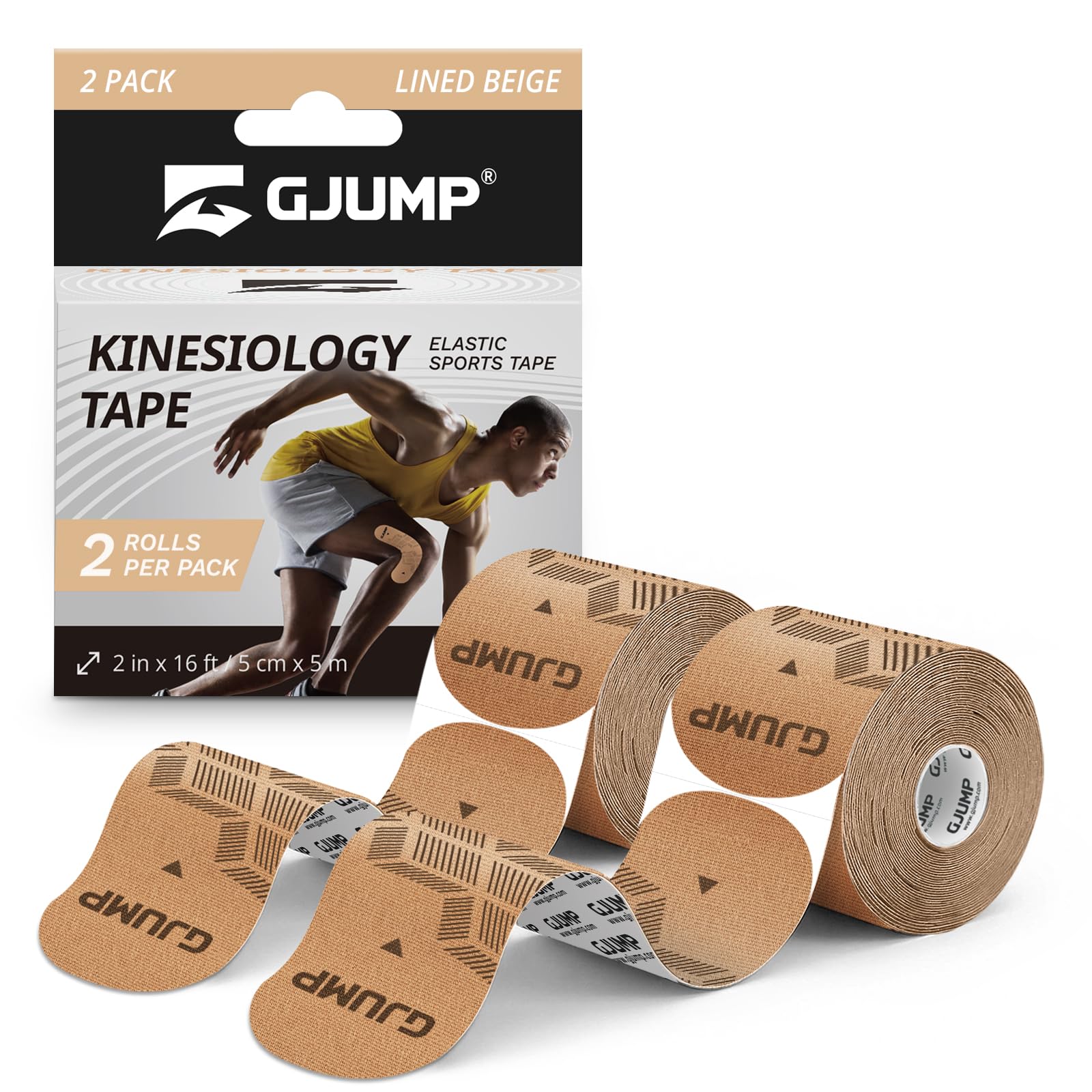
GJUMP Kinesiology Tape

90 /100
Trail Score Outstanding

Key details

Edges
Rounded
Format
2 rolls, 40 precut strips
Material
Cotton
Listed Wear Time
3 days
Check Price on Amazon

Rounded corners sound like a small thing until you have had a square-cut tape end curl up under a sock. GJUMP's precut strips come with rounded edges, and that shape is the reason we reach for this box when we want a low-fuss knee application. The strips are 10 inches long and come 40 to a pack across two rolls, so there is enough to practice with.

The cotton fabric has a wave-pattern adhesive and a water-resistant finish, and the tape is latex-free. The rounded edges are designed to prevent warping and premature lifting, and that matches what we look for in a knee tape: fewer catch points at the ends. We also like that the strips are already cut, so there is no scissors work before a morning run.

What holds it back is that it is comfortable and easy to place, but it is not the strongest hold in this group. We treat the 3-day wear claim as a guide, not a guarantee. For someone new to knee taping, though, the rounded strips and 40-strip supply make it a forgiving box to learn on.

If you have sensitive skin, patch-test first. Otherwise, this is the box we give to a first-time taper who wants a little margin for error.

Pros

  • Rounded precut edges
  • 40 strips across two rolls
  • Soft cotton fabric
  • Latex-free

Cons

  • Can itch on sensitive skin
Our verdict

We recommend GJUMP if you want rounded precut strips that are easy to place and less likely to catch at the corners.

Check Latest Price
7

Low-Cost Uncut

OK TAPE PRO Kinesiology Tape

89 /100
Trail Score Excellent

Key details

Format
2 uncut rolls
Adhesive
Japanese acrylic
Roll Size
2 in x 16 ft
Stretch Guide
Printed pattern
Check Price on Amazon

Printed patterns on the OK TAPE PRO are not just decoration: the circles and lines are there to show how far to stretch the tape for different applications, which is genuinely useful if you are still learning knee taping. At the low end of the price range, it is the uncut roll we keep for practice and for cutting odd lengths.

The roll is 2 inches wide and 16 feet long, so you can cut strips to match your knee rather than adapting a precut length. The adhesive is a Japanese acrylic, and the tape is latex-free. We like the two-roll format for keeping one roll at home and one in a gym bag.

The compromise is the learning curve: cutting your own strips takes practice, and the printed pattern is a little busy under clothing. That is enough to keep this in the practice-and-backup role for us, rather than the roll we reach for before a big event.

For the money, it is a fair way to try uncut taping or to keep a spare roll; for a knee that needs reliable all-day hold, the Pro is the safer spend. We treat this as a practice and backup roll, not the one we reach for before a long run.

Pros

  • Low-cost uncut rolls
  • Printed stretch guides
  • 2-inch by 16-foot rolls
  • Latex-free

Cons

  • Adhesion can be inconsistent
  • Skin can itch under long wear
Our verdict

We keep OK TAPE PRO as the low-cost uncut pick for knee taping on a budget and for cutting strips to exact lengths.

Check Latest Price

What Three Months of Wearing Knee Tape Taught Us

We started with every roll we could find that was marketed for knees, plus a few all-purpose rolls that kept turning up in customer reviews, then cut the list by reading the specifications that actually matter: stretch percentage, adhesive type, roll dimensions, and price per foot. Anything that didn't state its stretch, or that cost several times the median per foot, was dropped.

That left 16 rolls, worn over three months. Each went on before a morning run, a gym session, a long hike, and a full day of standing at a work event, and we slept in most of them before peeling them off.

We checked the edges after every sweaty session and noted whether they lifted, fuzzed, or rolled, then rated how supported the knee felt on stairs and long descents and whether the ache eased as the day went on. Application got its own test: we timed how long each roll took to lie flat without wrinkles, and whether it cut cleanly into narrower strips for the kneecap.

On removal we looked for redness and itching and wiped the skin with a dry cloth to see how much adhesive came off with it. Last, we counted how many days each roll lasted and divided the price by that number, since a cheap roll that quits in a day is the expensive one.

How to Choose Kt Tape for a Knee

Precut Strips vs. an Uncut Roll

Precut strips are the faster choice: open the box, peel, and apply. The 10-inch strips in the KT Tape Pro and Original are a practical length for many knee applications, though a larger knee or a full-wrap pattern may need two strips overlapped. An uncut roll, like the Hampton Adams two-pack or OK TAPE PRO, lets you cut exactly the length and tension you want, which is useful if you already know your application or need a longer run down the side of the knee.

Our rule: buy precut for speed and consistency, uncut for fit and flexibility. If you are new to taping, a 20-strip precut box gives you enough material to practice without committing to a large supply.

Put Adhesion Ahead of Everything Else

Adhesion is the specification that decides whether tape helps at all. A tape that lifts at the edge after ten minutes is not supporting anything, no matter how good its stretch feels. Apply to clean, dry skin with no lotion or oil, rub the adhesive after application, and round or trim corners if they start to catch.

We look for water resistance that matches your activity, not just the longest claimed wear time. Water-resistant tapes handle sweat and showers better, but none of them are fully immune; dry the tape gently after a shower and smooth down edges while they are still warm.

Skin Tolerance and Removal

Latex-free and hypoallergenic labels reduce the risk of a reaction, but they do not guarantee one will not happen. Patch-test a short strip on the inside of the arm or thigh before taping a knee for a workout, especially if you have reacted to adhesives before.

Remove slowly, in the direction of hair growth, and support the skin with one hand while peeling with the other; oil can help break down the adhesive if the tape is stuck. Stop using any tape that causes itching, blistering, or a rash, and give the skin a day or two before taping again.

Match Support to the Knee's Job

Kinesiology tape is flexible support, not a rigid brace. It can add a reassuring cue around the kneecap and make movement feel more comfortable, but it will not stabilize a knee that gives way or replace a brace prescribed for a ligament injury.

For everyday support and a tape that moves with you, a cotton or cotton-blend tape is comfortable; for sweat, showers, and longer wear, a synthetic tape like the KT Tape Pro is the more sensible default. Replace the tape when the edges lift or the fabric goes slack, because that is when the support disappears.

Frequently Asked Questions

Final Verdict

For most knees, we recommend starting with KT Tape Pro Synthetic. It has the best balance here of support, water resistance, and precut convenience, and its 10-inch strips are easy to trim or overlap for a knee application. The trade-off is price, but it is the tape we trust for a sweaty workout or a long day.

If you need longer or custom strips, the Hampton Adams two-pack is the better buy; if you tape often, JB Tape's 80 precut strips stretch the supply. And if you want the lowest-cost way into uncut taping, OK TAPE PRO is the practice roll. Start with one, patch-test, and adjust to your knee.