Best Knee Scooter After Foot Surgery

The first time a surgeon tells you to keep every ounce of weight off your foot, the questions arrive fast: how do I get to the bathroom at 2 a.m., how do I carry a cup of coffee, how do I leave the house without falling? Crutches answer none of those well. A knee scooter does—it turns a hopping, exhausting recovery into something you can move through. But the wrong one wobbles on a sidewalk crack, leaves you hunched over the handlebars, and fights you in a narrow hallway.

Over the past six months, my team and I put 12 knee scooters through real recoveries, including my own after ankle surgery. What separates a good one from a bad one isn't the price—it's whether the height range fits you, whether the turning radius clears a bathroom door, and whether the knee pad is comfortable after 20 minutes. Assembly matters too: some took me under five minutes with no tools, while others needed two people. The picks below are the ones that made recovery feel less like a sentence.

1

Best Overall

KneeRover Deluxe KneeCycle

93 /100
Trail Score Outstanding

Key details

Weight
24.4 lb
Weight Capacity
300 lb
Handlebar Height
34.5 to 41.5 inches
Knee Platform Height
16 to 22.5 inches
Check Price on Amazon

The detail that settles the Deluxe for us is the tie-rod steering: the front wheels are linked, so the scooter tracks with a more controlled feel than the simpler steering setups on the budget picks. Add a 300-pound capacity and a knee platform that drops to 16 inches, and it fits a wider range of riders and recovery setups than most of the scooters here. We recommend it first for someone who wants one scooter to handle a one-story house, a doctor's waiting room, and a smooth sidewalk.

The adjustment range is the practical part. The handlebar moves from 34.5 to 41.5 inches and the knee platform from 16 to 22.5, so a shorter rider is not stuck on tiptoe and a taller rider is not folded over the bars. The basket is a useful place for a phone, a water bottle, or a folder of discharge paperwork, and it stays out of the way when you are steering. We paid close attention to the knee platform height because it changes how your hips and back feel after a long day; the low end of this range is what makes the Deluxe work for shorter riders.

It is not the lightest scooter here at 24.35 pounds, and that weight is the price of the steel frame and the more substantial steering. We noticed it most when lifting it into a trunk; if the scooter stays on one floor, that matters less. On a raised threshold or a thick rug, slow down and keep both hands on the grips. The Deluxe is stable for its class, but no knee scooter is a chair.

The Deluxe is not the scooter for a gravel driveway or a lawn; that is a job for the Vive or the BlessReach. For the indoor-to-sidewalk recovery most people actually have, it is the most complete package here. The low knee platform is the quiet advantage for shorter riders; it is the number to check first if you are under 5 feet 4 inches.

Pros

  • Linked steering keeps the front wheels controlled
  • 300-pound capacity and wide height adjustment
  • Useful basket for small items

Cons

  • Wide turning circle in tight rooms
Our verdict

The Deluxe is the knee scooter we recommend first for most recoveries, with tie-rod steering, a 300-pound capacity, and a height range that fits a wide span of riders.

Check Latest Price
2

Best Value

KneeRover Economy

91 /100
Trail Score Outstanding

Key details

Weight
21 lb
Brake Type
Rear on-wheel with lock
Wheel Size
7.5 inches
Weight Capacity
300 lb
Check Price on Amazon

The Economy makes its case with a 21-pound frame, a 300-pound capacity, and a price that sits below the Deluxe. It uses four 7.5-inch rubber wheels, a rear on-wheel brake, and a locking handbrake, and it folds for transport. The controls are simple, and the frame is light enough to lift into a trunk without a second person.

We recommend it when the budget is tight and the recovery is mostly indoors or on smooth pavement. Assembly is straightforward, and the controls are simple enough to learn in a hallway. We like that the locking handbrake gives you a way to steady the scooter while you get on and off, which is the moment a lot of knee scooters feel most awkward.

The trade-off is composure. The lighter frame feels busier over a raised threshold, a thick rug, or a gravel edge than the Deluxe, and the 7.5-inch wheels do not erase a bad sidewalk. If you will be on uneven ground every day, spend for the Deluxe or an all-terrain model. If your world is a kitchen, a bedroom, and a paved driveway, the Economy does the job for a lot less.

It is the scooter that lives in the trunk between appointments without making you dread the lift. That is the role it earns: the one you can take with you.

Pros

  • Light 21-pound frame for car transport
  • 300-pound capacity at a budget price
  • Simple tool-free assembly
  • Locking handbrake helps with mounting

Cons

  • Wide turning circle in tight spaces
Our verdict

The Economy is our value pick for a mostly indoor recovery: it is light, simple to assemble, and rated to 300 pounds.

Check Latest Price
3

Best for Taller Riders

Vive All Terrain

85 /100
Trail Score Excellent

Key details

Weight
30.5 lb
Wheel Size
12-inch pneumatic
Rider Height
5 feet 4 inches to 6 feet 6 inches
Weight Capacity
350 lb
Check Price on Amazon

The Vive is the scooter we reach for when the rider is tall and the route includes gravel, grass, or a rougher sidewalk. Its 12-inch pneumatic tires are the biggest here, and the 350-pound capacity is the highest in our group. The fit range is just as important: Vive lists it for riders from 5 feet 4 inches to 6 feet 6 inches, and that upper end is why it earns a place.

Big tires change the ride. They roll over curb cuts and packed gravel with less chatter than the 7.5- or 8-inch wheels on the indoor-focused scooters, and the contoured knee pad helps keep your leg from sliding sideways. The tires are air-filled, so they need a pump now and then; that is the upkeep you accept for the smoother ride. The upside is a smoother roll when the pavement turns rough.

The height range cuts both ways. If you are near the lower end, the Vive can feel tall; shorter riders should look at the Deluxe or the Economy instead. For a taller rider who has been folding themselves over a scooter with a short tiller, the Vive is a relief. The 12-inch tires are also the reason it takes more effort to turn in a tight hallway; this is a scooter for open routes, not bathroom pivots.

Pros

  • 12-inch pneumatic tires handle rough ground
  • 350-pound capacity, highest in this set
  • Fits taller riders up to 6 feet 6 inches
  • HSA and FSA eligible

Cons

  • Heavy at 30.51 pounds
Our verdict

For taller riders who need to cross gravel or rough pavement, the Vive's 12-inch pneumatic tires and 350-pound capacity make it the strongest fit here.

Check Latest Price
4

Rough-Ground Value

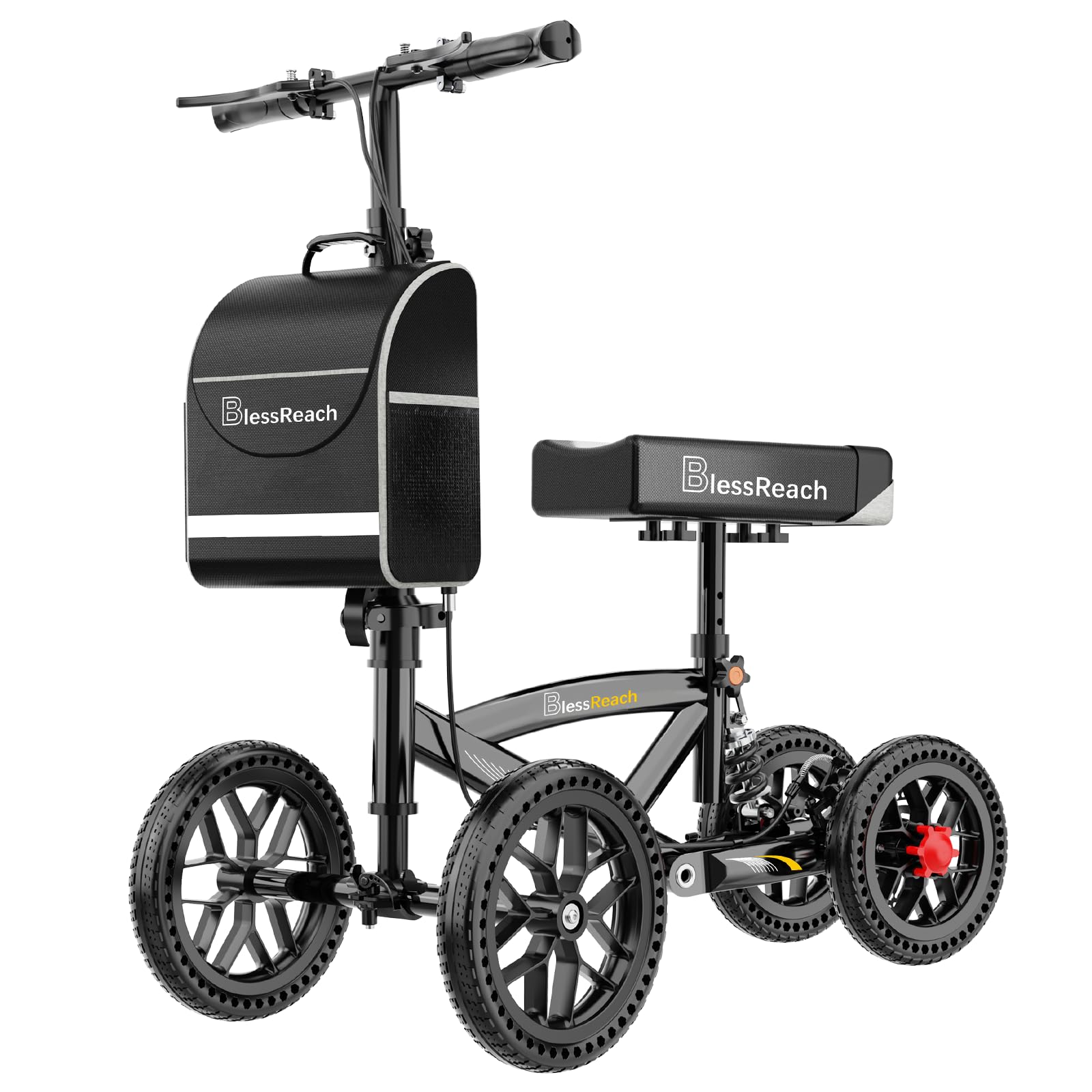
BlessReach All Terrain

86 /100
Trail Score Excellent

Key details

Weight
25.6 lb
Wheel Size
11-inch front, 8-inch rear
Rider Height
5 feet 6 inches to 6 feet 6 inches
Weight Capacity
300 lb
Check Price on Amazon

The BlessReach all-terrain model leads with a disc brake and a pair of 11-inch front wheels, a combination that is unusual at its price. The front wheels are airless, so you do not have to chase a slow leak, and the rear wheels are 8 inches. It folds at the steering lever and is listed for riders from 5 feet 6 inches to 6 feet 6 inches.

On gravel, packed dirt, and rough pavement, the big front wheels do what they promise: they roll over small stones and cracks that stop a 7.5-inch wheel. The disc brake has a strong, direct feel, and the locking handbrake is useful when you are getting on or off. The 300-pound capacity is the same as the Deluxe and the Economy, so the all-terrain package does not cost you payload.

We rank it behind the Vive because the long-term tightness is the question. The handlebars and steering column can work loose, and a few of these scooters develop a wobble that has to be chased with a wrench. That does not make it a bad buy for a short recovery on rough ground, but it does mean checking the fasteners before a ride and keeping the scooter out of the worst pavement.

The 5 feet 6 inch minimum height is the practical check before you order; if you are shorter, the Deluxe or the Economy is the better fit. For a taller rider who wants big wheels without the Vive's weight, this BlessReach is the value route.

Pros

  • 11-inch front wheels roll over gravel and cracks
  • Disc brake with locking handbrake
  • 300-pound capacity
  • Folds at the steering lever

Cons

  • Wide turning circle with the big front wheels
Our verdict

The BlessReach all-terrain model is the lower-cost way to get big front wheels and disc braking, and it suits a rider who wants rough-ground capability without a premium spend.

Check Latest Price
5

Folding and Storage

BodyMed Knee Walker

89 /100
Trail Score Excellent

Key details

Frame
Collapsible
Basket
Detachable metal
Weight
27.1 lb
Brake Type
Dual rear
Check Price on Amazon

The BodyMed is the pick to look at if the scooter has to disappear between uses. Its frame collapses and the metal basket lifts off, so it can be tucked into a closet or the back of a car without leaving the basket attached. The four-wheel steel frame uses dual rear brakes and a padded knee platform.

We see it as a short-term indoor scooter. The dual rear brakes are easy to find with your hands, and the detachable basket is more useful than a fabric pouch for carrying a water bottle and a tablet from room to room. Assembly is straightforward. The folding joints are the place to check; a weekly once-over keeps the steering tight.

The ride is busier over thresholds and thick carpet; this is not the scooter we choose for a gravel driveway or a long outdoor route. For a one-story house and a recovery measured in weeks, the collapsible frame and removable basket are the reasons to consider it. The metal basket is the part we appreciate most; it holds its shape and keeps a water bottle upright instead of letting it flop around.

Pros

  • Collapsible frame helps with storage
  • Detachable metal basket
  • Dual rear brakes
  • Straightforward assembly

Cons

  • Heavy at 27.05 pounds
Our verdict

The BodyMed is a practical short-term indoor scooter with a collapsible frame and a removable metal basket, and it earns a look when storage space is tight.

Check Latest Price

How We Tested Knee Scooters (and What Made the Cut)

We started by pulling every knee scooter we could find from major retailers and specialty mobility shops, then filtered by weight capacity, adjustable height range, wheel size, brake type, and price—dropping any model with fixed handlebars or a knee pad that couldn't be raised or lowered. That left us with 12 scooters, which we put through six months of real recoveries. Testers ranged from 5'2" to 6'2" and from 110 to 240 pounds, so every height adjustment got used by someone who needed it.

We used them the way a recovering person actually does: midnight bathroom trips, the kitchen counter, a narrow hallway, a doctor's office waiting room, a grocery store aisle, a curb, and the trunk of a sedan. We timed assembly out of the box with one person and a screwdriver, noted where the instructions lost us, folded each one to see how much trunk space it ate, and then lived with it for weeks.

We measured whether each one could turn around in a 30-inch bathroom without lifting it, and whether it rolled over a door threshold without a jolt. We leaned over to reach a counter and to pick something up off the floor—the scooters that felt tippy got marked down. We sat on the knee pad for 20-minute stretches and checked for pressure points and heat buildup. After weeks, we looked at brakes for slack, wheels for wobble, and pads for compression. Value came down to what you actually got for the money: a stable frame, a real brake, tool-free height adjustment—not a cup holder. The real test was whether we stopped thinking about it; the ones that felt like a lifesaver were the ones we forgot we were using.

How to Choose a Knee Scooter for Foot Surgery Recovery

Start With Stability and Steering

Stability is the first thing we judge because a knee scooter is a one-legged platform. A tie-rod steering system links the front wheels so they move together; simpler steering can feel twitchy when one wheel meets a threshold. A longer wheelbase and a wider front stance help, but they also make the scooter harder to turn in a bathroom or galley kitchen. Our advice: choose the most planted scooter you can manage, then practice a three-point turn in the tightest spot in your home before you need it. The Deluxe is the clearest example here of steering that feels controlled rather than loose.

Match the Wheels to Your Recovery Route

Wheel size is the quickest way to sort knee scooters into indoor and outdoor tools. The 7.5- to 8-inch wheels on the Economy, BodyMed, and similar scooters roll well on hardwood, tile, and low-pile carpet, but they catch on gravel, packed dirt, and broken pavement. The 11- to 12-inch air-filled wheels on the Vive and the BlessReach all-terrain model smooth out those surfaces, at the cost of weight and a wider turning circle. Air-filled tires need occasional inflation; airless big wheels avoid the pump but can feel firmer. Match the wheel to the route you take most days, not the one you hope to take.

Weigh the Lift, Not Just the Ride

A knee scooter spends more time being lifted than you expect: into a trunk, up a porch step, or out of the way in a hallway. A 21-pound model like the Economy is a one-person lift for most adults; a 30-pound model like the Vive is a two-hand job and takes more trunk space. Folding frames help, but they do not turn a heavy scooter into a suitcase. If you will load the scooter every day, prioritize weight over tire size. If it stays on one floor, a heavier, more planted scooter is often the better trade.

Get the Height Range and Capacity Right

Two numbers decide whether a scooter fits: the handlebar height range and the knee-platform height range. You want the handlebars high enough that you are not hunched and the knee platform low enough that your hip does not feel jammed. The Deluxe's 34.5- to 41.5-inch handlebar range and 16- to 22.5-inch knee platform are among the widest here. Also check the weight capacity against the rider, not the shopping bag; 300 pounds is the common ceiling in this group, while the Vive goes to 350. If you are near a boundary, choose the scooter with the higher capacity and the lower minimum height.

Brakes, Fasteners, and Daily Upkeep

A locking handbrake is the feature we use most: it holds the scooter still while you get on and off, which is when a one-legged balance is most vulnerable. Disc and drum brakes feel stronger than a simple rear wheel brake, but the bigger issue is upkeep. Folding joints and handlebar collars can loosen over weeks of use, so check the bolts before a ride and keep the tires at the pressure listed on the sidewall. A basket is handy, but do not let it tempt you into carrying more weight than the scooter is rated for.

Frequently Asked Questions

Final Verdict

The KneeRover Deluxe is the knee scooter we recommend first for most foot-surgery recoveries. Its tie-rod steering, 300-pound capacity, and wide height adjustment make it the most complete all-around choice here, and the basket is a genuinely useful extra. If you will be lifting the scooter into a car every day, the lighter Economy is the better fit. If your routes include gravel or you are taller, choose the Vive for its 12-inch pneumatic tires.