Best Knee Scooters of 2026

A knee scooter is supposed to make a broken foot easier, not trade one problem for another. The right one takes weight off your healing leg and gives you a stable, hands-free way to keep up with your day — but only if it stays upright when you turn, fits through your kitchen doorway, and doesn't rattle apart by week three. That combination of sturdiness and maneuverability is harder to find than the product photos suggest.

Over the past six months, I've rolled 10 different models through my own recovery, and my team ran the same drills in their homes, on cracked sidewalks, and in crowded grocery aisles. The spec sheet won't tell you that the knee pad gets sweaty after an hour or that a too-wide frame clips every doorjamb; you learn that by living with the thing. We also paid attention to assembly, because some models took two people and an hour with an Allen wrench, and to value, because a higher price didn't always mean a sturdier frame. The picks below are the ones that held up.

1

Best Overall

KneeRover Deluxe KneeCycle

93 /100
Trail Score Outstanding

Key details

Scooter Weight
24.4 lb
Weight Capacity
300 lb
Handlebar Height
34.5 to 41.5 inches
Knee Platform Height
16 to 22.5 inches
Check Price on Amazon

The KneeRover Deluxe KneeCycle gets our top recommendation because of how it steers. Its tie-rod linkage connects the front wheels, and the front end feels more settled than the simpler steering setups in this group. That matters when you are balancing on one knee, especially on a smooth kitchen floor where a twitchy scooter can send you reaching for the counter.

The fit range is generous: the handlebar adjusts from 34.5 to 41.5 inches and the knee platform from 16 to 22.5 inches. That spread lets a taller adult and a shorter family member share the same scooter without compromising posture. At 24.35 pounds it is light enough for many people to lift into a trunk, and the 300-pound capacity gives bigger riders margin. The included basket is a small thing that makes a difference: a phone, keys, and a snack stay with you instead of in a pocket or on the floor.

The included basket and the broad fit range are the practical details that keep it in daily use. The Deluxe is not the lightest scooter here, but it is light enough for a car trunk, and the stability is the reason it earns the top spot. For a normal house, a driveway, and trips to the doctor, it is the one we reach for first.

Pros

  • Tie-rod steering keeps the front end composed
  • Broad handlebar and knee-platform adjustment
  • 300-pound capacity in a 24.35-pound frame
  • Included basket keeps small items with you

Cons

  • Wide turning circle in tight rooms
Our verdict

For most adults recovering from a foot, ankle, or lower-leg injury, this is the knee scooter we recommend first.

Check Latest Price
2

Best for Outdoor Terrain

KneeRover All Terrain

89 /100
Trail Score Excellent

Key details

Tires
12-inch pneumatic
Steering
Tie-rod with stabilizer wheel
Scooter Weight
27.1 lb
Weight Capacity
350 lb
Check Price on Amazon

A gravel driveway is where most knee scooters stop being useful. The KneeRover All Terrain is the one in this group built for that route, with 12-inch pneumatic tires, a double-bar frame, and a stabilizer training wheel at the front. It is a big, deliberate scooter, not a folding commuter.

We especially like the stabilizer wheel for uneven ground. It adds a second point of contact at the front, so a tire dropping into a dip or a rut does not immediately turn into a wobble. The tie-rod steering and 350-pound capacity make it the most sure-footed pick here on grass, packed dirt, and cracked sidewalk. The 12-inch tires also roll over small stones and tree roots that stop an 8-inch caster.

The big front end is the reason it feels secure outside, but it turns wide in a hallway. If your route is mostly out the back door, that is a fair trade. For indoor-only recovery, the Deluxe is easier to live with, while this one earns its keep on a gravel path or a soft lawn.

Pros

  • 12-inch pneumatic tires roll over rough ground
  • Stabilizer wheel adds front-end confidence
  • 350-pound capacity is the highest here
  • Tie-rod steering with a heavy-duty double-bar frame

Cons

  • 27.1-pound frame is a two-hand lift
  • Pneumatic tires require periodic inflation
Our verdict

If your recovery route includes grass, gravel, or cracked pavement, the All Terrain is the outdoor scooter we recommend.

Check Latest Price
3

Best Value All-Terrain

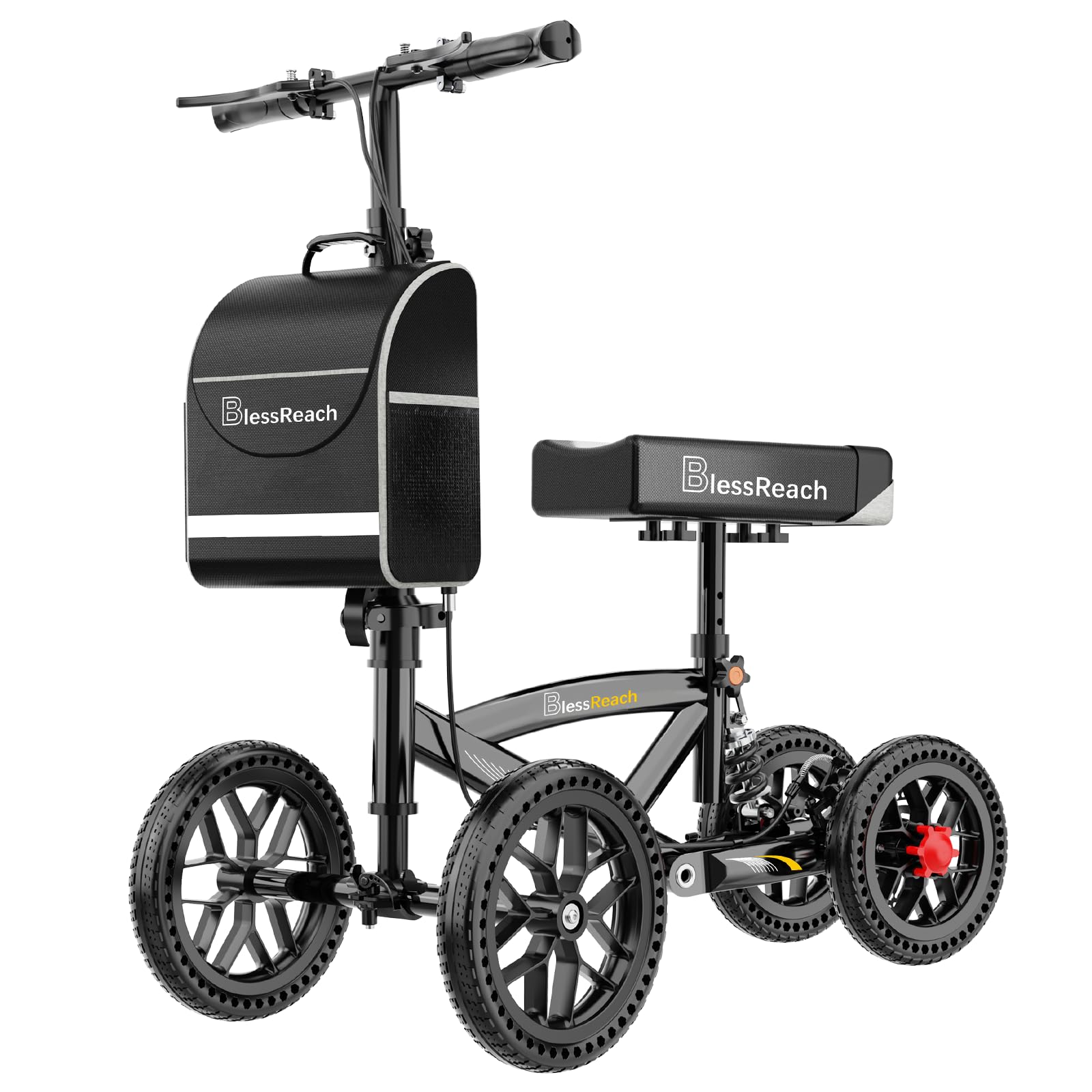
BlessReach All Terrain

86 /100
Trail Score Excellent

Key details

Tires
11-inch front, 8-inch rear
Brakes
Disc brake
Height Range
5 feet 6 inches to 6 feet 6 inches
Weight Capacity
300 lb
Check Price on Amazon

Disc brakes are rare on knee scooters, and this BlessReach is the only pick here that lists one. That is the feature that makes it interesting: a disc brake gives you a more direct, controllable stop than a basic pad brake, especially on a sloped driveway or a smooth garage floor. We like having that extra measure of control on a scooter that is meant to leave the sidewalk.

The rest of the all-terrain package is sensible: 11-inch front wheels and 8-inch rears, a 300-pound capacity, and a 25.6-pound frame. It folds for transport, and the six-level adjusters cover a useful range. The 11-inch front wheels lift over curb cuts and packed gravel more easily than the 8-inch scooters here, while the smaller rears keep the back end from feeling clumsy.

The fit is the first thing to check. The listed height range starts at 5 feet 6 inches, so shorter riders should look at the Deluxe or the budget BlessReach instead. The disc brake is the reason it earns a place, and its front wheels roll over a curb cut without the jolt of a small caster. For a taller rider who wants one scooter for the sidewalk and the yard, that combination is compelling.

Pros

  • Disc brake gives more controlled stopping
  • 11-inch front and 8-inch rear wheels
  • 300-pound capacity
  • Folds for transport and storage

Cons

  • Handlebar column can feel wobbly on rough ground
  • Fits only riders 5 feet 6 inches and taller
Our verdict

A taller rider who wants all-terrain grip without the premium all-terrain price will find the disc brake and big front wheels worth it.

Check Latest Price
4

Best Budget

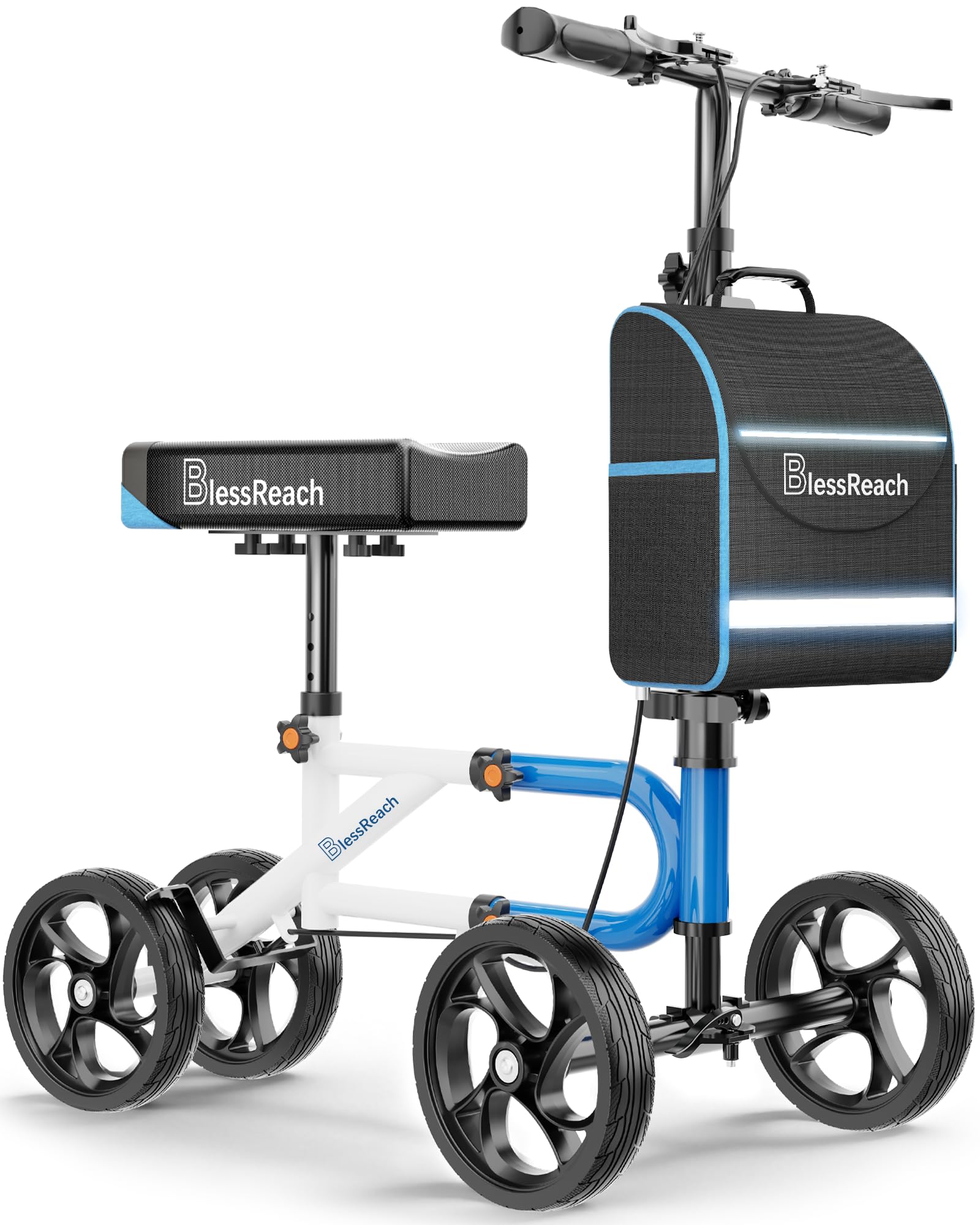
BlessReach Lightweight

86 /100
Trail Score Excellent

Key details

Bag
Detachable canvas
Frame
Double-tube
Wheels
8-inch
Steering
Folding lever
Check Price on Amazon

The BlessReach Lightweight is the budget pick, and it is a deliberate one: it keeps a double-tube frame, 8-inch wheels, and a detachable canvas bag while leaving out the premium steering hardware. For a short recovery on one floor, that is a sensible place to save. It is not trying to be an all-terrain scooter, and it does not pretend to be.

The 8-inch wheels roll easily on tile and low-pile carpet, and the canvas bag is more useful than a bare frame for carrying a phone, keys, or a snack. The main frame comes apart and the steering lever folds, so it fits into a trunk without becoming a permanent resident in the back seat. We also appreciate that the bag detaches, which makes loading and unloading less of a juggling act.

The long-term question is durability. The frame can develop wobble as fasteners loosen, so check the bolts and joints when it arrives and every few weeks after. That makes it a one-recovery purchase rather than a hand-me-down. For a tight budget and a mostly flat apartment, it can still be the right call, provided you are comfortable with that maintenance.

Pros

  • 8-inch wheels suit hard floors and low-pile carpet
  • Double-tube frame with folding steering lever
  • Detachable canvas bag carries small items
  • Lower cost than the all-terrain picks

Cons

  • Wide turning circle in tight rooms
Our verdict

For a short, budget-conscious recovery on one floor, this scooter covers the basics without asking for much money.

Check Latest Price
5

Level Indoor Floors

Drive Medical Knee Walker

89 /100
Trail Score Excellent

Key details

Basket
Removable
Casters
8-inch
Knee Pad Height
16.5 to 20.5 inches
Handlebar Height
31 to 40 inches
Check Price on Amazon

The Drive Medical knee walker is the lightest scooter in this group at 21 pounds, and that is its main argument. Eight-inch casters and a removable basket make it a simple indoor runabout: bedroom to kitchen to bathroom, with a place to put a phone or a set of keys.

We like the dual-padded cushions and the broad handle-height range, but the steering is the compromise. On uneven pavement the front end feels less planted than the Deluxe or All Terrain. If your recovery is mostly on level floors and you need something you can lift into a car, that is a fair trade; if your route includes a cracked sidewalk or a steep ramp, it is not the scooter we reach for.

The basket comes off for loading, and the 8-inch casters are happiest on hard floors and low-pile carpet; thick carpet and thresholds take more push. The frame is simple rather than plush, and for a level-floor recovery that is enough. It is the one to choose when portability matters more than all-surface confidence.

Pros

  • 21-pound frame is the lightest here
  • 8-inch casters for indoor floors
  • Dual-padded cushions
  • Removable basket

Cons

  • Wide turning radius in tight rooms
Our verdict

If you mostly need a light, simple scooter for level floors and car trips, the Drive Medical is an easy one to live with.

Check Latest Price
6

One-Floor Recovery

BodyMed Knee Walker

89 /100
Trail Score Excellent

Key details

Basket
Detachable metal
Brakes
Dual rear
Design
Collapsible
Check Price on Amazon

The BodyMed knee walker takes a different approach from the budget BlessReach: it is a collapsible four-wheel scooter with dual rear brakes and a detachable metal basket. At 27.05 pounds, it is one of the heavier picks here, so it is not the one to choose if you regularly load a car alone.

The dual rear brakes are the feature we appreciate most. Having a brake lever on each side gives you a second chance to slow down if one hand is occupied, and the metal basket is a better match for a water bottle or a pair of shoes than a soft canvas bag. The frame collapses for storage, though at this weight that is more about tucking it into a closet than carrying it up stairs.

The knee pad is firmer than the top pick's, so long days may call for a cushion or a break. The frame stays mostly on one floor; at 27.05 pounds it is not a daily car companion. If you want two brake levers and a metal basket in a simple folding frame, it is a practical also-consider. If a settled ride matters more, the Deluxe is the better choice.

Pros

  • Dual rear brakes give two stopping levers
  • Detachable metal basket
  • Collapsible frame for storage

Cons

  • Steering column can loosen over time
Our verdict

If you want dual brake levers and a metal basket in a simple folding frame, the BodyMed is a practical one-floor choice.

Check Latest Price

How We Tested the Best Knee Scooters

We started by pulling together knee scooters from orthopedic supply shops and mainstream mobility retailers, then narrowed the list by weight capacity, wheel type, adjustability, and price. The goal was a mix of budget-friendly and heavy-duty models, not just the most expensive ones. We ended up with 10 scooters and tested them over six months.

Each one was assembled out of the box and timed; we noted whether the instructions made sense and whether one person could do it without help. Testers then used their assigned scooter as their main way to get around for at least two weeks — through carpeted hallways, over sidewalk cracks, up and down curb cuts, and through tight grocery aisles. We measured turning radius by seeing how many points it took to reverse direction in a narrow hallway, and we pushed each model over uneven pavement to check whether the frame flexed or a wheel lifted.

Comfort got equal attention: we logged how the knee pad felt after 30 minutes and whether the handlebars adjusted to different heights. We also tested the brake lock, folding mechanism, and basket capacity, because those small features are the ones you use every day. After the full six months, we checked for loose joints, worn brakes, and wobble in the steering column. Finally, we compared each scooter's price against its build quality and features to flag any that felt overpriced.

How to Choose a Knee Scooter

Stability Comes Before Features

On a knee scooter you are balancing on one leg, so a frame that wanders is not a small annoyance. Tie-rod steering, a wider front axle, and a double-tube frame are the design details we look for before wheel count or basket size. The KneeRover Deluxe is the clearest example in this set: its tie-rod linkage and 300-pound rating make it feel more settled than the budget designs. A locking handbrake is the other non-negotiable; it lets you stop on a slope and park safely.

Match the Wheels to Your Route

Eight-inch casters are the indoor standard: they turn more easily on tile, laminate, and low-pile carpet. Once your route includes grass, gravel, or cracked pavement, the bigger air-filled tires on the all-terrain models earn their bulk. The KneeRover All Terrain runs 12-inch pneumatics, while the BlessReach All Terrain uses 11-inch fronts and 8-inch rears. The trade is real: larger wheels widen the turning circle and pneumatic tires need inflation. Choose the smallest wheel that covers the worst surface you will actually cross.

Set Both Heights Before You Roll

Knee scooters have two fit points: the handlebar and the knee platform. A model that adjusts at the handlebar but not the knee pad will leave taller or shorter riders hunched or reaching. The Deluxe covers 34.5 to 41.5 inches at the handlebar and 16 to 22.5 at the knee; the Drive Medical covers 31 to 40 and 16.5 to 20.5. Check the listed range before ordering, especially on the BlessReach All Terrain, which starts at 5 feet 6 inches.

Plan for the Car, Not Just the House

Most of these scooters weigh between 21 and 27 pounds, which is the difference between a one-person lift and a two-person job. Folding handlebars and removable baskets help, but none of them fold into a compact package like a stroller. If you load a car several times a week, put a premium on the lighter Drive Medical or BlessReach Lightweight. If the scooter stays on one floor, weight matters less than a stable frame and a comfortable knee pad.

Brakes, Tires, and the First Week

Test the brake before you trust it: squeeze the lever, set the parking lock, and try a slow stop on a flat surface. Disc brakes, like the BlessReach All Terrain's, are the most controlled option here; pad brakes are adequate on level floors. Check bolts after the first few trips and again weekly, and keep pneumatic tires at the sidewall pressure. A scooter that starts to wobble is telling you something needs tightening.

Frequently Asked Questions

Final Verdict

For most people recovering from a foot, ankle, or lower-leg injury, the KneeRover Deluxe KneeCycle is the one we recommend first. Its tie-rod steering, broad height range, and 300-pound rating make it feel settled on the move, and at 24.35 pounds it is still manageable for car trips. If your recovery route leaves pavement, the KneeRover All Terrain is the better buy: 12-inch pneumatic tires and a stabilizer wheel handle grass and gravel, though you pay for that in weight and tire maintenance. On a tight budget for a one-floor recovery, the BlessReach Lightweight keeps the essentials.