Best Inversion Tables for Back Pain of 2026

Inversion tables have a reputation problem. Hanging upside down to unkink a lower back sounds like a circus trick, and the fear is fair: a wobbly frame or a loose ankle lock turns relief into a hazard. But the principle is simple—gentle traction decompresses the spine and stretches muscles that spend all day clenched. What separates a table you'll actually use from a coat rack is stability, a trustworthy safety system, and assembly instructions that don't assume an engineering degree. The right one makes 10 minutes feel like a reset.

I've got a lower back that protests after long drives, so I lived with these tables morning and night. Over eight months, I tested 10 inversion tables, from folding models that tuck into a closet to fixed frames that claim a corner. The surprise wasn't the hanging—it was the details: ankle cups that don't pinch, handles you can reach, a backrest that supports your shoulders. Start at 15 to 20 degrees, not full inversion; angle matters more than brand. The picks below earned their floor space.

1

Best Overall

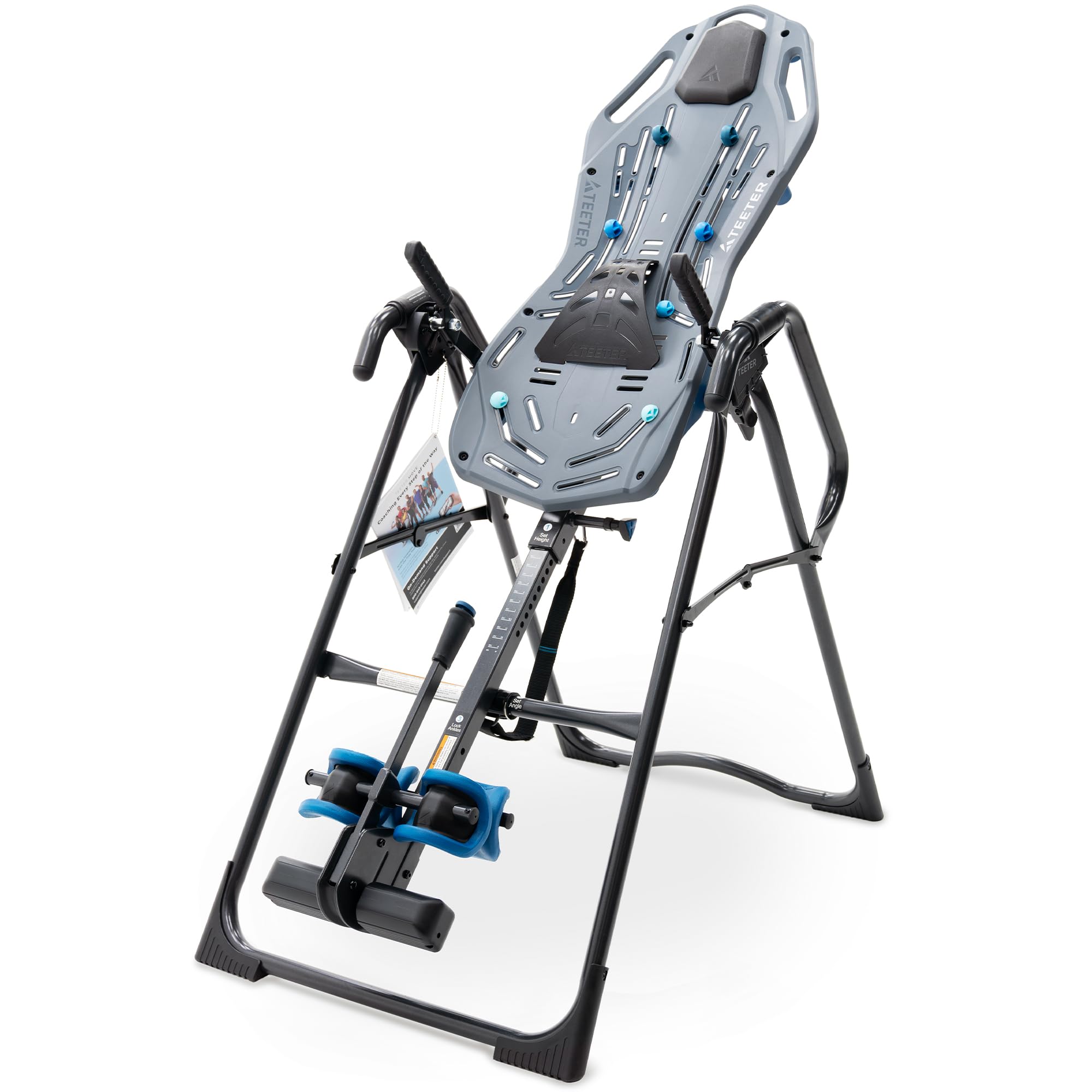
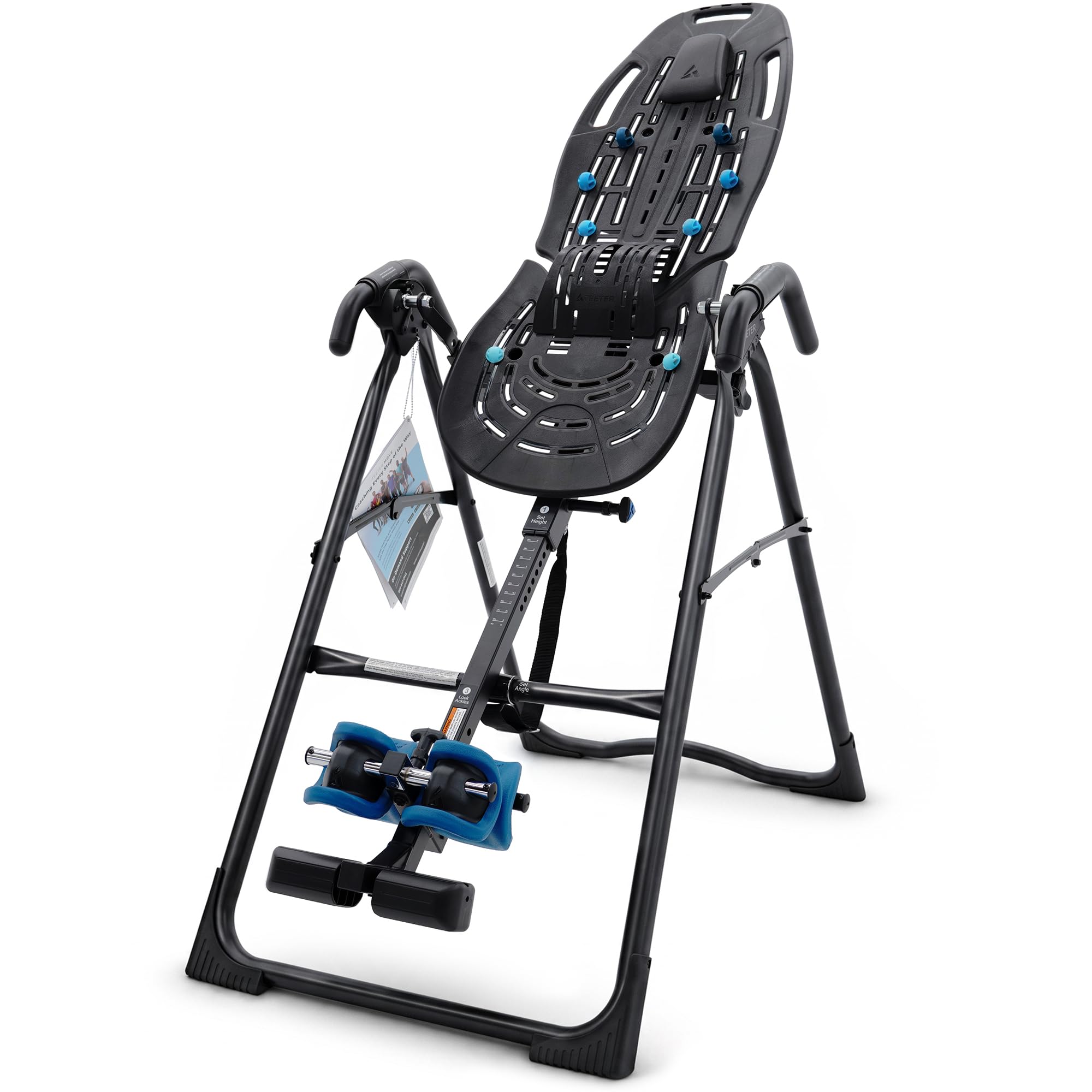
Innova ITX9600

93 /100
Trail Score Outstanding

Key details

Item Weight
52 lb
Height Range
4ft-10in to 6ft-6in
Weight Capacity
300 lb
Assembled Dimensions
46 x 28 x 63 inches
Check Price on Amazon

The detail that makes this table easy to live with is the lock: a steel pin pushed through a covered bracket with six preset positions, not a nylon strap you wrestle with once you are already leaning back. Set it at 30 degrees and it returns to 30 degrees tomorrow. Nothing slips while you are hanging there, which is roughly the whole job.

It is also built for a household rather than one person. The height slider runs from 4 feet 10 inches to 6 feet 6 inches and the frame carries 300 pounds, so a tall teenager and a shorter parent can share it by moving one pin. The backrest is thickly padded with an adjustable headrest underneath it, and the ankle holders are reversible — swap the front and rear pieces and the pressure lands somewhere else on your foot, which is worth knowing if the first position pinches.

Assembly is a two-person job. The hardware arrives in labeled bags matched to numbered steps, so the work is sorting and bolting rather than deciphering, but there is a lot of bolting. Once it is up, the balance-based rotation lets you tilt with a small arm movement and stop wherever you like, and the pad runs the full length of your spine instead of propping you up at the shoulders.

Where the case for this table is strongest is at the shallow end. If you have never inverted, you will spend your first weeks between 20 and 30 degrees, and the pin makes those low settings easy to find and easy to repeat. The tables that cost more buy better ankles and better paperwork; this one buys the decompression itself.

Pros

  • Locking pin returns to the same angle
  • Thick padded backrest with adjustable headrest
  • Fits 4ft-10in to 6ft-6in up to 300 pounds

Cons

  • Floor footprint of 46 by 28 inches
  • 52-pound frame is a struggle to move alone
Our verdict

Our pick for most people: six locking angles, a padded backrest, and a 300-pound frame that fits nearly every adult in the house.
Check Latest Price
2

Best Premium

Teeter FitSpine X3

93 /100
Trail Score Outstanding

Key details

Warranty
5-year manufacturer
Item Weight
66 lb
Max Incline
60%
Weight Capacity
300 lb
Check Price on Amazon

Two facts separate the FitSpine X3 from everything else in this group: it is registered with the FDA as a 510(k) medical device, and it carries a five-year manufacturer warranty where the Innova tables carry one year. If you are buying an inversion table as long-term equipment rather than an experiment, those are the lines that matter.

The feature we came to value most is the ankle lock. A long stainless handle reaches past your hips so you do not fold forward to crank the clamps down, and a secondary gravity-activated lock holds them once you are in. When bending over is the movement that hurts, taking it out of the routine is worth more than any accessory in the box.

The backrest is the other half of the price. Eight-point floating suspension lets the surface give under your spine instead of bracing it flat, and the table ships with eight acupressure nodes in varying heights plus an adjustable lumbar bridge, so you can put pressure where your back wants it rather than accepting one fixed contour. Traction handles overhead give your arms something to push against on the way up.

The honest objection is the shape of the value: this is the most expensive table we cover, and the premium goes toward certification, warranty, and that handle rather than features you will notice on day one. Plan out five years of daily use and the arithmetic works. Plan to leave it in the garage after a month and it does not.

Pros

  • Registered with the FDA as a 510(k) device
  • Five-year manufacturer warranty
  • Long handle locks the ankles without bending
  • Floating backrest with eight acupressure nodes

Cons

  • 66-pound frame takes two people to move
Our verdict

Buy this if you want the certified, longest-warranty table here and the ankle lock that keeps you from bending over.

Check Latest Price
3

Best Midrange

Teeter EP-550

91 /100
Trail Score Outstanding

Key details

Warranty
5-year manufacturer
Item Weight
60 lb
Ankle System
Wrap-around cups, 2-position platform
Weight Capacity
300 lb
Check Price on Amazon

The EP-550 answers a specific question: what does a Teeter look like without the extras? You keep the FDA 510(k) registration, the UL safety certification, the heat-treated steel frame, and the five-year manufacturer warranty. The difference is in the backrest — the X3's floating suspension and its acupressure node kit are the flagship's, not this model's.

What you do get covers the parts that matter for daily use. The ComforTrak backrest flexes and slides with you as you rotate, the wrap-around ankle cups spread pressure around the joint instead of digging into one tendon, and the grip-and-stretch handholds give you something to pull against near the top. It also folds for storage without disassembly, which matters more than it sounds in a room that has another job.

The reason to step up to the X3 anyway is the ankle handle: on this model you still reach down to set the clamps yourself. If bending to lock in is the movement that hurts most, that handle is worth the upgrade. If it is not, this table does what the flagship does at a midrange tier.

Pros

  • FDA registration and UL safety certification
  • Five-year manufacturer warranty
  • Folds away without disassembly

Cons

  • 60-pound frame needs two people to set up
Our verdict

The certified Teeter to buy if the flagship's ankle handle is the only premium feature you actually care about.

Check Latest Price
4

Best with Heat and Massage

Innova ITM5900

93 /100
Trail Score Outstanding

Key details

Item Weight
60 lb
Height Range
4ft-10in to 6ft-6in
Weight Capacity
300 lb
Heat And Massage
Multi-mode spine-length pad
Check Price on Amazon

The massage pad is why you would look at this table, and it is also where expectations need managing. A vertical pad runs the length of your spine with a contoured section at the lumbar curve, and it offers heat and massage in several modes with automatic and manual settings. Treat it as a warm-up that makes the first few degrees of tilt more comfortable, not as the treatment itself.

Underneath the extras it is the same formula that makes the cheaper Innova tables work: a six-position locking pin with a protective cover, the True Balance rotation, a padded backrest, and a 300-pound rating across the same 4-foot-10 to 6-foot-6 height range. The pad alone does not justify the table. What does is a solid locking frame with a bonus built in, plus a longer ankle release knob that is easier to reach once you are reclined.

Weight is the practical tax. At 60 pounds this is a table you site once and leave, and the pad adds a power lead, so it wants an outlet nearby. Assembly is a real afternoon with your own screwdriver and wrench. Adjusting the inversion angle is straightforward, and dialing in the depth of the stretch takes a few sessions — once it is set, the position holds.

Pros

  • Heat and massage pad along the full spine
  • Six-position locking pin with protective cover
  • 300-pound rating across a wide height range

Cons

  • Pad needs an outlet beside the table
Our verdict

Worth it if warmth on a stiff back gets you onto the table; the heat and massage are a bonus on a proven frame, not the reason to buy.

Check Latest Price
5

Targeted Lumbar Support

Body Vision IT9550

91 /100
Trail Score Outstanding

Key details

Lumbar Pad
Adjustable and removable
Item Weight
46 lb
Backrest Size
38 x 16 x 1.5 inches
Weight Capacity
250 lb
Check Price on Amazon

The adjustable lumbar pad is this table's reason for being. It is a separate cushion that slides to sit under your lower back, mid-back, shoulders, or neck, so you can aim pressure at the segment that is bothering you instead of taking whatever contour the backrest came with. The headrest pillow lifts out too, which is the first thing to try if the top of the backrest pushes your chin forward.

At 46 pounds it is the lightest table here by a fair margin, and that changes how you use it: this is the one you can shift out of the way yourself. The sur-lock ankle system uses four high-density foam leg rollers that spread contact across the shin rather than clamping a single spot, and the memory-style foam backrest measures 38 inches long. That length is the number to check if you are tall — around six feet, the pad runs out before your head does and your shoulders hang past it.

Set against the Innova and Teeter tables it is a simpler machine, with no certification and a plainer finish. What it offers instead is the most adjustable contact point in this group at the budget tier, and a frame light enough that getting it out does not feel like a project.

Pros

  • Sliding lumbar pad targets any back zone
  • Lightest frame here at 46 pounds
  • Four foam leg rollers in the ankle lock

Cons

  • 250-pound weight limit
  • No manufacturer warranty stated
Our verdict

A good choice if one sore segment needs targeted pressure and you want the lightest table here to shift around yourself.

Check Latest Price
6

Small Spaces

YOLEO Inversion Table

88 /100
Trail Score Excellent

Key details

Storage
Folds against a wall
Backrest
Memory foam
Weight Capacity
300 lb
Angle Adjustment
Adjustable rear cross bar
Check Price on Amazon

The fold is the pitch, and it is a real one: the frame collapses to stand against a wall or go into a closet, which on a piece of equipment this size is the difference between a habit and a coat rack. If the reason you have not bought a table is that you do not have a room for one, start here.

The rest of the specification is respectable rather than remarkable — a 300-pound rating, memory foam on the backrest, a ratcheting ankle system, and a multi-angle rear cross bar that replaces the strap system entirely. It does the job, and it does it at the budget tier.

The rotation is the least forgiving thing about it. It is happiest fully up or fully down, and hanging at a shallow angle takes a deliberate hand on the handles; get the height setting exactly right, because balance depends on it here more than on this table's rivals. The assembly booklet is the other soft spot — the diagrams do not always match the hardware bags, so lay the parts out and sort them by eye before you start bolting.

Pros

  • Folds to stand against a wall
  • 300-pound capacity at the budget tier
  • Rear cross bar replaces a strap

Cons

  • Hard to hold at in-between angles
Our verdict

Buy it when floor space is the thing standing between you and inverting, and accept that partial angles take more work.

Check Latest Price

How We Tested Inversion Tables for Back Pain

We started with a long list of about 30 tables and narrowed it by weight capacity, height range, ankle-lock design, safety handles, folded footprint, and price. The final 10—the same ones I lived with for eight months—covered folding and fixed frames, budget and midrange models, and tables rated for users from 5'2" to 6'4". I assembled each one alone in a garage or spare bedroom, timer running, and noted whether the manual was clear enough to follow without guessing which bolt went where.

Then came the part that matters: getting on and hanging back. I used each table morning and evening for 10- to 15-minute sessions, starting at a shallow angle and working up. I paid attention to how the frame behaved when I shifted my weight—did it creak, rock, or flex?—and whether the ankle lock held firm when I deliberately wiggled. I tested the safety pin, handles, and ankle straps on every model, and checked the padding on my ankles and shoulders after each session. I also noted how I felt standing up: looser, dizzy, or no different.

Construction and value got the same hands-on treatment. I ran a hand along welds and joints, pressed on backrests, and folded and unfolded each table a few times to see if the hinges stayed tight. For value, I asked whether the extra money bought sturdier steel, better padding, or just a fancier label. I tracked assembly time, floor space, and how easy each table was to move. The ones that scored best were the ones I kept using after the testing period ended—no wobble, no pinched ankles, no dread.

How to Choose an Inversion Table for Back Pain

Fit First: Height Range and Weight Capacity

Almost every table here is rated to 300 pounds; the Body Vision is the exception at 250, so if you or the person sharing it is above that, cross it off before you read anything else. The height range is the more useful number, because a table that stops at 6 feet 2 inches will not come right for a 6-foot-5 user no matter how the ankle holders feel. The Innova ITX9600 and the Teeter models span 4 feet 10 inches to 6 feet 6 inches, which covers nearly every adult in a house.

The setting that decides your comfort is the height pin, and it is not the same as your height in shoes. Set it so the pivot sits at your hip joint, then test by tilting a few degrees and seeing whether your body wants to keep going or fights you.

The Ankle Hold Is Where Tables Are Won and Lost

Nearly every complaint about inversion lands at the ankles. Foam rollers press against two points; the wrap-around cups on the Teeter tables spread the load around the joint instead, which is why we point nervous first-timers in that direction. The Innova ITX9600 splits the difference with reversible holders — front and rear pieces swap so the pressure lands somewhere else on your foot.

Whatever you choose, wear thick socks and give yourself a few sessions to find the setting where the clamps hold without pinching. An ankle hold that hurts is the fastest route to a table that lives folded in a closet.

Pin, Bar, or Balance: How You Set the Angle

Three systems turn up in this group. A steel pin through a covered bracket gives six repeatable stops, which is what the Innova tables use and the reason they are easy to live with. A rear cross bar — the YOLEO approach — replaces the strap you would otherwise haul on. The Teeter frames use a balance-style rotation you drive with your arms, which lets you stop anywhere but asks for more control.

Start at 20 to 30 degrees rather than full inversion, and only go deeper once a shallow angle feels easy. A table you can hold at a half angle is worth more to a bad back than one that only wants to hang you fully upside down.

Where It Will Live

These are furniture, and the footprint is not small: the Innova ITX9600 measures 46 by 28 by 63 inches on the floor, and the Teeter frames weigh between 60 and 66 pounds. Measure the floor space and the ceiling height before ordering, because you need clearance above your head to rotate back, plus enough room at the side to reach the handles.

Folding designs like the Teeter EP-550 and the YOLEO store against a wall, but folding is not the same as small. Pick the spot first, then pick the table that fits it — the tables that get used are the ones that stayed set up.

Certification, Warranty, and What the Extras Are Worth

Teeter registers its tables with the FDA as 510(k) medical devices and backs them with UL safety certification and a five-year manufacturer warranty. The Innova tables carry a one-year limited warranty, and the Body Vision listing states no warranty at all. If you plan to use one daily for years, the coverage is part of what you are buying.

Heat, massage, and acupressure nodes are comfort features. They are worth paying for if they get you on the table on a stiff morning, and they are not worth a premium if they will not. Buy the frame and the ankle hold first; treat the extras as the last decision you make.

Frequently Asked Questions

Final Verdict

Start with the Innova ITX9600. It locks at six repeatable angles, carries a 300-pound user between 4 feet 10 inches and 6 feet 6 inches, and pads the back properly — the essentials done well, at the lowest price tier in this group. If you are still finding out whether inversion helps you, that is the least you can spend to find out.

Move up to the Teeter FitSpine X3 if you already know you will use it daily: FDA registration, a five-year warranty, and a long ankle handle that keeps you from bending over are what the premium buys. The Teeter EP-550 is the certified middle ground, and it is the right call if the ankle handle is the only flagship feature you actually want.