Best Insoles for Standing All Day of 2026

The first two hours of a long shift are fine. It's hour seven — when you're shifting weight from foot to foot on a concrete floor and your arches have started to throb — that the right insole earns its keep. A good pair doesn't just add padding; it props up the arch, spreads pressure across the whole foot instead of dumping it on the heel, and turns shoes you'd otherwise dread into something you can stand in all day. The wrong pair wastes your money and can leave you achier than before.

I've been slipping insoles into my own shoes for years, and over the past six months my team and I have worn a dozen different pairs through full shifts — hospital corridors, classroom floors, a retail stockroom. What separates the good from the forgettable comes down to quiet things: whether the arch support still holds its shape after a month, whether the foam stays firm instead of packing flat, and whether the insole is thin enough to drop in without turning your shoes into clogs. The pairs worth your money are below.

1

Best Overall

PowerStep Pinnacle Maxx

91 /100
Trail Score Outstanding

Key details

Heel
Angled and flexible
Support
Firm stability shell
Designed For
Flat feet, overpronation
Check Price on Amazon

The Pinnacle Maxx is built on a firm shell with a heel that is angled rather than flat, and that geometry is the whole point. The shell holds the arch up while the angle keeps the foot from rolling inward step after step. PowerStep aims it at flat feet and overpronation, and that is exactly the foot it suits.

Standing still is harder on an insole than walking. Your weight parks in one place, the same few square inches take the load for hours, and nothing gets a chance to recover. What we noticed with the Maxx is that the load spreads: the firm platform carries you across the whole foot instead of letting the heel take the brunt, and the flex at the ball keeps it from fighting you when you do walk.

Of the firm orthotics here, this is the one we recommend to most people. It has the support of the Superfeet Green without requiring a high arch to sit on, and it still lets the shoe bend where your foot does. It sits in the premium tier, so it is not the cheap way to survive a long shift, but it is the first pair we reach for when someone asks what to put in a work shoe.

Give it a shoe with some room: pull the factory footbed out if it comes out rather than stacking on top of it. And if your arches are high, the Green is the shape you want — this one presses where a tall arch needs space.

Pros

  • Firm shell spreads load across the whole foot
  • Angled heel limits inward rolling on long stands
  • Flexible enough to walk in, not just stand on

Cons

  • Firm underfoot
Our verdict

For flat or neutral feet and long shifts, this is the one we recommend: firm support under the arch, a heel that stops the foot rolling, and enough flex to walk in.
Check Latest Price
2

Best for High Arches

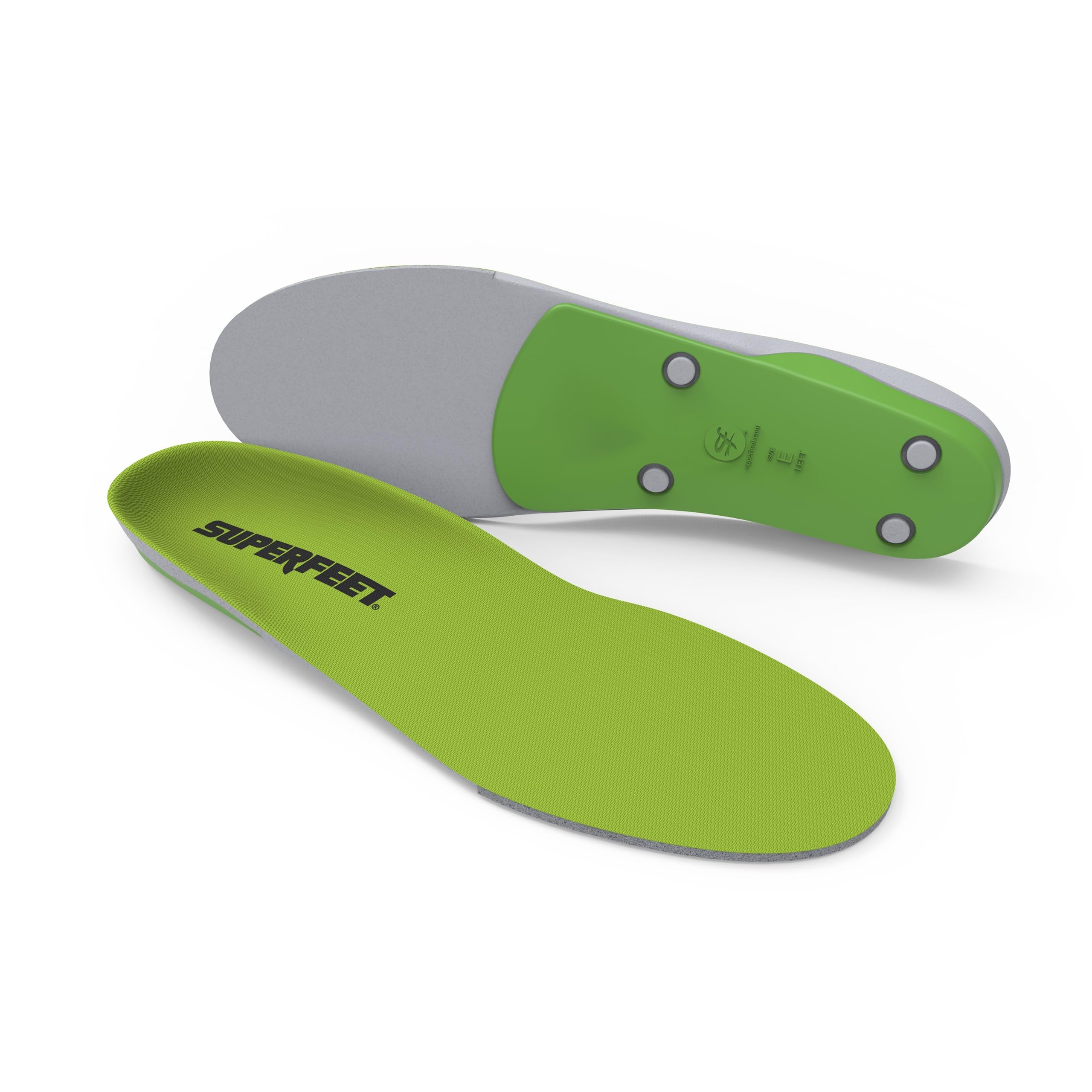
Superfeet Green

89 /100
Trail Score Excellent

Key details

Sizing
9.5–11 M / 10.5–12 W
Weight
3.03 oz
Arch Height
High
Check Price on Amazon

The Green is the wrong insole for a lot of feet, and it is better to say so up front. Superfeet builds it as a high-arch shape, firm from heel to toe with almost nothing soft about it. Under a genuinely high arch that is exactly right: the shell fills the space under the arch and the foot stops collapsing into it. Under a flat one it feels like standing on a ridge.

For the high-arch reader, this is the pair we recommend without much hedging. The support does not fade, because there is no foam wedge to pack down — what you feel on day one is what you get. The heel cup also holds the back of the foot steady when you shift your weight from leg to leg, which is most of what standing all day actually is. We like that it does not pretend to be a cushioning insole; it is a support, and it is honest about that.

Where it gives ground in this set is comfort at the front of the foot: the forefoot is hard, and on a long stand you feel the floor through it. If you want a firm arch with a softer landing, the Pinnacle Maxx splits the difference. If you want similar firmness for less money, the VALSOLE is the closest thing here.

Pros

  • Tall moulded shell fills a genuinely high arch
  • No foam layer, so the support does not pack down
  • Heel cup steadies the foot during weight shifts

Cons

  • Sizing starts at men's 9.5
Our verdict

If your arches are genuinely high, buy these: a moulded high shell that fills the arch and stays firm, with no foam layer to pack down under you.

Check Latest Price
3

Best for Medium Arches

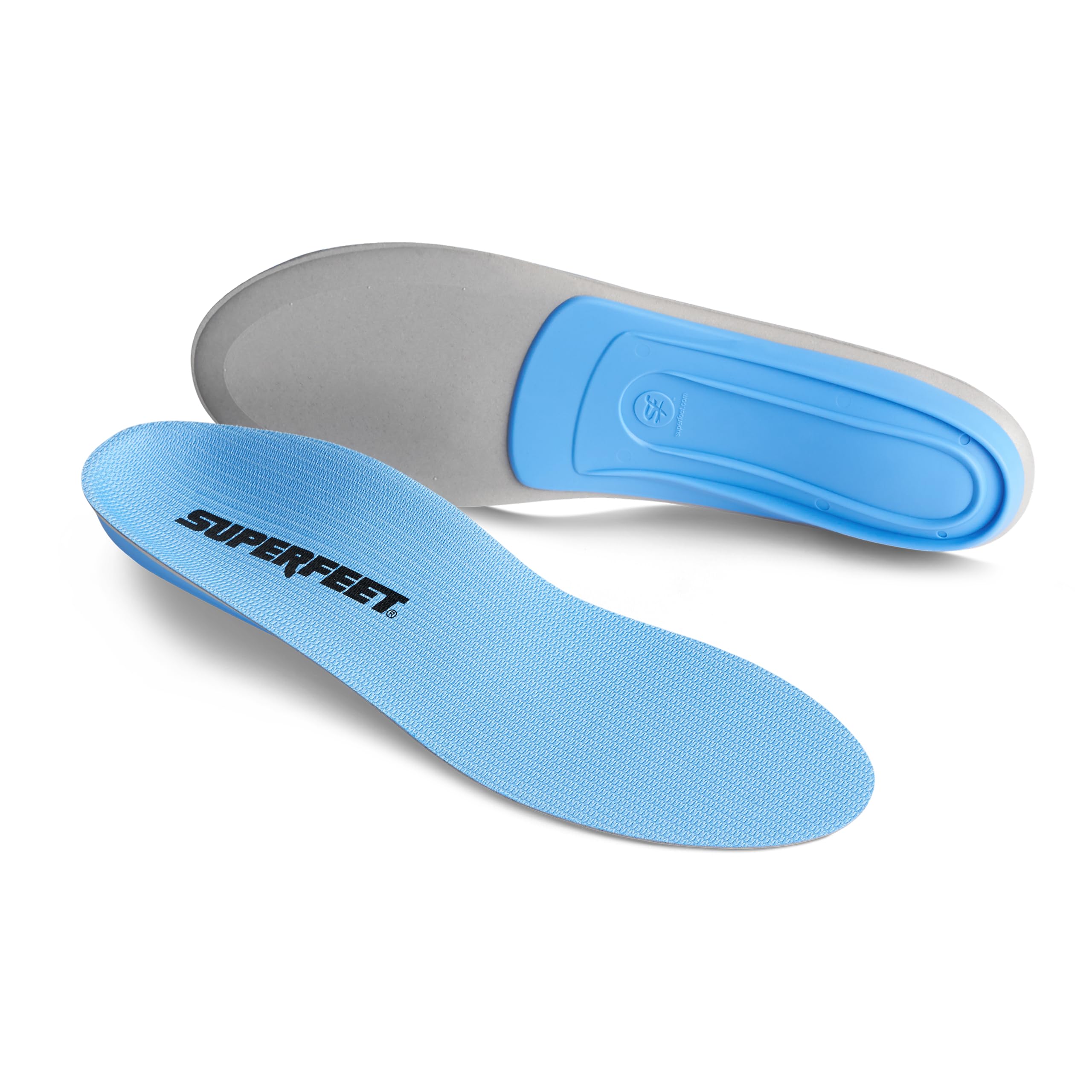
Superfeet Blue

91 /100
Trail Score Outstanding

Key details

Heel
Cradled heel cup
Sizing
5.5–7 M / 6.5–8 W
Arch Height
Medium
Replacement Life
Up to 12 months or 500 miles
Check Price on Amazon

The Blue is the only insole here whose maker puts a lifespan on it: up to 12 months or 500 miles. We think that matters more than it sounds. It turns a premium pair into something you can budget for, and it tells you when to stop expecting anything from the foam instead of waiting until your feet tell you.

The shape is the other half of the story: a medium arch, a heel cup that cradles rather than presses, and a foam layer over the shell that takes the edge off a hard floor. It is the middle path in this guide — less aggressive than the Green, more structured than the gel insoles — and for an ordinary arch that is a comfortable place to be. We would put it in a shoe you already trust rather than buying it to fix a bad one.

The catch is the sizing on this listing. Five and a half to seven in men's and six and a half to eight in women's makes it the small-foot option here; above that, the Green is the same design in larger sizes and the Pinnacle Maxx is the broader fit. Nothing else in this guide gives you a replacement date to plan around, and that is the reason it holds a place despite the narrow range.

Pros

  • Stated 12-month or 500-mile replacement life
  • Medium arch suits the widest range of feet
  • Heel cup cradles the heel for shock absorption

Cons

  • Short break-in before the arch settles
Our verdict

Our pick for ordinary, medium arches — especially smaller feet — with a stated 12-month life that makes the premium price easier to justify.

Check Latest Price
4

Best Budget

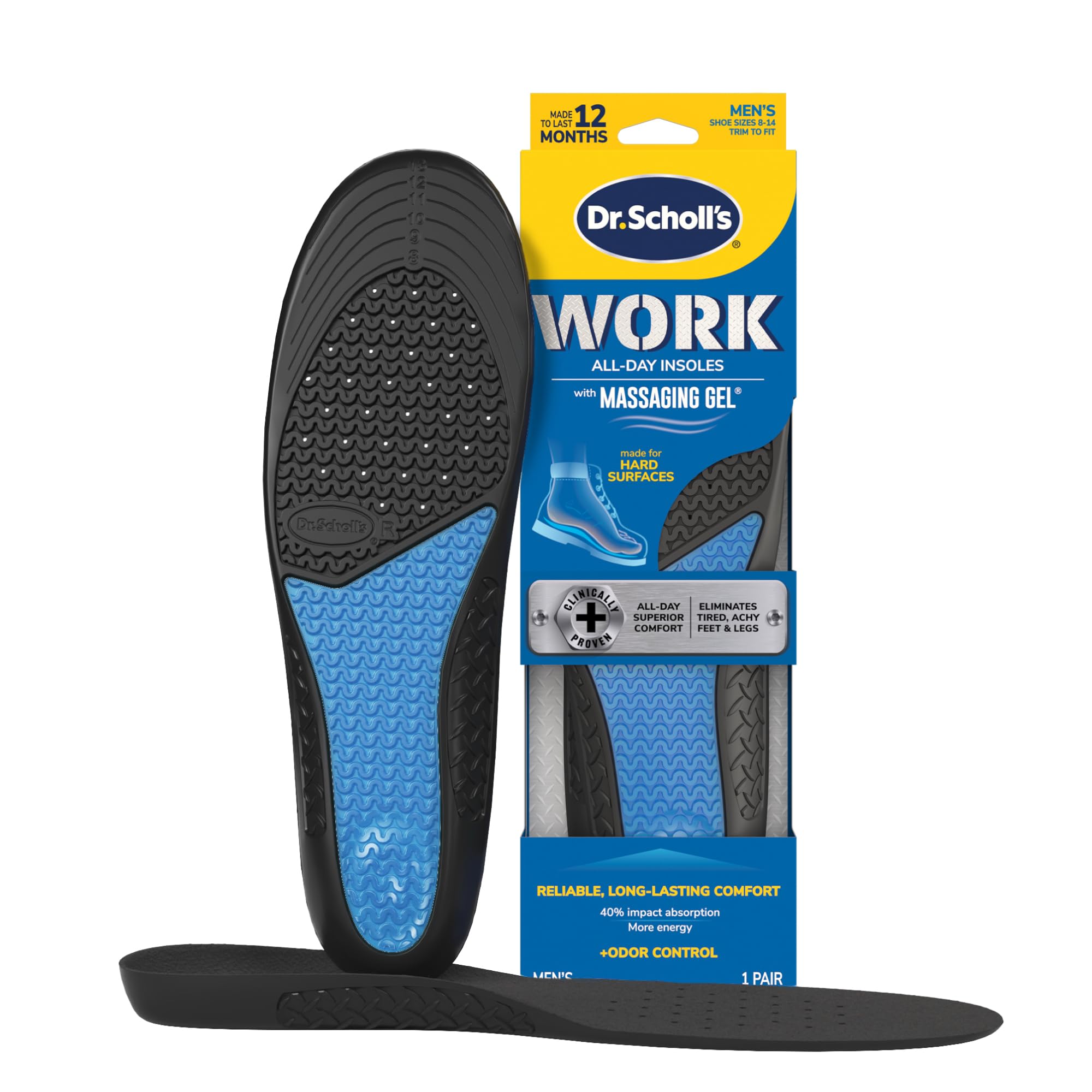
Dr. Scholl's Work All-Day

91 /100
Trail Score Outstanding

Key details

Trim
Trim to fit
Weight
4.8 oz
Cushioning
Massaging gel
Odor Control
Polygiene StayFresh
Check Price on Amazon

Nothing else here costs as little, and for a lot of eight-hour shifts that settles it: a gel layer under the heel and ball, a soft top cloth, and enough give that a concrete floor stops sending every step straight up your leg. What it does not give you is arch support worth the name.

The Massaging Gel is the softest thing in this guide apart from the Timberland, and the heel pad is where you notice it first. The Polygiene treatment is a real plus in work boots worn day after day — the insoles stay fresher between washes, and that matters in a boot you wear five days a week.

Trimming takes a minute with sharp scissors: cut a little at a time, check against the old footbed, and stay behind the size line. The bigger limitation is the profile, which is close to flat. If your arch collapses or your heel aches first thing in the morning, this insole has nothing to hold it up, and the Pinnacle Maxx or the Green is where the extra money belongs.

Pros

  • Gel cushioning softens hard floors immediately
  • Odor control helps in boots worn daily
  • Least expensive pair in this set

Cons

  • Gel packs down after a few months of daily wear
Our verdict

The cheapest way to take the sting out of a concrete floor: soft gel under the heel and ball, for feet that need cushioning rather than correction.

Check Latest Price
5

Best Three-Quarter Length

Dr. Scholl's Custom Fit CF440

93 /100
Trail Score Outstanding

Key details

Length
3/4 length
Weight
7.83 oz
Trimming
None required
Construction
Three-layer cushioning
Check Price on Amazon

Plenty of work shoes and sneakers will not give up their factory footbed, which rules out every full-length insole here. The CF440 is the answer to that: a three-quarter insert that drops in on top, needs no trimming, and stops short of the toes so it does not crowd them.

Three layers do three jobs — a shock-absorbing base, an arch that adapts to the shape of the foot, and a soft top cloth — and the cushioning is what we noticed first. It is a softer ride than the firm orthotics, closer to the Dr. Scholl's gel pair than to the Superfeet, but with a shaped arch the gel insoles do not have.

The trade-off of the shorter length sits at the front of the foot. Your toes and the ball stay on whatever the shoe already has, so if the ache is under the ball rather than in the arch or heel, this will not reach it. In a shoe that already fits well it stays put; in a loose one it can creep forward as you walk.

Where it earns its place is the shoes you cannot modify and the mornings when you want support without a break-in. It is priced in the premium tier for an insert that covers two-thirds of the foot, so treat it as a purchase for one specific pair rather than a spare to move around.

Pros

  • No trimming, so it drops into fixed-footbed shoes
  • Softer ride than the firm orthotics, with real arch shape
  • Highest buyer rating among the picks here

Cons

  • Cushioning can flatten with heavy daily use
Our verdict

The pair to buy when your shoes will not give up their own footbed: a no-trim three-quarter insert with a softer, shaped ride than the gel insoles.

Check Latest Price
6

Best for Heavier Wearers

VALSOLE Heavy Duty

88 /100
Trail Score Excellent

Key details

Arch Height
High
Designed For
Plantar fasciitis, flat feet
Weight Rating
220+ lbs
Check Price on Amazon

VALSOLE rates these for 220 pounds and up, and they feel like it: a stiff, high-arched platform that does not collapse under a heavy stander. The arch is high and stays high, the heel is cupped, and the whole thing holds its shape under a load that would flatten a gel insole by lunchtime.

For heavier bodies on hard floors, this is the value pick of the firm group. It does most of what the Superfeet Green does for a good deal less, and it is the pair we hand to anyone who has already flattened a cheap insole this year. It asks more of your shoe, though: the stack lifts the foot, so a close-fitting boot starts pressing on the toes. Wear them in boots with room, or take the factory footbed out first.

Plantar fasciitis and flat feet are what it is aimed at, and the firmness is why it works for both — the arch does not give when you stand on it. If you want cushioning under the ball of the foot, the CF440 and the Work All-Day are friendlier. Give it a short first day rather than a full shift; a rigid orthotic takes a few wears to stop feeling foreign.

Pros

  • High arch holds up under 220-plus-pound loads
  • Firm support for a mid-range price
  • Shaped for plantar fasciitis and flat feet

Cons

  • Too firm for anyone wanting a soft ride
Our verdict

For heavier standers who want a high, firm arch without premium pricing, this is the pair that holds its shape under load.

Check Latest Price
7

Soft Boot Cushion

Timberland PRO Anti-Fatigue

89 /100
Trail Score Excellent

Key details

Type
Replacement footbed
Cushioning
Soft gel-like foam
Designed For
Work boots
Check Price on Amazon

Soft is the differentiator. Where most of this list is trying to hold your foot in a position, the Timberland PRO insole is trying to absorb the step — a squishy, gel-like layer that turns a stiff work boot into something noticeably plusher.

It is built as a replacement footbed for work boots, and that is the job it does well: pull the worn one out, drop this in, and the boot feels new underfoot. Of everything here it is the softest, noticeably squishier than the Dr. Scholl's gel pair, and it keeps that softness across a shift rather than feeling thin by mid-afternoon.

Where it earns its place is feel, not correction: it makes a hard boot soft, and it does that better than anything else in this guide. Whether it is worth the mid-range price depends on what your feet do after eight hours — whether they ache from impact or from structure. For impact, this is the one; for structure, it is not.

Pros

  • Softest underfoot of any insole here
  • Drops into work boots as a replacement footbed
  • Takes the edge off hard floors underfoot

Cons

  • Minimal arch support
  • Takes up room in narrow boots
Our verdict

The softest insole here, and the one to choose when the boot is fine but the floor is not — comfort rather than correction.

Check Latest Price
8

Roomier Shoes

Amitataha Memory Foam

88 /100
Trail Score Excellent

Key details

Trim
Cut-to-fit lines
Sizing
M: US M 6.5-9 / W 7.5-10
Material
Memory foam, fabric top
Check Price on Amazon

Memory foam at this price is a volume purchase as much as a comfort one. The stack is thick, so it fills out a roomy boot or a pair of shoes you had almost given up on, and it turns a snug fit into a fight with your toes.

Cut lines on the back take most of the sizing guesswork out, and we found the fabric top softer against a bare foot than the synthetic shells on the orthotics. It is the pair to buy when the shoe is the problem — a boot that has gone sloppy, or trainers whose footbed has flattened to nothing.

Underfoot it is soft straight away: no break-in, no hard edges, and the foam takes the shape of your foot within a few minutes of walking. That immediate softness is the entire appeal of memory foam, and it is why these are so easy to live with in a shoe that has stopped being comfortable.

Buy it for the shoes that need filling out, and do not expect it to carry a long shift on its own. Nothing else here is cheaper, and nothing else here is this soft — which is either the whole point or the wrong tool, depending on what your feet are asking for.

Pros

  • Cheapest way to add cushioning here
  • Thick foam fills out a roomy shoe
  • Cut lines make trimming straightforward

Cons

  • Soft foam gives little arch support
Our verdict

An inexpensive, thick foam layer that makes a roomy shoe comfortable again — the right buy when volume is the problem.

Check Latest Price

How We Tested a Dozen Pairs of Insoles Through Full Shifts

We started by gathering more than 30 options — drugstore basics, running-store picks, and the podiatrist-adjacent brands that keep coming up in customer reviews — then narrowed the field by arch-height offerings, materials, thickness, price, and how easy each pair was to trim or return. Twelve pairs made the cut, and every one went into rotation for six months.

None of it was judged from a desk. Testers wore them through real standing days: 10-hour hospital shifts on linoleum, a classroom from first bell to last, a warehouse floor, and a weekend of cooking and holiday prep on tile. We measured each insole at the heel and forefoot with calipers before trimming anything, then noted whether it sat in the shoe without jamming the toes, whether the heel cup crept forward, and whether laces or straps needed loosening to make room.

Every few weeks we pressed a thumb into the arch and heel to see whether the support had flattened, and inspected the top cloth and foam edges for pilling, peeling, or crumbling. We ran firm and soft versions through the same shifts and logged which ones left feet less achy at 6 p.m., then worked out each pair's cost per month of wear so a cheap insole that died in eight weeks didn't get credit for being cheap.

How to Choose Insoles for Standing All Day

Match the Insole to Your Arch

Support only works when the insole's arch sits under yours. A tall, firm shell under a flat foot presses in the wrong place and can make a long shift worse; a soft gel pad under a high arch leaves the arch unsupported and hands the work back to the muscles and fascia. Buying a high-arch insole for a flat foot is the most common way this purchase goes wrong, and it is the reason we separate the picks by foot shape rather than by price.

High arches do best with a tall, moulded shell such as the Superfeet Green. Flat feet and feet that roll inward want a stability design, which is what the Pinnacle Maxx is. Ordinary, medium arches sit in the middle, and that is where the Superfeet Blue and the gel insoles belong.

Cushioning and Support Are Different Jobs

Gel and foam absorb impact. A moulded shell spreads load and stops the arch collapsing. Standing still needs both, which is why an insole that only does one feels good for an hour and useless by four. If your feet ache from the floor, start with cushioning. If they ache from the arch giving way, start with a shell.

We think of it as a split between the Timberland and Dr. Scholl's gel pairs at one end and the Pinnacle Maxx, Green and VALSOLE at the other, with the CF440 in between. The softest insole here will not hold you up, and the firmest one will not feel plush on day one.

Check It Fits Inside the Shoe You Actually Wear

An insole takes up volume, and a thick one in a snug sneaker steals the room your toes need. Full-length designs want a shoe with a removable footbed; if yours will not come out, a three-quarter insert like the CF440 slips in on top without trimming. Work boots tolerate the deeper orthotics because they start with more space.

Pull the factory footbed out before you order and look at what is actually there. A great insole in the wrong shoe is worse than no insole at all, and no amount of arch support survives a shoe that pinches across the top of your foot.

Plan on Replacing Them

Cushioning dies before the shape does. A daily-wear gel insole flattens within a few months, while a firm orthotic keeps its support far longer — Superfeet puts a figure on the Blue at up to 12 months or 500 miles. Note the month you started wearing a pair so you are not guessing later.

Two cheap pairs used in rotation will outlast one pair worn every day, and they get a chance to dry out between shifts, which matters in a boot that never fully airs.

Frequently Asked Questions

Final Verdict

Start with the PowerStep Pinnacle Maxx. It is the most complete insole here for a long standing shift: firm enough to hold an arch, forgiving enough to wear all day, and shaped for the flat-to-neutral foot most adults have.

If your arches are genuinely high, the Superfeet Green is the better shape and worth the premium. If you are on concrete and the problem is impact rather than collapse, the Dr. Scholl's Work All-Day handles it for the least money.