Best Indoor Air Quality Monitors of 2026

Indoor air is mostly invisible, which is why most of us are guessing. A pan of bacon, a new sofa, a bedroom with the door shut for eight hours — each one loads the air with something you can't see or smell, and a monitor's whole job is to turn that into a number you can act on. It tells you whether to crack a window, kick on the purifier, or leave things alone. What separates a useful one from a gadget that just blinks is whether the number holds up, whether you can read it from across the room, and whether it's still working in month six.

I've had a cheap one on my desk that swung wildly every time the heat kicked on, and a pricier unit that quietly dropped Wi-Fi and stopped logging for a week before I noticed. My team has spent the past eight months living with 11 monitors, and the gap between them is not subtle. The good ones tell you what changed and roughly how much, instead of just glowing red. The ones below earned their outlet space.

1

Best Overall

Airthings View Plus

81 /100
Trail Score Excellent

Key details

Power
6 AA batteries, up to 2 years
Measures
Radon, PM2.5, CO2, VOCs, humidity, temperature, pressure
Warranty
5 years with registration
Connectivity
Wi-Fi, app, Alexa
Check Price on Amazon

Radon is the pollutant most indoor air monitors skip, and it is the first thing the View Plus measures. The sensor set also covers PM2.5, CO2, VOCs, humidity, temperature, and pressure, so one box can answer the big questions about a bedroom, basement, or whole floor. That breadth is why it is our top pick: you are not choosing between a radon test and a particle check.

The two-year battery life is the practical detail we appreciate most. It lets the monitor sit at breathing height in a basement or living room without being tethered to an outlet, and the Wi-Fi app lets you check trends from another room. We value the continuous logging because one high reading is less useful than the pattern after a closed-door meeting or a night in the basement. Wi-Fi is the weak link; set it up near the router before moving it.

The catch is the premium price. You are paying for radon and a wide sensor set in one device, not for the most polished app or the most reliable connection. For a health-focused household that wants a single monitor for long-term radon awareness plus day-to-day particles and CO2, that trade is easy to accept. If your only question is ventilation, the Aranet4 is a more focused and confidence-inspiring CO2 tool.

Pros

  • Widest pollutant coverage here, including radon
  • Two-year battery keeps placement flexible
  • Continuous app history and alerts
  • Five-year warranty with registration

Cons

  • Premium price for the sensor set
  • Wi-Fi setup can be fussy
Our verdict

We recommend the View Plus as the whole-home default because it covers radon, PM2.5, CO2, and VOCs in one battery-powered monitor, even if the app and Wi-Fi take patience.
Check Latest Price
2

Best for CO2

Aranet4

93 /100
Trail Score Outstanding

Key details

Battery
Up to 4 years on 2 AA batteries
Display
E-ink
Measures
CO2, temperature, humidity, pressure
CO2 Sensor
NDIR
Check Price on Amazon

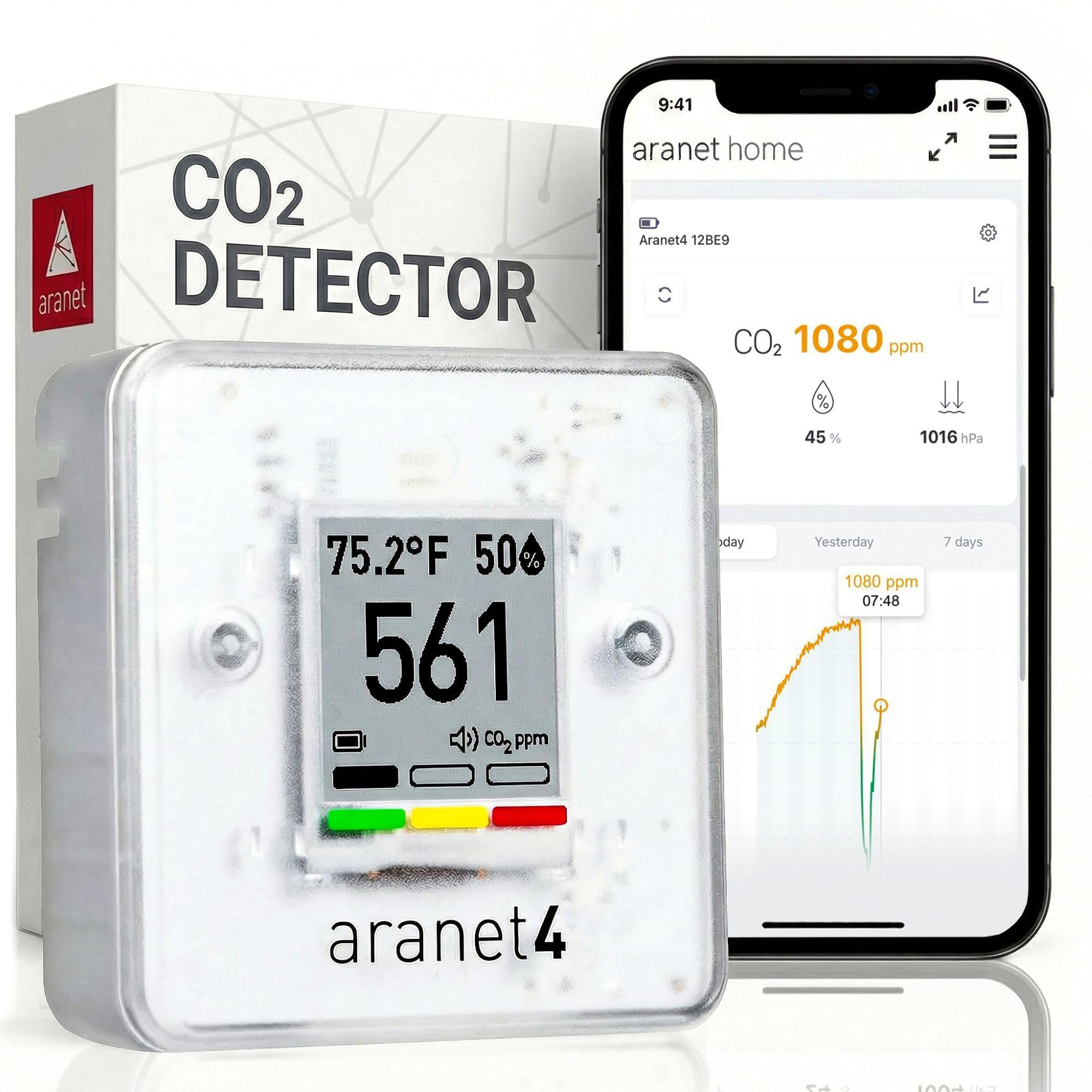
If the question you care about is whether a room needs fresh air, the Aranet4 answers it more clearly than anything else here. Its e-ink screen is easy to read at a glance, the color coding gives the CO2 number a quick meaning, and the unit runs for up to four years on two AA batteries. That combination makes it the CO2 specialist we reach for first.

The sensor is the reason it earns that role: NDIR CO2 measurement, plus temperature, humidity, and pressure. We like that it keeps a 90-day history in the app without demanding a Wi-Fi network. The trade-off is Bluetooth. Syncing history can feel slow, and pairing is not always instant, so it is a monitor you check rather than one that pushes data to you all day. That is fine for a classroom, office, or bedroom where you want a periodic ventilation check.

It is not a whole-home air quality monitor. There is no PM2.5, VOC, or radon sensing, so it will not tell you what is in smoke, dust, or cleaning fumes. We treat it as the best CO2-focused pick here, not a replacement for a broader sensor. If you want one device to cover more pollutants, the Airthings View Plus is the better default. If CO2 is your main concern, the Aranet4 is the one we trust to keep the answer simple.

Pros

  • Accurate NDIR CO2 sensing
  • E-ink screen is easy to read
  • Up to four years on AA batteries
  • 90-day history in the app

Cons

  • CO2 only, no particles or VOCs
  • Bluetooth-only, with no remote access
  • Premium price for a focused monitor
Our verdict

We recommend the Aranet4 when CO2 and ventilation are the main question; its clear display and long battery make it the most confidence-inspiring specialist here.

Check Latest Price
3

Best for Alexa Homes

Amazon Smart Air Quality Monitor

86 /100
Trail Score Excellent

Key details

App
Alexa app
Pack
2 monitors
Display
Color-coded LED
Measures
PM2.5, VOCs, CO, humidity, temperature
Check Price on Amazon

The case for this one starts with the pair. Two monitors for about the price of one midrange sensor let you put a PM2.5 and VOC check in a bedroom and a living room, and the Alexa app ties both into routines. We like that for an Alexa household: the data is not trapped in a separate app you have to remember to open.

The sensor set is PM2.5, VOCs, CO, humidity, and temperature. That covers smoke, dust, and combustion gases, but not CO2, so it will not tell you whether a closed room needs ventilation. The color-coded LED gives you a quick look, but the detail lives in the Alexa app; if you do not use Alexa, this is the wrong shape of product. For those who do, routines are the payoff: the monitor can trigger a purifier, a fan, or an announcement when air quality drops.

We recommend the two-pack for practical coverage rather than lab-style precision. The CO reading is useful context for a gas stove or attached garage, but it is not a substitute for a dedicated CO alarm. If you want a screen you can read across the room, the YNAK is more satisfying; if you want the simplest Alexa integration in two rooms, this is the easier buy.

Pros

  • Two monitors for multi-room coverage
  • Tracks PM2.5, VOCs, CO, and climate
  • Alexa routines and phone alerts
  • Simple color-coded LED status

Cons

  • No CO2 measurement
  • Detailed data only in the Alexa app
Our verdict

We recommend this two-pack for Alexa households that want PM2.5, VOC, and CO readings in two rooms, provided you do not need CO2.

Check Latest Price
4

Best Budget

GoveeLife H5106

85 /100
Trail Score Excellent

Key details

Power
Wired, 2.4 GHz Wi-Fi
Display
LED
Refresh
2-second refresh
Measures
PM2.5, temperature, humidity
Check Price on Amazon

The H5106 is the budget entry point in this group, and for a Govee household it is also the most useful one. It measures PM2.5, temperature, and humidity, refreshes every two seconds, and can trigger Govee purifiers, humidifiers, and fans when the air crosses a threshold you set. We like that it turns a small screen into an action, not just a number.

We treat it as a trend monitor rather than a precision instrument. The PM2.5 channel is sensitive enough to catch cooking and candle smoke, but the readings can sit at zero or one when the air is clean, and they are not a substitute for a calibrated particle counter. The LED display is compact and the clock mode is handy on a desk.

For a bedroom shelf or a 3D-printer corner, the low price and smart-home link are a fair trade. If you need a portable monitor or a fuller pollutant picture, spend more on the Airthings or the BREATHE. If you want a cheap second opinion on particles, this is the one we reach for.

Pros

  • Budget-friendly PM2.5 monitoring
  • Two-second refresh keeps readings current
  • Triggers Govee purifiers and fans
  • Compact LED display with clock

Cons

  • PM2.5 only, no CO2 or VOC data
  • Corded power limits placement
Our verdict

We like the H5106 as a budget PM2.5 monitor and Govee automation trigger, but it is a trend tool, not a complete air quality picture.

Check Latest Price
5

Best Portable Multi-Pollutant

BREATHE Airmonitor Plus Gen 2

79 /100
Trail Score Very Good

Key details

App
2.4 GHz Wi-Fi
Battery
Up to 6 hours
History
90 days
Measures
CO2, PM1, PM2.5, PM10, TVOC, HCHO, temperature, humidity
Check Price on Amazon

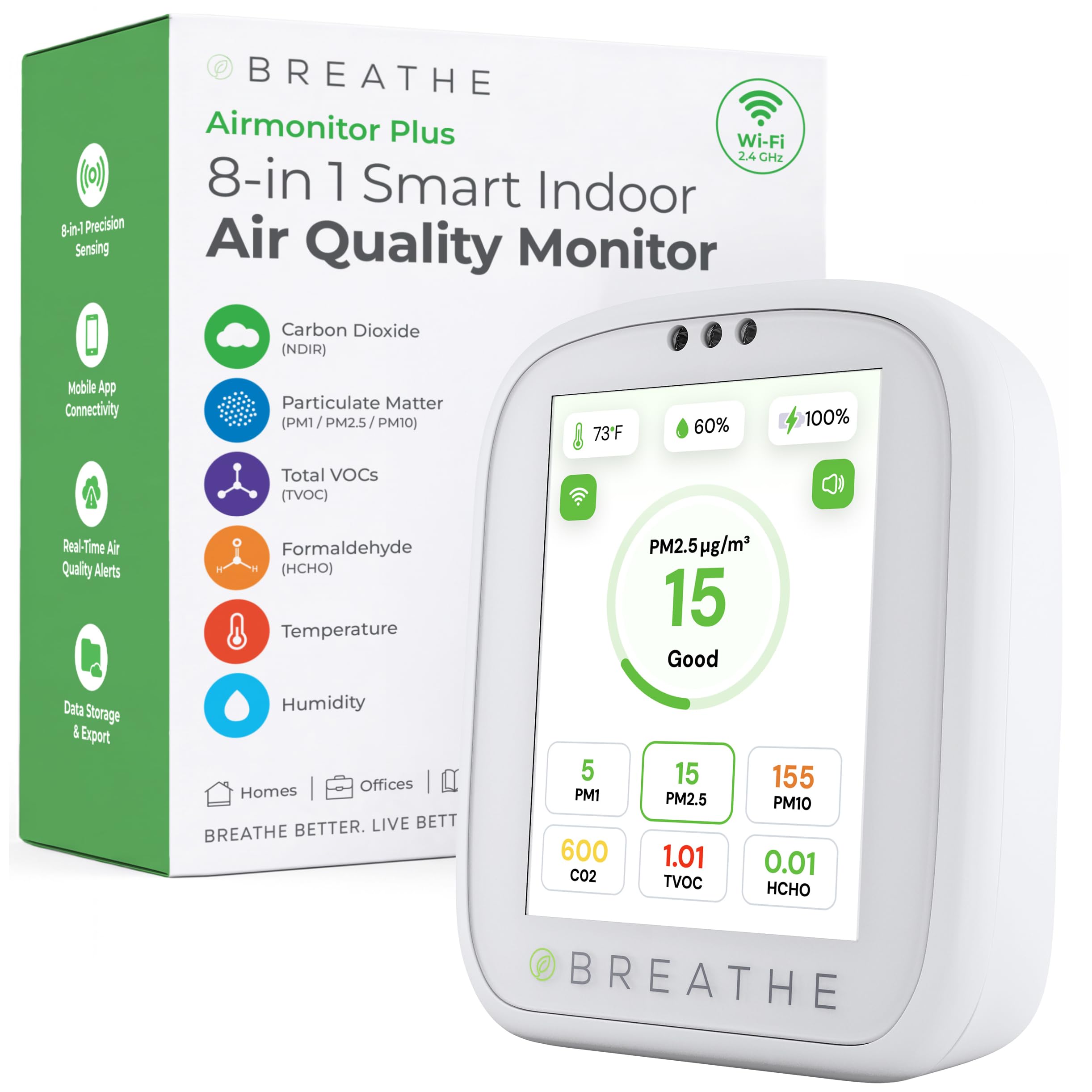
The Airmonitor Plus Gen 2 is the widest sensor set here in the smallest case. At about four ounces and roughly pocket-sized, it measures CO2, PM1, PM2.5, PM10, TVOC, formaldehyde, temperature, and humidity, and it keeps 90 days of history in the app. For someone who wants to compare a bedroom, a kitchen, and a home office, that portability is genuinely useful.

The battery is the reality check. The rated six hours is not a full day of continuous monitoring, and the color display and Wi-Fi app draw it down further. We treat it as a plug-in monitor that can be unplugged for a room-to-room check, not a leave-it-in-the-car air tracker. Setup is straightforward, but the 2.4 GHz Wi-Fi connection can be fussy, so get it onto the network before you need the history.

We recommend it when you want one compact device to flag particles, CO2, and VOCs without paying for radon coverage. The 90-day history and CSV export make it more useful than a screen-only monitor for spotting patterns. If you need all-day battery life, the Aranet4 is the better traveler; if you need a whole-home sensor, the Airthings is the one. For a portable multi-pollutant check, this is the pick.

Pros

  • Eight sensors in a compact body
  • 90-day history and CSV export
  • Portable enough for room-to-room checks
  • Configurable alerts through the app

Cons

  • No radon or carbon monoxide sensor
  • Battery life falls short of all-day use
Our verdict

We recommend the Airmonitor Plus Gen 2 for room-to-room checks of CO2, particles, and VOCs, provided it lives near a charger.

Check Latest Price
6

Best Budget CO2

SwitchBot Meter Pro CO2

84 /100
Trail Score Excellent

Key details

Battery
Up to 12 months
Display
92 mm screen
Measures
CO2, temperature, humidity
CO2 Accuracy
±(50 ppm + 5% of reading)
Check Price on Amazon

The 92-millimeter screen is the first thing you notice, and it is the reason to consider the Meter Pro CO2 over a smaller CO2 keychain. It shows CO2, temperature, and humidity at once, with a color-coded ring and a clock, so you can read the room from across a desk. The 12-month battery life and three alert methods make it a low-maintenance ventilation reminder.

The sensor is a Swiss-made NDIR unit rated to ±50 ppm plus 5% of the reading. That is a credible specification for the money, though the readings can be less consistent than the Aranet4's. We treat it as a budget CO2 check, not a lab instrument: good for noticing a stuffy meeting room or a closed bedroom, less good for comparing decimals. The Bluetooth app stores two years of history, but it is not a Wi-Fi monitor, so you have to be nearby to pull data.

We recommend it when you want a big, readable CO2 display and customizable alerts without paying premium prices. It does not measure particles, VOCs, or CO, so it is not a whole-home air quality monitor. If you want the most confidence in a CO2 number, the Aranet4 is better; if you want a clear screen for a classroom or office, this is the value pick.

Pros

  • Large 92 mm display
  • Swiss-made NDIR CO2 sensor
  • Up to 12 months of battery life
  • Audible, visual, and app alerts

Cons

  • CO2, temperature, and humidity only
  • Bluetooth-only app with no remote access
  • Less consistent than the Aranet4
Our verdict

We recommend the Meter Pro CO2 as a budget ventilation monitor with a display you can read across a room, not as a whole-home air quality meter.

Check Latest Price
7

Large Display

YNAK 16-in-1

82 /100
Trail Score Excellent

Key details

Battery
Up to 8 hours
Display
7-inch LED
Charging
USB-C
Measures
CO2, PM1, PM2.5, PM10, HCHO, TVOC, temperature, humidity, AQI
Check Price on Amazon

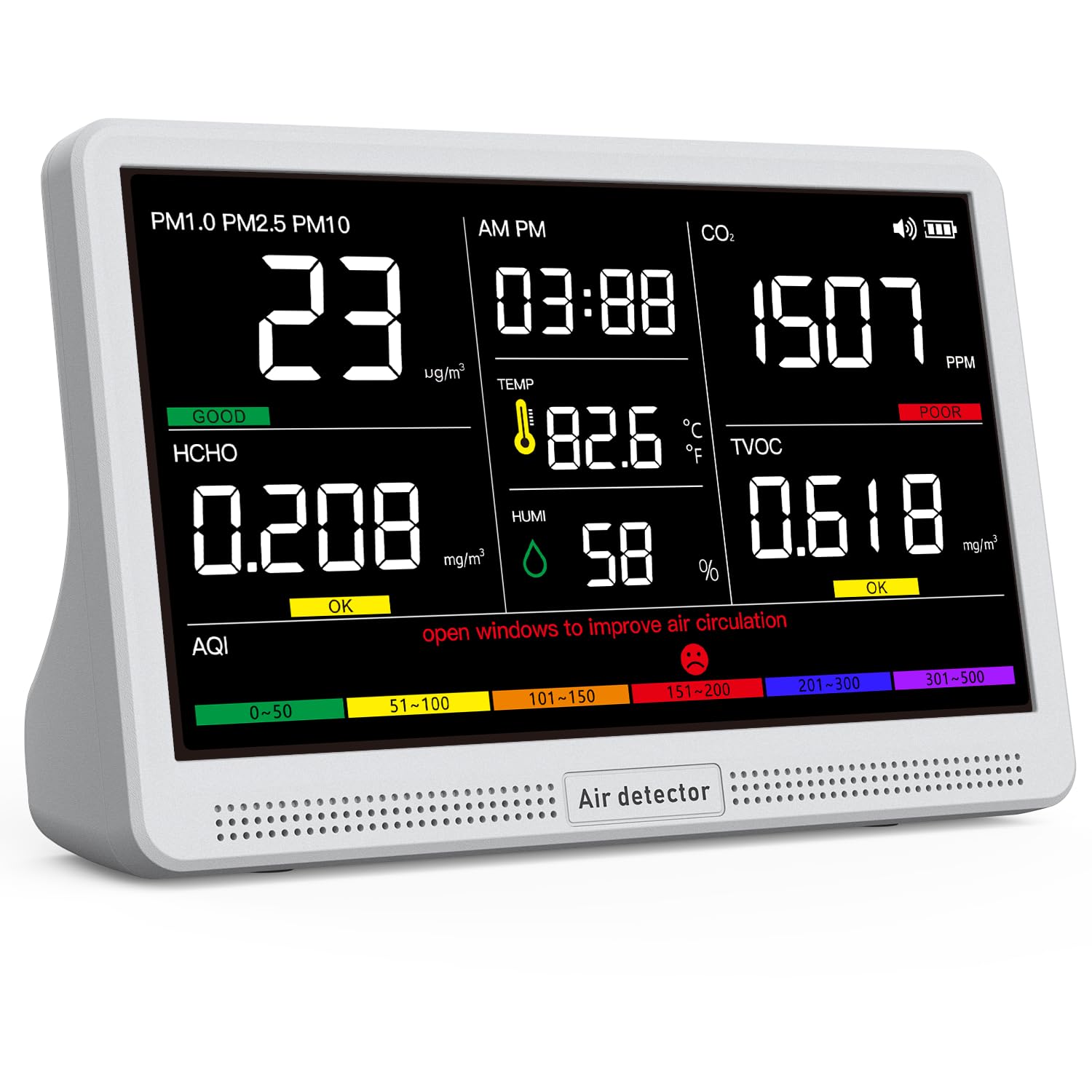
A 7-inch screen makes the YNAK the most glanceable monitor here. It puts CO2, PM1, PM2.5, PM10, formaldehyde, TVOC, temperature, humidity, AQI, and the time on one bright panel, with color indicators that let you spot a change from across a kitchen. For a workshop, classroom, or family room where several people need to see the reading, that is a real advantage.

The sensor list is ambitious for the money, but we do not treat every number as equally trustworthy. The particle and CO2 channels are the ones to watch; the formaldehyde and TVOC readings are better used as a prompt to ventilate than as a precise exposure measurement. The display makes it easy to compare rooms, but the extra readings invite more confidence than the hardware can justify.

The 7-inch panel is also the trade-off. It takes up more counter space than the compact monitors here, and the rated eight-hour battery is a portable window, not a week of untethered use. USB-C charging makes it easy to top up, and the audible alerts are useful if you want the monitor to call attention to a spike rather than wait for someone to glance at it.

We see the YNAK as a big, readable check-in screen for a kitchen or workshop, provided you treat its extra readings as directional. It is not the most accurate or the most connected monitor in this group, and it does not have the polish of the Airthings or the CO2 focus of the Aranet4. But if you want a lot of information on one panel for a shared space, it earns its place.

Pros

  • 7-inch display is easy to read
  • Nine parameters on one screen
  • Up to 8 hours of battery
  • USB-C charging and audible alerts

Cons

  • No carbon monoxide sensor
  • Extra readings are directional, not precise
  • Large footprint on a counter
Our verdict

We see the YNAK as a big, readable check-in screen for a kitchen or workshop, provided you treat its extra readings as directional.

Check Latest Price

How We Tested (and Lived With) 11 Air Quality Monitors

We started with a list of roughly 40 models and cut it to 11 by sensor type, price, and what owners reported months after buying. We leaned toward units that measure particulate matter and CO2 with dedicated sensors rather than a single vague air quality score cooked up by an undisclosed formula, and we passed on anything that couldn't show a reading on the device itself. Setup got timed before anything else: stopwatch running from the moment the box opened to the first stable number on screen, working alone and without reading the manual first.

Then they went into ordinary rooms. Each monitor spent time on a kitchen counter during seared steak, boiling pasta, and a struck match, on a nightstand through an eight-hour stretch with the bedroom door closed, and in a damp basement and beside a cat litter box. We ran every unit alongside a calibrated reference meter and a handheld particle counter, watching whether the reading moved within a minute of a real event, how far it drifted from the reference, and whether shower steam set off a false alarm.

Displays got read from ten feet away and again at 2 a.m. in a dark bedroom, which is where brightness settings and overly dim screens reveal themselves. We cut the Wi-Fi for an hour to see whether each unit kept logging or lost the data, unplugged them to run the batteries flat, and asked a voice assistant for the current reading the way you actually would from the couch. At the end of eight months we re-checked each one in the same room to catch sensor drift, and folded the cost of replacement sensors into our value call.

How to Choose an Indoor Air Quality Monitor

Decide Which Pollutants Matter

An air quality monitor is a bundle of sensors, not a single score. CO2 is the ventilation signal: it rises when a room is closed and people are breathing. PM2.5 covers smoke, dust, and cooking particles. VOCs point to cleaning products, paints, and furnishings, while CO flags combustion and radon is a long-term basement and soil-gas concern. We start with the pollutant you can change through ventilation, filtration, or source removal, rather than the longest feature list. If you want one broad home monitor, the Airthings View Plus covers the widest set here; if CO2 is the question, the Aranet4 is the more focused tool.

Choose How You Will Read It

A display is not a decoration. A monitor you pass in a hallway needs a readable screen with a clear color or number; a monitor you check from your phone can live in a bedroom or basement with a smaller display. App-only designs save hardware but tie the experience to one ecosystem: the Amazon monitor puts its detail in the Alexa app, which is fine if Alexa already runs your home and frustrating if it does not. We also look for history, because a single reading is a snapshot and a week of data shows the pattern.

Plan for Power and Placement

Battery life decides where a monitor can live. A two-year battery lets the Airthings sit at breathing height without an outlet; the Aranet4 runs up to four years on AA cells; the GoveeLife H5106 is corded, so it belongs near a desk or printer. Treat portable battery claims as a short window unless the monitor is designed around low power: the BREATHE's rated six hours is useful for room-to-room checks, not a week off-grid. Place the monitor where people breathe and air moves, away from a window draft or a direct vent.

Treat Accuracy as a Trend, Not a Verdict

Consumer sensors are useful for direction, not for medical diagnosis. An NDIR CO2 sensor is the right starting point for ventilation readings, and a particle sensor can show a spike when you cook or light a candle. Do not chase the last decimal; watch whether the number moves when you open a window, run a purifier, or start the stove. If a reading never changes, or sits at zero through obvious smoke, that channel has stopped earning your trust. Cross-check with a second monitor or a known event before you act on a single alarming number.

Weigh Smart Features and Support

Wi-Fi, app alerts, and smart-home routines are conveniences, not proof of better sensing. They matter when they trigger an action: the GoveeLife can turn on a compatible purifier, and the Amazon monitor can announce poor air through Echo. We also check the warranty because these are long-running devices; Airthings offers a five-year extended warranty with registration, while BREATHE lists two years. A good app with a short support window is a worse long-term buy than a simple monitor with clear coverage.

Frequently Asked Questions

Final Verdict

For most homes, we recommend the Airthings View Plus. It is the only monitor here that combines radon with PM2.5, CO2, and VOC sensing, and its two-year battery lets it sit in a basement or bedroom without an outlet. The premium price and fussy Wi-Fi are real trade-offs, but they buy the broadest picture in this group. If CO2 and ventilation are your only concern, choose the Aranet4; if you live in Alexa, the Amazon two-pack is the easier fit.