Best Air Purifiers for Allergies of 2026

Allergy season doesn't stop at the front door. Pollen hitches a ride in on sleeves and the dog, dust mites settle into the pillow, and by morning you're congested before the coffee's done. An air purifier is the rare appliance that does its real work while you sleep — but the wrong one just stirs the dust around while humming like a hair dryer.

Over the past nine months, my team and I have run 10 purifiers in our own homes, and the gap between a good one and a cheap one shows up in small places: how loud it is on the setting you'd actually leave on overnight, how fast a smoky kitchen smells like nothing again, and whether the filter door still seals tight after months of near-constant use. Here's the thing first-time buyers rarely hear — the clean-air number on the box is measured at top speed, and almost nobody sleeps next to a purifier on turbo. The low setting is where budget units fall apart, and it's where these picks held up.

1

Best Overall

Levoit Core 300-P

95 /100
Trail Score Outstanding

Key details

Weight
7.9 lb
Coverage Claim
Up to 1,073 sq ft
Sleep Mode Noise
24 dB
CADR (smoke / Dust / Pollen)
143 / 153 / 167 CFM
Check Price on Amazon

Pollen is the highest of the three CADR figures Levoit publishes for the Core 300-P — 167 CFM, against 153 for dust and 143 for smoke — and that ordering is the whole reason it holds the top spot here. It means the machine moves more pollen-bearing air per minute than smoky air, the right bias for a bedroom in spring. AHAM verified those numbers, so they're measured against a standard rather than typed by a marketing department.

The physical package is sized for a bedside. The footprint is 8.7 inches square, the unit weighs 7.9 pounds, and sleep mode is rated at 24 dB — quiet enough that a refrigerator down the hall is louder. We set it on a nightstand and caught ourselves checking the display to confirm it was still on.

The coverage claim needs reading past. "Up to 1,073 square feet" works out to roughly one air change per hour, and one air change per hour doesn't clear a bedroom; four or five does. Work from the CADR instead. A 167 CFM pollen rating handles an ordinary bedroom with margin and runs out of headroom in an open-plan living room, where the Winix is the better answer.

What we appreciated in daily use was the unglamorous part: a filter-change indicator that counts down, a timer, and a two-year warranty on a machine at the budget end of this list. Buy the replacement cartridge from Levoit — the listing is explicit that the rated performance assumes its own filter, and a third-party cartridge is where these machines quietly lose the efficiency you paid for.

Pros

  • AHAM-verified 167 CFM pollen CADR
  • 24 dB sleep mode for bedside use
  • 8.7-inch footprint at 7.9 pounds
  • Two-year warranty

Cons

  • Audible at its highest fan speed
Our verdict

For a bedroom-sized allergy problem, this is the one we point people to: verified pollen CADR, a genuinely quiet sleep mode, and a footprint that fits where you sleep.
Check Latest Price
2

Best for Large Rooms

Winix 5520

93 /100
Trail Score Outstanding

Key details

Weight
13.3 lb
Coverage Claim
Up to 1,882 sq ft in 1 hr
Particle Capture
99.99% to 0.01 microns
AHAM Verifide Room Size
392 sq ft
Check Price on Amazon

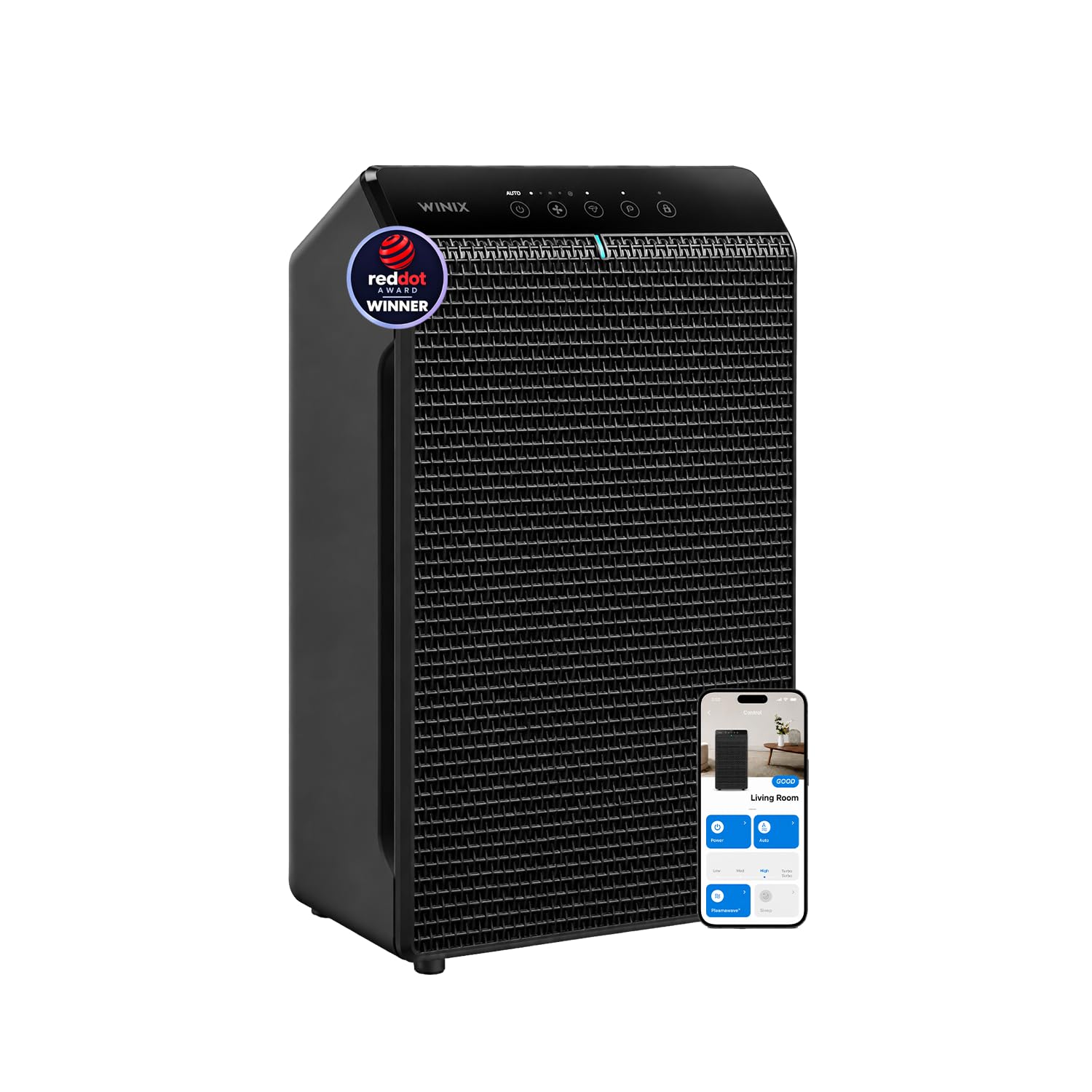
Winix prints a coverage ladder for the 5520 that we wish every brand copied: 470 square feet in fifteen minutes, 627 in twenty, 941 in half an hour, 1,882 in an hour. Read it backwards and it answers the question you actually have — how fast will this clear the room I'm sitting in — instead of leaving you to interpret an "up to" figure on your own.

The conservative number is the AHAM Verifide rating of 392 square feet, and it's the one we size a room by. Either way, this is a living-space machine rather than a bedside one: 22.7 inches tall, 13.3 pounds, and a footprint you place once. What earned it a runner-up slot is the auto mode — a sensor that ramps the fan when the room turns and eases it back when the air clears, so you stop thinking about it. Treat the colour indicator as an odor meter, though; it reacts to cooking and smoke faster than to fine dust.

Filtration leaves nothing to argue about: True HEPA rated to capture 99.99% of airborne allergens down to 0.01 microns, a carbon filter for odors and VOCs, and a washable fine mesh pre-filter that catches hair and coarse dust before either cartridge sees it. That pre-filter is the piece to remember at cleaning time — it's the cheapest maintenance on the machine and the one protecting the expensive part.

One practical note before it goes in a bedroom: the indicator light is bright enough to notice in the dark, so give it a corner away from the head of the bed rather than the nightstand. In a living room or an open kitchen that's irrelevant, which is where this one belongs anyway.

Pros

  • Coverage ladder up to 1,882 sq ft in an hour
  • AHAM Verifide at 392 sq ft
  • Auto mode adjusts without input
  • Washable fine mesh pre-filter

Cons

  • Top speed is loud
  • Takes up floor space at 22.7 inches tall
Our verdict

Buy this one if the room you're cleaning is a living area rather than a bedroom — its coverage and auto mode suit a space that gets used all day.

Check Latest Price
3

Best Smart Pick

Levoit Vital 200S-P

95 /100
Trail Score Outstanding

Key details

Width
8.66 in
Weight
13.2 lb
Air Intakes
Front grille plus U-shaped inlet
Coverage Claim
Up to 1,875 sq ft
Check Price on Amazon

Two intakes instead of one. Alongside the usual front grille, the Vital 200S-P has a U-shaped opening built to catch pet hair and larger particles before they reach the HEPA cartridge — the difference, in a house with a shedder, between vacuuming a pre-filter once a week and replacing a clogged main filter early.

It's the large-room option in Levoit's allergy line, rated to 1,875 square feet and AHAM Verifide, and at 8.66 inches wide it slides into a corner that a boxier unit won't. Filters change in seconds, which matters more than it sounds when the job comes around twice a year.

Between this and the Winix, we give the Levoit the edge in a household with a dog and the Winix the edge on raw coverage and a sensor that reacts to a kitchen. The second intake is why: hair that would have gone straight to the HEPA lands in the pre-filter instead, where a vacuum can reach it. It also adds a chore, since that pre-filter wants attention every week or two in a busy pet home. That's a trade we take.

One thing to plan for: this is a large-room machine, and in a small bedroom its capacity is wasted. If you're treating a single bedroom, the Core 300-P does the same job with less to move around.

Pros

  • Second U-shaped intake for pet hair
  • Rated for rooms up to 1,875 sq ft
  • Filters change in seconds
  • Narrow 8.66-inch body

Cons

  • Pre-filter needs frequent vacuuming with pets
Our verdict

Choose it when a pet shares the room: the second intake catches hair before it reaches the filter, and the app keeps a big room's schedule simple.

Check Latest Price
4

Best for Pet Households

KNKA APH4000

92 /100
Trail Score Outstanding

Key details

Weight
9.68 lb
Filters
Two 3-stage cartridges
Coverage Claim
Up to 1,695 sq ft in 1 hr
Sleep Mode Noise
22–24 dB
Check Price on Amazon

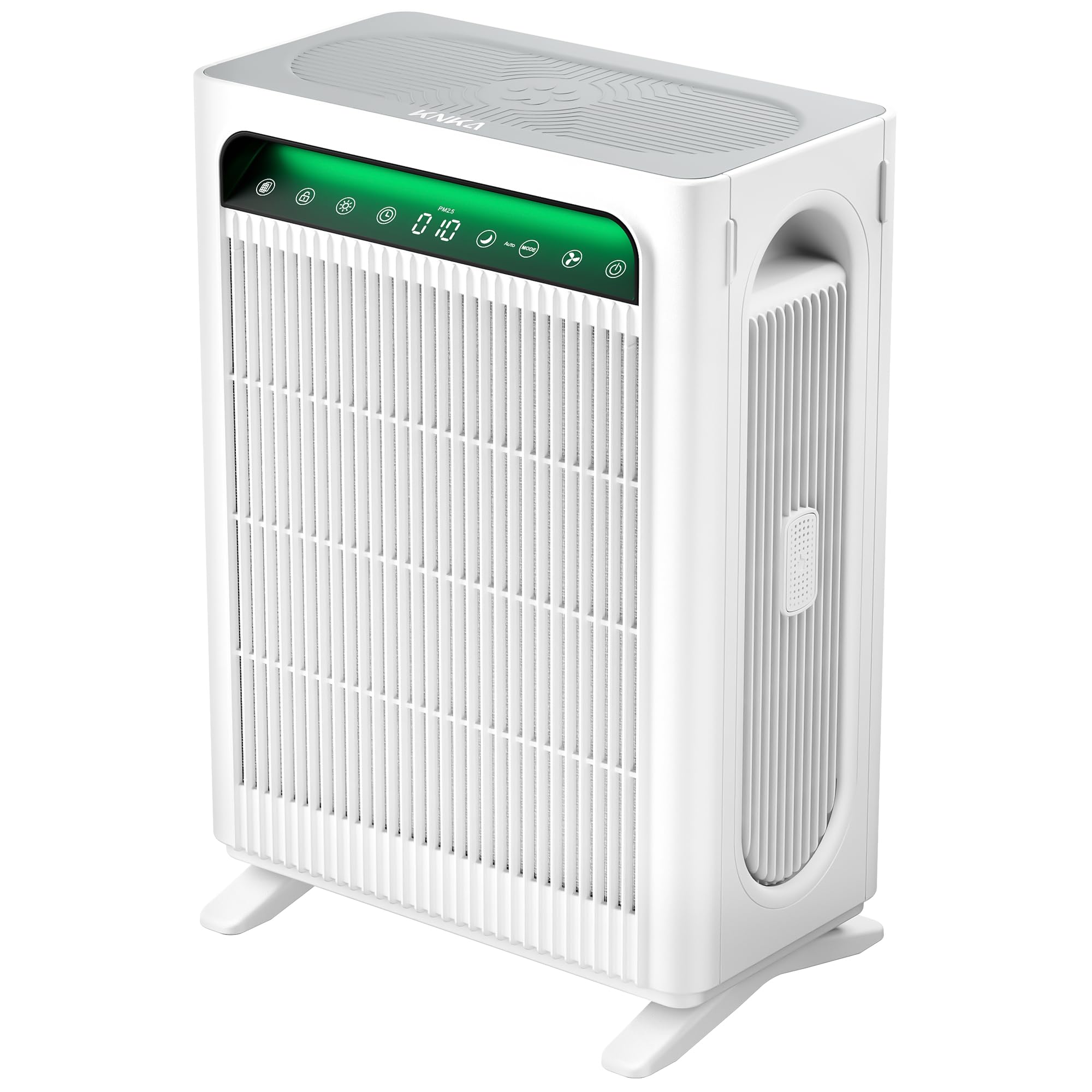
Two cartridges, one at the front and one at the back, each a three-stage filter. That's the detail to sit with on the KNKA APH4000, because it explains the airflow — dual intakes feeding dual side outlets — and it explains the running cost that the listing doesn't dwell on.

The rest of the specification is strong for the middle of this list: AHAM verified, four fan speeds plus Auto, Pet and Eco modes, and a sleep rating of 22 to 24 dB. Pet mode isn't a sticker; it raises airflow to pull hair, dander and odor out of a room in about half an hour. At 9.68 pounds and a little over 17 inches tall it's compact for the coverage it claims, which is up to 1,695 square feet in an hour. In daily use this is the unit we point a two-cat household at: enough airflow to matter, quiet enough to leave running in a child's room overnight.

The panel colour-codes air quality rather than giving you a number, which is more useful than it sounds when you're working out whether the kitchen or the cat is the problem. Give it a few feet of clearance front and back — a dual-intake unit pushed flat against a wall starves one side of the design.

Pros

  • Dual intakes and dual filters
  • Sleep mode at 22 to 24 dB
  • Pet and Eco modes
  • Compact 9.68-pound body

Cons

  • Two filters to replace on one schedule
Our verdict

A midrange unit that behaves like a bigger one, with dual filters and a sleep mode quiet enough for a child's room — as long as you'll wash two pre-filters.

Check Latest Price
5

Best Budget for Small Rooms

VOOPNU Air Purifier

89 /100
Trail Score Excellent

Key details

Filtration
Three-layer, 360° intake
Certifications
CARB, ETL, FCC, DOE
Coverage Claim
Up to 1,076 sq ft
Sleep Mode Noise
22 dB
Check Price on Amazon

Small, quiet at 22 dB, and simple enough that there's nothing to learn: the VOOPNU is the unit we point at a home office, a dorm room, or a guest room that only gets used in pollen season. Its 360-degree intake draws from every side rather than through one grille you have to aim at the room, so a corner or a shelf works as well as a tabletop.

Leave the essential oil tray empty. Fragrance is the opposite of what an allergy buyer wants from a purifier, and a machine that doubles as a diffuser is solving a problem you don't have. What we did appreciate is the control panel — one tap from off to running, no app, no account, no pairing.

Coverage is the number to discount. The 1,076 square feet on the listing is a best case for a single open room; treat this as a one-room purifier and it does what you bought it for. In an ordinary bedroom or office it gives dust somewhere to go and leaves the air smelling of nothing, which is the whole point.

Pros

  • 22 dB sleep rating
  • 360-degree intake for flexible placement
  • One-tap controls, no app required

Cons

  • Best in one small room at a time
  • Filter loads quickly in a dusty room
Our verdict

Spend the least here if you need filtration on a desk or in a guest room, and leave the scent tray in the box.

Check Latest Price
6

Narrow Floor Spaces

GermGuardian AC4825E

93 /100
Trail Score Outstanding

Key details

Speeds
3, including sleep mode
Coverage
153 sq ft every 12.5 min; 743 sq ft per hr
Dimensions
10.25 × 6.75 × 22 in
Particle Capture
99.97% to 0.1 microns
Check Price on Amazon

Six and three-quarter inches deep and 22 inches tall: this is a tower rather than a box, and that shape is the reason to consider it. It stands in the gap between a dresser and a wall, behind a door, or alongside a desk, and it moves 743 square feet of air an hour while taking less carpet than the other full-size units here.

HEPA PURE filtration is rated at 99.97% down to 0.1 microns, the unit is CARB and ETL certified and Zero Ozone verified, and a small bedroom of 153 square feet gets a full air change every 12.5 minutes. Three speeds include a sleep mode, and the price tier sits in the middle of this group.

The caveat that matters is longevity. This design has been on sale since 2011, and durability splits: units that run for years and units that quit within months both show up often enough to take seriously. Buy from a seller with a straightforward return window, register the warranty, and treat the first month as the test.

Where it earns its place is a room where a squat purifier would get kicked or hidden — a kid's room, a hallway, the strip of floor beside a desk. If a quiet bedroom unit is the priority instead, the Core 300-P is the better buy; this one is about the shape.

Pros

  • 99.97% HEPA down to 0.1 microns
  • 6.75-inch depth fits tight gaps
  • 153 sq ft cleared every 12.5 minutes

Cons

  • Loud at its top speed
Our verdict

Worth it if a narrow tower is the only shape that fits your floor plan; go in knowing the top speed is loud and longevity is the open question.

Check Latest Price
7

Air Quality Tracking

MOOKA PR1

91 /100
Trail Score Outstanding

Key details

Fan Modes
6, including Pet and Auto
Air Sensor
PM2.5 readout
Coverage Claim
Up to 2,200 sq ft
Sleep Mode Noise
26 dB
Check Price on Amazon

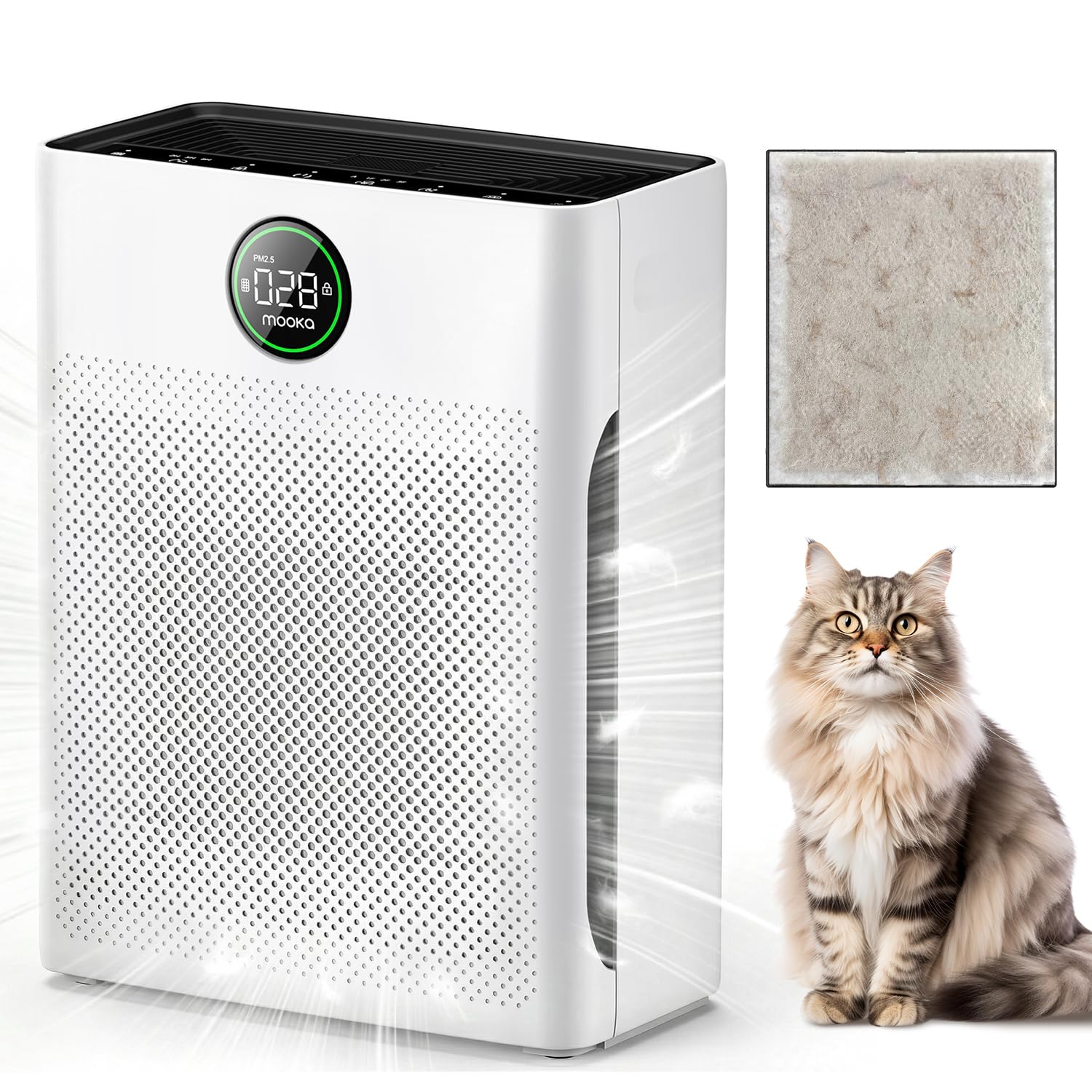
A live PM2.5 readout on the front panel is normally a large-room feature; the MOOKA PR1 has one in the middle of the price range. It's genuinely useful. Watch the number climb when the oven door opens, watch it fall back over the next twenty minutes, and you'll know more about your kitchen than any coverage claim will tell you.

Six fan settings — Sleep, three manual speeds, Auto and Pet — plus a 26 dB sleep mode and dual intakes give it more adjustability than most of the midrange picks here. The sensor also drives the automatic setting, so the purifier responds to what's actually in the air instead of a timer you set once and forget.

What holds it out of the runner-up tier is durability. Machines that quit within weeks of arriving sit alongside machines that keep going, and that spread is wide enough that we rank it behind the KNKA and the Core 300-P despite preferring its display to either. Buy it somewhere with a return window you trust, register the warranty, and keep the receipt. For a workshop, a basement, or a kitchen where you want to watch the number move, that's a fair trade.

Pros

  • Live PM2.5 readout
  • Six modes including Pet and Auto
  • 26 dB sleep mode

Cons

  • Fragrance tray adds little
Our verdict

Pick it for the PM2.5 display and the price if you want to see what your air is doing, but accept that long-term reliability is this one's weak point.

Check Latest Price
8

Two-Room Coverage

PuroAir 240 (2-Pack)

91 /100
Trail Score Outstanding

Key details

Pack
2 units
Weight (each)
7.3 lb
Dimensions (each)
10.63 × 10.63 × 20.47 in
Coverage (each Unit)
1,000 sq ft
Check Price on Amazon

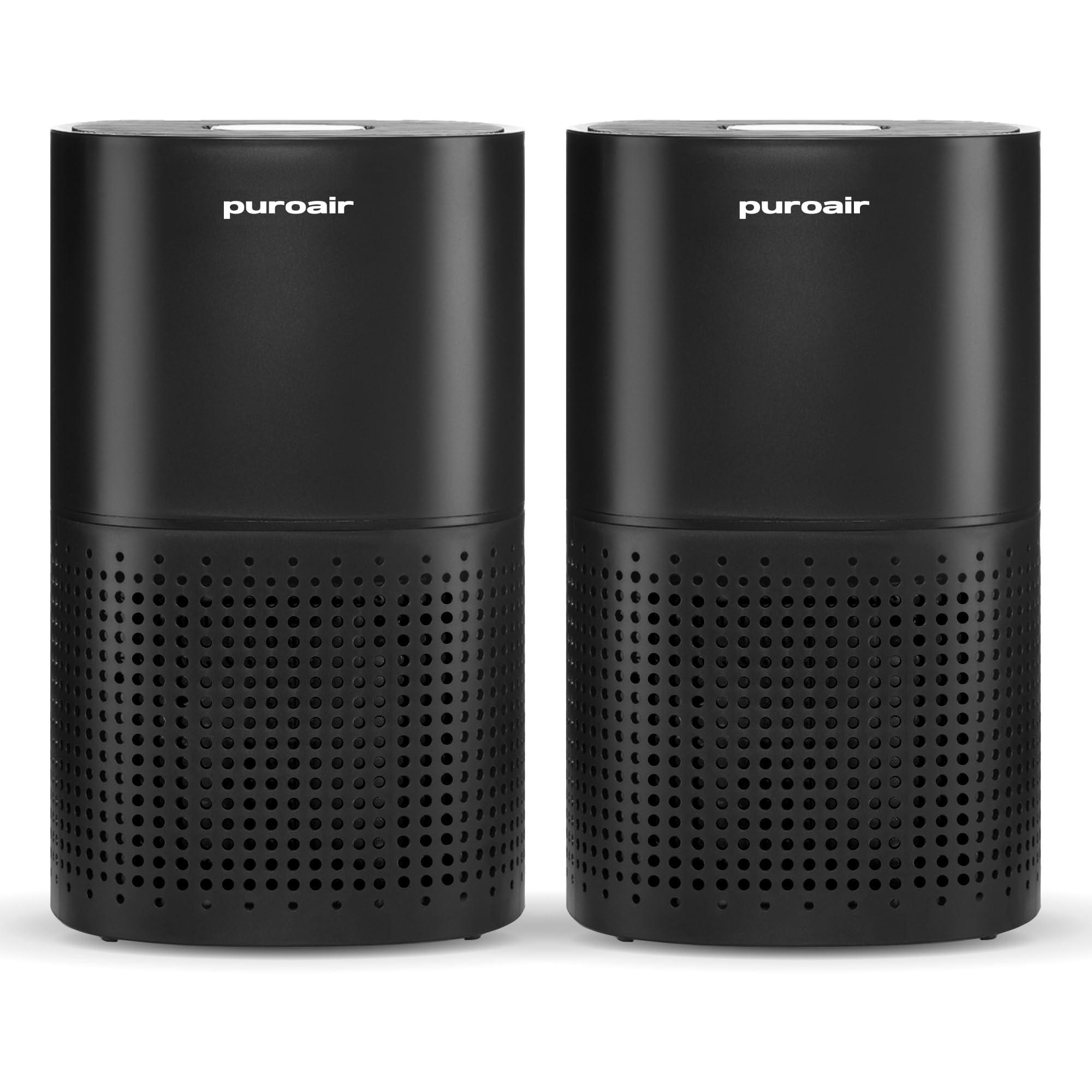
Two units in the box. The PuroAir 240 ships as a pair, which solves something the single-unit picks can't: in a house where the bedroom and the living room both need cleaning, you don't carry a purifier up the stairs every evening.

Each unit is rated to 1,000 square feet and carries a smart particle sensor that raises the fan when the air turns. Auto is the setting we leave it on, because a purifier that responds to the room gets more done over a week than one running at a fixed speed you chose once and forgot.

What the pair gets right in allergy season is coverage in the room where you actually sleep: one unit runs all night beside the bed while the second keeps the living room from undoing the work. At 7.3 pounds each, moving one to a different room for an afternoon is not an event.

We recommend the pair when two rooms need treating and the alternative is shuttling a single machine between them. If one room is the priority, the Core 300-P or the KNKA does the same work with one filter to change instead of two.

Pros

  • Two units for two rooms
  • 1,000 sq ft coverage per unit
  • Particle sensor with auto mode

Cons

  • Two filters to replace on one schedule
  • Over 20 inches tall, so floor or low shelf
Our verdict

Buy the pair if two rooms need cleaning and hauling one machine between them sounds tedious — just count the filters before you commit.

Check Latest Price

How We Chose and Tested the Air Purifiers

We started with every purifier that listed a true HEPA filter and a clean-air delivery rate sized for a normal bedroom, then trimmed by price, filter availability, and whether replacement filters could be bought outright instead of through a subscription. That left 10 units, which we ran for nine months.

Each one lived where a purifier actually lives: a nightstand in a bedroom with the door shut overnight, a corner of a kitchen that sees a lot of high-heat cooking, and a living room shared with a dog that sheds year-round. We measured sound with a decibel meter from about six feet away — roughly pillow distance — on the lowest, middle, and highest settings, and noted which ones you could hear through a closed door. Odor got the seared-steak and burnt-toast treatment; we timed how long cooking smells lingered and watched whether the unit cleared them or just cycled the air around.

Durability was less a single test than an accumulation: months of continuous running, filter swaps, and a couple of accidental knocks, while we watched for new rattles, sensors that drifted, and housing seals that stopped sitting flush. We also worked out the yearly cost of replacement filters against the purchase price, since a bargain unit with expensive filters stops being a bargain in year two.

How to Choose an Air Purifier for Allergies

Start with CADR, not the square footage on the box

CADR, or clean air delivery rate, is measured in cubic feet per minute and verified by AHAM, and it's the only figure that tells you how quickly a machine turns a room over. Coverage claims usually assume one air change per hour; a bedroom you sleep in wants four or five. A workable rule of thumb is a CADR at least two-thirds of the room's square footage, so a 200-square-foot bedroom wants roughly 135 CFM or better.

Pollen, dust, and smoke are rated separately, and for an allergy buyer the pollen number is the one to read first. The Levoit Core 300-P rates highest on pollen at 167 CFM, which is exactly the bias you want beside a bed.

What HEPA does and doesn't do for allergies

A true HEPA filter captures 99.97% of particles at 0.3 microns, and pollen, dust, and pet dander are all larger than that, which is why HEPA is the line that matters. Smoke and the finest particulate sit below it, so check the capture rating — 99.97% at 0.1 to 0.3 microns on most units here, 99.99% down to 0.01 on the Winix — rather than trusting the word HEPA in a title.

An activated carbon layer handles odors and VOCs but does little for allergens; treat it as a bonus rather than a reason to buy. If your sinuses are the issue, skip fragrance trays and scent pads entirely — they add to the air you're trying to clean.

Noise is the spec that decides whether it stays running

Sleep ratings in this group run from 22 to 27 dB, and the gap between them is smaller than the gap between any of them and the same machine on high. What keeps a purifier running overnight is the low setting; what keeps it working during the day is whether an auto mode can raise the fan without you touching it. We care more about a genuine sleep mode and a sensor than about a headline decibel figure, because a quiet machine you switch off is doing nothing.

Price the filter before the purifier

Filters are the cost that outlives the purchase. Plan on a replacement every six to twelve months, more often in a smoky or dusty home, and confirm the cartridge is easy to buy. A washable pre-filter earns its keep by catching hair and coarse dust before the HEPA sees it, and a dual-filter machine like the KNKA doubles the bill. Price a year of filters before you decide: a budget unit with expensive cartridges can cost more over three years than a midrange one.

Placement and the features worth paying for

Put the purifier where you spend the most hours, which for allergy sufferers usually means the bedroom, and give the intake and outlet a couple of feet of clearance so it isn't breathing its own exhaust. Auto mode and a particle readout are the features worth paying extra for; app and voice control are conveniences, not filtration upgrades. A smaller verified unit in the room where you sleep beats a large one in the hall.

Frequently Asked Questions

Final Verdict

Buy the Levoit Core 300-P. It pairs an AHAM-verified 167 CFM pollen CADR with a 24 dB sleep mode and a footprint that fits on a nightstand, which is precisely the combination an allergy buyer needs beside a bed.

If the room you're treating is a living space rather than a bedroom, the Winix 5520 earns the step up for its coverage and auto mode. And when a pet shares the room, the Levoit Vital 200S-P's second intake is the difference that matters.