Best GPS Running Watches of 2026

A GPS running watch has exactly one job: tell you the truth about a run and still have battery left when you finish. The failures are memorable — a watch that locks on in the open then draws a drunken zigzag through tree cover, a screen you can't read in glare, a strap that rubs raw at mile 12, a battery that quits in the last third of a long run. What you're buying isn't really the feature list; it's the confidence to leave your phone at home and trust the numbers you get back.

I've worn a watch on my wrist since the days of chest straps and foot pods, and my team and I have now spent eight months living with 11 GPS watches, from stripped-down trainers to multi-sport models with full maps. The surprise is how little the spec sheet predicts — the longest battery isn't always the one you'll want to wear to dinner, and the priciest model isn't automatically the most useful. Below are the ones that earned a permanent spot by the door.

1

Best Overall

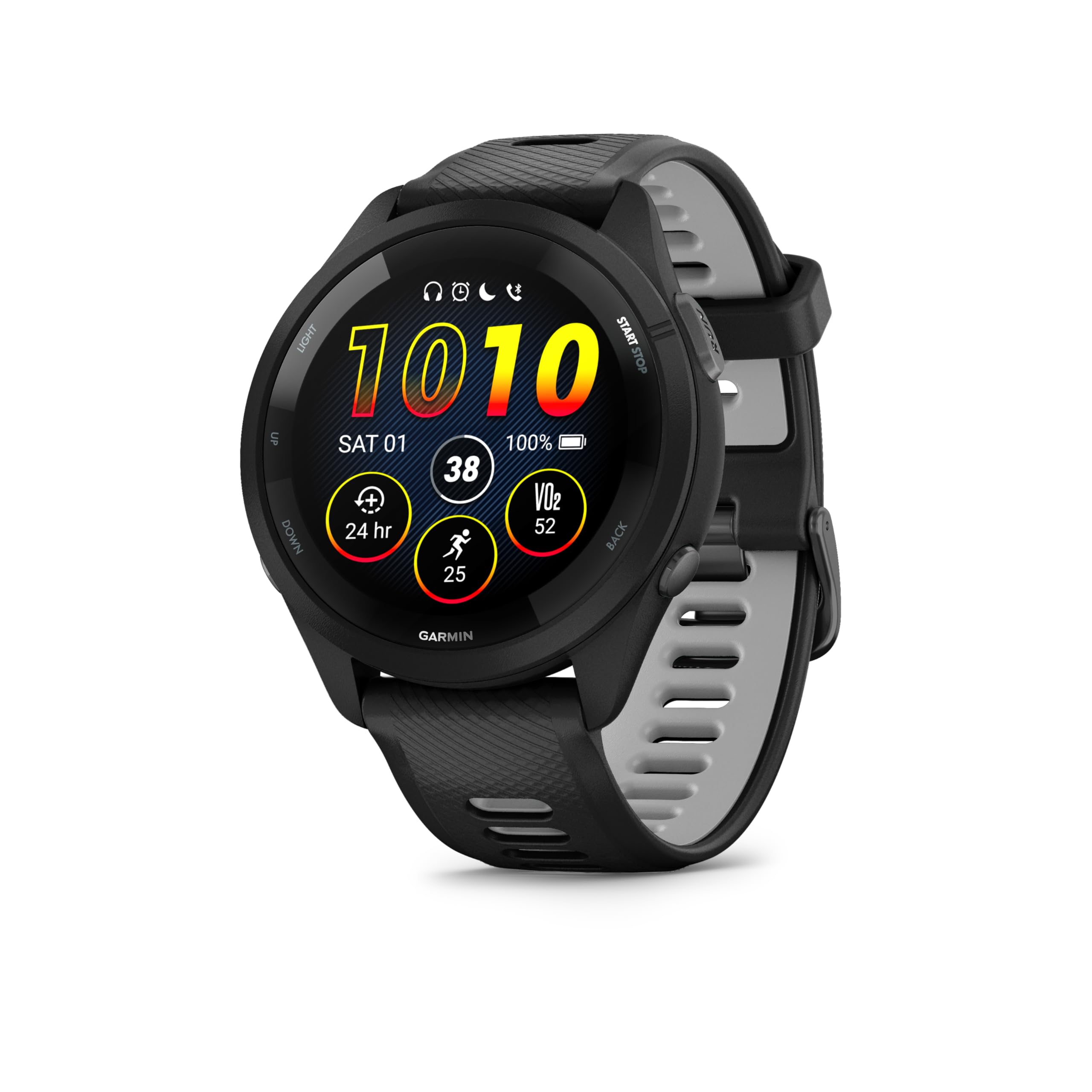
Forerunner 165

93 /100
Trail Score Outstanding

Key details

Weight
1.38 oz
Display
1.2-inch AMOLED
Training
Daily suggested workouts
GPS Battery
19 hours
Check Price on Amazon

The Forerunner 165 is the watch we recommend first because it delivers the training help most runners actually use without making them buy a race-day flagship. The 43mm case is comfortable on a range of wrists, and at 1.38 ounces it stays out of the way. The 1.2-inch AMOLED screen is bright and easy to read in sunlight, while the combination of touch and buttons means you can swipe through widgets but start a lap without looking down at glass.

Battery life is the quiet advantage: up to 19 hours in GPS mode and 11 days in smartwatch mode. The daily suggested workouts and Garmin Coach plans give beginners structure and experienced runners a useful second opinion, and 25+ activity profiles cover strength, cycling, and HIIT when you are not running. We also like that the essentials are here without a subscription.

The limitations are specific rather than deal-breaking. The satellite spec is standard GPS rather than multi-band, so the 265 is the better choice for dense downtowns and deep tree cover. Daily GPS use also pulls the battery closer to a weekly charge than the 11-day headline suggests.

For open-road training and everyday wear, neither is a reason to look elsewhere first. The 165 is the version most runners should be wearing on an ordinary Tuesday, and that is the strongest argument for it.

Pros

  • Comfortable 43mm case for daily wear
  • Bright 1.2-inch AMOLED display
  • Training guidance without a subscription
  • Up to 19 hours in GPS mode

Cons

  • Standard GPS only; no multi-band
  • Daily GPS use shortens battery to about weekly
Our verdict

We think most runners should start with the Forerunner 165: a comfortable 43mm case, bright AMOLED screen, and useful training guidance without race-day extras.
Check Latest Price
2

Best for Race Training

Forerunner 265

94 /100
Trail Score Outstanding

Key details

Weight
1.66 oz
Display
1.3-inch AMOLED
Satellite
Multi-band GPS
GPS Battery
20 hours
Check Price on Amazon

The Forerunner 265 earns its place on race mornings. Load a course and a goal time, and the race widget turns them into a pacing plan and daily suggested workouts; multi-band GPS is the other upgrade over the 165, and it is the feature that matters when your route passes between tall buildings or under heavy tree cover. The 1.3-inch AMOLED screen and 46mm case give all of that more room to breathe.

We think this is the pick for someone following a structured plan rather than simply logging miles. Training readiness, recovery insights, and the morning report give the watch a useful opinion about when to push, and the 13-day smartwatch / 20-hour GPS battery is generous for a screen this bright. The trade-off is a menu system that takes time to learn; it is powerful, but not instantly obvious if you are coming from a simpler watch.

The 265 also sits at a premium tier, so the decision is less about whether it is good and more about whether you will use the extra coaching. If you run the same loop and ignore recovery scores, the 165 is the smarter buy. If you want the watch to help you execute a race and hold a GPS line in difficult conditions, the extra spend is easy to justify.

Pros

  • Multi-band GPS for difficult routes
  • Race widget builds a pacing plan
  • 13-day smartwatch battery
  • Training readiness and recovery insights

Cons

  • Large 46mm case for smaller wrists
  • Menus require a learning curve
Our verdict

Our pick for race-focused runners is the Forerunner 265, which adds multi-band GPS, deeper recovery guidance, and a bigger AMOLED screen.

Check Latest Price
3

Best Battery Life

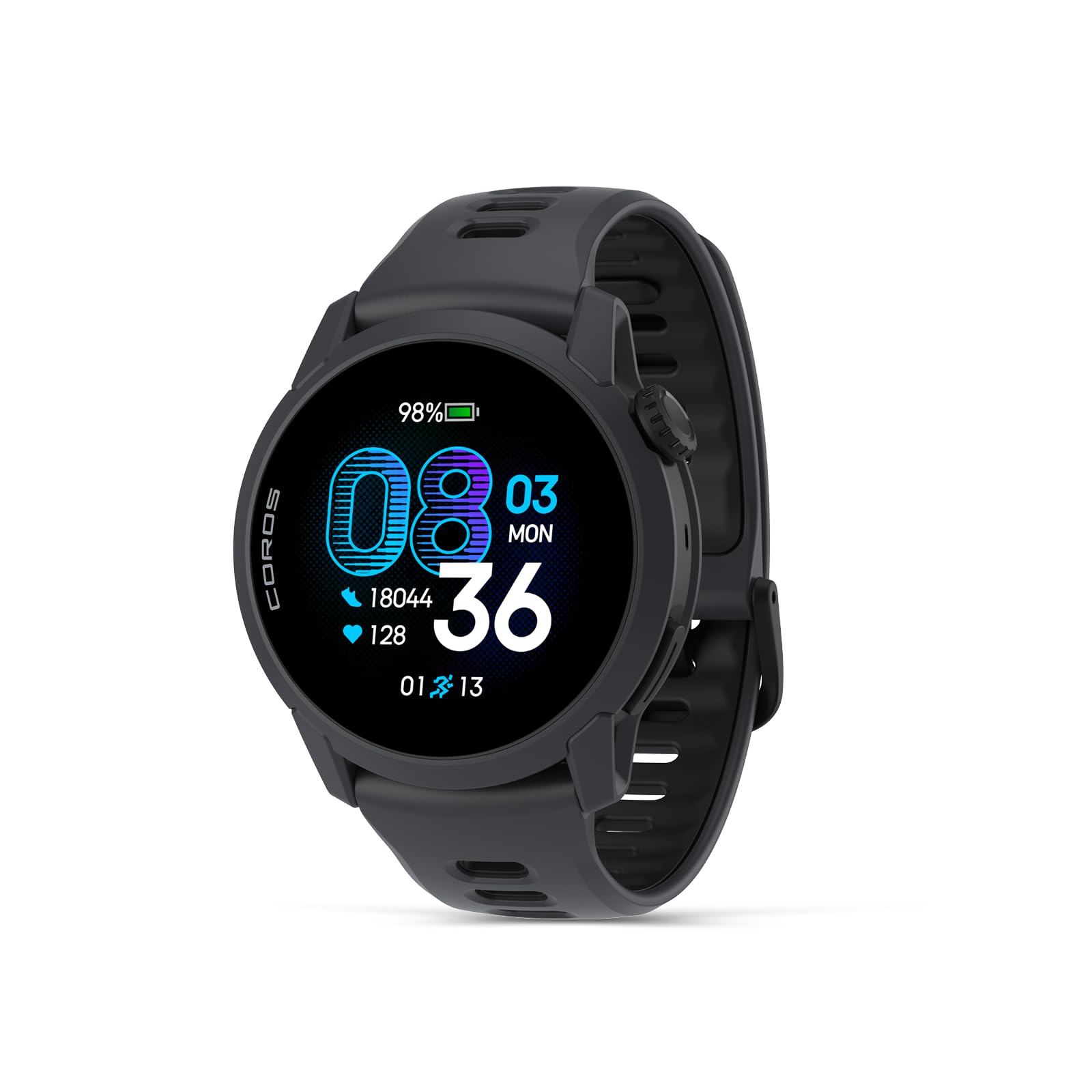
PACE 4

88 /100
Trail Score Excellent

Key details

Display
1.2-inch AMOLED
GPS Battery
41 hours
Smartwatch Battery
19 days
Check Price on Amazon

Forty-one hours of GPS recording is the number that makes the PACE 4 more than a lightweight alternative. That is the longest GPS battery in this guide, and it comes with 19 days of everyday use, so a week of daily runs does not automatically mean a charger. The 1.2-inch AMOLED screen is bright and sharp, and the digital crown plus two buttons are easy to operate when your hands are cold or you are breathing hard.

We think the PACE 4 is the right pick for the runner who cares more about time on the road than time in menus. The watch records the essentials, the voice-note feature is a neat way to capture how a session felt, and the battery means you can leave the cable at home for a weekend trip. The trade-off is a leaner training ecosystem than Garmin's: there is less race-day hand-holding and fewer recovery insights. The satellite spec is also standard GPS rather than multi-band, so dense city routes are not its strongest setting.

For long training blocks, back-to-back run days, or anyone who simply hates charging another device, that battery advantage is worth more than an extra metric. If you want the watch to coach you through a race build, the 265 is deeper. If you want to run for hours and forget the charger, the PACE 4 is the one we point to.

Pros

  • 41-hour GPS battery leads this set
  • 19-day everyday battery
  • Bright 1.2-inch AMOLED display
  • Digital crown is easy to control mid-run

Cons

  • Standard GPS only, not multi-band
  • Leaner training ecosystem than Garmin
Our verdict

The PACE 4 is the one we point to for runners who want the longest GPS battery here and a light, simple watch they can forget between charges.

Check Latest Price
4

Best Budget Running Plans

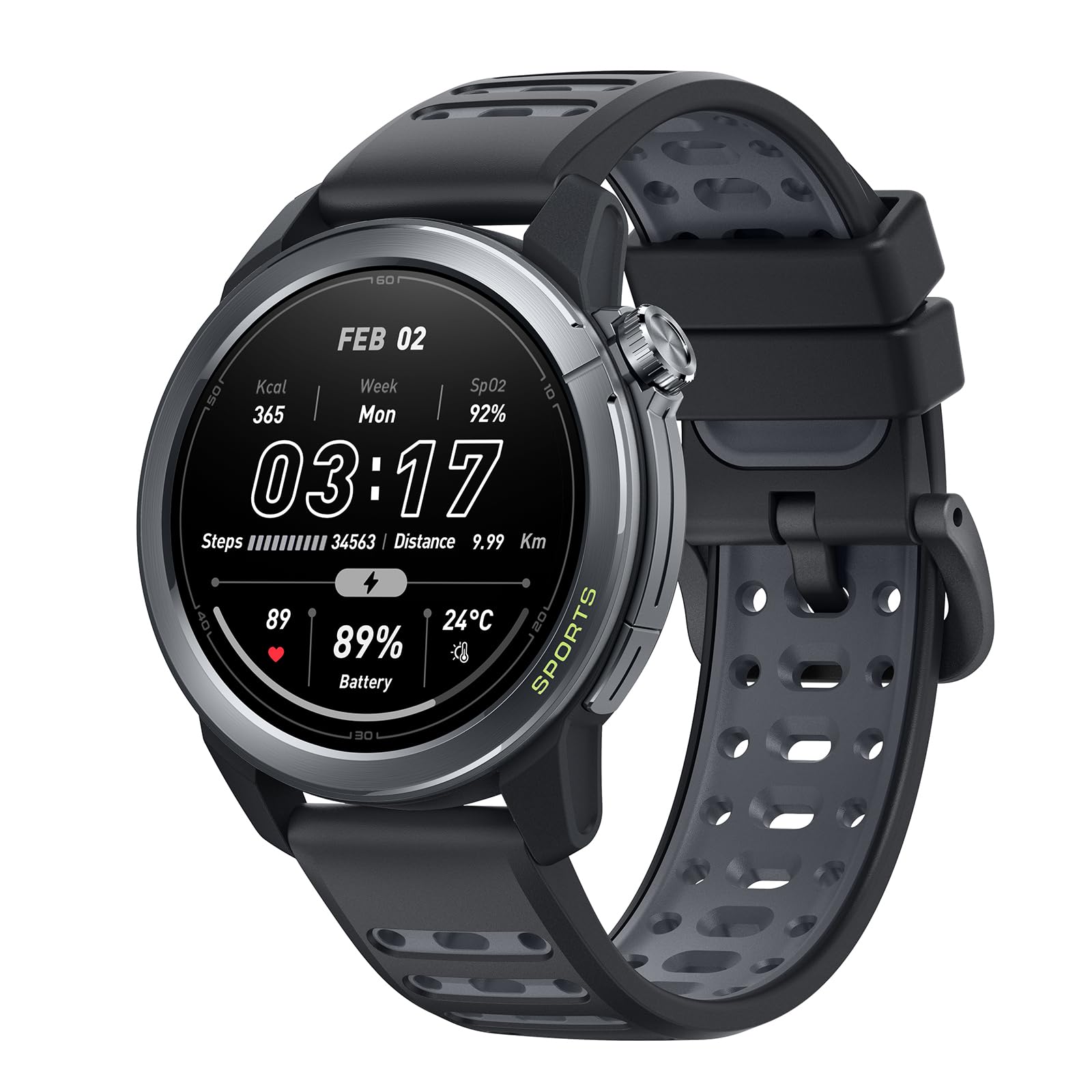
GS Active2

77 /100
Trail Score Very Good

Key details

Weight
1.41 oz
Display
1.32-inch AMOLED
GPS Battery
15 hours
Running Plans
8 preset
Check Price on Amazon

The GS Active2 is the budget pick that keeps its running focus. Eight preset plans cover everything from a running habit to a full marathon, and the watch tracks pace, cadence, stride length, running ability index, and VO2 max rather than just dumping raw miles. The 1.32-inch AMOLED screen looks far more expensive than the watch feels.

Dual-band GPS is a genuine surprise at this tier, and at 39.9 grams the watch is light enough for all-day wear. The 15-hour GPS battery covers a marathon with room to spare. The software is where the savings show: the app and menus are simpler than Garmin's, and the watch is not as polished for structured workouts or recovery guidance.

We think it is a smart first running watch for someone who wants structure without a subscription or a complicated ecosystem. That is an acceptable trade for a new runner who wants the watch to tell them what to do next. If you already follow a coach or a training app, the Mibro's plan library loses some value and the Forerunner 165 is the better all-around choice.

Pros

  • Eight built-in running plans
  • Dual-band GPS at a budget tier
  • Light 39.9 g build
  • Bright 1.32-inch AMOLED display

Cons

  • 15-hour GPS battery is modest for ultras
  • Software less polished than Garmin's
Our verdict

New runners get the most from the GS Active2: built-in plans and dual-band GPS at a budget tier, which we think is the right trade.

Check Latest Price
5

Dual-Band Value

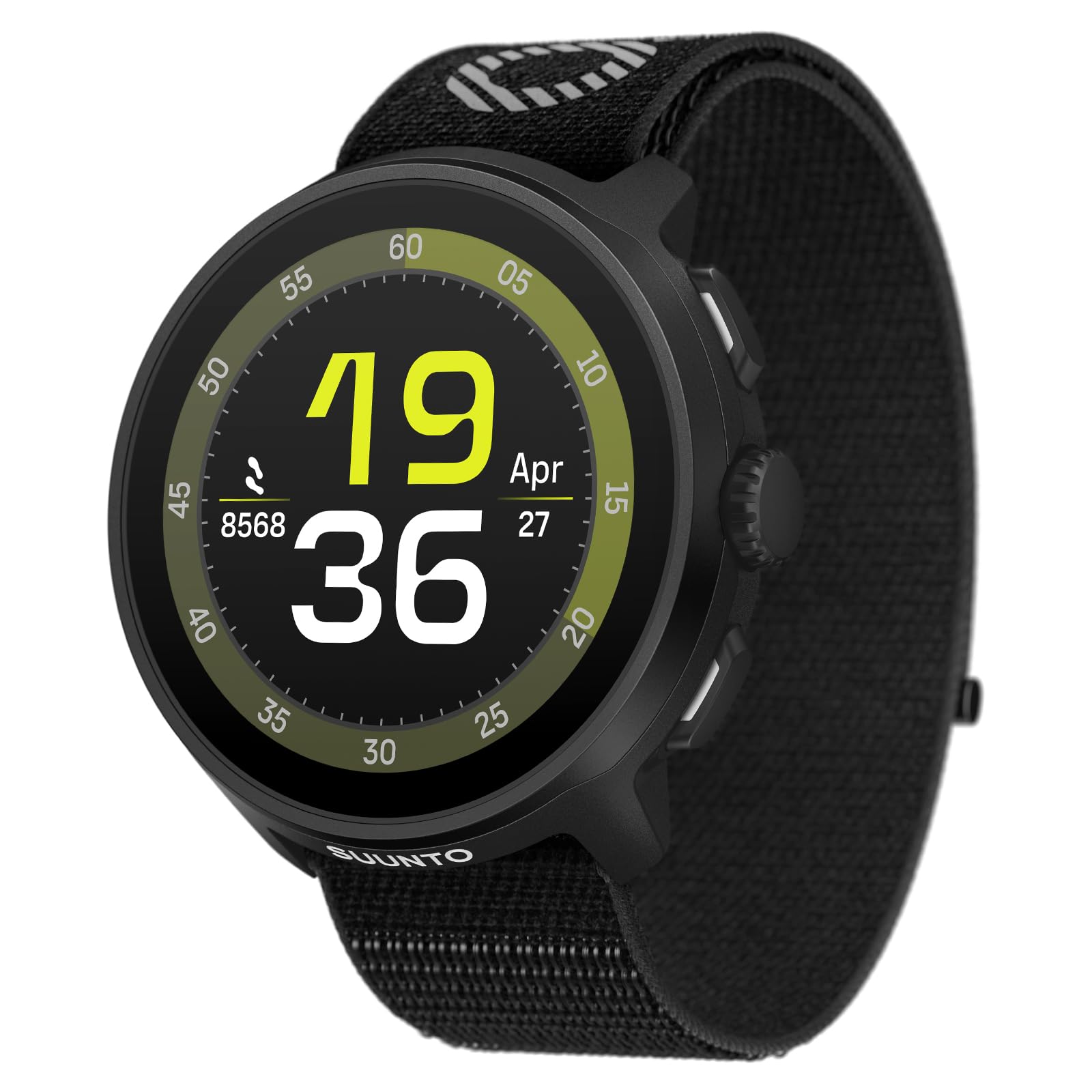
Suunto Run

79 /100
Trail Score Very Good

Key details

Display
1.32-inch AMOLED
Satellite
Dual-frequency GPS
GPS Battery
20 hours
Smartwatch Battery
12 days
Check Price on Amazon

The Suunto Run is the dual-frequency alternative in this group. It pairs a 1.32-inch AMOLED touchscreen with 12 days of everyday battery and 20 hours in GPS mode, and the breadcrumb navigation can get you back on route without pulling out a phone. Training load tracking and Training Stress Score give it more structure than a basic pace-and-distance watch.

We see it as a useful middle path for runners who care about satellite precision but not about race-day pacing widgets. The screen is easy to read, and the watch covers the training basics, though it stops short of the deep recovery and readiness tools on the 265. Where it falls short is polish: the Suunto app and on-watch menus are less intuitive than Garmin's, and the smart features are thinner. If dual-frequency GPS is the feature you care about most, the Suunto Run makes sense; if you want the most complete training experience, the 265 is worth the step up.

Pros

  • Dual-frequency GPS for cleaner tracks
  • 1.32-inch AMOLED touchscreen
  • 12-day everyday battery
  • Breadcrumb navigation without a phone

Cons

  • App and menus less intuitive than Garmin's
  • Thinner smart features than Garmin's
Our verdict

We see the Suunto Run as the dual-frequency alternative: bright AMOLED, solid battery life, and less coaching depth than the Garmin picks.

Check Latest Price

How We Tested: Eight Months, 11 Watches, a Lot of Tired Legs

We started by gathering every watch built specifically for running rather than general fitness tracking, then compared the claims that matter on paper: satellite systems, stated GPS battery life, weight, water resistance, and how many headline features sit behind a paid subscription. From that list we bought 11 watches and wore them for eight months, spanning simple pace-and-distance trainers up through mapping-capable multi-sport models, so we could speak to what the extra money actually buys.

Every watch ran the same routes: a five-mile loop through downtown streets where tall buildings bounce the signal, a tree-covered park trail, an indoor track, and a treadmill when the weather won. We ran each route with two watches at once and compared the resulting maps and splits against each other, watching for wandering lines and mile markers that jumped. For battery life, we charged each to full and ran it with GPS and heart rate until it died, noting whether the claimed hours held with the screen set to stay on.

Ease of use got its own test: we handed each watch to someone who'd never worn that brand and timed how long it took them to start a run, then repeated it in gloves and mid-run to count the taps needed to check pace. We built data screens, alerts, and watch faces from scratch to judge customization, and paired everything with a phone, headphones, and two training apps to see how fast syncing happened and whether the connection held. Crashed apps, frozen screens, and workouts that failed to upload went straight into the notes.

The last stretch was simply living with them — sleeping in a few, wearing them to work, reading the display in bright sun. After eight months we asked one question of each: is the build quality and functionality worth the cost, and would we grab it on a Tuesday without thinking? The picks below are the ones that answered yes.

How to Choose a Gps Running Watch

Satellite Support: Standard GPS vs Multi-Band

Standard GPS is enough for open roads, parks, and most everyday routes. Multi-band or dual-frequency GPS uses more satellite signals to hold a cleaner line between tall buildings, under heavy tree cover, and in valleys, and that precision is the main reason to move up. It can also cost battery life and money, so it is not an automatic upgrade. If your regular loop is exposed and simple, put the savings into a better screen or longer battery. If you train downtown or on wooded trails, prioritize multi-band: the Forerunner 265, Suunto Run, and Mibro GS Active2 all offer it, while the Forerunner 165 sticks with standard GPS.

Read GPS Battery Hours, Not Just Smartwatch Days

A long smartwatch rating can hide a short GPS runtime, and GPS is what you use on every run. We put the GPS-mode figure first: 15 to 20 hours covers most marathon training and race day with room to spare, while ultra runners and anyone doing long back-to-back days should look for 30 hours or more. The COROS PACE 4 leads this group at 41 hours, the Forerunner 165 and 265 sit around 19 to 20 hours, and the Mibro GS Active2 is the shortest at 15. Everyday battery still matters, but treat it as a separate number.

Case Size and Weight Decide Comfort

A running watch is worn for hours, so fit matters as much as the spec sheet. A 43mm case like the Forerunner 165 is a safer fit for smaller wrists; the 46mm Forerunner 265 gives the screen more room but will feel large on some people. Weight is the other half: a lighter watch disappears on long runs and at night, while a heavier one can bounce or feel bulky under a sleeve. The Mibro GS Active2 is the lightest of our picks at 39.9 grams, and the Forerunner 165 is close at 1.38 ounces. Match the case to your wrist rather than chasing the biggest display.

AMOLED vs LCD, Touch vs Buttons

AMOLED screens are brighter and more colorful, which helps at a glance in sunlight, but they use more battery than the LCD panels still found on older budget watches. A touchscreen is handy for scrolling widgets, yet buttons are faster for starting a lap or stopping a split when your hands are cold or wet. The best running watches give you both. The Forerunner 165, 265, Suunto Run, and Mibro GS Active2 all pair AMOLED displays with physical controls. If you run in gloves or care about battery above all, check that the buttons can handle the core run functions without swiping.

Training Tools: Buy Only the Coaching You Will Use

Daily suggested workouts and race plans are useful if you want the watch to set the structure; they are clutter if you already follow a coach or an app. The Forerunner 165 includes daily suggestions and Garmin Coach plans, which is enough for most self-guided runners. The 265 adds training readiness, recovery insights, and a race widget that builds a pacing plan from a course and goal time. The Mibro GS Active2 takes a simpler route with eight preset plans. Be honest about which camp you are in: paying for coaching you will ignore is worse than buying a simpler watch and using it consistently.

Frequently Asked Questions

Final Verdict

For most runners, the Garmin Forerunner 165 is the watch to buy. It has the comfortable size, bright screen, useful training guidance, and GPS battery life that make daily running easier, and it does not charge a premium for race-day tools many people never use.

If you are training for a specific race, the Forerunner 265 adds multi-band GPS and deeper pacing and recovery tools. If battery life is the priority, the COROS PACE 4 lasts longest between charges; on a tight budget, the Mibro GS Active2 covers the basics with built-in plans.