Best Ginseng Supplements of 2026

The supplement aisle has a trust problem, and ginseng sits right in the middle of it. Two bottles can both say 500 mg of ginseng and hold wildly different amounts of the compounds that actually do something — ginsenosides — because the label counts root powder, not potency. What you're buying, when it works, is a calmer kind of energy: fewer 3 p.m. crashes, easier focus, and none of the wired feeling that comes with a third cup of coffee. That's the bar I held these to.

I'd taken ginseng on and off for years, mostly guessing at doses, so I had a personal stake in sorting the real ones from the sawdust. Over four months, my team and I worked through 14 capsules, tinctures, and powders, and the pattern showed up fast: the ones that worked named a species and a standardized ginsenoside percentage, and the ones that did nothing leaned on a big milligram number. What's below earned its spot on steady energy, sharper focus, and how we felt the next morning.

1

Best Overall

NooMost Korean Red Panax Ginseng + Ginkgo

89 /100
Trail Score Excellent

Key details

Capsules
120, vegan
Ginsenosides
10%
Ginkgo Per Serving
60 mg
Ginseng Per Serving
1,000 mg
Check Price on Amazon

Ten percent is the number that put NooMost at the top of our list. Only a couple of bottles in this group state a ginsenoside percentage at all, and this one pairs 10% with a full gram of Korean red ginseng root extract, then adds 60 mg of ginkgo leaf extract on top. That's a genuine two-in-one — ginseng for the energy, ginkgo for the focus — and it means you're not stacking a second bottle to cover the afternoon.

We like the pairing for a specific kind of tired: the afternoon where you can't hold a thought, not the kind where your legs give out. The ginkgo here is a supporting dose rather than a full standalone serving, so don't expect it to carry the formula, but it's a sensible companion to a gram of ginseng. The capsules are medium-sized and go down easily, and the formula is vegan, non-GMO, and gluten-free, which makes it easy to slot in beside whatever else you already take.

What you give up is volume. The bottle holds 120 capsules, half the count of the 240-capsule bottles here, and it's the most expensive pick in this group — you're paying for the standardization and the second herb rather than for a long supply. If you burn through a bottle quickly, one of the plain 240-count options is the smarter repeat purchase. If you want the most complete formula here, this is the one we keep coming back to.

Pros

  • Ginsenoside content stated on the label
  • Full gram of Korean red ginseng per serving
  • Ginkgo adds focus support
  • Vegan, non-GMO, gluten-free capsules

Cons

  • 120 capsules is a shorter supply than rivals
  • Highest price in this group
Our verdict

The bottle we recommend first: a full gram of Korean red ginseng with its ginsenoside content stated, plus ginkgo for the focus half of the equation.

Check Latest Price
2

Best Ginseng-Only Capsule

Double Wood Korean Red Panax Ginseng

90 /100
Trail Score Outstanding

Key details

Capsules
240
Ginsenosides
10%
Third-party Tested
Yes
Ginseng Per Serving
1,000 mg
Check Price on Amazon

If you want ginseng without a second herb along for the ride, this is the bottle we hand you. Double Wood's Korean red ginseng matches our top pick where it counts — 1,000 mg per serving, standardized to 10% ginsenosides — and leaves the ginkgo out entirely.

That makes it the cleaner experiment. If you're trying to work out whether ginseng itself does anything for you, one variable is far easier to judge than two, and this gives you the top pick's strength without the confound. It also holds 240 capsules, double the count, for less money, which is the sort of arithmetic that decides a repeat purchase. Vegetarian capsules, non-GMO, gluten-free, third-party tested, and made in the USA from globally sourced root.

What it isn't is interesting. There's no flavor, no gummy, no ritual to it — just a large bottle of plain capsules you'll forget about between refills. For something you're meant to take every morning for months, we don't count that as a loss.

Pros

  • 10% ginsenoside standardization
  • 240 capsules per bottle
  • Ginseng alone, no ginkgo
  • Vegetarian, non-GMO, third-party tested

Cons

  • Red ginseng can bring on headaches
Our verdict

The ginseng-only pick: the same 10% standardization as our top choice, twice the capsules, and nothing else in the bottle.

Check Latest Price
3

Best Budget

Nutricost Panax Ginseng 1000mg

91 /100
Trail Score Outstanding

Key details

Dietary
Gluten-free, non-GMO, soy-free
Capsules
240 (120 servings)
Third-party Tested
Yes
Ginseng Per Serving
1,000 mg
Check Price on Amazon

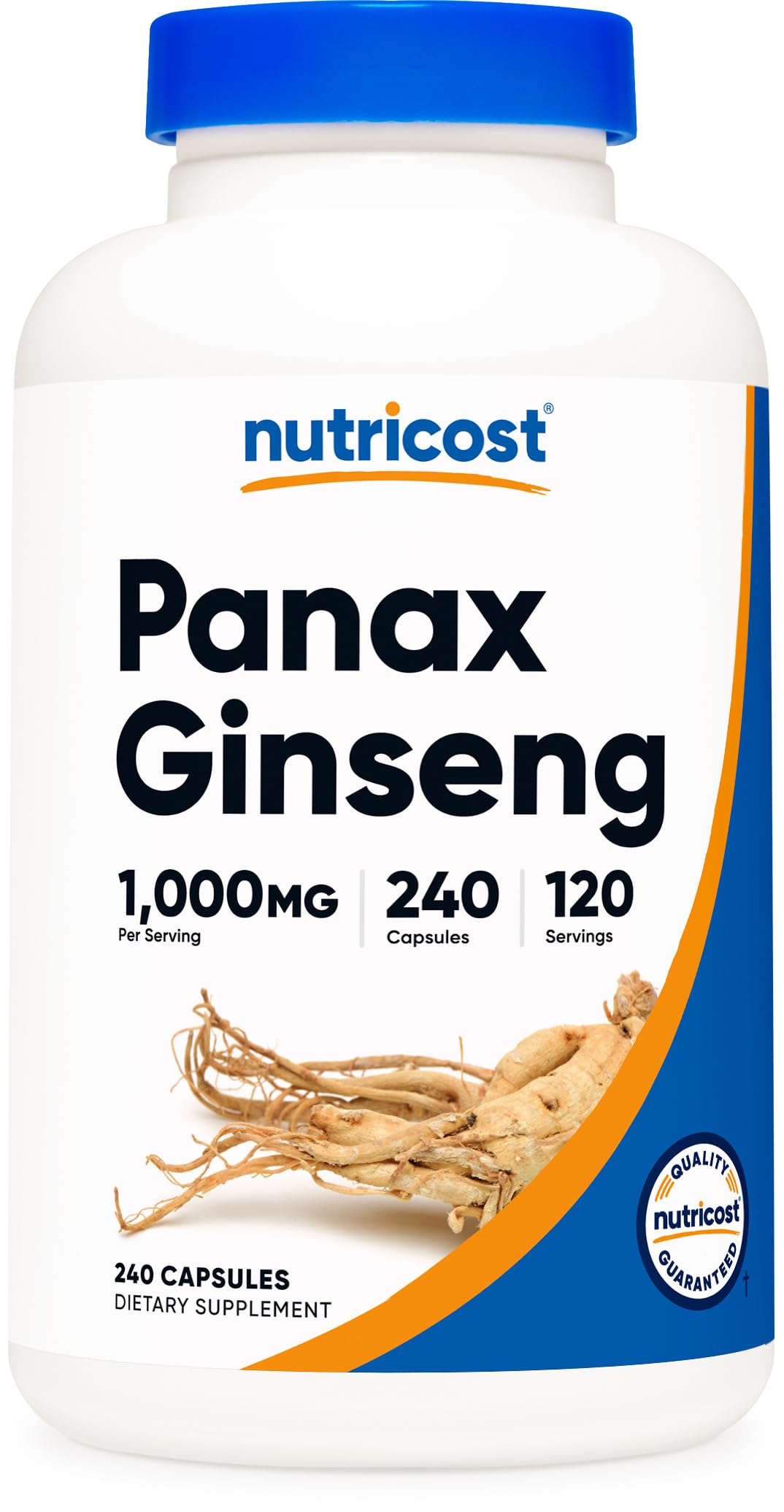
Nutricost is the cheapest way in this group to take a gram of ginseng a day. The bottle holds 240 capsules at 1,000 mg per serving, which works out to 120 servings — roughly four months of daily use from a single bottle.

That's the pitch: a long, inexpensive trial for anyone who isn't sure ginseng is worth the money. What we didn't expect at this price is the paperwork. Gluten-free, non-GMO, soy-free, third-party tested, and made in an NSF-certified, GMP-compliant, FDA-registered facility — that's more quality detail than several of the pricier bottles here bother to print, and it's why we're comfortable recommending a budget pick this plainly.

Two caveats worth knowing. Nutricost doesn't state a ginsenoside percentage, so you can't line its strength up against the standardized extracts here; you're buying a gram of root and trusting the testing behind it. And ginseng is a slow, uneven herb — some people take it daily for a month and feel nothing at all. If that turns out to be you, you've spent the least money here finding out, and you can move on to a 10% extract without regret.

Pros

  • Lowest cost per serving here
  • 120 servings per bottle
  • Third-party tested, NSF-certified facility
  • Gluten-free, non-GMO, soy-free

Cons

  • No stated ginsenoside percentage
Our verdict

Our pick for a low-stakes trial: a gram per serving, about four months in the bottle, and documented quality testing.

Check Latest Price
4

Best Liquid Extract

Prince of Peace Red Panax Ginseng Extractum

92 /100
Trail Score Outstanding

Key details

Form
Liquid extract vial
Strength
Ultra Strength
Daily Serving
1 vial
Vials Per Pack
30 (0.34 fl oz each)
Check Price on Amazon

Thirty small bottles of liquid ginseng extract is the pick for anyone who has already decided they hate capsules. Each 0.34 fl oz vial is a single dose: shake it, push in the straw, drink it, done. We like that for a desk drawer or a gym bag, where a bottle of capsules is one more thing to remember and a vial is simply there.

The catch is the taste. Red ginseng extract is earthy and bitter, and these are no exception — some mornings it goes down like a shot, others you'll want to chase it with something cold. If bitter flavors genuinely bother you, the capsules here have no taste at all and are the better buy; there's no version of this that tastes like nothing.

What you get for the trouble is convenience: 30 vials is a 30-day supply at one a day, with nothing to measure or count out. The one practical annoyance is the cap. The vials are small and the tops take a firm twist, which is worth knowing if grip strength is an issue for you or the person you're buying for.

Pros

  • Single-dose vials, no pill to swallow
  • Easy to keep in a bag or desk drawer
  • 30-day supply at one a day
  • No measuring or counting capsules

Cons

  • Bitter, earthy flavor
Our verdict

The one we hand to anyone who won't take another pill: a single-shot vial of red ginseng extract, bitter by nature and easy to keep in a bag.

Check Latest Price
5

Best Powder

Micro Ingredients Korean Ginseng Root Powder

90 /100
Trail Score Outstanding

Key details

Form
Root powder
Scoop
1,000 mg
Pouch Size
4 oz (about 113 servings)
Certifications
Organic, non-GMO, vegan friendly
Check Price on Amazon

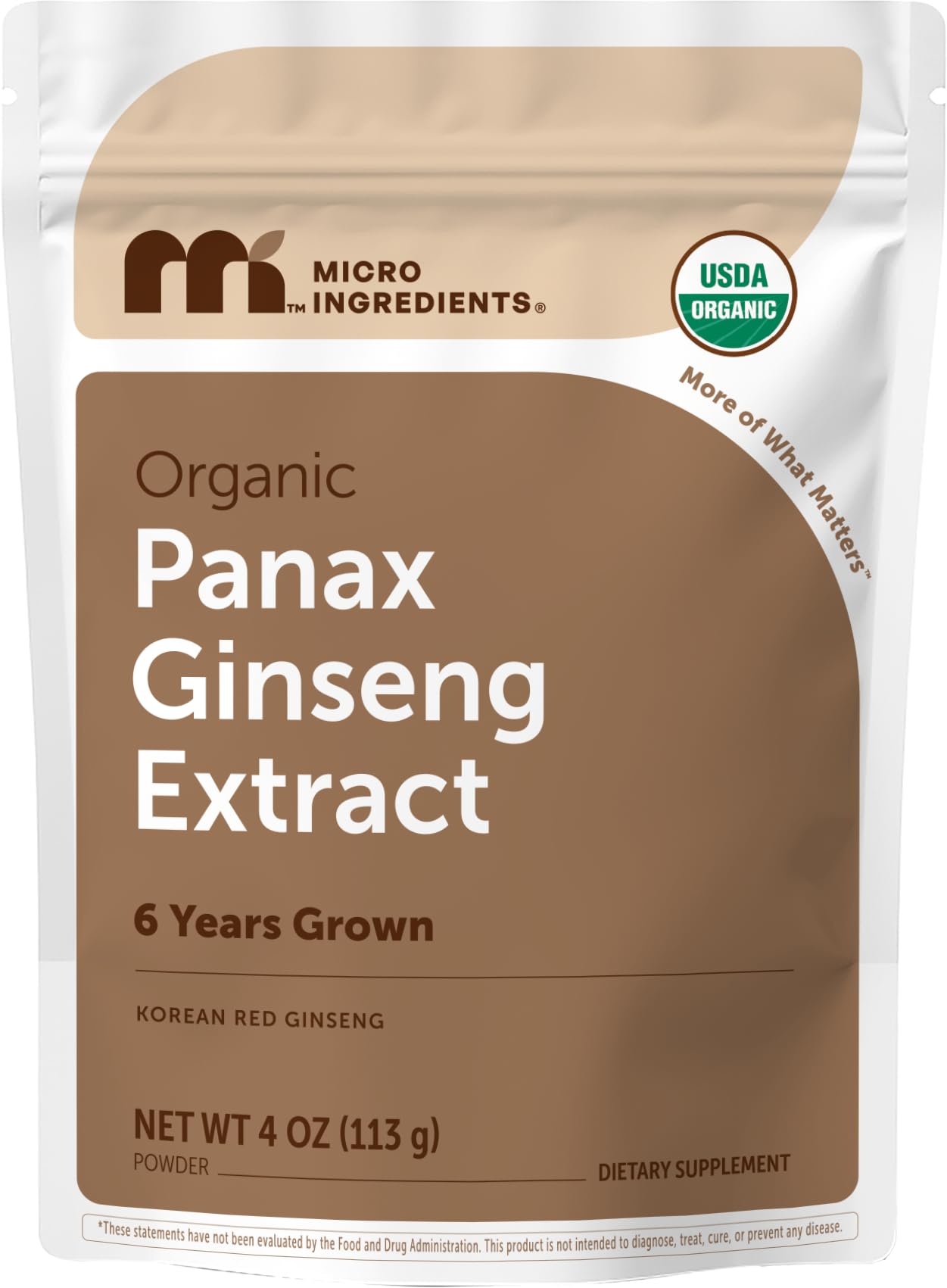
A scoop of this disappears into a hot cup of coffee with a stir, which is more than we can say for most powdered herbs. It's whole Korean red ginseng root, grown six years and milled fine, and the four-ounce pouch holds about 113 servings at the 1,000 mg scoop.

That's a long run out of one small pouch, and the flexibility is the real draw — tea, a smoothie, a shaker bottle, whatever you already drink in the morning. It's organic, non-GMO, and third-party lab tested, and it's made without soy, dairy, gluten, or tree nuts, which makes it the easiest pick here to fold into an existing routine rather than adding to it.

It tastes like what it is. The powder is bitter and earthy and it will change whatever you stir it into; coffee and smoothies hide it better than water does, and a heaped spoon of anything sweet helps more than you'd think. And because it's a whole-root grind, there's no ginsenoside percentage to compare against the standardized extracts here — you're buying the root, not a measured dose of one compound. If a number on the label matters to you, buy the capsules instead.

Pros

  • About 113 servings per pouch
  • Dissolves easily in coffee or smoothies
  • Organic, non-GMO, third-party tested
  • Whole six-year root, not an extract

Cons

  • Pouch closure gets gummed up with powder
Our verdict

We like this for smoothie and coffee drinkers: a fine organic whole-root powder with roughly 113 servings in the pouch and a bitterness worth planning around.

Check Latest Price
6

Best for a Higher Dose

NutraChamps Korean Red Panax Ginseng

86 /100
Trail Score Excellent

Key details

Made In
USA, cGMP facility
Capsules
120
Ginsenosides
5% minimum
Ginseng Per Serving
1,200 mg
Check Price on Amazon

At 1,200 mg per serving, NutraChamps is the largest single dose in our group, and that's the reason to look at it. If you've taken a gram of ginseng and felt nothing, a bigger scoop is one variable worth changing before you give up on the herb entirely.

The catch is how that milligram figure is reached. NutraChamps standardizes to a 5% ginsenoside minimum, half the percentage of our top pick, so a 1,200 mg capsule delivers less of the active compound than a 1,000 mg capsule at 10%. That's the trap with ginseng labels generally: the number on the front is the weight of the powder, not the strength of the extract, and the bigger bottle can be the weaker one. Read the two figures together, always.

What it has going for it is range — energy, focus, and mood all feature, and the capsules are easy to swallow with no aftertaste. But the reactions here are the most divided in this group, with flat felt-nothing mornings sitting right alongside the enthusiastic ones. We treat it as the higher-dose experiment rather than a first bottle: start here if you already know ginseng agrees with you and you want more of it.

Pros

  • 1,200 mg per serving, the largest dose here
  • No aftertaste, easy to swallow
  • Made in the USA in a cGMP facility

Cons

  • Standardized to only 5% ginsenosides
  • The most divided reactions in this group
Our verdict

We point to this one for a bigger ginseng dose in a single capsule, with the reminder that a 5% extract isn't automatically stronger than a 10% one.

Check Latest Price
7

Calmer, Gentler Option

NOW American Ginseng

92 /100
Trail Score Outstanding

Key details

Capsules
100 (pack of 2)
Root Age
4-5 years, Wisconsin-grown
Ginseng Type
American ginseng root
Ginsenosides
5% minimum
Check Price on Amazon

American ginseng is a different plant from the Korean red that fills most of this list — Panax quinquefolius, grown in Wisconsin rather than Korea, and traditionally considered the cooler, calmer of the two. If red ginseng has left you edgy or interfered with sleep, this is the species to try instead.

NOW uses roots grown four to five years and states a 5% ginsenoside minimum, and you get two bottles of 100 capsules. The capsules are small, tasteless, and easy to swallow — the least fussy thing on this list to take daily, and the one least likely to make you dread the morning routine.

Expect less of a lift and more of a level. This is the pick we reach for when the goal is getting through a stressful day without fraying rather than a burst of get-up-and-go at 3 p.m., and that difference is the whole reason it's here alongside the stronger red ginseng bottles.

So the choice is straightforward. If you want the most standardized, most potent ginseng in this group, buy the top pick. If red ginseng has felt like too much — or you're in this for the long haul and want something mild enough to forget about between refills — this is the bottle we reach for.

Pros

  • American ginseng, a different species from the rest
  • Small, tasteless capsules
  • Two bottles of 100 capsules
  • 5% ginsenoside minimum from four-to-five-year roots

Cons

  • Milder lift than Korean red ginseng
Our verdict

Our American ginseng pick: Wisconsin-grown root, milder and calmer than Korean red, in small tasteless capsules that are easy to keep taking.

Check Latest Price
8

Bulk Capsule Supply

Bronson Korean Panax Ginseng Root Extract

91 /100
Trail Score Outstanding

Key details

Form
Root extract capsule
Capsules
250
Manufactured In
cGMP-registered New York facility
Check Price on Amazon

Ginseng can be hard on the stomach, and this is the bottle in our group where that matters most. If red ginseng has upset your stomach before, take this one with food and start with a single capsule rather than a full serving, then build up once you know how it lands.

Everything else about it is plain and useful. Bronson has been making vitamins since 1960, this bottle comes out of a cGMP-registered facility in New York, and 250 capsules is the biggest count in this group — enough that you won't be reordering every couple of months, and enough that a bottle lasts through the point where you'd normally give up on a supplement.

What it won't tell you is how much ginseng is in each capsule. The label says high potency root extract and stops there — no milligram figure, no ginsenoside percentage — so there's no way to line it up against the standardized bottles here. That omission is part of what the price and the count are buying you.

We keep it on the list for the reader who takes ginseng on faith, wants one big bottle, and doesn't need a spec sheet with it. If you want to know exactly what you're getting each morning, spend a little more on a standardized extract and skip the guesswork.

Pros

  • 250 capsules, the biggest count here
  • Made in a cGMP-registered New York facility
  • Tasteless, easy-to-swallow capsules
  • Manufacturing since 1960

Cons

  • No milligram or ginsenoside figure stated
Our verdict

We recommend this one for a big, inexpensive bottle from a long-established maker, provided you don't need the label to tell you how much ginseng is inside.

Check Latest Price

How We Chose and Tested the Best Ginseng Supplements

We started with about 60 products from big retailers, supplement shops, and a couple of herbalists' shelves, then cut anything that wouldn't name its species, state a standardized ginsenoside content, or share a batch certificate of analysis. Proprietary blends that hid doses behind one number went too. That left 14: capsules, tinctures, and powders, split between Asian red ginseng and the milder American type.

With four of us running them in parallel, each product got at least three straight weeks at the same time every morning, followed by a week off so we could tell what was the supplement and what was a good night's sleep. Tinctures went under the tongue before the commute, powders into warm water at the desk, capsules about 30 minutes before a morning workout. We rated energy at 10 a.m., at the 3 p.m. wall, and at bedtime, and wrote down jitters, headaches, stomach upset, and whether anyone lay awake afterward.

Focus got its own check: the same inbox-triage and draft-editing blocks on product days and off days, scored on how long we stayed in them before reaching for a new tab. To judge strength, we weighed powder scoops on a kitchen scale to see how far they drifted from the label, opened capsules to look at what was actually inside, and tasted every tincture for the alcohol burn that makes some of them hard to take daily.

Four months also carried us through cold season, so we logged sick days and how long they lasted — not proof of anything, but worth watching. Anything whose label didn't match a certificate, or that only worked at triple the suggested dose, came off the list. What's left is what we kept reaching for after testing ended.

How to Choose a Ginseng Supplement

Start With the Ginsenoside Percentage

Ginsenosides are the compounds ginseng is studied for, and a standardized extract tells you how much of them you're getting per serving. Read the percentage and the milligram figure together: a 1,200 mg capsule standardized to 5% delivers less than a 1,000 mg capsule at 10%, so the bigger number on the front can belong to the weaker bottle. That is the single most common way shoppers get turned around.

Whole-root powders and plain root capsules often state no percentage at all. That isn't a flaw so much as a different proposition — you're buying the root rather than a measured dose of one compound — but it does mean you can't line them up against a standardized extract on strength. If comparison matters to you, find the percentage before anything else.

Choose the Form You'll Take Every Day

Capsules and tablets are the default for good reason: no taste, no measuring, nothing to remember beyond the bottle. Liquid extracts in vials suit anyone who won't swallow pills; they're single-dose and portable, but they taste powerfully of ginseng, which is bitter. Powders are the most flexible and go furthest per container, and they need something to hide in — coffee, tea, a smoothie.

The right form is the one you'll still be taking in week three. Be honest about whether you'll measure a scoop when you're running late, and buy accordingly.

Read the Serving Size, Not the Bottle Size

Bottle counts are the easiest thing on the shelf to misread. A 240-capsule bottle with a two-capsule serving is 120 doses, not 240, and 120 capsules taken one at a time is roughly four months. Divide the capsule count by the serving size before you compare anything, then work out what a day actually costs.

The bottle with the higher price is often the cheaper one per dose, because the serving is smaller or the extract is more concentrated. Reverse the arithmetic and a bargain bottle can turn out to be the expensive one.

Decide Between Ginseng Alone and Ginseng With Ginkgo

Combination formulas pair ginseng with ginkgo because the two are taken for related complaints: energy and focus. Check the ginkgo dose before you buy. In a typical combination it runs around 60 mg, a supporting amount rather than a full standalone serving, so the ginseng is doing most of the work.

If you're trying to work out whether ginseng helps you at all, buy a ginseng-only bottle first. One variable is much easier to judge than two, and you can always add ginkgo later.

Frequently Asked Questions

Final Verdict

For most people, the NooMost bottle is the one to buy. A full gram of Korean red ginseng with the ginsenoside percentage spelled out is the single most useful thing a label can do for you, and the small dose of ginkgo covers the focus half of the equation without turning the bottle into a mystery blend.

If you'd rather keep ginseng on its own, Double Wood gives you the same 10% standardization with twice the capsules and no ginkgo. And if you aren't yet convinced ginseng does anything at all, Nutricost is the cheapest way to run the experiment.