Best Gait Belts with Handles of 2026

A gait belt is the quiet difference between a confident transfer and a scary one. The worry is specific: a parent or partner slips getting out of a chair, their knees buckle in the hallway, and you’re left grabbing fabric instead of something solid. A good belt with handles gives you a secure grip and gives them a steady point to lean into. The differences show up fast — buckles that creep loose, handles that bunch under your palm, webbing that rolls instead of staying flat.

I’ve been the person holding a too-thin belt while my dad moved from recliner to walker. Over the past six months, our team tested 14 gait belts with handles during bed-to-chair transfers, hallway walks, car rides, and bathroom trips. We noted how quickly each belt tightened one-handed, whether it stayed snug after sitting and standing, and where the handles landed on different hand sizes. The picks below are the ones that made all of that feel easier.

1

Best Overall

Vive Gait Belt

91 /100
Trail Score Outstanding

Key details

Handles
7 padded handles
Strap Width
4 inches
Waist Range
Up to 51 inches
Weight Capacity
350 lb
Check Price on Amazon

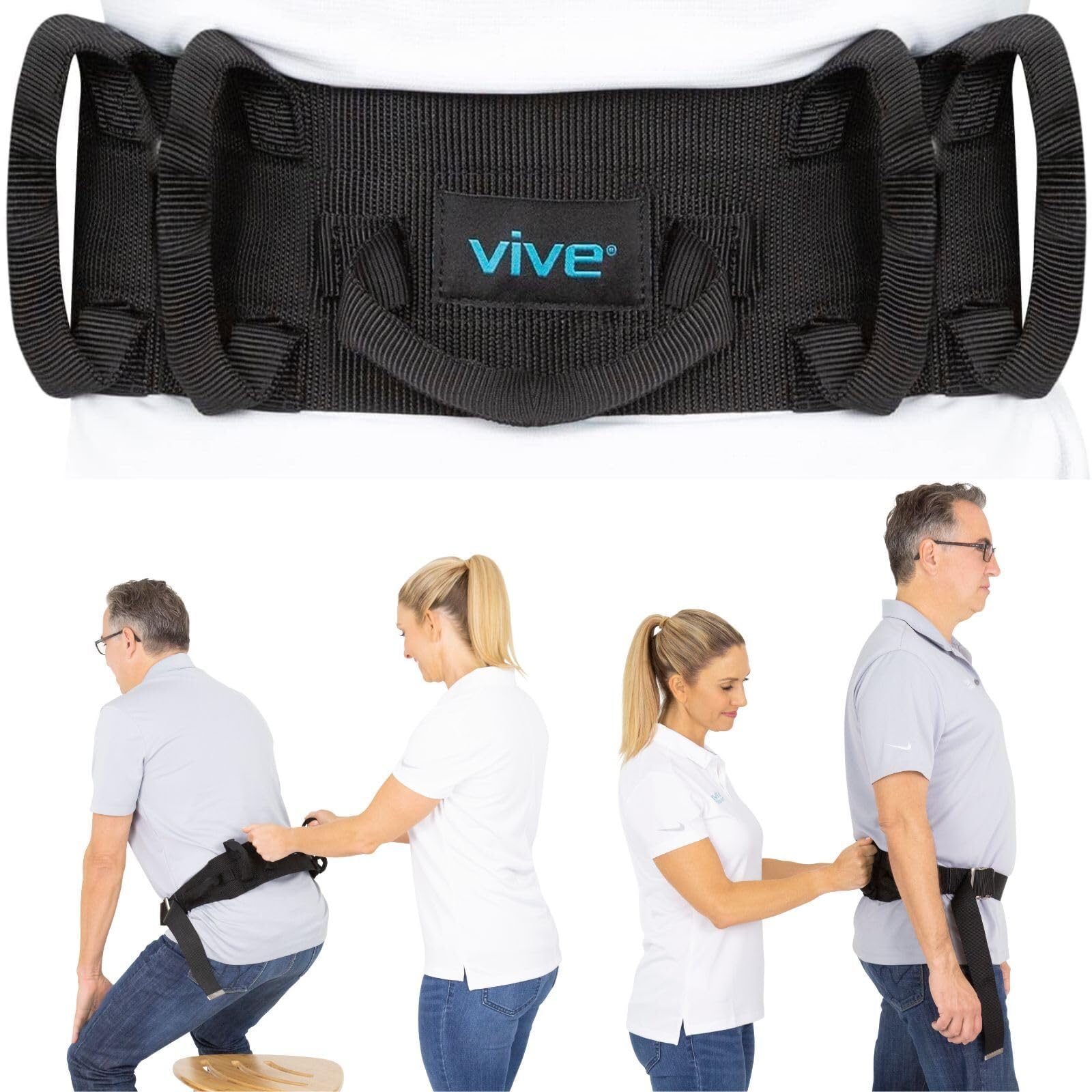
The metal quick-release buckle is the first thing we notice on this Vive belt, and it is why the whole package feels more serious than a basic strap. The 4-inch nylon webbing gives you something substantial to hold, and the 350-pound capacity and up-to-51-inch waist range cover a broad set of everyday transfers. That combination makes it our default here.

Seven padded handles are the other reason it earns the top spot. The extra grip points matter when someone shifts direction mid-step or needs help rising from a low chair, and padding makes a longer walk easier on the caregiver's hands. The handle count gives you more than one place to hold without reaching across the wearer. We also like the reinforced stitching and the quick-release latch, which lets you get the belt off without threading it back through the buckle.

The trade-off is weight. At 11.36 ounces, it is not the lightest belt here, and the metal buckle adds bulk at the front. That is a fair exchange for a belt that feels locked in, but it is worth knowing if you plan to fold it into a small bag. The 4-inch width is the bigger factor in comfort; it spreads pressure across the waist instead of digging in like a narrow strap. For a belt that stays by the bed or in the car, the extra heft is easy to live with.

Pros

  • Seven padded handles for multiple grips
  • 4-inch webbing spreads pressure
  • Metal quick-release buckle
  • 350-lb capacity and 51-inch waist fit

Cons

  • Can ride up on rounder waists
Our verdict

For most home caregivers, we recommend the Vive first: seven padded handles, a wide 4-inch strap, and a metal quick-release buckle make it the most complete belt here.

Check Latest Price
2

Best for Two-Person Transfers

Secure STWB-52 Gait Belt

92 /100
Trail Score Outstanding

Key details

Buckle
Quick-release adjustable buckle
Handles
4 vertical, 2 horizontal
Weight Capacity
350 lb
Check Price on Amazon

Four vertical handles and two horizontal ones make this the belt we want when two people are moving someone together. One caregiver can take a side grip while the other works from the back or front, and nobody has to crowd the same loop. The horizontal grips are useful for a straight pull toward standing; the verticals help you steer. That is a different job from a solo walking belt, and the Secure is built around it.

This is our pick for two-person transfers rather than a universal belt. The 350-pound capacity matches our top pick, and the quick-release adjustable buckle makes it easy to set and remove between chair, bed, and car. The six-handle layout is the feature that earns the place; the Vive still has the edge in handle count and padding, while the Secure wins on directional grip.

The belt is lighter than the Vive at 9.6 ounces, which makes it easy to keep in a care bag. Its quick-release buckle is the right choice for transfers that happen several times a day, and the six grips are easier to explain to a second helper than a plain strap. If you mostly walk beside one person on your own, the Vive's seven padded handles are the more forgiving choice.

Pros

  • Four vertical and two horizontal grips
  • 350-lb capacity matches the top pick
  • Quick-release adjustable buckle
  • Light 9.6-ounce build

Cons

  • Can slide up during standing transfers
Our verdict

We choose the Secure when two people usually transfer together, because its four vertical and two horizontal handles give each caregiver a clean grip.

Check Latest Price
3

Best for Longer Waists

NYOrtho Gait Belt

91 /100
Trail Score Outstanding

Key details

Buckle
Quick-release buckle
Handles
6 handles
Waist Range
28 to 55 inches
Weight Capacity
275 lb
Check Price on Amazon

The 55-inch waist range is the reason to look at this NYOrtho belt. It is the longest fit in this group, and the six handles—four vertical, two horizontal—give you options whether you stand beside the wearer or slightly behind. The quick-release buckle is simple to operate, and the belt is light at 9.14 ounces.

The light build is easy to keep in a care bag, and the four vertical grips make a side-by-side walk feel natural. The two horizontal handles give you a second option when you need to pull straight back from a chair. The 4-inch webbing gives you more surface area than a thin strap. For a belt with this much adjustment, it stays out of the way.

This is our pick for longer waists and lighter users, especially if you want a belt that does not add much weight to a care bag. The 55-inch range is the feature that earns the place; the six-handle layout and quick-release buckle make the day-to-day routine easier. It is a straightforward belt that does its job without extra hardware.

Pros

  • Fits waists up to 55 inches
  • Six handles in four vertical, two horizontal
  • Quick-release buckle
  • Light 9.14-ounce build

Cons

  • 275-pound capacity is the lowest here
Our verdict

We recommend the NYOrtho for waists up to 55 inches, provided the wearer is within its 275-pound limit and you want six handles in a light belt.

Check Latest Price
4

Best Machine-Washable

Cow&Cow Gait Belt

89 /100
Trail Score Excellent

Key details

Care
Machine washable, line dry
Handles
6 handles
Strap Width
4 inches
Waist Range
28 to 52 inches
Check Price on Amazon

Machine-washable nylon is the detail that makes this Cow&Cow belt easy to live with. A gait belt sits against the body and gets handled all day, so being able to wash it and line dry it is a real advantage in a shared home or therapy bag. The 4-inch width and six handles are the working parts; the green finish is just easier to spot when you are digging through a closet.

This is the shared belt we reach for. The 28-to-52-inch waist range covers most adults, and the quick-release buckle is simple to operate when you are helping someone in and out of a chair. The six handles give you several grip points around the belt, so a second caregiver can join without reaching across the wearer.

It does not have the structured back band of the Posey or the extra-wide padding of the supregear, but it does not need to; this is a straightforward belt for everyday walking and seated transfers. A machine-washable belt that still gives you a 4-inch grip surface is a sensible default for shared care.

Pros

  • Machine washable and line dry
  • 4-inch webbing for a broader grip
  • Six handles around the belt
  • 28-to-52-inch waist range

Cons

  • No stated weight capacity
Our verdict

We reach for the Cow&Cow when a belt will be shared and washed often; its 4-inch nylon, six handles, and 28-to-52-inch fit make daily care easier.

Check Latest Price
5

Best Clinical-Style Support

Posey 6537Q Gait Belt

89 /100
Trail Score Excellent

Key details

Handles
6 stitched grab handles
Strap Width
4 inches
Waist Range
28 to 52 inches
Rear Support Band
Included
Check Price on Amazon

The rear support band is what sets the Posey apart from the flat nylon belts here. It adds structure across the back, and combined with the 4-inch webbing and six stitched handles, it gives a transfer a more controlled feel. This is the belt we choose when the person needs a little more guidance than a simple walking strap provides.

The 28-to-52-inch range is standard, and the quick-release buckle is the right choice for a belt that comes on and off several times a day. The handles are securely stitched into the belt, which is the construction detail we look for when a caregiver is pulling against it. The six handles are arranged to give you a grip on both sides and the back, so you can change your hand position without letting go of the person. At 10.8 ounces, it is mid-pack in weight, with enough substance to feel reassuring without being a burden.

The premium price is the main trade-off. For a shared therapy bag or a household where transfers happen several times a day, the extra structure is easier to justify than for occasional use. It is a belt for controlled transfers, not a light spare to keep in the car.

Pros

  • Rear support band adds structure
  • Six securely stitched handles
  • 4-inch nylon webbing
  • Quick-release buckle

Cons

  • No stated weight capacity
Our verdict

We prefer the Posey when a transfer needs more structure; the rear support band and six stitched handles make it the most clinical-feeling belt in this set.

Check Latest Price
6

Lightweight Backup

Patient Aid Gait Belt

89 /100
Trail Score Excellent

Key details

Strap
Adjustable strap
Buckle
Quick-release buckle
Weight
5.11 oz
Handles
Reinforced grab handles
Check Price on Amazon

At 5.11 ounces, the Patient Aid is the belt that disappears into a glove box or a tote. It rolls up small enough to keep as a spare, and the quick-release buckle makes it easy to put on when you are already standing in a parking lot or at the bottom of a stairway.

The reinforced handles are the part that matters once you are actually moving. They give you a place to hold without grabbing the wearer's clothing, and the adjustable strap lets you tighten the belt before a transfer. The compact build is the reason it packs away so easily. The compact size also makes it less conspicuous in a purse or wheelchair bag, which is useful if you want a belt on hand without carrying a full care kit.

This is the one we keep as a lightweight backup rather than the main belt for a heavier adult. For a smaller wearer or a short trip, the low weight and simple buckle are worth the trade-off; for a daily transfer with someone who needs a lot of support, choose a wider belt with a stated higher capacity.

Pros

  • 5.11-ounce packable design
  • Reinforced grab handles
  • Quick-release buckle
  • Adjustable strap

Cons

  • Fit can run short for larger waists
  • Plastic buckle can loosen with use
Our verdict

We keep the Patient Aid as the spare: at 5.11 ounces it rolls up small, and its reinforced handles and quick-release buckle are enough for light assistance.

Check Latest Price
7

Wide Padded Fit

supregear Gait Belt

87 /100
Trail Score Excellent

Key details

Handles
7 handles
Material
1680D polyester and mesh
Waist Range
27 to 50 inches
Padding Width
5.7 inches
Check Price on Amazon

The 5.7-inch padded panel is the widest here, and it changes who this supregear belt is for. The padding spreads pressure across a broader band, and the seven handles give you grips in several directions, which is useful when a transfer angle changes halfway through. The 27-to-50-inch adjustment is generous for a belt with this much panel.

We like it for a taller or heavier wearer who finds a 4-inch belt too narrow. The 1680D polyester and mesh fabric is built to be tough and breathable, and the reinforced seams matter more than the padding once the belt is under load. The quick-release polymer buckle is easy to adjust, and the wide panel is meant to stay comfortable during a longer walk.

The width is also the catch. On a petite wearer, the panel can feel like too much belt, and it may not settle as low as a narrower strap. That is a fit boundary rather than a flaw in the padding; if the waist is small, the Cow&Cow's 4-inch width is the easier starting point.

Our pick is the supregear for a wider, padded fit up to 50 inches, especially for a taller wearer who wants more surface area and seven handles. It is not the belt for a very small frame, and it is not the one we choose when a low, unobtrusive fit matters most.

Pros

  • 5.7-inch padded panel
  • Seven handles in multiple directions
  • 27-to-50-inch waist range
  • 1680D polyester and mesh build

Cons

  • Can ride up toward the chest
  • No stated weight capacity
Our verdict

We recommend the supregear for a wider, padded fit up to 50 inches, especially for a taller wearer who finds a 4-inch belt too narrow.

Check Latest Price
8

Up to 51-Inch

TKWC Transfer Belt

89 /100
Trail Score Excellent

Key details

Handles
6 padded handles
Back Width
4 inches
Waist Range
Up to 51 inches
Strap Length
55 inches
Check Price on Amazon

The 55-inch strap and 51-inch waist rating put this TKWC belt in the larger-fit conversation. The extra length gives you room to adjust around clothing, and the 4-inch back panel spreads pressure across the lower back instead of concentrating it in a narrow band. For a taller or broader wearer, that extra coverage is the reason to look here.

Six padded handles are spaced around the belt, with two horizontal and four vertical grips. The oversize buckle is easy to find with your hand, and the belt can be hand washed and air dried. We like that combination for a caregiver who needs a clear grip without hunting for a loop.

The belt tightness is the part we flag. The buckle can loosen under load, especially during a longer walk, so this is a belt for someone who will reset it between transfers rather than set it once and forget it. Check the fit after the wearer stands and again before you move.

The TKWC earns its place for a 51-inch waist and a 4-inch back panel, with the understanding that it needs a mid-transfer check. It is a good fit for a larger wearer who wants padding and a broad back, but not the belt we choose for a long, uninterrupted walk with someone who needs constant support.

Pros

  • 55-inch strap fits up to 51-inch waists
  • 4-inch back panel spreads pressure
  • Six padded handles
  • Hand washable and air dry

Cons

  • No stated weight capacity
Our verdict

We like the TKWC for a 51-inch waist and a 4-inch back panel, but it suits a caregiver who will check the buckle between transfers.

Check Latest Price

How We Tested Gait Belts With Handles

We started by pulling together the gait belts with handles that show up most often in home-care supply catalogs and caregiver forums, then narrowed the list by belt width, handle count and placement, buckle type, padding, and stated weight capacity. That left us with 14 belts. We did not test them in a lab; we used them the way they actually get used — in living rooms and bedrooms, on hallway walks, during car transfers, and on trips to the bathroom. Testers included people with small and large hands, and belts went around waists from roughly 28 to 48 inches.

Each belt got the same run of daily transfers. We timed how long it took to thread and tighten one-handed, then checked whether the belt stayed snug after a person sat, stood, and sat again. We watched where the handles landed against the caregiver’s wrist and whether they stayed open or collapsed under a firm grip. We also noted whether the webbing rolled, twisted, or stayed flat against the waist, and whether the buckle crept loose under a lean.

After six months, we rechecked every belt for frayed edges, loose stitching, and handle attachment points that had stretched. The best ones felt like an extra set of hands: easy to snug down, supportive when someone leaned back, and sturdy enough that we stopped thinking about them mid-transfer. The ones that slipped, pinched, or made us re-tighten between every move did not make the cut.

How to Choose a Gait Belt with Handles

Start With the Waist Range and Weight Rating

Treat the waist range and weight capacity as separate numbers. The Vive and Secure both rate 350 pounds, while the NYOrtho reaches a longer 55-inch waist but stops at 275 pounds. Measure the wearer's waist over clothing, not a pants size, and leave room for a snug fit. The handles and padding only help after the belt is correctly sized. If the wearer is near a limit, choose more capacity rather than less.

Choose a Buckle You Can Release Under Pressure

Quick release matters in both directions: the buckle has to hold when you tighten it and open fast if the wearer becomes unsteady. Metal buckles feel more substantial; plastic ones are lighter but can slip or stick. We give an advantage to buckles that adjust without a fight and leave enough tail to thread. Test the release before the first transfer, and keep the buckle where you can reach it. A buckle that is hard to open is a one-handed emergency problem.

Match Handle Layout to How You Help

Seven handles are not automatically better than six. What matters is where they sit relative to the caregiver. Four vertical and two horizontal handles, as on the Secure, let two people approach from different sides without crowding. A belt with handles all around, like the Vive, is more forgiving for a solo caregiver who changes position. Padded handles are easier on the hands during a longer walk; unpadded loops can dig in. Walk through the usual route from bed to chair or car to curb, and picture your hand position before you choose.

Width, Padding, and the Ride-Up Problem

A 4-inch belt spreads pressure across the waist better than a narrow strap, and a wider padded panel can be kinder to a heavier or more sensitive wearer. The trade-off is bulk: the supregear's 5.7-inch panel is the widest here and can overwhelm a petite frame. Ride-up is the more common frustration; belts can migrate toward the chest during standing or a pivot. Set the belt low, snug it before the transfer, and check it again after the person is upright. If the wearer has a very round waist, a shorter, wider belt may settle better than a long one.

Look at Stitching, Weight, and Daily Checks

The belt's safety depends on the attachments, not just the handle count. Reinforced stitching at every handle and a buckle that stays put matter more than a soft finish. A lighter belt, like the 5.11-ounce Patient Aid, is easier to keep in a bag; a heavier one often carries more substantial hardware. Check the stitching and webbing before each use and retire the belt if a handle pulls loose or the fabric frays.

Frequently Asked Questions

Final Verdict

For most home caregivers, the Vive is the belt we recommend first. Seven padded handles, a 4-inch strap, a 350-pound capacity, and a metal quick-release buckle cover the common transfers without asking you to choose between grip and security.

If two caregivers usually work together, the Secure's four vertical and two horizontal handles are the better fit. If waist size is the limiting factor, the NYOrtho reaches 55 inches, but only up to 275 pounds.