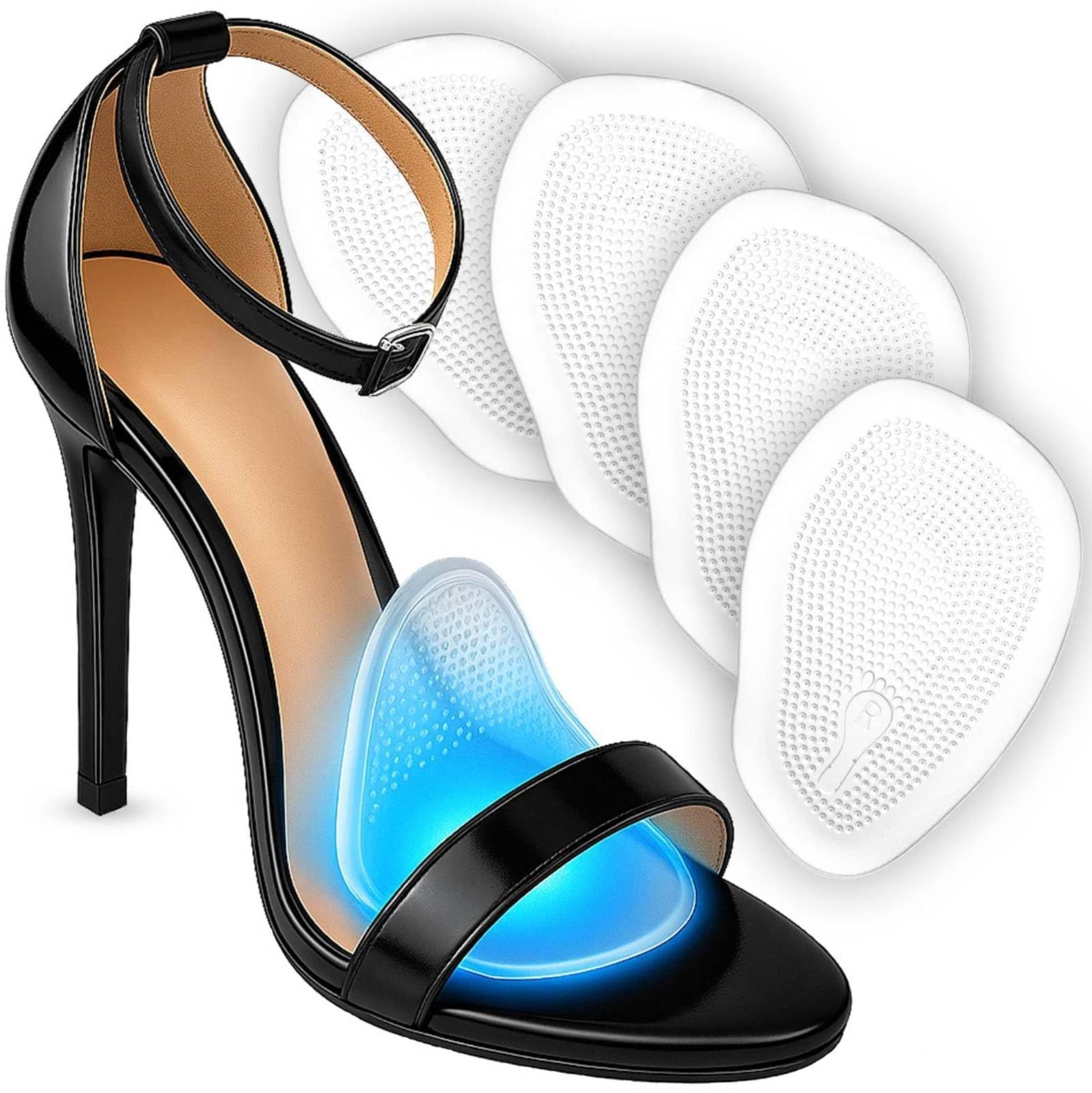
Best Foot Insoles for High Heels of 2026

The shoes came off under the table before the cake was cut. I'd picked the heels for the dress, not for eight hours of standing, and by the second hour I was shifting my weight foot to foot like a slow-motion tap dancer. Insoles made for high heels exist for exactly that gap: thinner than anything you'd drop into a running shoe, shaped to sit under the ball of the foot or behind the arch, built to stay put in a shoe that gives them almost no room. The right pair buys you the whole evening.

The catch is that a heel has less real estate than any other shoe. An insole a millimeter too thick will push your heel out the back or mash your toes into the point, and one with weak adhesive starts creeping toward your toes by dessert. We've worn 14 pairs through weddings, conferences, long dinners, and one airport sprint, and the differences really do come down to that millimeter. Trim and test-fit at home, days before the event, not in the parking lot.

1

Best Overall

Walkize Ball of Foot Cushions

86 /100
Trail Score Excellent

Key details

Type
Ball-of-foot cushion
Material
Gel
Pairs Included
2 pairs
Dimensions And Weight
2.75 x 0.12 x 3.95 inches; 2.12 ounces
Check Price on Amazon

A good ball-of-foot cushion has to do two jobs at once: soften the landing and keep the foot from sliding forward. The Walkize pair does both more convincingly than anything else in this set, and it does it without turning a favorite pump into a shoe you have to break in again. The gel has enough give to take the sting out of a hard footbed, but the pad stays low enough that we stopped noticing it after a few steps.

In our testing, the low profile mattered as much as the cushioning. At about 0.12 inch thick, the pad adds less bulk than many gel inserts, so it fits into heels that already run snug. The grippy top surface is the other useful detail: it gives the forefoot something to hold against when the footbed is slick, which is why these earned the top spot for everyday heels rather than just special occasions.

The two-pair count is practical: one pair can live in a work shoe and the other in a going-out pair. For forefoot pressure and forward sliding, this is the pair we reach for first. They are not a full insole, so do not expect them to change how an arch feels, but that is a fair trade for a pad this unobtrusive.

Pros

  • Soft gel cushioning without a bulky feel
  • Grippy surface helps stop forward sliding
  • Low 0.12-inch profile fits snug heels
  • Two pairs for work and going-out shoes

Cons

  • Not a full arch-support insole
Our verdict

For most people, these are the pair to start with: soft gel cushioning, a low profile, and enough grip to keep feet from sliding forward in heels.

Check Latest Price
2

Best 3/4 Insole

Bukihome 3/4 Invisible Insoles

85 /100
Trail Score Excellent

Key details

Type
3/4-length insole
Sizes
S/M/L
Thickness
3 mm
Pairs Included
2 pairs
Check Price on Amazon

Most ball cushions stop at the ball. The Bukihome pair keeps going: it is a 3/4-length insole that covers the forefoot and runs back toward the arch, but stops short of the toes. There is no pad sitting under the toes to peek through a strap, and the trim line stays out of sight.

That shape is why we like it for open-toe and strappy heels. The 3 mm foam is not a cloud; it is a firm, thin layer that takes the edge off a hard footbed, and the leather surface wipes clean when you move the same pair between shoes. We were also impressed by the sizing: it comes in S, M, and L, so you can match the insole to the shoe rather than trimming a one-size pad and hoping the edges stay neat.

The adhesive is the part to watch. It holds well on a clean, dry footbed, but it can lift at the edges after hours in a hot shoe. That is a small enough trade-off for a shape that disappears under a strap, and it is why we keep this pair for open shoes.

Pros

  • 3/4 shape hides under open-toe straps
  • 3 mm foam softens hard footbeds
  • Wipe-clean leather surface
  • Three sizes for a closer fit

Cons

  • Stops short of full-length coverage
Our verdict

Choose these when your heels are open or strappy and you want coverage from ball to arch without a pad peeking out.

Check Latest Price
3

Best for All-Day Cushioning

ZAIWOO Ball of Foot Cushions

86 /100
Trail Score Excellent

Key details

Type
Ball-of-foot cushion
Design
Invisible
Pairs Included
2 pairs
Check Price on Amazon

Discreet is easy; staying discreet after an hour is the harder part. The ZAIWOO cushions are the ones that stayed put in our testing, and that is the main reason they earned a runner-up spot. The adhesive holds them in dress pumps and boots without the pad creeping toward the toes, so you are not stopping to adjust your shoe in the middle of a dinner.

The cushioning is soft without collapsing into nothing. We were also impressed by how little they change the fit: they add a layer of comfort, not a bulky lump that makes a close-fitting heel feel tight. The invisible design helps under open straps, and the two-pair set gives you a spare for a second favorite pair.

What these are not is a full insole. If your foot aches through the arch or your heel lifts, this pad will not solve that. For the ball of the foot, though, it is one of the most confident picks here, and it is the one we keep in the shoes that have to look polished.

Pros

  • Strong grip keeps pads in place
  • Soft cushioning with little added bulk
  • Invisible under open straps
  • Two pairs for a spare set

Cons

  • Not a full arch-support insole
Our verdict

If you want a discreet ball-of-foot pad that stays put through a long day, this two-pair set is the one we reach for.

Check Latest Price
4

Best Budget

benoo Ball of Foot Cushion Pads

87 /100
Trail Score Excellent

Key details

Type
Ball-of-foot cushion
Design
Clear
Material
Gel
Dimensions And Weight
4 x 3 x 0.2 inches; 2.12 ounces
Check Price on Amazon

The benoo pads are the low-cost trial in this group. The clear gel disappears under a strap, the 0.2-inch thickness is enough to cushion the ball of the foot, and the adhesive holds them in sandals and dress shoes without a fight.

For a first pair of heel cushions, that is a useful combination. They are softer than we expected for a budget pad, with a slightly rubbery feel that keeps the forefoot from sliding. The clear design is the detail that makes them easy to recommend for sandals, where a colored pad would spoil the look. If you are between sizes or wearing a shoe that already pinches, start with one pair and see how the fit changes before committing the second.

They are not the pick for someone who wants maximum cushioning or arch support; they are the pick for someone who wants to find out whether a ball cushion helps without spending much.

Pros

  • Clear gel hides under straps
  • Low-cost way to try heel cushions
  • Sticks well in sandals and dress shoes
  • Soft, slightly rubbery feel

Cons

  • Less cushioning than thicker gel pads
Our verdict

A smart first buy if you want to try clear gel cushioning without spending much, though very tight shoes may feel the pad.

Check Latest Price
5

Best Multipack

Temiart Ball of Foot Cushions

83 /100
Trail Score Excellent

Key details

Type
Metatarsal pad
Material
Medical-grade gel
Reusability
Washable
Pairs Included
4 pairs
Check Price on Amazon

Four pairs in one box is the reason this set exists. If you keep a pair in the office, a pair in the car, and a pair in the shoes by the door, you are not moving a sticky pad from shoe to shoe every morning.

The medical-grade gel has a little more spring than the cheapest pads here, and the metatarsal shape sits back from the toes rather than under them. The gel holds its shape after a rinse, and the pad is firm enough to give a concentrated lift under the metatarsal heads. They are washable and reusable, which is the feature that makes a four-pair set worth storing.

We like that they work as a small kit rather than a single pair you have to baby. That makes them a practical pick for someone who rotates through several pairs of heels and wants a pad within reach. They are not as invisible as a clear ball cushion, and they take a little more care to position, but the four-pair count and the washable gel make them easier to live with than a single pair.

Pros

  • Four pairs cover several shoes
  • Medical-grade gel cushions the forefoot
  • Washable and reusable
  • Metatarsal shape sits behind the toes

Cons

  • Adhesive can lose grip with sweat
Our verdict

The practical pick for anyone rotating through several pairs of heels: four washable gel pads with strong metatarsal relief.

Check Latest Price
6

Arch Support

Dr. Scholl's Soft Cushioning Insoles

84 /100
Trail Score Excellent

Key details

Type
High-heel insole
Footbed
Foam
Arch Support
High arch
Dimensions And Weight
1.14 x 3.7 x 9.56 inches; 1.76 ounces
Check Price on Amazon

Most high-heel insoles in this guide are ball cushions. This Dr. Scholl's pair tries to be a full insole, with a high arch and a foam footbed, and that makes it the odd one out in a useful way. If the ache runs through your arch rather than just the ball of your foot, a pad under the forefoot will not reach it.

The arch lift is the reason to consider this one. The foam footbed has a little give, and the rubber base feels more substantial than a gel pad, so it suits a roomier pump or a boot where you have space for a full-length insole. We would not force it into a barely-there sandal; it takes up more room than a ball cushion and can crowd the toes.

It is worth trying when arch support is the missing piece, and when the shoe has enough room to accommodate a fuller insole. If your pain is concentrated under the forefoot, the dedicated ball cushions here are the better choice.

Pros

  • High arch support in a heel insole
  • Foam footbed molds to the foot
  • Full-length coverage for roomier shoes

Cons

  • Modest cushioning under the ball
Our verdict

Buy these for the arch lift, not as a ball-of-foot pillow; they suit women who want a fuller insole in a high heel.

Check Latest Price
7

Metatarsal Pressure

ZUCNANA Metatarsal Pads

84 /100
Trail Score Excellent

Key details

Type
Metatarsal pad
Material
Silicone gel
Reusability
Washable
Dimensions And Weight
3.4 x 2.7 x 0.24 inches; 6.38 ounces
Check Price on Amazon

A metatarsal pad is not just a ball cushion with a bump. The ZUCNANA pad is shaped to sit behind the ball of the foot, where it can lift and spread the metatarsal heads rather than simply soften the whole forefoot. That is the detail that makes it useful for a concentrated ache, especially with Morton's neuroma or a high, bony forefoot.

The silicone gel is dense enough to hold its shape, and the non-slip backing keeps the pad from wandering once you have it in place. Placement matters more than with a flat cushion: start with the pad just behind the sore spot, press it down, and walk a few steps before you commit. If it sits too far forward, the raised area can press uncomfortably instead of helping.

These are not the pick for general forefoot cushioning. They are the targeted tool for a specific ache, and they work best in a shoe with enough depth to accommodate the extra height. For a broad, burning ball-of-foot pain, a softer cushion like the Walkize pair is easier to live with; for a pinpoint metatarsal problem, this is the one to try.

What we keep coming back to is the focus. It does one job with less bulk than a full insole, and it gives a pinpoint ache somewhere to go. We do not wear it for broad forefoot pain; that is what the softer cushions here are for. For a specific metatarsal hotspot, it is the pair we reach for.

Pros

  • Targeted metatarsal pressure relief
  • Soft silicone gel with non-slip design
  • Washable and reusable

Cons

  • Firmer feel than soft gel ball cushions
Our verdict

These are for a specific job: concentrated metatarsal pressure relief when a flat ball cushion does not reach the spot that aches.

Check Latest Price

How We Tested 14 Pairs of Heel Insoles

Every pair started on the same shortlist test. We read through customer reviews for anything with a heel-specific shape, filtered out inserts too thick to clear a pointed toe, and kept only options that came in multiple sizes or could be trimmed to fit. That left 14 pairs, from drugstore-cheap to genuinely spendy, which four of us wore over four months.

Each pair got the same rotation: a full workday in a three-inch pump, a three-day conference, a long dinner in a strappy sandal, one wedding, one airport sprint, and plenty of hours on a hard kitchen floor. After every wear we pulled the shoe off and checked whether the insert had slid toward the toe or lifted with the foot, since adhesion is where most of these fail. We held each one against a ruler before and after testing to see how much cushioning it lost, and noted whether the extra height pushed a heel out of a slingback.

For support and hardness, we pressed a thumb into the arch and forefoot of every pair to gauge how much give there was, then wore each through a four-hour stretch on our feet, writing down where the pressure landed at hour one versus hour four. Anyone with a high arch, a bunion, or plantar fasciitis pain kept separate notes, because a soft gel pad and a firm arch cookie solve very different problems.

Finally, we tried each insert in three shoe shapes — pointed pump, block-heel sandal, open-back slingback — to see what fit straight out of the package and what needed scissors, then tracked cost per wear against how the top layer held up. The pairs that ranked highest still had their adhesive intact and hadn't gone flat.

How to Choose Insoles for High Heels

Match the insert to the shoe

A ball-of-foot cushion is the most versatile shape for heels because it sits under the forefoot and leaves the heel and toes alone. A 3/4 insole runs from the ball back toward the arch and stops before the toes, which makes it the better choice for open-toe and strappy styles. A full-length insole can work in a roomier pump or boot, but it takes up more volume and can crowd the toe box. If you can see the pad through the straps, it is the wrong shape for that shoe.

Keep the profile thin

In a high heel, thickness is a trade-off: more cushion can mean less room for your foot. Look for a pad that softens the footbed without lifting your heel out of the shoe or pressing the top of your foot. A ball cushion around 0.12 inch thick, like the Walkize pair, is a useful reference for a low-profile fit; a 3 mm foam insole like Bukihome's is still thin but covers more of the foot. Try the insert in the shoe you plan to wear before a long day; if your toes feel pinched, go thinner.

Test the adhesive before you trust it

Adhesion is the difference between an insole that helps and one that rolls up under your arch. Heat and sweat are the enemies, so clean and dry the footbed, press the pad down firmly, and give the adhesive a minute to set before you slide your foot in. We put adhesion ahead of a fancy top cover because a pad that moves is worse than no pad. If you change shoes often, a reusable set makes more sense than a very sticky pad you have to reposition.

Choose cushioning or support by where it hurts

A soft ball cushion is for forefoot pressure and the burning feeling that builds under the ball of the foot. A metatarsal pad sits farther back and lifts the bones behind the ball, which is more useful for a concentrated ache or Morton's neuroma. A full insole with arch support, like Dr. Scholl's high-heel insole, is the choice when the ache runs through the arch. Do not expect one shape to solve all three; match the insert to the spot you press when your foot hurts.

Decide how many pairs you need

Gel pads lose tack before they lose cushioning, so a multipack can be the practical buy if you rotate through several heels. Four pairs, like the Temiart set, let you leave a pad in the shoes you wear most instead of moving one pair every morning. If you only wear one or two pairs of heels, a two-pair pack is enough, and you can spend the difference on a better shape for the shoe. Washable pads are worth it only if you will actually take them out and let them dry.

Frequently Asked Questions

Final Verdict

Start with the Walkize pair if your pain is under the ball of the foot and you want a low-profile pad that grips. It is the most complete everyday choice here: soft enough to matter, thin enough to fit, and sticky enough to keep your foot from sliding forward.

If your shoes are open or strappy, Bukihome's 3/4 shape hides better. If the ache is in your arch, Dr. Scholl's full insole is the more logical choice, even though it gives up some forefoot cushioning.