Best Insoles for Running Shoes of 2026

Somewhere around mile eight, the shoe stops feeling like a shoe and starts feeling like a stack of foam with opinions. The ache under the arch, the burning at the ball of the foot, the heel that's sore the next morning — that's rarely the shoe's fault. The insole in the box is a flattened sock liner doing a job it was never built for. A real aftermarket insole adds arch support, cushions the landing, and can keep a good pair of running shoes going after the originals pack out.

My left arch started complaining on easy days last spring, and I've had a drawer full of half-used insoles ever since. Over six months we ran in 12 different pairs, from wafer-thin inserts that barely change the fit to thick, structured ones that took a few miles to break in. One thing nobody mentions up front: thickness changes how the shoe fits, so a roomy trainer handles a beefy insert better than a snug racer does. The picks below are the ones that stayed in the shoe.

1

Best Overall

CURREX RunPro

92 /100
Trail Score Outstanding

Key details

Sizing
Large, high arch
Heel Cup
Deep, decoupled
Cushioning
Rebound
Arch Profiles
Low, medium, high
Check Price on Amazon

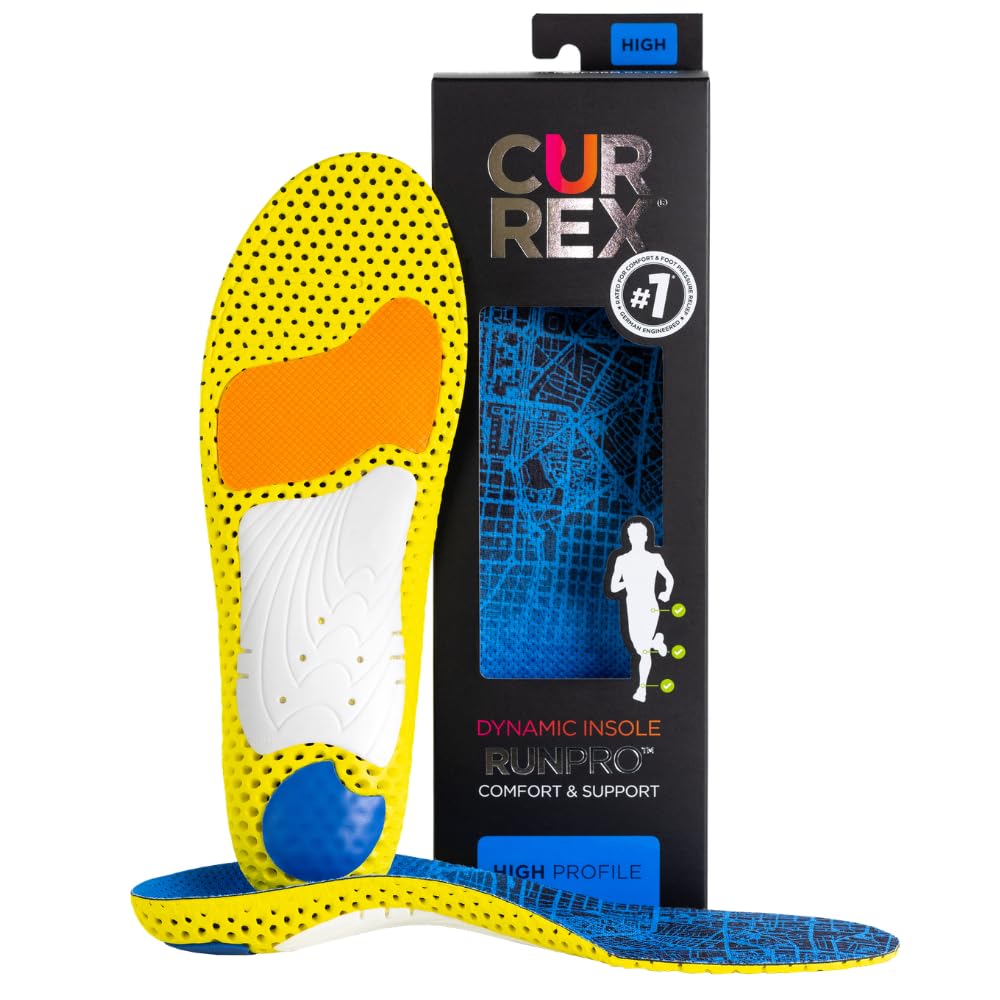
Running-specific construction is the reason the CURREX RunPro earns the top spot in this group. It comes in low, medium, and high arch profiles, so you can match the shell to your foot instead of buying a generic arch and hoping. We wore the high-arch version, and the deep, decoupled heel cup is the detail that stood out: it centers the heel without the hard, locked-in feel some rigid insoles give you.

The rebound cushioning is lively rather than mushy. It takes the edge off road impact while still letting you feel the ground, which is what we want in a running insole; a soft, squishy layer can make a neutral shoe feel vague. The shape also fits neatly into our running shoes without pushing the heel out of place.

The trade-off is price. This is one of the pricier picks here, and the value is not automatic if you only run a couple of miles a week. Durability is the other question: the cushioning is the part that will decide when you replace them, so high-mileage runners should treat the RunPro as a wear item rather than a permanent upgrade.

What makes it the default is the combination: a running-specific shape, a choice of arch heights, and cushioning that does not flatten the ride. The high-arch version is the one we reach for when a daily trainer needs more support without feeling like a medical device.

Pros

  • Running-specific shell in three arch profiles
  • Lively rebound cushioning
  • Deep heel cup centers the foot
  • Fits neatly in daily running shoes

Cons

  • Premium price for a replaceable insole
Our verdict

For most runners, the CURREX RunPro is the best starting point: a running-specific shape, three arch profiles, and lively support that does not turn a neutral shoe mushy.

Check Latest Price
2

Best Value

Sof Sole Athlete

89 /100
Trail Score Excellent

Key details

Weight
5.61 oz
Coverage
Heel to toe
Cushioning
PU foam and gel
Moisture Control
Yes
Check Price on Amazon

A heel-to-toe cushioning upgrade does not have to be the most expensive experiment in your shoe. The Sof Sole Athlete uses PU foam and gel from heel to toe, and that even spread is what makes it feel more balanced than an insole that only props up the heel. In a daily trainer, it takes the sting out of the road without turning the shoe into a marshmallow.

What we appreciate most is the middle ground it strikes. It is softer than the Superfeet and more structured than a flat factory sockliner, and it settles into a running shoe without the break-in fuss of a rigid shell. The fit is the part to check: this is a substantial insole, so a snug racing shoe may feel crowded even though a roomier daily trainer has space to spare.

The 5.61-ounce weight is noticeable in hand next to the thinnest insoles here, but in a trainer it disappears; we noticed the cushioning more than the number. That is the trade we want at this price: a little more material underfoot in exchange for an easier everyday ride.

Pros

  • Heel-to-toe PU and gel cushioning
  • Balanced, not overly soft
  • Value price for the cushioning
  • Settles into roomy daily trainers

Cons

  • Durability is mixed under heavy use
Our verdict

The Sof Sole Athlete is our value pick for daily trainers, with heel-to-toe PU and gel cushioning that softens the road without feeling vague.

Check Latest Price
3

Best for Women

Dr. Scholl's Run Active

89 /100
Trail Score Excellent

Key details

Fit
Trim to fit
Cushioning
3-zone heel-to-toe
Arch Support
Reinforced
Odor Control
Polygiene StayFresh
Check Price on Amazon

Women's running shoes often get a unisex insole stuffed into them; the Dr. Scholl's Run Active starts from a different place. The three-zone design puts cushioning under the heel and forefoot, and the reinforced arch is meant to smooth the landing-to-push-off transition. On easy runs, the shoe felt more planted without turning into a stability shoe.

The Polygiene StayFresh treatment is the detail we did not expect to care about, but it earns its place if you run back-to-back days or go sockless. It does not change the ride; it keeps the footbed from becoming the weak link between washes.

The fit needs a little patience. It is trim-to-fit, and the sizing runs small enough that you should start at the toe and check before cutting. The heel cup is the part you do not want to shorten. In the right shoe, it is a low-bulk way to get running-specific support.

Pros

  • Women's-specific running shape
  • Reinforced arch support
  • Polygiene odor control
  • Trim-to-fit length

Cons

  • Moderate arch support won't suit firm-support seekers
Our verdict

The Dr. Scholl's Run Active is our women's pick for runners who want a lighter, odor-resistant insole with moderate support and a trim-to-fit shape.

Check Latest Price
4

Best Premium Support

Superfeet Women's High Impact

89 /100
Trail Score Excellent

Key details

Sizing
Women's
Weight
3.99 oz
Support
High impact
Check Price on Amazon

Firm, planted support is the whole brief here. The Superfeet Women's High Impact uses a rigid shell and a supportive arch to give the foot a stable platform. We liked it most in high-impact sessions where a soft insole can feel like it is collapsing under the load.

What we appreciate is the women's-specific shape. It is easier to trim for a running shoe than a unisex slab, and it leaves less excess at the toe. The catch is cushioning: this is not a plush insert, and runners who want a soft step will find it abrupt. The firmness is the point, not a defect, but it narrows the audience.

The shoe pairing matters. In a cushioned daily trainer, the firm shell balances the soft midsole; in a minimal racing flat, it can feel like too much insole. We kept it for high-impact days and left it out of our lightest shoes.

Pros

  • Firm, stable high-impact shell
  • Supportive women's-specific shape
  • Trims cleanly for running shoes

Cons

  • Premium price relative to the rest of the set
Our verdict

The Superfeet Women's High Impact is the premium pick for runners who want a firm, stable platform and women's-specific shaping rather than soft cushion.

Check Latest Price
5

Best Budget

Dr. Scholl's Sport

89 /100
Trail Score Excellent

Key details

Use
Multiple sports
Sizing
Men's
Weight
5.92 oz
Support
Flexible side-to-side
Check Price on Amazon

An easy, low-cost way to rescue a gym shoe is a fresh insole, and the Dr. Scholl's Sport is the one we reach for. Its flexible side-to-side support is the reason it works across activities: it does not lock the foot into one plane like a rigid running shell, so lateral work and short runs do not feel like a compromise.

It is not the insole we choose for a long, cushioned run. The arch support is milder than the Superfeet or the CURREX, and the top layer feels closer to the shoe than to a plush recovery insole. For gym sessions, errands, and shorter efforts, that lighter feel is a plus; it does not add the rigid, built-up feel of a premium shell.

What we noticed is that it does not try to be a premium running insole, and that honesty is why it works in a gym bag. It gives an old pair of shoes a useful second life without asking you to rebuild your stride around it.

Pros

  • Flexible side-to-side support
  • Works across gym and short runs
  • Does not lock the foot into one plane
  • Budget-friendly entry point

Cons

  • Durability can fall short under heavy use
Our verdict

The Dr. Scholl's Sport is our budget pick for gym shoes and shorter efforts, with flexible side-to-side support and a lighter feel than premium shells.

Check Latest Price
6

Soft Cushioning

Spenco Polysorb Cross Trainer

89 /100
Trail Score Excellent

Key details

Heel
SpenCore pad
Forefoot
Crash pad
Cushioning
Polysorb foam
Arch Support
Soft
Check Price on Amazon

Softness is the first thing you notice in the Spenco Polysorb Cross Trainer, and that is both its appeal and its limitation. The Polysorb foam, SpenCore heel pad, and forefoot crash pad put cushioning where a runner lands and pushes off, so sensitive feet get a more forgiving surface than a firm shell provides.

We like it for recovery runs and for runners who find rigid insoles exhausting. The trade-off is volume: the heel is substantial, and in a low-volume running shoe it can lift the back of the foot enough to change the fit. If your shoe already has a snug heel, try it with the original sockliner removed first.

The cushioning is generous without feeling like a marshmallow; it has some spring to it. We keep it in the rotation for easy days, not for tempo work where a firmer platform is more useful.

Pros

  • Generous Polysorb cushioning
  • SpenCore heel and forefoot pads
  • Soft arch support
  • Good for sensitive feet

Cons

  • Narrow midfoot can pinch wide feet
Our verdict

The Spenco Polysorb is our soft-cushion pick for sensitive feet and recovery runs, provided your running shoe has room for its substantial heel.

Check Latest Price

How We Chose and Tested These Insoles

We started with roughly 40 pairs on paper, comparing stated arch height, thickness in millimeters, materials, and whether they came pre-sized or trim-to-fit, then cut that list to 12 that spanned the price and firmness range. Each pair went into at least three different running shoes — a soft neutral daily trainer, a firmer stability shoe, and a low-volume race-day shoe — because an insole that sings in one can ruin another. Trim-to-fit pairs were cut with kitchen scissors using each shoe's original liner as a template, and we checked whether the edges curled or sat proud of the heel.

Testing ran six months and covered easy treadmill runs, weekend long runs, a rainy 10K, and the unglamorous stuff: eight-hour standing shifts, dog walks, and a hotel gym. We noted whether the heel slipped, whether the shoe suddenly felt a half size small, whether socks bunched at the toes, and whether an insole ran hot or squeaked when wet. Arch support got checked at mile one and again at mile six, since some push back hard under the foot while others simply fill the space.

Pain relief and foot relief were logged rather than guessed. Runners on the team rated heel and arch soreness every morning after long days and compared those notes against the same weeks in their old setups, which is how we separated an insole that genuinely helped from one that just felt novel for a week. Durability meant pulling pairs out at 50 miles and again near 150 to look for flattened foam, pilled top fabric, and arch shells that had creased or cracked. We also weighed cost against lifespan: a premium pair that holds its shape for hundreds of miles is a different purchase than a cheap one that flattens in a few weeks. We're still running in the top performers and will update as they wear.

How to Choose Insoles for Running Shoes

Match the arch profile to your foot

More arch is not automatically better. A high, rigid arch that does not match your foot can feel like a bruise under the midfoot, while a flat insert leaves a high-arched runner searching for support. Look at your bare footprint after a shower: a narrow band often suggests a high arch, a wide band a low one. Then choose an insole with a matching profile; the CURREX RunPro is the clearest example here because it comes in low, medium, and high versions.

Decide between soft cushioning and firm support

Running insoles sit on a spectrum. Soft foams and gel pads take the edge off impact and suit runners who want comfort on easy days, while firmer shells give a more planted push-off and can be easier to trust in a stability shoe. The Sof Sole Athlete leans soft; the Superfeet Women's High Impact leans firm. Neither is better in the abstract. Think about the shoe you are pairing it with: a plush daily trainer often balances a firmer insole, while a firm racing shoe can feel harsh with too much extra structure.

Check volume before you trim

Running shoes are already fitted closely, and an insole adds volume under the foot. Take out the original sockliner if it is removable, drop the new insole in, and check that your heel sits in the cup and your toes are not pressed against the top of the shoe. If the insole is trim-to-fit, shorten the toe only; the heel cup is shaped to hold your foot. A thick heel is the usual culprit when a shoe suddenly feels too shallow.

Know when to replace them

An insole does not fail all at once. The top cover wears through, the foam stays compressed after a run, or the arch feels less distinct than it did. Those are better replacement signals than a calendar date. A fabric top cover or an odor treatment helps between washes, but it will not restore lost cushioning. If you rotate two pairs of running shoes, mark the insoles so you can compare wear; a fresh pair should feel noticeably more supportive under the same shoe.

Frequently Asked Questions

Final Verdict

The CURREX RunPro is our default because it starts with the right question: which arch profile fits this runner? Add running-specific cushioning and a secure heel cup, and it works across daily trainers without feeling like a medical insert.

If the price is more than you want to spend on an experiment, the Sof Sole Athlete is the value alternative, especially in a roomier daily trainer. Runners who want a firmer, more planted platform should go to the Superfeet Women's High Impact, provided they have a cushioned shoe to balance it.