Best Food Scales for Portion Control of 2026

Eyeballing a portion of pasta or a spoonful of peanut butter is a losing game. A food scale turns 'about a cup' into a number you can trust, whether you're tracking macros, dividing a pot of chili into containers, or trying to keep a snack from becoming dinner. Over four months, my team and I weighed, tared, and re-weighed 14 scales; the good ones disappeared into the routine while the bad ones made every meal feel like a quiz.

What separates a keeper from a drawer-dweller comes down to details: a display that stays readable under a dinner plate, a tare button that responds on the first press, a platform big enough for a mixing bowl but small enough to live on the counter. Accuracy and reliability matter most, but so do build quality, durability, battery life, and a finish that fits the kitchen. Value and ease of use matter too — if zeroing or switching units is fiddly, you'll stop bothering. The picks below earned their spot by being easy to live with, not just precise on day one.

1

Best Overall

Etekcity EK5250 Bowl Scale

95 /100
Trail Score Outstanding

Key details

Units
oz, lb, g, fl oz, mL
Capacity
11 lb / 5 kg
Increments
0.1 g below 1 kg; 1 g to 5 kg
Weighing Vessel
Detachable bowl and cover
Check Price on Amazon

Five grams of chia seeds is a real portion, and on a scale that counts in whole grams it's a coin flip — the display sits at 4, jumps to 6, and you're guessing at the middle. The EK5250 counts in 0.1-gram steps below a kilogram, so a small portion lands on a number instead of a rounded one.

That resolution is why this is the one we point people toward when they ask about portion control. Sliced almonds, nut butter, parmesan, the teaspoon of oil you'd rather not eyeball — it all reads precisely, and the bowl means you're not hunting through the cupboard for a container. The bowl flips down over the platform as a cover, so the whole thing stores as one flat object; lift it off and it becomes a vessel you can carry to the stove or the table. The milk and water density settings are the sort of detail that saves a conversion on a protein shake.

Two things to know before you commit. Above a kilogram it steps back to whole grams, which is fine for a pot of chili and beside the point for a 30-gram portion of cheese. And it starts reading at 1 gram, so a pinch of salt still shows zero — the fine increments only help once you're past that floor.

Pros

  • 0.1 g increments below 1 kg
  • Detachable bowl doubles as a cover
  • Milk and water density settings
  • Bowl lifts off for easy cleaning

Cons

  • Bowl format won't take a dinner plate
Our verdict

This is the scale we recommend for portion control: 0.1-gram steps below a kilo and a bowl that goes where you need it, so small servings land on a real number.

Check Latest Price
2

Best for Big Bowls

OXO Good Grips 11-Pound Scale

95 /100
Trail Score Outstanding

Key details

Display
Pull-out, backlit
Capacity
11 lb
Platform
Removable stainless steel
Increments
1 g / 1/8 oz
Check Price on Amazon

Set a wide cereal bowl on most scales and the rim swallows the display; you end up crouching to read a number you can't quite see. OXO's answer is a display head on a stalk that pulls out and away from the base, so the weight stays legible past the biggest bowl in your cupboard.

The rest of the scale is built for the same kind of cooking. The stainless platform lifts off for washing, which makes cleanup easier than wiping around a fixed plate, and 1 g / 1/8 oz increments cover everything from a 15-gram portion of cheese to a pound of pasta. There's also a small meter showing how much capacity is left — quiet insurance against overloading the sensor with a full stockpot.

We reach for this one when the vessel is the problem: a mixing bowl, a meal-prep container, a rimmed plate of food. Eleven pounds of capacity is ordinary at this point; being able to read it at that size is not. If your portions go into something the width of a dinner plate, this is the scale that stops the guessing.

Pros

  • Pull-out display clears wide bowls
  • Removable stainless platform for washing
  • Large backlit numbers
  • Capacity meter shows remaining headroom

Cons

  • The most expensive scale in this group
Our verdict

We reach for it when we weigh into big bowls or onto plates: the pull-out display ends the crouching, and that's worth more than finer numbers.

Check Latest Price
3

Best for Tight Counters

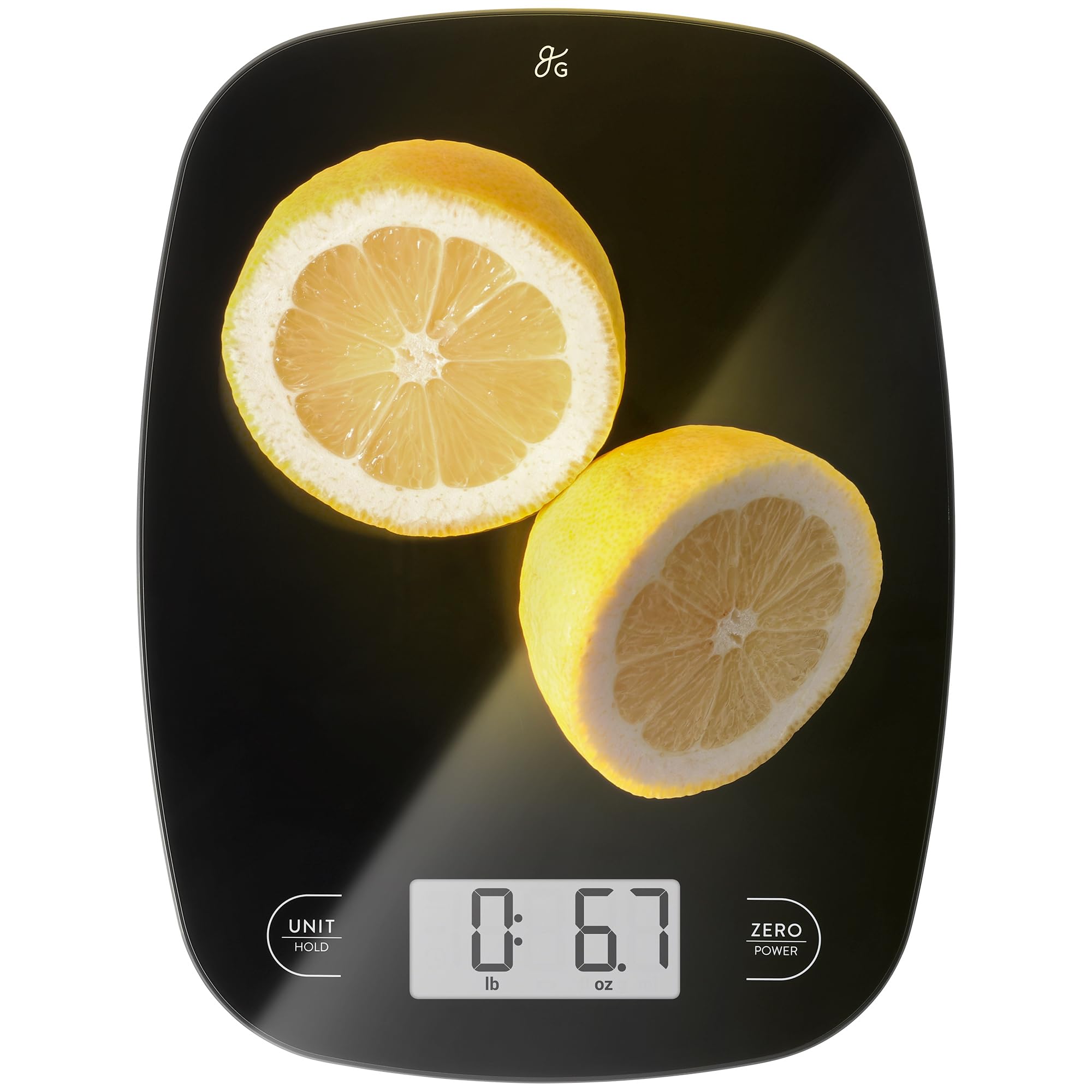
Greater Goods Slim Scale

93 /100
Trail Score Outstanding

Key details

Profile
0.5 in
Capacity
11 lb / 5 kg
Warranty
5 years
Increments
0.04 oz
Check Price on Amazon

One of the least expensive scales here also carries the longest warranty: five years, against the two-year terms on several of the others. That's the pitch, and it's a good one in a category where the usual failure isn't a cracked screen but a unit that quietly stops turning on.

At half an inch tall it's the slimmest thing in this group, which matters more than it sounds. It slides into a drawer, a cookbook slot, or the gap beside the microwave, so it's there when you're portioning instead of in a cupboard you don't open. The 6.5 by 6.1 inch surface takes a mixing bowl, and the controls are touch-sensitive rather than raised buttons, so there's less to wipe around.

Accuracy is the softer part of its record, and the way to handle that is a ten-second check on arrival: a stick of butter or a full cup of water, and see whether the reading matches. Four sensors and 1-gram steps are the right specification for weighing chicken, rice, and yogurt — the precision question only bites if you're counting individual almonds.

Pros

  • Five-year warranty, the longest here
  • Half-inch profile stores in a drawer
  • Four sensors for steady readings
  • One-tap unit switching

Cons

  • Starts at 2 g, so small pinches read as zero
  • Coin cell rather than the usual AAA pair
Our verdict

We think a half-inch-tall scale with a five-year warranty and room for a mixing bowl is the sensible pick for a kitchen with no spare counter.

Check Latest Price
4

Best for Big Batches

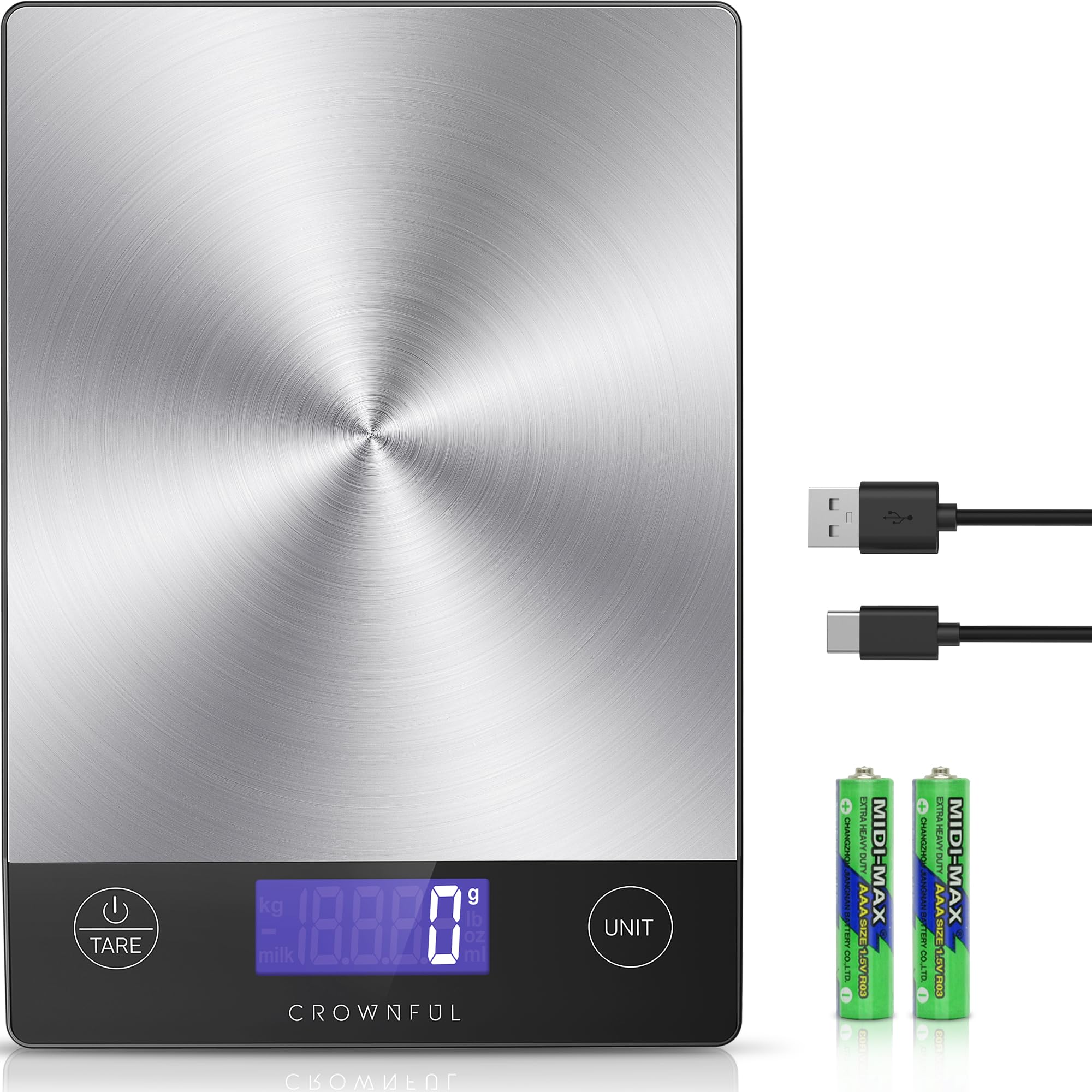
CROWNFUL 33-Pound Scale

93 /100
Trail Score Outstanding

Key details

Power
USB-C or 2 AAA
Units
g, kg, lb, oz, mL, milk mL
Capacity
33 lb / 15 kg
Increments
0.04 oz
Check Price on Amazon

Thirty-three pounds is more capacity than most kitchens need, and that's the point. This is the scale for the person who buys chicken in bulk and divides it into fourteen bags, or weighs a stockpot before it goes into the oven. Everything else in this group tops out between 11 and 22 pounds.

That capacity, plus the way it's powered, makes it the most forgiving scale we tested: it runs from a USB-C cable or two AAA batteries, both in the box, so a dead battery doesn't take it out of service for a night. The slanted display is a small piece of good thinking — you can read it past a bowl that's wider than the platform underneath.

The compromise sits at the bottom of the range. It starts at 3 grams and counts in whole grams, so it's the least useful of our picks for small amounts, and readings at the low end can wander while nothing is being added. Weigh something whose weight you know — a stick of butter, a cup of water — before you trust it with a 5-gram portion of yeast.

Pros

  • 33 lb capacity, the largest here
  • Runs on USB-C or two AAA batteries
  • Slanted display reads past a wide bowl
  • Six units including milk and water

Cons

  • Starts at 3 g and counts in whole grams
Our verdict

For bulk packs, stockpots, and batch cooking, this is the one: 33 pounds of capacity and two ways to power it, at the cost of fine resolution.

Check Latest Price
5

Best for Calorie Tracking

Etekcity ENS-L221S Smart Scale

93 /100
Trail Score Outstanding

Key details

Power
USB-C rechargeable
Connectivity
Bluetooth
Nutrition Data
19 nutrients via VeSync
Weighing Range
2 g to 22 lb
Check Price on Amazon

Weighing 120 grams of rice is the easy half of portion control. The annoying half is opening a second app, searching for rice, and choosing between four entries that disagree with each other. This Etekcity pairs over Bluetooth with the VeSync app, which takes a barcode scan or a search and returns 19 nutrients for the exact weight sitting on the platform.

The hardware underneath is sound on its own terms: a 2-gram floor, 22 pounds of capacity, 1-gram steps, and a USB-C battery you recharge instead of feeding AAAs. If you already track macros, the rechargeable part alone is a small daily mercy — no scramble for batteries on a Sunday night, no dead scale on a Monday morning.

Whether it earns the step up depends entirely on whether you'll open the app. Count calories or protein against a target and the math happening automatically is the whole reason to buy it, saving a nightly lookup and a guess about portion size. Just want grams on a screen? A plain scale weighs the same food for a lot less.

Pros

  • Barcode scanning for 19 nutrients
  • USB-C rechargeable instead of AAA
  • 22 lb range with 1 g readout
  • Daily, weekly, and monthly trend reports

Cons

  • Nutrition data only comes through the app
  • 2 g minimum for small amounts
Our verdict

We recommend it to anyone counting macros: the app does the arithmetic for you, which is the reason to spend more and the reason to skip it if you don't.

Check Latest Price
6

Basic Everyday Weighing

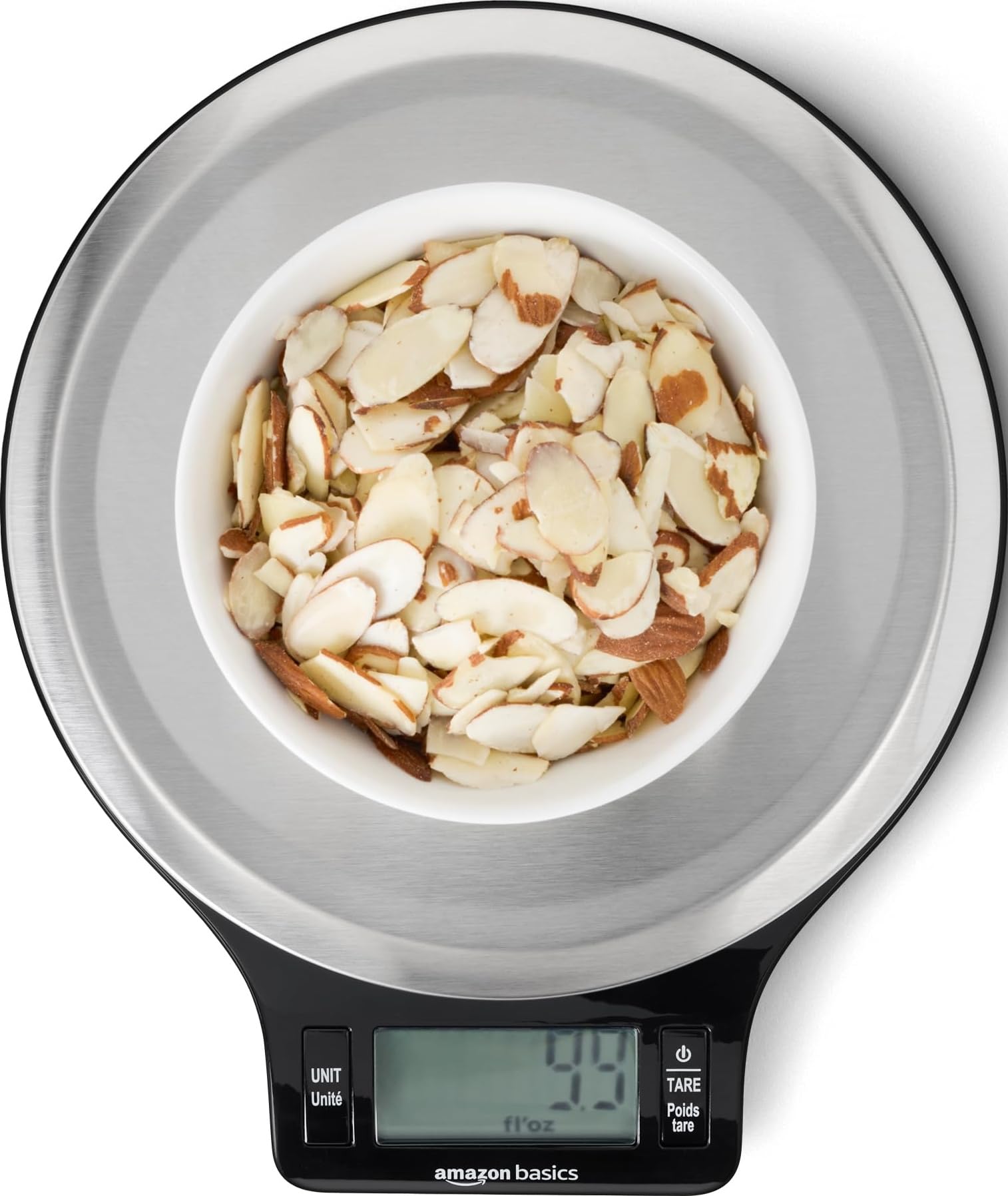
Amazon Basics Digital Scale

95 /100
Trail Score Outstanding

Key details

Units
lb, oz, g, fl oz, mL
Battery
2 AAA included
Capacity
11 lb / 5 kg
Increments
0.04 oz
Check Price on Amazon

Nothing about this scale is clever. It counts in whole grams, starts at 2 grams, and shows the number on a plain LCD. What it does is weigh food for less than anything else in this group, and for a lot of people that is the entire requirement.

It's the one that lives in a cupboard and comes out for a chicken breast and a scoop of rice. The stainless platform wipes clean, the tare is one press, and the display is wide enough to read from standing height with a bowl on top. Five units, including fluid ounces and milliliters, cover anything a beginner needs.

Accuracy is the uneven part of its record. For a 150-gram portion of chicken it's fine; for a 10-gram portion of nuts, where a couple of grams either way changes the count, it's the wrong tool and the Etekcity bowl scale is the right one. That's the honest split with this scale — it's a starting point, not a precision instrument.

Pros

  • Weighs up to 11 lb in 1 g steps
  • Wide LCD in five units
  • Stainless platform wipes clean
  • Two AAA batteries included

Cons

  • Long-term durability is the gamble here
  • LCD washes out in direct sunlight
Our verdict

Our cheapest pick does the basic job — grams, ounces, tare — and it's the right first scale if you're not chasing half-gram precision.

Check Latest Price

How We Tested Food Scales for Portion Control

We started by reading through specs and owner reviews for dozens of scales, then narrowed the field to 14 that promised the precision, capacity, and footprint that portion control actually demands. Over four months, we kept them on the counter and used them the way anyone would: weighing yogurt and berries at breakfast, dividing a pot of chili into five containers on Sunday, portioning coffee beans, splitting a family-size bag of chips into snack bags, and checking a teaspoon of yeast for a baking project. We also tared mixing bowls, plates, and a whole chicken, because a scale that can't handle a real container is useless in a real kitchen.

Accuracy came first. We weighed the same 100-gram bag of rice three times in a row on each scale, then again a week later, and noted any drift. We checked how quickly the reading settled, whether it held steady when we nudged the bowl, and whether small additions — a few grams of nuts, a pinch of salt — registered clearly. Display was judged in use: could we read it while a dinner plate covered half the platform, was the backlight helpful at 6 a.m., and did the numbers stay visible from a normal standing angle?

Each scale was wiped down after messy prep and checked for scratches, stains, or sticking buttons; we noted battery type and how often we swapped cells. Ease of use came down to whether tare zeroed on the first press, whether unit switching was obvious, and whether the platform was big enough for a bowl but small enough to store. Size and appearance were noted where they mattered — on a crowded counter and in the hand. At the end, we compared cost against performance, because value isn't the lowest price; it's the price you don't regret.

How to Choose a Food Scale for Portion Control

Resolution and the floor beneath it

For a 150-gram chicken breast or 200 grams of rice, the 1-gram steps on nearly every scale here are plenty. The differences show up below about 20 grams — seeds, spices, nut butter, the oil you're measuring instead of pouring. A scale with a 3-gram floor reads zero while you add almonds one at a time, and that is where a diet log quietly goes wrong.

This is why we rate the Etekcity bowl scale so highly: 0.1-gram steps below a kilogram turn a 6-gram portion into a number rather than a guess. If you only ever weigh main-dish portions, skip the extra resolution and put the money elsewhere.

Tare, and the bowl that gets in the way

Tare is the button that zeroes the display with a container already on it, and every scale here has one — it's how you weigh yogurt into the tub it came in and save a dish. The practical snag is the container itself: a wide bowl sits between your eyes and the numbers you're trying to read.

Measure the bowl you actually use before ordering, or buy a design that answers the problem. The OXO's display head pulls out on a stalk, and the Etekcity bowl scale puts the vessel on the sensor instead of around it.

Capacity, and what the extra pounds cost

Eleven pounds covers a mixing bowl, a batch of dough, and every single portion you'll serve. Go higher only for a reason: 22 pounds takes a bulk bag of flour or a stockpot, and 33 pounds is for people dividing family-size packs into bags.

The trade sits at the bottom of the range. The highest-capacity scale in this group starts reading at 3 grams, while the 11-pound models generally start at 1 or 2. If small amounts are the whole point of the purchase, the bigger scale is the wrong shape of tool.

Power, cleaning, and the odds of it lasting

Most of these run on two AAAs; two take a USB-C charge and one uses a coin cell, so pick the battery you already keep in a drawer. For cleaning, wipe the platform rather than rinsing the unit, and keep liquid away from the buttons even on a water-resistant model — spills around the controls are the usual way a kitchen scale dies.

Lifespan is the soft spot in this whole category, which is why the five-year warranty on the Greater Goods counts for more than an extra unit or two of anything else on the box.

Frequently Asked Questions

Final Verdict

The Etekcity bowl scale is what we tell people to buy for portion control. It reads in 0.1-gram steps below a kilogram, brings its own bowl, and has the most consistent accuracy in this group — the three things that decide whether a portion log is worth keeping.

If you weigh into a wide bowl or onto a plate every day, the OXO's pull-out display is the upgrade that ends the crouching. If you count macros, the Etekcity smart scale does the arithmetic for you. And if you simply want grams and ounces for as little as possible, the Amazon Basics scale covers the basics and asks nothing of you.