Best Juicers of 2026

The fantasy of buying a juicer is a glass of cold green juice before work; the reality is usually a sink full of wet pulp and a machine that sounds like a small aircraft. Almost anything with a spinning blade will produce juice, which is why the differences between models show up everywhere else: how much liquid you actually get out of a bag of carrots, whether kale clogs the basket three minutes in, and how long cleanup takes once you're already running late. What a good juicer really buys you is a habit that survives past January — one you'll actually use on a Tuesday instead of hauling out of the cabinet twice a year.

I've killed two juicers myself, both mid-carrot, so I came into this with opinions about motors and feed chutes. Over eight months, my team and I put 12 juicers through thousands of pounds of produce — apples, beets, kale, frozen berries — and the spread in performance was wider than I expected. One thing worth knowing before you shop: centrifugal machines are faster and cheaper but foamier, louder, and fussier with leafy greens, while slower masticating models coax out more juice and handle greens without complaint. The picks below cover both camps, and the right one depends on which mornings you're actually juicing for.

1

Best Overall

Nama J2 Cold Press Juicer

91 /100
Trail Score Outstanding

Key details

Motor
200 W at 50 RPM
Hopper
Hands-free, self-feeding
Dimensions
9 x 9.8 x 17.7 in
Juicer Type
Cold press (single auger)
Check Price on Amazon

The J2 is built around its hopper. You load an entire recipe, apples and carrots and a fistful of kale, lock the lid, and walk away while the auger works through it. That is the reason it is our top pick. At 50 RPM and 200 watts it crushes rather than shreds, so the pulp comes out dry enough to compost and the juice does not need straining. It is not fast the way a centrifugal machine is fast; it is fast the way a dishwasher is fast, in that you are doing something else while it runs.

Quiet is the second thing you notice. This is a machine you can run at six in the morning without waking the house, which is rare in a category where centrifugal juicers sound like small aircraft. Cleaning keeps pace with it: the parts release in a few seconds, the strainer comes with a spinning brush that does the awkward work, and nothing has a hidden channel you have to go fishing in.

What you are paying for is the hopper and the motor rather than the materials. The pitchers are plastic, and every part is hand wash only, which is the honest trade against the machines below it. A household juicing three or four times a week gets that back in produce and patience. A household juicing twice a month will not, and should buy one of the cheaper picks instead.

Pros

  • Self-feeding hopper takes a whole recipe
  • 50 RPM pressing leaves pulp dry
  • Quiet enough for early mornings
  • Quick-release parts come apart in seconds

Cons

  • All parts must be hand washed
Our verdict

Our top pick because juicing stops being a project: load the hopper, walk away, and come back to dry pulp and a glass that needs no straining.

Check Latest Price
2

Best Everyday Juicer

Ninja NeverClog JC151

89 /100
Trail Score Excellent

Key details

Motor
150 W
Pulp Bin
36 oz
Juice Jug
24 oz
Juicer Type
Cold press (masticating)
Check Price on Amazon

Most juicers lose their home to a cupboard, because they are tall, heavy, or miserable to wash. The JC151 is 7.15 inches wide and 15.93 inches tall, which puts it under the cabinet next to the coffee maker, and its parts are dishwasher safe. Two pulp filters snap into the same housing so you can choose a clear glass or a thicker pour, and the 24-ounce jug sits in front of a separate 36-ounce pulp bin.

What settled it for us is how little ceremony a glass takes. One button starts it, one reverses it, and the 150-watt auger is slow enough that carrots and beets go through without the motor sounding strained. Slow pressing at this speed is genuinely slow, a few minutes of feeding for a full glass, but nothing about it feels like a project. The NeverClog name is the one overpromise: soft, stringy things like mango and berries bridge in the auger. Smaller handfuls and a press of reverse clear it.

Noise tracks the ingredient. Soft fruit is a hum, while hard apples and dense roots make the machine complain, which is worth knowing if you juice before the rest of the house is up. The warranty runs a year, and the motor is what decides any juicer's life. Where it earns its place in a small kitchen is the pulp bin: 36 ounces means a bag of carrots goes through before you stop to empty it, so cleanup happens once, at the end.

Pros

  • Fits under cabinets at just over 7 inches wide
  • Dishwasher-safe parts
  • Two pulp filters adjust texture
  • 36 oz pulp bin handles a full bag

Cons

  • Narrow chute means cutting most produce first
Our verdict

The juicer we recommend to anyone who has not decided how often they will juice: compact, dishwasher safe, and easy to leave out on the counter.

Check Latest Price
3

Best Centrifugal

Breville Juice Fountain Plus

91 /100
Trail Score Outstanding

Key details

Motor
850 W
Juice Jug
1 L
Feed Chute
3 in
Juicer Type
Centrifugal
Check Price on Amazon

Three inches of chute and 850 watts is the whole idea. Apples, carrots, and whole beets go in, and juice comes out in seconds rather than minutes. The 1-liter jug has a froth separator built into the spout, so what pours into the glass is juice rather than foam, and the removable parts are dishwasher safe. It is a centrifugal machine, a shredding disc spinning against a mesh basket, which makes it the fastest way to a glass and the loudest.

We were also impressed by how settled the design is. This model has been on sale since 2009, long enough that its chute, its basket, and its technique are what other centrifugal juicers get measured against, and the parts are still easy to find. It is the machine we point people to when the morning routine is the priority and they want juicing finished in about a minute.

The cost of that speed is noise and a little heat. A centrifugal basket is loud enough to end a conversation and warms the juice slightly, which is the trade for a minute-long glass. Cleanup is straightforward if you rinse the basket before anything dries on it, and the cord wraps under the base so it stores without a cable flapping around.

Pros

  • 3-inch chute takes whole apples and carrots
  • 850 watts extracts in seconds
  • Froth separator pours cleaner juice
  • Dishwasher-safe removable parts

Cons

  • Leaves more juice in the pulp than a cold press
Our verdict

Our pick when speed matters most: whole apples go in the chute, juice lands in a jug designed to leave the froth behind.

Check Latest Price
4

Best Value Batch Juicer

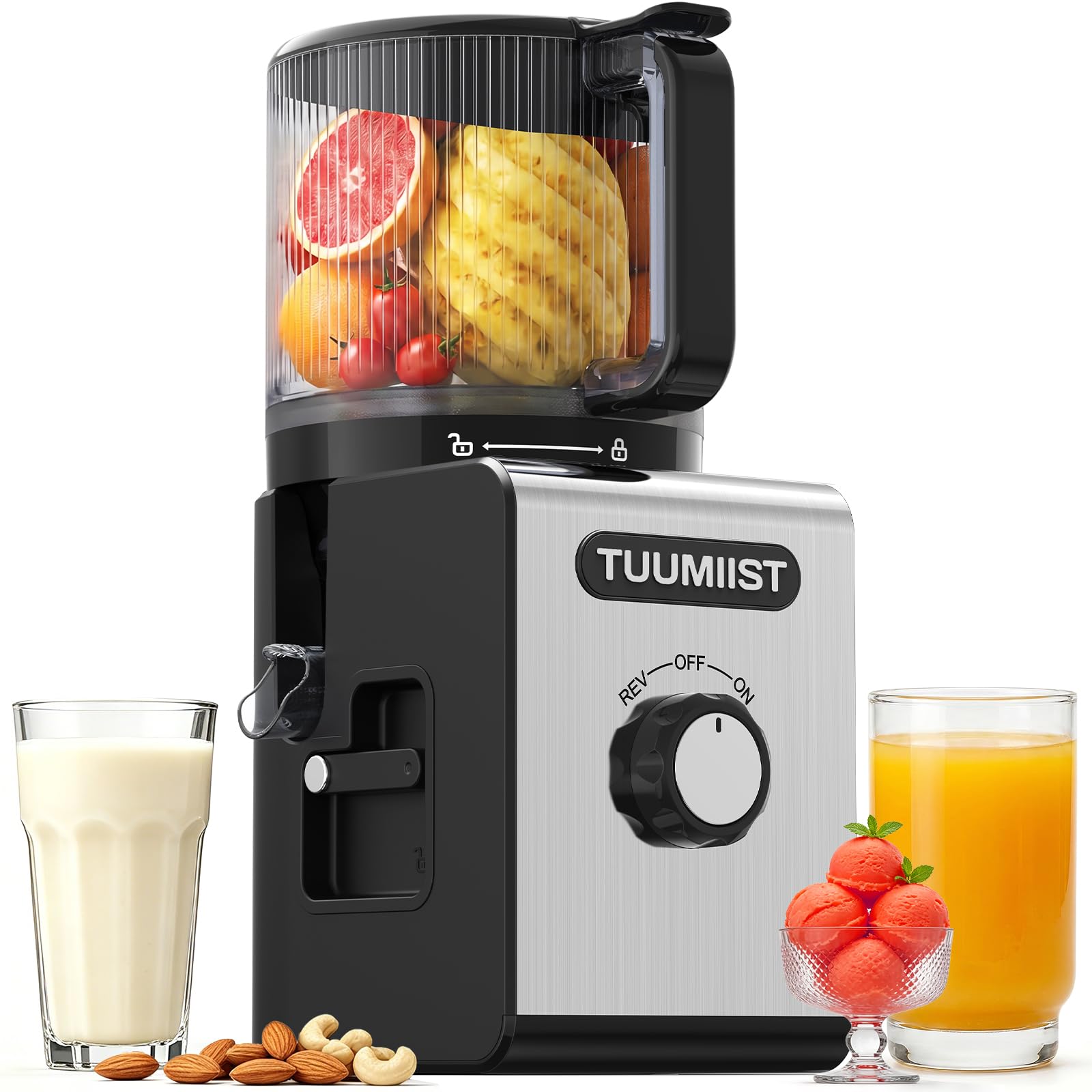
TUUMIIST 780 3-in-1 Cold Press

89 /100
Trail Score Excellent

Key details

Motor
350 W at 60 RPM
Hopper
100 oz
Feed Chute
6.5 in
Juicer Type
Cold press (single auger)
Check Price on Amazon

A 6.5-inch chute is the point at which juicing stops needing a cutting board: whole apples, whole carrots, a whole celery heart. Behind it sits a 100-ounce hopper, so a full recipe goes in at once and the machine feeds itself while you wipe down the counter. It is the batch setup of the premium machines at a midrange price.

One strainer does juice, nut milk, and sorbet instead of three you have to store and keep straight, and there is no mesh screen to scrub, so the parts rinse and go in the dishwasher. That single design decision is worth more day to day than another hundred watts of motor.

At 60 RPM it is quiet enough for a weekday morning, and at 7 pounds it is light enough to move when the mixer wants the counter. The footprint is the catch: 17 inches tall and 13 wide, with a hopper lid that swings up, so measure the gap under the cabinets before you commit the space.

What earns it a place is the arithmetic. Whole-fruit feeding, dry pulp, and dishwasher-safe parts at a midrange price is the combination most families actually need, and it is the reason we send people here rather than to the premium machines. Buy it if you juice in batches and would rather spend the difference on produce.

Pros

  • 6.5-inch chute takes whole apples
  • 100 oz hopper holds a full recipe
  • One strainer for juice, nut milk and sorbet
  • No mesh screen to scrub

Cons

  • Plastic parts can crack after a few months
Our verdict

The batch juicer we point families to first: whole apples fit, the hopper takes a full recipe, and one strainer covers juice, nut milk, and sorbet.

Check Latest Price
5

Best Budget Cold Press

TUUMIIST 580 Compact Cold Press

85 /100
Trail Score Excellent

Key details

Motor
300 W at 55 RPM
Filter
No mesh screen
Feed Chute
5.8 in
Juicer Type
Cold press (single auger)
Check Price on Amazon

The part that decides whether you keep juicing is the filter, and this one has no mesh screen to scrub. The strainer lifts out, rinses, and goes back. At the bottom of the cold-press range, that is the detail that makes it the budget machine we are comfortable recommending, and the 5.8-inch chute takes whole apples and carrots without a cutting board.

A 300-watt motor sets the pace. Fibrous things such as celery, kale stems, and wheatgrass want a slower feed than apples, and the manual asks for a 20-minute cooldown after every 20 minutes of that kind of work. That is not a quirk, it is what a small motor costs you, and it is manageable if you juice in two shorter sessions instead of one long one.

Everything detaches without a fight, the included brush reaches the corners, and at 8 inches deep and just over 7 pounds it moves out of the way when the counter is needed for something else. For a first slow juicer, that is the whole proposition: modest money, a small footprint, and a routine you can actually keep.

Pros

  • No mesh filter to scrub
  • 5.8-inch chute takes whole produce
  • Quiet 55 RPM pressing
  • Compact 8-inch depth and 7 lb body

Cons

  • Motor can quit within weeks
Our verdict

The cheapest cold press we are comfortable recommending: no mesh screen to scrub, a wide chute, and a gentle 55 RPM pace, as long as you feed it slowly.

Check Latest Price
6

Best for Small Spaces

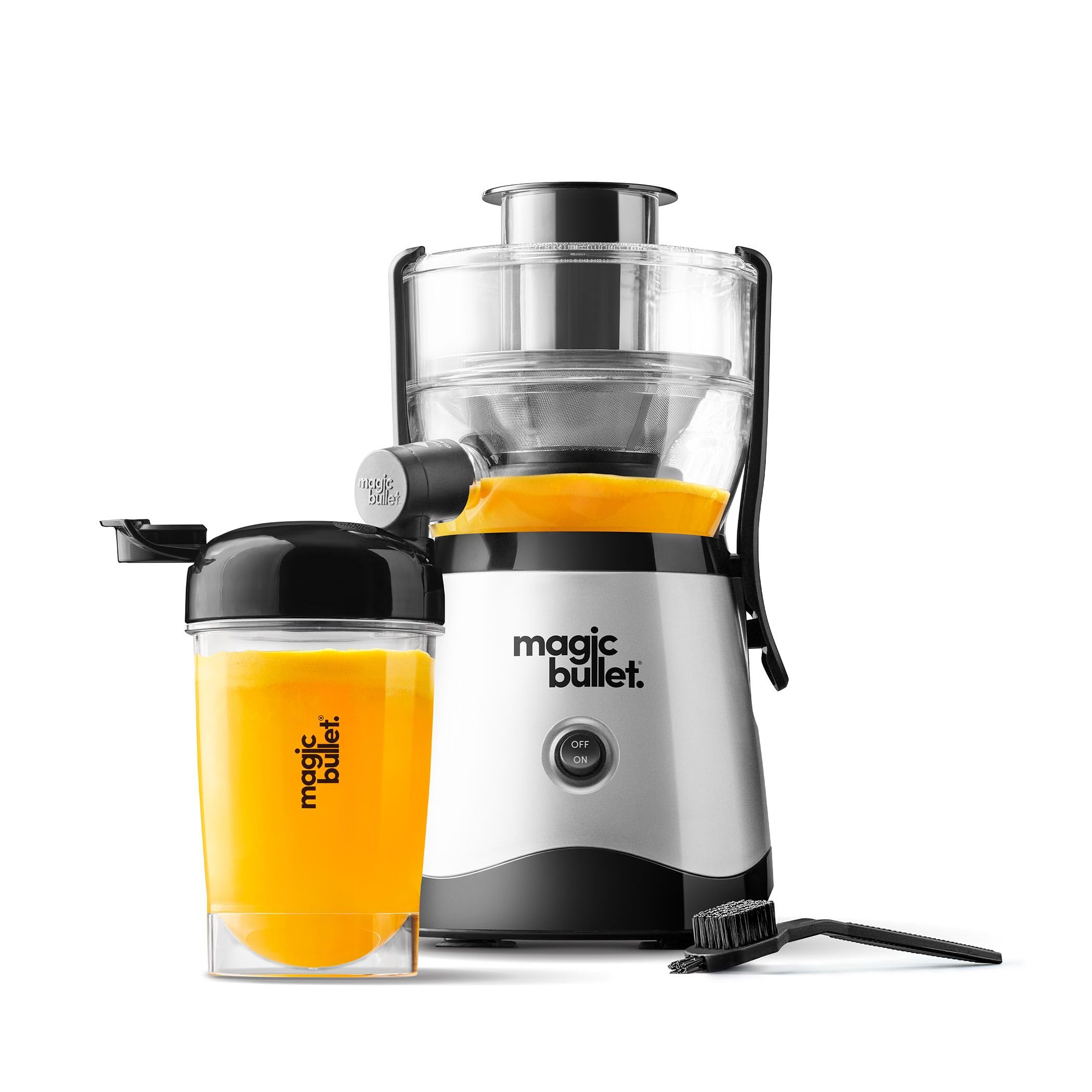
Magic Bullet Mini Juicer

89 /100
Trail Score Excellent

Key details

Cup
16 oz with to-go lid
Motor
400 W
Feed Chute
2 in
Juicer Type
Centrifugal
Check Price on Amazon

The unit of production here is a single 16-ounce cup. You juice directly into it, twist on the to-go lid, and drink, which means no jug to wash afterward. The machine itself is 11.5 inches tall and 6 inches wide, so it fits under a cabinet in a kitchen that has no room for a juicer, and the silicone spout cap catches drips before they reach the counter. That sounds minor until you have wiped carrot off a white surface.

Four hundred watts is more than the size suggests. Celery, carrots, and apples all go through without the motor bogging down, and it is quicker than its footprint implies. The attachments are top-rack dishwasher safe and the sieve lifts out for a rinse, so cleanup is a couple of minutes rather than a session.

We think it is the right juicer for one person and one glass a day. Against the cold presses here it gives up yield and quiet, but it costs a fraction of them, takes up almost nothing, and does not ask you to wash a jug as well as a cup. If you are testing whether juicing fits your morning at all, this is the least expensive way to find out.

Pros

  • Fits under a cabinet at 11.5 inches tall
  • Juices straight into a 16 oz to-go cup
  • Top-rack dishwasher-safe parts
  • Silicone spout cap catches drips

Cons

  • 2-inch chute means chopping everything first
  • Pulp comes out wet enough to notice
Our verdict

For one glass a day in a kitchen with no spare counter, this is the small juicer we suggest, provided you do not mind cutting everything up first.

Check Latest Price
7

Best for Large Households

Breville Juice Fountain Cold XL

92 /100
Trail Score Outstanding

Key details

Motor
1200 W
Juice Jug
70 fl oz
Feed Chute
3.5 in
Juicer Type
Centrifugal
Check Price on Amazon

Seventy ounces is the number that matters. That is the jug, roughly a week of juice for one person or a long Sunday session for a family, and behind the 3.5-inch chute whole apples, carrots, and beets go in uncut. Twelve hundred watts pushes them through faster than anything else in this guide, and the pulp bin sits behind the base so the machine stays comparatively shallow on the counter.

Breville calls the extraction Cold Spin, and it is worth being precise about what that means. This is still a centrifugal machine with a spinning basket, engineered to limit heat build-up rather than to crush at 50 RPM. In practice the juice tastes fresh and the froth is manageable. What you do not get is the bone-dry pulp a slow auger leaves behind.

The quiet setting cuts mechanical noise noticeably, which is a genuinely useful switch in an open kitchen where the machine runs while people are talking. The parts are hand wash only, and that is the real running cost of a big batch: a 70-ounce machine means more to clean when you are done.

We wondered whether a jug that size was overkill, and for a household going through a fridge drawer of produce at a time, it is not. Fill the jug, refrigerate, and stop thinking about juice until Wednesday. If you make one glass at a time, its bulk, its hand-wash parts, and its premium price are all cost and no benefit.

Pros

  • 70 oz jug holds a week of juice
  • 3.5-inch chute takes whole produce
  • Quiet setting cuts mechanical noise
  • Pulp bin behind the base saves depth

Cons

  • 15.5 pounds and 17.4 inches tall
Our verdict

What we recommend when the fridge drawer is full of produce: a 70-ounce jug and a 3.5-inch chute turn a week of juicing into one session.

Check Latest Price
8

Narrow Counters

YPONE 2-in-1 Cold Press Juicer

87 /100
Trail Score Excellent

Key details

Cups
500 ml and 700 ml
Motor
400 W at 55 RPM
Feed Chute
5.8 in
Juicer Type
Cold press (single auger)
Check Price on Amazon

Five inches of depth is unusual here, where most machines run 8 to 14 inches front to back. That is the reason to look at this one if your counter is shallow, and it does not cost you the features that matter: a 5.8-inch chute takes whole apples, the auger turns at 55 RPM, and the 400-watt motor is the largest of the cold presses in this guide.

Two strainers with 0.3mm mesh cover juice and nut milk, a reverse function clears jams, and a safety lock keeps the machine from running with the lid open. It also carries a one-year warranty, which is more coverage than several machines here state in their own specifications, and that counts for something on a press with a plastic auger housing.

While we have not put enough hours on this one to speak to its motor, the design is sound and the price sits between the budget presses and the big-hopper machines without giving up much. It is the pick for a narrow counter, or for anyone who wants a wide chute without a three-liter hopper taking over the kitchen.

Pros

  • Only 5 inches deep
  • 5.8-inch chute and 400 watts
  • Reverse function clears jams
  • One-year warranty

Cons

  • 500 and 700 ml cups need emptying mid-batch
Our verdict

A well-specified cold press for a shallow counter, with a wide chute, a one-year warranty, and cups that suit one or two glasses at a time.

Check Latest Price

How We Tested the Best Juicers

We started by pulling together more than 40 juicers and narrowing them down by feed chute size, motor type, dishwasher-safe parts, warranty length, and price relative to capacity. That filtered list became 12 machines spanning centrifugal and masticating designs, from compact countertop models to taller Slow Juicers that barely fit under a cabinet. Each one lived in a real kitchen for eight months, used by couples, families, and one person juicing solo before a 7 a.m. shift.

Every machine got the same lineup: a pound of carrots, a head of kale, beets, apples, and a handful of frozen berries. We weighed produce going in and juice coming out, then squeezed the pulp in a paper towel to see how much liquid was left behind — wet pulp meant the machine was leaving money in the bin. We ran four batches back to back without disassembling to see where greens clogged the basket, and we timed assembly, feed-chute clearance, and full cleanup including scrubbing the mesh filter by hand.

Ease of use got judged at 6:30 in the morning, which is its own stress test. We noted whether the machine walked across the counter, whether cutting fruit down to fit the chute added ten minutes of prep, and how hard it was to lock the lid with wet hands. Noise got measured with a decibel app at arm's length while a roommate tried to take a phone call in the next room, and we tracked each juicer's physical condition over the months — hairline cracks in plastic, stained housings, motors that started to smell warm after extended runs.

How to Choose a Juicer

Centrifugal or Cold Press: Start With What You Juice

A centrifugal juicer spins a shredding disc against a mesh basket. It is fast, loud, and at its best with hard produce: apples, carrots, beets. A cold-press or masticating machine crushes produce through a slow auger at roughly 40 to 80 RPM, which leaves the pulp drier, handles greens better, and runs quietly enough to use before anyone else is awake.

Watch the wording on the box. Cold Spin and similar names on centrifugal machines describe a design tweak that limits heat; they are not cold presses and they still spin. We would rather you pick by produce than by badge: greens and wheatgrass belong with an auger, apples and carrots are genuinely well served by centrifugal speed.

Cleaning Is the Feature That Decides Everything

Count parts before you count watts. A mesh basket to scrub, a pulp chute, and a lid with a gasket can take longer to clean than the juice took to make. Screen-free augers and dishwasher-safe parts change that arithmetic: the Ninja's parts go in the dishwasher, the TUUMIIST 580 has no mesh screen at all, and the Breville Cold XL, for all its power, asks to be hand washed.

The trap is the phrase dishwasher safe itself. Check whether it covers every part or just the top rack of one attachment you will still rinse by hand first. We put more weight on this than on any other single specification, because a machine that is annoying to clean stops being used.

Chute Size Buys Time, Not Speed

A 2-inch chute means apples in wedges. Three inches takes them whole. A 6.5-inch chute swallows whole apples, whole carrots, and a celery heart in one push, and the 100-ounce hopper behind it means you stop feeding altogether.

That matters most on a centrifugal machine, where the juicing takes seconds and prep is the entire job. On a slow juicer a wide chute shortens the feeding but the auger still sets the pace. The trap: chute width is not throughput. A 6.5-inch chute on a 60 RPM auger is still a slow machine, just a far less tedious one.

Match Capacity to How You Actually Juice

One glass a day wants a small cup. A family wants a pulp bin that survives a bag of carrots. The Ninja's 24-ounce jug and 36-ounce pulp bin suit a couple of glasses at a time; the TUUMIIST 780's 100-ounce hopper and the Breville Cold XL's 70-ounce jug are built for a week of juice in one session.

Think about the pulp container as carefully as the jug. Stopping mid-batch to empty it is the interruption people resent most, and no motor specification makes up for it.

Where It Will Live: Height, Depth, and Noise

Most of these machines stand 15 to 17 inches tall, which is at or near the underside of upper cabinets, and a hopper lid that swings up needs clearance as well as width. Measure the gap before you commit the counter. Depth separates them too: the Breville Cold XL parks its pulp bin behind the base to stay shallow, while the YPONE is only 5 inches deep.

On noise, auger machines are quiet enough for an early weekday; centrifugal machines are not. If someone in the house is asleep when you juice, that single difference settles the choice before yield enters the conversation.

Frequently Asked Questions

Final Verdict

Start with the Nama J2 if the budget allows. The self-feeding hopper, dry pulp, and quiet motor make it the best juicer here, and its parts come apart quickly even though they must be washed by hand.

If you are not yet sure juicing will stick, buy the Ninja JC151 instead: it is the cheaper machine to own, it goes in the dishwasher, and it is small enough to leave out. Choose the Breville Juice Fountain Plus only if speed is the whole point and you would rather not cut anything up.