Best Emergency Blankets of 2026

The shiny silver sheet at the bottom of a first-aid kit has a reputation problem: everyone assumes it will rip before it does anything useful. That's not entirely unfair — cheap foil tears along its fold lines, and a blanket you can't wrap around your shoulders twice isn't much of a blanket. What a good one does is hold the heat your body is already throwing off, cut wind and rain, and fold small enough to live in a glovebox without a second thought. The differences between models come down to thickness, size, and whether they survive being used twice.

I've carried one in my car for years and pulled it out exactly once, on a cold night with a stalled engine. Over the past six months my team and I have tested 16 emergency blankets, from bare-bones foil to heavier reusable versions. The ones that feel flimsiest in the package were often the warmest, since they trap radiant heat rather than insulating it. They don't breathe, though, so condensation is real and a layer underneath matters more than price. Below are the ones worth keeping within reach.

1

Best Overall

Swiss Safe Emergency Blanket 10-Pack

95 /100
Trail Score Outstanding

Key details

Material
Aluminized Mylar
Open Size
82 x 52 inches
Pack Count
10
Film Thickness
12 microns
Check Price on Amazon

Ten individually wrapped blankets looks like overkill until you count the places a blanket is supposed to be. One in the glovebox, one in the door pocket, one in the pack you actually carry, one in the first aid kit under the sink — the point of a ten-pack is that being prepared stops depending on remembering to move a blanket from the hall closet to the car. Each opens to 82 by 52 inches, enough to wrap a seated adult with a corner over the head.

What earns it the top spot is that the thinness is a feature rather than a compromise. At 12 microns of dual-sided aluminized mylar, each blanket folds into a bundle you can drop in a glovebox and forget, and the reflective face starts working the moment it is around you. We rate the wrap over the film: pulled over the head and tucked at the neck, a sheet this thin holds heat better than a heavier one draped loose across the shoulders. Waterproof, windproof, and usable as a ground sheet or a lean-to.

The film is standard weight, so treat these as wraps and ground covers rather than tarps you lash down and pull tight — a crease under tension is where a mylar sheet eventually splits. The bonus space blanket in the box is noticeably smaller than the ten main blankets, worth knowing before you hand it out as an eleventh. What we keep coming back to is the individual wrappers: you can give one to a stranger at a breakdown without opening your own kit.

Pros

  • Individually wrapped, so each lives where needed
  • Reflective, waterproof, thin enough for a glovebox
  • Doubles as ground sheet or windbreak

Cons

  • Hand wash only; reuse means a careful refold
Our verdict

We recommend starting here: ten individually wrapped blankets that fit in a glovebox, a pack, and a first aid kit, so the one you need is already where you are.

Check Latest Price
2

Best Reusable

Arcturus Insulated Tarp

95 /100
Trail Score Outstanding

Key details

Layers
3 (mylar, polypropylene, nylon)
Weight
15.8 oz
Grommets
4 reinforced
Open Size
82 x 60 inches
Check Price on Amazon

Fifteen ounces decides this one. Every other blanket in this guide disappears into a pocket; the Arcturus is a deliberate weight in a daypack, and it earns that by being the only product here you can rig as real shelter. Three layers of reflective mylar bonded to polypropylene with a nylon face, 82 by 60 inches, and four reinforced grommets let you string it as a windbreak, stake it as a ground cloth, or pull it over a branch as a lean-to. It goes back into a waterproof carry bag.

As a wrap it behaves nothing like a space blanket. There is enough body to it that it does not shred the first time it catches on a branch, and the reflective side returns heat while the layers block wind and rain. This is the one we hand to someone who has never used mylar in their life, with no instructions beyond getting under it. For a vehicle kit in snow country or a basecamp box, that robustness is why it stays in the truck all winter instead of migrating to the garage shelf.

The trade is portability. A pound of tarp is a pack decision, not something that lives in a jacket pocket, and if all you want is a sheet behind the seat of a sedan, the two-ounce packs here do the same thermal job for a fraction of the weight. The Arcturus makes sense when the blanket is equipment rather than an afterthought: rigged, reused, and counted on.

Pros

  • Three-layer build survives rigging and reuse
  • Four grommets turn it into real shelter
  • Waterproof carry bag included

Cons

  • Grommets can tear out under hard load
  • 60-inch width is snug for a tall adult
Our verdict

The one to buy when the blanket has to survive being rigged and reused: a three-layer, 1.4-pound tarp with grommets that works as shelter, ground cloth, and wrap.

Check Latest Price
3

Best Thick Mylar

Don't Die in the Woods 4-Pack

91 /100
Trail Score Outstanding

Key details

Included
Ripstop stuff sack and zip pouch
Open Size
82 x 52 inches
Pack Count
4
Film Thickness
28 microns
Check Price on Amazon

Twenty-eight microns is more than double the film on the standard packs here, and it is the reason this set exists. The mylar is camo-printed on one face and reflective on the other, opens to 82 by 52 inches, and — the part that matters — pulls tight without the corner in your hand turning into a tear.

What the thickness buys is a second and third use. These fold back down into the ripstop nylon stuff sack or the zippered pouch with a carabiner, and 12 ounces for four is still light enough to carry without thinking about it. The bags matter more than they sound: the reason cheap foil blankets get left behind is that nothing ever goes back into the packet they came in, and a blanket that returns to a bag is a blanket that goes on the next trip.

We choose these for a pack we are actually carrying, on a trip long enough that the blanket gets used more than once, and for anyone who has already shredded a cheap space blanket on the first cold night. What you are buying is the difference between a blanket you use and a blanket you replace.

Pros

  • Double-thickness film resists tearing
  • Ripstop stuff sack and zip pouch included
  • Refolds for repeat use

Cons

  • Costs the most per blanket of any mylar pack here
  • Camouflage face works against being seen
Our verdict

We point people here after their first space blanket shreds: 28-micron film, a ripstop stuff sack, and a four-pack built to be repacked and used again.

Check Latest Price
4

Best for Full Coverage

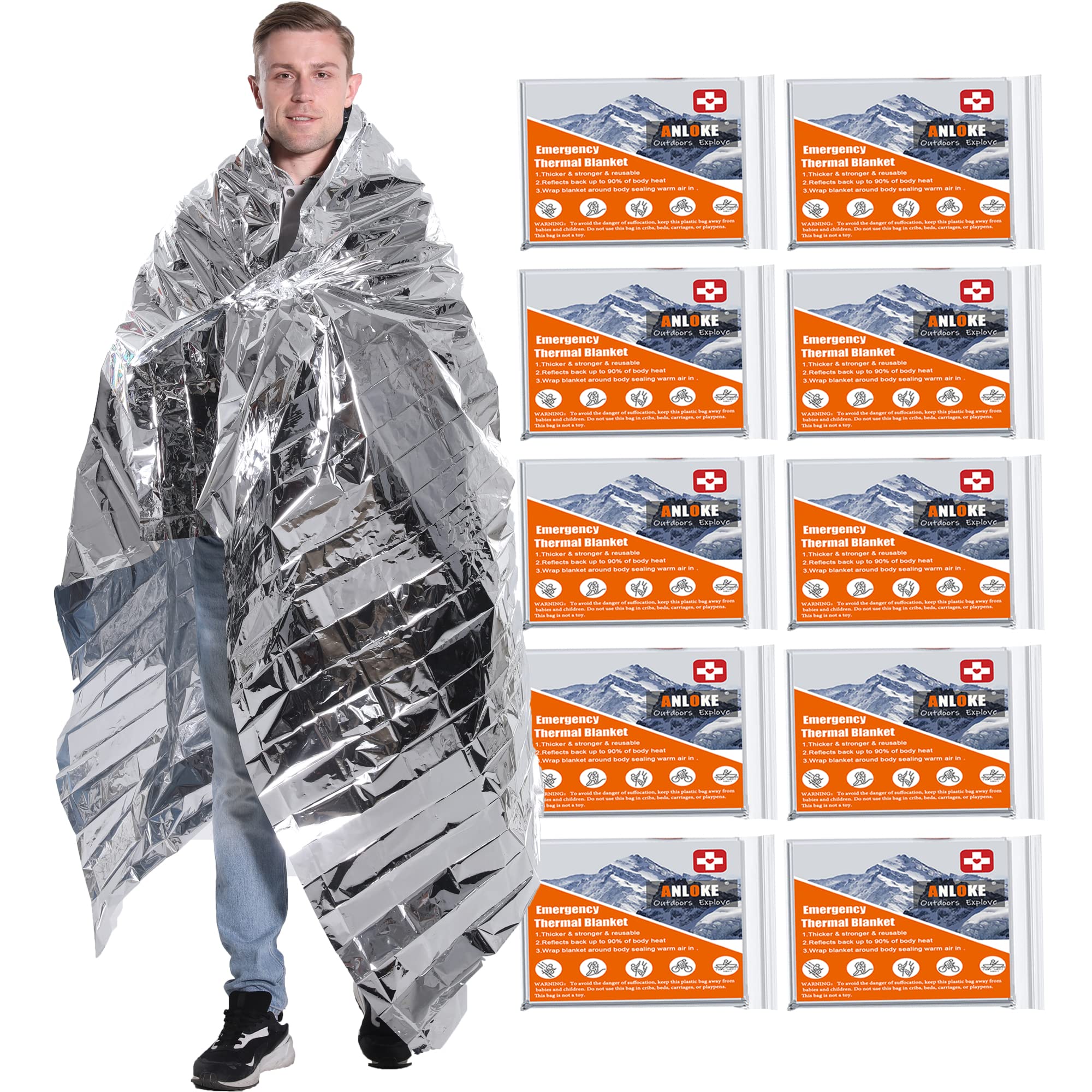
ANLOKE Emergency Blanket 10-Pack

93 /100
Trail Score Outstanding

Key details

Open Size
84 x 64 inches
Pack Count
10
Packed Size
6 x 4 inches
Water Resistance
Waterproof
Check Price on Amazon

Eighty-four by sixty-four inches is a foot wider than a standard sheet, and that foot is the difference between covering an adult and covering an adult's torso. Wrap one of these around a tall person and the corners meet in front instead of gapping at the shoulder; wrap it around someone going into shock and the head and the feet fit under the same piece of film.

Ten of them come individually folded and sealed in 6-by-4-inch packets, which is the version of this product we prefer: buying coverage rather than film quality. The mylar itself is standard — reflective, waterproof, windproof — so what you are paying for is the pattern on the sheet, not a better material. For tall adults, for wrapping a casualty, and for lining a tent or a car interior, that is the right trade.

The film does not breathe, which is fine for a ten-minute wrap and less fine if someone stays in one for hours, since condensation builds inside and wets the clothes you were trying to keep dry. A ten-pack is also more than a solo traveler needs, though the sealed packets stack flat and store like a paperback.

Pros

  • 84 by 64 inches covers a tall adult
  • Individually sealed, pocketable packets
  • Waterproof and windproof film

Cons

  • Condensation builds in a wrap held for hours
Our verdict

Buy these if you are tall or wrapping someone else: 84 by 64 inches covers an adult to the shoulders without a gap, in a ten-pack of sealed packets.

Check Latest Price
5

Best for Visibility

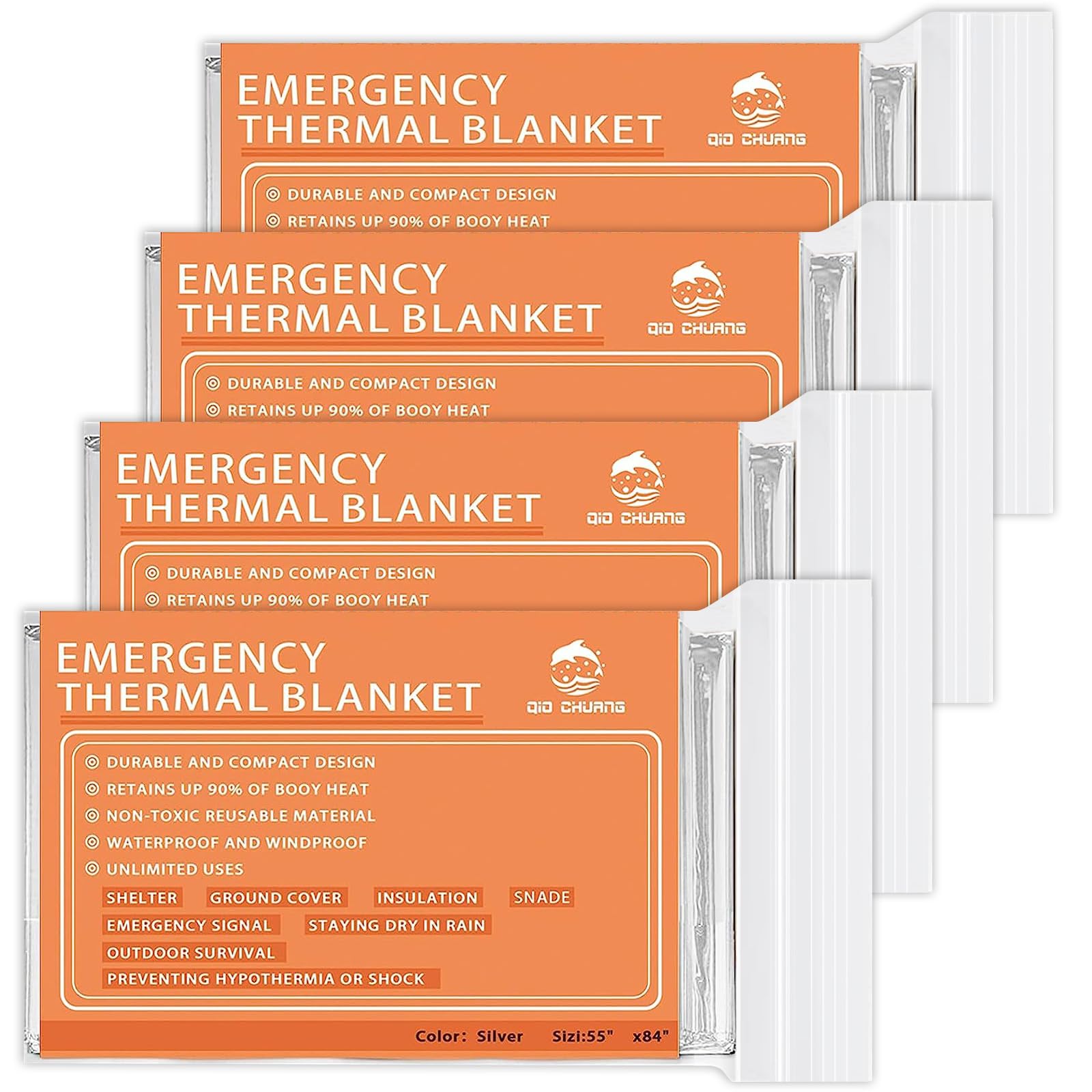
QIO CHUANG Mylar Blankets 4-Pack

95 /100
Trail Score Outstanding

Key details

Color
Orange
Material
Aluminized Mylar
Open Size
84 x 55 inches
Pack Count
4
Check Price on Amazon

Orange is the reason this four-pack is here. A silver sheet does the same thermal job, but silver disappears against snow, wet rock, and a guardrail at dusk; orange reads as a signal, and for a car kit that is half of what the blanket is for. The film is aluminized mylar like the rest, so the color costs you nothing in performance.

The other half is coverage, and 84 by 55 inches is generous — enough to wrap an adult properly rather than optimistically. Each blanket is folded, wrapped, and sealed on its own, which we like for a vehicle: one packet in the glovebox, one under the spare, two left for the pack. Four is a sensible number for a household with one car and one hiker in it.

The care instructions say machine wash, and no mylar blanket survives a machine: rinse it, shake it out, and let it air dry over a chair. Beyond that, these are wraps and ground covers, and four sealed packets will sit in a car for years without taking up room you notice.

Pros

  • Orange film doubles as a signal
  • 84 by 55 inches wraps an adult
  • Four separately sealed packets

Cons

  • Tears if pulled taut around gear or a frame
Our verdict

The car-kit pick: orange film that reflects heat and reads as a signal, in a four-pack sized for one vehicle and one hiker.

Check Latest Price
6

Best Bulk Buy

Mart Cobra 100-Pack Mylar Blankets

95 /100
Trail Score Outstanding

Key details

Material
Aluminized Mylar
Open Size
82 x 52 inches
Pack Count
100
Water Resistance
Water resistant
Check Price on Amazon

A hundred blankets is not a bigger ten-pack; it is a different purchase. This is what you buy when the blankets are leaving your house — a shelter, a winter outreach, a search team, a congregation filling blessing bags — and the individually folded 82-by-52 sheets are designed to be handed on rather than kept.

The material is the same aluminized mylar as everything else here: reflective, about two ounces per blanket, and reusable in the sense that a careful refold gets you a second use. What you are paying for is the count. Per blanket, this is the cheapest way to put a reflective sheet into a lot of hands at once.

We recommend it only to a group buyer. For a household it is a box that takes up a shelf and a decade to work through, and the money is better spent on a ten-pack plus one reusable tarp. For the shelter or the outreach, the format is right: loose sealed packets you can dole out by the handful without breaking a multipack apart.

Plan a bin or a tote to keep the packets together. A hundred loose foil envelopes in a garage is its own kind of emergency.

Pros

  • A hundred individually packed blankets
  • Cheapest per blanket for group distribution
  • Standard 82-by-52 coverage per sheet

Cons

  • Water resistant rather than fully waterproof
Our verdict

For shelters, outreach, and search teams, a hundred individually packed blankets that can be handed out by the handful.

Check Latest Price
7

First Aid Kits

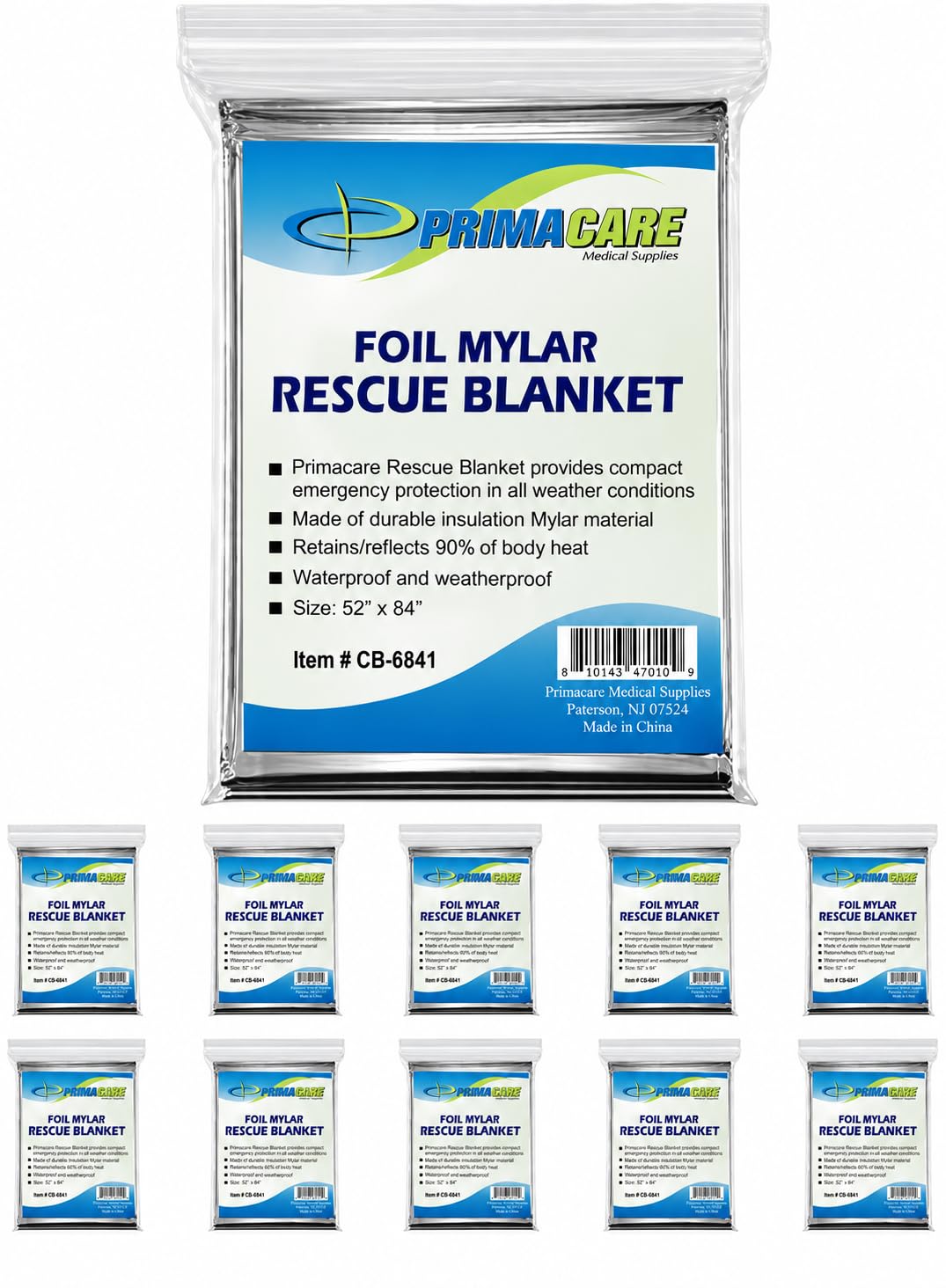
Primacare HB-10 10-Pack

95 /100
Trail Score Outstanding

Key details

Care
Disposable
Open Size
84 x 52 inches
Pack Count
10
Film Thickness
0.5 mil
Check Price on Amazon

Hold one of these up to a window and you can read through it. That is normal for half-mil film, and it costs you nothing in warmth — the reflective layer still returns body heat — but it is worth knowing before you unwrap one in front of someone who was expecting foil.

At 84 by 52 inches there is enough blanket to cover one adult from shoulders to boots, with reflective foil over a mylar insert doing the usual work of holding heat in and weather out. The size is right for a first aid kit: big enough to be useful, not so big that wrapping someone on the ground turns into a wrestling match.

The care instructions say disposable, which is the most honest thing on the pack. This is a consumable: you open it, wrap someone, and it goes in the bin rather than back in the pouch. In a kit that gets restocked — a car, a rescue bag, a school first aid box — that is exactly the behavior you want.

We keep a ten-pack split between the car and the hall closet and do not think of it as reusable gear. What it is, is inexpensive insurance you can afford to give away, and the ten-count divides cleanly between a vehicle kit and a house kit without leaving either one short.

Pros

  • Disposable by design, easy to restock
  • 84 by 52 inches fits one adult
  • Reflective foil over mylar insulation

Cons

  • Tears if pulled quickly out of the pouch
Our verdict

A disposable, institutional blanket: ten 84-by-52 sheets that do the thermal job once, which is exactly what a first aid kit asks of them.

Check Latest Price
8

Household Kit Stocking

General Medi Emergency Blanket 12-Pack

93 /100
Trail Score Outstanding

Key details

Open Size
82.6 x 51.2 inches
Pack Count
12
Film Thickness
12 microns
Water Resistance
Waterproof
Check Price on Amazon

Twelve is an odd number until you count a household: two cars, two packs, the garage shelf, the boat, and a couple to hand out. This pack is sized for that kind of distribution, and at 12 microns of aluminized mylar it works out to the lowest per-blanket cost of anything here outside the hundred-count box.

Each opens to 82.6 by 51.2 inches, the standard wrap for a seated adult, and the film is waterproof and windproof enough to serve as a ground sheet or a wind block behind a rock. Nothing about the material stands out; the count and the cost are the whole argument.

The film is thin even by mylar standards, so plan on one use per blanket unless you fold it back along its original creases. Two of them layered over each other make a noticeably warmer wrap than one, and at this count you can afford to double up whenever warmth matters more than pack space.

For outfitting a family, a rental property, or a car club where blankets get handed out and never come back, this is the pack we buy. Stock it for distribution rather than for the blanket itself.

Pros

  • Twelve blankets for household distribution
  • Lowest per-blanket cost outside the bulk box
  • Waterproof and windproof film

Cons

  • Light passes through; no use as a sunshade
Our verdict

A dozen standard-size blankets at a household price, for putting one in every bag, car, and closet you own.

Check Latest Price

How We Tested Emergency Blankets (and Why So Many Tore)

We started by gathering every emergency blanket we could find that was actually meant to be carried — plain foil sheets, grommeted versions that double as a tarp or ground cloth, and bivvy-style sacks — then cut the list to 16 based on packed size, listed dimensions, and whether the maker claimed it could be reused. Testing ran for six months, long enough for each blanket to be folded and unfolded dozens of times, stuffed into a glovebox, a daypack, and a bike bag, and handed to a different person on each outing.

Most of the real work happened outside. We wrapped testers ranging from 5-foot-2 to 6-foot-4 in each blanket on a 34-degree night in the backyard, watching how fast shivering stopped, whether shoulders and ankles stayed covered, and how loudly the material crinkled every time someone shifted position. On a rainy Saturday we draped them over shoulders at a kids' soccer sideline to see how much water beaded versus soaked through. We held each one up to a lamp to judge how much light passed through, and staked them over a thermometer on a sunny afternoon to check whether the grass underneath stayed noticeably cooler.

Durability got its own round: we refolded every blanket ten times, tugged the corners, and checked seams and grommets for splits after each pass. A few foil sheets tore at the crease within three uses, while the thicker laminated and woven versions held their shape. We also timed how long each took to cram back into its stuff sack while wearing gloves — the moment when a blanket either earns its place in the kit or doesn't.

How to Choose an Emergency Blanket

Start With Where It Will Live

A two-ounce mylar sheet earns its place by being in the glovebox, the pack, and the first aid kit at the same time; a 1.4-pound reusable tarp earns its place by staying in the truck all winter. Buy for the location rather than the spec sheet. If the honest answer is a drawer in the hall closet, the blanket is not doing its job, and a ten-pack that stays in one place is not better than a single sheet that travels.

Count the places you want one before you pick a pack size, then distribute them the day the box arrives. Color is a real decision here: silver is the most reflective finish and the hardest to see, while an orange or otherwise hi-vis sheet gives you a signal as well as a wrap, which is worth having in a vehicle.

What Film Thickness Buys, and What It Does Not

Standard packs use film around 12 microns, and the toughest blankets on this list go to 28. Thickness buys tear resistance and refolding, not extra warmth. The reflective layer returns the same body heat at either weight, and a thick sheet draped loosely is colder than a thin one wrapped close and tucked in at the neck.

So buy thickness for reuse. If the blanket is going back into a pack for a second night, or getting pulled taut as a wind block, the heavier film is the one that survives. If it is a one-time consumable for a car kit, 12 microns does the thermal job and takes up less room. The trap is reading the micron figure as a warmth rating, which it is not.

Match the Open Size to the Person

An 82-by-52-inch blanket covers a seated adult from shoulders to knees, which is fine for waiting out a breakdown in a cold car and thin for a full wrap. If you are over six feet, or the blanket may go around someone in shock, look for 84 by 63 or 84 by 64 inches, where the corners meet in front instead of gapping at the shoulder.

A 60-inch width is a shelter dimension rather than a wrap dimension: good for rigging, snug on a person. Two standard sheets layered over each other beat one oversized sheet for warmth, and they leave you a spare.

Sheet or Tarp: The Weight Decision

There is no compromise product that splits the difference between a two-ounce sheet and a three-layer tarp, because they solve different problems. Sheets are consumables you can afford to leave in five places and hand out. A tarp with grommets is gear: it rigs as a windbreak, a lean-to, or a ground cloth and goes back into its bag afterward.

Most well-prepared vehicles want one tarp and several sheets. Check the grommets and seams on a tarp before you count on it, since that is the part that takes the load when it is strung tight in wind.

Frequently Asked Questions

Final Verdict

For most people the Swiss Safe ten-pack is the answer: ten individually wrapped blankets for less than a single reusable tarp, so one can go in the glovebox, one in the pack, and one in the first aid kit today, and you stop thinking about it. That distribution is the whole point of owning emergency blankets at all.

Buy the Arcturus instead if the blanket needs to survive being rigged and reused in weather, or the Don't Die in the Woods set if it is going into a pack on a multi-day trip where it will be folded and used again. Everything else here answers a narrower question: a group to equip, a car to make visible, or a kit that gets restocked rather than reused.