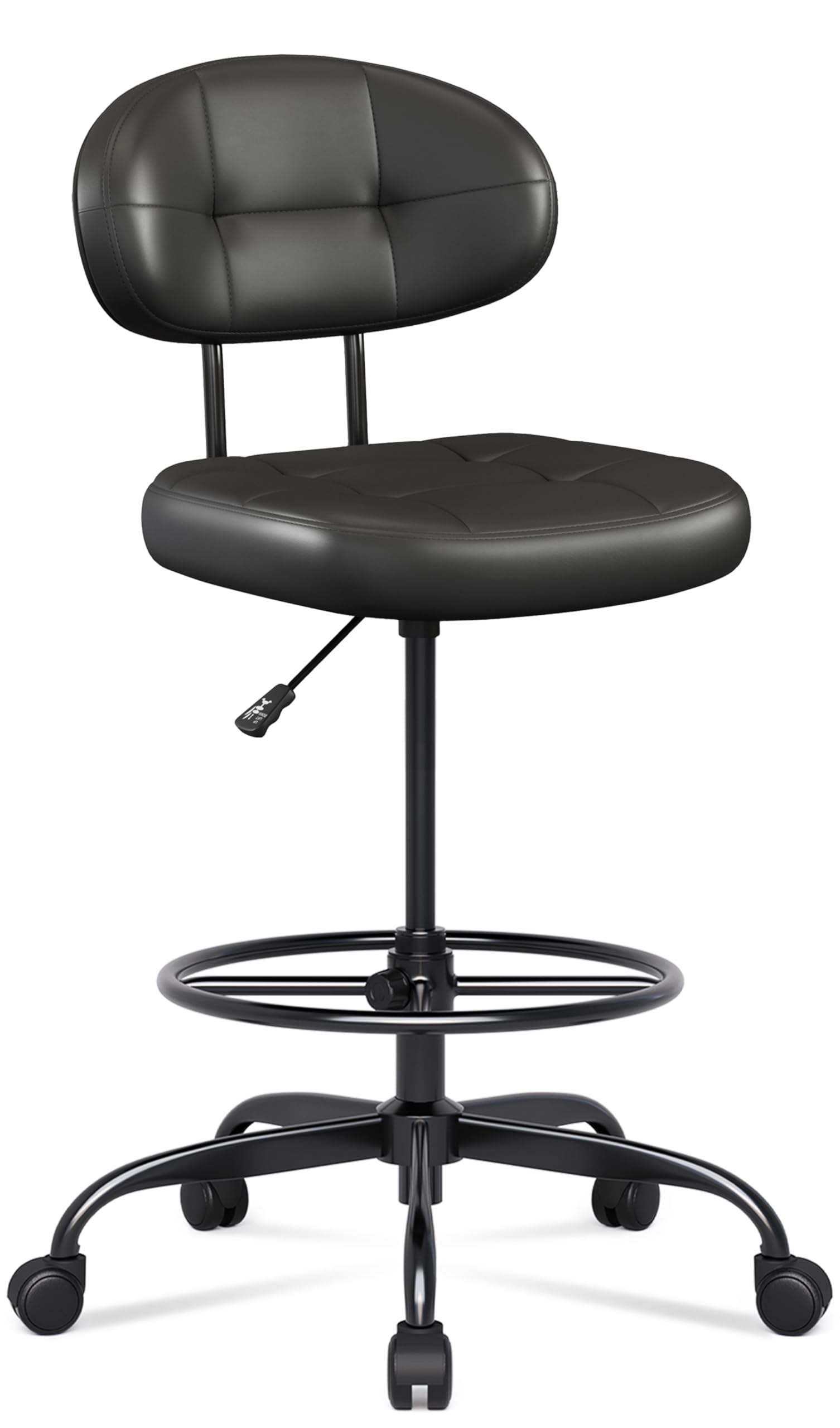
Best Drafting Chairs of 2026

A drafting chair has one job most office chairs can't handle: putting you at eye level with a slanted table or tall workbench without leaving your feet dangling. The trouble is that extra height can make a chair feel tippy, and a foot ring in the wrong place turns a long sketching session into a fidget fest. I've spent the past eight months with ten drafting chairs — rolling them between a drafting table and a standing desk, assembling them on a Saturday morning, and adjusting them mid-project — to find the ones that feel planted, comfortable, and worth the money.

What surprised me is how much the small stuff matters. A cushion that looks plush can bottom out by hour two, and a chair that fits a six-foot tester can leave a five-foot-four user with numb legs. Assembly is another divider: some went together in twenty minutes with the included tool, while others had misaligned holes and vague instructions. The picks below cover a range of heights, footprints, and budgets, so you can find one that fits your body and your workspace, not just your standing desk.

1

Best Overall

Office Star DC517V

90 /100
Trail Score Outstanding

Key details

Foot Ring
Height adjustable
Certification
GREENGUARD
Weight Capacity
275 lb
Seat Height Range
24 to 34 in
Check Price on Amazon

Thirty-four inches is the number that earns this chair its place. That's the top of the Office Star's seat range, and it's the highest seat in this group — enough to sit properly at a 40-inch drafting table instead of reaching up to your work. The bottom of the range sits at 24 inches, so the same chair covers a standing desk and a tall kitchen counter, and the lift moves on a one-touch pneumatic.

If you want a single chair to handle a drafting table, a standing desk and the island without a compromise, this is the one we point to. The foot ring travels on its post and clamps to your leg length, the vinyl spot-cleans when ink or clay lands on it, and the chair is approved for commercial use and GREENGUARD certified for low emissions — worth knowing if it lives in a small studio or a spare room.

Two details are easy to miss. The sculptured foam seat is 2.5 inches thick and firm, and we prefer it that way at drafting height, because a soft seat lets you sink until the leg angle the foot ring exists to set is gone. And the casters are carpet casters: on hardwood or tile they drag and eventually flat-spot, so plan on a soft-floor set or a chair mat when you order.

The warranty is the quiet argument — 15 years on non-moving metal parts, five on the mechanism, base and casters, three on the upholstery, which is longer than anything else in this guide. The back is only 11.75 inches tall, so this is lumbar support rather than a chair you lean back in, and that's the price of a seat that reaches higher than any other here.

Pros

  • Highest seat range here at 24 to 34 inches
  • Foot ring adjusts on the post to your leg length
  • Commercial-rated and GREENGUARD certified
  • Long warranty: 15 years on metal parts

Cons

  • Low 11.75-inch back gives lumbar support only
  • Ships with carpet casters that drag on hard floors
Our verdict

Our pick for anyone who needs one chair to serve a drafting table and a standing desk: the seat climbs to 34 inches and the foot ring adjusts to match.

Check Latest Price
2

Best Budget

Brick Attic T12

89 /100
Trail Score Excellent

Key details

Backrest
Removable
Height Range
33.86 to 41.75 in
Cushion Width
15.8 in
Weight Capacity
300 lb
Check Price on Amazon

Value is the whole argument here. The Brick Attic costs about what the plainest stool in this guide does and still gives you an adjustable foot ring, a 300-pound rating and a backrest you can unbolt. That rating is 50 pounds more than the Amazon Basics and the Primy manage, and the base spreads 23.6 inches across five legs, which is what keeps a seat this tall from feeling like it wants to tip.

The backrest comes off with a few bolts, and that's the detail that makes the chair do more than its price suggests. At a potting bench or a shipping station, where you're stepping on and off every few minutes, a backless stool is the better tool — you can convert this one in about ten minutes and put the back in a closet. Bolted on, the curve lands at your lumbar rather than your shoulder blades.

The seat is 15.8 inches across, the narrowest in this group alongside the Primy, so if you're broad through the hips the Office Star or the BOLISS will fit you better. The foam is high-density over PU leather that wipes down, the instructions are clear, and the box includes spare screws — a small courtesy that tells you how the rest of the hardware was specified.

Pros

  • Adjustable foot ring at a budget price
  • 300-pound rating, higher than the other budget chairs
  • Backrest unbolts into a backless stool

Cons

  • Narrowest seat pan here at 15.8 inches
Our verdict

Buy this one if you're furnishing a studio on a budget and still want a foot ring, a 300-pound rating and a back that comes off.

Check Latest Price
3

Best Mesh

Primy PR777-Z

90 /100
Trail Score Outstanding

Key details

Arm Style
Armless
Foot Ring
Height adjustable
Item Weight
17.6 lb
Weight Capacity
250 lb
Check Price on Amazon

At 17.6 pounds this is one of the lightest chairs here, and that changes how it gets used. You can carry it one-handed from the drafting table to the kitchen counter, and because there are no arms you pull up until your ribs are almost on the table edge — exactly where you want to be when you're drawing, cutting or soldering. The C-shaped mesh back curves into your lumbar instead of pushing your shoulders forward, and the woven seat lets air through on a long afternoon. We choose it first when the chair has to share space with other people.

The foot ring adjusts high enough to keep your knees at a right angle even with the seat near the top of its travel, and the armless build means nothing catches on a table apron. The seat angle is fixed, though, so if you like to rock back between passes at the table, this isn't the chair that does it.

Assembly takes about 15 minutes with the single tool in the box, and it's light enough that one person can put it together on the floor without help. For a studio where the chair moves between stations more than it holds still, the low weight and the armless tuck are worth more than a bigger seat pan would be.

Pros

  • 17.6 pounds, easy to carry between stations
  • Armless frame pulls right up to the table
  • Breathable mesh seat and C-shaped mesh back

Cons

  • 250-pound capacity is the lightest in this guide
  • One-year warranty, shortest of the group
Our verdict

Pick this if you share the studio and need a chair you can move one-handed: it's light, armless and breathable.

Check Latest Price
4

Best for Tight Spaces

Misolant Drafting Chair

89 /100
Trail Score Excellent

Key details

Foot Ring
Height adjustable
Upholstery
Faux leather
Cushion Width
16.5 in
Seat Height Range
23.5 to 31.9 in
Check Price on Amazon

A 16.5-inch cushion and a 16.3-inch seat depth are the numbers to start with, because they decide who this chair suits. A shallow pan means the front edge doesn't press in behind your knee, which is the complaint that pushes shorter sitters out of deep-pan drafting chairs. The seat runs from 23.5 to 31.9 inches, so it covers a drafting table and drops toward counter height without becoming a bar stool.

The wrap-around back is the other half of the design: it curves around your ribs rather than sitting only behind your lumbar, so you get a little lateral support when you twist to reach a ruler or a brush. The faux leather is the trade — soft and wipeable, but warmer than mesh, which you'll notice against your back by mid-afternoon in a heated room. It cleans up easily after a session with clay or pastel.

Our call: this is the chair for a tight room. Armless, 21.6 pounds, and narrow enough to slide under a counter when the work is done. The gas lift carries SGS certification and the chair is BIFMA-tested, which is more third-party paperwork than most chairs at this level offer. But Misolant doesn't publish a weight capacity anywhere in its listing, so if you're a heavier sitter, ask before you order rather than assuming the certification covers it.

Pros

  • Shallow 16.3-inch seat depth suits shorter sitters
  • Armless and 21.6 pounds, easy to tuck away
  • Certified lift and BIFMA-tested frame

Cons

  • PU upholstery traps heat in a warm room
  • No weight capacity published in the listing
Our verdict

The one we suggest for a small room: a short seat pan and an armless frame that tuck under a counter, at a height that still reaches a drafting table.

Check Latest Price
5

Best for Big and Tall

BOLISS 2818HD

88 /100
Trail Score Excellent

Key details

Headrest
Adjustable 3D
Seat Foam
5 in molded
Weight Capacity
400 lb
Seat Height Range
24.8 to 32.1 in
Check Price on Amazon

Four hundred pounds is the rating and 46.2 pounds is the chair, and the two figures belong together. The BOLISS is built like furniture: a 20.1-inch seat pan, 5 inches of molded foam, a 19.68-inch mesh back and an adjustable 3D headrest. It isn't a chair you move from room to room; it's one you set up where you work and leave there.

The flip-up arms are the feature we appreciate most. Fold them up and your knees clear a table with drawers or a deep apron; fold them down and they sit at a useful height for reading. The lift covers 24.8 to 32.1 inches, a 7.3-inch stroke, which takes in standing desks and tall benches, and the base is designed to keep the roll quiet.

If you're over 200 pounds, or you've had a cheap drafting chair go soft and wobbly under you, this is the one we point to, and the mesh back keeps a long session from turning sticky. What it won't do is fit a small sitter: the seat starts at 24.8 inches and the pan is 20 inches deep, so if you're short in the leg or the torso your feet dangle and your lower back never reaches the curve. The Office Star and the Misolant serve that sitter instead.

It's the most expensive chair in this guide, and the money is in structure rather than trim — a 400-pound-rated base, a wide pan, and a headrest that does something. For a heavy daily user that's the right place to spend it.

Pros

  • 400-pound rating, the highest here
  • Flip-up arms clear a deep table apron
  • 5-inch molded foam seat over a 20.1-inch pan
  • 7.3-inch lift range from 24.8 to 32.1 inches

Cons

  • Too tall and too deep for shorter sitters
Our verdict

For heavier sitters who want a chair that holds still: a 400-pound rating, a deep pan and a headrest, at the top of this guide's price range.

Check Latest Price
6

Counter-Height Work

Amazon Basics Drafting Stool

91 /100
Trail Score Outstanding

Key details

Item Weight
18.1 lb
Back Cushion
16.5 by 10.2 in
Weight Capacity
250 lb
Seat Height Range
20.3 to 25.4 in
Check Price on Amazon

There's no foot ring, and the seat stops at 25.4 inches. Both facts point the same way: this is a counter-height stool with a back, not a drafting chair. Set it at a 30- to 36-inch bench, island or potting counter and the 20.3-to-25.4-inch range is exactly right; take it to a drafting table and you'll spend the day reaching up to your work.

We keep it in the guide because at that height it's a better stool than most of the dedicated drafting chairs here are. The back cushion measures 16.5 by 10.2 inches and adjusts, the bonded leather wipes clean with a dry cloth, and at 18.06 pounds you can carry it to the garage and back under one arm. The round base will roll out from under you if you lean far to one side — sit square on it and it's steady.

Assembly is quick, the swivel is smooth, and the one-year limited warranty covers a chair that will spend most of its life at a workbench. If you need a foot ring and a seat that climbs past 30 inches, that's a different purchase, and the Brick Attic is the next step up.

Pros

  • Cheapest route to back support on a tall seat
  • 18.06 pounds, easy to carry between rooms
  • Adjustable back cushion on a round swivel base

Cons

  • No foot ring and a 25.4-inch seat ceiling
Our verdict

Worth it as a counter-height stool with a back, not as a drafting chair — buy it for a bench or an island, not a 40-inch table.

Check Latest Price

How We Tested Drafting Chairs

We started by pulling together a shortlist of drafting chairs sold by established office and art-furniture brands, then filtered it by seat-height range, weight capacity, foot-ring adjustment, footprint, and price. From that pool, we brought in ten chairs and used each one for eight months in the same two spots: a home studio with a slanted drafting table and a standing desk set up for laptop work. Two testers of different heights — one just over six feet, one around five-foot-four — swapped chairs every few weeks so we could see how the same seat height and foot ring felt to very different bodies.

Assembly was timed from opening the box to the first sit, solo and with whatever tools came in the box. We noted whether holes lined up, whether the instructions made sense without a video, and whether the chair felt solid or wobbly once the casters hit the floor. During daily use, we sat for three-hour sketching and writing sessions, logged where the cushion and backrest created pressure, and checked whether the seat height, foot ring, and armrests stayed put after we adjusted them. We also reached for the controls while seated to see whether the chair did what its listing promised without making us contort.

Size and stability got their own reality checks. We measured each chair's footprint and rolled it around a cluttered studio to see whether the base clipped desk legs or doorframes, and we noted how much floor space the foot ring added. To judge stability, we leaned forward to reach the far edge of a drafting table and pushed off the foot ring to stand, watching for tipping or caster skid. At the end, we compared what each chair cost against how it held up — loose upholstery, squeaky gas lifts, and wobbly armrests counted against the ones that looked nice but felt cheap.

How to Choose a Drafting Chair

Measure your work surface first

Sit with your elbows level with the surface and your seat lands roughly 9 to 11 inches below it. A standard desk at 29 to 30 inches wants a 17- to 19-inch seat; a 36-inch kitchen counter wants 25 to 27; a drafting table or a raised standing desk at 40 inches wants close to 30. Drafting chairs live between about 24 and 34 inches, which is why the Office Star, with the longest range here, is our default.

The trap is in the word tall. Plenty of listings describe the backrest, not the seat: the Amazon Basics stands 37.8 inches overall and its seat still tops out at 25.4. Find the seat-height figure before you fall for anything else.

A foot ring has to lock, not float

A foot ring is structure, not trim. Once the seat passes about 28 inches your feet no longer reach the floor, and without something to push against, your weight hangs on the backs of your thighs. Set the ring so your knees sit near a right angle with your thighs level.

What separates a good ring from an irritating one is the clamp. A collar that tightens around the post with a bolt holds where you set it; a friction fit drifts down under the weight of your heels and needs re-tightening every week or two. Check that detail before you buy, not after.

Arms, seat depth and who actually fits

Fixed arms are the enemy of a drafting table, because they catch the apron and hold you away from your work. Armless or flip-up is the practical choice: the Primy and the Misolant are armless, and the BOLISS folds its arms out of the way.

Seat depth matters just as much. A 20-inch pan with a 24.8-inch minimum height, like the BOLISS, is built for a long-legged, big-framed sitter and leaves a shorter one with dangling feet and no lumbar contact. A 16-inch pan with a lower floor, like the Misolant's, does the reverse.

Mesh, vinyl or PU leather

Mesh breathes and stays cooler over a long session; vinyl and PU wipe clean when ink, clay or glue lands on them, but they hold warmth against your back. Choose by how you work. A painter or a potter wants a surface that cleans with a dry cloth and should expect a warmer seat by mid-afternoon, while someone drafting on screen for six hours will be happier with the BOLISS's mesh back.

Mesh is harder to clean, since dust and clay settle into the weave. A studio with a lot of particulate pushes the decision toward vinyl.

Weights, bases and casters

Every chair here is rated, and the rating includes you plus however much you lean. 250 pounds is the floor in this group and 400 the ceiling, so a heavy daily user should buy the rating rather than the price.

Then look at the wheels. The Office Star ships dual-wheel carpet casters, which grip pile and drag on hardwood, while soft casters do the opposite. If your floor is mixed, a chair mat is less trouble than swapping wheels twice a year.

Frequently Asked Questions

Final Verdict

The Office Star DC517V is the chair we recommend to most people. A 24-to-34-inch seat range is the one thing that lets a single chair serve a drafting table, a standing desk and a counter without an awkward compromise, and the adjustable foot ring, commercial rating and warranty back it up.

If you're a heavier sitter, or you want a headrest and a mesh back, the BOLISS 2818HD is the upgrade. If the chair moves around a shared studio all day, the 17.6-pound Primy is easier to live with. Start with your surface height, then choose.