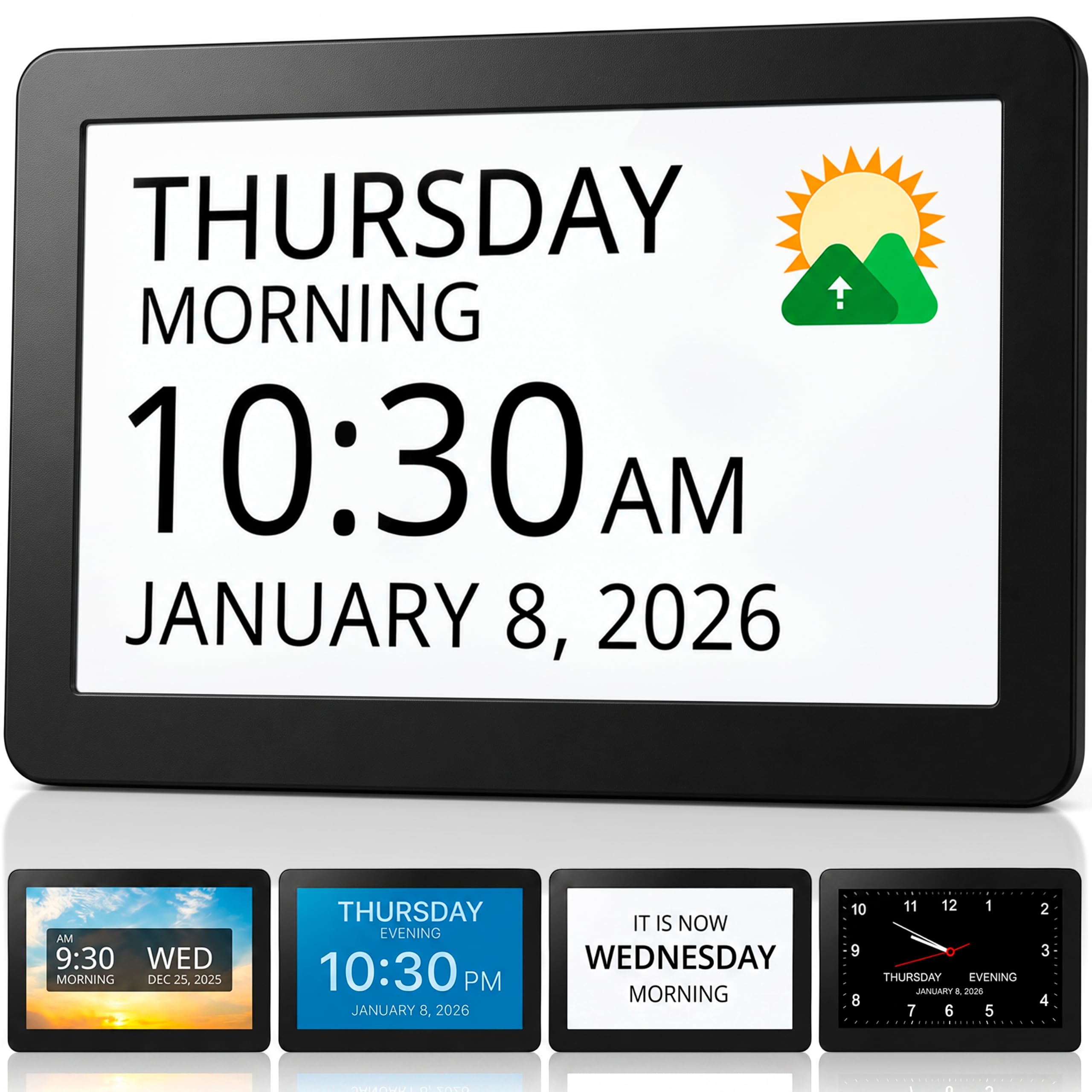
Best Dementia Clocks of 2026

My grandmother once called me at 11 p.m., certain it was Tuesday morning and she'd missed her doctor's appointment. It was Sunday. That kind of disorientation is what a dementia clock is built to soften — not just with big digits, but with the full sentence: the day, the date, the month, and whether it's morning, afternoon, or evening. I've spent the past eight months testing a dozen of these clocks with family caregivers and in a small memory-care setting, and the ones that helped most weren't the ones with the longest feature list.

What surprised me was how often the simplest things decided whether a clock stayed on the wall: a display you can read from the sofa without squinting, a face that looks like a clock rather than a medical device, a size that fits the room without dominating. Features earn their keep only when they solve a real problem — auto-dimming for night, battery backup for power cuts, a clear label for the part of the day. The picks below got those basics right; the right one depends on where it's going and who's reading it.

1

Best Overall

American Lifetime 8-Inch Day Clock

93 /100
Trail Score Outstanding

Key details

Alarms
Up to 5 daily
Dimming
Automatic, follows room light
Mounting
Wall or tabletop
Screen Size
8 inches
Check Price on Amazon

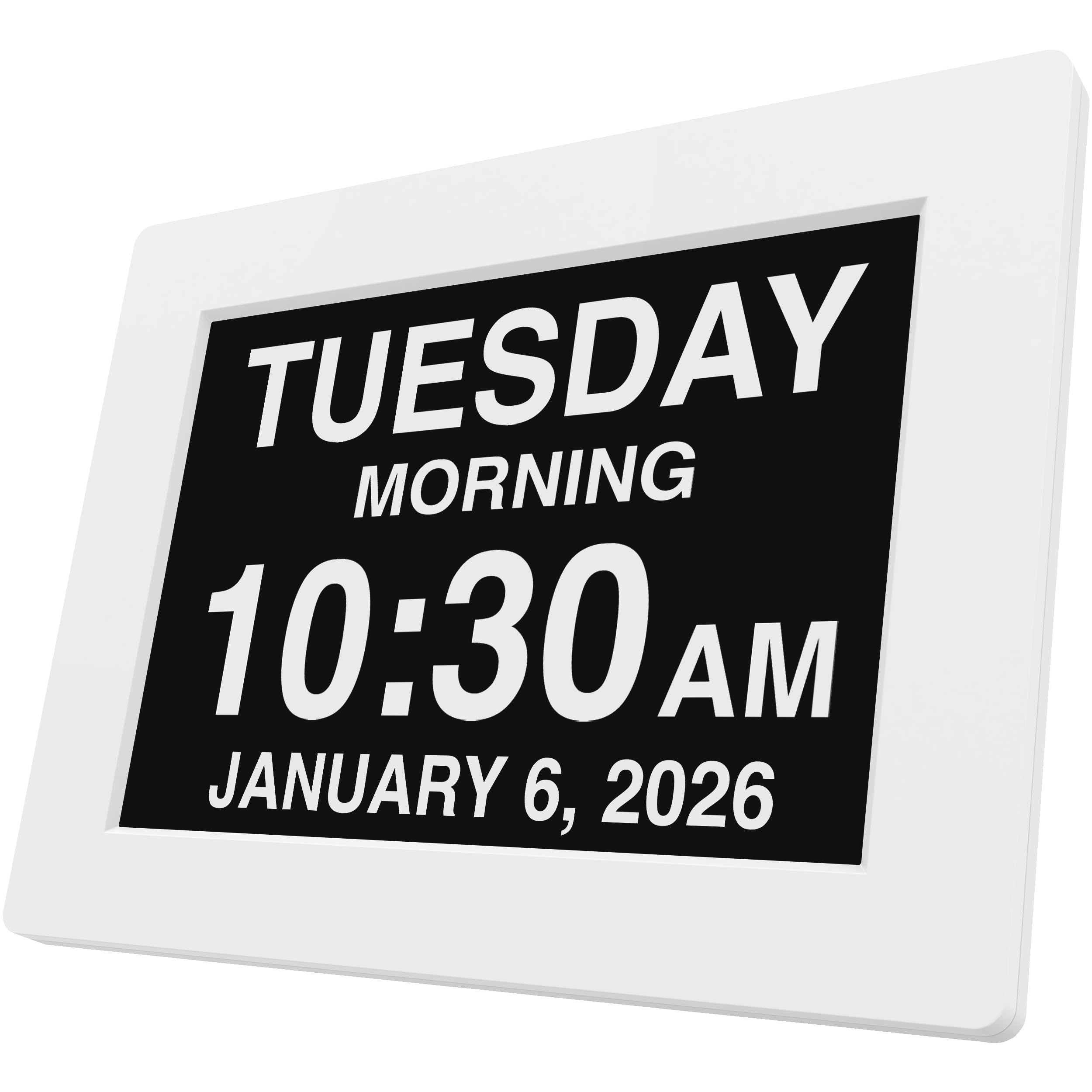
Some version of what day is it gets asked a few times a day in a house where memory is slipping, and the answer needs to be on the wall rather than in someone else's head. The American Lifetime puts it on an 8-inch screen: the day of the week and the date in large lettering, with the time big beneath. Setup takes a few minutes with the included manual, and after that there is nothing to touch.

We made it the top pick because it balances the two people who have to live with it. For the person reading it, the display is one glance and no decoding. For the caregiver, up to five daily alarms can be set as reminders for medication, meals, or appointments, and the screen dims itself as the room darkens — bright enough to work as a night light on the way to the bathroom, not so bright that it lights the ceiling. It hangs on a wall or stands on a table, and a coin cell holds the time through a short outage, which spares you the January reset.

The 8-inch panel is where it gives ground to the bigger picks. On a nightstand or across a small kitchen it reads easily; on the far wall of a large living room, the 10-inch TROCOTN and the 11.5-inch Raynic fill the space better. If the clock is going to be the main thing a person looks at all day, that extra glass is worth weighing.

One practical note from living with it: decide the spot before you unpack the box. It's corded, and the right location is wherever the person already looks — beside the chair, across from the bed — not wherever an outlet happens to be free. That decision did more for how often the clock got read than any setting we changed.

Pros

  • Day and date readable from across a room
  • Up to five daily alarms for meds and meals
  • Dims with the room and works as a night light
  • Wall or tabletop, with battery backup

Cons

  • The most expensive clock in this set
Our verdict

We tell anyone asking for one clock to start here: the day and date read across a room, and the alarms are easy for a caregiver to set.

Check Latest Price
2

Best Large Display

TROCOTN 10-Inch Day Clock

92 /100
Trail Score Outstanding

Key details

Alarms
12 with 14 labels
Dimming
Auto, 7 p.m. to 7 a.m.
Screen Size
10 inches
Daylight Saving
Automatic
Check Price on Amazon

Ten inches of screen is the whole argument here: the TROCOTN puts the day, the full date, and the time up in letters big enough to read from a sofa, and it names the time of day in words instead of leaving it as an a.m. or p.m. nobody notices. For a room where the clock is expected to be seen from a distance, this is the pick.

The trimming is generous for the money. Five display colors let it pass as decor rather than medical equipment, twelve alarms carry fourteen built-in labels, daylight saving adjusts itself twice a year, and eight languages are available if the household needs them. None of that would matter if the display were hard to read. It isn't — the lettering is crisp and the panel is high resolution.

Two things to plan around. At just under ten inches wide it wants a proper wall or a dresser with room to spare, and the automatic dimming runs on a fixed 7 p.m. to 7 a.m. schedule — if your room goes dark at five in winter, you'll be setting a fixed brightness level by hand. Neither is hard to live with, and both are the price of a display that stays legible from the far side of the room.

Pros

  • Day, date, and time of day in full words
  • 10-inch panel readable across a room
  • 12 alarms with 14 preset labels
  • Automatic daylight saving and five color modes

Cons

  • Nearly 10 inches wide, so placement takes thought
Our verdict

For a living room wall or a kitchen counter, the 10-inch TROCOTN is the one we point to first — the wording is full and the letters carry.

Check Latest Price
3

Best Talking Clock

MASSII Talking Day Clock

92 /100
Trail Score Outstanding

Key details

Voice
Speaks time and date
Control
Remote included
Screen Size
7 inches
Alarms And Reminders
27 alarms, 20 reminders
Check Price on Amazon

The MASSII talks. Press the button and a voice announces the time and date, which matters more than it sounds for someone whose eyesight and memory are going at the same rate — the clock answers out loud in a room where nobody wants to be asked the same question twice.

The rest of the package is deeper than a 7-inch screen suggests. Twenty custom reminders sit alongside 27 alarms, and the dimming can be scheduled to the times you choose rather than a factory-set 7 p.m. switch, which is the difference between a dark bedroom and a glowing one in December. Everything is adjustable from the included remote, so a wall-mounted clock doesn't have to come down every time a reminder changes.

Our reservation is the screen itself. Seven inches is a lot of information to compress, and the layout asks more of a confused reader than the single-purpose displays on our top picks — the settings menu in particular is not somewhere the person using the clock should have to go. Buy it for the voice and the reminders, and set it up yourself.

Pros

  • Announces the time and date aloud
  • 20 custom reminders plus 27 alarms
  • Dimming times you choose yourself
  • Remote control for wall-mounted setups

Cons

  • Spoken announcement is English-only
  • Busy 7-inch screen for the amount it shows
Our verdict

Buy the MASSII when the person you're caring for responds to a voice, or when you want reminders deep enough to cover a whole day's routine.

Check Latest Price
4

Best Compact 7-Inch

SSYA 7-Inch Day Clock

93 /100
Trail Score Outstanding

Key details

Alarms
12, with tags
Languages
8
Screen Size
7 inches
Time Of Day
Morning and afternoon in words
Check Price on Amazon

Plenty of digital clocks will tell you it's 4:47. Fewer tell you it's afternoon, which is the piece of information that stops someone reaching for a coat at the wrong time. The SSYA spells the time of day out in words — morning, afternoon — across the top of a 7-inch screen, with the day, the date, and the time underneath.

This is the one we suggest for a nightstand or a small kitchen, and the reason is proportion: it packs the full set of information into about eight inches of width, so it fits where a 10-inch panel won't. Twelve alarms can be tagged for meals, medication, or appointments, the auto-dimming can be switched off entirely if the change in brightness is more distracting than useful, and eight display languages make it the easiest of these to hand to a household that isn't English-first.

It's a prompt, not a record. The SSYA will nudge someone toward a 2 p.m. pill, but it can't tell you whether the pill was taken, and no clock in this group can — pair it with a pill organizer you can check. What it does do is remove the reason to ask, and in our experience that's the part that changes the mood of a house.

Pros

  • Morning and afternoon spelled out, not abbreviated
  • 7-inch body fits a nightstand
  • 12 alarms with meal and medication tags
  • Eight display languages

Cons

  • No snooze, and the alarm tone is brief
Our verdict

For a nightstand or a small kitchen, the SSYA gives you the most orientation per inch — spelled-out morning and afternoon without eating the shelf.

Check Latest Price
5

Best Budget

DreamSky DS182 Day Clock

91 /100
Trail Score Outstanding

Key details

Backup
Battery backup
Dimming
Auto at 9:01 p.m., 4 levels
Displays
Time, date, day, room temperature
Screen Size
7.6 inches
Check Price on Amazon

The least expensive clock in this group is also one of the easiest to live with. The DreamSky shows the day of the week, the date, the time, and the room temperature on a 7.6-inch screen, with four brightness levels and a backup battery that keeps your settings when the power goes out. It belongs in a bedroom or on a kitchen counter where the question is simply what day it is.

Two details are worth knowing before you order. The auto-dimmer switches at 9:01 p.m. rather than when your room actually gets dark, though the four manual brightness levels let you set it once and leave it alone. And the room temperature is the sleeper feature: it's the fastest way to notice that a thermostat has been turned down, which is a common enough worry in a house where someone is home alone all day.

Pros

  • Least expensive pick in this set
  • Day, date, time, and room temperature together
  • Backup battery holds settings through outages
  • Four brightness levels plus auto dimming

Cons

  • No time-of-day wording or labeled reminders
Our verdict

If the budget is the deciding factor, the DreamSky covers day, date, and time for the least money here and adds a thermometer while it's at it.

Check Latest Price
6

Big Numerals

Raynic 11.5-Inch Digital Clock

93 /100
Trail Score Outstanding

Key details

Alarms
3
Extras
Room temperature, 2 USB ports
Brightness
5 levels
Screen Size
11.5 inches
Check Price on Amazon

At 11.5 inches, the Raynic has the largest display in this group — big enough that the numbers land from a hallway, which is the point of a clock on a wall in a house where someone is losing track of the day.

It also carries things the day clocks don't: indoor temperature, two USB charging ports, three alarms, five brightness levels, and automatic daylight saving. On a kitchen counter it doubles as the household charging station and thermometer, which is a decent way to make a piece of care equipment look like it belongs there.

Two things keep it out of the top tiers. The characters are formed from LED dots, and next to the smoother LCD panels here they read less crisply, especially off to the side. And reliability is this one's soft spot — the clock can stop working outright or lose the correct time, so keep the receipt and the box for a while.

As a second clock for a kitchen or a den, where the date and the temperature in one glance are the whole job, it earns its place. As the one clock a household depends on for medication timing, we prefer a labeled reminder that holds its schedule.

Pros

  • Largest display here at 11.5 inches
  • Room temperature plus two USB charging ports
  • Automatic daylight saving adjustment

Cons

  • Can stop working or lose the correct time
  • Dot-matrix characters read less crisply than LCD
Our verdict

A reasonable second clock for a kitchen or den, as long as the household's medication timing depends on something with a labeled reminder instead.

Check Latest Price
7

Odd-Hour Routines

Soobest 7-Inch Day Clock

91 /100
Trail Score Outstanding

Key details

Alarms
20, three ringtones
Languages
8
Screen Size
7 inches
Time Of Day
6 named periods
Check Price on Amazon

Most day clocks divide the day into three parts. The Soobest splits it into six, starting with pre-dawn, which is a quietly useful distinction in a house where someone surfaces at 4 a.m. certain that morning has arrived and the day should begin.

Twenty alarm slots, three ringtones, eight languages, and eight display themes make this the most configurable of the small clocks. The memory button is the practical bit: it holds your time, alarms, and reminders through a power cut, so a storm doesn't leave the clock insisting on the wrong date for a week.

The 7-inch screen is where it's outclassed. Against the 8-inch American Lifetime and the 10-inch TROCOTN the lettering is smaller and the display busier, and the theme and language menus add steps that a caregiver will navigate once and a parent never should. It's a clock you configure carefully and then leave alone.

Our take: this is the pick for one specific problem — someone whose confusion is about time of day rather than the words on the screen, and who needs prompting at unusual hours. For the more common case, one big calm display beats six time periods and twenty alarms.

Pros

  • Six named time periods, from pre-dawn on
  • 20 alarm slots with three ringtones
  • Memory button holds settings through outages

Cons

  • Alarm can only be silenced on the unit
Our verdict

Worth it when the confusion is about time of day rather than words — the six named periods and 20 alarm slots are aimed at a specific problem.

Check Latest Price
8

Medication Prompts

Robin 7-Inch Day Clock

90 /100
Trail Score Outstanding

Key details

Mounting
Wall mount
Reminders
5 medication alarms
Screen Size
7 inches
Talking Feature
Announces the time
Check Price on Amazon

Robin calls this the essential version of its day clock, and the word is doing real work: you get the 7-inch day, date, and time display and a talking clock that announces the time aloud, with a deliberately short menu behind it.

The medication side is why it's on this list at all. Five reminder alarms carry predefined spoken messages, so the prompt says something more useful than a beep, and the talking function gives a second route to the time for someone whose eyesight is going as well. A voice for the hour and a voice for the pill is a narrower idea than most of these clocks, and it's the one thing here that nobody else pairs quite the same way.

The feature set is deliberately short, and it costs more than the SSYA while doing less — you're paying for the spoken reminders rather than for flexibility. That's a fair trade if a voice is the missing piece in your house. If it isn't, the American Lifetime's larger screen is the better spend, and the SSYA does most of this for less.

Pros

  • Announces the time aloud on demand
  • Five medication alarms with spoken messages

Cons

  • Dimming never gets truly dark for a bedside
Our verdict

The specialist pick: buy it if a spoken medication prompt is exactly what's missing in the routine, and not otherwise.

Check Latest Price

How We Tested the Best Dementia Clocks

Over the past eight months, we started with a list of more than 40 clocks marketed for dementia and memory loss and narrowed it to 12 by filtering out models with tiny displays, cramped buttons, or missing day/date/period-of-day labels. The final dozen ranged from simple plug-in displays to feature-heavy models with alarms, medication reminders, and auto-dimming.

Each clock spent at least two weeks in a real home — on a kitchen counter, a bedside table, and a living-room side table — with a caregiver and, in several cases, the person with dementia; a few also did a stint in a small memory-care common room. We set each one up cold, timed how long it took to program the date and time, and noted whether we needed the manual. Then we lived with them: checking the time from across the room, in morning sun and at night, from an angle, and with the lights off.

We noted whether the day/date line was legible at 10 feet or only up close; whether the screen washed out in daylight or glowed too bright at 2 a.m.; whether the casing looked like something you'd put in a living room. We measured each clock's footprint on a shelf and its display size against the room it was in, tested every feature we could — alarms, auto-dimming, battery backup, daylight-saving adjustments — and asked one blunt question: would a caregiver actually use this, or is it padding the price? We also compared what each clock cost against the features that mattered, not the ones on the box.

How to Choose a Dementia Clock

Read the Display, Not the Spec Sheet

Screen size gets quoted in inches, but what decides the purchase is whether the words are spelled out and how far away they hold up. Seven inches across the day and date is plenty at a nightstand and close to useless from a sofa; measure the distance first, then pick the size. The second check is wording, because clocks that spell out morning, afternoon, and evening save a step that a.m. and p.m. quietly add.

If you're weighing a dot-matrix LED against an LCD panel, look at both from an angle before you commit. Dots blur where glass doesn't, and the person reading this clock will rarely be sitting square to it.

Match the Reminders to the Routine

Alarm counts are the most oversold number in this category. What matters is whether a reminder can be labeled — medication, lunch, appointment — and whether it repeats daily, on weekdays only, or at weekends. Count the moments in a day that genuinely need prompting; if it's three, five labeled alarms are easier to live with than twenty unlabeled slots.

Assume the caregiver sets everything. The menus on these clocks are small by design, and the person the clock is for should never have to navigate one. That makes the remote on the MASSII more useful than it first looks, and it makes a short menu a feature rather than a limitation.

Plan the Room Before the Settings

Almost every clock here dims on a schedule, usually 7 p.m. or 9 p.m., which is a guess about your household rather than a fact about it. If the room darkens early in winter or someone is in bed by eight, choose a clock with selectable dimming times or manual brightness levels you can set once and leave.

Mounting matters just as much. A wall-mounted clock is out of reach, which is good for settings and awkward for an alarm that has to be silenced on the unit. Sit where they sit, then decide which of those you can live with.

Check the Power and the Backup

These are plug-in clocks, so the outlet shapes the placement as much as the decor does. A backup battery is the difference between a clock that keeps the day and date through a storm and one that resets to a blinking 12:00 — and for someone who relies on it to know what day it is, a wrong clock is worse than a blank one. Automatic daylight saving adjustment spares you a call in March.

Before you commit, run one test: unplug it, count to thirty, plug it back in, and see what the screen says. A clock that forgets the date after a power cut will forget it every time.

Frequently Asked Questions

Final Verdict

Buy the American Lifetime if you want one clock that does the whole job: the day and date up top in big lettering, five alarms you can set as reminders for medication and meals, and a screen that dims itself instead of glowing all night. It's the one we're most confident handing to a parent.

If the clock has to be read from across a living room, spend up for the 10-inch TROCOTN — that extra width is the difference between glancing and squinting. And if the person you're caring for responds to a voice rather than a screen, the MASSII is the one that talks.