Best Compression Socks of 2026

Somewhere over the Atlantic, my ankles stopped fitting into my shoes. By the time I reached the hotel, the socks I'd put on that morning had left a deep ring around each ankle and my calves ached in a way that made the trip feel twice as long as it was. Compression socks are what fixes that: graduated pressure that squeezes hardest at the ankle and eases as it climbs, so blood moves instead of pooling. The trouble is that a bad pair is worse than none — too tight and you're wrestling them on the floor for ten minutes, too loose and they're bunched around your arch by lunch.

Over the past six months, my team and I have worn 12 pairs through long-haul flights, ten-hour desk days, a half-marathon training block, and a handful of genuinely hot afternoons. What decides it usually isn't the number printed on the box; it's the small stuff — whether the cuff rolls, whether the toe seam rubs, whether the sizing chart bears any resemblance to a real calf. Everything below earned its place on somebody's legs.

1

Best Overall

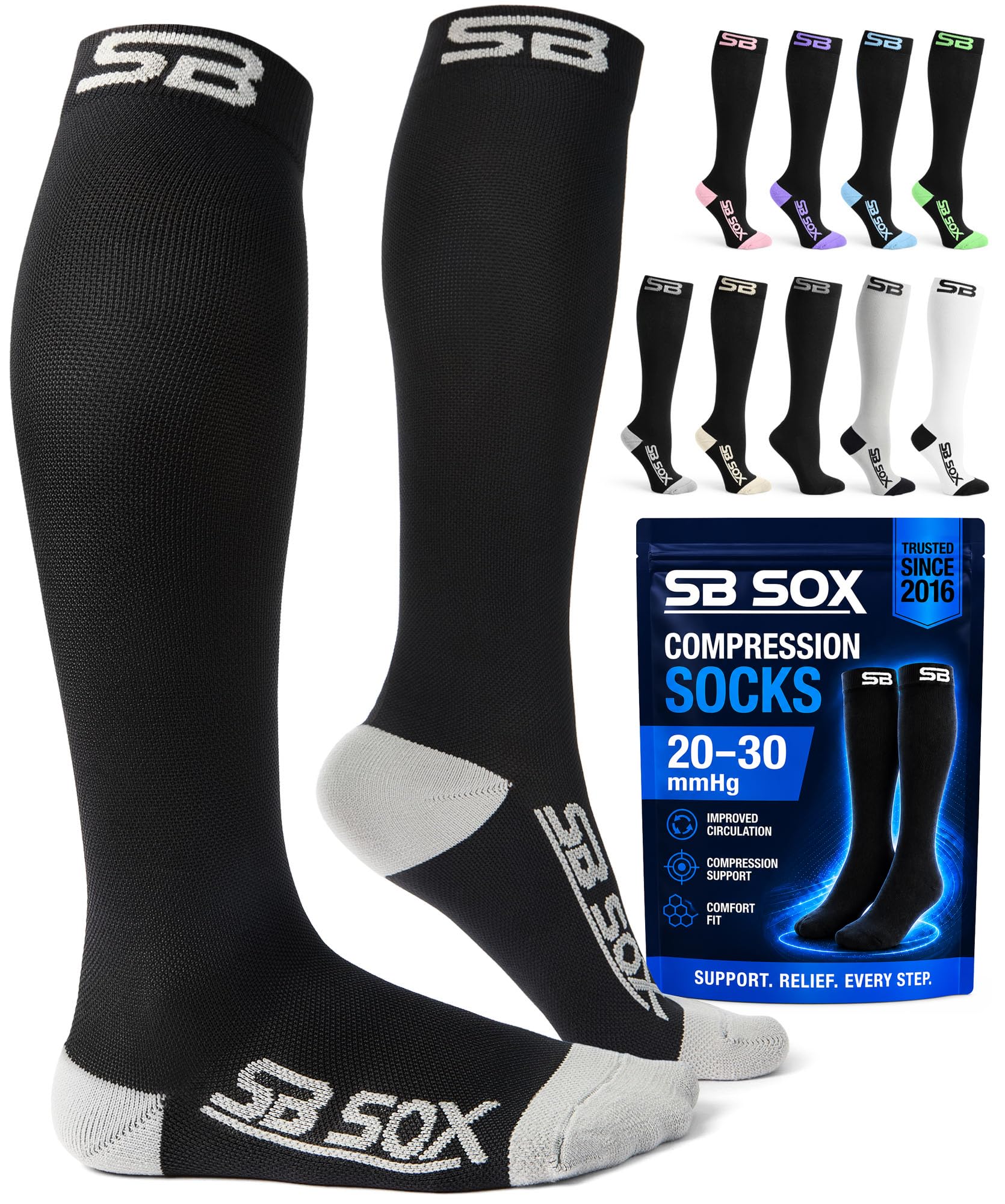
SB SOX Compression Socks

89 /100
Trail Score Excellent

Key details

Care
Hand wash only
Fabric
80% nylon, 20% spandex
Fit Guide
Calf and shoe size chart
Compression
20–30 mmHg
Check Price on Amazon

Most compression socks are sold in small, medium and large plus a bit of hope. SB SOX asks for two numbers instead — your calf circumference at its widest point and your shoe size — and its chart pairs them, with a note to go up a size when your shoes run past the range for your calf. That's the detail that made this our top pick: at 20–30 mmHg, a sock that's one size off is either a wrestling match or a waste of money, and this is the only brand here that hands you a way to get it right before you order.

The pressure is the real thing. Twenty to 30 mmHg is the firmer of the two levels sold to consumers — the one for a 14-hour flight, a 12-hour shift, or a leg that swells by evening — and it's where cheap construction shows, because a sock that loses its spring at the ankle is just a tight tube. The knit is 80% nylon and 20% spandex, dense and even from ankle to calf, and the heel and toe are cushioned rather than seamed hard. The compression runs close to the toes, which is comfortable in a roomy shoe and pinching in a narrow one.

Hand washing is the price. The care label says hand wash only, and at this pressure you'll want to follow it, since heat and agitation are what take the spring out. If you know you'll never hand wash, that alone should send you to the CHARMKING eight-pack or the BLUEENJOY instead — both go in the machine.

Sizing deserves one more caution. The chart is precise but not generous: a calf near the top of a range often needs the next size up, and so does anyone sitting between shoe sizes. Measure in the morning, before a day on your feet adds fluid, and round up rather than down. Do that and you're holding the closest thing in this guide to a fitted garment — and the only pick here sold on the medical compression shelf rather than the athletic one.

Pros

  • True 20–30 mmHg medical-level pressure
  • Calf and shoe size chart for a measured fit
  • Cushioned heel and toe with a flat toe cap
  • Convincing relief from swelling and leg fatigue

Cons

  • Hand wash only
Our verdict

Buy this for genuine 20–30 mmHg support: the calf-and-shoe size chart means the fit is measured rather than guessed, and the pressure holds all day.

Check Latest Price
2

Best Everyday Multipack

CHARMKING Compression Socks

91 /100
Trail Score Outstanding

Key details

Length
Knee-high
Pack Size
8 pairs
Compression
15–20 mmHg
Check Price on Amazon

An eight-pack changes the arithmetic of compression socks. Instead of one pair you baby through repeated washes, you get a week's rotation and a spare, and the cost per pair drops below what a single medical-grade sock runs. CHARMKING's version is 15–20 mmHg, the lighter of the two common levels, which makes it the pack we hand to someone who has never worn compression before.

That lighter squeeze is why we like it as an everyday sock. Fifteen to 20 mmHg is enough to stop legs feeling heavy after a shift on your feet, and forgiving enough to pull on without a fight — the thing that sinks most first-time compression buyers. The cuff stays where you put it through a full day, the fabric doesn't shrink down the leg in the wash, and the colors are cheerful enough to wear with scrubs or shorts without feeling like a medical device.

The toe is where the money went instead. The knit is thin, and holes at the toe and heel are the failure to expect — pairs give out well before the compression does. Treat them as a season of hard-wearing everyday socks rather than an investment, and check the toes when you sort laundry. It's still the pack we point to for a first foray into compression, because at this price you can afford to find out whether you'll actually wear them.

Pros

  • Eight pairs at a low cost per pair
  • Easy to pull on and off
  • Cuff stays in place all day
  • 15–20 mmHg light enough for all-day wear

Cons

  • Toe and heel wear through early
Our verdict

The best-value way into compression: eight pairs of easy-on 15–20 mmHg socks that stay put, as long as you don't expect the toes to last forever.

Check Latest Price
3

Best for Running and Recovery

Physix Gear Compression Socks

89 /100
Trail Score Excellent

Key details

Fit
Unisex adult
Length
Knee-high
Compression
20–30 mmHg
Check Price on Amazon

The sizing is the first thing to get right with Physix Gear, and the thing most likely to go wrong: this sock runs big and long. A calf that measures into a large can end up swimming in it, tall legs have pushed the cuff into a fold at the knee, and a genuinely wide calf has no comfortable home here at all. Measure the widest part of your calf, ignore your shoe size, and size down if you're between two — get that right and you're holding one of the firmest, most convincing 20–30 mmHg socks in this guide.

For running and for nursing shifts, this is the most support in the set. Calf fatigue eases, end-of-day swelling drops, and the pressure is even from ankle to knee, which is the difference between a sock that works and one that just feels tight. Runners buy it for shin splints and plantar fasciitis as much as for recovery, and it's the sock they reorder rather than shop around for.

It's also the hardest of these to pull on. Twenty to 30 mmHg doesn't glide, and if your hands are weak or your leg is swollen, put them on before you get out of bed, while swelling is at its lowest, and give yourself a couple of minutes rather than a countdown. That small habit is what makes a firm sock a daily sock instead of a drawer ornament.

Pros

  • Firm, even 20–30 mmHg pressure ankle to knee
  • Relief for shin splints and plantar fasciitis
  • Reduces end-of-day swelling

Cons

  • Toe seam can rub on long days
Our verdict

For runners and nurses who want firm, even 20–30 mmHg pressure and will measure a calf before ordering, this is the strongest athletic pick here.

Check Latest Price
4

Best Light Compression

BLUEENJOY Copper Compression Socks

91 /100
Trail Score Outstanding

Key details

Care
Machine wash
Size
Large–X-Large
Fabric
85% nylon, 15% polyester
Pack Size
6 pairs
Check Price on Amazon

If you've tried a 20–30 mmHg sock and hated every second of getting it on, BLUEENJOY is the correction. This is a light compression sock — the pack carries no pressure rating at all — aimed at people who want their legs to feel better without feeling gripped.

We like it for exactly that: a six-pack of soft, thin socks that gets you through a healthcare shift or a long flight without announcing itself. Copper is the marketing hook, and we're skeptical it's doing the work — what helps is the graduated knit and the fact that these are comfortable enough to leave on for twelve hours. They're machine washable, which the firmest socks here aren't, and the striped patterns pass as dress socks under trousers.

The calf is where it gets unpredictable. These run snug on a larger calf and loose on a smaller one, and the range stops at large–extra-large, so at either end you're guessing rather than choosing. Buy them as an everyday sock for mild heaviness, pregnancy or travel — not as a medical garment, and not if you need the same fit on two very different legs.

Pros

  • Soft, thin knit comfortable for long shifts
  • Machine washable
  • Six pairs at the budget end of the set
  • Patterns pass as dress socks

Cons

  • No published pressure rating
Our verdict

Buy this if you want light, comfortable compression you can machine wash and wear under trousers — not if you need a documented medical pressure.

Check Latest Price
5

Best 20–30 mmHg Multipack

fenglaoda Compression Socks

91 /100
Trail Score Outstanding

Key details

Length
Knee-high
Pack Size
8 pairs
Compression
20–30 mmHg
Check Price on Amazon

The pressure in these sits low. fenglaoda prints 20–30 mmHg on the pack, and around the foot and ankle you get it; up the calf the hold is much gentler than the number suggests. If you need even, firm compression all the way to the knee — the kind a clinician specifies — this isn't the pair. If your swelling collects at the ankle after a long day, the distribution works in your favor.

Where it wins is volume and ease. Eight pairs at a medical-level rating is the cheapest way here to build a rotation at that pressure, and the padded foot and flat toe seams make them the most comfortable of the firm socks to wear in a shoe. They pull on without a fight, which is rare at 20–30, and they look like ordinary athletic socks instead of hosiery.

Two things to check before you commit. The length runs short on a tall leg, landing below the knee rather than at it — easy to live with at average height, less so if you're not. The cuff is the bigger question: it can drift down a slim calf over a long day, so try one pair and walk around the block, and if the band doesn't hold, send the rest back unopened.

Pros

  • Cheapest per-pair route to 20–30 mmHg here
  • Pulls on easily for the pressure level
  • Padded foot and flat toe seams
  • Looks like an ordinary athletic sock

Cons

  • Cuff can slip down slim calves
  • Runs short on tall legs
Our verdict

The value pick at 20–30 mmHg: eight easy-on pairs for the cheapest per-pair rotation here, so long as your swelling sits low on the leg.

Check Latest Price
6

First Pair, Travel

FuelMeFoot Compression Socks

89 /100
Trail Score Excellent

Key details

Fit
Unisex adult
Length
Knee-high
Pack Size
3 pairs
Check Price on Amazon

Three pairs, not eight. That changes how you'd use them: this is the pack you buy to find out whether compression socks help you at all, or the one that lives in a carry-on, rather than the rotation you build a week around.

The socks are more convincing than the pack size suggests. The compression is firm enough to matter on an 18-hour flight — the kind of trip where your ankles tell the story on arrival — and forgiving enough that you'll get them on in a hotel room at 5 a.m. For swelling and end-of-day leg ache, these are among the more convincing pairs in this guide, and they do it at the lowest price tier here. One caveat: the pressure is moderate rather than medical, so if you sit at a desk all day rather than stand, the 20–30 pairs above will do more for pooling legs.

Length is the wild card. These run long — fine on a tall frame, a nuisance if you're short and the cuff bunches behind the knee — and the toe is the first place the knit gives out. Try one pair before the other two go in a drawer. For a first pair or a travel-only pair, it's a low-risk way in: affordable enough that a wrong guess isn't a disaster, and good enough that it probably won't be one.

Pros

  • Strong swelling and ache relief for the price
  • Firm but far easier to pull on than firm socks
  • Three pairs to try before committing

Cons

  • Runs long on shorter legs
  • Toe wears through first
Our verdict

A low-risk three-pack for travel, swelling and end-of-day ache, and the pair we suggest to anyone who isn't sure compression is for them.

Check Latest Price
7

Under Trousers

FITRELL Compression Socks

89 /100
Trail Score Excellent

Key details

Fit
Unisex adult
Length
Knee-high
Pack Size
3 pairs
Compression
20–30 mmHg
Check Price on Amazon

Thin is the whole idea here. FITRELL's knit is the lightest in this guide — thin enough that dress trousers slide over it and a work shoe doesn't feel stuffed — and nothing about it is bulky under a trouser leg. That's the difference between a compression sock you wear to a meeting and one you take off at lunch.

The label reads 20–30 mmHg, and that's the number to hold loosely: the squeeze wears closer to a 15–20 sock, which is either a relief or a disappointment depending on what you wanted. It's also why they're so easy to get on and off, with no wrestling the cuff over the heel, and why they suit a desk day or a flight better than a genuinely swollen leg.

Fit is where the thin knit shows its limits. The sizing is unisex and coarse, so a smaller calf can swim in them while a larger one finds the top band biting; where the size does land, the cuff holds all day without rolling, which plenty of budget socks never manage. And the thinness that makes them wearable is the same thinness that opens holes at the heel and toe within a season of regular washing.

We call these the pair to buy when you want compression you can wear under anything and you're willing to replace them. If you want a sock that still feels firm next year, put the money into the SB SOX. If you want to get through a workday without your legs aching and without anyone noticing your socks, this is the pack — just order by calf measurement, not by the size you wear in shoes.

Pros

  • Thin enough to wear under dress trousers
  • Very easy to get on and off
  • Comfortable, non-itchy knit

Cons

  • Squeeze feels lighter than the 20–30 label
  • Heel and toe wear through in a season
Our verdict

The best pick here for wearing under trousers — thin, easy on, genuinely comfortable — though the 20–30 label overstates the squeeze and the knit is a season-at-best proposition.

Check Latest Price

How We Tested a Dozen Pairs of Compression Socks

We started with more than 40 pairs from brands readers keep recommending and brands we'd had good luck with, then cut the list by what the packaging actually promised: real graduated compression, a calf-circumference range instead of a shoe size, and a knee-high option. Twelve made it through, from drugstore basic to fancy athletic knit.

Every pair went into a rotation that looked like a normal week: a long-haul flight, several ten-hour desk days, a run-and-recovery stretch, and one memorably hot afternoon in an office with no air conditioning. Getting them on was the first thing I logged — whether a pair went up standing in a hotel bathroom in under a minute or took sitting down and both hands. Before ordering, I measured each tester's calf at its widest point so we could say plainly whether the size chart matched the leg in front of us.

Swelling was measured rather than guessed: ankle circumference by tape before a flight and again six hours in, and the same at the start and end of a standing shift. We noted where the squeeze was strongest — a good pair is firm at the ankle and clearly easier below the knee — and whether the band under the knee dug in or rolled down by mid-afternoon. Length got its own check, since a knee-high that stops mid-calf is a different product from what most shoppers are after.

Durability came last and took the longest: at least 15 machine washes per pair, with checks for pilling at the heel, slack elastic at the cuff, and thinning at the toe. Functionality was simpler — whether they vanished under trousers and into dress shoes or announced themselves with every step.

How to Choose Compression Socks

Start with the pressure rating

The most useful number on the pack is the pressure rating in millimeters of mercury. Fifteen to 20 mmHg is a light, everyday squeeze: enough to counter heavy legs on a long shift or a flight, and forgiving enough to pull on before coffee. Twenty to 30 mmHg is a firmer, medical-level garment — better for real swelling, long-haul travel and recovery, and noticeably more work to get into. If a clinician gave you a number, that number wins. Otherwise start at 15–20 and move up only if it isn't enough.

It helps to stop treating the higher number as the better sock; it's a different tool. The 20–30 pairs here are for a swollen ankle after a twelve-hour flight. The 15–20 pairs are the ones you'll still be wearing on an ordinary Tuesday.

Measure your calf, not your shoe size

Sizing is where compression socks fail, and S/M/L is usually why. Measure the widest part of your calf with a tape and check your shoe size against the brand's chart — the two together set the size, and when they disagree, the calf wins. Measure in the morning, before a day on your feet adds fluid, and round up rather than down if you land between sizes.

SB SOX is the one pick here that builds its chart from a calf measurement plus a shoe size; elsewhere a coarse unisex range does the work, and a wide or narrow calf is a gamble. If your calf sits well outside a brand's chart, look for a wide-calf option rather than sizing up and hoping.

Getting them on is part of the decision

A 20–30 mmHg sock is a genuine wrestling match on a swollen leg, and the pairs you can't get into are the ones that stay in the drawer. If your hands are weak, if you're recovering from surgery, or if you've never worn compression before, a lighter sock you wear daily does more than a firm one you avoid.

Put them on first thing, before you swing your legs out of bed, while swelling is at its lowest, and use a rubber glove or a sock aid for grip instead of yanking the cuff. Never roll the top band down to make a sock fit — a folded band concentrates pressure in one place instead of spreading it up the leg.

Watch the length and the cuff

Knee-high means the cuff sits just below the crease at the back of your knee — not on it, and not bunched. A sock you have to fold over is simply too long for your leg, and several picks here run long enough that shorter wearers notice. The opposite problem exists too: on a tall leg, a sock that stops mid-calf has given up on the part that swells most.

Try one pair before you open the whole pack, walk around for ten minutes, and see whether the band stays where you put it. A cuff that creeps in the first hour will be at your ankle by dinner.

Buy enough to rotate, and skip the dryer

Compression socks are laundry-limited: wash one, wear one, and you're hand-washing every night. A pack of six or eight is what makes the habit stick, which is why the multipacks here hold their own against a single fancier pair on cost per wear.

Wash them cool and let them air dry. Heat is what takes the spring out of the elastic, and a compression sock that has gone slack can't be brought back. Retire a pair when the cuff no longer snaps back or the heel has thinned to a shine.

Frequently Asked Questions

Final Verdict

If you want one pair that does the job properly, buy the SB SOX. The 20–30 mmHg pressure is real, the calf-and-shoe-size chart is the only one here that lets you order with confidence, and it's the sock we hand to anyone whose legs swell on a flight or a twelve-hour shift.

The exception is the person who wants compression as a daily habit rather than a medical garment: the CHARMKING eight-pack costs less per pair, goes on without a fight, and is the right place to start at 15–20 mmHg. If you need firm pressure in quantity, fenglaoda's eight-pack splits the difference — provided the cuff holds your calf.