Best Button Hooks of 2026

A button hook is a tiny tool with one job: pull a button through its hole when your fingers can't. The trouble is that the smallest differences decide whether it helps or fights you—a hook that's slightly too wide misses a collar button, a handle that's too slick twists in a stiff hand, and a wire that flexes under pressure can leave a button half-fastened. The right one gives you back the ten seconds of dressing that arthritis, a wrist injury, or an annoyingly tight cuff has taken away.

I started paying attention after watching my mother wrestle with a dress-shirt cuff for a full minute. Over the past five months, I've cycled 14 button hooks through shirt cuffs, jean flies, and dress buttons, including a few with wire hooks so narrow they barely cleared a standard button. The ones that worked were effective one-handed, fit everything from tiny collar buttons to thick denim, felt sturdy enough to toss in a purse, and were worth the few dollars they cost. The ones that made the cut are below—the rest are in a drawer, and I don't miss them.

1

Best Overall

Vive Button Hook with Zipper Pull

92 /100
Trail Score Outstanding

Key details

Handle
1.25 in, ribbed, latex-free
Length
7.5 inches
Weight
2.4 oz
Zipper End
Narrow steel hook
Check Price on Amazon

On paper this is the plainest hook in the group: 7.5 inches of tool, a 1.25-inch ribbed handle, a slim steel wire loop at one end, and a narrow zipper hook at the other. It's also the one we reach for.

The loop is what settled it. We put it through dress-shirt plackets, a blouse with small pearl buttons, and the cuffs of a stiff cotton shirt, and it slid through and caught the button without the hunt for the right angle that makes people abandon these tools. The ribbing helped more than we expected — a smooth handle rotates in a loose grip, and a hook that turns mid-pull puts the button right back where it started.

The zipper end is a narrow steel hook that seats in most metal and molded pull tabs: jackets, fleece, boot zips. On a tight jeans tab it can be a squeeze, so keep this end for the zip you can see.

Where it gives ground is the grip. At 1.25 inches it's a slim handle — comfortable, but not built up, and someone whose fingers no longer close tightly around a pen will want more to hold. The 60-day guarantee means you can find that out on your own shirts rather than in the abstract.

Pros

  • Slim wire loop clears small buttonholes
  • Ribbed latex-free handle resists twisting
  • Narrow steel zipper hook seats in most tabs
  • Lowest price of the full-length hooks here

Cons

  • Slim 1.25-inch handle is not a built-up grip
Our verdict

We recommend this one first: the slim loop finds small buttonholes, the ribbed handle stays put in a loose grip, and it costs less than any other full-length hook here.

Check Latest Price
2

Best for a Fuller Grip

Fanwer Button Hook and Zipper Pull

93 /100
Trail Score Outstanding

Key details

Handle
1.97 in, soft-grip
Length
7.87 inches
Weight
2.82 oz
Zipper End
Yes, opposite the loop
Check Price on Amazon

At 1.97 inches across, this is the widest handle in the group, and for plenty of people that one figure settles the choice. A grip that fills the hand lets you close your fist around the tool instead of pinching it between thumb and forefinger, which is the movement arthritis takes away first. The tool runs 7.87 inches, the longest here, and weighs 2.82 ounces.

The soft-grip surface is the headliner, but the loop decides whether the purchase was worth it. Shirt and blouse buttons go through in one pass. Heavy trouser buttons are a different job: a thick shank through a stiff waistband needs a firm straight tug, and this is the moment the tool feels least planted, so line the button up before you pull rather than correcting halfway.

Length is the other thing to weigh. Nearly eight inches gives you room to work at arm's length, which is what makes a cuff possible while the shirt is still on you, but add a two-inch handle and you have a tool that lives on a nightstand or in a drawer rather than in a pocket.

Pros

  • Widest handle in the set at 1.97 inches
  • Longest reach of the group at 7.87 inches
  • Handles shirt and blouse buttons in one pass

Cons

  • Wire loop can pull away from the handle under force
Our verdict

Buy this one when the handle is the problem: at nearly two inches across it gives stiff hands something to close around, and the extra length reaches a cuff on a shirt you're already wearing.

Check Latest Price
3

Best for Shirt Collars and Cuffs

RMS Button Hook with Zipper Pull

92 /100
Trail Score Outstanding

Key details

Handle
1.5 in, ribbed
Length
7.5 inches
Weight
3 oz
Zipper End
Built-in
Check Price on Amazon

Every hook here can eventually do up a shirt. This one is best at the buttons you can't see: a collar button, a cuff placket, the top button of a dress shirt, all of which sit at the edge of your vision and the limit of your reach. It's 7.5 inches long with a 1.5-inch ribbed handle and a built-in zipper pull at the other end.

The handle sits between the Vive's slim 1.25 inches and the Fanwer's two-inch grip, and for us that middle size was the most natural to hold through a run of buttons. The ribbing gives your fingers something to push against rather than a surface to chase. At 3 ounces it's the heaviest single hook here, weight you feel in the hand, though it settles the tool rather than tiring it.

Where it won us over was consistency. Dress shirts are the garment that made us keep it in the bag: the loop finds a stiff collar button, and the pull is short enough that you don't have to lift your elbow past your shoulder to finish the job. If you have a drawer of office shirts and one shoulder that doesn't cooperate, this is the pick.

The zipper end is a proper steel hook, and it does its best work where the tab is big and the pull is stiff — a jacket, a coat, a boot zip. Treat the second end as a bonus rather than the reason to buy.

Pros

  • Made for collar, cuff, and placket buttons
  • Deep ribbing holds in a stiff hand
  • Built-in zipper pull for jackets and coats

Cons

  • Zipper hook is too wide for some jeans pull tabs
Our verdict

This is the hook for dress shirts specifically: the mid-size ribbed handle and short pull make collars, cuffs, and plackets easier than anything else here.

Check Latest Price
4

Best Two-Pack

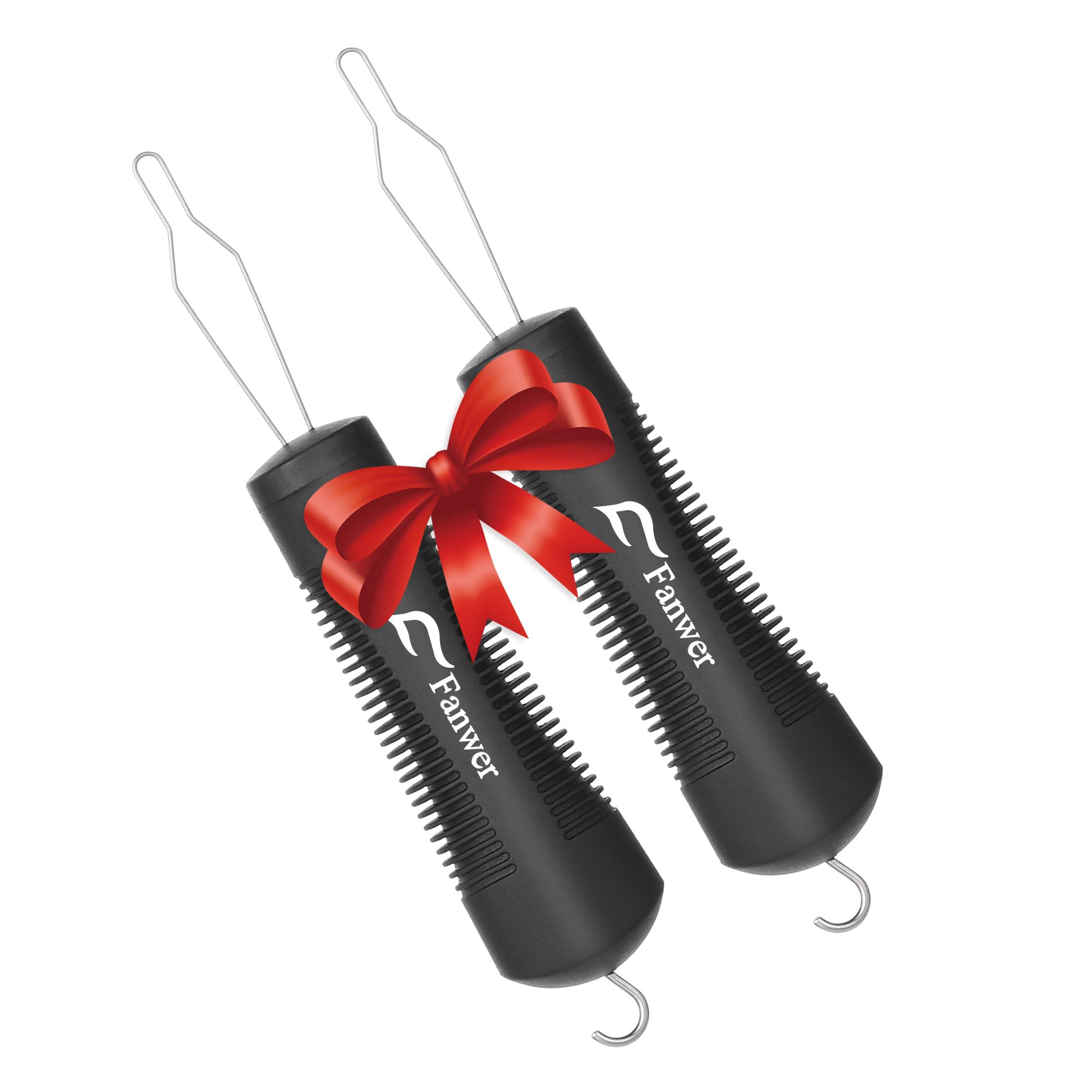
Fanwer Button Hook with Zipper Pull, 2-Pack

93 /100
Trail Score Outstanding

Key details

Pack
Two tools
Handle
Extra-wide, ribbed
Weight
5.29 oz
Zipper End
Yes, opposite the loop
Check Price on Amazon

Two identical tools come in the box, and within a week the second one stopped being a spare. One stayed in the bathroom drawer where the shirts hang; the other went into a handbag, which is the argument a two-pack makes that a single hook can't. Each has an extra-wide ribbed rubber handle, a steel wire loop, and a zipper hook at the opposite end.

The handle is why you'd choose this pair over a slimmer tool. It's broad, softly ribbed, and covered in rubber that stays put in a damp hand straight out of the shower — the most forgiving grip here for stiff morning fingers. Both tools are identical, so there's nothing to relearn when you pick up the other one.

What the second tool asks of you is a decision before ordering: this pair runs noticeably more than the single hooks here, and it only pays off if the second one has a real home. If you can't name where it goes, buy a single and save the rest.

Pros

  • Two tools for home and bag
  • Extra-wide ribbed rubber handle
  • Zipper hook on the opposite end

Cons

  • Head flare is too wide for some narrow buttonholes
Our verdict

Buy the pair if the hook needs to be in two places — one by the bathroom mirror and one in a bag — and if the broadest, softest grip is what your hands want.

Check Latest Price
5

Best for Travel

LYIGEOL Button Hook with Zipper Pull, 2-Pack

87 /100
Trail Score Excellent

Key details

Pack
Two tools
Heads
Foldable, lock open
Material
Stainless steel heads
Functions
Button hook, zipper pull, key turner
Check Price on Amazon

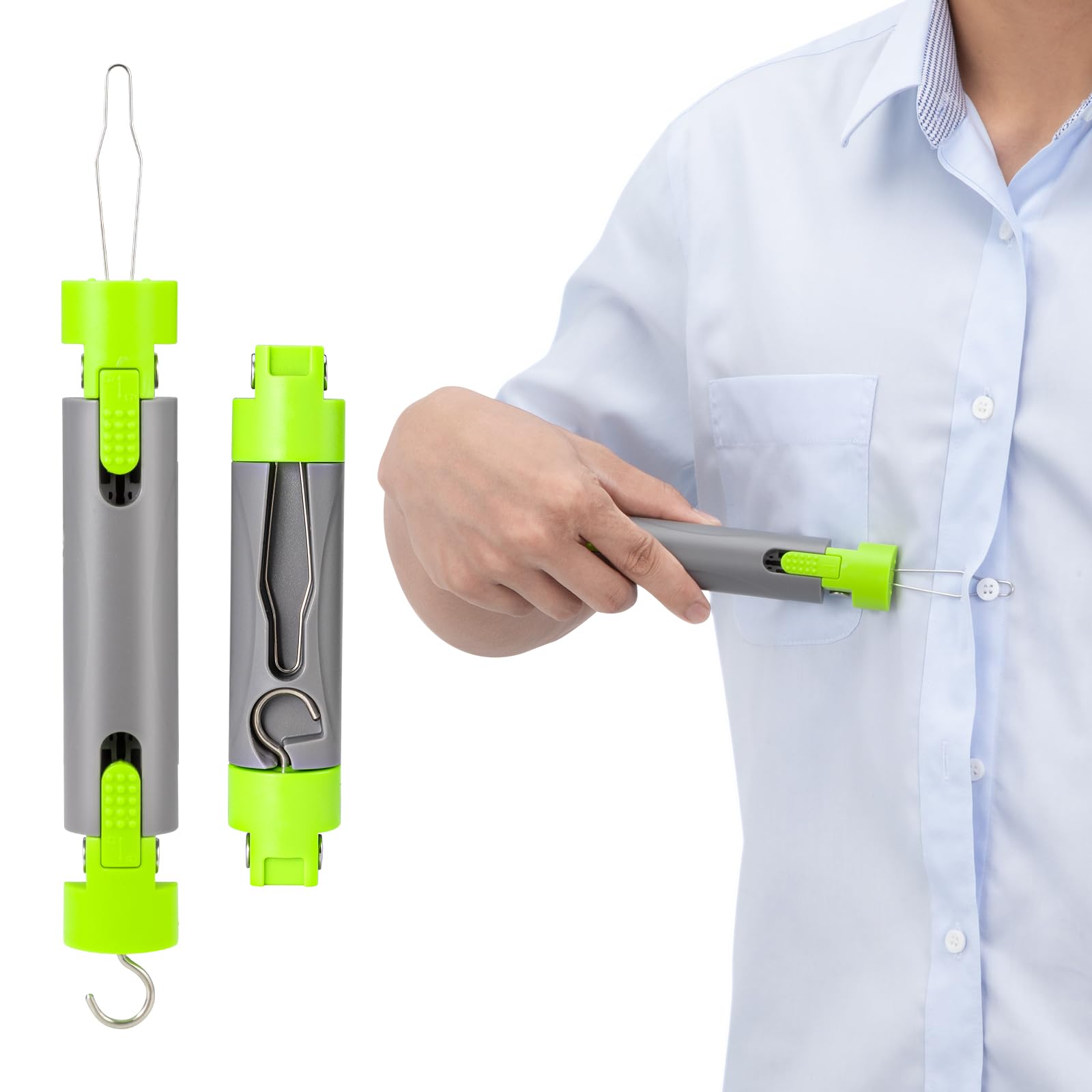
The heads fold back into the handle, which sounds like a novelty until you've carried a wire hook in a trouser pocket and felt it snag on the lining. Folded, these travel in a handbag, a glovebox, or a hospital bag without the loop catching on anything on the way.

Unfolded, a push tab locks the working end in place, and the lock matters more than the fold. A head that shifts mid-pull undoes the entire point of the tool, so the tab seating with a click is the detail we checked first on each of the two in the pack.

The stainless heads cover a button hook and a zipper pull, with a third job as a key turner for anyone whose grip struggles with a door key. It's also a sensible thing to hand to whoever is doing up the back of a wedding dress, since the folded tool drops into a clutch.

Folding is both the recommendation and the caveat. In a bag it buys you a tool that arrives with its loop intact; at home, where the hook sits on a dresser, unfolding and locking adds a step you'll notice every morning, and a fixed hook is simply quicker. Buy this pair for the bag and keep a fixed hook where you dress.

Pros

  • Heads fold away to protect the loop
  • Push tab locks the head open
  • Two tools in the pack
  • Key-turner third function

Cons

  • Adds an unfold-and-lock step before every use
Our verdict

This is the pair to buy for a purse, a glovebox, or a hospital bag: the heads fold in, lock open, and travel without a wire loop snagging the lining.

Check Latest Price
6

Best All-In-One

Vivi Zipper Pull and Button Hook Pocket Dresser

87 /100
Trail Score Excellent

Key details

Carry
Pocket clip and hand strap
Length
4.88 inches
Weight
4.8 oz
Functions
Large hook, small hook, zipper pick, closed loop
Check Price on Amazon

Four dress aids live in a body 4.88 inches long: a large hook for trousers, a smaller one for shirt buttons, a pick for zippers and shoelaces, and a closed loop for finer buttons on delicate fabric. A quick-release hand strap and a folding pocket clip finish it off.

The closed loop is the detail worth understanding. An open hook grabs a button by sliding behind it; a closed loop traps the button inside a ring, which is why it's the end to use on a shirt you'd rather not snag. The pick handles zip tabs and knots in laces, and it's the part that gets used outside of buttons.

It's the most capable tool in this group, and the one we point to when the problem runs past buttons — a shirt, a fly, a shoelace, all handled by one object clipped where you can reach it.

Whether it earns its place depends on how much you'll use the extra ends. It's the most expensive hook here, and someone who only struggles with a collar button is paying for three functions they'll never unfold. The clip is the tell: this is a tool meant to be carried, not a hook that waits in a drawer.

Pros

  • Four dress aids in one short body
  • Closed loop is gentle on delicate buttons
  • Pocket clip and hand strap keep it on you
  • Handles zips, laces, and buttons

Cons

  • Takes practice before it's quick
  • Dense 4.8-ounce body is not a jeans-pocket tool
Our verdict

Buy this when dressing trouble goes past buttons: one clipped tool covers a shirt, a fly, a zipper, and a shoelace, and it is the only pick here that carries like a penknife.

Check Latest Price
7

Spares and Visibility

PINGARA 3-Pack Button Hook Tool

87 /100
Trail Score Excellent

Key details

Loop
Reinforced metal
Pack
Three tools
Handle
Non-slip, bright colors
Weight
1.76 oz
Check Price on Amazon

Three hooks arrive in one pack, each 1.76 ounces with a bright handle and a reinforced metal loop. That's the lightest tool here, and the only one that can be in three places at once.

The case for three is placement rather than spares: one by the bed, one in the bathroom, one in a bag, so the hook is always closer than the shirt. Bright handles do more work than they look like they do — a colored grip is easy to spot in a cluttered drawer and easy to find on a dark nightstand, which matters for anyone whose vision isn't what it was.

The loop is reinforced and the tip tapered, which is what you want from a tool that will be dropped in a drawer and forgotten between uses. What we can't yet tell you is how that loop holds up over a year of daily dressing; this is a recent design, and buying three means betting that one lasts.

Pros

  • Three tools for three locations
  • Bright handles are easy to spot
  • Lightest tool here at 1.76 ounces

Cons

  • Only sold as a three-pack
Our verdict

Worth it if you lose things: three light hooks with bright handles let you keep one by the bed, one in the bathroom, and one in a bag without paying much for the privilege.

Check Latest Price
8

Bridal Button Rows

Nakpunar Crochet Button Hook Tool

89 /100
Trail Score Excellent

Key details

Hook
Crochet-style, smooth
Handle
Aluminum
Weight
1 oz
Check Price on Amazon

A wedding dress with a covered-button back is a two-person job against the clock, and this is the shape the bridal trade reaches for: a smooth crochet-style hook on a light aluminum handle, one ounce, one piece.

The motion is a single pull: slip the hook through the fabric loop, catch the loop, draw it over the button. There's no wire to thread and no button to trap, which is why a long row of covered buttons moves quickly. The hook is rounded and smooth, the quality that matters most on satin, lace, and silk-covered buttons.

It is not, though, an adaptive dressing aid, and that distinction decides who should buy it. There's one working end, no zipper hook, and no built-up grip — the tool assumes two steady hands, one holding the loop open while the other pulls. Anyone shopping because of arthritis, a stroke, or one working hand should choose a wire-loop hook instead.

Buy it for the dress, then: the bride, the person doing up the back, or the seamstress finishing a gown. Ours lives in the garment bag with the dress, which is the only place it will be wanted again.

Pros

  • Smooth hook is gentle on covered buttons
  • Fast down a long row of buttons
  • Light 1-ounce aluminum handle

Cons

  • Not a one-handed or adaptive aid
Our verdict

This is the tool for a row of covered buttons down a wedding dress, and it is not an adaptive dressing aid — buy it for the gown, not for arthritic hands.

Check Latest Price

How We Tested Button Hooks

We built the shortlist by researching button hooks sold for daily dressing and comparing hook opening widths, overall length, handle shape, wire thickness, and price. From that group, we ordered 14 and used them for five months. Each one lived in a bedroom drawer and went through the same morning routine: buttoning a shirt at the mirror, fastening jeans while seated on the edge of the bed, and working shirt cuffs after a shower when hands were still damp.

We timed how long each hook took to fasten a standard shirt button and a smaller collar button, then tried the same hook on thick denim and a tight blouse placket. We watched whether the hook slipped off the button, bent under a firm pull, or frayed thread. For ease of use, we worked each one with a single hand and noted whether the handle twisted, the wire dug into a finger, or the length forced an awkward wrist angle.

Fit and size got their own check: the hook had to clear the buttonhole without being so wide that it missed small buttons, and the handle had to feel secure in a palm with limited grip. We carried a few in a purse and a jacket pocket to see whether the length made them awkward. At the end, we compared cost against how each held up after repeated use; several inexpensive hooks outlasted thicker, more polished handles.

How to Choose a Button Hook

Match the loop to the buttonhole

Every button gets done in one motion: the loop goes through the hole, catches the button, and pulls it back through. A head that flares wide enough to trap a jacket button can be too broad to enter the narrow slit on a blouse placket, and a pick that slides through fine holes can struggle to hold a thick shank. Think about which garment actually defeats you before you look at handles.

Our widest-headed pick, the Fanwer two-pack, is lovely on coats and a fiddle on a close-fitting blouse. If your hard buttons are small and set close together, start with a slim wire loop rather than the biggest grip on the page.

The handle does the work your fingers can't

Handles here run from 1.25 to 1.97 inches across, and that range matters more than any other figure. A broad grip lets you close your fist around the tool instead of pinching it between thumb and forefinger, which is the movement arthritis tends to take first. A slim handle is easier to keep in a pocket but asks more of your fingers.

As a rough test, think about whether you can comfortably hold a thick pen: if yes, a slim handle will serve; if not, go wide. Ribbing and a rubberized surface matter as much as diameter once hands are damp or shaky.

Treat the zipper hook as a bonus

Most of these tools put a steel hook opposite the wire loop, and on a jacket, a coat, or a boot zip it's genuinely useful — the tab is big and the pull is stiff. It is not universal. Pull tabs vary, and a hook broad enough to seat easily in a coat zip can be too wide for a jeans tab.

Test the second end once on the trousers you wear most, while the trousers are off and you can see what you're doing, rather than discovering the mismatch at seven in the morning.

Buy for where it will live

A hook only helps if it's within reach at the moment you need it, which is why the two- and three-packs earn their place: one where you dress, one where you go. If it has to travel, folding heads protect the wire and shorten the tool enough for a purse, and a pocket clip keeps a multi-tool on your belt.

The corollary is that a folding or clipped tool adds a step, and a big handle adds bulk. Decide which of those you'll put up with before you decide which hook looks best.

Frequently Asked Questions

Final Verdict

Buy the Vive. It costs less than the other full-length hooks here, its wire loop is slim enough for the smallest buttons we tried, and the ribbed handle doesn't rotate in a loose grip — the three things that decide whether a hook gets used or ends up in a drawer.

If your hands need something broader to close around, the Fanwer with the two-inch handle is the better first tool, and the one to leave beside the bed. And if the hook is going into a bag rather than a drawer, buy the folding LYIGEOL pair instead; a loop that arrives bent is no use at all.