Best Bottle Sterilizers of 2026

A bottle sterilizer is one of those appliances you don’t think much about until it’s 2 a.m., the sink is full, and you’re trying to figure out whether the valve you just rinsed is actually clean. The appeal is simple: load bottles, nipples, pacifiers, and pump parts, press a button, and let steam do the work. What you’re really buying is a more predictable routine—fewer pots of boiling water and one less thing to second-guess at a middle-of-the-night feed.

Drying and fit matter more than capacity, because wet bottles and orphaned pump parts undo the convenience. A sterilizer is also only as useful as it is easy to clean, since mineral film and milk residue build up fast. Over six months, we tested eight sterilizers, comparing how thoroughly they sterilized, how dry they left bottles and pump parts, how easy they were to use and clean, and whether they held up and felt worth the money. The picks below are the ones that made the routine feel lighter.

1

Best Overall

Papablic Sterilizer and Dryer Pro

95 /100
Trail Score Outstanding

Key details

Weight
4 lb
Capacity
10 tall or 6 wide-neck bottles
Full Cycle
36 minutes, steam and dry
Heating Plate
Ceramic coated
Check Price on Amazon

Ten tall bottles or six wide-neck ones, plus a full set of pump parts on the upper tier — that is the load the Papablic Pro takes, and it is why this is the sterilizer we point most people toward. The second figure is the honest one, since wide bottles are what most of us actually buy. One twist of the dial runs steam and hot-air drying together in 36 minutes, and the machine shuts itself off at the end.

The plate at the bottom is where we think the money went. Scale is the quiet enemy of every steam sterilizer: it crusts onto the element, slows the boil, and leaves a chalky film on bottle threads. The ceramic coating here wipes down far more easily than bare metal, and a vinegar-and-water soak now and then keeps it that way. Bottles, teats, and flanges come out genuinely dry, which is the entire point of paying for a drying function — nothing goes back to a rack.

The single knob is a small thing that matters at three in the morning: no menus, no double-taps, just turn and walk away. Both tiers lift out for washing, and the bin is big enough that a day of feeding fits in one go rather than two. What you give up is space; this is a substantial box, so plan a permanent corner for it rather than a spot in the cupboard.

Pros

  • Holds a full day of bottles and pump parts
  • Ceramic-coated plate wipes clean of scale
  • One-dial operation with auto shut-off
  • Bottles come out dry and ready to store

Cons

  • Heating element is the failure point
  • Takes a permanent stretch of counter
Our verdict

For most families this is the sterilizer to buy: it takes a day of wide-neck bottles and pump parts, dries them properly, and the ceramic plate makes descaling a wipe rather than a scrub.

Check Latest Price
2

Best Simple Routine

Dr. Brown's All-in-One Sterilizer and Dryer

95 /100
Trail Score Outstanding

Key details

Modes
Sterilize, dry, both, storage
Weight
5.6 lb
Capacity
6 narrow or wide-neck bottles
Sterile Storage
Up to 24 hours
Check Price on Amazon

Dr. Brown's puts a number on something the other machines leave vague: with the lid unopened, contents stay sterile for up to 24 hours after the cycle ends. In practice that means running a load after the last feed of the night and finding dry, sterile bottles at six in the morning without touching a rack.

That sealed-lid window is the feature we would miss most, but the rest holds up too. Four modes — sterilize only, dry only, both, or storage — cover the evenings when you need fast steam and the mornings when you just want last night's bottles finished. Six narrow or wide-neck bottles fit, with a roomy upper compartment for teats, pacifiers, and valves, and the auto shut-off means you can start it and leave the room.

Six bottles is the ceiling, and it is a real one if you are pumping: a full pump set competes with the bottles for the same space, so a heavy pumping day becomes two loads. For formula feeding, or a baby down to four bottles a day, it is the machine here we would hand to a partner or a grandparent without explaining anything twice.

Pros

  • Lid keeps contents sterile up to 24 hours
  • Four modes including dry-only and storage
  • Roomy upper compartment for small parts

Cons

  • Six-bottle ceiling fills fast with pump parts
Our verdict

If you want one button, a dry bottle, and somewhere to leave everything until morning, this is the simplest machine here and one of the least expensive of the full-featured electrics.

Check Latest Price
3

Best for Fast Cycles

Grownsy Compact Sterilizer and Dryer

94 /100
Trail Score Outstanding

Key details

Modes
Sterilize, dry, both, store
Weight
2.49 lb
Steam Time
8 minutes
Product Dimensions
8.1 x 7.5 x 14.94 inches
Check Price on Amazon

Eight minutes of steam is the fastest figure in this group, and it is genuinely quick, but it is not the number you live by. The dry phase that follows sets the total, and a full load still runs close to an hour before everything is ready to put away. That is physics rather than a flaw — warm air and plastic take the time they take — but it is worth knowing before you compare cycle times across listings.

What impresses us is how much fits in a body this small. The interior is laid out to be about a fifth more space-efficient than the bulky older shape, and in practice that means five bottles plus a set of pump parts, which covers one baby's day if you wash twice. It weighs almost nothing, the built-in filter keeps kitchen air out between cycles, and the four modes cover sterilize, dry, both, and storage.

Load size is the trade-off. Four or five bottles is the realistic ceiling, and wide-neck bottles or long flanges eat that quickly. For a single baby and a short counter it is a fair exchange; for twins or a heavy pumping schedule it is not, and we would spend more for the bigger bin.

Pros

  • Eight-minute steam cycle
  • Small footprint and light enough to move
  • Built-in filter between cycles

Cons

  • Load tops out around five bottles
Our verdict

The quickest steam cycle here in the smallest body — just plan around the drying, and do not expect it to carry a full day for a pumping parent.

Check Latest Price
4

Best for Small Kitchens

Momcozy Modular Nesting Sterilizer and Dryer

92 /100
Trail Score Outstanding

Key details

Power
120V only
Capacity
Up to 6 standard bottles
Steam Time
8 minutes
Sterile Storage
Up to 72 hours
Check Price on Amazon

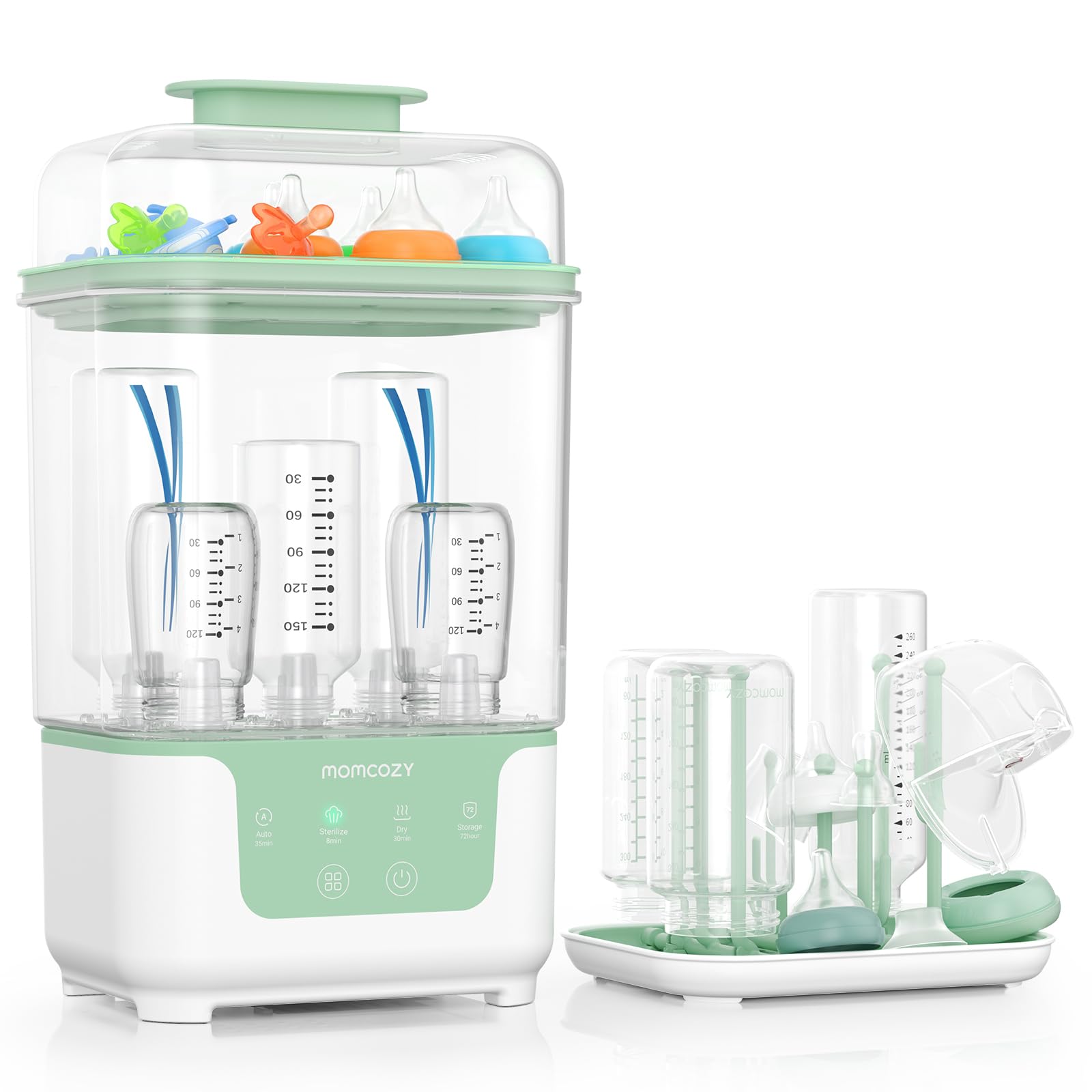
Most sterilizers claim a permanent square of counter. This one gives it back: the body nests into itself, so once the day's bottles are done it packs down and goes in a cabinet. In a kitchen where the counter is also the prep space, that is the difference between a machine you keep out and one you quietly resent.

It does not trade away much for the size. Six standard bottles fit, steam takes eight minutes, and the lid keeps contents sterile for up to 72 hours — the longest window in this group — with a drying rack included for the parts that need to stand. We would put it in an apartment or a shared kitchen without hesitating. The one thing to know is the power: it is built for 120V US outlets, so it is not a machine you plan to take overseas.

Pros

  • Nests down for cabinet storage
  • 72-hour sterile storage window
  • Compact body without losing the full load

Cons

  • Six bottles and no more
  • 120V only, so it stays in the US
Our verdict

For a small kitchen this is the one we would choose: full-size sterilization in a body that folds away between uses instead of living on the counter.

Check Latest Price
5

Best for Pump Parts

Momcozy 3-Layer Sterilizer and Dryer

92 /100
Trail Score Outstanding

Key details

Filter
HEPA
Capacity
6 to 12 bottles
Dry Timer
10 to 60 minutes
Steam Time
9 minutes
Check Price on Amazon

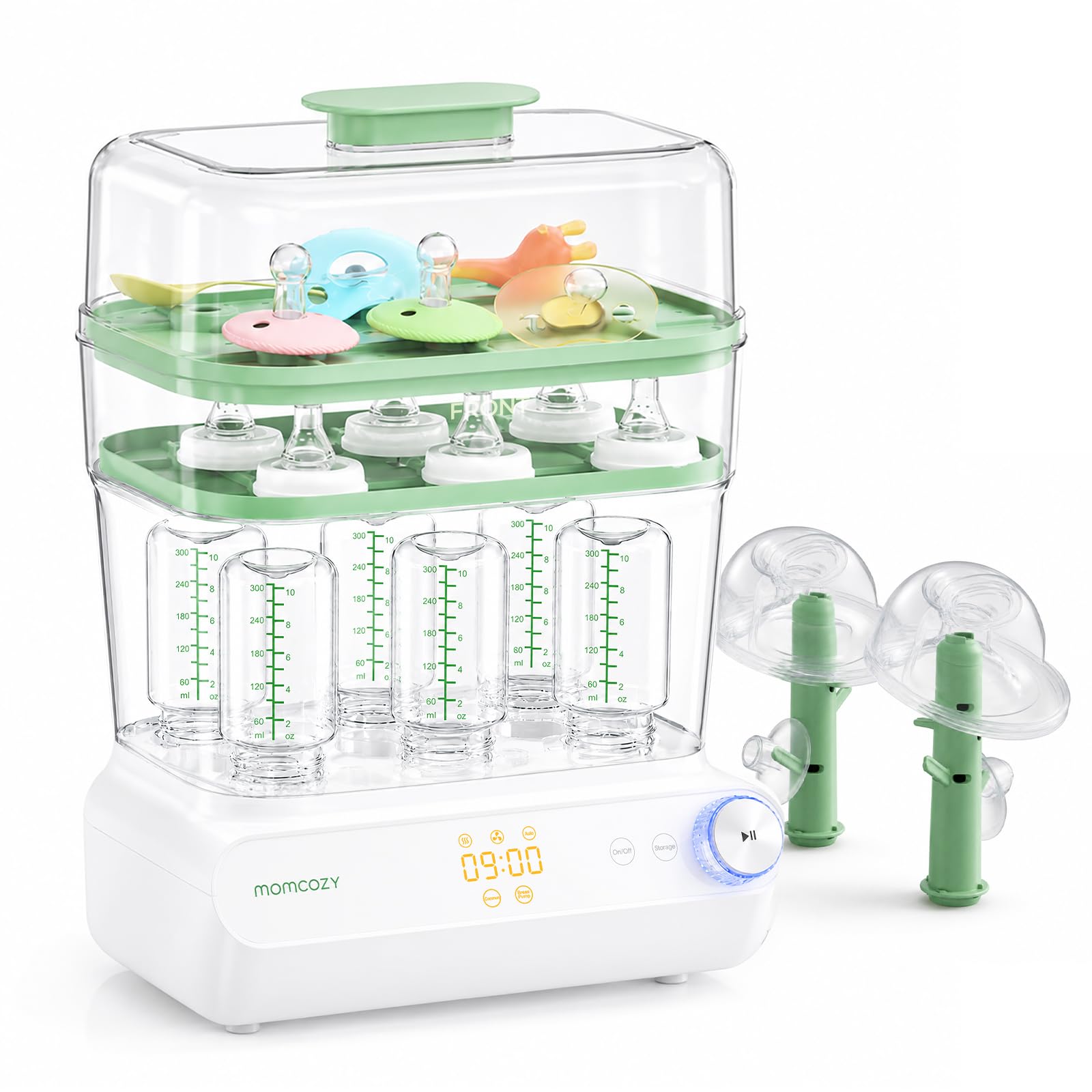
This is the machine that made us reconsider our top pick, and the reason is small and specific: dedicated stands for flanges and valves. A full pump set — both sides — stands upright through the whole cycle instead of slumping into a pile of silicone at the bottom of the bin, which is the difference between parts that dry and parts that come out with water trapped in the threads.

The rest is built for volume. Six to twelve bottles, a nine-minute steam, a HEPA filter, and a drying timer you set yourself anywhere from 10 to 60 minutes. That last one earns its place: a two-bottle load gets ten minutes of air, a full bin gets an hour, and you are not running a fixed cycle that is wrong for both.

Sterile storage runs 24 hours, with a ventilation and drying pass every 55 minutes, so the bin doubles as a cupboard and you are not unloading it the moment the cycle ends. What you pay for all that is footprint, and when tall bottles share a layer with a full pump set they compete for the same headroom.

Pros

  • Stands hold a full pump set upright
  • Adjustable 10-to-60-minute dry timer
  • HEPA filter and 24-hour sterile storage

Cons

  • Tall bottles crowd out pump parts
  • Takes up serious counter space
Our verdict

For a pumping parent who wants every flange and valve standing up in one load, this is the sterilizer worth paying for.

Check Latest Price
6

Best Microwave Option

Dr. Brown's Microwave Steam Sterilizer

92 /100
Trail Score Outstanding

Key details

Method
Microwave steam
Weight
1.5 lb
Capacity
4 Dr. Brown's bottles
Steam Time
As little as 2 minutes
Check Price on Amazon

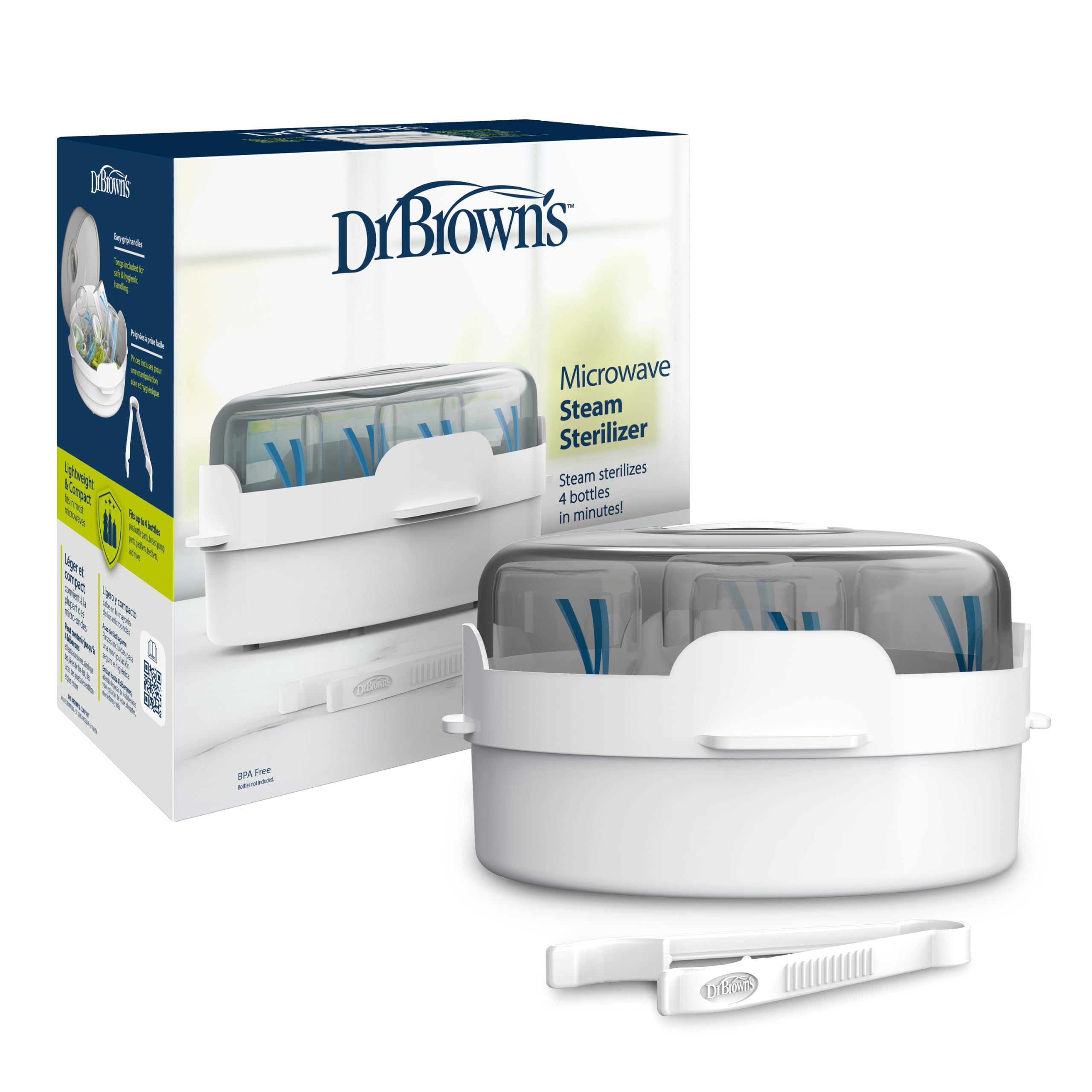
It is a plastic tub with a molded tray, a pair of tongs, and a lid, and it needs your microwave to do anything at all. That dependency is the whole design, and it is also the reason it costs so little in space.

The routine is simple: water in the base, bottles and parts on the tray, lid on, a few minutes on high, then a cool-down before you lift anything out. The tongs are there because the whole thing comes out hot, and the molded wells hold parts upright so steam reaches the inside of a teat rather than a puddle.

There is no drying, so bottles come out wet and go onto a rack — the step you were probably hoping to delete. The wells are also shaped around Dr. Brown's bottles, and wider or taller shapes may not seat properly, which is the complaint that shows up most often about fit.

Where it earns its place is as the second sterilizer: the one at a grandparent's house, the one that travels, or the one for a household that will not hand over counter space to an appliance. At a pound and a half it stores flat on a shelf, and we would keep one alongside a countertop machine rather than instead of one.

Pros

  • Sterilizes in as little as two minutes
  • Stores flat with no counter footprint
  • Cheap way to add a second sterilizing station

Cons

  • No drying, so everything comes out wet
  • Molded wells fit only certain bottle shapes
Our verdict

As a second sterilizer or a travel one, this earns its place: a couple of minutes of steam, four bottles, and no counter footprint once it is back in the cupboard.

Check Latest Price
7

Biggest Loads

Baby Brezza Sterilizer and Dryer Advanced

90 /100
Trail Score Outstanding

Key details

Filter
HEPA
Capacity
8 bottles plus 2 pump part sets
Steam Time
10 minutes
Dry Settings
30, 45, or 60 minutes
Check Price on Amazon

Eight bottles, two full pump sets, and a HEPA filter: the Brezza is the answer when capacity is the thing breaking your routine. It is the only machine here that states a two-pump-set load, and for a twin household or a parent who runs one big batch a day, that changes the shape of the evening.

The three layers reconfigure four ways, so a tall-bottle-only run and a shallow bin of nipples do not have to share the same space. Steam takes ten minutes, and the dry offers three settings — 30, 45, or 60 minutes — with a digital countdown that tells you exactly how long you have before the next feed.

The catch is consistency for the money. Loads that fill the middle layer can finish with droplets still on the bottles, and the drying is the least predictable of the machines on this page. We would still take it where capacity is the binding constraint, because nothing else here swallows that much in one pass — just load it loosely and give it the full 60 minutes.

Pros

  • Largest stated load in this group
  • Three-layer body reconfigures four ways
  • Three dry settings with a countdown

Cons

  • Packed loads can finish with droplets
  • Priciest of the electrics here
Our verdict

Buy this one for the load size — eight bottles and two pump sets — and accept that a packed layer can finish with a few droplets still on the bottles.

Check Latest Price

How We Tested Bottle Sterilizers

We started by pulling every sterilizer we could find from the major baby-gear brands, then sorted the list by capacity, counter footprint, drying method, and price so we were comparing like with like. We ended up with eight models and ran each one on our own kitchen counters for six months, through the nightly bottle-and-pump-part pileup rather than in a lab.

For sterilization, we placed steam indicator strips in the top rack and inside an upright bottle, then checked them after full cycles; we also watched whether condensation coated every nipple and valve. For drying, we pressed a dry tissue into bottle bases and nipple threads after the cycle and noted any dampness, then left a load sitting for an hour to see if moisture returned. For fit, we loaded wide- and narrow-neck bottles, breast pump flanges, pacifiers, and sippy cup lids to see what actually closed without tilting.

Cleaning got its own messy test: we let hard-water spots and milk film build for a week, then descaled and wiped each unit by hand, counting parts that needed scrubbing and noting whether the water reservoir had corners a sponge couldn't reach. We assessed ease of use by filling and starting cycles one-handed while holding a baby, and checked durability by inspecting hinges, lids, and heating plates for cracking, cloudiness, or staining after repeated daily use. Value came last: we asked whether each model's performance justified its price relative to the others.

How to Choose a Bottle Sterilizer

Start With Drying, Not Sterilization

Every machine here kills what washing leaves behind, so sterilization is not where the picks separate. The difference you feel twice a day is the dry phase. Steam-only units leave water in the threads, valves, and the ring around a teat, so you are back to a rack and a rotation of bottles that never quite finishes drying.

A dry cycle adds time — a full sterilize-and-dry run on most of these lands between 35 minutes and an hour — but it ends with bottles you can put straight in the cupboard. Check whether the dry time is adjustable: a fixed long dry wastes most of an hour on a two-bottle load, and an adjustable one lets you run small batches without waiting.

Count Pump Parts, Then Subtract for Wide Necks

Headline capacity is written for narrow bottles. A ten-bottle machine holds six if yours are wide-neck, and flanges, valves, and caps eat the same space as a bottle each. If you are pumping, budget three or four bottle slots for one full set of parts before you count the bottles.

Tall bottles are the other squeeze. A bin that clears a standard bottle may not clear a tall anti-colic one with the lid shut, and stacking a second tier on top is how loads come out damp. Measured capacity is a starting point; the load you actually run is what matters.

Decide Where It Lives Before You Decide What It Does

These are countertop appliances, and the biggest bins hold the most while claiming the most counter. If your kitchen is short on surface, the answer is often a different shape rather than a smaller one: a body that nests into itself between uses, or a microwave tub that lives in a cupboard and only appears when you need it.

Compact in a listing means compact next to other sterilizers, not compact next to a kettle. Check the depth against your counter and the height against your upper cabinets before you order, because this is the appliance you will look at every day.

Water, Scale, and How These Machines Actually Fail

Tap water leaves calcium on the heating plate. That crust slows the boil, lengthens every cycle, and eventually puts a chalky film on bottle threads. Distilled water and a regular vinegar-and-water soak are the cheapest maintenance you can do, and a coated plate makes the job a wipe instead of a scrub.

When one of these stops working, it is usually the heating element or the control panel rather than the plastic. That is why we would rather buy from a seller with an easy return window, register the warranty the day it arrives, and keep the receipt somewhere you can find it.

Storage Windows and Controls Are the Small Features You Use Daily

A sterilizer with a sealed lid keeps its contents sterile for a stated window after the cycle — 24 hours on the Dr. Brown's All-in-One and the Momcozy 3-Layer, 72 hours on the Momcozy Modular. Treated properly, that turns the machine into a drying rack and a cupboard at once, and it is the feature most likely to change your evening routine.

Controls matter more than they look in photos. One dial beats a five-button panel at three in the morning, and a countdown display is worth having if you are timing a feed around the cycle.

Frequently Asked Questions

Final Verdict

The Papablic Pro is the one we would buy. It takes a day of wide-neck bottles and a full pump set in a single 36-minute run, the dry cycle means nothing goes back on a rack, and the coated plate keeps descaling short.

If your counter is tight, the Momcozy Modular nests into a cabinet and still handles six bottles. If you are pumping, the Momcozy 3-Layer's stands keep every flange upright. Otherwise, buy the Papablic.