Best Sunscreens for Kids of 2026

The first warm Saturday of the year goes beautifully until someone produces the sunscreen. Then it's a wrestling match: a bottle that squirts out thin and runny, a smell that makes your kid gag, and a ghost-white mask across their nose that they will not stop wiping. A good kids' sunscreen ends that fight instead of starting it — it goes on fast, stays put through a sprinkler session, and doesn't sting when it inevitably creeps toward the eyes. What you're really shopping for is compliance, because the best formula in the world does nothing if your kid won't sit still for it.

Over the past five months my team and I worked through 18 kids' formulas — lotions, sticks, and sprays — at swim lessons, in backyard sprinklers, and through the daily camp drop-off line. Two things surprised me. SPF 100 is not meaningfully better than a well-applied SPF 50; how much you use and how often you reapply matter far more than the number on the cap. And white cast varies wildly even among mineral-only formulas, which is why we checked every one in direct sunlight rather than in the shade of a porch. The picks below are the ones that survived our toughest critics.

1

Best Overall

Blue Lizard Baby Mineral SPF 50+

96 /100
Trail Score Outstanding

Key details

SPF
50+
Formula
Mineral zinc oxide
Fragrance
Free
Water Resistance
80 minutes
Check Price on Amazon

The first summer with a baby is a run of decisions you make once and then live with, so we start with the least complicated bottle in this group. Blue Lizard Baby is a zinc oxide mineral formula with no fragrance and no parabens, and it is infused with calendula extract and organic aloe — the kind of short, plain label we are comfortable handing to a grandparent or a sitter without a briefing.

What settled it for us is how little it asks of you. The lotion spreads more like a moisturizer than a paste and sinks in without the greasy film we braced for, and it is water resistant for 80 minutes, the longest a sunscreen label is allowed to claim. Of everything here, this is the bottle we trust most in the sun, and it is also the one that has drawn the fewest complaints about irritated skin — unusual for a mineral formula.

The cap earns its keep too. It changes color in strong UV, so it works as a visual nudge to reapply instead of a timer on your phone, and we ended up glancing at it the way you glance at a watch.

The trade-off is the finish. On pale skin it rubs down to a faint sheen, but on deeper skin tones it can read as a visible white layer, and that is the one thing we wish Blue Lizard had solved. Faces show it most, so we use this on arms, legs, shoulders, and the back of the neck, and keep a clear stick for cheeks and noses.

Pros

  • Fragrance-free zinc formula for sensitive skin
  • Full 80 minutes of labeled water resistance
  • Spreads like lotion rather than paste
  • Color-changing cap nudges reapplication

Cons

  • Feels tacky layered over body moisturizer
Our verdict

Our default for a baby's first summer: a fragrance-free zinc lotion that spreads easily, stays through 80 minutes of swimming, and rarely irritates sensitive skin.

Check Latest Price
2

Best for Beach Days

Thinkbaby SPF 50+

93 /100
Trail Score Outstanding

Key details

SPF
50+
Size
6 oz tube
Formula
Mineral zinc oxide
Water Resistance
80 minutes
Check Price on Amazon

Thinkbaby comes out of the tube thick, closer to paste than lotion, and after a week of shorebreak and sandy sandwiches we count that as the point rather than a flaw. This is the bottle that stays on shoulders when everything else has washed away.

The formula is mineral and broad spectrum SPF 50+, free of PABA, parabens, phthalates, and BPA, and Leaping Bunny certified. Water resistance sits at the FDA's highest level, which means 80 minutes in the water, and the tube is 6 ounces with a recommended age range of 6 months to 5 years.

Application is a negotiation. You warm it between your fingers first, and on a wriggling toddler it takes a minute longer than a chemical lotion does. The payoff is that it does not budge, and the scent — mild and coconut-adjacent — is the rare sunscreen smell that does not start an argument.

It also costs more than the budget lotions in this group, and a 6-ounce tube disappears fast when you are coating three kids twice a day. Neither has stopped us from buying it again for beach weeks.

Pros

  • Stays put through surf and sweat
  • Mineral SPF 50+ with a clean ingredient list
  • Mild coconut scent, not a sunscreen smell
  • Six-ounce tube suits a full family

Cons

  • Leaves a visible white film on skin
  • Takes a washcloth to wash off
Our verdict

The beach-day bottle: a thick mineral paste that stays where you put it through surf and sand, with a mild coconut scent kids do not complain about.

Check Latest Price
3

Best Budget Lotion

Coppertone WaterBabies SPF 50

95 /100
Trail Score Outstanding

Key details

Age
3 months and up
SPF
50
Size
8 fl oz
Water Resistance
80 minutes
Check Price on Amazon

Kids' sunscreen is a volume purchase. Between the beach bag, the school bag, and the bottle that lives in the car, a family with two children can go through a lot of it in a summer, and Coppertone WaterBabies is the one that makes that affordable — an 8-ounce bottle at the lowest cost per ounce in this group.

The formula is SPF 50 broad spectrum and water resistant for 80 minutes, hypoallergenic, and free of PABA, dyes, octinoxate, and oxybenzone, and it is labeled for babies from 3 months. It goes on like hand lotion and disappears in a few seconds, with none of the drag you get from a zinc formula.

We keep it for the days when sunscreen is a production line: three kids on the driveway and one adult with a bottle in each hand. It is the fastest full-body option here that is not a spray, and the one we do not think twice about using generously.

It will sting if it creeps into eyes, so we keep it below the brow line and use a stick on faces and the hairline. The bottle is also the one to leave at Grandma's, because nobody minds if it comes home half empty.

Pros

  • Lowest cost per ounce here
  • Spreads like hand lotion and disappears
  • 80-minute water resistance
  • Labeled for babies from 3 months

Cons

  • Strong baby-powder scent that lingers
Our verdict

Buy this one in bulk: an 8-ounce lotion that spreads like hand cream, costs the least per ounce here, and is labeled for babies from 3 months.

Check Latest Price
4

Best Face Stick

Sun Bum Kids Clear Face Stick

94 /100
Trail Score Outstanding

Key details

SPF
50
Size
0.53 oz
Format
Clear face stick
Application
Wet or dry
Check Price on Amazon

Sun Bum's kids stick is the best face option in this group, and the reason is simple: it goes on clear. No white nose, no argument about whether it has been rubbed in, and a 4-year-old can swipe it across their own cheeks.

It is SPF 50 broad spectrum and designed for wet or dry application, so a reapplication at the pool does not need a towel first. It is made without oxybenzone, octinoxate, parabens, or synthetic fragrance, it is Hawaii 104 Act compliant, and the stick is 0.53 ounces — small even by face-stick standards.

Clear has one downside that does not show up on the front of the package: you cannot see where you have been. We do a second pass over ears, the hairline, and the back of the neck, because a missed strip of skin looks exactly like a covered one.

What it is not is a body product. It will not cover arms and legs, and it does not try to — buy it as the face stick and keep a lotion for everything else. Ours lives in a jacket pocket from April onward, which is the highest compliment we can pay a sunscreen.

Pros

  • Goes on clear with no white cast
  • A kid can apply it themselves
  • Works on wet or dry skin
  • Fits in a pocket or diaper bag

Cons

  • Most expensive per ounce in this group
  • Small stick that empties quickly
Our verdict

The face stick for kids who insist on doing it themselves: clear, quick, and small enough to live in a pocket, with no white nose to negotiate over.

Check Latest Price
5

Best for Very Fair Kids

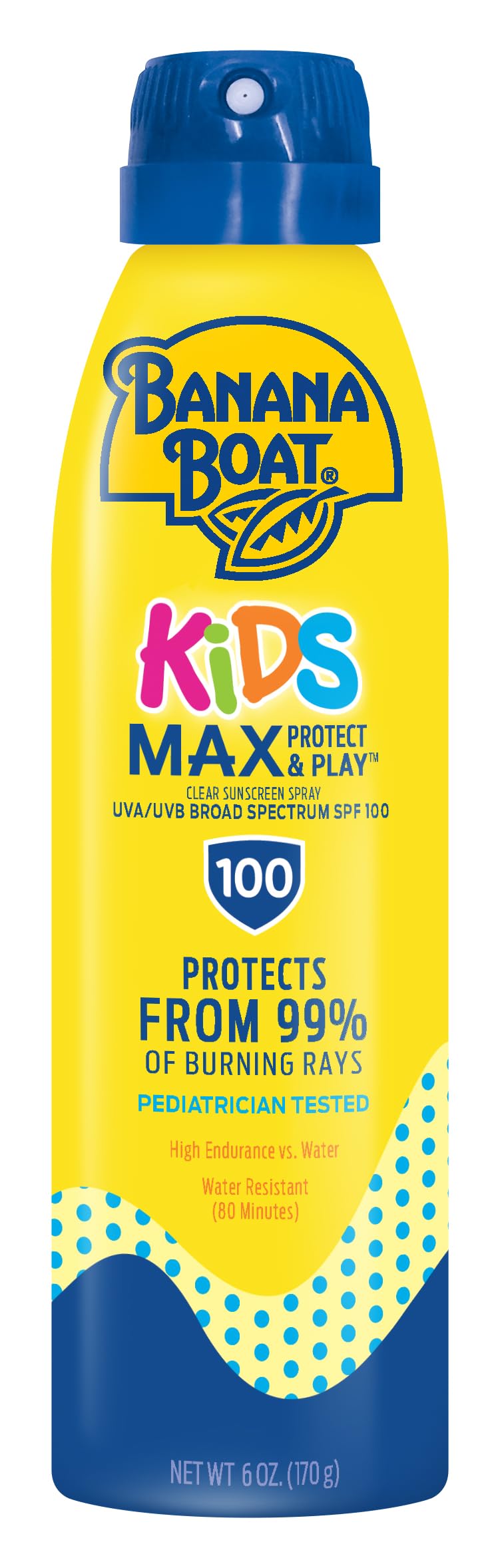
Banana Boat MAX Kids Spray SPF 100

96 /100
Trail Score Outstanding

Key details

SPF
100
Size
6 oz
Format
Spray
Water Resistance
Very water resistant
Check Price on Amazon

SPF 100 is the number that gets this can picked up, and we understand why — some kids burn through a 50 in an hour of midday sun. The number is not why we kept reaching for it, though.

It is a 6-ounce spray that goes on invisible and rub-free, with a twist-and-lock cap that has kept it from emptying itself into a beach bag, and it carries the very water resistant label, which is the 80-minute category. The first time we used it, nobody had to be held down and nobody ended up with stinging eyes.

Here is the thing about the SPF race: SPF 50 already blocks about 98 percent of UVB rays, so stepping up to 100 adds a fraction rather than a doubling. What earns this can a place is the finish and the eye claim — on a windy beach with a kid who sweats and squints, that matters more than the number on the front.

Pros

  • SPF 100 for long, intense exposures
  • Rub-free and invisible on skin
  • Won't run into eyes
  • Twist-lock cap stays shut in a bag

Cons

  • Nozzle can stop spraying
  • Six ounces empties fast with daily use
Our verdict

For very fair kids and long afternoons, an SPF 100 spray that goes on invisible, does not run into eyes, and locks shut in the beach bag.

Check Latest Price
6

Fast Body Coverage

Banana Boat Sport Kids Spray SPF 50

95 /100
Trail Score Outstanding

Key details

SPF
50
Pack
Two 6 oz cans
Format
Spray
Water Resistance
80 minutes
Check Price on Amazon

There is a moment in most sunscreen negotiations — usually about ninety seconds before you need to leave — when a lotion bottle loses the argument. That is the moment this two-pack is for.

Two 6-ounce cans of SPF 50 that dry down without a greasy film, carry no added oils or fragrance, and are labeled sweat and water resistant for 80 minutes. We keep one in the car and one in the beach bag, which is the entire point of buying two.

Spray coverage is uneven if you just wave the can, so we spritz into our palms and rub it in — shoulders, ears, the backs of the arms, the places that burn first. On a breezy day we spray low and close rather than at arm's length, which is also the safer way to do it around faces.

Where this one falls short is certainty: it is the spray here we trust least to cover evenly, so we do not use it on faces and we do not count on it alone for a long beach day. For a quick top-up at the park before dinner, though, it is the fastest thing in the bag.

Pros

  • Fast body coverage on wriggling kids
  • Two cans for car and beach bag
  • No added oils or fragrance
  • 80-minute sweat and water resistance

Cons

  • Can leave orange marks on light clothing
Our verdict

Two cans of spray that turn a five-minute sunscreen fight into thirty seconds, and our pick for bodies when nobody wants to stand still.

Check Latest Price
7

Diaper Bag Travel

Baby Bum SPF 50 Lotion

95 /100
Trail Score Outstanding

Key details

Age
6 months and up
SPF
50
Size
3 oz tube
Formula
Mineral zinc oxide
Check Price on Amazon

The travel tube earns its place in the diaper bag, which is the only place a sunscreen has to prove anything. Baby Bum is a zinc oxide mineral formula at SPF 50, with coconut oil, shea butter, and cocoa butter in the base, and it is vegan, cruelty-free, and Hawaii 104 Act compliant.

It is a 3-ounce tube recommended from 6 months up, pediatrician and dermatologist tested, and made without octinoxate or oxybenzone. It spreads more easily than most mineral lotions, which is not the same as spreading easily — give it a few extra seconds on a squirming baby.

Unscented is not the same as odorless, either. The zinc and coconut base has a faint smell of its own, so test it on a wrist before a car trip rather than in the parking lot.

Where it lands for us is the size. Three ounces will not cover a family for a beach week and it is not meant to; it is the tube that stays in the bag instead of the cupboard, which is why it gets used. Full-body duty at the beach belongs to a bigger bottle.

Pros

  • Unscented zinc formula for babies
  • Small enough to keep in the diaper bag
  • Spreads more easily than most mineral lotions

Cons

  • Leaves a visible white cast
  • Can cause a rash on very reactive skin
Our verdict

A three-ounce zinc lotion for the diaper bag: unscented, gentle enough for a baby's cheeks, and small enough to actually be there when you need it.

Check Latest Price
8

Sensitive Faces

Blue Lizard Kids Mineral Stick

93 /100
Trail Score Outstanding

Key details

SPF
50
Size
0.5 oz
Format
Stick
Formula
Zinc oxide only
Check Price on Amazon

Zinc oxide alone, no fragrance, and 80 minutes of labeled water resistance. That combination is harder to find in stick form than you would think, and it is what Blue Lizard's kids stick is built on.

It is SPF 50 broad spectrum, protects against up to 98 percent of UVB rays, and is free of oxybenzone and octinoxate. On a face it does what a mineral stick should: it stays where you swipe it, through a swim and a towel-dry.

It also drags. A zinc stick takes more rubbing than a clear one, and on a toddler's cheek those extra seconds feel much longer. Warm the tip on the back of your hand first and it glides on more willingly.

For the child whose skin reacts to fragranced and chemical formulas, this is the stick we reach for first, and it goes further than the size suggests because you are only doing faces, ears, and the back of the neck. Keep a lotion for arms and legs and this one for the parts that matter.

Pros

  • Zinc-only, fragrance-free formula
  • Fast on faces and ears
  • 80 minutes of water resistance

Cons

  • 0.5 oz tube is smaller than expected
  • Costs more per ounce than a lotion
Our verdict

Zinc oxide only, fragrance-free, and water resistant for 80 minutes — a face stick for the child whose skin reacts to everything else, in a tube smaller than the photos suggest.

Check Latest Price

How We Tested the Best Kids' Sunscreens

We started with every kids' formula we could find that carried a broad-spectrum label, a stated water-resistance time, and a price that wouldn't make a twice-daily habit feel like a luxury purchase. From that group we narrowed to 18 — lotions, sticks, and sprays, including a few pharmacy staples and several newer formulas. Testing ran from April through August, which meant we hit swim lessons, sprinkler afternoons, two beach weekends, and the morning rush to camp.

Each formula went onto the same group of testers, ages two through nine, two of whom have sensitive, eczema-prone skin. We timed how long a quarter-size dollop took to rub in on a wriggling kid and noted whether it spread evenly or dragged and pilled. Right after application we checked cheeks and shoulders in daylight for white cast, then asked the kids point-blank whether it smelled gross or like nothing at all. Greasiness showed up later: sand stuck to shins, and we checked T-shirts and car-seat straps for residue at the end of the day.

Then we let them loose. Formulas had to get through a full swim-lesson block plus the walk home, a sprinkler session, and a sweaty playground afternoon, with a midday visual check for pink shoulders and a second look at bath time. We watched for stinging eyes on sweaty foreheads and tracked how often we actually needed to reapply rather than how often the label said to. Sticks rode in backpack side pockets to see whether they melted or leaked, and we weighed cost per fluid ounce against how far a single bottle got us through the summer.

We can't measure SPF in a lab, and we won't pretend otherwise. What we could judge was how each formula behaved in real sun — whether it lived up to its water-resistance claim, whether it held on through a towel-dry, and whether anyone came home with a burn we couldn't account for. Anything that failed that last check came off the list.

How to Choose a Kids Sunscreen

Mineral or chemical: start with your child's skin

Mineral filters, zinc oxide and titanium dioxide, sit on the surface of the skin and are the usual first choice for babies and for children who react to everything. Chemical formulas absorb into the skin, spread faster, and suit a kid who will not stand still for a paste. We lean mineral for the first two years and for any child with eczema or a history of reactions, and chemical for older kids who tolerate a lotion but not a white one.

The label does not settle it. A mineral formula can still carry botanicals — Blue Lizard Baby includes calendula and organic aloe — and a hypoallergenic lotion can still be strongly scented. Patch-test any new bottle on the inside of an arm the day before you need it, especially before a vacation.

Lotion, spray, or stick: pick by how your kid cooperates

Lotions give the most control and the best value per ounce, which is why they should be the backbone of a family beach bag. Sprays are faster on bodies and worse at covering a face. Sticks are for faces, ears, and reapplications in public, and no stick is meant to cover a body.

Two traps come with that. Do not spray directly onto a child's face — spray into your hands first, then apply, both to avoid inhaling it and to get an even layer. And a mist you cannot see is easy to under-apply, so rub in what you spray instead of trusting it.

What SPF and water resistance actually buy you

SPF 50 blocks about 98 percent of UVB rays; SPF 70 or 100 adds a fraction more, and none of them compensate for a thin application. Water resistance is the more useful number: 80 minutes is the maximum a label may claim, and very water resistant means the same ceiling. Reapply after swimming, after toweling off, and at least every two hours.

Sunscreen is one layer of a plan. Shade and a hat do as much work on a beach day, and for babies under 6 months the usual guidance is to keep them covered and out of direct sun rather than rely on sunscreen at all.

The finish decides whether it gets worn

Mineral formulas leave residue, and on deeper skin tones a zinc lotion can look like a mask. That is not a sign it is protecting better; it is a cosmetic trade-off, and a clear face stick solves it for faces while a lotion handles the rest. Scent matters just as much, since a bottle that smells strongly of baby powder will get refused by some kids while a mild coconut one will not.

Buy two products rather than one: a lotion for arms and legs and a stick for faces. It sounds like more money and it usually is less, because you stop spending the face product on a shin.

Frequently Asked Questions

Final Verdict

For most families, the answer is Blue Lizard Baby. It is fragrance-free, zinc-based, water resistant for the full 80 minutes, and thin enough that applying it is not a fight — which is the quality that decides whether sunscreen gets used at all.

If your child will not sit still, split the job: a Sun Bum clear stick for faces and a Banana Boat spray for bodies, with the Blue Lizard for everything else. And if your summer is mostly surf and sand, Thinkbaby's thicker paste stays on longer when it counts.